




Abstract
Rape myth acceptance is an important determinant of sexual assault behaviors. This study explored country and gender differences in rape myth acceptance among undergraduate students in the United States, Japan, and India. Male and female college students (N = 637) in these three countries participated in a self-administered survey in the fall of 2012 (the United States, n = 206; Japan, n = 215; and India, n = 216). The order of the countries arranged in increasing order of likelihood of disbelieving rape claim was as follows: the United States, Japan, and India. U.S. and Japanese students were less likely to disbelieve rape claims (p < .01) while U.S. students also were less likely to believe that victims are responsible for rape (p < .01). Overall, female participants were less likely to believe in the rape myth acceptance, disbelief of rape claim and victims are responsible for rape (p < .05). Acceptance of rape myth also varied by whether a participant knew about an organization or who do not believe they would seek help for sexual assault. Non-help seeking is associated with rape myth acceptance. This study, which used the same survey and data collection methods, provides comparative information on rape myth acceptance among college students in the United States, Japan, and India, which is not otherwise available, and contributes to providing fundamental knowledge to develop country-specific prevention programs.
Introduction
Sexual assault is one of the common forms of violence against women. Sexual violence refers to any sexual act without consent, with coercion, or in circumstances when a victim is unable to give consent. It includes—but is not limited to—physical force, psychological intimidation, threats, rape, and attempted rape (World Health Organization, 2002). The percentage of women aged 16 years or older who reported sexual assault in the previous year in 20 countries located in Africa, Latin America, Asia, or Eastern Europe ranged from 0.3% to 8.0% (World Health Organization, 2002). However, a large number of women do not report sexual assault (Dartnall & Jewkes, 2013). As a result, the prevalence of sexual assault is likely to be underreported. Although a perpetrator of sexual violence can be an intimate partner or a nonpartner, an intimate partner is often a perpetrator of sexual violence against women (World Health Organization, 2016).
Acceptance or nonacceptance of rape myths is one of the important determinants of sexual assault behaviors by perpetrators. Rape myths refer to false beliefs and stereotypes about rape, rape victims, and rapists in which rape is considered the victims’ fault, relieving the perpetrator from responsibility for their actions (Burt, 1980; Lonsway & Fitzgerald, 1994). Rape myth also includes ideas that women ask or want to be raped, are not harmed by rape, and “ask for it” by the way they dress (Littleton, 2011). Rape myths are related not only to the issue of rape but also to perceptions about women; endorsement of rape myths is related to hostile attitudes and behavior toward women often resulting in sexism (Suarez & Gadalla, 2010). In general, men are more likely to accept rape myths than women (Suarez & Gadalla, 2010). Individuals who accept the idea that women are responsible for rape usually will not willingly help people at risk of sexual assault (McMahon, 2011). An examination of rape myths is essential to understanding and preventing sexual assault against women. Eliminating rape myth acceptance is a key factor for university policies to prevent sexual violence on campus (Streng & Kamimura, 2016). There are few studies on rape myth acceptance in the United States and even less for other countries.
In this study, we surveyed college students in the United States, Japan, and India regarding rape myth acceptance. It is generally accepted that gender and culture shape attitudes toward violence against women (Flood & Pease, 2009). We chose these countries because they have enacted laws to prevent violence against women at different points in time and have different cultural views of violence against women. This study targeted college students because many are in the stage of intellectual and social development and have the potential to change the future culture of violence against women (Fleck-Henderson, 2012).
The United States
Female college students in the United States are especially at high risk of sexual assault: Nearly 20% of women have experienced a sexual assault by their senior year of college (Krebs, Lindquist, Warner, Fisher, & Martin, 2009), and up to half of female college students experience physical assaults in college dating relationships (Straus, 2004). Despite the high percentage of sexual assaults, the reporting rates on college campuses are very low (Armstrong, Hamilton, & Sweeney, 2006). One of the reasons may be that most college women are assaulted by someone that they know, possibly making it harder for the women to report the assault or it may be that it is unclear on where to report an assault to campus officials (Streng & Kamimura, 2015).
Title IX of the Educational Amendments of 1972 is a federal civil law that protects all students from discrimination based on sex. Sexual discrimination includes sexual harassment, sexual battery, sexual assault, and rape. Title IX applies to all programs and activities that receive federal assistance from local school districts to postsecondary institutions (U.S. Department of Justice, 2016). Title IX is actively enforced to ensure that institutions that receive federal assistance comply with the law (U.S. Department of Education, 2014). Although campus violence against women prevention programs are essential in changing perceptions which may modify behavior to reduce or eliminate the number of sexual assaults (Karjane, Fisher, & Cullen, 2005), ongoing efforts to prevent violence against women, including sexual assault, in higher education are still needed (Fleck-Henderson, 2012).
Japan
There are fewer studies of college students and violence against women, including sexual violence in Japan compared with the United States. One study of alcohol-related harassment among male and female students in a medical college found that verbal abuse, physical abuse, or sexual harassment are common and tended to occur at a drinking party organized by a student club (Nagata-Kobayashi et al., 2010). Although approximately half of male and female college students in Japan reported they had experienced harassment from an intimate partner, the majority did not recognize verbal harassment, controlling behaviors, and unprotected sexual intercourse as violence (Ohnishi et al., 2011). In addition, male and female college students in Japan tend to accept traditional gender roles (Yamawaki & Tschanz, 2005) and were more likely to minimize, blame, and excuse domestic violence compared with American college students (Yamawaki, Ostenson, & Brown, 2009). It is possible that norms are changing among students in Japan, as a recent study found that almost 80% of college students believe sexual violence is a very serious problem in Japan (Carlson et al., 2015). In Japan, there are no laws or regulations to prevent sexual violence specifically on college campuses. In addition, criminal laws on a very narrow part of sexual assault–rape assume that a perpetrator is a man and a victim is a woman (Japan Ministry of Justice, 2016) as well as define rape very narrowly. For example, if a victim of rape is 13 years or older, unless physical violence and threats are used at the time of sexual violence, the sexual conduct is not considered being against the victim’s will (Japan Ministry of Justice, 2016) and therefore not considered rape.
India
Similar to Japan, there are fewer studies on college students and sexual violence in India compared with the United States. In India, more than one third of women experience physical or sexual assault at some time in their life (Jain, 2013). According to a multinational study of 16 countries (Straus, 2004), the rate of physical assault by a dating partner at a university in Pune, India, was 41.2 % for women. This percentage was the third highest among the 31 universities in the study. Approximately a quarter of female college students in India had been victims of sexual violence by an intimate partner (Kamimura, Nourian, Assasnik, Rathi, & Franchek-Roa, 2016). Comparable with college students in Japan, almost 70% of college students in India believe that sexual violence is a very serious problem (Carlson et al., 2015). In addition, female students tend to have a higher level of awareness of violence against women than male students (Agrawal & Banerjee, 2010). Social and cultural norms, in which younger women have less power than male or older female family members within a family, are closely related to violence against women (Kamimura, Nourian, Assasnik, Rathi, & Franchek-Roa, 2016; Kimuna, Djamba, Ciciurkaite, & Cherukuri, 2013).
There are few laws regarding violence against woman in India and most are relatively new. The Parliament of India passed a law related to violence against women in 2013 in response to a widely publicized event in 2012 (Bajaj, 2013). However, there are no laws regarding marital rape rather than saying it is not a crime (Raj & McDougal, 2014). Similar to Japan, there are no laws or regulations to prevent sexual violence specifically on college campuses.
Purpose
Because rape myth acceptance is an important determinant of sexual assault behavior, we wanted to explore country and gender differences in rape myth acceptance among undergraduate students in the United States, Japan, and India. This study is significant because little is known about cross-national differences in rape myth acceptance among college students. A better understanding of national and gender differences in rape myth acceptance is important to develop culturally and country-specific effective sexual assault prevention programs.
Method
Data Collection and Study Participants
The data were collected at four universities in three countries in the fall of 2012: one state university in the United States, two national universities in Japan, and one public university in India. All universities are located in a mid- to large-size city. At each university, an instructor or professor distributed a consent cover letter and a survey instrument to undergraduate students aged 18 to 30 years attending a social science class. If a student agreed to participate, he or she responded and returned the survey during class time. The lead Institutional Review Board (IRB) for this study was located at the U.S. University. One university in Japan obtained IRB approval. The other Japanese university and the university in India did not have an IRB. The IRB at the U.S. University has detailed guideline for international research, including the case in which there is no local IRB. This study followed every step of the guideline.
Survey Administration
The survey was administered in English in the United States and India. The survey instrument was translated into Japanese for use at the two universities in Japan. The survey was translated into Japanese by a professional translator and was back-translated by another professional translator into English. After the reconciliation was checked by one of the investigators whose native language is Japanese, the Japanese version was pilot tested in Japan to increase the accuracy of the translation. Minor changes related to wording were made to the Japanese version after the pilot survey.
Survey Instrument
Modified Rape Myth Acceptance Scale
The first 11 items of the original Rape Myth Acceptance Scale (Burt, 1980) were used to measure rape myth acceptance with a 5-point Likert-type scale (1 = strongly disagree, 5 = strongly agree). The 11 items are divided into two subscales: (a) Disbelief of Rape Claim (six items: for example, Any healthy woman can successfully resist a rapist if she really wants to) and (b) Victims Responsible for Rape (five items: for example, Women who get raped while hitchhiking get what they deserve). The grand mean was used for analysis. A higher score of disbelief of rape claims means that a person is more likely to disbelieve the rape statement. A higher score of victims responsible for rape indicates that a person is more likely to believe victims are responsible for rape.
Demographic questions and experience/knowledge related to sexual assault
We developed standard demographic questions regarding gender, age, marital status, year in college, and college major. The U.S. participants were also asked their race/ethnicity. We did not include race/ethnicity for the Japanese and Indian participants as most of the students are Asian at the universities in these countries. We also included questions on whether the participants had heard about any organizations or programs on campus or in the community that work to prevent sexual assault (e.g., Have you heard about any organizations or programs on campus that work to prevent sexual assault?). In addition, we had questions on whether the participant had experienced sexual assault victimization or knew someone who had experienced sexual assault, including friend/acquaintance at college, friend/acquaintance outside of college, family, or neighbor. A participant was also asked from whom they would seek help if they were a victim of sexual assault (including not seek any help, family, friends, university resources, hospital/clinic/other health care facility, police, attorney/legal expert, and help center for victims of sexual assaults).
Data analysis
Data were analyzed using statistical software SPSS (Version 19). Descriptive statistics were used to describe the distribution of the demographic characteristics of the participants. Descriptive data were presented as proportions for categorical variables and means with standard deviations for continuous variables. Multiple regression was conducted to test the impact of individual characteristics on rape myth acceptance. MANOVA was used to compare multivariate means by country and gender on rape myth acceptance. The further mean differences on the results between countries were analyzed by the post hoc Tukey analysis.
Results
Participant Demographics
Table 1 presents demographics of the 637 participants who met the study inclusion criteria. Each country represents approximately a third of the sample. The average age was 20.2 years, most participants were not married, and a little over half (59.6%) were women. Although there were some variations by country, overall the sample was comprised of freshman with economics, political science, and sociology as the predominant major areas of study.
Demographic Characteristics.
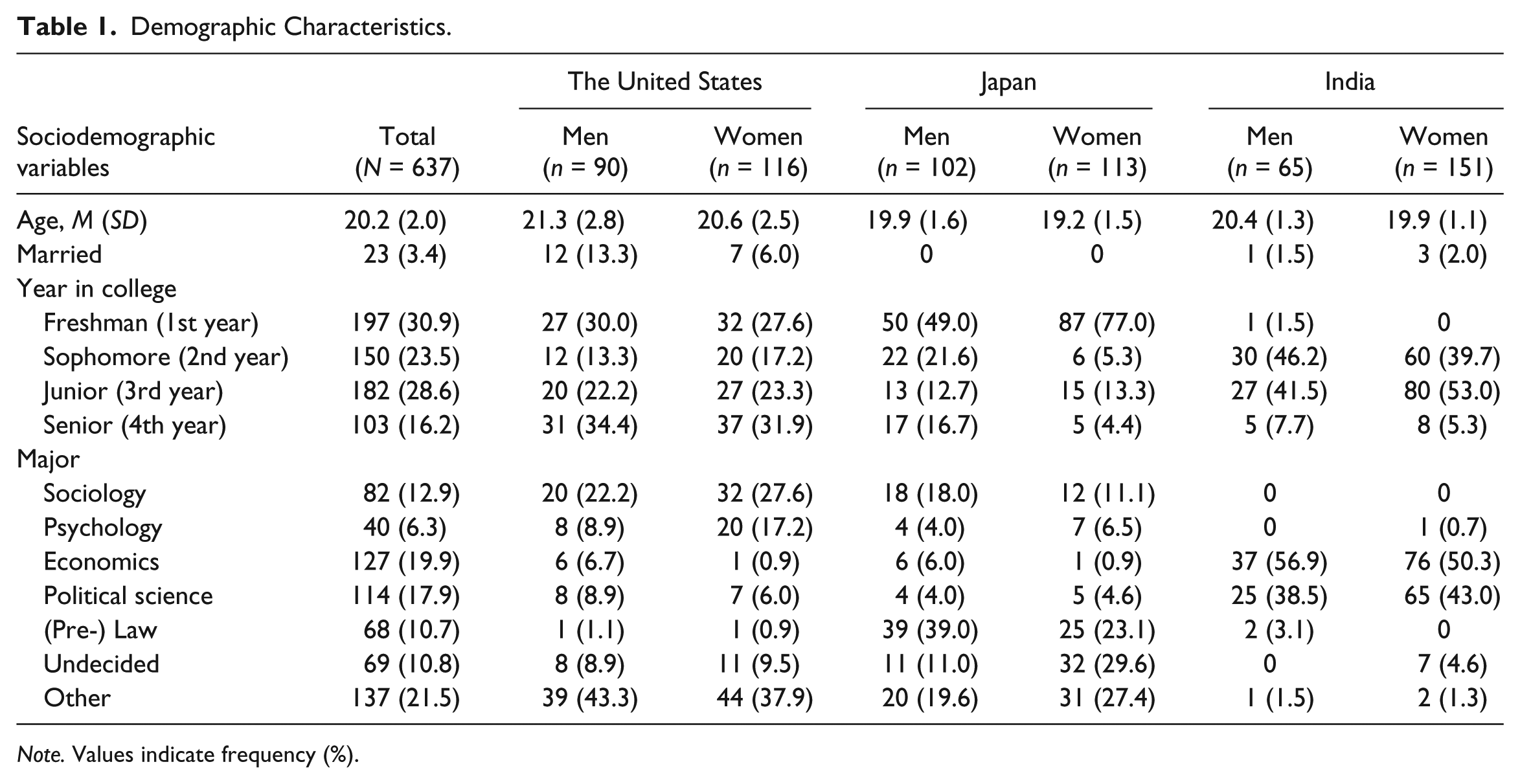
Note. Values indicate frequency (%).
Experience and Help Seeking Related to Sexual Assault
Table 2 shows the reported experience and help-seeking intention toward sexual assault. The post hoc Tukey analysis showed significant differences by country and gender (p < .01) regarding a participant’s knowledge of a campus organization, a community organization, someone who was a victim of sexual assault, or help seeking if he or she was a victim of sexual assault (not shown in the table). Overall, less than half of the respondents had heard of campus or community organizations that worked to prevent sexual assault, but this varied by country and gender (p < .01). U.S. women reported the highest percentage of hearing about either type of organization (47.4% and 67.2%, respectively) and Japanese men reported the lowest percentage (19.6% and 17.6%, respectively). While a little more than a third of the sample (40.2%) reported knowing anyone who had experienced sexual assault, almost two thirds of U.S. women (71.6%) reported knowing someone compared with 20.6% of the Japanese men. Most respondents knew a friend or college friend who had experienced sexual assault. Overall, 35 participants (5.5 %) reported experiencing sexual assault. U.S. women reported the highest percentage of experiencing sexual assault (18.1%) and Japanese men the lowest (0%). This pattern was reversed when respondents reported whether or not they would seek help if they experienced sexual assault. Approximately a third of Japanese women (40.7%) and men (33.3%) reported they would not seek help compared with 5.6% and 5.2% of U.S. men and women (p < .01). Most respondents reported that they would seek help from a family member, friend, or the police. University resources were the least common place to go for help.
Experience of and Help-Seeking Intention Toward Sexual Assault.

Note. Values indicate frequency (%).
Association Between Individual Characteristics and Modified Rape Myth Acceptance Scale
Table 3 shows the results of regression analysis to predict rape myth acceptance from the 5-point Likert-type scale controlling for gender, age, and country. The respondents who knew about a campus organization that worked to prevent sexual assault were more likely not to accept disbelief of rape claim (p < .05) or that victims are responsible for rape (p < .01). The participants who reported that they would not seek any help for sexual assault are more likely to disbelieve rape claims and to believe victims are responsible for rape (p < .05). Male participants are more likely to disbelieve rape claims (p < .01) and to believe victims are responsible for rape (p < .01) regardless of country. Both U.S. and Japanese students were less likely to disbelieve rape claims (p < .01) while U.S. students also were less likely to believe that victims are responsible for rape (p < .01).
Predictors of Rape Myth Acceptance.
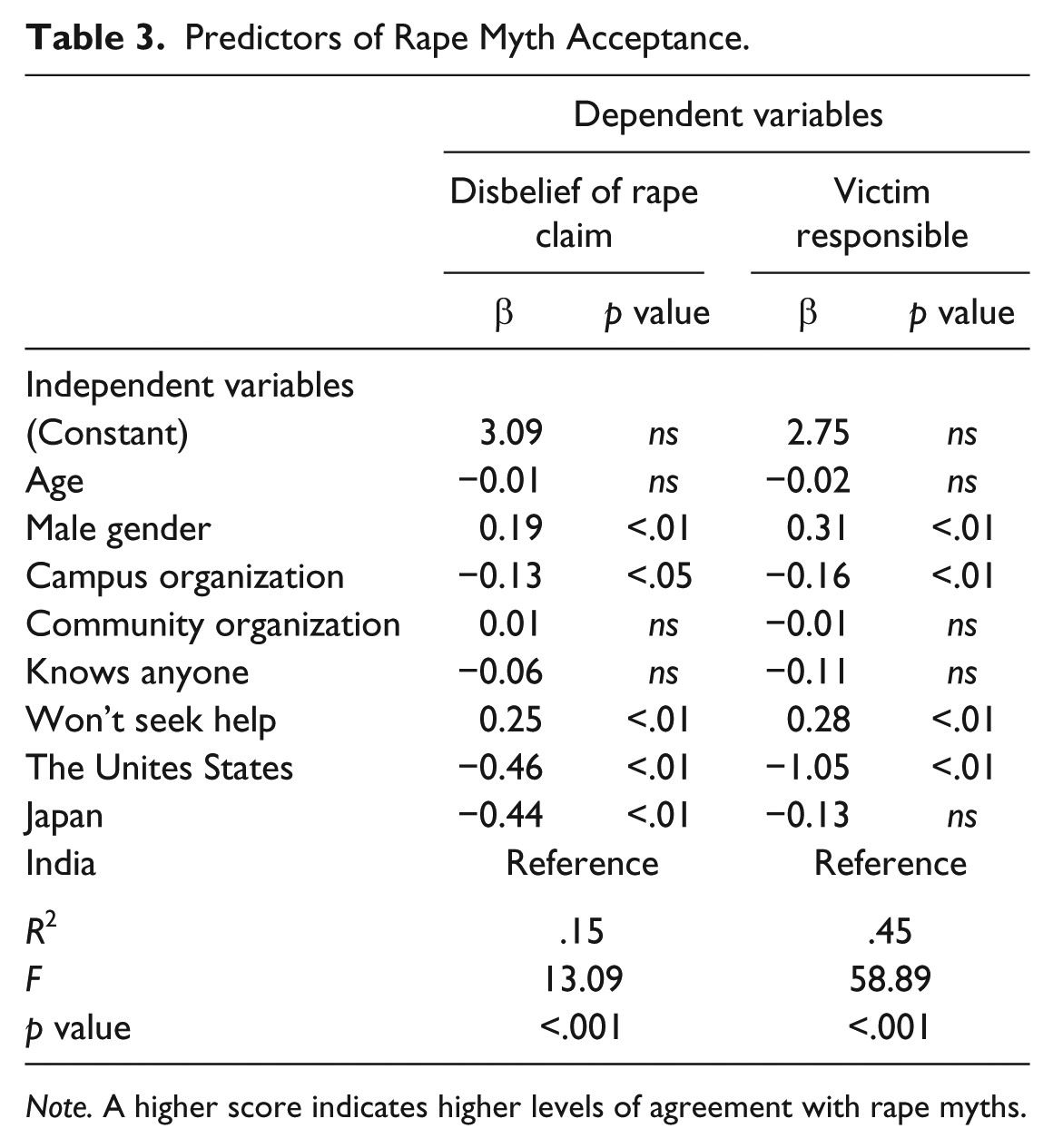
Note. A higher score indicates higher levels of agreement with rape myths.
Modified Rape Myth Acceptance Scale by Country and Gender
Table 4 presents the results of MANOVA. There were significant gender and country differences in disbelief of rape claim and victims responsible for rape. The interaction between country and gender was significant both for disbelief of rape claim and victims responsible for rape. The post hoc Tukey analysis (at the .05 significance level) for national difference indicates each country was significantly different in disbelief of rape claim from each other. The order of the countries arranged in increasing order of likelihood of disbelieving rape claim was the United States, Japan, and India. The U.S. participants were less likely to believe victims responsible for rape than the Japanese and Indian participants. The post hoc Tukey analysis (at the .05 significance level) for the gender comparison shows that overall female participants were less likely to believe in the rape myth acceptance, disbelief of rape claim and victims are responsible for rape.
Rape Myth Acceptance by Country and Gender.

p < .01.
Discussion
This study explored differences in rape myth acceptance among men and women undergraduate students in the United States, Japan, and India using the same instrument and deployment strategy. There are three main findings. First, rape myth acceptance varies by country. Second, acceptance of rape myth varied by whether a participant knew about an organization or who do not believe they would seek help for sexual assault. Third, non-help seeking is associated with rape myth acceptance.
Although this study does not describe the context of rape myth acceptance in each of the countries, it does show that levels of rape myths varied among college students in the United States, Japan, and India. Specifically, the U.S. participants were more likely to disbelieve rape claim compared with Japanese and Indian students. The same pattern existed for believing if victims were responsible for their rape. One of the reasons that the U.S. students were different from the two other countries may be attributed to Title IX. U.S. participants from grade school to college have received protection from sexual discrimination due to the civil law which prohibits sex discrimination in education, including protecting students from sexual harassment in all of a school’s programs or activities. In particular, Title IX is a tool to fight campus sexual assault by all students by addressing the effects of sexual assault on campus and including a mechanism through which students can file a complaint if schools do not act accordingly. Previous studies conducted outside the United States suggest that cultural background could affect rape myth acceptance (Lee, Lee, & Lee, 2011; Shalhoub-Kevorkian, 1999; Tavrow, Withers, Obbuy, Omollo, & Wu, 2013). Participants from the university in India were more likely to accept rape myths than participants from other universities. It is possible that using informal as well as formal networks to prevent sexual assault may be beneficial, because college students in India were more likely to have respect for informal crime control than formal crime control compared with those in the United States (Lambert, Pasupuleti, Jiang, Jaishankar, & Bhimarasetty, 2012). The results of this study add to the growing knowledge about differences in rape myth acceptance among countries.
The more sexual knowledge a student has, the less likely they are to accept the negative social norms of peers and also less likely they would be to accept rape myths (Aronowitz, Lambert, & Davidoff, 2012). In our study, students who reported knowing about a campus or community organization were less likely to accept rape myths. Providing workshops about rape awareness on campus may be one effort to reduce rape myth acceptance. One study showed that college students who had not attended a rape awareness workshop were more likely to accept rape myths compared with those who had not (Hinck & Thomas, 1999). A higher percentage of the Japanese participants reported not hearing about organizations on campus or in the community that work to prevent sexual assault compared with students in the United States or India. In the United States, all higher education institutions receiving federal funding must provide rape prevention programs (McMahon, 2010). Our data suggest that including information about campus or community resources in a new student’s orientation may be needed.
The results of this study also suggest that non-help seeking is associated with rape myth acceptance. Previous studies conducted in the United States indicate the reasons of non-help seeking after an experience of rape varies. As the majority of perpetrators are usually known to the victim, men and women who experience sexual assault may have difficulties in reporting the assault to others (Orchowski, Meyer, & Gidycz, 2009). Those who experience sexual assault may also fear of not being believed (Sable, Danis, Mauzy, & Gallagher, 2006). Non-help seeking for intimate partner violence (IPV) is a problem in Japan and India (Kamimura, Bybee, & Yoshihama, 2014; Kamimura, Ganta, Myers, & Thomas, 2014; Kamimura, Yoshihama, & Bybee, 2013), while the information about sexual violence and help seeking is limited in these countries. This study suggests that rape myth acceptance may be one of the reasons behind non-help seeking in these countries.
Our study has several limitations. This study is based on cross-sectional data; hence, causal relationships cannot be examined. The scales were developed and validated using U.S. populations and are not validated for populations in Japan and India. Further research on validation of the scales outside of the United States is warranted. The participants were drawn using a convenience sample and are not necessarily representative of college students in each country. For example, the sample for India and Japan was not as diverse in regard to major area of study compared with the United States, and the U.S. population was predominately White. We do not know if this affected our findings. In addition, freshman students were the largest percentage of participants, and this was especially true for Japanese women. It is possible that freshman students are less familiar with campus programs possibly skewing our results. We did not ask race/ethnicity for the Japan and India sample, and caste in India, and so we do not know whether these factors had an impact on rape myth acceptance in our study. Despite these limitations, this study, which used the same survey and data collection methods, provides comparative information on rape myth acceptance among college students in the United States, Japan, and India, which is not otherwise available, and contributes to providing fundamental knowledge to develop country-specific prevention programs.
Footnotes
Acknowledgements
We gratefully acknowledge the students who participated in this study, and the contribution of Larry Bench, Marcie Goodman, Ron Hrebenar, Masami Okaue, and Takeshi Sato for data collection.
Declaration of Conflicting Interests
The author(s) declared no potential conflicts of interest with respect to the research, authorship, and/or publication of this article.
Funding
The author(s) disclosed receipt of the following financial support for the research and/or authorship of this article: Funding from the Asia Center, University of Utah, partially supported this project.