




Abstract
Using a qualitative method, our study aims to explore, identify, and describe Italian health care providers’ reflections on the contraceptive behaviors of adolescents attending family health centers, and health care providers’ self-perception of their own job attitudes toward these adolescent patients. Semi-structured interviews with 46 Italian health care providers were conducted and analyzed using thematic analysis. Two main themes emerged from the thematic data analysis regarding Italian health care providers’ self-perceptions and reflections. The first main theme was labeled “adolescents’ contraceptive behavior” and included two subthemes: “adolescents are confused and unprepared” and “contraception is a girls’ responsibility.” The second theme was labeled “job attitudes with adolescents,” and included three subthemes: “to inform and to educate,” “to build trustful relationships,” and “to go beyond personal beliefs.” The findings of this study showed that Italian health care providers perceive themselves as nonjudgmental and they interpret their own behavior as an attempt to answer adolescents’ sexual and reproductive health (SRH) needs in an open-minded way. Their work with adolescent patients with relation to contraceptive behaviors is led by the desire to educate through building a significant and long-term relationship that could sustain these patients.
Adolescent sexuality is still a sensitive issue, and several research findings have reinforced the importance of addressing adolescents’ contraceptive needs (Mittal, 2015).
Today, adolescents are still at risk of early and unwanted pregnancy and sexually transmitted infections (STIs), including HIV and AIDS. The World Health Organization (WHO, 2012) estimated that about 16 million girls aged 15 to 19 and two million girls under the age of 15 give birth every year. Regarding STIs, the WHO (2008) estimated that 499 million new cases of curable STIs occur annually worldwide in adults aged 15 to 49 years. Compared with adults, adolescents aged 15 to 19 and young adults aged 20 to 24 are at a higher risk for acquiring STIs (Centers for Disease Control and Prevention, 2009).
In 1994, the International Conference for Population and Development set the stage for putting adolescent and young adult sexual and reproductive health (SRH) on the international agenda, stressing the importance of having unique health services that can appropriately meet the needs of young people aged 10 to 24 years (McIntyre, Williams, & Peattie, 2002). Moreover, according to McIntyre et al. (2002), adolescent needs should be addressed by prepared, motivated, and supporting staff who are equipped to deal with adolescents’ problems with care and respect.
Evidences from the literature suggest that perceptions, beliefs, and attitudes of health care providers may influence the care they provide to their adolescent patients (Breheny & Stephens, 2007). Recent studies highlighted the presence of barriers in the provision of contraceptives and, in particular, of emergency contraception (EC) due to inadequate knowledge or ethical objections of health care providers (Ceva & Moratti, 2013; Richman et al., 2012). This, according to Ceva and Moratti, could create a barrier to access to EC for women, as this may limit their reproductive self-determination right. Moreover, each country has its own culture and legislation regarding adolescent sexuality, contraception and EC which differently influence health care providers’ attitudes and practices (Ahanonu, 2014; Ceva & Moratti, 2013; Dawson, Wijewardena, & Black, 2013).
In our study, considering these suggestions provided by literature, we aim to explore Italian health care providers’ reflections on the contraceptive behaviors of adolescents attending family health centers and to describe providers’ self-perception of their own job attitudes job with these adolescent patients. To our knowledge, in fact, the investigation of health care providers’ perceptions and attitudes regarding adolescent contraception and EC is infrequent in European countries. Since European adolescents continue to be a population at risk for sexual and reproductive health issues, their SRH requests should be better fulfilled (Avery & Lazdane, 2010). We believe it is important to investigate how health care providers perceive their own job taking into account adolescent patients’ reproductive and contraceptive needs.
By analyzing literature regarding health care providers’ perception of adolescent patients, it emerged that European studies focused mainly on the assessment of health care providers’ perceptions and reflections regarding the process of caretaking of pregnant adolescents (Fredriksen, Lyberg, & Severinsson, 2012; Wahn, von Post, & Nissen, 2007; Olivari, Confalonieri, & Ionio, 2011). Evidences of these studies stress the need to build a trusting and committed relationship with these adolescents, taking them seriously.
To our knowledge, only one study in Europe specifically investigated health care providers’ attitudes and practices in relation to adolescent patients, assessing a sample of 26 health workers working in family health centers (Olivari, Santoro, Stagni Brenca, Confalonieri, & Di Blasio, 2015). This qualitative research, carried out in Italy, aimed to identify how health workers perceived the sexual attitudes and behaviors of their minor patients and how they tried to meet the adolescent SRH needs. Findings showed that Italian health care providers felt a sense of concern and preoccupation toward these adolescents because they were perceived as unprepared and unequipped, not adequately informed, and sometimes too immature for sex. The health workers’ mission in relation to these patients was to teach them the correct information and to educate them to be responsible regarding health issues, especially their reproductive health.
Regarding the provision of EC, to our knowledge, only a study in Europe examined health care provider’s habits and knowledge (Bo, Casagranda, Galzerano, Charrier, & Gianino, 2011). This survey focused on emergency room physicians and revealed gaps in physician knowledge about the properties of EC pills. Findings showed that just more than half the physicians stated that EC prescription was not an appropriate part of care to be provided at an emergency department, and about 25% asserted health care provider’s right to conscientious objection. The majority also stated they felt uncomfortable about prescribing EC.
There is, on the contrary, a strong tradition of research concerning health care providers’ beliefs and practices regarding adolescent contraceptive behaviors, and SRH needs in both underdeveloped and developing countries. Recently, two studies evaluated knowledge, attitudes, and practices of health care providers working with adolescents in Kenya and Swaziland (Godia et al., 2013; Mngadi, Faxelid, Zwane, Höjer, & Ransjo-Arvidson, 2008). Godia and colleagues (2013) found that the majority of the health staff were considered to be not adequately equipped with knowledge and skills to provide high-quality services that could meet adolescents’ SRH needs. Mngadi and colleagues (2008) found that health care providers were believed to be not adequately competent in providing SRH services to young people, especially counseling and interpersonal communication. Moreover, they were conservative with the provision of SRH services to adolescents, in particular, contraception and abortion. According to these health professionals, this situation occurs because of a conflict between personal feelings, cultural and religious values and beliefs, and the desire to respect young people’s rights to access and obtain SRH services.
In line with these findings, the literature pointed out that in underdeveloped and developing countries, many health care providers showed unfavorable attitudes toward the provision of contraceptives for unmarried adolescents. In two studies carried out in Nigeria and Sri Lanka emerged that health care providers reported to feel uncomfortable to discuss contraception with adolescents because of their religious and ethical beliefs (Ahanonu, 2014; Dawson et al., 2013).
In regard to health care providers’ attitudes and practices about EC, findings of two research carried out in Turkey, have shown a quite low level of knowledge in terms of lack of accurate information and permanence of the association between EC and abortion. Consequently, health care providers were not likely to prescribe EC, because it is contrary to their personal religious and ethical beliefs (Mandiracioglu, Mevsim, & Turgul, 2003; Uzuner et al., 2005)
Because of the paucity of studies conducted within the European context and the presence of risk for sexual and reproductive health issues among European adolescents, we believe that it is important to deepen the investigation of how the health care providers perceive and interact with adolescent patients coming to the family health services. Addressing adolescent SRH needs and requests remains an important challenge to prevent unsafe and risky behaviors among adolescents.
In Italy, contraception, emergency contraception, and interruption of pregnancy are regulated by the laws 194/78 and 405/75. The first one allows the possibility of contraceptive prescription to minors, and the second regulates the institution of family health centers as places aiming to promote women’s and children’s health. These centers provide clinical services and counseling regarding sexual health, contraception, pregnancy, and birth. Hence, to fulfill all these functions, several health care providers work in these centers. Specifically, we can identify midwives, psychologists, gynecologists, social workers, health care assistants, nurses, and educators as health workers who deal with adolescents going to family health centers, rendering reception service and assistance to them.
With regard to EC, the distribution of EC in Italy was authorized in 2000 with a decree of the Minister of Health (Ministerial Decree, 26 September 2000, n. 510). Since then, patients needed to visit a health care provider to obtain a medical prescription before purchasing levonorgestrel (LNG) EC pills. In 2009, ulipristal acetate (UPA), a selective progesterone receptor modulator, was first marketed for EC in Europe, and in most of European countries, UPA EC pills were available for patients by prescription-only. Italy was the only country that, in addition to a medical prescription, required patients to do a pregnancy test to obtain UPA EC pills. In November 2014, the European Medicines Agency’s Committee for Medicinal Products for Human Use recommended a change in the classification status of UPA EC pills from prescription-only to nonprescription (European Medicines Agency, 2014). Following the European Medicines Agency’s assessment, in January 2015, the European Commission issued an implementing decision that UPA EC pills should be available without a prescription. In April 2015, the Italian Medicines Agency (AIFA) announced that UPA EC would be available for sale without a prescription for women 18 years of age and older and that a pregnancy test will no longer be required to access UPA EC (Gazzetta Ufficiale, p. 105; 8 Maggio, 2015). This means that UPA EC can be bought without a medical prescription but is not on the shelves of the pharmacies, and women need to require it to pharmacy clerks. For women and girls below 18 years, UPA EC is still available only with a medical prescription. Moreover, since October 2015, one brand of LNG EC (Escapelle) can be sold without medical prescription (behind the counter) to women aged above 18 years (European Consortium for Emergency Contraception, n.d.).
In this study, using a qualitative method, we aim to explore, identify, and describe Italian health care providers’ reflections about the contraceptive behaviors of adolescents attending family health centers, and health care providers’ self-perception of their own job attitudes with these adolescent patients.
Method
Participants
Forty-six health care providers (11 midwives, 10 psychologists, eight gynecologists, six social workers, five health care assistants, four nurses, and two educators) of family health centers participated, giving written informed consent before taking part in the study.
Health care providers were mainly women (N = 43; 93.5%) with a mean age of 50.8 years (SD = 9.9). They work in family health centers located in four different regions of Italy: Lombardy (n = 25), Piedmont (n = 5), Tuscany (n = 6), and Sicily (n = 10).
Participants had a mean working experience of 24.7 years (SD = 10.1) and a mean working experience in family health centers of 12.8 years (SD = 9).
Procedure
Persons in charge in each family health centers were contacted by phone or by e-mail asking for permission to involve health care providers in this study. After receiving this permission, trained researchers contacted by phone the family health centers asking to talk with health care providers dealing with adolescents attending the centers. During the phone talk, health care providers were explained the study’s objective and were invited to take part to the study. Appointments were made with health care providers interested in participating to the study. The recruitment of participants continued until saturation was reached, and no new topics emerged in the interviews. Specifically, we relied on the general notion of data saturation “as the point in data collection and analysis when new information produces little or no change to the codebook” (Guest, Bunce, & Johnson, 2006).
A semi-structured interview was used to explore and describe their attitudes and perceptions regarding adolescent patients, adolescents’ contraceptive behaviors, and the work with these patients. Interviews were conducted in comfortable rooms located in each respective family health center by trained researchers during 2013. All sessions averaged around 50 min each, and they were tape recorded and later transcribed verbatim in Italian.
The interviews were analyzed using thematic analysis, “a method for identifying, analyzing and reporting patterns (themes) within data” (Braun & Clarke, 2006). A four-step process to conduct the thematic analysis was used. First, the researchers worked on achieving familiarity with the text, by transcribing the focus groups, reading the text, highlighting keywords and phrases, and then noting down initial ideas. Subsequently, they started the coding process, organizing data into themes and subthemes. After that, the researchers reviewed the themes by reading them again, mainly checking their coherency and consistency to the coded extracted and the entire data set. Finally, the themes and their underlying subthemes were defined and labeled. First, the three authors reviewed the transcripts separately to determine the initial themes and subthemes. Subsequently, they met to review and reach an agreement in relation to themes and subthemes, and to identify the key participants’ quotes.
Ethical Consideration
This study was carried out after receiving ethical approval from the Catholic University Ethics Commission. The participants consented to join in the study and were informed on several occasions that their participation was voluntary. The identity of participants was protected by confidential handling of the data.
Results
Before presenting the findings of the thematic analysis, from the data collected, it is possible to first provide a brief description of female adolescent patients attending family health centers.
According to the health care providers, the most common reasons that lead female adolescents to family health centers are the requests for gynecological examination, EC prescription, oral pill prescription, psychological counselling, and contraceptive consultation (to receive assistance in choosing contraceptive methods).
In the experience of our participants, adolescents who ask for contraceptive consultation frequently make use of condoms, choose to resort to coitus interruptus, or use nothing. Few female adolescents use contraceptive hormonal pills before coming to the family health center. In fact, this is often a choice that girls make after the consultation with the health care providers of the center.
In regard to EC, from the health care providers’ point of view, the most frequent reasons for this request are condom breakage or the occurrence of unprotected sexual intercourse. Moreover, from the experience of interviewed providers, EC request is more frequent after the weekend and during winter and summer holidays. Finally, it is common to find habitual adolescents who turn more than once to the family health center to ask for EC in a short period of time.
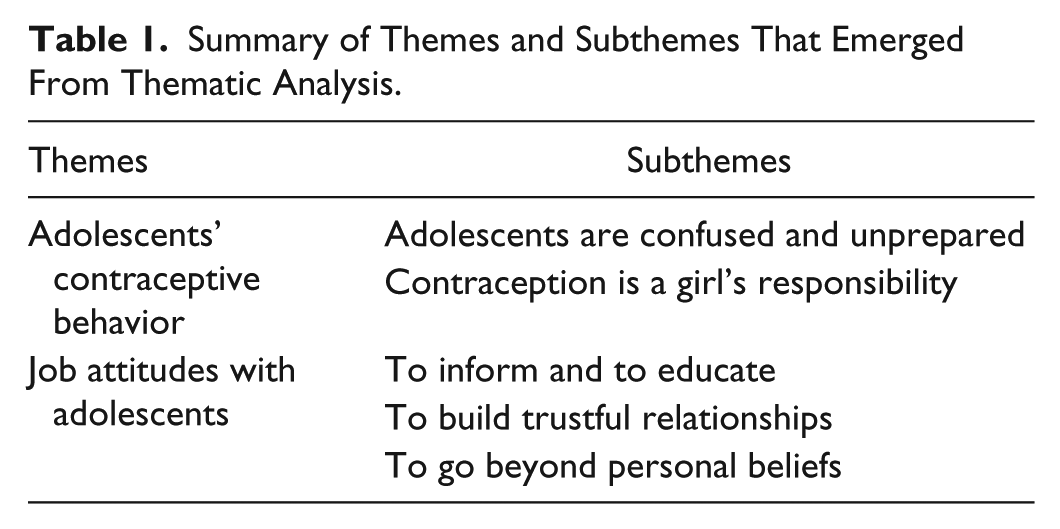
Two main themes emerged from the thematic data analysis regarding Italian health care providers’ reflections about the contraceptive behaviors of adolescents attending family health centers and their job attitudes with these adolescent patients. The first main theme was labeled, “adolescents’ contraceptive behavior” and included two subthemes: “adolescents are confused and unprepared” and “contraception is a girl’s responsibility.” The second theme was labeled “job attitudes with adolescents” and included three subthemes: “to inform and to educate,” “to build trustful relationships,” and “to go beyond personal beliefs.” The findings that emerged from the thematic data analysis are summarized in Table 1. Then, an accurate description of each theme and subtheme is provided by using direct quotations from the interviews (to better explain health care providers’ perceptions). An interpreter translated the reported quotes from Italian into English, trying to respect the original verbal expressions related to the discursive context from which they were elicited. Then, a native English speaker performed the back translation.
Summary of Themes and Subthemes That Emerged From Thematic Analysis.
Adolescents’ Contraceptive Behavior
Adolescents are confused and unprepared
The health care providers described the adolescents who arrived to the family health centers as quite unprepared to explore sexuality in a safe way. In their experience, adolescents have some information, but it is not always correct. Usually, they gained this information from the Internet and through speaking with their friends.
Misinformation is high, information is quite incorrect and sometimes knowledge is fantasy rather than reality! (Social Worker) Without underestimating what adolescents have already known through other means of information, I think that they are confused and they have very little knowledge. There is often a gap between a precocious sexual debut and the awareness of the resulting risks. (Psychologist)
According to the health care providers, adolescents were confused about contraceptive methods and their efficacy. In their experience, adolescents mainly used condoms, but not from the beginning of the sexual intercourse. Moreover, many adolescents reported using coitus interruptus as a contraceptive method.
What I see is that condom is frequently used, but it is often used incorrectly, we can say “in an Italian way.” Hence, it becomes similar to coitus interruptus since it is not used from the beginning. (Gynecologist) Even though we explain that the coitus interruptus is not a contraceptive method, we see that female adolescents are sure it works, since they had used it and they were not pregnant. (Midwife)
In health care providers’ experience, only a few adolescents recurred to hormonal contraceptives, such as a contraceptive pill, contraceptive patch, or vaginal ring. In their opinion, this choice is not so frequent because, among adolescents, there are many false myths or worries that limit the decisions to use these methods.
They say: “Contraceptive hormonal pill is makes you get fat, it’s harmful, it brings cellulite . . .” These fears still exist. (Health Care Assistant) [Referring to vaginal ring], “How gross! To put your hand there . . .” (Psychologist)
Regarding the EC, health care providers described adolescents as not well informed, as they only knew that it helps to avoid pregnancy. Besides this information, health care providers reported that adolescents had false beliefs about its use.
They are totally unaware about the risks that can ensue. For them, it is the instant solution. They are ready for anything. (Midwife) They are often frightened, as they say: “If I use it now, I won’t be able to use it for the rest of my life”; or “Oh my god! What will happen? I won’t be able to have children in the future!” (Educator)
Contraception is a girl’s responsibility
The health care providers described the decision to use contraceptives as the outcome of an autonomous process of female adolescents.
Girl’s choice prevails, and the boy follows her decision. (Midwife) Most of the times, the girl comes alone. Just a few times, they come together as a couple. (Midwife)
Health care providers said that the adolescents reported a quite open dialogue between them and their partners about contraception. However, health care providers described the contraceptive choice as an exclusive decision that the girls made by themselves. In the health care providers’ experience, it frequently happened that the boys suggested their partners to look after, help, and counseling within the family health center, and then delegated completely the decision to the girls, leaving her also the financial commitment for the hormonal contraception.
The negotiation (upon the contraceptive choice) within the couple is rare; it’s often a girl’s choice, a choice of responsibility. Often, the boy comes with her, but then he leaves the decision to the girl. (Educator)
Job Attitudes With Adolescents
To inform and to educate
The health care providers believed that, facing adolescent patients, it is important to inform and to educate them. In fact, when the adolescents arrived at the family health center, especially when requesting an EC, counseling is provided. This moment allows the health care providers to listen to the adolescents as they speak about their doubts, and the health care provider can then correct any misinformation the adolescents possessed regarding sexuality and contraception.
[Referring to EC], I think we need to educate and inform adolescents. We must explain that it is not contraception, but, in case of emergency, there is this possibility, this option. (Psychologist) Beyond the prescription of EC pill, we insist to have a dialogue with them in order to give information and provide a sort of education. (Midwife)
Moreover, the moment of counseling was seen as a unique opportunity to talk about the consequences connected to unprotected sex, focusing on the possibility of an unplanned and unwanted pregnancy, as wells as the possibility of contracting a STI. In fact, in their job experience, the health care providers reported that adolescents rarely appeared to be worried about STI. According to the health care providers, it seemed that adolescents were perceived to worry only about the possibility of being pregnant.
In my experience, talking with them, the fear of STIs has never come out. After an unprotected sexual intercourse, they come here to request the EC pill, but they are not worried about anything else than a pregnancy. (Educator)
To build trustful relationships
All the health care providers believed it is important to connect with adolescents, trying to build a trustful relationship with them. From this point of view, the moment of counseling was seen as extremely useful, because it becomes an opportunity to invite the adolescents to come back to the health center. Hence, this offers the adolescents a place to speak and to make prevention.
When they come requesting EC pills, we make them think about contraception. This is a chance to “hook them” in order to make them capable of taking care of themselves. (Psychologist) We try to make them understand that the family health center is not a day-hospital but a place in which adolescents can go to discuss their problems and ask questions receiving assistance and getting answers. (Social Worker)
Therefore, for the health care providers working in family health centers, the main aim was to create a long-lasting relationship with the adolescent users. This was to make them aware and active in taking care of themselves.
For us, this consultation becomes a way to “hook” the adolescents for the future and to speak about contraception and prevention. (Midwife) The aim of the family health center is to create a dialogue . . . in order to teach them how to take care of themselves. This is the working method of the center and the focus of our attention. (Psychologist)
To go beyond personal beliefs
The health care providers strongly believed that they should adopt a nonjudgmental attitude in their work with adolescent patients. This means that they ought to distance themselves from their personal and moral beliefs to respond in the best way to adolescents needs.
I always try to leave my personal moral and religious beliefs when I sign in . . . (Nurse) It depends on your sense of ethic and morality. Professionally speaking, I believe the family health centers have to provide the whole range of possibilities to answer to users’ requests. It is not my duty to judge. When someone comes here, I should be able to offer all the expected chances. (Social Worker)
The need to be beyond ethical and moral personal beliefs often emerged in regard to the prescription of EC. According to the interviewed health care providers, it is important to put aside personal beliefs and attitudes to perform their work in the best way within the family health center. Meeting adolescents in their work could mean having to prescribe the EC pill, an action that is in line with the aims of the family health center in which they work. In fact, these services were created to protect and guarantee women’s and adolescents’ sexual reproductive rights.
We do what is provided for the Italian Law, which allows to prescript the EC pill. So, it is right to provide it as it is right to do a blood test when it needed. We must put aside what we think and our personal beliefs. We must guarantee people’s rights. (Psychologist)
Discussion
Our study represents an effort to explore, identify, and describe Italian health care providers’ reflections about the contraceptive behaviors of adolescents attending family health centers, and health care providers’ self-perception of their own job attitudes with these adolescent patients. We believe that, because European adolescents continue to be a population at risk for sexual and reproductive health issues (Avery & Lazdane, 2010), our work fills in a gap existing in European literature in relation to these important themes.
In regard to health care providers’ reflections about the contraceptive behaviors of adolescent patients, it emerged from our study that adolescents were perceived as not adequately prepared to practice safe contraceptive behavior. From the narrations of our participants, adolescents appeared to be confused about contraceptive methods, scared by false myths and legends about hormonal contraception and EC. This, in health care providers’ work experience, led frequently to the “unhappy” choice not to use any contraceptive methods at all, or to practice coitus interruptus. This result is in line with previous research (Olivari et al., 2015), where a consistent part of adolescents were described as not mature enough to practice safer sex (Ciairano, Kliewer, Bonino, Miceli, & Jackson, 2006; Giannotta, Ciairano, Spruijt, & Spruijt-Metz, 2009). On the contrary, they appeared prone to run serious risks for their own and their partner’s lives. Moreover, and consistent with a previous study (Olivari et al., 2015), health care providers describe the choice of contraceptive behavior as mainly taken by female adolescents. This may be due to the fact that for girls, rather than for males, the possibility of an unplanned pregnancy appears to be a more real consequence of unprotected sex. Furthermore, this recognition could lead girls to become more active in a choice that could affect their future lives.
In response to these perceptions of their adolescent patients, health care providers believed that they have to fulfill different aims in the process of taking care of these young patients. Health care providers found extremely important to inform and to provide education regarding sexuality, sexual transmitted diseases, and contraceptive methods to adolescents coming to the family health centers. Therefore, they try to fulfill this aim and, at the same time, to start to build a long-lasting relationship with these patients to become a reference point for them and to let them understand that the family health center is a safe place where the adolescents can find help. These attitudes have already been traced by Olivari et al. (2015) among Italian health care providers practice with adolescent users in relation to sexuality matters. It seems that Italian health care providers aimed to raise conscious adolescents who can become the protagonists in choices that affect their lives. The third attitude emerged as leading within health care providers’ job is the necessity to leave out of their professional life the personal and moral beliefs that they possess in their private life to meet the adolescents’ SRH needs.
To our knowledge, the lone studies carried out on similar topics concern underdeveloped and developing countries. Despite the different cultural contexts, we still refer to them in the comments of our results. Several researches (Ahanonu, 2014; Mngadi et al., 2008) showed high reticence among health care providers in prescribing contraception while proposing, and sometimes imposing sexual abstinence before marriage. Often at the base of this reticence, there were providers’ religious and ethical beliefs (Ahanonu, 2014; Ceva & Moratti, 2013; Dawson et al., 2013; Mngadi et al., 2008; Uzuner et al., 2005). The interviewed providers of our study, instead, think that it is fundamental for their work and practice to adopt a nonjudgmental attitude toward adolescents who are asking for contraceptive methods, trying to understand their reasons, and to answer to their needs. The interviewed health care providers strongly believed that their role requires the ability to distance themselves from their personal and moral beliefs, because working with adolescents means to be welcoming and open minded.
The attitudes that seem to guide the Italian health care providers appear to meet the need of youth friendly services where providers could work with adolescents to develop and evolve their capacities (McIntyre et al., 2002). Bogani and colleagues (2015) have in fact showed that the role played by school-based sexual education in Italy is important to increase and improve adolescents’ knowledge about sexual health and contraception. However, these education programs are not correlated neither to an attitude modification nor a reduction in adolescents’ high-risky sexual behavior. Therefore, the role played by Italian health care providers within the family health center could fill this gap between adolescents’ knowledge, attitudes, and behaviors.
The strength of this study is the use of a qualitative methodology to go through health care providers’ reflections and attitudes. In fact, drawing upon the interview of health care providers dealing with adolescents in family health centers has allowed us to deeply understand peculiarities as well as some of the difficulties that entail working with this specific category of patients.
When considering the implications of the findings, it is important to underline that this study was carried out with a limited number of health care providers of only four Italian regions. The health care providers taking part in the research were voluntarily recruited, and they had varying degrees of experience in caring for adolescents. We believe that findings cannot be generalized but can serve as a contribution to an area that has not been deeply described in earlier research.
Adolescents were not involved in this study, as the focus was on providers. In the future, it will be helpful to investigate the consideration of the users’ knowledge, attitude, and behaviors toward contraception and EC. Moreover, it could be interesting to assess adolescents’ perceptions and opinions toward family health centers and providers working in these structures. These future findings could be compared with those of our study for a broader picture of the actual situation in Italy.
Conclusion
In conclusion, the results of this study show that health care providers working on Italian family health centers perceive themselves as nonjudgmental, and they interpret their own behavior as an attempt to answer adolescents’ SRH needs in an open-minded way. In the future, it would be useful to investigate with quantitative studies, also in Italy, whether this perception of a nonjudgmental attitude actually affects providers’ medical practice, as recently done in Europe (Italia & Brand, 2016). Evidences in fact have shown the presence of a reticence among health care providers in prescribing contraception to adolescents (Ahanonu, 2014; Mngadi et al., 2008) and a tendency to put barriers in the provision of EC pills (Ceva & Moratti, 2013).
According to our results, Italian health care providers’ work with adolescent patients with relation to contraceptive behaviors is led by the desire to educate them by building a significant and long relationship that could sustain these patients. Our participants appeared willing and able to do it with the final aim of making adolescents capable of taking care of themselves. This aspect seems to be consistent with the requests and the priorities identified by McIntyre et al. (2002) regarding health services that can appropriately meet the specific needs of young people. Consequently, these findings can also be useful to promote family health centers as a reference point for adolescents to incentivize them to turn to these structures and their providers for health matters.
Footnotes
Declaration of Conflicting Interests
The author(s) declared no potential conflicts of interest with respect to the research, authorship, and/or publication of this article.
Funding
The author(s) received no financial support for the research and/or authorship of this article.