




Abstract
There have been indications that self-employment could be a viable option for individuals with disabilities. Unfortunately, the sparse empirical literature limits our understanding of the phenomenon. Thus, the present study sought to contribute new knowledge. An empirical study was conducted of individuals with disabilities who were self-employed through vocational rehabilitation (VR) services. Individual and in-depth, in-person qualitative interviews were conducted with VR counselors and clients. From our analyses emerged three predominant themes: relationship dynamics, system mechanics, and social identities. Relationship dynamics described facets of counselor–client interactions; system mechanics described facets of procedures in a self-employment case; and social identities described facets of self-employment case development. These themes highlighted and explained differences between counselors’ and clients’ perspectives on self-employment success and challenges. While tentative, the findings in the present study inform the conceptual framework in new ways while also circumscribing implications for researchers, VR counselors and administrators, and government policymakers.
Keywords
Introduction
For most adults, employment—working for self or others—is a central activity and a necessary pursuit for meeting basic needs and maintaining a particular standard of living. Over the last three decades, changes have occurred to the conditions under which that pursuit had taken place. Rapidly evolving technologies and globalized economies have shaped current employment realities, which differ from previous generations. Lifetime employment is less prevalent than contingent or fixed-term employment, and jobs in manufacturing are outpaced by jobs in information technology and service occupations. These changes have also been acutely experienced by individuals with disabilities within another historical context, of never having gained socioeconomic parity with individuals without disabilities (e.g., Newman et al., 2011; United States Census Bureau, 2008).
The Rehabilitation Act of 1973 (P.L. 93-112) initiated substantial mandated support of employment for individuals with disabilities through vocational rehabilitation (VR) agencies. Specifically, the Act describes the government taking a central role and self-sufficiency and social integration as desired outcomes for individuals with disabilities. Despite this and other efforts and initiatives (e.g., Workforce Investment Act of 1998, P.L.105-220), employment disparities persist between individuals with disabilities and individuals without disabilities. The Bureau of Labor Statistics recently reported that the unemployment rate was 10.8% for persons with a disability and 4.9% for persons without a disability; labor-force participation rates were 19.9% and 68.6% respectively (U.S. Department of Labor, 2016). Interestingly, employed persons with a disability were also reported to be more likely in self-employment (11.1%) than employed persons without a disability (6.2%). Since the 1990s, there have been indications that self-employment can be a viable employment option for individuals with disabilities (Griffin & Hammis, 2008). The present study sought to contribute to a better understanding about self-employment of individuals with disabilities in the United States by analyzing their individual experiences of becoming and being self-employed in various businesses and in their communities.
Review of the Literature
Literature Review
One noticeable aspect of the research literature on self-employment of individuals with disabilities in the United States is the small number of refereed studies, about a dozen, most of which were published between the mid-1990s and mid-2000s. There have been no studies using an experimental or quasi-experimental design. In addition, these studies are largely descriptive and mostly focus on the role of VR in self-employment—the involvement of VR counselors or VR policies regarding self-employment. Only within the last 3 years have there been refereed studies that utilized large-scale data analyses of VR self-employment.
Among refereed studies of VR self-employment, a common theme is the dynamic between agencies and clients, the basis for an employment case and allocation of client services. Research has indicated that the relationship between VR and clients in self-employment varies greatly by counselor, agency, or region (Arnold & Seekins, 1995, 1997; Ravesloot & Seekins, 1996). The nature of a typical VR self-employment case is typically individualized, based on a client’s employment and vocational needs, technical skills, personal characteristics (e.g., motivation), agency and counselor resources, available employment options, disability services and supports, economic conditions, and regulations (Blanck, Sandler, Schmeling, & Schartz, 2000; Hagner & Davies, 2002; McNaughton, Symons, Light, & Parsons, 2006; Palmer, Schriner, Getch, & Main, 2000).
Revell, Smith, and Inge (2009) have authored, to date, the only refereed publication to compare financial outcomes of VR employment across all states and for multiple years. In 2007, the most recent year they examined, the authors reported that the national average weekly VR self-employment earnings at closure were $396, whereas the national average weekly earnings for all VR employment closure outcomes were $350. Connecticut had the highest average weekly self-employment closure earnings of $896, compared with its average weekly earnings for all employment closures of $538. Mississippi, the state with the highest rate of VR self-employment case closure (i.e., the ratio of the number of self-employment cases closed to total number of all employment cases closed), had average weekly self-employment closure earnings of $439 and average weekly earnings for all employment closures of $423.
Blanck et al. (2000) evaluated the role of VR and other state agencies in systematic support of self-employment through a special statewide program, Iowa Entrepreneurs With Disabilities. This program supported VR clients with disabilities in self-employment with technical and financial assistance for starting or maintaining a business. Clients were required to provide at least 50% of business capital, be monitored monthly, and produce business financial disclosure statements. Clients reached case closure—defined as success by VR—when their business reached or demonstrated moving toward profitability and viability. Most of the successful cases were White males who had at least finished high school. The results of the program may be limited in its generalizability, however, given the stringent selection criteria used to select VR clients for participation in the program.
In the only study of its kind to date, Yamamoto and Alverson (2013) developed and tested a conceptual framework of self-employment success for individuals with disabilities comprised of three interrelated factors: individual characteristics, accountability systems, and level of supports. Their multilevel modeling of federal data from the Rehabilitation Services Administration (RSA) for fiscal years 2003 to 2007 resulted in several significant predictors of successful VR self-employment case closure; the three with the largest effects were client ethnicity, gender, and level of education attainment, respectively. Yamamoto and Alverson (2015) also recently conducted another analysis of that conceptual framework, testing a three-factor model using Structural Equation Modeling of federal RSA data. They found some support for their conceptual framework, but also emphasized conducting further analysis to more precisely understand the role of each factor in successful VR self-employment.
Conceptual Framework
While some research suggests self-employment can be a viable option for individuals with disabilities, given the aforementioned sparseness of refereed studies about self-employment and the role of VR in that process, additional empirical research is clearly needed to advance our understanding of this complex phenomenon. Thus, the purpose of this study was to conduct such research, that is, to learn directly from the individuals who have experienced self-employment through VR services and those providing those services.
The conceptual framework by Yamamoto and Alverson (2013) was utilized in this exploratory study to provide a theoretical grounding. It describes three interrelated factors that most influence self-employment success for individuals with disabilities: individual characteristics, accountability systems, and level of supports. Individual characteristics include demographics, such as ethnicity and gender, and traits such as motivation. Accountability systems include external elements that govern and shape self-employment activities, such as laws and regulations, funding sources, and market/economic conditions. Level of supports includes assistance in self-employment, such as VR resources, individual savings, health insurance, and Social Security. The interactions among the three factors occur over time, as self-employment is a VR outcome and developmental process before, then, after VR case closure. Furthermore, the relationships among factors change, sometimes substantially, such as by the impact of an economic recession, and their influence on self-employment success can vary significantly depending on other factors such as location or education level and family support. Thus, to gain further insights into the conceptual framework, two research questions were investigated.
Method
Research Design
In this exploratory study, we utilized a qualitative research design “to better understand human behavior and experience” and “to grasp the processes by which people construct meaning and to describe what those meanings are” (Bogdan & Biklen, 2007, p. 43). We believed this was the most appropriate design as it allows for the contextual examination of VR counselors and clients’ perspectives on self-employment. The strength of the method could also be brought to bear: the direct interactions with participants whose expressed thoughts are the reasons for the study (Rossman & Rallis, 1998). Moreover, the design can produce data “with strong potential for revealing complexity” because “such data provide ‘thick descriptions’ that are vivid, nested in a real context” (Miles & Huberman, 1994, p. 10).
Data Collection
The authors contacted eight VR agencies in four Western states by phone and email to recruit participants and used purposeful sampling (see Brantlinger, Jimenez, Klingner, Pugach, & Richardson, 2005; Shadish, Cook, & Campbell, 2002). Recruitment criteria were VR agencies in (a) urban and rural settings to gain insights into those differing perspectives that were noted in the literature review, and (b) at least two different states to gain insights into the different contexts in which self-employment was experienced during the Great Recession of 2007-2009. Also, to identify VR clients and counselors for interviews, the authors focused on prospective participants who were “information rich” and could also identify others who were information rich (Bogdan & Biklen, 2007; Miles & Huberman, 1994). Thus, while counselors and clients were not recruited as pairs, they were asked to identify those who might be interested in participating. They were given basic information about the research and what their participation would entail. Those who expressed an interest or who knew someone who might be interested were then provided a general description of the study and a consent form.
The first author conducted in-person individual interviews with VR counselors and with individuals with disabilities who had current or recent VR case experience in self-employment (i.e., VR clients). Interviews were conducted in a quiet neutral setting, and the format was semi-structured with open-ended questions to allow the necessary flexibility for participants to respond and for the interviewer to further explore topics using follow-ups and probes (Bogdan & Biklen, 2007; Rubin & Rubin, 2005). Handwritten notes were also taken at the interviews.
Data Analysis
The “Constant-Comparative Method” (Glaser & Strauss, 1967, as cited in Bogdan & Biklen, 2007, pp. 73-75) was used to analyze the interview data. This method requires a series of steps in which data collection and analysis activities are ongoing, as themes or categories emerge and codes are evaluated against the data to assess what relationships and social processes might be occurring. The first and second authors individually conducted open coding, after which consensus coding established one set of codes. An iterative process continued until saturation, the point at which researchers “exhausted the dimensions of the categories . . . and the information you get is redundant” (Bogdan & Biklen, 2007, pp. 69-75). In the final stage, consensus was reached on a set of emergent interconnected themes. Throughout this process, and applying best practices in qualitative research (see Brantlinger et al., 2005), the authors conducted regular procedural reviews to avoid specific and selective “fishing” for interviewee quotes that gave the most desirable answers for the research questions in order to ensure codes and themes genuinely emerged through a rigorous process of data analyses.
In qualitative studies, researchers must establish trustworthiness and credibility to ensure methodological rigor and audience believability in the analysis and findings (Brantlinger et al., 2005; Lincoln & Guba, 1985; Whittemore, Chase, & Mandle, 2001). This is analogous to validity and reliability in quantitative studies (see Shadish et al., 2002). In the present study, the authors followed these best-practices steps: (a) select appropriate participants and obtain informed consent; (b) follow approved IRB protocol for reducing risk of participants’ exposure to potential emotional or psychological harm; (c) produce verbatim transcriptions; (d) provide thick descriptions; (e) reach data saturation; (f) use disconfirming evidence; (g) triangulate theory with multiple perspectives on data interpretation; (h) maintain audit trail of interviews, memos, and notes; (i) acknowledge researcher perspectives, beliefs, and biases; and (j) ensure data confidentiality and security (Brantlinger et al., 2005; Whittemore et al., 2001).
Results
Overview
From four Western states, 11 VR counselors and 10 VR clients were identified from eight agencies and contacted for possible participation. After multiple contacts and reminders, a total of four counselors and four clients from two states signed consent forms. Every participant completed her/his interview in their entirety; their legal names were changed to pseudonyms in the interview transcripts and in this article, and specific names of communities and locations were also withheld for security and confidentiality reasons. The four interviewed VR counselors were Jane, Todd, Rachel, and Jennifer. The four interviewed VR clients were Joe, Susan, Mary, and Brian. Their background information is presented in Table 1 and Table 2.
Background Information on Interviewed VR Counselors.

Note. VR = vocational rehabilitation.
Status of active self-employment cases.
Background Information on Interviewed VR Clients.
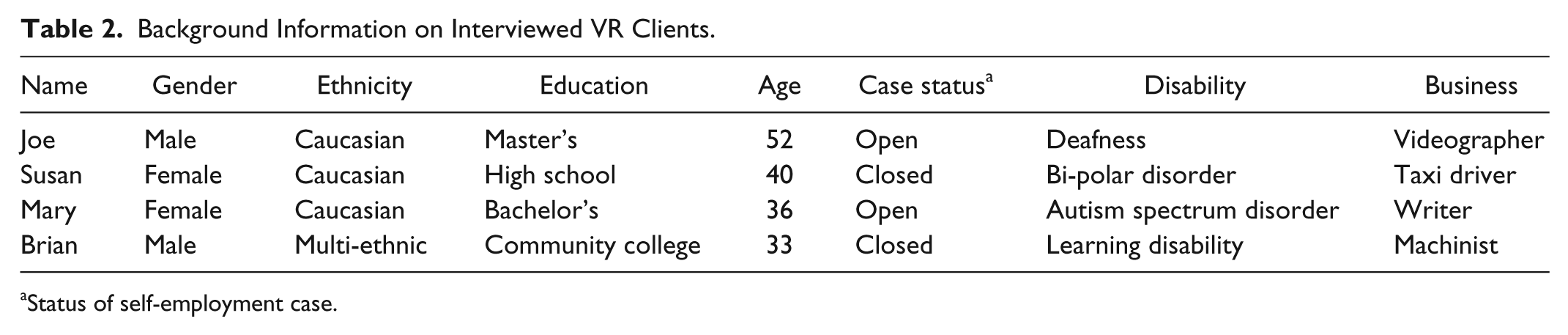
Status of self-employment case.
Themes
Three predominant interconnected themes emerged from our analysis of the interview transcripts: Relationship Dynamics, System Mechanics, and Social Identities. Each theme also emerged from several sub-themes. Each sub-themes and theme are described in turn and supported with direct quotes from interviewees. The Results section concludes with a summary of how these sub-themes and themes connect to answer the two research questions.
Relationship dynamics
This theme emerged as the interpersonal focus of a self-employment case, invoking the context and contours of the VR counselor–client relationship. Interviewees articulated a perspective of relationship dynamics, which always began as a service contract between a counselor, the service provider, and a client, the service recipient, and became a case. Each case was unlike every other, not just because different people required different services, but also because each person brought a unique set of abilities, life experiences, and expectations to that relationship. Several facets, as sub-themes, formed the thematic framework of relationship dynamics: case individualization, structural autonomy, personal rapport, and conditional support. These facets served as a starting point for understanding the lived case experience, while also underscoring the centrality of the counselor–client relationship. Thus, the meaning of relationship dynamics for interviewees lay in the culmination of the degree to which they made sense of the facets and reconciled contradictions between the totality of their case experience and their perspectives on specific instances in counselor–client interactions.
For VR counselor Jane, the relationship dynamic highlighted the facets of case individualization nested within the context of structural autonomy, and conditional support structured by her around a set time frame:
I set a time frame for my clients, and typically it is up to the counselor. It’s not required in policy . . . It’s in the counselor and client’s best interest to have a time-frame set, you know, that things are moving along in a timely way, but it depends, too, on the disability. They may need more support, so that type of thing. So it’s individualized and, you know, that’s how VR works, on an individual basis.
Among the counselor interviewees, Todd was the youngest and with the fewest years of VR experience. His relationship dynamic appeared to be directly influenced and shaped by the VR administration, particularly in case individualization and structural autonomy, which in turn affected his personal rapport and conditional support:
Got to integrate people into competitive employment. We have that obligation or else we’re not doing what we’re funded to do by the feds. Do I generally look at that as the least costly route to employment? Yeah. Is it going to make the client the most happy they can be, self-fulfilling? Probably not. But you got to draw that line and try to figure that out what might be best for this person, why, and work with them. And, ultimately, there’s going to be pressure from the administration. You got to do this and do that or you’d be fired . . . it is a numbers game, and there is a lot of external pressure.
For VR client Susan, the relationship dynamic included a personal-history and familial context, her own unsatisfactory experience with a previous VR case employment outcome and her mother’s experience as a client. That context seemed to impact particularly on case individualization, conditional support, and personal rapport:
My mom was helped by Voc Rehab and told me about it . . . I had finished working with Voc Rehab on another thing and kind of closed my case because I decided it wasn’t going to work for me. So they were very, they were very helpful. It was difficult to get the plan down, a lot more difficult for self-employment . . . so it took a couple of years to get the plan together with them, but they were supportive through the whole thing, and I never felt that they had abandoned me.
Among the interviewees, the relationship dynamic appeared most pronouncedly focused on conditional support for Joe, a client with an extensive education and employment history:
I moved here and I’ve been here two and a half years now . . . and I’m progressively working with VR to help me, to get the start-up equipment and things of that nature to get it going. And, that’s what I’ve been doing here now at VR for a year. We just got the money, but they had to cut certain things out of the budget for me, and I feel like they kind of shifted a little bit more.
For Rachel, the counselor with the most years of experience among the interviewees, the relationship dynamic and its four facets were upended by a historical anomaly:
I had a woman who had a business that didn’t work out. But who could have predicted the economy? She’s a very talented artist . . . . She had connections to various art galleries. So we set it all up, and she started out relatively well, and then the economy took that downturn, and people weren’t buying art . . . We went through about a year of just nothing happening, very minimal sales. About last spring, she came to me and said, “You know, this isn’t working” and shut it down. We shut it all down. So yeah, that was a bummer.
Mary, a first-time VR client with a bachelor’s degree in English literature, was perhaps the most expressive among the interviewees in describing the relationship dynamic in very personal terms, particularly the facets of personal rapport and conditional support, the latter being notably different in focus from Joe’s perspective on conditional support from VR:
Two years ago when we started the process, I was very much depressed and just kind of in despair . . . When we finished the business plan everyone liked it, and [VR counselor not interviewed] said she liked it and could almost guarantee we were gonna get it passed, and it didn’t, and she felt bad about it. This new business plan, they’re guaranteeing this one. I’m not, not crossing or holding my breath yet [slight laughter] because I don’t completely trust, but I know she got one of the people [on VR self-employment plan review committee] who turned it down to help me this time. I hate to say it’s going to happen, because I did, I thought that before, but I really do think it will this time.
System mechanics
This theme emerged as the material focus of a self-employment case, encompassing the technical-procedural set of activities and requirements that clients and counselors followed from client application to service provision and to successful case closure, VR’s definition of success when a client achieves a stable employment outcome. Interviewees articulated a perspective of system mechanics with a level of detail that not only revealed their knowledge of specific case elements, but also their situational or circumstantial affective disposition. Several facets, as sub-themes, formed the thematic framework of system mechanics: resource management, rule interpretation, activity negotiation, and external collaboration. Though each case was unique, these facets provided the necessary familiar organization—language, norms, and culture—in which the counselor–client relationships first formed and then proceeded. Thus, the meaning of system mechanics for interviewees lay in the culmination of the degree to which they made sense of the facets and reconciled contradictions between system mechanics and its constituencies—VR administration, agency, counselor, client, client’s family, and external collaborators such as other government agencies.
Jennifer, a counselor whose career history included working in two states, described a few prominent bureaucratic dimensions of VR while revealing how system mechanics might typically unfold in her self-employment cases. This was most evident for the facets of rule interpretation, resource management, and external collaboration:
I think what has changed most is that now they have an administrative review group . . . There’s of course a lot of steps when somebody applies. If they expressed interest in self-employment, then figuring out, “could they manage it?” If they need help, do they have a support system or could develop one? Then gradually get to a point where they do a feasibility study. After that, if the business is considered feasible, then working with a qualifying [local independent] business expert. The next step is that a business plan is developed. Then I take that plan and I review it with my manager and prepare a draft VR plan to support that. Then both forms go to the administrative review committee. They can approve it or decline it, or what I understand is, often they do approve it but they might want some additional work to be done and then it comes back to them.
Brian, who had a single case experience as a VR client, became a self-taught machinist. The facet of system mechanics that appeared to most affect his perspective on that experience were activity negotiation and resource management:
I didn’t know what I wanted to do, but I just didn’t want to work for anybody else. I just wanted to be on my own, doing what I liked and earning a living. I knew about VR so I went there to see if they could help me. But there was so much stuff involved, though, at first, and I hated it because all the paperwork and steps, “Do this, do that . . . but can I do this or what about that?’ But my dad reminded me it would be good in the long run because they [referring to VR] would help me to start up and support and so on, and me being my own boss, so I went through it and doing what I’m doing now, this, on my own.
Jane’s counselor perspective on a VR counselor’s basic function highlighted three facets of system mechanics—resource management, rule interpretation, and activity negotiation:
So really, you’re looking at either self-employment or integrated employment in the community. Do they have transferrable skills to work with individuals without disabilities? Or some clients just want self-employment. Maybe it’s the thing they can do right now because of their disability. So, that’s kind of just guidance and counseling . . . Self-employment has a whole separate policy in VR, and requires different criteria . . . A business plan is the initial step. I usually give them a draft and ask to fill it out. I give them a time period because I’m also looking at their timeliness to get back documents, and how consistent they are, how reliable they are, and how much they are able to fill out that information on their own without initial assistance. If they meet that time period, then they kind of get a check mark, you know, from me.
Mary’s client perspective, in the most personal terms among interviewees, seemed most impacted by two facets of system mechanics, resource management and external collaboration:
The most enjoyable part of the process was getting my mind thinking creatively again, and starting to feel a sense of self-worth . . . and I could get my old life back. So that was the good part—the creative process and self-esteem. Then the hard part was that [name of DD services assistant] had to do all the social networking and contacts. It’s hard for me even when I do it well, which I can do in small doses, it wears me out. She’s very good socially. She’s a good salesperson. I relied on it because I’m very scared to talk to new people. With this new business plan, I wouldn’t have to worry about that. So that eliminates the whole problem, which helped me with the book that I’m writing.
Rachel’s counselor perspective was focused on questions for clients around “why self-employment?” and “what is success?” The system-mechanics facets of rule interpretation, activity negotiation, and resource management brought those questions to the forefront:
The process as a whole when I have somebody come in right from the intake and is talking about self-employment, we have a packet of information of some basic preparation they have to do. Some people take the packet home and get really excited about it, and some will take it home and get overwhelmed and come back and say “Whoo, that’s not what I want to do.” So it kind of helps sort out their interest and their abilities, as they look at and self-analyze themselves, “Am I going to be able to do everything that’s involved in a business?” . . . We can work together on different aspects of the plan and help with the start-up, but not with the ongoing maintenance of the business. So an important part of the plan is defining “What is success?,” and when do we say “We met that goal and it’s now time to close that file because you’re off and running”?
Social identities
This theme emerged as the developmental focus of a self-employment case, circumscribing changes in the thoughts and behaviors of counselors and clients over time. Interviewees articulated a perspective of social identities that captured the development of their case in expected and unexpected ways and the way they saw themselves, in practical and/or aspirational terms, relative to the possible effects of their experience. Several facets, as sub-themes, formed the thematic framework of social identities: personal development, business philosophy, cultural awareness, and societal impact. While similarities and differences existed in the developmental case trajectories across counselors and clients, the facets elucidated how each shared in their case progress and outcome and in the varied implications of the case as a result of that experience. Thus, the meaning of social identities for interviewees lay in the culmination of the degree to which they made sense of the facets and reconciled contradictions between social identities and their understanding, in any particular instance during the case and over the entire course of the case, of the reciprocal nature of case development and experience.
From Joe’s client perspective, the sheer complexity of social identities was animated through the facets of cultural awareness, social impact, and personal development:
I want to be a good role model for other Deaf people, to say that they can do it and set up a business too . . . . Let me explain to you how I identify myself. There is a Deaf disability, and then there is a disability of people. There’s absolutely a different kind of group . . . but in the community they call me “disabled” but I resent that. Call me “Deaf” . . . I don’t want them to pity us. I want them to know we face different challenges and different cultures . . . . They’re looking at me as a Deaf person and they’re not looking at me as a professional. They have a tendency to focus on the Deafness, and they get fascinated by the sign language, but I want them to shift towards who I am as a producer and an executive director . . . sadly, a lot of Deaf people in this community are not like me. I don’t mean to sound arrogant in any way, but I’m trying to get them to understand and become empowered . . . . self-taught with the latest technology, since the 80s, from analog to digital, and I got wireless stuff going now . . . I am really good. I don’t let one thing lag behind.
Jane’s counselor perspective on self-employment of individuals with disabilities was couched within the context of a larger social issue and included a historical critique, reflecting three facets of social identities, personal development, cultural awareness, and social impact:
When a client first comes in, I ask “Why do you want to be self-employed?” . . . . So I go through that . . . more times out of ten, it’s about the disability is why they cannot work in an integrated setting . . . I would not look at disability type in denying self-employment, but you know, I think that clients with mental illness would struggle more . . . I certainly would offer more guidance and counseling and more business consultation . . . . Because most times, but not always, I’m approving a business plan because of the disability. I kind of tell clients—and I don’t know that the agency will approve me saying this (slight laughter)—but I feel that clients were just locked away with disabilities for far too long, and were not put in the workforce and were held back. So I want to see our clients in the community. I don’t want to see them behind closed doors in a self-employed business, not being integrated with other people that are not disabled. So I look at it, too, that way.
Susan’s self-employment as a green-taxi driver was at the center of her perspective on what she seemed to value most in that experience. All four facets of social identities—business philosophy, cultural awareness, personal development, and social impact—were apparent:
I have dreams about the business. I would love to have a co-op. That’s my biggest wish. This is something that depends on other people, if I could find like-minded people . . . each driver would own their taxi and the company itself is like a non-profit . . . I run on vegetable oil . . . I converted [her taxi vehicle] in March right before I started the company. It was part of the business plan . . . You know [name of home city] is really into alternative type things, green stuff. So even before I was thinking about starting my own taxi company, I heard about these guys [name of a local bio-fuel and green-vehicle conversion company]. I admire their business model . . . . The taxi driving doesn’t seem to be a problem with my disability. And, you know, keeping the records and paying the bills and stuff like that hasn’t been a problem either . . . . I think my favorite part is the customers, to meet so many different kinds of people and circumstances, developing relationships with regulars . . . I’m really interested in joining the Sustainability Coalition . . . . They get together and work on projects for sustainability.
Todd, in addition to being a VR counselor, also managed a small family farm, reflected on his approach to managing self-employment cases that underscored social identities in all four facets—business philosophy, personal development, cultural awareness, and social impact:
I’ve got one client that thinks they might be able to do $50,000 a year and has the potential to do it. I’ve got others that think, “If I’m not using the state system, TANF, food stamps or something, I’m bettering the world and I’m not being a drag on society.” It’s not money for everybody, and business isn’t all about it. I mean that’s why there’s hundreds of non-profits started everyday probably. You know, it’s about helping others or giving back . . . I think the job has certainly changed, and of course I’ve learned a lot . . . It has become convoluted because of new policies, changes to how we pay for services . . . some of them are gonna be cheap, some of them are gonna be more. But if a person is working and able to sustain employment, I don’t care. That’s how I kind of look at it . . . the pride comes in the work, in the outcomes . . . If there was a way to make the policy more convenient, to do modified self-employment plan and not jump through so many hoops.
For Mary, her self-employment experience, which included a changing sense of spirituality and a long-held interest in writing and technology serving as the outlet for its expression, weaved through the four facets of social identities, personal development, business philosophy, cultural awareness, and social impact:
The whole year I was working and converting to Catholicism . . . it’s a spiritual thing. I have reasons and purposes for being. It just keeps me going. So actually, I want to make my books religious and spiritual . . . Two years before I became Catholic, I was reading Saint Theresa of Avila. She established the Contemplative Order of Carmelites. I’m trying to learn it for the book I’m writing to teach people how to do contemplative prayer . . . . I need to get a new computer and Adobe professional software so I can self-publish for e-books and then for apps I can use Snappy . . . I’ve already researched how to get marketing on that through Lightning Source . . . I’m volunteering a lot. I volunteer at a clinic that’s pro-life . . . one of my goals is financial independence and security, and another goal is service toward god, but I’m not gonna give everything I make to charity . . . I want to get off my disability . . . . People shouldn’t look down on people who can’t work, but I do, and now that I am one, I really do. I don’t know, I don’t know. A lot of this I should figure out spiritually within myself.
Summary of Results
In summary, the findings—the three emergent themes (Relationship Dynamics, System Mechanics, and Social Identities)—answer the two research questions in ways that are complex and interrelated. The first research question was as follows: “How is self-employment success defined?” For counselors, success was principally, though not exclusively, defined as case closure after a period of what they determined as stable employment based on their evaluation of a client’s business, which varies across cases—evoking the themes Relationship Dynamics and System Mechanics. One counselor, Todd, while bluntly describing VR’s goal of case closure as “a numbers game” by administrators, nevertheless also expressed that success included clients learning adult-life skills (e.g., paying bills) and becoming more educated. There was a clear difference in defining success, however, and this could be explained by the fact that when a case closes, the VR counselor’s involvement ends, but the client still has a business to run. Thus, client success is defined along a developmental path—during the case and after closure. During the case, success is the same for clients and counselors. After closure, however, the now-former client’s success become a set of goals and pursuits that reflect his/her beliefs and values, for example, Joe being a role model for a disability group, Mary advocating a religious practice, or Susan running a green-energy co-op—these evoke the theme Social Identities.
The second research question was as follows: “What are the challenges of self-employment?” For counselors, challenges mostly focused on clients’ effort, skill, and motivation, and managing expectations and commitment to owning and running a business—evoking the two themes Relationship Dynamics and System Mechanics. Counselors also acknowledged that the VR system could be a challenge for clients, especially the policies and amount of paperwork—the VR bureaucracy. Interestingly, only one counselor, Rachel, specifically discussed the challenge of external conditions (e.g., recession) on a client’s case. Clients also referred to the VR bureaucracy as a challenge, but they also cited other challenges, including obtaining adequate financial and technical support beyond VR, and trying to learn more about owning and running a business—evoking all three themes Relationship Dynamics, System Mechanics, Social Identities. For example, James and Mary openly expressed frustrations about the case process and worried about receiving and having an adequate level of support for their business. Disability as a challenge for clients was only directly and explicitly addressed by Mary (i.e., Autism Spectrum Disorder). For the VR counselors, this was less directly isolated as a challenge and more integrated with the case process and VR policies.
Discussion
Research Questions
As Brantlinger et al. (2005) assert, “Interpretation is a necessary stage of all qualitative work. It typically follows, is infused with, or occurs simultaneously with the description of findings and analyses of results” (p. 200). The richness of the three emergent themes, Relationship Dynamics, System Mechanics, and Social Identities, contextualized by direct quotes from interviewee, allowed us to answer the research questions. In turn, these answers support the present study’s conceptual framework and contribute to the theoretical foundations of research about self-employment of individuals with disabilities that are necessary to advance our understanding of this complex phenomenon.
The interviewee perspectives on self-employment success definition and challenges are intertwined through the facets in all three themes. For the VR counselors, these perspectives are driven by the nature of their relationship with their clients, the policies and procedures they follow within the VR system, the personal and institutional resources they provide clients, and their beliefs and expectations about cases and clients. The counselors’ role as service provider and agency gatekeeper means that, although success, in essence, is pre-defined by VR policies for client case management, the counselors still decide whether clients are best suited for self-employment or other employment and provide services. Through this authority the VR counselors, as official members of a large government agency with access to its resources, express their power. As such, this could explain, for example, why counselors may require a client to complete certain tasks without explicit policy requirement. The individualization of self-employment cases is not merely a symbolic but real manifestation of their discretionary authority to uniquely direct and control cases. Conversely, for clients, while their perspectives are also driven by the same elements in all three themes, their definition of self-employment success differs, as it begins within a case but does not end at VR case closure. It evolves over time and after the case, and self-employment challenges also follow that arc. Case closure serves as a new point from which now-former clients—a role change—make independent decisions in self-employment and redefines success according to personal beliefs and what they seek in business. The clients’ case role as service recipient, however, places them in a subordinate and dependent position, particularly in relation to resource access in their professional relationship with counselors, resulting in comparatively less autonomy and necessitating more negotiation and self-advocacy.
The emergence of the three themes, Relationship Dynamics, System Mechanics, and Social Identities, is consistent with what is known in the empirical research literature on self-employment of individuals with disabilities. Previous research has also described the counselor–client relationship to vary significantly across dyads and agencies, and how this is influenced by individual talent, motivation, experience, and expectation, and by agency resources, policies, and employment circumstances in the community (e.g., Arnold & Ipsen 2005; Blanck et al., 2000). In addition, the empirical research literature also consistently references challenges that VR clients and counselors experience in self-employment cases due to the case process and the technical nature of owning and running a business (Colling & Arnold, 2007; Hagner & Davies, 2002) and concern over having adequate support systems (Arnold & Ipsen, 2005; Ipsen & Arnold, 2005). Variations in the types of businesses individuals with disabilities pursue in self-employment and their goals based on financial and non-financial considerations, such as personal values (e.g., green-energy co-op), are among the most common consistent findings in the literature (Blanck et al., 2000; Hagner & Davies, 2002; McNaughton et al., 2006; Palmer et al., 2000).
The emergence of these themes adds new knowledge to the research literature by explaining how and to what extent each factor of self-employment success for individuals with disabilities is connected to the other two factors and self-employment success. This is presented in Figure 1. The relationships among individual characteristics, accountability systems, and level of supports and their influence on self-employment are observed concurrently within and across the three emergent themes. In every self-employment case, the counselor–client relationship is unique as the individuals are, which to varying degrees shapes the nature of that relationship in service provision and resource allocation, processes and policies for business planning and initiating, and development and involvement of multiple identities.
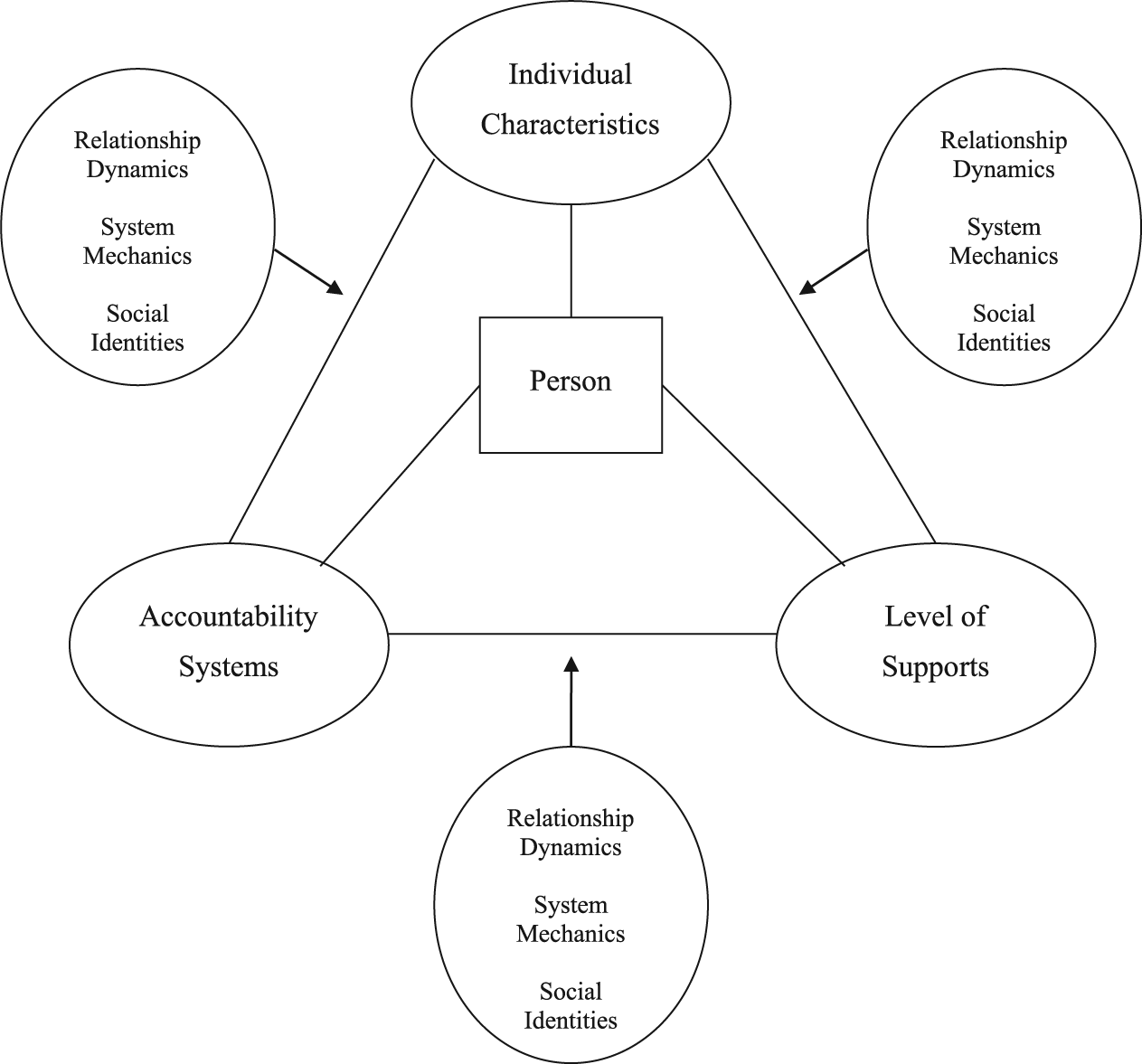
Conceptual framework explained by three emergent themes changing over time.
As an example of how the three emergent themes “fit” into the conceptual framework and explain the interrelationships of the three factors, in reference to Figure 1, here is one possible scenario involving the client, Joe. As his comments indicate, Joe’s individual and social identities are strongly integrated with his diagnosed disability condition, Deafness, but also with his work experience and highly developed professional expertise as a videographer. Therefore, referring to Figure 1, all three themes—and their constituent facets—moderate and inform each line connecting the three factors. Between accountability systems and level of supports, Joe’s interaction with his counselor is driven by his need to acquire VR funding for his business (level of supports), which requires a case process (accountability systems). This interaction takes place within the context of (a) counselor–client relationship; relationship dynamics, for example, “what are the services to be provided?” (b) case process; system mechanics, for example, “what are the requirements in a self-employment plan?” and (c) development experience; social identities, for example, “what are the implications of the business?” The arrows from the three themes do not touch the lines connecting the factors because themes are not additional factors, but instead are “contained” within each line. The person is presented in a different geometric shape because she/he is the only element of the model not representing a theoretical construct. Over time, this three-dimensional model is expected to change, as individuals and businesses naturally do.
Limitations of This Study
In considering the contribution of this study to the literature, it is important to first recognize its limitations. The biggest limitation is the relatively small number of participants and the lack of counselors from different regions of a state (i.e., urban, rural, and suburban) and across the United States (i.e., South, Midwest, Northeast, West). This is especially important given what is known in the research literature regarding regional differences in VR self-employment and its outcomes, and regional economic differences (e.g., Revell et al., 2009; Yamamoto & Alverson, 2013). While knowing that self-employment through VR was a relatively rare occurrence based on the research literature, authors also faced significant challenges in recruiting participants and gaining consent from them. Of the 11 VR counselors and 10 VR clients who had expressed interest in participating, only four counselors and four clients actually signed consent forms. The others did not return repeated calls and emails.
Another limitation of this exploratory study is the lack of diversity of interviewees. The latter is especially important, given the historical challenges people with color have faced in securing and maintaining employment or in obtaining financing for their small business by conventional means, such as bank loans. A third limitation is the limited engagement with interviewees. A longer interview session or multiple interview sessions with each participant may have elicited more detailed answers and other perspectives about the experience of a VR case or experiences in self-employment, and perhaps coupled with field or onsite observations (e.g., clients engaged in business activities with customers) could have added breadth and depth. Finally, given the exploratory nature and design of this study, neither causal explanation nor any definitive conclusion about VR self-employment or the conceptual framework is to be drawn. The purpose of this exploratory study was narrowly focused on contributing to the sparse refereed research literature about self-employment of VR clients with disabilities.
Implications for Stakeholders
The implications of this study primarily reach two stakeholder groups, researchers and VR agencies. For researchers, the study adds new empirical knowledge to the research literature, as it also points to other directions the research can take, especially in terms of theory development and testing. For VR agencies, they gain an understanding of what other counselors experience in self-employment cases, the types of challenges they could face, and the technical learning process that occurs depending on the client and on the type of business. The learning might also facilitate enhancement in agency service delivery or resource usage, and in interagency collaborations to share knowledge and resources in supporting clients in self-employment. For agency managers and administrators, policy implications are found in the autonomy of counselors, specifically in terms of the amount and types of services provided to clients, or how they could improve identification and potential reduction of paperwork and the time involved in drafting and reviewing a client’s business plan.
Recommendations for Further Research
One emergent theme from this study that should be further explored is power in the relationship between VR counselor, the service provider with resources, and VR client, the service recipient who needs those resources to become self-employed. Such research could contribute important new understanding of the role of power in that relationship and how it fits into or modifies the conceptual framework developed by Yamamoto and Alverson (2013).
In addition, given the developmental trajectory of business, another area for further study is self-employment over time. For example, multiple interviews of counselors and former clients over several years could identify important changes and the factors related to success and how the three emergent themes may evolve. This could answer the next important research question, “To what extent do these three emergent themes explain the conceptual framework over time?” Also, given the phenomenological nature of the self-employment experience, for clients and counselors alike, a more prolonged engagement with participants, with perhaps the inclusion of site observations, would add informational depth to research knowledge base. This would also allow the process of examining “fittingness” (Lincoln & Guba, 1985), the substantive comparison and contrast of multiple, different empirically based theories of self-employment for individuals with disabilities as changing, active not static over time, further clarifying the relationship of the three emergent themes to the three factors of the conceptual framework in authentic settings.
Looking beyond the VR system, individuals with disabilities who want to become or stay self-employed could find non-traditional sources that may provide greater flexibility they often need to timely address specific issues of personal services, income generation, and business expansion or modification. The proliferation of social-media driven crowd funding, such as Kickstarter and Indiegogo, is fundamentally changing how people acquire funding for small start-ups and how they think about entrepreneurship, business, and commerce. The possibilities for individuals with disabilities using crowd funding for self-employment are intriguing and lucrative. For researchers, it could mean greater understanding of the role of technology and social networking in business and in redefining self-employment of individuals with disabilities.
Footnotes
Declaration of Conflicting Interests
The author(s) declared no potential conflicts of interest with respect to the research, authorship, and/or publication of this article.
Funding
The author(s) disclosed receipt of the following financial support for the research and/or authorship of this article: This research is based upon work supported by the National Science Foundation under Grant Number 1103370.