




Abstract
Political connection is multiform, and each of its components may affect the enterprise in different ways. In this article, we have studied the advantages of two types of political connections with data from private enterprises. An enterprise can financially support a political party’s campaigns or support only a single candidate of a political party. The enterprises choose between these two types of political connections according to the respective profitability of each. We make use of primary data collected in 2014 from enterprises that take part in Burkina Faso’s public procurements to analyze the expenses and profits linked to each of these political connections. The database has helped us to identify three categories of enterprises according to the type of political connection being implemented. The first category of enterprises financially supports only political parties, and the second finances only politicians. The third category is composed of those that finance both politicians and political parties. The data show that the enterprises that establish both types of political connections bear more expenses. These enterprises also earn more public contracts. The difference in treatment between these three types of enterprises is only viewed at the level of the number of public contracts obtained. This process allows us to say that the only advantage linked to the establishment of political connection in Burkina Faso is the profitability linked to government procurements. Our data do not address the hypothesis of tax reduction as a benefit of a given category.
Introduction
In democratic countries, two powerful entities hold the power. There are the enterprises governing the economic arena holding the power of financing and the political parties in the political arena holding the power of regulation. To better exercise their political power, the political parties need a huge amount of cash and the backing of the big entrepreneurs. This facilitates political power management and helps to avoid a clash between the economic and political powers. The big enterprises also need assurance that the political authorities will not establish economic policies that thwart their interests (Ferguson, 1995).
Thus, each of these two entities feels the need to partner with the other. If the need of protecting oneself is a natural behavior, the way these two entities implement their closeness strategies has often gone beyond the norm. The enterprises make use of their financial resources to support politicians to control them and ascertain that no decision of the political party in power will question their position of economic leader. This behavior has direct effects (profitable and undesirable) on those enterprises (Fisman & Svensson, 2007; Kaufmann and Wei, 2000), and it also produces indirect effects that penalize the enterprises that honestly and fully fulfill their role as an economic unit (Mauro, 1995).
The theoretical literature has different approaches to the behavior of the enterprises establishing a connection with the political decision makers. The money transfers made by the enterprises to the political parties are viewed in different ways. Some analysts view them as acts of corruption, and others consider them as acts of charity (ideological donations).
Corruption is henceforth considered as an iceberg, of which the visible part is said to be hand-to-hand 1 corruption and the submerged part is the political connection. The submerged part is silent and very important in terms of achievement frequency but is also fatal (Arbache, Habyarimana, & Molini, 2010). Several theoretical and empirical contributions have been carried out in this domain. The first approach studied the problem under the form of an interaction between the political and economic arenas (Bernhagen & Bräuninger, 2005). These two arenas are compelled to interact because the actions of one will inevitably influence the other’s behavior.
Rose-Ackerman (1999) addressed corruption but did not explicitly consider the political connections enterprises establish with political parties. Later, authors who support Rose-Ackerman’s definition of political economy focused instead on the study of economic policies and institutions but not on political parties (Gerring & Thacker, 2004). Some authors have made a connection between political parties and the variable “political competitiveness” that has prevented them from studying their interrelations with enterprises (Hellman, 1998).
Recently, Della Porta (2004), Burris (2001), and Grant (1993) considered political parties in their studies. Hillman, Keim, and Schuler (2004) studied the case of enterprises that individually make connections with political parties. Greenwood and Jacek (2000) as well as Bennett (1999) studied the case of political action committees. In a study of political connections, McMenamin (2012) distinguished two types of financial supports enterprises can bring to politicians: ideological and pragmatic. Donations motivated by ideology are supposed to be stable, and pragmatic donations are liable to change in the short term according to the political party in power. These two motivations interact in enterprises’ decision to finance political parties. Studies carried out in Australia, Canada, and the United States show that enterprises have always favored pragmatic donations (Burris, 2001; Della Porta, 2004).
McMenamin and Schoenman (2007) exclusively analyzed the political party–firm relation. The authors showed that the two influence each other in a structural manner in the sense that the government always needs the enterprises’ financial support. The influence can also be institutional and manifests itself as lobbying, in which the enterprises seek advantages (Bernhagen & Bräuninger, 2005). McMenamin and Schoenman (2007) tried to see if each enterprise establishes its relations with one or several political parties at a time.
Our study is close to McMenamin’s (2012). This author analyzed the relations established between enterprises and political parties. He studied more exclusively the costs and profits linked to the enterprises’ pragmatic behaviors in this interaction. We also study the costs and advantages linked to the political connection, but our study is distinct from McMenamin’s because we view the political party as two entities. We propose to study the advantages and costs linked to financing the political party as well as those linked to financing the political party candidates. When the enterprise finances the political party, we speak of the firm–political party connection; this corresponds to the analysis of McMenamin. Our contribution is then to add an analysis of the firm–politician connection.
These two types of connections can take many forms. For example, in countries with planned economies, enterprises consult each other, make corporate decisions, and then inform the political arena of their wishes (McMenamin, 2012). In democracies, the enterprises adopt diverse strategies. They can connect individually (Coen, 1997; Martin, 2000) or collectively (Greenwood & Jacek, 2000) with the political arena.
The connections between the enterprises and the political arena are favored by the fact that politicians need cash to finance their political campaigns (Ohman, 2014). Smilov and Toplak (2007) showed that enterprises’ financing represents an important part of political parties’ incomes. In some cases, the enterprise finances the political parties or politicians and expects a reward from them when they are elected. Donations given under these conditions are said to be pragmatic donations. Enterprises can also give their financial support to a political party or a politician by simple charity. These donations are viewed as ideological donations (McMenamin & Schoenman, 2007).
Enterprises are always motivated by earning high profit. Consequently, they opt for the political connections that bring the most profit (Ansolabehere, De Figueiredo, & Snyder, 2003). This led McMenamin (2012) to say that the cash distribution an enterprise pays to political parties is a strategic decision that takes into consideration the power of the political party. This implies that, in most cases, pragmatic contributions are highly superior to ideological contributions.
In short, enterprises establish political connections either to escape the harmful effects of regulations (policy) or to benefit from legal protection (Clawson, Neustadtl, & Weller, 2003). In the context of the current analysis, we think that enterprises invest in political campaigns for concrete and immediate profits. Under this hypothesis, we think that, in developing countries, the fastest method for enterprises to utilize this advantage is by obtaining public contracts.
Numerous are the reasons justifying our research idea. First, political formations are generally poorly organized in low-income developing countries. In these countries, the power of a political party comes mostly from its politicians’ power (military or financial power or ethnic dominance), rather than from its ideological positions. Indeed, in poor developing countries, the private demand is so low that the only source of growth offered to private enterprises is the public demand (Akouwerabou & Bako, 2013). In these conditions, enterprises are often compelled to adopt a pragmatic behavior. This implies always giving one’s support to the political party in power. The main purpose of this article is then to show that the need to access government procurements is the main reason that pushes enterprises into financing political campaigns.
The data used in this article are primary sources, collected in Burkina Faso in 2014 from big enterprises participating in the government’s invitation to tender. From the information published by the National Directorate of Public Procurements, we took a census of all the enterprises allotted public procurement between 2010 and 2013. We only listed the enterprises participating in big public contracts because the political connection is costly, and to make it profitable, an enterprise must make sure to participate in government contracts offering huge sums of money.
In the present analysis, we only use the data of the entrepreneurs who admitted to financing political campaigns and then declared the amounts spent. Of the 660 sampled enterprises, only 34 enterprises fit this case. Had we adopted the technique of Svenson (2003), we could have obtained a higher number of enterprises. Svenson suggested asking the enterprise whether its competitors practice corruption and considering the enterprise’s response to represent its own behavior. We did not use this author’s technique because we want to know (a) the amount of money given, (b) whether the transfers are carried out to help the political party in power or a political party of the opposition, and finally (c) whether the transfers are carried out to help the political party or the political party’s candidate. In regard to our sample’s size, we use descriptive statistics and graphic representations to show the correlations between the studied variables.
We have shown through the methods used that the main motivation of the enterprises establishing political connection is the obtainment of public contracts. Our data show that the enterprises’ main strategy is pragmatic donations. They have always brought their support either to the political party in power or to this political party’s candidates. We have also found that the enterprises financing political parties spend more than those financing candidates. However, those financing candidates receive more public contracts than those financing the political party. Our data reveal that the enterprises financing political parties are bigger in size (number of employees) and in terms of profit than those financing the political parties’ candidates.
The remainder of this article is organized as follows: the “Literature Review” section presents the literature review. The “Theory of the Choice of the Type of the Political Connection” section presents the theoretical context. The “Data” and “Results” sections, respectively, present the data and the results. The conclusion reviews the issue and the fundamental results.
Literature Review
Political connection and its benefits for private enterprises have been much empirically studied in the last few years. Z. Chen, Sun, Newman, and Xu (2012) show that enterprises establish political connections to benefit from preferential treatments. These authors, as well as Kroszner and Stratmann (1998), show that establishing political connection allows the entrepreneurs to influence the policy decision makers to put in place profitable policies for them. Political connection can also allow enterprises to avoid institutional constraints, such as administrative slowness (McNally & Wright, 2010; Zhou, 2009). Y. Chen and Touve (2011) show that bypassing administrative slowness helps the enterprises increase their productivity.
Preferential treatments can also be viewed from the angle of illicit access to public resources. Establishing political connections allows the enterprises that take part in government procurements to obtain more information than their competitors (Faccio, 2006; Johnson & Mitton, 2003). Enterprises that obtain this information gain a technical and financial advantage in preparing their tenders for the selection of enterprises that will carry out the public procurements. In this case, government procurements are used as a reward for the enterprises that play the role of political allies through the financing of political activities either for a political party or a politician. Zhou (2009) and Bai et al. (2006) show that in Pakistan and China, respectively, political connection facilitates the access to bank credit. Similar results to those of these authors have been obtained by Johnson and Mitton (2003) and Khwaja and Mian (2005) in Malaysia and Pakistan, respectively.
In a review of the literature, Faccio (2010) shows that politically connected enterprises are more profitable than those that do not establish political connections. W. H. Chen (2007) discovered that in Asian countries, political connection helps private enterprises protect themselves against public agents’ and the army’s exactions. According to Brandt and Zhu (2007), as well as Farrell et al. (2006), in countries where the business environment is corrupt, only the politically connected enterprises grow rapidly. Establishing political connection also protects the enterprises from national and international competition (McNally & Wright, 2010; Shih, 2004). Faccio, Masulis, and McConnell (2006) have found that the connected enterprises pay less tax and often benefit from public financial aid in case of bankruptcy. Goldman, Rocholl, and So (2013) argue that the establishment of political connections allows enterprises to be illicitly allotted public procurements. This allotment is why Mougeot and Naegelan (1997) suggest that public procurements are a means of financing political parties.
A political connection does not have advantages exclusively. Politicians can also compel the enterprises to invest more of their financial resources to support them (Gu, Hung, & Tse, 2008; Warren, Dunfee, & Li, 2004). Politicians can also ask the connected enterprises to invest in less profitable social projects, which may lead the vulnerable enterprises to bankruptcy (Wu & Leung, 2005).
There are several levels of political connection. For the enterprise to take advantage of its political affiliation, it must set up relations with high political authorities or government leaders and/or the majority political party (Ahlstrom, Bruton, & Lui, 2000). Zhang and Zhang (2005), as well as Goldman et al. (2013), have found that the enterprises that have hired former government officials have succeeded in reducing the uncertainty faced by their enterprise. Z. Chen et al. (2012) show that when all the members of an enterprise (shareholders and managers) are politically connected, it is more profitable to the enterprise than when only the manager is politically connected. Dickson (2003) and McNally and Wright (2010) obtained similar results by showing that the enterprises that establish political connection through their syndicates are more profitable. Goldman et al. show that in leading democracies, each enterprise is connected to only one political party. They show that the enterprise takes advantage of the public procurements only when the political party that it supports is in power.
Political connection is defined in diverse ways. Faccio (2006) regards a politically connected enterprise as any enterprise of which the promoter, a shareholder, an advisor, a board member, a manager, or a secretary has been a minister, a member of parliament, or a member of a political party staff. In this article, we consider that an enterprise is politically connected when it financially supports election campaigns. The reason that leads us to adopt this definition is that in the least developing countries (LDCs), politicians ask entrepreneurs for support in every election to finance their campaigns.
The political connection is not being practiced solely in poor countries. Faccio (2006), who highlights the situation in wealthy countries, shows that 22 of 25 surveyed enterprises in Russia and 839 of 2,149 surveyed enterprises in the United Kingdom are politically connected. The same study shows that the political connection is rather less developed in Africa. Bardhan and Mookherjee (2000) and Tanzi (1996) suggest that in the future, the political connection is due to spread in Africa because, like hand-to-hand corruption, the political connection is being rapidly spread in countries where the private sector is far less developed. Proof that the political connection is due to spread in Africa has been given by several authors. The poor functioning of institutions in the LDCs is a weakness that makes these countries more unstable. Recently, Li, Meng, Wang, and Zhou (2008) have shown that the political connection is more profitable in countries where there is little legal protection of private copyrights. Li et al. (2006) suggest that when there is a poor protection of copyrights, being close to the government gives more advantages to the enterprise that help it avoid certain issues.
Our study seeks to fill a gap in the literature linked to the political connection. Previous studies have investigated the political connection without considering with whom the enterprises establish their political connection. During a given election, the political party puts in place strategies to support its candidate(s). Thus, it is not forbidden for a candidate to look for additional personal financings. Thus, entrepreneurs also decide either to finance the political party or the person himself who is a candidate in the election. The question being studied in this article is to determine whether the connection that links the enterprises to the political party’s authorities or the connection that links the enterprise to a candidate is more profitable. In practical experience, the benefits linked to the financing of the political party are not the same as those linked to the financing of the politician. In theory, we suppose that in democratic countries where political parties are well organized, it is preferable to support the political party. This idea is proven by the fact that in those countries, political power is held by the political party. However, in countries where political parties are much less organized, the political party obtains its power from one or several of its members. In this case, it is preferable for the enterprise to finance the politician than to directly finance the political party.
In some democracies, in the beginning of every election campaign, the committed political parties obtain financial support from the national department in charge of organizing elections. These subsidies are generally insufficient; thus, each political party, or each candidate in the election, will have to seek additional financings. The other sources of financing the political parties are diverse and varied. The political parties may use the contributions of members 2 and followers and may also obtain multiform support from political parties with the same ideology abroad and from other sources. They may also ask for financial or material support from domestic or foreign private enterprises.
In Burkina Faso, during the 2007 municipal election, a subsidy of US$213 per candidate was granted (National Independent Election Committee, 2013). This subsidy varies from a year to another. The more the years, the more those subsidies decrease because the political parties increase in number. For example, during the 2016 municipal elections, the political party in power gave about US$85 to every electoral ward of two or three candidates. But, in terms of the elections, each candidate spent about US$667. The electoral expenditures increase because one should henceforth pay the voters to get their votes (Ohman, 2014). The low amount of this subsidy vis-à-vis election expenditure proves why it is easy for the enterprise to establish a political connection. When such connection is possible, the enterprise is free to set up its political connection with the political party’s acting authorities. In this case, the political connection may, for instance, be established with the national, regional, or provincial coordination or any other official structure of the political party.
The enterprise may also establish a political connection with a powerful politician. In this case, the enterprise may even refuse to finance the political party when the politician whom it typically finances is not a candidate in a given election. The studied question may then be formulated again as follows: Is it profitable to the enterprise to finance the political party or the politician?
Theory of the Choice of the Type of the Political Connection
We make the assumption that the political connection is profitable only when several members of the enterprise are involved in establishing it. Under this hypothesis, it becomes impossible to analyze the choice of the type of political connection through the maximization of a utility function. It has been shown that it is difficult to add several individuals’ utilities (McFadden, 2001). Likewise, by using the joint utility function, we suppose that individuals are altruistic. However, it is unrealistic to say that individuals who are very selfish in the quest of individual welfare are perfectly altruistic in an enterprise (Samuelson, 1956).
Under these conditions, the enterprise’s decision to establish one or the other type of political connection must be studied by using an objective function of the enterprise. Consequently, we can suppose that the enterprise sets up the political connection to maximize its outcomes. It will consequently decide the type of connection that is more profitable to it. Consequently, to comprehend the enterprise’s choice, the expected profits should be compared in each type of political connection.
Supposing that before deciding the type of political connection, the enterprise had extensive experience in the practice of both types of political connection. Entrepreneurs do not have the same capability of influencing the policy decision makers. Supposing the ability to earn profit from the political connection depends on the enterprise’s strength, enterprises being run by less influential entrepreneurs are unable to influence the political party as an institution, but they may influence the politicians. It is then recommended to these enterprises to finance the politicians, whereas enterprises being run by influential entrepreneurs finance the political parties.
Moreover, financing the political party may be more costly than financing the politician. Under these conditions, enterprises having very large cash flows will finance the political parties, whereas the less wealthy will support the politicians. At the moment, an enterprise capable of practicing both forms of political connection is not forbidden from doing so. The procedure of choosing the type of political connection is simple. The enterprise ends up adopting the type of political connection where the expected marginal profitability of its future efforts is higher. Consequently, when an enterprise chooses between these two forms of political connection, it is that very choice that allows it to make more profits.
Data
The data being used in this article have been collected for a study of the impact of the political connection on the productivity of private enterprises in Burkina Faso. The survey took place in May 2014 and considered the enterprises that take part in public procurements. For the data collection, we used the daily publications of General Directorate of Public Procurements (DGMP) from 2010 to 2013. These publications give the names of all bidders and winners. We identified 1,172 large companies from the publications of DGMP. The names of the enterprises are insufficient to conduct the survey well. In facilitating the collection of the data, we made use of the national companies and groupings of companies (Fichier Nere) file of the Chamber of Commerce to obtain the identified companies’ addresses (street, telephone, etc.). The collection of data concerning corruption at the company scale is also impossible in Burkina Faso without the reinforcement of the National Network to Fight Against Corruption (RENLAC). We have a strong collaboration with RENLAC to support us in the collection of data on the field.
From the list of 1,172 enterprises, we ask the enumerator to randomly choose 660 enterprises in three branches of industry. These three branches do not have the same weight on the public procurement. Regarding the numbers of the public procurement passed each year in Burkina Faso, the need for a self-weighted sample compels us to collect data in addition to the 30% of enterprises operating in building and public works, 53% in office supplies, and 17% in intellectual services. During the collection of the data, approximately 186 entrepreneurs refused to participate in the survey. Other entrepreneurs left many questions unanswered on the questionnaire. We deleted this type of questionnaire, which reduces the size of the sample to 611 enterprises.
The pieces of information collected have focused on the enterprise’s size. The enterprise’s size has been approached by proxy variables, such as the number of employees and the turnover. The number of public tenders for which the enterprise applied, as well as the number of the contracts obtained, the number of hand-to-hand procurements, and the degree of the enterprise’s dependence vis-à-vis the public procurement have also been collected. Information on proxy variables has been collected to capture the enterprise’s dependence vis-à-vis government procurements. These variables are the portion of public procurements in the enterprise’s turnover and the portion of the profit that the enterprise has generated with public contracts. The enterprise manager’s level of education as well as the enterprise’s experience in government procurements and the type of political connection established by the entrepreneur have also been collected.
Results
The 611 enterprises sampled can be placed into several categories. The descriptive statistics show that 523 (80.7%) do not practice any form of corruption. Among those that practice corruption, 84 (13.7%) practice hand-to-hand corruption and 5.6% practice political connection. Of the 34 enterprises that practice political connection, 15 finance only political parties, 11 finance politicians, and eight finance both political parties and politicians. The financings have only been carried out in favor of the majority party and its candidates. No amount has been paid in aid of the opposition political parties. Seven entrepreneurs confessed that they have wanted to help the opposition politicians but have not given them anything. The reason they give is that they would not have earned any profit. No entrepreneur has shown the desire to financially or materially support an opposition political party. To identify the enterprise’s behavior vis-à-vis corruption, the entrepreneurs were asked some straightforward questions. The entrepreneurs who have been considered corrupt are those who answered in the affirmative: “yes I practice such and such type of corruption.” In contrast, if we made use of Svenson’s strategy (2003), we would have obtained higher numbers. Svenson proposes asking the entrepreneur whether his competitors practice corruption and then uses the entrepreneur’s response to this question as his own behavior. The data from the 34 enterprises have been used to obtain the results below.
Analysis of Costs and Benefits Linked to the Political Connection
Private enterprises establish political connections for several reasons: to protect themselves from exactions or to take advantage of the incomes linked to the public procurements and to escape paying taxes; to realize these advantages, however, they must first bear the costs.
The Costs of the Political Connection
Jain (2001) suggests that corruption not only has benefits but also has costs. Each enterprise will behave so that the costs linked to its corrupt actions are less than the income it might obtain. The amounts raised in financing these connections are not the same. On average, establishing a political connection costs an enterprise in Burkina Faso US$1,105. However, enterprises that establish both types of political connection spend more. Such enterprises pay US$2,638 on average, whereas those financing only political parties pay US$1,097 and those financing politicians spend approximately US$927. The standard errors associated with these averages is very high (columns 1 and 2 of Table B1 in Appendix B), which shows that there are large intra- and inter-group variabilities.
Figure 1 shows that enterprises that establish both types of corruption finance mostly politicians. The fact that the Cost_party_3 curve’s length is inferior to the Cost_politician_3 curve implies that these enterprises finance the politicians more than they do the political parties. This same figure also shows that the enterprises that establish both types of political connections spend more than those financing only the politicians (Cost_politician_2). Note also that the enterprises spendingmore on political connections are among the enterprises financing only political parties (Cost_party_1). In the remainder of this analysis, we explore whether there is a type of political connection that ensures more profits than the others.

Costs of political connection for all categories of enterprises.
Benefits of Political Connections
Obtaining public procurements
The recent literature stipulates that the most immediate profit ensured by the political connections of an enterprise is obtaining government procurements (Goldman et al., 2013). Figure A1 of Appendix A shows that the enterprises that finance both political parties and politicians do not apply for the public procurements more than other enterprises; however, from the proportion of the obtained public procurements to the total of submitted procurements shown in Figure 2, it is evident that the probability of obtaining a procurement for which they apply is higher. Thus, the curve Submitted/Won_3 is far above the other two curves, whereas the curve Number_Submitted_3 is not completely above the others (Figure A1). Thus, we may say that the enterprises that finance both politicians and political parties are almost always sure of being allotted the public procurements for which they apply. This finding is shown in Figure 2, where we notice that the minimum of the curve Submitted/Won_3 is superior to that of the other curves.
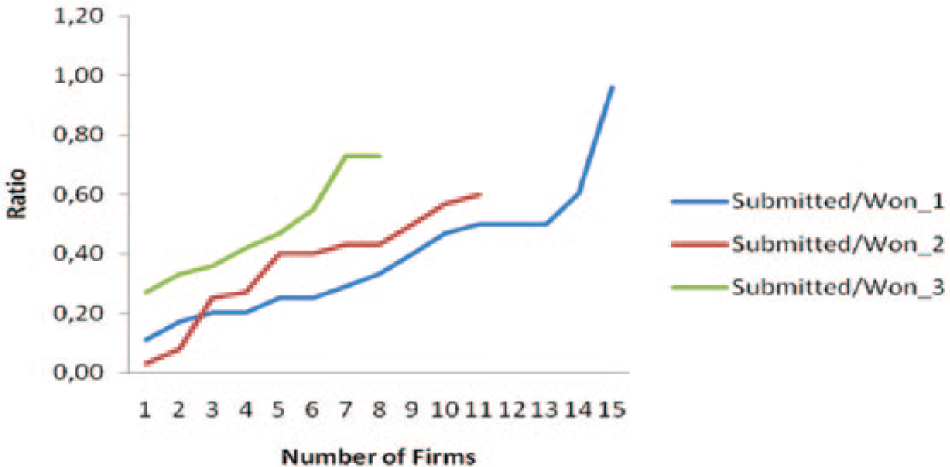
Proportion of the obtained public contracts to the total applications for procurements submitted.
On the scale of the whole sample, when an enterprise applies for a public procurement, the probability that it will be an allottee is approximately 40% (column 5 of Table B1 in Appendix B). On the scale of the subcategories of enterprises, the probability of obtaining procurement is 35% for the enterprises financing only politicians, whereas it is 38% for those financing only political parties. The last column of Table B1 in Appendix B shows that the probability of being allotted procurement is 48% for enterprises establishing both types of political connections, whichcorroborates the comment above associated with Figure 2. When we compare the curves of Figures A1 and A2 of Appendix A, we realize that the enterprises that finance both politicians and political parties participate relatively less in the public tenders but win more government procurement contracts than the others, on average.
There is a strong possibility that the results for the enterprises that finance both types of political connections are the consequence of behaviors other than those associated with political connections. The first possibility is the seniority in public procurements. The curves of Figure A3 show that the enterprises having more experience in public procurements are among those financing only political parties. Generally, we notice that the enterprises financing both types of political connections are not more experienced than the others. The curve representing their experience, though slightly higher, is similar to that of the other enterprises.
Hand-to-hand public procurements
The curves represented in Figure 3 lend weight to the assumption that enterprises establish political connections to take advantage of direct allotments of hand-to-hand public contracts. 3 From the figures, it is evident that only enterprises financing politicians win public contracts. The data in column 6 of Table B2 in Appendix B show that the enterprises that finance only political parties obtain fewer hand-to-hand procurements than the other enterprises, on average the data in this table show that it is preferable to finance both political parties and politicians than to finance only politicians.
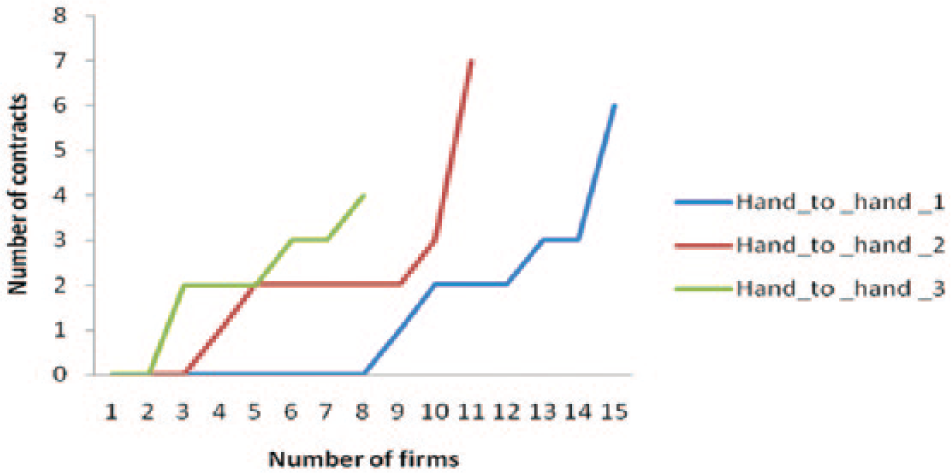
Number of hand-to-hand public procurements obtained by the enterprise.
Other Benefits Linked to the Political Connection
The literature shows that public procurements are not the only benefits linked to the establishment of political connection. When we consider the advantage linked to the access to the government procurements, we observe that it is preferable to finance both political parties and politicians. We will see whether this is also true for other types of benefits.
Tax payment
According to Goel (2012), enterprises establish political connections to reduce their taxes. Figure 4 shows that enterprises that pay more taxes are those financing only political parties. The slopes of the three curves seem to indicate that the other two categories of enterprises pay less tax, for example, the curve Taxes_paid_1 is higher than the other curves. The data in column 10 of Table B2 in Appendix B also support this comment. On average, an enterprise that finances only political parties pays approximately US$45,814 in taxes per year, whereas, on average, an enterprise pays US$31,430 per year. The other two subcategories of enterprises pay approximately the same amount of taxes. Figure A4 of Appendix A and column 11 of Table B3 in Appendix B show that this result can be linked to the size of the enterprises of each subcategory. As shown in Figure A4, the most important enterprises in terms of size are among those financing only political parties. The hypothesis that enterprises that finance only political parties pay more taxes because they are large enterprises seems to be confirmed by the data in the table in Appendix B. The information in column 9 of Table B2 shows that, on average, these enterprises generate more income than the other subcategories of enterprises.

Amount of taxes paid by the enterprise.
Access to bank credit
It commonly known that private enterprises have limited access to bank credit in the LDCs because of credit rationing (Stiglitz & Weiss, 1981). Our data show that this constraint has not been loosened. Indeed, only 58.8% of the enterprises studied have access to bank credit. At the level of the subcategories studied, enterprises that finance both types of political connections have more access to bank credit. These enterprises have access to extremely large amounts of credit (column 12 of the Table B3 in Appendix B), and 75% of them have access to bank credit (column 14 of Table B3 in Appendix B). The data in this column show that the enterprises that finance only politicians are the subcategory of enterprises with very limited access to bank credit.
Dependence vis-à-vis public procurements
Another reason that may lead enterprises to establish a political connection is their dependence vis-à-vis public procurements. When public demand is the main source of growth for the enterprise, it has been shown that enterprises compete strongly in the sphere of corruption (Akouwerabou & Bako, 2013). The curves of Figure 5 show that all the subcategories of enterprises are dependent on public procurements. This dependence is measured by the annual turnover of government procurement. From these curves, we can say that the enterprises that finance both types of political connections are those that are more dependent on public procurements. The enterprise’s dependence vis-à-vis public procurements is thus the main factor in decision making on the establishment of political connections. The robustness of this comment comes from the fact that entrepreneurs are informed people. Figure A5 of Appendix A, as well as column 13 of Table B3 in Appendix B, show that, on average, the entrepreneurs’ level of education is approximately 11 years. This result implies that the entrepreneurs are informed economic agents.

Rate of dependency of enterprises compared with public procurements.
Conclusion
Arbache et al. (2010) have shown that corruption is like an iceberg. We have shown in this article that its submerged portion is the political connection, because the action of establishing the political connection is temporally shifted in comparison with the access to the potential income linked to the connection. Enterprises finance the election campaigns of politicians, who grant these enterprises advantages once they obtain high positions. This temporal shifting allows both stakeholders to conceal their corrupt transactions. We have shown that there are several types of political connections. The political connection can be set up between the enterprise and a political party. It can also connect the enterprise to a politician. It can also take both forms at the same time. The enterprises choose from these three forms of political connections according to the expected net profits.
The amounts raised by enterprises in financing politicians’ election campaigns are extremely large, which explains why the policy makers do not implement effective policies against corruption (Colombatto, 2003). The political connection is also to the private enterprises’ advantage. Our data show that the main benefit linked to the political connection in Burkina Faso is the access to public procurements. The politically connected enterprises do not escape paying taxes. We have found out that the amount of taxes paid by an enterprise is a growing portion of its annual income.
The enterprises that finance both politicians and political parties not only bear more expenses but also obtain more public procurements. Broadly speaking, we show that financing the politician provides more public procurements than financing the political party. This report is founded in the case of hand-to-hand allotted government procurements in comparison with the allotted public procurements per open tender.
The data we have used are primary data. Because the data sample is small, we limit ourselves to correlation analysis. Econometric analyses on large data samples are consequently necessary to confirm the results reported in this article.
Footnotes
Appendix A
Appendix B
Descriptive Statistics of the Third Group of Variables Used in the Analysis.

| Type of political connection established | 11. Number of permanent workers | 12. Financial debt (bank credit; US$) | 13. Schooling (years) | 14. Access to bank credit (%) | |
|---|---|---|---|---|---|
| Finance only political party | M | 49.9 | 74,666.7 | 11.5 | 73.3 |
| SE | 101.8 | 256,744.1 | 8.4 | ||
| Number | 15 | 15 | 15 | ||
| Finance only politician | M | 9.0 | 28,181.8 | 10.7 | 27.3 |
| SE | 8.9 | 63,058.4 | 4.5 | ||
| Number | 11 | 11 | 11 | ||
| Finance both (party and politician) | M | 6.7 | 88,625 | 11.2 | 75 |
| SE | 4.6 | 155,571.7 | 2.7 | ||
| Number | 8 | 8 | 8 | ||
| Total sample | M | 26.5 | 62,911.8 | 11.2 | 58.8 |
| SE | 69.83 | 186,893 | 6.2 | ||
| Number | 34 | 34 | 34 | ||
Acknowledgements
The author is grateful to Hervé Kafimbou and Bako Parfait, PhD, for the comments on this article’s previous versions. He is also thankful to Romain Kiragoulou and Kini Janvier for their contribution in improving the English.
Declaration of Conflicting Interests
The author(s) declared no potential conflicts of interest with respect to the research, authorship, and/or publication of this article.
Funding
The author(s) disclosed receipt of the following financial support for the research and/or authorship of this article: The author acknowledges financial support by the Private Enterprise Development for Low-Income Countries (PEDL), which is a joint the Department For International Development (DFID) and the Centre for Economic Policy Research (CEPR) initiative. The study has also benefited from the institutional support of Réseau National de lutte Anti Corruption (RENLAC) and the Centre for Studies and Social and Economic Research (CEDRES). He also benefited from the support of Laboratory of Quantitative Analysis Applied to the Development-Sahel (LAQAD-S) during the process of publishing this article.