




Abstract
This article is about teaching art-based inquiry and equity pedagogy. The author introduces an aesthetic-inspired afterschool curriculum in the urban context in the United States and theorizes the meaning of active citizenship and community. Conceptually framed by “community without community,” this article explicates the ways in which the ARtS children (Aesthetic, Reflexive thoughts, & Sharing) investigated the meanings of community through dance, poetry, and clay art. The author imagines and theorizes community that goes beyond emphasizing solidarity and a collective “we”-ness in the pursuit of social transformation. Rather, the author argues that “community without community” could be an important framework to revisit children’s exploration of community, self-other, and active citizenship. The ARtS initiative opens up the possibility of valuing diverse epistemologies and calls for releasing the imagination for a different community. Most notably, the notion of community without community leaves open the possibility of reconceptualizing existing community and its vision for creating new communities always open to possibilities.
Community is being together and opening to spaces. Students like the ideas of openings if they look beyond the closed space.
It was Day 2 of the dance activity. The ARtS (Aesthetic, Reflexive thoughts, & Sharing) initiative team, comprised of teaching artists, teachers, and university faculty, asked children to articulate the ways in which group dancing was related to our ongoing discussion on active citizenship. During the poetry, clay art, and dance activities so far, children have imagined and conceptualized the meaning of “open” community with the same eagerness Greene highlights in the above excerpt, stressing the importance of creating possibilities outside of a typical closed, exclusive community. Although children seemed to be exhausted after practicing gestures, they soon enthusiastically participated in dance activities that were meant to represent who they are and their concepts of active citizenship and community. Children made connections between group dances and active citizenship by underscoring their open, inclusive components—that is, looking at community in a different way by challenging any closed understanding of it (Greene, 1995). For example, Daniella said, “Group dancing is related to active citizenship because everyone is working as a group in a community. If we mess up, then somebody might correct you nicely.” Isabelle responded to Daniella’s elaboration about active citizenship by employing the metaphor of a street dance to express her own conception of the term. Isabelle mentioned, “Group dancing is active citizenship . . . you are like being active when you are dancing and maybe if there is a street dance, the whole street is hosting a dance, then you could join in.” Isabelle’s metaphor of group dancing as active citizenship was creative and engaging. She hoped that anyone could join in the community as an active citizen regardless of his or her cultural background. Isabelle’s metaphor of community as “a street dance” opened up space for participation in the community’s urgent issues without remaining within already-restricted borders or being aware of existing limitations.
“Community” and Active Citizenship: Where Our Conversation Begins
This article focuses on teaching art-based inquiry and equity pedagogy. The ARtS initiative is an aesthetic-infused afterschool curriculum that goes beyond increasing artistic skills to foster student sharing of individual lived experience in the community. Pedagogically, the ARtS initiative team intended to promote children’s imagination and to allow them to see the world in new ways. This openness toward possibility is a means to release the social imagination, conceivable only if children are open to new ideas and are willing to revisit and share their existing values (Greene, 1995). The team of teaching artists, classroom teachers, and professors creatively imparted the difficult concept of active citizenship to children through the use of vivid metaphors, personal experience in making clay art, and bodily movement in small and large group activities during a 9-week afterschool program.
In imagining different versions of community, I apply the notion of “community without community” (Derrida, 1997; Nancy, 1991) in revisiting the ARtS children’s exploration of community, self-other, and active citizenship. The overarching question is, what possibilities exist in the field of multiculturalism when I, as a researcher, apply poststructuralist theories while analyzing children’s experiences during the ARtS initiative? Mainstream multicultural education practices favor a universalized, collective voice that ironically excludes other important voices within the group. I deconstruct the meanings of community and solidarity by reflecting on salient learning moments. I explore the possibility of imagining community that moves beyond emphasizing solidarity and a collective “we”-ness in the pursuit of social transformation.
Conceptual Framework: Community Without Community
The ARtS initiative aims to support the existing school communities’ efforts to establish a much healthier community. I conceptualize a community without community as one that underscores the importance of imagining the multiplicities of communities that cannot be universalized by existing cultural norms, or by predetermined notions of cultural sameness and difference (Derrida, 1997, Nancy, 1991). My theorization of “community without community” stems from Derrida’s (1997) elaboration of proleptic eschatology—that is, challenging a linear, chronicle understanding of the past, present, and future and anticipating its integral relationship among these three parts of time in order to create a space with eternally open-ended possibilities. In his book The Politics of Friendship, Jacques Derrida calls for a “community without community of thinkers to come” (p. 62). He develops this idea of community without community with an analogy of friendship politics. Conventionally, “good” friendship derives from a certain form of intimacy among friends; these friends supporting each other because of their established genuine intimacy. Derrida, on the other hand, argues that actual and genuine intimacy of friendship is intangible, and the singularities between two friends are permutated without predictable, stable anticipation. The notion of “good” friendship is deferred in that relationship and is not predetermined before these interactions have happened. According to Derrida, friendship (or enmity) operates interdependently and “letting the other come” for friendship is perhaps possible “only if the other precedes and informs me—only if the other is the condition of my immanence” (p. 42). The predetermined understanding of friends (or enmities) becomes dangerously unstable in that good friendship does not operate by encouraging a typical understanding of a true friendship. Derrida paradoxically articulates that “the friends of truth are not in the truth” (p. 43). He continues, it is not true friendship if friends are “installed there as in the padlocked security of a dogma and the stable reliability of an opinion” (p. 43). Due to its danger of establishing “true” friendship with a dogma or stable prediction, the apex of “good friendship” is never reached, nor can its definition be confined within a monolithic, universal meaning. Rather, the meaning of “friendship” is always deliberately withheld and delayed because actual interactions between friends, operating within a very particular sociocultural context, influence the very construction of such unpredictable meanings.
Furthermore, in the articulation of “to-come,” Derrida explicates the notion of community yet to come [à venir]. In different writings, Derrida (2005) uses the term of “yet to come,” such as “democracy yet to come” (p. 62). This proleptic component of hope resides in his expression of democracy as never existing as its current existing form; rather, democracy always remains aporias in its structure—aporias of uncertainty and mismatches between language and its meaning. In other words, the democracy we experience is not yet democracy at all because it exists as a futuristic “future” hope relating from desire in the present. No fixed meaning is possible due to democracy’s apophatic characteristics. Similar to the elaboration on democracy yet to come, Derrida imagines the ontological meaning of community without closing its “is-ness” within a fixed format. Thus, community without community imagines a community yet to come without normalizing it within the existing community (Derrida, 1997). As democracy exists only by differing its meaning from a universalized definition of it, so does community in a structure that community itself is kept open “to the yet to come” (Rebentisch, 2005, p. 929).
Indeed, community without community is paradoxical and confusing. How can a community exist if it does not presume its essential existence? In what ways does a community possibly exist, if any, when ontological negativism precludes the being of community? Despite this ontological paradox, I elaborate upon this concept as a means to examine “open” spaces for creating community with unimagined possibilities. I interpret taken-for-granted-ness about community and citizens’ roles in the community while reflecting on the ARtS activities. What are the epistemology and practical implications of community without community in current multicultural discourses? This question originates from ontological concerns about current practice in mainstream multiculturalism drawn from establishing collective solidarity and normalizing identity within the predetermined community. A cultural group cohesively advocates for its political rights, yet it ostracizes the “other” within the group that does not follow a set of existing social norms. Butler (1999), for example, argues that a universalized concept of “women” excludes women of color, the lesbian, gay, bisexual, transgender, and questioning (LGBTQ) community, and those experiencing ability issues. In this article, I offer two salient learning moments that emerged throughout my data analysis in articulating counternarratives about community. Drawing from children’s activities, I theorize the meanings of community without community that emerged from the ARtS initiative and outline the resultant implications promoting the positive advancement of multicultural education discourses.
Methodology
This current article is part of a larger, funded project to examine children’s understanding of active citizenship and community through the use of art. The ARtS initiative supports existing learning communities that place an emphasis on art-based inquiry and the aesthetic experience through an afterschool curriculum. In 2013-2014, 40 fourth to sixth graders living in underrepresented communities in the United States participated in poetry, dance, and clay art classes. In 2014-2015, 20 fourth to sixth graders continued their participation in this initiative. We implemented the same program in three instances over the 2 years. Painting was substituted for the dance component during the second year of implementation. The participants in this initiative were from two elementary schools: 100% of the school population from Freedom Elementary School received reduced/free lunch rates and 84% of the school population were students of color; 98% of the school population from Independent Elementary School received free/reduced lunch rates and 52% of the school population were students of color. University professors, teachers from urban schools, and local artists collaborated to design an innovative afterschool curriculum that explored active citizenship and children’s participation in a community. Table 1 indicates cultural backgrounds and major roles of teaching artists, teachers, and professors during the ARtS initiative.
Cultural Backgrounds of Teaching Artists, Teachers, and Professors.

The ARtS initiative was a 9-week afterschool program composed of biweekly sessions (3:30-4:30 p.m. on Tuesday and Thursday). Each art genre was covered during a 3-week period. A total of 18 sessions were provided for children, and the program concluded with a gallery night to display children’s artwork and to celebrate their achievement with the community members. In addition, clay artists, poets, painters, and a dancer participated in 6-hr professional development for the ARtS initiatives and collaboratively developed a curriculum with the support of classroom teachers and university professors.
Data Sources and Analysis
The implementation of the ARtS initiative was completed in June 2015. The project team transcribed the whole class discussion during the 2013-2014 academic year. The amount of transcripts for poetry, clay art, and dance classes comprised 156, 130, and 93 pages, respectively. All teaching artists participated in a 1-hr interview during the program in order to reflect on their teaching and children’s engagement with the project. As a project director, I developed and conducted these semistructured interviews. They were audio-taped and fully transcribed (60 pages). We also videotaped the gallery night event in April 2014, an activity that ran for approximately 2.5 hr. The data sources included the class discussions, student artifacts, semistructured teacher and artist interviews, and videos from the gallery night and class activities.
Highly influenced by poststructuralist theories, I generally do not follow a linear approach to analyze qualitative data: generating themes, testing emerging hypothesis, searching for alternative explanations, and then writing a report (Marshall & Rossman, 2006). Informed by Wolcott’s (2008) qualitative research analytic tools, I instead describe, analyze, and interpret research participants’ discussions, artifacts, and interview data. With this project, I first analyzed the written and visual texts that contained the children’s experiences during the ARtS initiative. Reviewing children’s lived experience formed the core of this analysis. The frames of investigation included examining children’s experiences when the activities focused on the notions of community and active citizenship. I inquired about the nature of the meanings created and interpreted by children during the activities.
In addition to noting Wolcott’s guidance for the data analysis, I partially adopted research strategies developed by Corbin and Strauss (2015). I categorized the data, applying coding procedures in order to examine salient themes regarding children’s understanding of active citizenship and community (Corbin & Strauss, 2015). The children’s artifacts represented the major portion of the analysis, which focused on their interpretation of these important concepts. Rather than reference coherent emerging themes to describe what happened in these children’s conceptualization of active citizenship and community, I examined the ways in which data sources are discursively generated within a specific sociopolitical, economic, and historical context, especially during this afterschool program (Foucault, 1978). I investigated how power operated, both in data representation and my interpretation about data. This approach pushed the boundaries of not only “what is included” but also “what is not included” in children’s and educators’ narratives. Furthermore, I asked myself in what ways were the ARtS children required to represent their learning and artifacts as part of their afterschool program. Some children were adept at “pleasing” educators by sharing knowledge that the educators expected to hear, including positive elements focused on community and personal actions that would change a community. Pitt and Britzman (2003) write, “[w]hile a narrative is made from a specific context, the affective force of what precisely is represented in narrative may derive from other scenes and from unresolved psychical conflicts” (p. 759). By accepting Pitt and Britzman’s methodological concerns, I acknowledged the possibility of psychological conflicts that the ARtS children might experience throughout the afterschool program and data analysis.
During the data analysis, I coded initial concepts that the children used to share their ideas about active citizenship and community. Coding (Corbin & Strauss, 2015) and “thematic analysis” (Riessmann, 2008) of brief, bound segments of children’s artifacts, discussion notes, and interview data were sources necessary to review data and to organize familiar unfamiliar data. Delineated concepts encompassed (a) children’s notions of active citizenship, (b) understanding of community, (c) urgent issues in the community, and (d) actions that children take. Table 2 shows major themes generated through data analysis.
Open and Axial Coding and Themes.
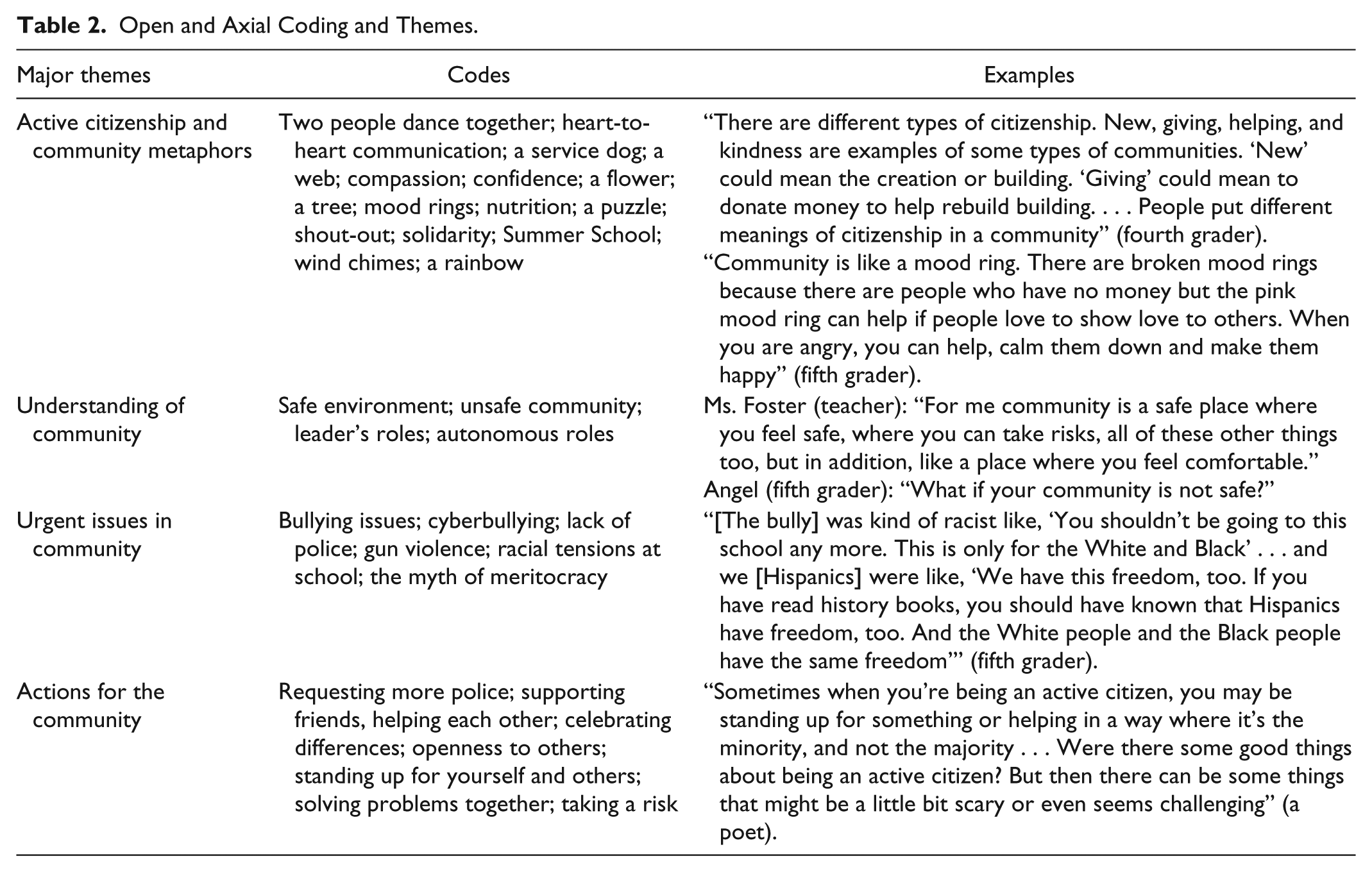
Among these four major themes of (a) children’s metaphors of active citizenship and community, (b) understanding of community, (c) urgent issues in the community, and (d) actions that children take, this article mainly focuses on the second theme, “understanding of community.” This theme demonstrates the complexity of community discussed by children and educators. I selected the stories and examples narrating the issue of “community” from multiple perspectives. Grounded in the narratives, I include more discussion of the theory, outcomes, and my reflections on the children’s lived experiences in their own communities and actual class discussions about the issue of community. During the data analysis process, I recognized my subjectivity embedded in categorizing salient themes. I challenged myself during the data analysis in order to rethink any foregone conclusions about the “proper” or “romantic” way of understanding community and teaching this concept to children. I narrated children’s engagement and/or disengagement with community, anchored in the conceptual framework of community without community. Thus, I analyzed and represented two vignettes of rethinking community highlighted during the ARtS activities: (a) community of interrelationality and (b) multiplicities of community.
Two vignettes represent the ways in which children dismantle preexisting notions of citizenship and active citizenship, drawing from creative ideas and their own understanding of community. Many potentially meaningful discourses were also generated during the project regarding leadership, loss and mourning, and collaboration with the community. Paralleled with class engagement in the process of data analysis, I focused on two vignettes which provided circumstances that aided both the production and the interpretation of ethnographic and narrative data (Riessmann, 2008). All the names appearing in this article are pseudonyms, and I also collected informed consents from children’s parents/guardians and from all adults. Overall, by examining children’s very specific learning moments to imagine different approaches to community, this article examines the ways in which children develop their views on active citizenship and community. In the next section, I describe and analyze two salient teaching-learning moments during which children were active in learning and demonstrated their concepts of active citizenship and community.
Vignettes of Rethinking Community 1: Community of Interrelationality
The ARtS team discussed the importance of community leadership by introducing citizenship and civic engagement in a community. Dance activities played major roles in articulating leadership and community. Most discussions during the activity reiterated a conventional approach to leadership: that is, a leader has a vision and community members follow his or her guidance, although conventionally people highlight “shared” leadership for those decisions that involve distribution or allocation of resources. Unexpectedly, an interesting conversation emerged during the leader–follower activity and the subsequent shared reflection. The ARtS children and the team examined a complicated meaning of leader–follower during the activity. We challenged the leader–follower relationship as a predetermined concept when understanding different roles in a community. Below is a brief overview of the activity.
Angie, the dancer, grouped children in pairs and told them to decide who would lead movement. Then, the “leader” started gestures describing what leadership in a community would look like. The basic rule was to be quiet when each person initiated and the other person followed the gestures. After listening to this guidance, the two children in each group looked at each other and one child slowly initiated a gesture and the partner followed the movement. Each child took turns to invent and follow the movements. After the activity, the children and teachers exchanged their reflections, an exercise that exposed the children to a different version of leadership–followership. Having indicated the leader and the follower in each group, Peggy, a classroom teacher, reported what children in her group shared concerning an outstanding insight about the leader–follower relationship. A child in her group discussed the notion that no leader existed in this activity.
The leaders! Did you guys notice if you move too fast then the person who’s following steps behind?
They told us there’s no leader . . . It is hysterical because we learn together where we’re going . . . It’s actually a lot of fun where you stand and no one is leading. You do it as a group. You feel like you’re connecting with the person standing in front of you.
I see. Did you hear what Ms. Peggy said? When you really get to do this, and you’re really doing it correctly, and the signal is so clear: There is no leader any more. You give up control to be part of a group . . . When it works really well, you can’t tell who the leader is . . . because if the follower doesn’t follow, the leader stops leading, and then the leader starts following the person.
When I was doing this . . . I felt like I knew what she was going to do next . . . so I was like, following she was doing something next.
The above conversation among the dancer, classroom teacher, and a student illustrates the blurred boundaries that exist between leader–follower while taking actions and following directions. While a space exists between these concepts, the division between leader and follower is conflated through taking actions and achieving close connectivity between the “two” parties. No leader exists without the follower, and vice versa. Even the border between leader and follower disappears when the leader does not have to control the others out of self-interest. This leader–follower movement provided the insight that the bifurcation or hierarchy of leader–follower is irrelevant when each person feels connected. No control is necessary when two supposedly different parties merge as one. As Angie indicated, this is the point when the leader stops leading, yet continues to collaborate with other people. Shared leadership goes beyond distributing different leadership roles in the community. Rather, the community members consider the importance of active collaboration without requiring control, guaranteeing that no vertical hierarchy exists in creating a supportive community.
Vignettes of Rethinking Community 2: Multiplicities of Community
During the ARtS initiative, the team learned that it was of benefit to children to address the safety issues of living in a challenging community. Most of the class discussions focused on maintaining a safe community by illustrating the positive aspects of sustaining a caring, safe, and healthy community. The grand narrative during the activity seemed to support an equity-oriented, multicultural curriculum that encourages children to enhance their critical consciousness for addressing injustices and inequities in their community (Murray & Milner, 2015). Although I valued awakening children’s consciousness toward social inequity and safety, I hoped to encourage children to think beyond a romanticized notion of community, such as simply “helping each other” or “keeping our community health.” The poetry class provided students with a seminal moment in which to examine the space between safe and unsafe while acknowledging the violence and danger existing within their own community. Children were realistic about violence and safety issues in their community, and the team used this aesthetic-inspired afterschool curriculum to discuss these issues within a safe, supportive environment.
During the poetry activities, the ARtS team maximized the brainstorming process by having children imagine multiple metaphors for representing active citizenship. Children wrote poetry and shared their ideas about community and active citizenship. They used magazines to imagine and visually express what active citizenship looks like in a collage format, before completing an individual poem for the gallery night. On Day 1 of the poetry activity, a poet invited children to share what images they visualized when pondering the concept of community. The poetry teacher encouraged children to start from a notion of friendship as the beginning of the deeper conversation on community. A poet and classroom teacher, Chris, used the following example: “I usually think of friendship as two halves of a whole. So, sometimes I think about twins, or conjoining people . . . I just see friendship as being connected.” Children designed their name tags by using the images of a heart, a tree, a dog, a puzzle, a rainbow, and other objects to display their notions of friendship.
Creating a name tag was an opening exercise in order to practice metaphors in representing community with the use of poetry. Children were asked to interpret their chosen image of friendship and specifically describe how it conceptualized their notions of community. Tim, for example, connected the image of a tree and its leaves with citizens, explaining that the leaves are like active members in a community. Another fourth grader, Keith, also used a tree metaphor to emphasize that friendship which lasts forever is reminiscent of an evergreen tree. After the name tag activity, the team asked the children to think about the core question: “What does community mean to me?” Below is a brief excerpt from the class discussion:
What is the definition of community to you?
Like a bunch of people come together to make a big town . . .
A community to me is like when people are working together and actually making something.
Anybody else? For me community is a safe place where you feel safe, where you can take risks, all of these other things too, but in addition, like a place where you feel comfortable.
During the ARtS initiative, the team had time to share the idea of creating a much safer community in both schools and neighborhoods. While discussing the notion of community, educators have a tendency to imagine a romantic community that emphasizes collaboration and a supportive environment. However, the direction was shifted when Angel, a fifth grader, raised the issue of an “unsafe” environment in her neighborhood.
What if your community is not safe?
What if your community is not safe . . .
That is a great question. What if your community is not safe?
I have experience, I got chased by pit bulls.
Somebody shot a house.
In your community?
Yeah, it was my house, then another house, then it was the street lamp near the house.
Some people shot at it?
Yeah, it’s pretty dangerous.
And what else you could do is that if there was something dangerous like a fire, you could call the police or 911.
And then you would help your community . . .
So, there are lots of people that can help out in a community too when a community isn’t necessarily safe, right?
The ARtS children delved into the multiple aspects of community through the various activities. Children raised their concerns about their own neighborhood’s experience of violence, safety, and lack of police presence. Angel’s real concern about the “unsafe” community made the conversation multifaceted and authentic. Her question “what if our community is not safe?” was supported by the poet and the professor, who shifted the class discussion to explore safety issues in the children’s own communities.
As the poetry activities continued, the ARtS children shared their experiences of their school community, which included a cyberbullying issue. Included below is the transcript of the part of the class discussion when children described taking a risk in their community and its costs in order to sustain a healthy community:
Like this year, there was a situation like cyber-bullying in our classroom. I was included like a suspect and three other people were suspects. It was like a cyber-bullying on Facebook. Anthony [pseudonym] was cyber-bullying about [racism] . . . He was going to be telling about us . . . , “You shouldn’t be going to this school any more. This is only for the White and Black” . . . [Oh . . .] and we [Hispanics] were like, “We have this freedom, too. If you have read history books, you should have known that Hispanics have freedom, too. And the White people and the Black people have the same freedom.”
Everybody has the equal right, no matter what skin color you have.
I can’t stand, when people get judged, because they’re White or they’re Black, or like it doesn’t really matter if you’re White or Black. Sometimes kids get judged because they don’t have a phone, or their parents don’t have much money, or they don’t have a Facebook [page] . . .
I wonder what we can do, when so many bad things happen in our community.
Yeah, I was related to when people are cyber-bullied. When someone gets bullied right in front of you, some people you just don’t want to listen because you feel like bad about not wanting to leave anybody who is still getting bullied . . .
Addressing the bullying particularly cyberbullying is crucial in order to gauge children’s experience in schools and the community. The poet, Foster, connects this issue with the discussion of active citizenship and our action plans for creating a safe environment. When the idea of community becomes vague and idealistic, as in “a place where citizens feel comfortable,” it is important to explore the subtle border between safe and unsafe, just as Angel did when she shared her daily experiences in her own community. Angel wanted to explore how her community is neither absolutely safe nor unsafe. Rather, the community is a space and place where Angel and other children endeavor every day to feel at ease. Similarly, as the above brief conversation indicates, cyberbullying becomes an urgent issue for children when such bullying is racially motivated in a racially and ethnically diverse community. Using media input and actual conversations in schools, children can politically and discursively construct their personal understandings of what it means to inhabit a liminal space that is both safe and unsafe.
Angel’s curiosity, Joan’s concern with cyberbullying, and the ARtS team’s elaboration on the safety issue provided an opportunity to review the meaning of community without community. The poetry activity followed by sharing children’s ideas became a launching pad for the children to challenge a normalized approach to safe–unsafe community, which has been particularly assigned to them by mainstream media using the term “urban” school to assuage fear of living within a city. The term of “urban school,” thus, is normalized by applying a populational reasoning to associate “urban” with an unsafe and dangerous community (Popkewitz, 1998). The idea of community without community avoids such stereotypical understanding about community. For example, the ARtS team challenges the normalized understanding of “urban” community with the use of the safe–unsafe dichotomy. Multicultural educators encounter a plethora of issues when attempting to promote social justice and deal with safety issues in the community. While working on these social justice issues, I argue that they should challenge any normalized understanding of “urban” that reinforces negative stereotypical images about children living in an underresourced community. At the same time, educators should consider creating an emotionally, intellectually, and spiritually “safe” environment when articulating the notion of community and active citizenship within the community. Drawing from the notion of community without community, I argue for creating an in-between space of safety–unsafety that challenges a generalized understanding of an urban area as an “unsafe” place. In-between is the space where children actually imagine a different aspect of community, both overcoming a negative image about “urban” community and recognizing the multiplicity of community as an ongoing process of creating a healthier environment.
Community Without Community: Where Our Conversation Is to Come
Reflecting on children’s counternarratives, I further develop the notion of community without community. Rather than pursue the right answer, this community without community aims to invoke more questions about the purpose of collaboration, the practice of democratic values, and pursuit of education advancement. Most notably, I emphasize the interrelationality of self–other and the multiplicities of community in theorizing about community without community.
I introduced Derrida’s notion of community without community as a theoretical foregrounding for this article. I elaborate on this notion by drawing from other philosophers and discourse concerning politics. For example, in his book The Inoperative Community, Nancy (1991) articulates the notion of community without community, clearly highly influenced by Derrida’s ideas. He states,
Community without community is to come, in the sense that it is always coming, endlessly, at the heart of every collectivity . . . It is no more than this: to come to the limit of compearance, to that limit to which we are in effect convoked, called, and sent . . . Its essence is composed only in the act that interrupts, with a single stroke—by an incision and/or an inscription—the shaping of the scene of myth (pp. 71-72, emphasis in original).
In this excerpt, Nancy (1991) underscores that community does not exist in the predetermined form of a common being. Rather, community exists as a provisionary form—a form that resides “at the limit of the other” where the subjects pivot over one another (p. 76). Drawing from Derridian concepts, Nancy eloquently articulates this provisional and différance aspect of community. He said, “we communicate to each other not the meaning of community, but an infinite reserve of common and singular meanings” (p. 79, emphasis in original). Community is important not because we create solidarity within the community but because of its eternal openness through not creating a universal agreement. This open-ended, provisional element of community opens up discussion about subjectivity within the group. Like Nancy, I challenge the danger of universalized solidarity and public uniting that highlights collective, monolithic identity without considering the multiplicity of community and community members. While underscoring community as a “common” entity, multicultural educators have a tendency to close the possibility to imagine multiple meanings of community and thus limit political actions responding to diverse needs within the community.
Nancy’s argument about community is often cited by other theorists, including Devadas and Mummery. In their article “Community Without Community,” Devadas and Mummery (2007) provide an overview of this concept, mainly drawing from Nancy. They argue that traditional understanding of community, which is a romanticized view of community, “reproduces a collectivity that is built upon, engenders and fosters a sense of closure, continuity, unity and universalism” (p. 1). In the critical theory tradition, solidarity among the “underprivileged” is considered to be a prerequisite in the fight against social injustice toward the “oppressed” group. Devadas and Mummery explicate the potential violence of an exclusionary community, borrowing from Nancy’s notion of community without unity. An exclusion/inclusion version of community normalizes its citizenship and ostracizes a community member who does not follow such a set of social norms. They reject a community with exclusionary solidarity, yet propose “an alternative concept of community that produces new constitutions and networks of relationships that are not hinged upon predisposed notions of community and identity” (p. 2). Now new questions emerge regarding this ontological confusion. How can the community without essence (the community that is neither “people” nor “nation,” . . . etc.) be presented as such? That is, what might the politics be that does not stem from the will to realize this essence? These questions are crucial starting points from which to rethink humanistic, enlightenment versions of identity and community.
Other philosophers and educators have participated in similar epistemological approaches to articulate community from multiple angles. By using the concepts of “community without consensus” and “community with dissensus,” Miller (2010) and Rancière (2011), respectively, emphasize the multiplicity of community and the impossibility of creating a universalized community. Drawing from a feminist, poststructuralist tradition, Miller argues for a community that “possibly enables representations of self, other, and the [educational] field to be unfixed, mobilized, destabilized, and released as forces capable of recombining in as yet unimagined and perhaps untraceable ways” (Miller, 2010, pp. 99-100). Communities without consensus are always in-the-making, where any boundaries are reconceived as contingent and yet intricately intertwined (Miller, 2010). When the solidarity of stable, collective community is mainly highlighted in the discussion of equity and diversity, Miller and other poststructuralists endeavor to minimize any normalized violence by universalizing cultural identity in a collective manner and ignoring the multiplicity of identities that constitute a community member. Similarly, in his article “The Thinking of Dissensus: Politics and Aesthetics,” Rancière (2011) conceptualizes “dissensus” as political, aesthetic discourse. Namely, politics cannot be reduced to a collective, essentialized version of community. “Community with dissensus” creates a space for making “a difference within the same, a sameness of the opposite” (p. 1). Similarly, Gere (2012) utilizes the notion of community without community by highlighting a new community and relationality brought in by technology of the digital age. In his book Community Without Community in Digital Culture, Gere paradoxically underscores the situation that technologies “effect non-relationships, and non-communities, community without community” (p. 1). This idea dismisses an overarching, grand framework that connects community members. Gere’s argument is consistent with my articulation of community without community, although I do not apply it to digital technology, per se.
By subscribing to these notions of community without consensus and community with dissensus, I theorize communities without communities as those in which multicultural educators challenge universalized “solidarity” in order to open up in-between spaces for imagining “unexplored” possibilities about self, other, and the community. My support of a “just” community stems from recognizing the value of community without community in that it generously emphasizes the multiplicities of community and diverse voices within a given community without bias. The “emancipation” project from mainstream multiculturalism unintentionally and unconsciously creates exclusivism in the pursuit of social justice. Group solidarity, ironically, generates exclusionism of community, although such collectiveness is a prerequisite for taking actions. Yet I argue that blind solidarity is problematic in that it normalizes membership and belonging. Furthermore, the absolute duty of a citizen is to inflict violence upon the “Other”—which causes unethical consequences in terms of fairness and justice. Because of this potential problem of solidarity, poststructuralist theories pay attention to subject construction as the effect of political, active interactions among people. This new idea about interrelationality further encourages us to imagine community that goes beyond, “already constituted communities, already established subjects” (Butler, 2009, p. 31). New epistemological groundings invite us to rethink the concepts of “closed community” and “solidarity in the pursuit of justice” and the creation of a new community.
The two themes articulated in this article indicate the possibility of exploring “openness” in a community in which any binary opposition is not sufficient to fight against social injustice and create a “safe” community. The leader–follower activity shows the ways in which children rethink the bifurcated notion of leader–follower. The blurred division between the leader–follower in the activity emphasizes that roles and responsibilities are operated by a power operation occurring between the leader–follower. No singular, universal, or agreed-upon notions of selves, collectivity, or solidarity exist. Nor does stable subjectivity exist before the subjects interact with each other; instead, the self–other or leader–follower relation is linguistically and materially constructed within the proximity of self and other where power operates through multiple directions, depending on a very specific sociopolitical context (Todd, 2009). This structure is not predetermined but it is constantly evolving, depending on specific circumstances of the community. No dichotomous understanding is possible in understanding self–other or leader–follower.
Similarly, Angel’s crucial concern “what if our community is not safe?” initiated an important issue in sustaining a “safe” environment in an urban context while minimizing any stereotypical images discursively generated by urban/suburban and unsafe/safe dichotomies. Community without community requests examine the power operation in articulating such division and imagine the subjectivity and community from these in-between spaces that cannot be essentialized or normalized with the use of any dichotomous terms. By raising the concept of community without community, I argue for creating an open space of “safe” community where educators challenge existing normalized practice of urban education, particularly informed by this “unsafe” rhetoric. Community without community is theoretically and pedagogically in-the-making by highlighting interrelationality among the subjects rather than imposing existing, normalized understandings of “urban” community upon them. Overall, the notion of community without community is a sociopolitical and discursive endeavor that can be used to create an emotionally, intellectually, and spiritually “safe” environment and encourage children to imagine an “open” space while looking beyond any closed space (Greene, 1995).
Toward Community Without Community and Social Transformation
According to critical ethnography tradition, making the distinction between the “haves and have nots” or “leader and follower” is imperative in order to combat social injustice in a racialized, classed, gendered, abled, and sexualized society. The rhetoric of emancipation argues that power should be shared within a community and that shared leadership is a meaningful democratic practice in decision making. In conceptualizing the open-ness of community without community, Butler’s (2009) challenge to current multiculturalism discourse is pertinent. Central to Butler’s theory of recognition is the claim that war and globalization construct a differential apprehension and recognition of life. She calls for interrogating the “frames” of recognition as an urgent task: “The problem is not merely how to include more people within existing norms, but to consider how existing norms allocate recognition differentially” (p. 6). What to put “in” or “outside” the frame is not the major concern. Rather, what matters is to investigate a very specific frame in order to make visible the rationale for recognizing a subject as grievable or not, although the subject lost his or her life (Butler, 2009). She also emphasizes analyzing social norms because subjects are discursively constructed within and through a set of social norms. Butler (2015) conceptualizes the notion of “subject” from a different ontology. No subject exists with a free will without actual interactions with others. It is interrelationality among subjects that constructs self and other. In her book Senses of the Subject, Butler (2015) argues,
I do not arrive in the world separate from a set of norms that are lying in wait for me, already orchestrating my gender, race, and status, working on me, even as a pure potential, prior to my first wail. So norms, conventions, institutional forms of power, are already acting prior to any action I may undertake, prior to there being an “I” who thinks of itself from time to time as the seat or source of our actions (p. 6).
According to Butler, identity is not the collection of an autonomous individual’s choice and conscious performance in front of other people. Rather, Butler highlights a set of social norms that constructs the subject by reiterating such norms constantly. The subject is not an agent with free will; rather, power-knowledge operating within a community discursively constructs gender identity. Similar to Butler, Todd (2009) challenges existing understanding about cultural self and other without considering the discursive interactions among the subjects and its consequences for the subjectivity construction. Drawing from Levinas’s notion of human and humanity, Todd theorizes humanity that occurs as the consequence of interactions. Humanity is not a predetermined ideal or a virtue of a shared value in humanity. Rather, humanity is “located in the proximity where self and other meet” impacted by the threat of violence (p. 19). Exploring the power operation between self and other as well as the explication of specific sociopolitical, economic contexts becomes the crucial point for understanding supposedly different roles and power structures in a community. According to Butler (2015) and Todd (2009), actual interactions among the subjects construct the very meaning of self–other, rather than imposing predetermined meanings on cultural sameness and difference.
Using feminist politics as an example, Butler (1999) asks, “To what extent does the effort to locate a common identity as the foundation for a feminist politics preclude a radical inquiry into the political construction and regulation of identity itself?” (p. xxxii). In this context, Butler is concerned with how feminist politics based on heterosexual normalcy hinders an open-ended search for a “politics of recognition” (Lloyd, 2005, p. 143)—which is, finding ways in which all citizens are recognized as equal to all others. Butler (2004) continues to challenge the single epistemological approach to gender that predominantly exists in identity politics, including an emphasis on “women’s ways” of knowing, thinking, or behaving. She argues that these notions of women are already “orchestrated by power precisely at that moment in which the terms of ‘acceptable’ categorization are instituted” (p. 215). In other words, the very ideas of women’s ways of knowing, thinking, or behaving are constructed by power and historical discourses.
Informed by Butler’s (1999, 2004) argument for against a normalized version of identity politics, I revisit the communal effort to universalize collective cultural identity, or what Dolby (2000) labeled as “blind identity politics” (p. 909). Educators mainly influenced by identity politics assume seamless “we-ness” among a specific cultural group (e.g., ethnicity/race, gender, and class) before considering its discursive and political constructions of identities (Moon, 2011). Community without community encourages multicultural educators to examine the ways in which such concepts as race, gender, or class are discursively circulated, reproduced, and changed with/in specific sociopolitical, cultural, economic, and historical contexts. The point is that educators need to explicate the ways in which such identity categories are discursively naturalized within a community. I challenge the coherence of the categories, or collective “we-ness” of a community with unanimous voice, in order to minimize any normalization of people. The recognition of diverse voices within a community is a project of creating new vocabulary to specifically articulate what we mean by “we” in fighting against social injustice (Moon, 2011).
The ARtS Community Without Community: Questions for Further Inquiry
I utilized the concept of community without community as a means to rethink a potential problem of solidarity in defining “normative” community without considering the “Other” within the community. A normative version of community reproduces “violence” that applies the binary of “us and them” if the subject does not reiterate norms given to him or her. Rather than confining identity within normative categories, I argue for community without community that underscores the interrelationality of self–other in considering cultural identity and its construction within a sociopolitical context. The learning moments illustrated in this article addressed the complexity of leader–follower and safe–unsafe issues.
I raise questions about the notions of community, solidarity, and collective identity in order to explore multiple aspects of community and active citizenship within the community. I explicate children’s rethinking about their community drawing from their experience. There is no taken-for-grantedness in this learning and experimental space: Children revisit, rethink, and always reconsider their habitual ways of thinking about a community and their roles in the community. Rather than affirming community with solidarity, community without community challenges the current practices in multiculturalism—multiculturalism that normalizes cultural identity with the use of collective “we”-ness and provides little space for examining a specific sociocultural, political, and economic context in subjectivity construction. The labels of “marginalized,” “at-risk,” or “underrepresented” are political, strategic terms to fight against social oppressions recurring historically toward people of color, women, and the poor. Yet the request to think of the ARtS initiative as a “community without community” shifts the major discourse in multicultural education. It challenges the reproduction of stereotypical images of a community by investigating power operations which construct the self–other relationship.
Thus, community without community invites multicultural educators to investigate the complexities of identities that move beyond highlighting the essence of cultural difference and solid “we-ness” (Butler, 1999; Lloyd, 2005). This invitation can lead multicultural educators toward a di777fferent way of looking at and thinking about racial/ethnic identity and racism more broadly than would result from exploring social inequity based on the simple binary of oppressor/oppressed, male/female, and us/them. As the ARtS initiative implies through multiple constructions about self–other, I argue for creating and sustaining diverse epistemologies in order to release children’s imagination for the purposes of social transformation (Greene, 1995). Most notably, the notion of community without community could allow for the possibility of reconceptualizing existing communities and their vision for promoting justice in education by minimizing any normalized practices for children “at risk” or “underprivileged” communities.
Footnotes
Acknowledgements
Special thanks to the ARtS initiative team and graduate assistants (Yeorim Ana Hwang, Mary Danley, and Natalie Astigarraga). Liesa Smith introduced the notion of community without community through her work. I thank reviewers for thoughtful review of the initial manuscript and Lydia Craig for editing the earlier version of this article.
Declaration of Conflicting Interests
The author(s) declared no potential conflicts of interest with respect to the research, authorship, and/or publication of this article.
Funding
The author(s) disclosed receipt of the following financial support for the research and/or authorship of this article: This work was supported by the Oklahoma Arts Council-Major Grants (#2493-4033) and Oklahoma State University (ED-13-OT-045).