




Abstract
Work on creative careers has focused on the main national populations, while little research has addressed the situation of artists and creators of immigrant origin or different ethnic groups to determine whether they have the same access to work and employment rights. To respond for a call for research on different ethnic groups in the cultural sector, or the ethnic consequences of the individualization of careers, we therefore undertook research on the creative careers of immigrants in Montreal. We were interested in how they emerged as an artist, how they developed their careers, the access and rights they have in terms of support to their career, as McRobbie seems to indicate that ethnicity adds its “own weight to the life chances of those who are attempting to make a living in these fields. We found that these immigrant artists consider their main difficulties to be the lack of social networks, access to various forms of support to compensate for financial risks and difficulties in finding a job. We conclude with a few suggestions: measures to facilitate networking for immigrants, more training and information on government programs, mentoring support, as well as the support from community organizations, associations, and programs.
Introduction
In recent years, the theme of the creative careers has attracted much interest in Canada and elsewhere (P. Hall, 2000; Landry, 2000). Workers and cultural workers in particular must also face various issues such as an increasing workload, low pay, and lack of job security (Human Resources Council for the Cultural Sector, 2010). Trends in human resource issues are important elements in the success of the cultural sector. “The forces such as new technologies, an aging workforce and changes in economic conditions force more employers and workers and cultural workers to do more with less and to fight for survival” (Human Resources Council for the Cultural Sector, 2010).
Work on creative careers has focused on the main national populations, while little research has addressed the situation of artists and creators of immigrant origin or different ethnic groups to determine whether they have the same access to work and employment rights. To respond for a call for research on different ethnic groups in the cultural sector, or the ethnic consequences of the individualization of careers (McRobbie, 2002), we therefore undertook research on the creative careers of immigrants in Montreal. We were interested in how they emerged as an artist and how they developed their careers, the access and rights they have in terms of support to their career, as McRobbie (2002: 520) seems to indicate that ethnicity (as well as age, gender, and family income)
re-emerge like phantoms (or in Beck’s terminology ‘zombie concepts,’ dead but still alive) from the disguised hinterland of this new soft capitalism and add their own weight to the life chances of those who are attempting to make a living in these fields (Beck, 2000).
This is all the more surprising because the thesis on “Creative Careers” often values the creative sectors’ diversity and cultural originality, often associated with the various ethno-cultural backgrounds.
We therefore undertook research whose purpose is to deepen our knowledge on the creative careers of immigrants in Montreal and try to offer recommendations to correct this problem, which has been observed by McRobbie (2002), but not addressed in most work on creative careers. We are interested in how ethnicity plays out in the specific case of immigrant artists and creative, and more particularly how they develop their careers, the problems and risks (Beck, 1997) they encounter, the access and rights they have, and the possible solutions to integrate them into the social networks which appear to be crucial to develop a career in the so-called “new cultural economy” (McRobbie, 2002; Menger, 2001).
The definition of our object of research as artists, creators, or cultural workers poses a question of course, as the contours of the definition have been blurring over recent years, and the “theoretical and methodological challenges” (Menger, 2001) posed by the definition of the “Artists as workers” (Menger, 2001) is an important issue. Other authors have also questioned the definition of the “artist.” Lena and Lindemann (2014) pose the question directly in the title of their paper: “Who Is an Artist?” and define “the ‘professional artist’ as the outcome of an identity process, rendering it the dependent rather than the independent variable” (p. 70). In our own research, we used a similar approach; although the precise definition of an artist or cultural worker remains open, we put out a call for “artists and cultural workers” from an immigrant background, and thus let individuals decide whether they fell into this category. Contrarily to the work of Chan, Bruce, and Gonsalves (2015), we did not address the issue of the artistic process, as to whether it is more of a seeking or a finding process. However, in line with these authors, we consider that “Creative processes of contemporary art are (thus) inseparable from artists’ strategies for surviving in the art world,” and we actually think this is characteristic of other sectors of artistic and cultural work. Our main objectives in the research and in the article were thus to identify the problems and risks associated to an artistic or cultural career for an immigrant, and to try to determine what solutions or recommendations could possibly be put forward, on the basis of the experience of the immigrant artists who we interviewed.
This is important not only because McRobbie (2002) indicates that there is little work on artists and cultural workers of various ethnic backgrounds but also because immigrant entrepreneurs have been an essential force for the economic development of many countries, including the United States, Canada, the United Kingdom, and many others (Thai & Turkina, 2013). This makes our research all the more important not only in terms of economic development but also for those interested in the integration and the rights of immigrant populations.
According to the report on the statistical profile of artists and cultural workers in Canada (Hill Strategies Research, 2014), 17,400 visible minority artists represent 13% of all the artists in Canada, which is less than the percentage of visible minority Canadians in cultural occupations (15%) and in the overall labor force (18%). Visible minorities is of course a different definition from that of an immigrant, and in fact, our immigrant respondents are mainly also visible minorities as they are mainly Latin Americans, with others from Tunisia, Morocco, China, and Pakistan; only three French may not be “visible minorities,” but rather be part of the white Aryan population.
The 28,000 immigrant artists in Canada make up about a fifth of all artists (21%), exactly the same percentage as in cultural occupations and roughly the same as in the overall labor force (22%). Five percent of artists (6,900 persons) immigrated between 2001 and 2011 compared with 6% of cultural workers and 7% of the entire labor force. Finally, in 2001, there were 1,300 visible minority artists in the Montreal Census Metropolitan Area (CMA), which represents 11% of all visible minority artists in Canada and 7% of all artists in Montreal (Hill Strategies Research, 2005). Data on these groups are not always easy to find, and some elements may overlap, although not always, as immigrants are often visible minority groups, but not all are (as the French).
The Dictionary for the Census Statistical Profile of Artists in Canada defines visible minorities and immigrant populations as follows. The Employment Equity Act defines visible minorities as persons, other than Aboriginal peoples, who are non-Caucasian in race or non-White in color. The visible minority population is established through a question in the Census on ethnicity and race of the person, with the following response options classified as visible minorities: Chinese, South Asian, Black, Filipino, Latin American, Southeast Asian, Arab, West Asian, Japanese, Korean, and Pacific Island residents. Other responses can be specified in the space provided for this purpose.
This article therefore responds to the call for more research taking ethnicity into account in the analysis of creative or cultural careers (McRobbie, 2002) and thus extends the work done on creative careers by focusing on a particular group, namely, immigrant creators and artists. We begin with a general literature review on creative careers and the role of boundaryless careers—or what Menger (2001) has referred to as an “increasingly fragmented and brokered employment relationship” (p. 241). We follow up with our literature review on the main themes we chose to cover in our research. We then outline the research methodology, before turning to the results. We turn then to the difficulties and tensions inherent in the development of a creative career, as seen by immigrant creators; some of these are common to all artistic endeavors, but we feel they may be somewhat stronger because many of these immigrant artists may live these feelings in stronger isolation. Then, as some authors in our literature review suggest, there should be more support to artists and cultural workers, we looked into the support available to immigrant artists, and we then expose the contribution that intermediary organizations can bring to the careers of these immigrants creators. As some studies have examined the role of intermediary organizations or associations and the assistance they can provide to the cultural and creative workers, to support their careers (Tremblay & Pilati, 2008a, 2008b), and others (Shorthose & Strange, 2004) have suggested some form of support to these micro-spaces of autonomy in creative work, we wanted to see whether immigrant creative workers had access to these supports to their careers or whether there are inequalities in access.
Literature Review
Creative and Boundaryless Careers
The theory of internal labor markets was traditionally the core of career theory, which has historically focused on the organizational or vertical career. Other forms of careers, such as self-employment, were not studied as much, although they appear to have increased over recent years, particularly in the artistic and cultural sectors (McRobbie, 2002; Menger, 2001). Authors such as Super (1957), or D. T. Hall and Goodale (1986), divide careers into four phases: exploration (learning period), mastery (development), maintenance (routine), and disengagement (retreat). Although the precise number of successive stages is contested by some, it does constitute an important reference. Weick (1976) also considers there is no empirical basis to confirm the succession of these phases, and the new career theories tend to indicate that lines are more blurred and there is no regular succession of phases. Indeed, as Menger (2001) indicates, we observe an “increasingly fragmented and brokered employment relationship” (p. 241). The traditional linear model of the career has clearly been questioned (Sullivan, 1999; Sullivan & Baruch, 2009), particularly in the cultural and artistic fields (McRobbie, 2002; Menger, 2001), and some authors have put forward the concept of “boundaryless careers” (Arthur, Claman, & DeFillippi, 1995; DeFillippi & Arthur, 1996, 1998). This model of boundaryless careers insists on the fragmentation of careers, the frequent interruption by unemployment spells, an important mobility in the labor market, but a mobility which is more often than not assumed, but not chosen (Arthur et al., 1995; DeFillippi & Arthur, 1996, 1998). It is a model of mobility and contingency in work. As McRobbie (2002) notes, there is a process of individualization, and she indicates that individualization is not so much “about individuals per se, as about new, more fluid, less permanent social relations seemingly marked by choice or options” (p. 518).
Other authors have highlighted the contingent character of many careers, including precariousness and instability of many trajectories (Jones, 1996), with negative impacts on income at times, and important unemployment spells as well.
Given the contingency and mobility characteristic of these careers, success in such careers is apparently dependent on knowledge sharing, networking, and reputation building (DeFillippi & Arthur, 1994). This appears to be more and more crucial for artistic and cultural careers, where knowledge, ways of seeing things, ways of thinking, tricks of the trade, or job opportunities are transmitted through the network and social relations (DeFillippi & Arthur, 1994). It appears these elements are crucial in an artist’s career and identity construction. The concept of the boundaryless or protean careers (D. T. Hall, 1996) thus leads to an understanding of careers as being built largely on experience and networks (knowing whom), which contributes to develop a “career capital,” which in turn can lead to access to some specific institutional or professional networks (Cadin, Bender, Giniez, & Pringle, 2000, p. 79). For many people, however, these boundaryless (DeFillippi & Arthur, 1994) or simply new forms of careers or “new labour” (McRobbie, 2002) can actually be rather precarious careers, as it is not always easy to develop networks and social capital. This may particularly be the case for immigrant artists, as we will see further on, and as McRobbie (2002) had hypothesized.
Career or social capital results from an accumulation of career competencies and this can contribute to building a reputation in a creative career, but at the same time possibly contribute to the neutralization or at least reduction of risk, an important dimension in creative careers (Cadin et al., 2000). This vision of careers or “new labour” thus highlights the importance of networks for access to projects and, in turn, to support career development. McRobbie (2002) speaks of “club culture sociality” at work and indicates that the “realm of “speeded-up” work in the cultural sector now requires the holding down of several jobs at one time” and that “such working conditions are also reliant on intense self promotional strategies and, as in any business world, on effective “public relations” (p. 519). She adds that this clearly “throws into question the role and function of ‘network sociality’ (Wittel, 2001)” (McRobbie, 2002, p. 519). And she concludes that there is “a manifest tension for new creative workers, highly reliant on informal networking but without the support of these being underpinned by any institutional ‘trade association.’” In our research, we also tried to determine whether such trade or professional associations could eventually help out our immigrant artists as they might open doors to the network, as is mentioned above. However, it may be that there can be only “individual (or ‘biographical’ as Beck puts it) solutions to systemic problems (Beck, 1997)” (cited in McRobbie, 2002, p. 519).
Indeed, network development (knowing whom) or “network sociality” (Wittel, 2001), passion for the cultural sector (knowing why) but also more traditional elements related to Knowledge (knowing how) are crucial in the analysis of these careers (DeFillippi & Arthur, 1998, 1996). McRobbie (2002) uses different terms but her analysis also highlights the importance of social networks in the new cultural careers, mentioning the “much expanded workforce comprising of freelance, casualized and project-linked persons” (p. 518), which she relates to the “fiercely neo-liberal model in place with the blessings of government for overseeing the further de-regulation and commercialization of the cultural and creative sector (Department for Culture, Media & Sport [DCMS], 2001, cited in McRobbie, 2002, p. 518).
Artistic and Creative Careers
Having presented the basic theoretical references on the new forms of careers, we now turn to our literature review on artistic and creative workers and industries, to better understand their specific identity and working context. Of course the variety of identities and professional trajectories are difficult to synthesize, but a certain number of authors have written on creative/artistic careers and identities and bring elements to better understand the creative/artistic careers, elements which we took into account in our analysis.
We start with the work by Bain (2005) which centers on the social construction of artistic identity. On the basis of a research on professional visual artists, where she has studied the difficulties faced by artists in the context of precarious incomes, which make it more difficult to impose an artistic identity, Bain indicates that the “professional artist” is difficult to identify per se. In our view, it is mainly an auto-definition or personal identification to this status that defines one as an “artist,” and Bain confirms this by highlighting the very informal nature of “artistic occupational definitional parameters” as she calls them. As we will also see with our interviewees, the line between amateur and professional is sometimes fuzzy, all the more so since artistic work is not always seen as “real” work, as Bain indicates. She indicates that a “repertoire of shared myths” is often the source of artistic identity and its projection onto others. Also, she shows that secondary employment plays an important role in securing a regular income, but this creates tensions and contradictions in the construction and maintenance of the artistic identity, as it contributes to blur the image of the “artist.” This is something which was also shown by Courpasson (1994), who insists on the challenges posed by the “market” or entrepreneurial identity which often has to come along with an artistic project.
Eikhof and Haunschild (2007) also develop a similar theme, by showing that in artistic and creative production, and economic or entrepreneurial preoccupations are often intertwined with the artistic dimension, something which on one hand, may be detrimental to the artistic production, but is on the other hand essential to the livelihood of the artistic organization. Although Eikhof and Haunschild’s (2007) work is concerned with a theater, and therefore more on the collective organizational level, it is basically the same tension between art and entrepreneurship, or artistic and economic preoccupations that is put forward here.
Loacker (2013) also questions the concept of the cultural industries and the flexible cultural capitalism; she particularly insists on the fact that while artists and cultural workers may in part contribute to their own marginalization in the present economic context, they may simultaneously contribute to the strengthening of what she calls “neoliberal orders” and “culturpreneurial subject ideals” of flexible capitalism, even if in fact they often do affirm their opposition to the promotion of competition and market-determined valuations or assessments. Again, the issue of marketization of the art field is at the center of the article, questioning the tension between art on one hand, and economics or finance on the other.
On a more individual level, Shorthose and Strange’s (2004) work centers on the precarious nature characteristic of much of artistic work, as well as work in the so-called “new economy” in general (Gadrey, 2003). It is indeed typical of many new jobs in the new Knowledge Economy to be less characterized by internal labor markets and traditional vertical careers and much more so by frequent mobility between jobs, including periods of unemployment, and in this sense, artistic careers may be just similar to what is happening elsewhere in the labor market, although the level of incomes seems often lower and the precariousness of positions seems higher than in other sectors of the economy, and even the “new” economy (DeFillippi & Arthur, 1996, 1998; Gadrey, 2003). Throsby and Zednik (2011) have shown that multiple-job holding is common in artistic careers on the basis of an empirical analysis of professional artists’ portfolios, and McRobbie (2002) also mentions that this is the trend for young fashion designers. Canadian research has also shown that Canadian artists have rather low incomes and often try to increase their incomes with multiple-job holding or at least with a secondary job, often in teaching or in management of small cultural organizations (Pilati & Tremblay, 2008; Tremblay & Pilati, 2008a, 2008b).
Hesmondhalgh and Baker (2010) analysed the situation in cultural industries (television, magazines and the recording industry) that are somewhat more integrated into capitalism but also present an “artistic” component. Their work is interesting for us as it indicates there is often a very complex and ambiguous response to the autonomy and freedom present in much of cultural work. They also show how pleasure and obligations can become blurred in such work and how individuals can feel anxiety in such situations because of this dual obligation, or paradox of simultaneously needing to be original and creative and at the same time not forget the market dimension.
Although Shorthose and Strange (2004) highlight the interest of these micro-spaces (small zones) of autonomy that are particularly important within artistic communities, also mentioning the “contradictory nature of the new economy under capitalism,” they call for macro-level policies or interventions—“governance for autonomy”—to support these micro-spaces and artistic communities. It is on the basis of this that we also looked into the various types of support that could be offered to immigrant artists, trying to compare this with the type of support offered to others. Bohm and Land (2009) develop similar issues, but have a more critical, or radical, view on the value of culture, as well the role of culture and the support that should—or should not—be brought to artistic and cultural activities in the context of the new economy.
In her paper, McRobbie (2002) questions the extent to which the entrepreneurship or market dimension is integrated into the artistic career. On the basis of her work on the fashion design sector, she indicates that young fashion designers are no longer able to concentrate on their “own work.” Most of them have to “sign up with a bigger company and more or less relinquish “creative independence” (McRobbie, 2002, p. 524). She seems to think that this integration of market and art is not that uncommon, nor difficult in cultural careers. There are thus different views on this question and this is one of the elements we sought to analyze in our research.
Our research thus centered on the identity construction of the artist and in particular the immigrant artist, income and secondary employment or multiple-job holding, as well as the tensions between the artistic endeavor and economic or financial imperatives. These elements are thus at the core of our research, following our literature review on the main challenges of an artistic occupation in the present context. We decided to analyze the particular situation of immigrant artists, as there has not, to our knowledge, been much work on this specific group, and McRobbie (2002, p. 528) calls for more research on this issue, indicating that “Research on these areas would have to consider the specifically gendered and ethnic consequences of individualization,” that is, of these new forms of more independent careers.
Research Methodology
The research we conducted on immigrant artists and creators is based on qualitative methods (Deslauriers & Kérisit, 1997). We chose to do interviews and qualitative work as there is not much work on this specific population and also there is no list of “immigrant artists,” so it appears to be the best method to investigate this issue, at least to start investigating the issue. We thus contacted various immigrant associations, starting with Latino American associations, as this is an important group of immigrants to Canada. We had to go to other groups also as we had some difficulty in getting sufficient numbers of interviewees. The individuals confirmed their immigrant status with us before the interviews. We seeked a certain diversity of artistic and cultural activities, which we did find in the respondents who volunteered for the interviews.
Our research is in continuity not only with other works that have studied the creative professions, particularly those mentioned in “Artistic and Creative Careers” section, but also with works on the creative professions in Canada (Tremblay & Pilati, 2008a, 2008b; Tremblay & Yagoubi, 2014).
Our field survey is based on interviews with 21 artists (12 men and nine women; see Table A1). We also met with 12 organizations working with immigrant artists and creators as various authors indicate that professional or commercial associations could support these careers or had done so in the past (McRobbie, 2002). We thus wanted to determine whether any such support is available, and if so, to better understand not only the support and assistance that is available or could be offered to them (cf. Shorthose & Strange, 2004) but also the perception of these organizations on the professional integration of immigrant artists and creators in Quebec.
The research rests on semi-structured interviews (Beaud & Weber, 1997), based on the adaptation of a grid established for previous research with creators of various sectors (film, fashion, multimedia, etc.), with the addition of some questions related to the elements presented in the literature review, including role of networks, network sociality, and so on. The interviews lasted an average of 1 hr, usually between 45 min and 1 hr 30 min. All the interviews were transcribed, and were then the object of a thematic analysis.
The interviews were analyzed based on the comprehensive method of Kaufmann (2006) and also with a method of thematic content analysis (Bardin, 1993; Savall & Zardet, 2000). We established an inventory of the theme expressed in various sentences of the interviewees, then we selected the main views and themes expressed by the participants.
This analysis allowed us to extract the visions and representations of respondents and the dominant trends, without neglecting the diversity of opinions. This led us to identify quotes that represent the main observations through key-phrases, as Savall and Zardet (2000) suggest.
Results and Discussion
In the following pages, we look at the difficulties inherent in the development of a creative career, as seen by immigrant artists and creators. Our interviewees mainly mentioned the importance of not only financial risks and difficulties in accessing contracts or regular positions but also the difficulty in getting access to networks and support from associations or government programs, which they often did not know very well. Indeed, it seems that immigrant creators do not have access to the networks which would ensure them the same rights and access as other groups, and make it easier for them to engage in creative or cultural careers.
The Difficulties Experienced by Immigrant Artists and Creators
As mentioned in our literature review, the precarious working conditions and income difficulties are among the main challenges for artistic professions. Indeed, the artists and creators we interviewed mainly complained of financial risks, and the uncertainty they must face if they wish to devote themselves to their art, some also mentioned the necessity to find a secondary job, and sometimes even more:
If artists are seeking money, they need to contact companies or go freelance. It’s harder when they are seeking employment which they are proud, for example, if they are doing paintings, maybe they will need to find a second job, on the side, to make a living. (Participant 5, France [FR], multimedia designer [MMD])
1
It is our daily challenge, the financial risk. It’s very difficult, it’s expensive our work, we tried to develop a loyalty card with an organization, so that our members have a loyalty card and have reductions in prices with a company that sells material for design, or painting, but they must have a certain amount of money on the card, but if they do not reach that amount of money, they cannot take advantage of the reduction. In any case, the group tries to be faithful to this card . . . (Participant 21, TUN, Artist) I have two jobs, I wake up at 7 am, and I go to bed at 1 am, I finish my job at 5 pm, I get home and I start working on my own projects, I design things, and weekends I work, I spend 20 hours a week on my projects, it is very demanding . . . (Participant 31, VEN, Artist and MMD) I think I have a strong dose of optimism and when I am really close to the precipice, I do other things, for example, I do renovations, I let the storm pass and I come back to my work. (Participant 7, CHIL, Artist) Yes, the risk is to be unemployed, the pressure is felt even if Canada we have unemployment insurance, there is always a risk, we cannot spend the same way. (Participant 22, COL MMD) The reality of immigrant artists is that there are many among them still struggling. There are people who have been here for 15 or 20 years and they are identified as artists from a visible minority, with a label. Artiste. The job insecurity can produce frustration among artists. (Participant 32 MAR Artist).
As we can see, many artists see the difficulty in earning a living and often have to look for other jobs to survive. Job insecurity seems to be important and seems to be part of the cultural or artistic career, as other authors had observed for non-immigrant groups (McRobbie, 2002).
Also some feel the strong tension between, on one hand, their artistic endeavor and their desire to impose themselves as an artist, to affirm their artistic identity, and on the other hand, the financial challenges and necessity to make a living. Although some abandon their artistic endeavors for some time as we saw above, others continue and search for the right balance between their artistic endeavor and making a living:
You can’t abandon your professional career, you must find the balance between artistic work and working for food. One has to be open, to insist and take one’s place. (Participant 30, ARG, Artist)
Some mention they have to rely on other people in their network, to reduce the risk, but they feel they do not necessarily have access to the main or the right networks, as they are not part of the “dominant” group in society. In some cases, they resort to an accountant or a production company to try to reduce financial risks:
Now we are working with an accountant who will help us better manage the budget, but the risk is still there. If artists have a production company and put money in it themselves, this can reduce the risk, but otherwise it’s risky. It is love for our work that makes us live. (Participant 27, MEX, Artist)
As we mentioned the importance of having a regular income, some wish to have a more “regular” job, but would like to have it in the arts or cultural sector, even if it is not in their own field:
In the future, professionally, what I would like to do is to integrate an existing show, for example, Cavalia, to sing in this environment which is already organized, stop being on my own, I would like to have an experience where I can relax a bit, in an environment where I can sing regularly. For me, if I could integrate an existing show it would be fantastic, like Cirque du Soleil for example . . . (Participant 19, FR, Artist)
This confirms what is mentioned by McRobbie (2002) as she mentions that more and more artists and cultural workers have to develop multi-skilling. She indicates that the new wave of cultural activity is characterized by
despecialization, by intersection with Internet working, by the utilization of creative capacities provided by new media, by the rapid growth of multi-skilling in the arts field, by the shrunken role of the sector ( . . . of) the “independents,” by a new partnership between arts and business. (p. 517)
Several of our interviewees did point out the difference between a self-employed artist and a salaried artist, highlighting the importance of risk for the self-employed or independents:
There is no financial risk if I’m an employee; I offer my services, there is no risk as an employee. (Participant 18, BRA, Artist) The reality in terms of cultural entrepreneur of immigrant origin is different from that of an employee in a cultural structure. Being an entrepreneur is a risk, being an employee is less risky, because you have a salary coming in every month; if there is a budget cut, they will cut the position, while as an entrepreneur, there is no income if you don’t have a project for which you are paid. (Participant 32 MAR Artist)
Some immigrant artists prefer to finally take a more regular job to have a regular income and marginal benefits as they find it more difficult to get into the job market in the creative and artistic sectors, where networks are crucial and where they feel they may be at a disadvantage in comparison with the local-born population, which has more access to these networks in their view. Being an employee thus appears to reduce financial risk while freelance work is a precarious job that does not even provide access to employment insurance and yet the financial risks are there:
I have no financial risk now; when I had a temporary job, it meant that I worked on call and I replaced people when they were not there. The good thing is that I always had work, we had to replace people, but I did not have job security, I had no benefits, paid vacation yes, but no insurance . . . In this sense, the work was precarious, because to have a permanent position, I would have to wait a lot. I had a colleague who had waited 15 years for a permanent position. What we see is that it is more and more precarious work, because employers they will hire you freelance, that is to say, you propose an article, a subject and they take it or do not take it. It’s just like being self-employed, this is difficult, because you’ll never have a stable job with benefits. So there is no more job security in the communications sector . . . Now I have my registered savings plan, I earn less money, but I have a secure job that I did not have before. I have vacation and I have insurance, I have lots of benefits, it is the quality of life for me, I’m fine. I prefer to have stability in employment; being a cultural entrepreneur, you must be comfortable to take risks, I do not like that, I prefer to have a stable base. (Participant 16, CUB, Artist)
As secondary jobs or multiple-job holding appear to give access to a better income level (McRobbie, 2002; Menger, 2001), many immigrant artists do like many other local artists and opt for a regular job, even if this means they have to abandon some of their creative work and this does increase the tension between artistic achievement and career and financial issues and might be risky for the artistic project, as one interviewee (among others) mentioned,
The fact of having a job as an employee, gives you peace of mind and makes it possible to pay all your business expenses and your materials to develop your own projects, but of course if you take this path, it is safer, but quite demanding and risky for the artistic part. (Participant 31, FRI, Artist and MMD)
Some try to escape this risk by having their own commercial production alongside more artistic activities, but with activities that are not too far apart, to reduce the tension between the artistic endeavor and the entrepreneurial or economic dimension:
The photography sector is interesting because you can have an artistic and a commercial career simultaneously, and you can choose. It is the passion more than the objective of getting rich that keeps me in photography. I can teach photography, give workshops, there is a commercial part, I develop projects with friends, we have specific projects, for example, I do corporate projects, I have a friend who does commercial photography and I did things with him. I introduced the artistic part into the commercial photography. I’m interested in the commodification of the body . . . (Participant 29, BRA, Artist)
Although most depend on the local opportunities, for some, financial activities and revenue from the home country are key factors that help them to flourish as an artist, but this is not a very common case:
I have a stable income, because in my country I have properties that are leased and every month I get X amount of money; it is the comfort of having this money, it gives me the opportunity to develop myself artistically, even commercially speaking. I did not need to work as a server or in things that have nothing to do with me, or with my artistic career. I can devote my time to find money in things that interest me. I can pay my rent, my groceries . . . (Participant 29, BRA, Artist)
As we can see in the above quote, the challenge of balancing artistic and entrepreneurial or commercial objectives is always present, but in this case, the artist has an external revenue which makes it easier for him. For many others, the only option is to take on another job or to refer to multi-skilling, as seems to be the trend in general for artists (McRobbie, 2002). Also, some mention that the financial risk is often related to intermittent or seasonal work, which is quite common in some sectors of the artistic and cultural industries:
With the circus, my career is intermittent, always by project, depending on the show, for example there are circus artists who go on tour with others for two or three years, but I work just sporadically, there months that there is nothing, but for me it’s okay, because I love it. (BY 27, MEX, Artist)
This is again in line with what is indicated for cultural and artistic activities in general, where there is apparently a “shift in the balance of power from a social “milieu of innovation” to a world of individual “projects” ” (McRobbie, 2002, p. 525).
Also, beyond the seasonal characteristic of some sectors, the importance of the network to get into some productions such as is the case in not only the film industry (Jones, 1996) but also the fashion industry (McRobbie, 2002) is a huge challenge, mentioned by many as a factor which increases the financial risks and difficulties:
If I think of the film industry, it’s such a hard career, it’s difficult, networks are important for one’s career, there are very few grants, you come and you make the movie. Sometimes you have a film that begins and you have not finished the other, then there are no contracts for some time, and after you have no one who supports you in any way . . . (Participant 4, MEX, Artist/MMD)
Some artists and creators use volunteering as a way to try to integrate into the local labor market, to develop networks; this seems to confirm the need for multi-skilling as a way to move into and stay in the cultural and artistic professions (McRobbie, 2002). However, this can pose problems inasmuch as the time taken in volunteering takes time away from the creative work and does not always pay off in terms of opening new networks, and getting other contracts or projects:
I do a lot of volunteer work, but at the end I am very tired and I am not paid for what I do, so what I’m doing? Sometimes I think I must just focus on my profession, I like to be paid for my work. I do it to enrich my CV, hoping to have paid work later on because of this volunteering network. (Participant 21, TUN, Artist)
Our results highlight the difficulty of living with the financial risks and uncertainty associated with work as an artist, craftsperson, or creator. In this context, some are trying to get by with a secondary job (not creative), or as many have indicated, using the support of not only the family but also friends, church, or others, when this is available. This again highlights the importance of the network in creative and artistic sectors apparently even more than in other sectors as in many cases it is project work, where teams are created and recreated with each project and where networks appear to be crucial (Jones, 1996).
Some authors indicated that commercial associations and even the public sector used to be important supports for the artistic and cultural workers (McRobbie, 2002), but this seems to be less the case according to this same author, at least for the United Kingdom. We thus wanted to determine whether support organizations, professional or commercial associations, can indeed help out, or if this is a thing of the past, or if it is more difficult for immigrant workers, who might not have the networks to bring them into contact with these associations or organizations that may be able to help out.
Among our interviewees, some mentioned that they did turn to local associations or intermediary organizations for various forms of aid to creators. As we observed, much of the help came from community associations often linked to the ethnic origin of the artist:
To help me, I got the support of one professor at McGill University and some support from the organization called Jewish Family Services of the Baron of Hirsch, today its name is OMETZ Agency (Jewish response to employment, immigration, school and social services in Montreal). (Participant 24, ARG, Artist) The first organization that helped me is one that offers services to the Chinese community, it was they who introduced me to the Botanical Garden, it is with them that I got my first job, I play traditional Chinese music there since 2013. The second organization that helped me is a small private Chinese school where I taught traditional Chinese music for children in Montreal, during the weekend. (Participant 28, CHIN, Artist)
Although it is interesting to note that the associations or organizations mentioned by the immigrant creators are often ethno-cultural associations (Jewish, Chinese associations were mentioned among others), it appears to indicate that these immigrant artists do not have access to the more traditional networks available to artists in general. Indeed, other research on Canadian artists mentioned governmental and local or national associations, with no ethnic particularity (Pilati & Tremblay, 2008; Tremblay & Pilati, 2008a, 2008b). We now look into this network issue in more detail.
Difficulties in Access to Networks and Support for Creators
Various forms of support or help for creators were mentioned in the interviews but the interviewees indicate they feel they are not part of the right networks, or mainstream networks, and have difficulty accessing the various forms of support. There exist support programs but also help to networking, mentoring, training, and so forth (Pilati & Tremblay, 2008), but the immigrant artists and creators indicate they are not well informed about these programs, as they are not necessarily part of the right networks to access this information.
Support for job integration
A good number of immigrant creators and artists emphasize the importance of networking, a finding that is also observed among non-immigrants creators (Tremblay, 2003; Tremblay & Pilati, 2008a, 2008b), but immigrant artists and creators appear to have more difficulty in accessing these networks, except those with an ethno-cultural link to a specific association, often in communities that are long established in the city (Jewish and Chinese associations mentioned). Indeed, many ethnic groups are not present in sufficient numbers or have not been present long enough to have long-standing associations to help them get access to information and networks.
For example, one respondent stressed the difficulty of breaking into certain groups or networks:
I have a friend from Quebec, he explained to me that people here in Quebec, keep to themselves, with those whom they know, that is to say in their own gang. People with whom we studied, we go to college and then it is with them that we will do all our artistic career. (Participant 2, ORG. INTERM, NPO)
However, some have said they are working with other artists of various origins with whom they have affinities, including Canadians, while other participants at the beginning of their career indicated they worked with colleagues they knew from college or university (see Participant 7, CHIL, Artist; Participant 25, PAK, MMD; and Participant 6, COL, Artist).
These networks appear important in developing a creative or artistic career. In all cases, artists mention that collaboration is essential to help each other, in getting a job as well as in developing and maintaining a professional network:
It is necessary to choose the good colleagues with whom you are going to work, this will make the difference between success and failure. (Participant 31, VEN, Artist and MMD) I helped other artists through videos or in outsourcing projects. I participate in many artistic projects, I am open to give a boost to other projects. I’ve worked with other musicians, either for the production as graphic designer for the CDs or the web page, as a volunteer or paid, it’s cool to work with different artists. (Participant 31, VEN, Artist and MMD) My network, I created it through LinkedIn and it is an informal network; arriving here, I met many Brazilians, too, and it is all word of mouth. I developed a network to find people in my field who could give me advice on finding a job. (Participant 18, BRA, Artist).
Our interviewees, however, indicate that they often tend to stay in their “natural” networks of immigrants and sometimes find it difficult to access the major networks and those that can help them develop their career. Although organizations such as colleges or schools can contribute to the development of networks and careers, many indicate that they sometimes access mainly networks of immigrants:
I built my network through organizations such as DAM (note: A diversity organization) who suggested some projects to do with other artists. I also have friends who have helped me to get to know students from the University of Montreal, the music department, University of Québec in Montreal, and a little less from the University of Concordia. (Participant 28, CHIN, Artist)
Various intermediary organizations and associations have realized that immigrant artists have difficulty in getting into the right networks to develop their activities, so some try to help out, but they also recognize that many of the important networks are informal so they have no impact on that. However, they do try to create networks to try to help immigrant artists and creators to get into some network or another, hoping this will lead to other networks.
My organization created a private Facebook group for school graduates, the group allows young people to network with each other or look for actors, for example. (Participant 1, INTERM ORG., NPO) As an association, we also put in contact artists and employers, art experts, galleries, Houses of Culture, whatever is good for the professional career. For example, we bring all our artists to visit cultural organizations, Houses of Culture, the Festival of the Arab world, galleries and try to get them to make an appointment with officials. (Participant 2, INTERM ORG., NPO) I had the support of one employment services organisation here in Montreal; they help the Anglophone community to find jobs. I took their workshops and the coaching service. Nowadays, after 3 years working with them, now I give workshops in their organisation. They were a substantial help for me, in my career in Montreal, because they help artists to become entrepreneurs and to have a business career with their work . . . .I give the workshop as a volunteer. I got a lot of information from them at the beginning, then I get back to them with my volunteer work. (Participant 15, MEX, Artist)
Indeed, volunteering appears to play an important role in developing networks, and this is apparently more the case for informal networks which can not only emerge from volunteering but also lead to more professional networks:
I suggest to other artists to get involved as volunteers to enrich their CV, open up, move. To forge links is the most important, and at the same time learn and help each other. It is necessary to be involved in the cultural life of Montreal. (Participant 21, TUN, Artist) Volunteering, it makes us network, it makes us happy too. In the Women’s group of St Leonard, I have given workshops in painting as a volunteer, 5 sessions of 2 hours each. (Participant 21, TUN, Artist)
Information on government support programs
As mentioned above, government programs can be a support for integration into the labor market. However, for immigrant artists and creatives, not knowing which organizations could provide support can slow integration into employment. In Canada and Québec, language issues can also be important, especially the fact that many do not speak both official languages, which are English and French. For many, it is important to know the organizations providing assistance in this regard. But some say they do not know the services offered by the governments of Quebec and Canada, or by other organizations:
I have some idea of subsidies; my husband was trained in an organization called Eureka; is an organization for artists, but we did not know it when we arrived, we only discovered them in 2014. This training helped him understand the cultural and artistic system in Montreal. (Participant 21, TUN, Artist)
Formal and informal training
Formal training as well as informal training can facilitate integration into employment, as other research has shown (Tremblay & Pilati, 2008a, 2008b). Technical training, such as training in job search, information meetings on the recognition of diplomas obtained in other countries as well as informal training (advice or shared networks) are considered essential tools to enable artists and creators to integrate the labor market, but also to look for grants, scholarships, or to become self-employed:
For artists, we need to access training in the multimedia field, then there are various fields in video games: there are 3D artists, illustrators, graphists, artists, illustrators, and this can help us visualize the projects, to have access to them. (Participant 5, FR, MMD) I took a course on how to build a business with the local School Board. The course was 5 months long and I learnt how to manage a small business. I learned how to do advertising, marketing, and everything to run a business. In the marketing course, I learned to earn the customer’s trust, that’s what I always try to do, to get a contract. It is important to have good customer references. (Participant 13, MEX, Artist)
Training in management and in the local language is essential to develop the career of an immigrant artist or creator. Even if management is not the objective, many consider it is essential to know how business functions in the new national environment, how people do business here, and what are their attitudes, their habits. All these appear essential, and many creators and artists indicate that this is not easy to acquire, just as language skills, which also require some practice, and often some formal courses as well.
I took some private lessons on budget administration, how to create a business from scratch; for us as artists, it is important to follow this type of training, because we are often not too smart on this, we are too abstract, we must learn to put our ideas on paper, calculate the budget, and how we will finance it all. (Participant 27, MEX, Artist) My training has helped me understand how to get contracts. I know how to market myself and my concerts, and how to find the information needed to become a concert pianist on the local scene, I know how to find students. My education and training give me an edge over others. I am an artist and I’m also an artist manager. (Participant 28 CHIN, Artist)
For some, the fact that they followed a local training enabled them to complete their understanding of the profession and the local environment, made it easier to approach the local network, and also to see how they could take advantage of their cultural background in the context of the cultural diversity of the City of Montreal, and also to position their products in this diverse market:
If you have access to a history class, or sociology class, it will give you a holistic point-of-view, it will help you grow in your career, because the beginners who take only classes in technology, they will have a limited point of view. If you are a technician, you limit your career. If you are an immigrant, I suggest you go to school and you learn something to give you a new skill, because otherwise it will be more difficult to connect with the local network; the best way to connect to the local networks is when you interact with them. If you are a senior artist and you are from Latin America, I will say, use this to your advantage, you can create products around that, because immigration is a reality in the world today. You can connect immigrants in the world, their forces, and you can connect your products in this context. (Participant 17, COL, MMD)
Synthesis of Recommendations for a Better Integration of Immigrant Artists
Before we conclude, we want to synthesize the recommendations which appear essential to a better integration of immigrant artists. Taking into account the difficulties presented by the various interviewees, we also asked them to identify possible sources of support and the main elements that they consider would be the most useful to help immigrant artists integrate the labor market in their field, and some of these were mentioned in the last paragraphs.
Among the main sources of support mentioned by the creators and artists, the following appear the most important: access to networking opportunities beyond the immigrant network, information on government programs, access to mentoring, and formal and informal training, including language and business practice in the local environment. Some indicate that associations, community organizations, and governmental programs, especially designed to offer services to the immigrant artists might be a good solution as they encounter particular difficulties that would need to be addressed and general programs are not always tailored to their specific needs. Indeed, immigrant artists and creators clearly indicate that their lack of social connections and networks disadvantages them and they consider there should be specific services for the immigrant artists. In our view, given our research results, it would appear important to develop services and programs aimed specifically at this population, including language courses and specific professional training courses aimed at immigrant artists, mentoring programs to facilitate the access to professional networks, and possibly even a separate pool of grant funds exclusively for immigrant artists. At the same time, to develop networks with the local community, it is important not to set immigrant artists completely apart from the local networks, so it may be preferable for some programs or trainings to actually integrate the immigrant artists with the local community.
Conclusion
Our research on immigrant creators and artists revealed that these people go through significant difficulties as an artist or creator. Even if all artists encounter significant difficulties in terms of income and finding a stable job, and often have difficulty in trying to balance their artistic project with the financial challenges of making a living with precarious jobs (Eikhof & Haunschild, 2007; Shorthose & Strange, 2004), it seems immigrant artists and creators have more difficulties than the local artists and creators (Tremblay & Pilati, 2008a, 2008b), largely because they appear to lack the networks for job access, as well as access to information and support programs. They have important challenges in terms of accessing the local networks, speaking the local language, and getting to know how people do business and how to find contracts in this new environment. Often, they have precarious jobs, and have to have a second job or multiple projects to survive. Therefore, they suffer from the uncertainty and financial risks related to creative careers, but with increased difficulties because of their lack of knowledge or understanding of the local scene and networks.
To address these uncertainties and risks, many turn to associations where they can find help to facilitate their professional career but it seems it is not always clear how to gain access to these organizations. As is indicated in the theoretical part of the article, access to networks is crucial and immigrant artists and creators apparently have more difficulty accessing these networks. Territorial agencies could be called upon to help access these networks and thus support the immigrants’ creative careers and culture (Pecqueur, 2005). Among the sources of support that the creators and artists mentioned as possible solutions or help for their careers, they often mentioned better access to networks, information on government programs, mentoring, formal and informal training, as well as community organizations and programs, including organizations and programs which could be directly aimed at immigrant artists and creators as a specific group. Indeed, career support for other types of jobs is not always appropriate in the specific case of artists and creators, and support offered to the local population is not always appropriate or sufficient either.
It would thus seem important to develop a series of programs and supports that would specifically address immigrant artists and creators, taking simultaneously into account the specificities of the immigrant condition and the creative career. To this day, there are small initiatives here and there, but nothing which simultaneously takes into account the dual identity of immigrant and artist/creator. International comparisons of lived experiences of immigrant creators could be useful to develop such programs or supports to the immigrant creators and artists’ careers.
As the manager of one organization mentioned:
It is necessary to help them understand how to jump back into the labor market, to make a place for themselves, to talk to people in the field, to know how it works here, if I’m going to break into the music business, I have to understand how it works. (Participant 10, INTERM ORG, NPOs)
If all of these supports and programs are not always enough to ensure a successful integration of immigrants in the labor market, the fact remains that most creators and artists recognize that the support of associations is essential to facilitate integration into employment and particularly useful when specifically oriented toward a better understanding of creative and artistic sectors and the particularities of an immigrant status. As one organization mentions:
What we want to do is to strengthen the intercultural dimension, this does not mean that the person fully integrates and imitates all the local ways of doing things, it is more of a reciprocal attitude, that he be influenced by us, but we are also influenced by his culture or his art, so it’s mutual, so the way to do this is to integrate them into the networks, bring them to work with other artists, sometimes with younger artists, but it is important not to create a ghetto . There has to be cross-fertilization, we have to create a mix of different types of creativity and this facilitates integration in the specific artistic or creative sector. (Participant 12 ORG. INTERM, PUB)
At the same time, as mentioned above, it is important not to completely isolate immigrants from the local community, and participation in some training programs with the local community can also be a source of access to local networks and, eventually, to support in their creative and artistic careers.
To conclude, we need to mention the limitations of our study. First, we obviously do not have a perfect representation of all ethnic groups represented in Montreal; we interviewed not only a majority of Latin American creators but also some other groups (Chinese, North African, etc.). Further analysis of all groups and a better representation of sub-groups would make it possible extend our findings or validate them. For the moment, it is not possible to present specificities for any sub-group, whether it be a cultural specificity, gender, or place of origin characteristic. Also, we did not obtain full representation of all the various sectors of cultural and creative activity either, and it would certainly be difficult to obtain such perfect representation. In any case, we opted for some diversity as a basis for selection of our respondents, and we think we have got a good diversity, as desired, which gives us a good picture of a very wide variety of situations. In any case, we found a good convergence in the realities and difficulties that face all these immigrant artists and creators, as well as in the solutions they find to these difficulties. In future research, it would be interesting to pursue by analyzing the characteristics of various sub-groups, but this could maybe be better done with a quantitative study and access to higher numbers. The present research can thus be considered as a first step in this direction.
Footnotes
Appendix
Intermediary Organizations and Associations interviewed.
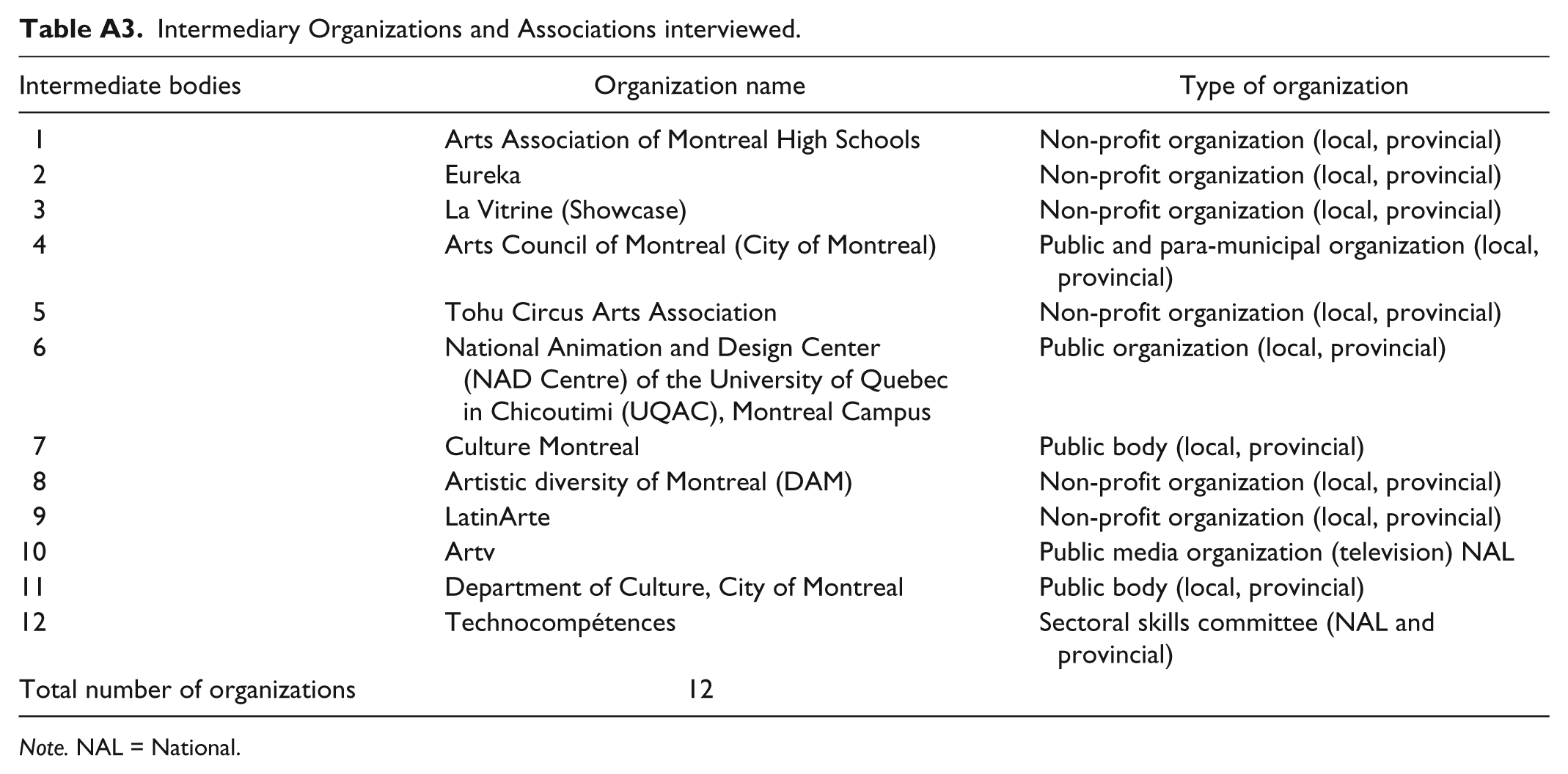
| Intermediate bodies | Organization name | Type of organization |
|---|---|---|
| 1 | Arts Association of Montreal High Schools | Non-profit organization (local, provincial) |
| 2 | Eureka | Non-profit organization (local, provincial) |
| 3 | La Vitrine (Showcase) | Non-profit organization (local, provincial) |
| 4 | Arts Council of Montreal (City of Montreal) | Public and para-municipal organization (local, provincial) |
| 5 | Tohu Circus Arts Association | Non-profit organization (local, provincial) |
| 6 | National Animation and Design Center (NAD Centre) of the University of Quebec in Chicoutimi (UQAC), Montreal Campus | Public organization (local, provincial) |
| 7 | Culture Montreal | Public body (local, provincial) |
| 8 | Artistic diversity of Montreal (DAM) | Non-profit organization (local, provincial) |
| 9 | LatinArte | Non-profit organization (local, provincial) |
| 10 | Artv | Public media organization (television) NAL |
| 11 | Department of Culture, City of Montreal | Public body (local, provincial) |
| 12 | Technocompétences | Sectoral skills committee (NAL and provincial) |
| Total number of organizations | 12 |
Note. NAL = National.
Declaration of Conflicting Interests
The author(s) declared no potential conflicts of interest with respect to the research, authorship, and/or publication of this article.
Funding
The author(s) received financial support from the Canada Research Chair on Socio-Organizational Challenges of the Knowledge Economy, chaired by Diane-Gabrielle Tremblay and financed by the Social Sciences and Humanities Research Council of Canada (SSHRC).
Notes
Author Biographies
 )
)