




Abstract
Studies on women’s experiences as correspondence or Internet brides that were conducted used survey instruments, interviews, and other tests created and normed on U.S. populations. This study specifically examined the experiences of Filipina women who have utilized an international dating agency or other venues to meet their husbands. It attempted to phenomenologically extract the essence of this population’s experiences as correspondence or Internet brides. Phenomenological analysis was conducted on the experiences of seven Filipina correspondence or Internet brides. Forty-four categories were determined and collapsed into eight broad themes: connection with the Filipino culture while acculturating to U.S. culture, negotiating the self, importance of family, correspondence experiences, connecting with her husband, resilience, betrayal, and the importance of one’s socioeconomic status. The women’s experiences were comparable with the previous literature, including the dichotomy with gender roles, the need to maintain harmony in their marital relationships, and maintaining a sense of independence.
The mail-order bride industry has been in existence since the mid-1800s, though its original intent of introducing men to women from the same ethnic group for the purpose of marriage has changed (Perez, 2013). Various literatures found that although the current mail-order bride system was superficially similar to the traditional picture bride system practiced at the turn of the 20th century, the modern industry relied more on stereotypes and international economic inequalities (Sims, 2015; Perez, 2013). The industry prospered in the United States during the 1970s, in which finding women from countries such as the Philippines satisfied the needs of white men who preferred women with a more traditional outlook on gender roles (Perez, 2013). There were an estimated 300,000 to 500,000 Filipina women who left the Philippines as mail order brides (Sims, 2015; Perez, 2013; Maher, 2003; Philippine Women Centre of B.C, 2000). Although the decision to participate in the mail order bride industry varied, the tumultuous economy of the Philippines was a contributing factor in becoming a mail-order bride. Due to its derogatory nature, many women involved in the process preferred the term correspondence wife or correspondence bride (Zug, 2012; Julag-ay, 1997).
The term mail-order bride is widely used by the media and in governmental documents. However, a research study by the Philippine Women Centre of B.C. (2000) showed that the social construct of the identity of Filipino women as mail-order brides in Canada was slowly emerging. The project revealed two things: A significant number of Filipino domestic workers married their male employers and such terms as penpals or migrants for marriage (Cacas, 1994; Roces, 2000). Ordoñez (1997) defined the term as women “who [were the] wives or fiancées of men who [were] U.S. citizens or permanent residents, whom they met through fee-for-service programs operated by international match-making agencies (IMAs)” (p. 127). Several reasons materialized why many of these women left their countries, the most prevalent of which was economics, including “flight from the depressed economic conditions, socioeconomic and natural upheavals, and extreme poverty” (p. 128).
The practice of electronically ordering a spouse from a catalog is not a new concept in the United States (Zug, 2012; Vergara, 2000). An estimated 40.89% (or approximately 5,000 per year) of women who left the Philippines as “marriage migrants” came to the United States (Bonifacio, 2009, p. 142). The majority of the men involved came from the United States, and the rest came from Australia and Europe. Scholes (1997) reported that the U.S. Census Bureau data indicated about 4,000 to 6,000 women immigrated through international correspondence services per year. There were over 200 matchmaking Internet organizations operating within the United Sates, and the number was continually rising (Dovlatov, 2005). Many of the women who participated in various international matchmaking agencies were often subjected to stereotypes either by their own community or by the community at large (Ordoñez, 1997). In addition, Filipina women often subjected themselves in sexualized and romanticized objects by participating in these international matchmaking industries (Mahalingham & Leu, 2005). Ordoñez (1997) further explored the stereotypes and idealization from both the men and the women involved and found that American men reported that many American women have lost the qualities of that traditional role as a housewife and mother as a direct result of the feminist movement. They saw Filipina women as the embodiment of tradition as Filipina women hold on to the “internalized colonization influences” (p. 123). Furthermore, it was found that many of the Filipina women who participated in this industry experienced racism and exclusion from their husbands’ families and the Filipino community.
Ordoñez (1997) examined the socioeconomic, psychological, political, as well as cultural reasons that helped shape the increase of correspondence or Internet brides in the United States. Filipinos have the highest involvement in the workforce among Asian Americans, including correspondence or Internet brides who contributed most of their income to families back in the Philippines (Agbayani-Siewart & Revilla, 1995). Many Filipina women participated in various international matchmaking sites (e.g., www.filipino-women.com) that aided in initiating the process of becoming a correspondence or Internet bride. A study by Minervini and McAndrew (2006) found minimal cross-cultural variability in the preferences for potential mates between the women from the three countries. Results confirmed that Filipina women were “significantly more interested in ambition/status/wealth than . . . commitment or sexual fidelity” (p. 123) in a mate compared with women from the other ethnic groups.
Although U.S. laws protected them from fraud, many correspondence or Internet bride sites failed to communicate this to the women. In addition, the lack of awareness of U.S. immigration laws subsequently gave the men power and control over their wives. The Committee on Foreign Relations (2004) found trends of abuse within correspondence or Internet marriages and the connections made through eyewitnesses between the matchmaking industries, human trafficking, and organized crime.
Women in Filipino Culture
The family played a significant role in a Filipino’s life and well-being, as it defended against outside stressors that affected a Filipino’s mental health. Santos (1997) found three themes when examining Filipino cultural values: sacrificing one’s needs for the benefit of the family, maintaining strict discipline on the children, and for women to tend to the home as a wife and mother. To maintain harmony within the family structure, a Filipino could not deviate from the cultural values mentioned. If a member deviated more than the family allowed, the individual may be shunned from family activities, creating tension in the family, not to mention distress for the individual. In addition, within each family was a distinct authority figure who maintained family cohesiveness and ensured that each individual did his or her part to benefit the family as a whole. Bacho (1997) found that Filipina women carried the majority of the task in upholding the emotional well-being of the family. There has been an increase in the number of married women joining the labor market, and some researchers found that women exerted both greater autonomy and household control when they contributed to the household income (Alcantara, 1994). Nonetheless, the wife’s economic role has always been viewed as secondary to her domestic role. In cases where she clearly made more money than her husband, the latter remained the recognized household breadwinner. Another indication with regard to many Filipina women’s loyalty to the gender role set by a “patriarchal” (Torres, 1988, p. 25) society was their participation in the need to marry Caucasian men to climb the social ladder (Bergano & Bergano-Kinney, 1997).
Filipina women, unlike women from other Asian countries, were able to attain the same, if not more, education than their male counterparts. Those who were in fields dominated by men, such as medicine, and law, were able to obtain and compete for employment (Rojas-Aleta, Silva, & Eleazar, 1977). They were also politically active participants in the Philippines both as voters and political candidates. However, Filipina women were still expected to adhere to the traditional role as mothers and wives set by society. Although young girls were expected to obtain education as the boys, they were “held closer to home and socialized to assume these roles” (Rojas-Aleta, 1977a, p. 22). Filipina women were made “invisible” (p. 25) in the political and economic sphere due to early socialization to their gender roles early on in life (Torres, 1988). Roces (2000) found that Filipina women expressed ambivalence with the issue of empowerment and the feminist perspectives versus the traditional Filipino values. These opposing images of Filipina women were clearly depicted by two prominent figures in Filipino history, the Maria Clara and Gabriela Silang. The Maria Clara is a fictional character that illustrated the essence of innocence and beauty through passivity and subservience, an image that all Filipina women were supposed to ascribe to be (Julag-ay, 1997, p. 92; Rizal, 1887/2006). The fictional story of Maria Clara included denying herself the rights to marriage, love, children, and freedom, to maintain her loyalty to her true love (Rizal, 1887/2006). Gabriela Silang, a historical figure, is known for her courage against the Spanish army in the 1762-1763 rebellions (Romana-Cruz, 1992). Both Gabriela and her second husband, Diego, openly protested the abuses the alcalde mayor, or ruler, did to the people in Ilocos and in other Philippine provinces. She was the first Filipina woman to lead a rebellion against a formidable Spanish army, earning her the name Generala, or woman general.
Theoretical Frameworks
According to relational-cultural theory, one of the first steps in overcoming the challenges in working together with women from various backgrounds was to acknowledge each woman’s collective history and to be willing to take risks (Jordan & Hartling, 2002). These risks may include stumbling into “relational impasses” (p. 194). Asian and Asian American feminist scholars argued that discourse on women of Asian descent usually occurring within a framework reflected the experiences of Caucasian, middle-class women. In addition, not all feminists embrace postmodern feminist views (Marecek, 2002) that included the following: (a) There will always be presuppositions based on one’s values and assumptions in a societal setting, (b) the research will only obtain partial truths, and (c) a researcher shaped the inevitable outcome of the research process. Ordoñez (1997) utilized the eclectic approach, a culturally sensitive framework that included Western feminist ideologies, in her study of Filipina correspondence or Internet brides. The model of psychology to indigenous Filipino society was one of many dynamics that led Ordoñez (1997) to conclude that the idea of feminism was not the same for Filipina women as that of Caucasian women.
The history of migration by Filipinos has brought about a different perspective on feminism (Julag-ay, 1997). The experiences of migration have left many Filipina women to focus their energy mainly on their survival in an unfamiliar territory while, at the same time, trying to overcome the obstacles brought about by acculturation stressors. Maintaining employment status is a major incentive for many of these women, even if it means cooperating with an oppressive system. Furthermore, Filipina women are often ostracized in their own communities, depriving them of social circles. Because of this, many Filipina correspondence or Internet brides may not feel a sense of connectedness or ability to relate to others (Stiver, 1991).
Filipino psychology or Sikolohiyang Pilipino (SP) was first developed by Virgilio Enriquez as a response to the dominant usage of Western psychology in various academic and clinical settings in the Philippines (Church & Katigbak, 2002; Montiel & Teh, 2004; San Juan, 2006). Filipino scholars have criticized the application of some of the Western models of psychology, indicating that its usage promoted “intellectual dependence” (Church & Katigbak, 2002, p. 130) and “academic imperialism” (p. 130). SP illustrated the importance of interpersonal relationships and how such relationships bounded him or her to the community or to the home country (Revilla, 1997). As a caveat, the relational-cultural theory and SP were theories used to help better understand the behavior of Filipina correspondence or Internet brides from an emic point of view. These theories were not used to conceptualize the results of the study.
Method
Phenomenological study draws out the essence of an experience, which requires the researcher to undergo a process of meditative thinking prior to data collection and analysis (Heidegger, 1959/1966). Husserl (1927/1962) and Heidegger (1959/1966) indicated that individuals were vaguely aware of anything outside of their peripheral attention and were “only implicitly aware of the wider horizon of things in the world around” them (Smith, 2008). In addition, individuals interpret their activities, ideas, and experiences in the context of their immediate world (Heidegger, 1927/1962). Therefore, a researcher is required to bracket her experiences of the world by maintaining an epoché to bring these biases into conscious thought.
Research Question
After consultation with the participants and other literature, it was decided that the question would be as follows:
Phenomenological Reduction
Interest in the topic included the sociopolitical complexities of international matchmaking within the Filipino community in the Philippines and abroad. It was imperative the writer underwent the epoché process to bring to conscious awareness any presuppositions about the correspondence or Internet bride experience. The writer listed all the assumptions of the men and women involved in the international matchmaking industry prior to literature review and continued to add to and elaborate on these presuppositions as she became aware of them.
Participants
Those who agreed to participate in the study included women of Filipino descent, who were currently or have been married to Caucasian men through a matchmaking organization or were introduced by a mutual friend. Exclusion criteria were women who were married for less than a year, born in the United States, did not speak English fluently, and who were not at least 18 years old on arrival to the United States. The researcher obtained seven participants.
Procedure
A snowball sampling method was utilized. After the initial contact with the first participant, which was conducted in her home sans family members present, the writer asked for at least three other contacts to interview. It was agreed that the first participant would first contact the women to briefly introduce the study and to let them know that they would be contacted via telephone or email within a week. Most of the interviews were conducted in the participants’ home sans family members present. One participant had her children remain upstairs as the interview was conducted in the downstairs living room. Some participants opted to conduct the interview via telephone, as they resided in a different state, while another decided to correspond with the researcher via email and explained her discomfort talking over the phone with her husband within the vicinity. Much like the first interview, each woman was asked for names and contact information for at least three additional women willing to participate. Once contact has been established, many of the women asked the researcher what questions would be asked during the interview to prepare. They were informed that there was only one question. The length of the interview depended on how much the participant wanted to elaborate.
Rapport was established either through commonalities (e.g., where in the Philippines the researcher is from) or through generic statements and questions (e.g., “How are you?”). In addition, the use of the participants’ language assisted in rapport building. However, the interview was conducted in English. When a participant chose to speak a different language as part of the rapport building, the researcher did not utilize that part of the interview in the data analysis. Once the participant was situated and the audio recorder was set up, the interview began with the research question. If the participant gave limited information or if clarification was warranted, unstructured follow-up questions were asked: “What do you mean by _____?” “Can you tell me more about _____?”
Analysis
When enough data were gathered, or once saturation was attained that to go beyond would be redundant (Husserl, 1927/1962; Moustakas, 1994), the researcher transcribed the interviews and ensured that every word was preserved. The reduction phase included purging any unnecessary language (e.g., word fillers) obtained in the interviews before separating the data into meaning units. The meaning units were placed on a Microsoft Excel spreadsheet to organize the themes that emerged in the analysis. Each meaning units was labeled that expressed the essence of the statement(s) made by the participant. Reflective analysis was then performed to determine the researcher’s own personal biases that have contributed to the reconstruction prior to extracting the essence of the phenomenon. If it was determined that biases have contributed to the reconstruction, adjustments were made in categorical relationships.
Results
Findings in the study were organized into two sections: (a) bracketing of researcher biases throughout the data collecting and data analysis processes, and (b) obtaining descriptions from the themes that emerged in the data analysis.
Bracketing Assumptions
The first bias that was brought to conscious awareness was the researcher’s personal investment in eliminating the practice of correspondence or Internet bride and believed that international dating organizations exploited the women as commodities for profit. It was anticipated that the study would provide evidence proving the degrading practices of the industry and the victimization of the women involved. In addition, there was an obligatory response to provide the participants a different view beyond their economic necessity to the Western feminist point of view.
The term mail-order bride conflicted with the purpose of the study, which is to dismiss the assumption of correspondence or Internet brides as economic opportunists. Although the women may be as educated as most of their peers, it was believed that they lack or chose to ignore the capacity to comprehend the complexities of the international sociopolitical arena, especially the relationship between the United States and the Philippines.
In addition, the men involved in the international dating industries are typically older, White males with a preference for women who observed stereotypical gender roles. The men may not necessarily portray the image of a stereotypical male (e.g., macho) but hold beliefs that their wives should adhere to the traditional gender role. The men who participated in the international dating organizations have difficulty socially asserting themselves, thus their preference for a less anxiety-provoking course to dating. They may view Western women as domineering, career-driven feminists, who have lost touch with family-oriented values whereas they viewed Filipina women as loyal housewives, who placed the family’s needs ahead of their own.
The final bias that was brought to conscious awareness was the view of the women’s marriage with their husbands. It was assumed that the women desired to be rescued from a life of poverty in the Philippines by their American husbands. Marriage in this case was not always one of love or convenience, but also of empowerment as the women chose to be correspondence or Internet brides for their own various, albeit economic, reasons. Therefore, communication between husband and wife would result in misunderstandings and frustration due to culture and language barriers. In addition, the women were hoping to realize that American dream of owning a home and raising lighter skinned children.
Core Themes
The meaning units were then placed into 44 broad categories prior to placing them into subcategories, if necessary. The broad themes were later extracted based on commonalities of the categories and the meaning units within each of the categories. The meaning units within categories and subcategories were then collapsed into a statement to reflect the essence of the meaning units obtained. Table 1 provides an example of this process analysis from meaning unit to category to theme. The purpose of the process described was to take the significant experiences in the meaning units and form categories, or subcategories, which created cohesive statements that depicted the overall essence of the women’s experiences. Categories with similar meanings were grouped into broad themes.
Three Examples of Phenomenological Analysis.

The categories obtained were organized into eight broad themes, which were grouped according to the similarities of the categories. The eight broad themes included being connected with the Filipino culture while acculturating to U.S. culture, negotiating the self, importance of family, the woman’s corresponding experiences, connecting with her husband, resilience, betrayal, and importance of socioeconomic status. Table 2 provides all eight themes along with categories under each theme.
Breakdown of Themes and Categories.
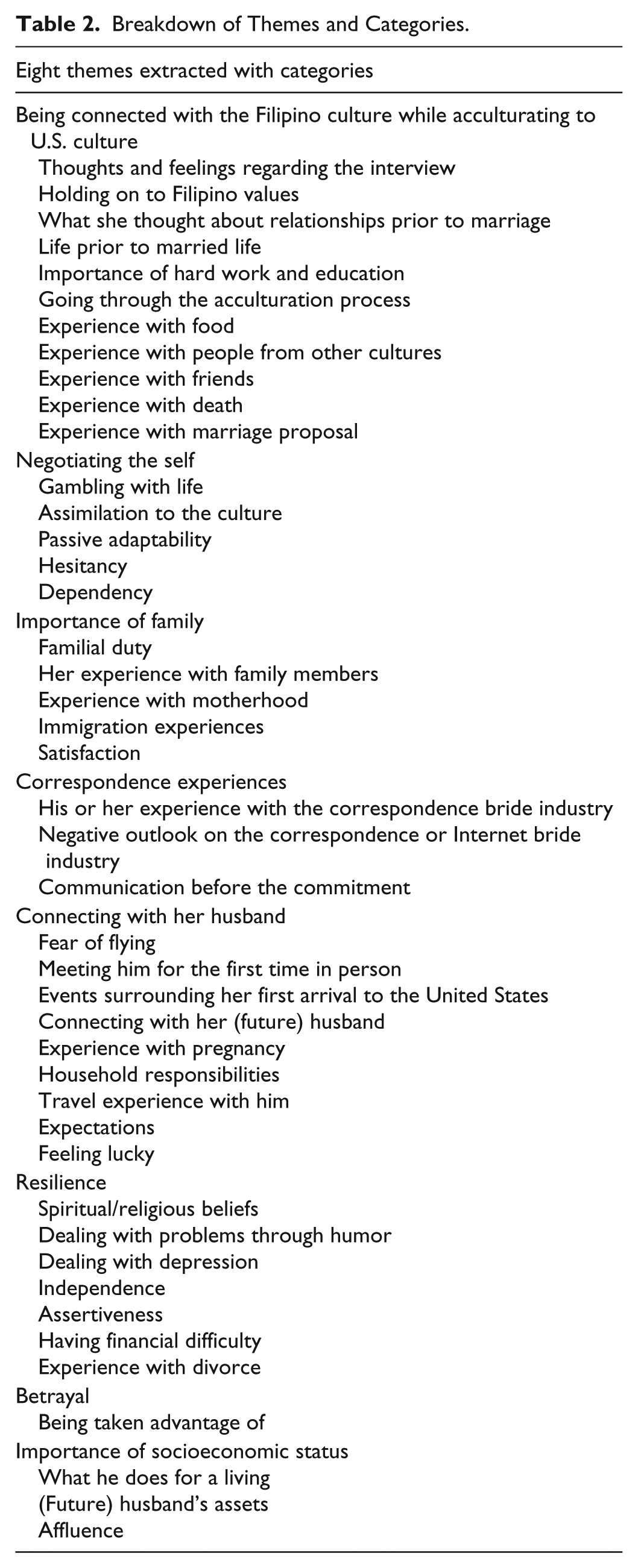
Being connected with Filipino culture while acculturating to U.S. culture
Thoughts and feelings regarding the interview
To decrease anxiety during the interview process, some of the women verbally discussed their concerns with the interviewer. They verbalized their concerns with how the interview was approached, such as the lack of clarity of the question due to its broad nature. One participant prepared notes to discuss during her interview to help organize her thoughts. Familiarity was observed by some of the women during the interview process by asking questions (e.g., asking the interviewer if she visited the Philippines). One woman informed the interviewer through email that she hoped to see the interviewer “soon.”
Holding on to Filipino values
The women revealed several ways they hold on to their Filipino values; their values included adhering to their marriage vows and the traditional roles of a wife, of which their duties included household responsibilities and child rearing (e.g., adhering to distinct and strict parenting roles). The women taught their children obedience and respect toward their elders. These values were ways to achieve success in life, which included exceptional academic performance. In addition, some of the women discussed their own experiences with dating that paralleled the traditional Filipino views, of which a chaperone was required, preferably the father or a female friend. The women also attempted to maintain their connection to their culture by attending Filipino cultural events or ensuring distance between themselves and their in-laws. They stressed the importance of chastity prior to marriage and the practice of the man asking the woman’s parents for her hand in marriage. The point of this tradition, according to one woman, was to protect the daughters in the family.
What she thought about relationships prior to marriage
Prior to marrying their husbands, the women had their own opinions about relationships. For some, a romantic relationship was compared with a game involving compromise to a more liberal attitude toward marriage. The women stated that at the time, their careers or familial duties prevented them from taking relationships seriously; others maintained a conservative stance on relationships, much like other Filipinos. They preferred establishing a friendship with the man prior to rushing into marriage.
Life prior to married life
Most of the participants had limited experiences with dating, and others were hesitant to discuss their romantic relationships prior to marriage. Most of the women discussed their childhood experiences in the Philippines. Although most grew up with less privileges compared with their children (e.g., not having as many toys), the women related a more or less satisfactory childhood with some academic struggles.
Importance of hard work and education
Two of the women stressed hard work and education as essentials for a successful life. They agreed that adhering to strict parenting and having a career constituted success. The ethos of education and hard work reflected the Filipino value of education as a way for children to help increase the family’s socioeconomic status. In doing so, the children showed their debt of gratitude toward the family by being successful with their academics and careers. The women strived to maintain this cultural practice by passing their values down to their own children.
Going through the acculturation process
The women faced many challenges as immigrants in a foreign country. It was especially difficult for them to acclimate to a culture unlike their own. Some women expressed their feelings of culture shock when they first arrived to the United States. Others reported having minimal support from their families of origin due to physical distance, which made acculturation more difficult. Some women had a challenging time acclimating family members to American culture while struggling with their own acculturation concerns, which included the differences in clothing styles (e.g., wearing shorts in church, wearing thick jackets). In addition, all of the women did not drive when they lived in the Philippines, and the majority of them had a difficulty adjusting to this level of independence. Some of the women postponed driving lessons due to their frustrations in learning how to drive; others continued to dread driving to places outside of their usual routes. The colder climate was another acculturation issue for these women, whose bodies were accustomed to warmer weather. They stated that the cooler temperature was less of an issue currently.
The women with children reported comparing how they were raised in the Philippines with how the children in the United States were being raised. They observed how young girls in the United States were less inhibited with their manners and their clothing compared with how Filipina girls were when they were growing up in the Philippines. This difference in cultural practices was another acculturation struggle discussed.
Learning the nuances of the English language was an incredible obstacle for many of the women. Despite having learned English while in school in the Philippines, the women continued to have difficulty speaking the language. Some expressed frustration talking in English either because of their heavy accent or their limited English vocabulary. One woman stated overcoming her fear of making grammatical errors when speaking in English through persistence: “Now I don’t care if my English is right or wrong. But I just keep talking” (7.221). She added that after having lived in the United States for several years, she learned to ignore her perception of what others thought.
Experience with food
Food represented one aspect of acculturation the women experienced. One of the challenges discussed was their difficulty adjusting to the food in the United States. One woman described her distaste for American bread: “And the bread is so hard for me. We’re not used to . . . sourdough bread ’cause our bread in there is always soft and flour all white” (1.29). It was not just American food that the women had to become accustomed to but also food from other cultures (e.g., Mexican food). Rice was an essential part of the meal for some women, and it was important for them to have access to this staple grain.
Experience with people from other cultures
The women reported experiencing both positive and negative interactions with people from other cultures. Although some of the participants reported having an overall positive experience with people from other cultures, others faced challenges with culture-specific issues such as values, language, and personality differences (e.g., patience). One woman reported,
Yes, ’cause understanding one’s . . . culture, you know, it’s not that easy. ’Cause . . . you know . . . Filipino values, you know, we have . . . you know, Filipino values have different values from American values you know. Sometimes you know you might not understand things where a person is coming from and the other person wouldn’t understand where person is coming from because they . . . have different values. (5.69, 5.70, 5.71)
This difference between American and Filipino values contributed to the difficulties with the acculturation process.
Experience with friends
Friendships were a vital aspect for the majority of the women. It was through friendships that they were able to obtain social reprieve and emotional support. Friends also provided an outlet for which the women were able to reminisce about the past, plan for the future, and laugh about the present. Their friendships, especially with other Filipinas, allowed them to connect with others who shared similar experiences and provided a bridge to the home they left behind. Their friends aided them in times of need, such as driving the women to places or babysitting. The women in return provided emotional support to those who struggled in their own relationships as correspondence or Internet brides due to conflicts with in-laws, infidelity, husbands with children from previous marriages, or having controlling husbands. Some women discussed sacrificing their time to help friends in their times of need.
Experience with death
The women reported their experiences with death, and how they dealt with the loss. Some women discussed the loss of a parent that was especially devastating. One woman recently lost her mother, and she struggled to collect herself during the interview. Other women discussed deaths of their husbands’ family members but remained apathetic; one stated feeling “lucky” that her mother-in-law died prior to her marriage, which enabled her to freely carry out Filipino traditional practices in the home.
Experience with marriage proposal
The women reported having an overall positive reaction to their marriage proposals. They discussed the length of time they dated prior to the marriage proposal and the comical events that led to the event. Some discussed how their husbands followed through with the Filipino practice of asking the parents’ permission prior to the marriage proposal or soliciting familial support with the marriage ceremony.
Negotiating the self
Gambling with life
Gambling in their relationships and gambling with money were risks the women considered. They agreed that pursuing a relationship with a man they knew only through letters or the Internet was risky, especially after hearing negative stories about other correspondence or Internet brides from friends and family. One woman stated that in addition to gambling on the relationship, she also gambled her and her husband’s finances in the stock market: “and like you know what you have to take a risk a little bit too because if you don’t, you’re just not gonna” (3.245). This category involved the necessary risk of gambling to progress in life either through relationships or finance.
Assimilation to the culture
The process of assimilation was a topic broached by all of the women. They negotiated behaviors and practices to blend in and ease their assimilation into American culture. Some women learned how to drive a car despite their fears; others acknowledged having husbands who refused to attend Filipino social events.
Hesitancy
Some women initially had reservations pursuing relationships with their husbands because of their perceptions of family reactions or concerns about leaving a lucrative career. They were faced with a decision to compromise their careers. One woman left her position at a radio station to relocate to the United States with her husband; another woman overcame her initial fears and introduced her husband to her family despite their initial protests against the relationship.
Passive adaptability
In contrast to the one-dimensional individuals the media have portrayed correspondence and Internet brides to be, the women proved to have dynamic personalities that can often contradict each other. They discussed ways they passively adapt to situations and in their relationships to maintain harmony. These passive adaptations included having their husbands make decisions (i.e., financially, religious matters, or daily activities), compromises they were willing to commit to as long as they were able to assert themselves in other areas. For some women, this passive adaptability was not necessarily a means to an end but was attributed to their own feelings of inadequacy and lack of self-confidence.
Dependency
The women reported feeling dependent on their husbands, especially when they first arrived to the United States. They depended on their husbands financially by ensuring an updated wardrobe, owning a luxury vehicle, paying for bills, and supporting family in the Philippines. Some women depended on their husbands to file their immigration paperwork or drive them to places.
Importance of family
Familial duty
A value practiced by many Filipinos the women sustained as they struggled in their new environments was their sense of familial duty. This sense of duty ranged from financial support to adherence to the family’s opinions about their relationships. They sent money to the Philippines or petitioning for family members to come to the United States as a means of support. One woman expressed her debt of gratitude to her parents who helped her take care of her children.
Her experience with family members
The women retained that bond with their families of origin despite the physical distance. It was important for them that their families accepted their relationships or emotionally supported their decisions. To ensure that their family ties remained intact, the women continued to openly communicate with their families through the Internet, telephone, or written letters. They also fostered relationships with their in-laws to maintain harmony within the family.
Experience with motherhood
An aspect of familial duty that was important to the women was spending quality time with their children. This included helping with schoolwork, being actively involved in extracurricular activities, or attending church services as a family. One woman was adamant in ensuring that her children remained ignorant of her involvement in the matchmaking industry, whereas another admitted disclosure with her involvement in the matchmaking industry to her children at a later time. Those who have children expressed their challenges with raising children in the United States (e.g., differences in cultural disciplinary practices), which they revealed was a barrier for effective parenting. It was especially difficult when their husbands openly disagreed with their disciplinary practices. Maintaining strict parenting was a way the women honored their own upbringing in the Philippines, and it was to also a way to steer their children clear from the materialistic, entitled, and stubborn attitudes of American children.
Immigration experiences
Some women decided that a way to help family members in the Philippines was to petition for them to immigrate to the United States. One woman had a relatively easier time with the immigration process for her parents compared with her own paperwork process. Another woman expressed having a financially supportive husband, which made it possible to bring her mother and her sister to the United States.
Satisfaction
Although the women faced numerous acculturation challenges, they reported feeling overall satisfaction. They attributed some of this feeling to having an emotionally supportive family, including their families of origin and their husbands. Some of the women expressed feeling satisfied that their husbands were able to financially support them and their families of origin.
Correspondence experiences
His or her experience with the correspondence bride industry
The majority of the women reported having an overall positive experience with matchmaking industries, especially after meeting supportive and understanding men and made it possible for them to immigrate to the United States. One woman reported knowing the owners of one international dating website, on which she was featured. Corresponding with other men aside from their husbands was fairly common, as they navigated through letters of potential mates. Some of the women kept the letters during those times. As they recalled their early experiences, some of the women reminisced about their physical appearances, such as having long hair. Despite the benefits of marrying an American, some women were convinced there were men in the industry who exploited Filipina women; one woman was left by a man who decided to marry another Filipina from another island. After her initial shock, she eventually accepted his decision and congratulated him.
Negative outlook on the correspondence or Internet bride industry
The fear of being exploited or abused was deeply ingrained for most of the women, contrary to their mostly positive experiences. They expressed having difficulty imagining being exploited and killed for insurance scams. For other women, these tragedies hit close to home when friends experienced infidelities or isolation from families of origin. Although the majority of the women had an overall positive experience, there were some who faced initial challenges as correspondents. These negative experiences included disapproval of their relationships by their in-laws and explained that the families of the men expressed concerns for their loved ones. One participant stated that her mother-in-law was concerned that the participant would marry her son only to “forget” about him when she leaves him.
Communication before the commitment
Prior to committing to the relationship, the women solicited their families’ support and input including their hesitancy with commitment and the advantages and disadvantages of Internet communication. For the majority of the women, corresponding with their husbands facilitated the connection that ultimately helped in their decision to commit to the relationship despite having corresponded with multiple men simultaneously. One woman added having received numerous gifts from her husband during their first meeting.
Connecting with her husband
Fear of flying
One participant expressed her experience with her husband in overcoming his fear of flying (e.g., flying to the Philippines to meet her), which essentially showed her of his commitment to the relationship. She stated that her husband at the time feared boarding a plane, especially after the events of 9/11, and this gesture facilitated further connection between them.
Meeting him for the first time in person
The women shared what their marital relationships were like, and discussed their first meetings with their husbands. The events that surrounded their first encounters influenced their decisions to pursue or not pursue the relationship. They talked about what they did and what the weather was like during their first encounter; others stated that the initial feelings of attraction were enough to lean toward marriage.
Events surrounding her first arrival to the United States
On arrival in the United States, the women reported feeling reassured by their husbands’ financial stability (e.g., having his own home), which meant having comfortable distance from in-laws. One woman reported feeling closer to her husband after he introduced her to his family as a welcoming gesture; another discussed shopping for food after arriving in the United States. The events when each of the women first arrived to the United States strengthened the connection with their husbands (e.g., husbands’ willingness to ensure comfort through familiar foods, welcoming her to his family).
Connecting with her (future) husband
The women emotionally connected with their husbands in a variety of ways that included spending quality time, gift giving, or becoming parents. They also connected to each other by maintaining a good relationship with their in-laws. Another way they connected was through verbal or nonverbal communication, such as using terms of endearment (e.g., “love”), having small talks (e.g., talking about the weather), being truthful, or through compromise (e.g., compromising on practicing her religion). Practicing religion (e.g., attending church services together), having children, and attending to household responsibilities (e.g., paying the bills together) were ways they maintained that close connection. The women expressed their appreciation toward their husbands’ support and acceptance of their families of origin. It was especially important for them to have husbands who understood their culture and familial relationships. One woman stated, “And so . . . my husband, you know, he doesn’t complain if I talk so much to my family members, my sisters, my brothers, and . . . sometimes my bills [telephone bill] is really high” (3.114, 3.115). She explained that despite the expense accrued on long-distance phone calls with family members in the Philippines, her husband remained understanding of her need to connect with family. Communicating with their husbands helped them continue to connect even through marital strife. In addition, having complementary personalities, along with his continued support and trust, helped facilitate that connection in the relationship.
Experience with pregnancy
One woman’s experience with pregnancy helped her emotionally connect with her husband. Her husband exhibited extra support throughout her pregnancy, such as offering to have her mother live with them to help take care of household chores. He also offered to drive her to and from doctor’s appointments without missing a single appointment because of her inability to drive.
Household responsibilities
The women’s husbands relied on them to take care of all transactions (e.g., mortgages, telephone bills), and other household responsibilities. They stated that their husbands exhibited immense trust in them to assume financial responsibilities, which strengthened their emotional connections. In addition, they discussed their husbands’ capacity for teamwork to have a more effective household.
Travel experiences with him
Some women connected with their husbands by traveling together for leisure purposes. One experienced traveling to another U.S. city with her husband a few days after her first arrival. Others discussed traveling to the Philippines together to visit family and friends. Another discussed meeting her husband at a city in the Philippines. In each of their experiences, the women discussed the experiences of traveling to new places.
Expectations
Most of the women had expectations on what married life would be like, and most thought that their marital relationships did not turn out as initially expected. One participant stated, “So, it was it . . . was really everything was not really boring for us because I didn’t realize this is gonna like this” (2.232).
Feeling lucky
Most of the women reported feeling lucky to have husbands who were not only financially supportive of the family but also of their families of origins. Others expressed feeling lucky that their husbands did not have prior complicated relationships. The women reported feeling lucky to have husbands who treated them well despite what other Filipina women experienced as correspondence or Internet brides.
Resilience
Spiritual/religious beliefs
The women expressed resilience with life’s challenges, such as betrayal or acculturation issues, by turning to religion or spiritual guidance. They discussed turning to religion during their first few years in an unfamiliar environment and away from families. One relied on fate despite acculturation challenges. By turning to religion or spirituality, they exhibited resilience through the various obstacles faced as immigrants in a foreign country. In addition, the women’s religious or spiritual beliefs helped them feel more connected with their families of origin.
Dealing with problems through humor
Some of the women used humor as a way to deal with problems in life, such as when deceived by a friend or a male correspondent. Others utilized humor when feeling anxious (e.g., meeting her husband for the first time), marital problems, and unwanted pregnancies. Having a sense of humor helped minimize their grief and anxiety in life.
Dealing with depression
Resilience was exhibited in how the women dealt with depression due to isolation from friends and families of origin and being unemployed. They immersed themselves in various activities, such as cooking, painting, or taking care of their children, to overcome their depressed mood. They also maintained communication with their families of origin to help cope with depression.
Independence
Some of the women defined independence through their determination to work despite feeling depressed. Working was also a way for them to avoid financial dependence on their husbands. As they juggled the responsibilities of motherhood and wives, they maintained their independence by obtaining paid or volunteer work and by having friendships with other Filipina women outside of their marriages. In this way, they continued to surround themselves with what was familiar and exhibited resilience through the challenges of acculturation.
Assertiveness
The women showed resilience in how they assert themselves toward family members. It was important for them to be adamant in their intentions to marry their husbands despite disapproval by family members. This was also true in their relationships with friends, who found ways to assert their opinions about careers and relationships. In this way, the women maintained their independence and decreased resentment toward their families and friends. They also exhibited assertiveness in their relationships by disagreeing on child-rearing practices, finance, and religious practices. In doing so, they minimized subservience toward their husbands’ expectations.
Having financial difficulty
Most of the women reported growing up poor in the Philippines. Although the majority of them obtained financial stability in the United States, there were others who continued to struggle. Some discussed their experiences with financial hardships, such as bankruptcy, unemployment, having bad credit, and losing money in the stock market. Despite these financial hardships, they felt they were able to overcome them with the support from their husbands and families.
Experience with divorce and second marriage
One woman experienced divorce with her first husband after a year of marriage. She stated that the divorce was due to personality differences and not feeling like she fit into his “business world.” Rather than remain in an unhappy marriage, she asserted herself, filed for divorce, and obtained her U.S. citizenship with the help of her lawyer.
Betrayal
Some of the women discussed feeling betrayed. One woman felt exploited by a friend and eventually lost trust in that friendship. Another felt betrayed by a family member, which resulted in temporary financial struggle due to fraudulence. She dealt with the issue by confronting the bank and eventually taking her case to the court. Others discussed feeling betrayed by men they were corresponding with prior to their current marriages (e.g., the men met with other women while seeing the participants). The women dealt with their feelings of betrayal by emotionally and physically distancing themselves from the individuals who had betrayed them or by problem solving.
Importance of socioeconomic status
What he does for a living
Most of the women married men with white-collar jobs (e.g., engineering, business, or computer administration). They valued their husbands’ stable income and were grateful that they were able to afford certain luxuries (e.g., car, house). They emphasized the importance of having husbands who were financially stable, as it afforded them to also help families of origin.
(Future) husbands’ assets
The women discussed feeling lucky for having husbands who owned their own homes, which made it easier to not “mingle” with in-laws. Financial stability also afforded them to provide extracurricular activities (e.g., piano lessons) for their children, buy a house, or own a luxury vehicle. Knowing that their husbands were able to financially take care of them maintained that security and emotional connection in the relationship.
Affluence
All of the women came from underprivileged backgrounds but are currently financially secure due to their husbands’ jobs. Their husbands’ stable careers afforded them to not work, purchase whatever they wanted, send their children to private schools, buy their children various toys, and live in affluent neighborhoods.
Discussion
The purpose of this study was to examine the experiences of Filipina correspondence or Internet brides through phenomenology research. As a qualitative study, phenomenology explored the “structure of consciousness as experienced from the first-person point of view” (Smith, 2008), while bracketing the researcher’s own biases of the phenomenon being studied. Seven participants revealed 44 categories found in the analysis of interviews conducted, which were then collapsed into eight general themes: the women’s connection with Filipino culture, negotiating the self, importance of family, corresponding experience, connecting with their husbands, resilience, betrayal, and importance of socioeconomic status. These themes reflected the women’s experiences as Internet or correspondence brides, of which the data suggested that these were both positive and negative. Furthermore, the women showed that they could possess the dependent, stereotypical traits of a traditional wife that the past literature had suggested, while maintaining an independent, inner strength, as some of the women were constantly alternating between the opposing roles of the Gabriella Silang and Maria Clara (Julag-ay, 1997; Rojas-Aleta et al., 1977b; Torres, 1988).
General description of Filipinos and its relevance to the women in the study
A general description of Filipino culture and values was illustrated in the literature review, of which one aspect of the Filipino culture that Santos (1997) highlighted was the significance of family in an individual’s life. Three themes also emerged in his research: sacrificing one’s need for the benefit of the family, maintaining strict watch over children, and placing high value on women who tend to the home and raise the children. The women in the study discussed sacrificing the familiarity and comfort of home and family to relocate to a foreign country with a man they barely knew. Although most of the women obtained employment (e.g., nurse aide) that was different from the field in which they graduated (e.g., teaching, chemical engineering), they arrived in the United States financially dependent on their husbands. Others did not obtain employment but opted to stay at home to take care of their children. They sacrificed their need of comfort from family, familiarity, and home in the Philippines to obtain financial security not just for themselves or the future of their children but to also help their own families of origin. Most of the women in the study illustrated this theme discussed by Santos (1997) through their emphasis on the importance of family and negotiating values to benefit the family.
Although the majority of the women had children, only one placed emphasis on maintaining strict watch over them. She discussed limiting her children’s social activities while encouraging them to focus on their academics. The women also discussed the differences in how children in the Philippines were raised in comparison with how children in the United States were raised and disciplined. One woman discussed how Filipina women traditionally did not date unless they were chaperoned either by their father or a trusted family member. This traditional Filipino dating practice was how Filipino parents maintained a strict watch over their children and, successively, preserved harmony within the family unit. In a way, the women in the study have deviated from the traditional value of tending to household chores and motherhood. For instance, the majority of the women obtained employment outside of the home and relied on their spouses or families of origin to help with household duties. In addition, most of them valued the importance of work, whether it was voluntary or paid employment. One woman volunteered at her children’s school to acquire work outside of the home and to be closer to her children. The women’s flexibility to adapt in their new environments helped them survive living in a foreign country, although they still appeared to hold on to some of the traditional gender roles.
Another description of Filipino values found in the literature was the prevalence of the neo-colonized mentality that many Filipinos came to adopt (Bergano & Bergano-Kinney, 1997; David & Okazaki, 2006; David, 2008; Julag-ay, 1997). This was best depicted by one of the women who expressed her wish to have a “Caucasian boyfriend” since she was a young girl. Although she did not indicate feelings of shame and embarrassment regarding Filipino culture, the participant confirmed the sentiment various Filipina women shared: the fascination and idolization of the culture in the United States and the expectation of increased status in society through their biracial children.
How mental health is perceived and its consistency with the women in the study
Some of the women experienced depression as they faced acculturation challenges in the United States. They dealt with depression through emotional support from families of origin or husbands, or by distracting themselves with various activities (e.g., household chores, child-rearing responsibilities). The women dealt with acculturation issues while adjusting to their roles as wife and mother by turning toward religion or spirituality. One woman discussed how she turned to her religion when she faced difficulties in her marriage.
Contradictions between existing research and the present study’s results
Rojas-Aleta and colleagues (1977a) found that Filipina women were able to compete for higher education and employment in stereotypical male-dominated fields, such as medicine and law while maintaining active roles in the political arena. Despite the country’s progressive stance in politics, most Filipinos still adhered to traditional gender roles (Rojas-Aleta et al., 1977c; Torres, 1988). This combination of progressive and traditional values resulted in an expectation of women to juggle a career as well as maintain their roles as mother and wife in the family (e.g., juggling a career and raising her family). The women discussed having careers or maintaining friendships outside of their marital relationships while feeling financially dependent toward their spouses or being able to speak their minds while compromising their religious practices or agreeing to speak only English when their spouses were in the room. By balancing these seemingly contradictory values, the women ensured harmony in their marital relationships.
One of the themes extracted from the study was the idea of gambling with their lives by marrying foreigners and relocating to a different country. The women explored the concept of “gambling” on the whether their husbands would treat them well, especially after hearing from the media, family members, and other Filipina correspondence or Internet brides’ experiences of infidelity, manipulation, and abuse. Despite the negativity surrounding the correspondence or Internet bride industry, the women still made the conscious decision to participate. Although not all of the women verbalized their reasons to participate in an international dating service, they verbalized that financial security, familial duties and obligations, and a romanticized image of foreigners as rationale toward becoming correspondence or Internet brides.
Comparison of the bracketing content and results of the study
Prior to and during the process of data analysis, the researcher continued to bracket suppositions of the experiences of Filipina correspondence or Internet brides. One such experience was the researcher’s expectation of betrayal that the women may have undergone. The women discussed experiencing betrayal from either a friend or a family member, whereas, the researcher expected the women to experience betrayal from spouses instead. Another unfounded expectation uncovered in the bracketing experience was the expectation of negative experiences (e.g., abuse) as a correspondence or Internet bride. Aside from one participant in the study, who obtained a divorce from her husband after a year of marriage, most of the women reported overall satisfaction in their marriages despite facing challenges due to separation from culture and family.
Themes, such as the importance of family, that were confirmed by the women in the study were also bracketed. One way the importance of family was illustrated was how the women gambled what was familiar (e.g., food, language, culture) to marry an individual from a different culture to obtain financial security for their families of origin. Despite obtaining higher education or securing a stable career in the Philippines, the women chose to relocate to a foreign country away from their families and the familiar to help their families back home. Another theme that emerged was the women’s resilience. They reported experiencing depression during their first few years in the United States and were able to resist severe depression by turning to religion or spirituality; others utilized humor. As expected during the bracketing process, the women also exhibited resilience through their independence and assertiveness in relationships.
Limitations of the study
A phenomenological study could result in infinite possibilities depending on the socio-cultural context in which the interview occurred such as mood, the time of day, and even the researcher’s background. Therefore, limitations of the current study should not be based on empirical expectations but through the experiences of the participants. Although the researcher’s familiarity and similar ethnic background with the participants may have affected the women’s candidness to fully disclose their experiences, this same limitation helped in obtaining participants in the community. However, their desire to remain anonymous and not be marginalized by others may have hindered them from fully revealing their innermost thoughts and feelings regarding their experiences as Filipina correspondence or Internet brides. In any case, extraction of the women’s experiences may vary when there is less familiarity with the population on the researcher’s part. Any other researcher, regardless of race, ethnicity, gender, or background, would have a different outlook on the phenomenon studied due to the experiences he or she brings.
Suggestions for future research
For the purpose of time and financial constraints, the current study excluded women who spoke only their native language (e.g., Tagalog). Experiences by women who did not speak English may vary significantly from those who were able to communicate their needs and wants in their marital relationships. Future phenomenological studies could include women who spoke limited English and women who were married to their husbands for less than a year. In addition, the men’s experiences in soliciting women via international matchmaking agencies, or comparing the experiences of Filipina correspondence or Internet brides versus Filipina women who met their spouses through an online dating site, such as eHarmony.com, are another suggestion for future research.
Footnotes
Declaration of Conflicting Interests
The author(s) declared no potential conflicts of interest with respect to the research, authorship, and/or publication of this article.
Funding
The author(s) received no financial support for the research and/or authorship of this article.