




Abstract
Swearing acceptance as a function of media and family influences was examined among 763 college students from a large southeastern public research university. Participants completed an online questionnaire and answered a series of questions related to their personality characteristics, religiosity, and swearing histories and attitudes. Participants reported being most frequently exposed to swearing from their mothers followed by media sources. Swearing acceptance varied as a function of the Big Five personality characteristics as well as religiosity. The extent to which media and family influences related to swearing acceptance through potential mediating factors of personality characteristics and religiosity was assessed with structural equation modeling. Overall, the model was able to explain some of the relationship between media and family influences and the swearing acceptance of participants.
Keywords
The use of profanity has risen greatly since the 1960s. This rise has been attributed to increasing social familiarity and independence in Western society, lack of religious importance, and the reduction of profanity restrictions in movies and media (Baruch & Jenkins, 2007). It is estimated that 80 to 90 swear words are used daily by U.S. citizens (Jay, 2009). Even so, research in this area is extremely limited, with past studies focusing on swearing as an expression of anger and frustration (Jay, 2009; Rassin & Muris, 2005). However, it is interesting to note that swearing crosses all socioeconomic statuses, age ranges, and levels of education (Jay, 2009).
There are many unfounded assumptions on the use of swear words that are not based on research. For instance, it has been assumed that media play an influential role in exposing children to swear words. Even though implications of harm from swearing through media sources are yet to be determined, censorship on such sources has been put in place as means of prevention. Only one recent study has concluded that exposure to swear words via television and video games was related to more positive attitudes regarding the use of profanity (Coyne, Stockdale, Nelson, & Fraser, 2011). Without certainty of the implications of swearing and the source of which profanity is initially introduced, funding for prevention may not be adequately placed in the sources a child is actually being exposed to such stimuli (Jay & Janschewitz, 2012).
Swearing, however, is common within cable television programming, occurring in nine out of 10 shows at least once every 5 min (Kaye & Sapolsky, 2009). Swearing also occurs within song lyrics. Jones (1997) found that rap music contained more swear words than other music genres, indicated by the number of times lyrics were “bleeped” out. There is concern about antisocial penalties from the media introducing adolescents to offensive language. Jay (2009) found that there were minimal effects, determining that children under the age of 12 are unlikely to even comprehend such language. Considering the high usage frequency of swear words among the public and the varying misconceptions about the influence of swear words, research in this area is needed. The current study examined the influence of media exposures from music artists, song lyrics, and movies on acceptable attitudes toward swearing, in the context of additional influences on swearing, such as familial and social exposures.
The use of swear words among children and adolescents is often considered verbal aggression, and parents often fear that adolescents will repeat the words in socially unacceptable ways (Kaye & Sapolsky, 2009). With these assumptions, exposure to profanity seems to be a determining factor in parental monitoring in Western culture (Jay & Janschewitz, 2012). It may seem common sense to assume that the use of swear words is related to various forms of aggression; however, little research has examined such a relationship (Jay, 2009). Only recently has research found a relationship between relational and physical aggression and the use of swear words (Coyne et al., 2011).
Our study is unique in its examination of media and familial influences on acceptable attitudes toward swearing, as research on swearing is rather limited. Another unique aspect of this study is the development and use of an attitude toward swearing scale, which is absent in literature on the topic.
What Is a Swear Word?
Language is an important aspect of one’s culture and a form of communication of one’s ideas, emotions, and state of mind. Language is unique across cultures with varying degrees of expression in communication that may be central to one culture but not another. One aspect that seems to be static across cultural barriers is that each language has its own form of profanity or taboo words that express emotion (Patrick, 1901). Swearing across cultures can be categorized on seven levels: names of dieties, angles, and demons; names connected with sacred matters of religion; names of saints; names of sacred places; words relating to future life; vulgar references; and phrases (Patrick, 1901). Suggesting that swearing has roots in religious connotations designed to offend or shock the individual may be a plausible explanation as to where or why swearing began to be considered negative and offensive (Patrick, 1901).
Standards of what makes a certain word a swear word are difficult to decide because words are subject to variability, which makes context difficult to determine (Jay, 2009). For instance, Siperstein, Pociask, and Collins (2010) examined the social context of using the word “retard” and found that if the word was not being used in reference to or heard by someone mentally disabled, then the term was deemed acceptable and even considered slang when referring to someone as an “idiot.”
Why Do People Swear?
People may swear when they are punished or feel wronged in some way. It seems that their natural reaction is to release the emotion or tension caused by the incident. Expressing emotion through the use of swear words may help avoid immediate physical violence (Jay, 2009). Swearing may provide a release of negative emotion that cannot be exhibited in other forms. The use of swearing to release such emotion may be attributed to classical conditioning (Baruch & Jenkins, 2007; Jay, King, & Duncan, 2006). In addition, in certain social gatherings, individuals may use euphemisms in place of profanity or use profanity in a joking manner (Baruch & Jenkins, 2007).
In an effort to investigate affective parenting styles, Jay and colleagues (2006) asked college students to recall instances in which they were punished for using profanity. The results indicated no differences between men and women in the level of emotion in their stories and amount of swear words used. Mothers tended to be the primary disciplinarian, and verbal punishment was more common than physical punishment. Although the participants recalled the punishment with accuracy, it was recorded that 94% currently use swear words (Jay et al., 2006). This study supports Jay’s (1992, 1996) earlier findings: Children learn to swear at an early age and continue to do so throughout life. Furthermore, the participants reported learning to swear from peers and people in their social circle, not through various forms of media, such as television (Jay et al., 2006).
Previous research has examined both the positive and negative consequences of swearing. For instance, swearing around others can reduce emotional support and increase symptoms of depression (Robbins et al., 2011). Other research, however, concluded more positive effects of the use of swear words, such as improving management and leadership among workers who are allowed to swear in the workplace (Baruch & Jenkins, 2007), as well as reducing physical pain (Stephens & Umland, 2011).
Factors Related to Swearing
Personality has been shown to play a role in the use of profanity. For example, hostile swearing has been positively correlated with those who tend to be competitive, hard driving, impatient, verbally aggressive, and more prone to anger, also known as demonstrating a Type A personality (Friedman & Ulmer, 1984; Janschewitz, 2008). The level of impulsivity has also been shown to influence how swear words are used (Jay, 2009; Reisig & Pratt, 2011). Those who are more impulsive have been found to use profanity more frequently than those who are not as impulsive (Reisig & Pratt, 2011). However, research examining other aspects of personality, such as the Big Five personality traits (i.e., openness, conscientiousness, extrinsic, agreeableness, and neuroticism), has been largely ignored in the literature. When examining past studies regarding the relationship between personality and the use of profanity, not one study examined the Big Five personality traits, demonstrating a large gap in the literature on this topic.
Another factor that could influence the level of swearing and swearing acceptance is the level of religiosity. Little research has examined this potential relationship as well. One study found that those who held strong existentially comforting religious beliefs were more likely to be offended by profanity (Beck, 2009). Other than that one study, research examining this relationship is nonexistent. This is unfortunate as religious participation reinforces attendants’ religious messages and teachings. These teachings generally view the use of profanity as unacceptable. Religious participation indicates the attendants’ level of dedication to their religion. Level of participation may also designate regular contact with believers of the religion providing behavioral monitoring, regulation of unapproved actions, as well as social sanctions within the religious community (Sherkat & Wilson, 1995).
Theoretical Perspective
This research was grounded in the social learning theory proposed by Bandura (1977). According to social learning theory, behavior occurs through the attainment of information from the external environment, specifically from other people. Within families, children learn behaviors from their parents. From a social learning perspective, then, the use of swear words is a result of the child learning and imitating the use of swear words of their parents. Social learning theory (Bandura, 1977) speculates that children learn behavior by observing the actions of others as well as the consequences associated with those actions. Here, the family unit is viewed as the main source of observational learning, with parents serving as role models (Kohn, 1969, 1983). It was hypothesized, then, that media influences on acceptable attitudes toward swearing would be mediated by familial acceptance of and use of swear words. A primary goal of this research was to assess the effects of media influences on the attitudes of swearing and to assess the mediational role of familial influences.
The Current Study
The current study assessed the effects of media and familial exposures to swearing on accepting attitudes toward swearing. A primary goal of this research was to assess the extent to which the effects of media influences on swearing varied as a function of participants’ age, gender, familial influences, and social influences on swearing. Although some of these factors have been addressed in past research, little is known about the influential factors that promote the acceptance of swearing. Each of these factors was expected to contribute to variance in acceptable attitudes toward swearing in hierarchical regression analyses.
An additional goal was to test a mediational model specifying that media and family exposures to swearing are linked to swearing acceptance via personality characteristics and measures of religiosity. As indicated in the simplified structural model presented in Figure 1, personality characteristics and measures of religiosity were hypothesized to play a central role in the model, mediating the association of media and family exposures to swearing and swearing acceptance and closing a large gap in current knowledge on the subject.
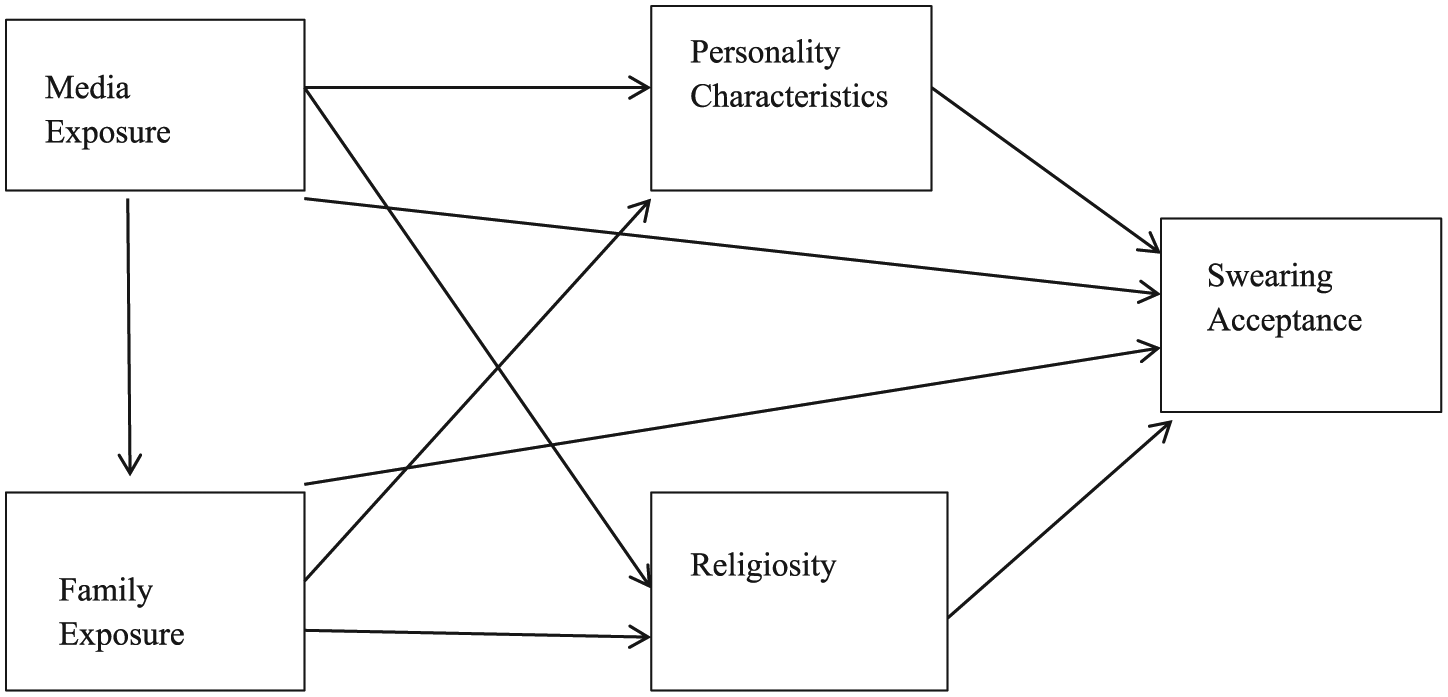
Structural equation model.
It is important to note that research on swearing is rather limited, with most research on the topic focusing on media swearing content, reasons for the use of swear words, and consequences of swearing. In addition, many efforts have been made to censor media under the assumption that exposure to swearing would be detrimental to children and adolescents. However, children and adolescents are exposed to swearing from a number of sources and may be exposed to swearing from sources other than media, which may have more of a profound impact on the use of swear words. Therefore, the current study aimed at determining the initial source(s) of swear word exposures.
Method
Participants and Procedure
Data were originally collected from 818 college students from a large southeastern public research university. Participants were recruited through psychology courses and received research credit or class extra credit for their participation. All participants read an explanation of research prior to completing the online questionnaire. Participants took on average 27.25 min to complete the questionnaire. Participants were first asked questions about their personality characteristics, religiosity, swearing exposure, swearing history, and attitudes regarding swearing, followed by general demographic questions. By asking participants questions about swearing exposure prior to asking questions regarding their own swearing histories and acceptance, the possibility of demand influence was reduced. For instance, although it is possible for participants to recognize that they use swear words during the course of the study, it is not possible for participants to seek an explanation for their swearing habits while completing the questionnaire. The order of questions prevented participants from seeking to blame the effects of media exposures for their swearing habits, rather than that of their parents.
A total of 55 participants were deleted from the study because their responses indicated that they were not involved with the survey or they did not answer important questions in the study. Of the 763 participants remaining, approximately 66% of the participants were female (n = 501) and 34% (n = 262) were male. The majority of the participants (86.7%, n = 662) ranged from 18 to 21 years of age and identified themselves as White (74.8%, n = 571).
Measures
Demographics
Participants were asked three questions to determine their age, ethnicity, and sex.
Personality characteristics
The Big Five Inventory (BFI; Benet-Martinez & John, 1998; John, Donahue, & Kentle, 1991; John, Naumann, & Soto, 2008) was used to assess participants’ level of extroversion, agreeableness, conscientiousness, neuroticism, and openness. This is a 44-item scale that asks participants to rate themselves on a scale of 1 (disagree strongly) to 5 (agree strongly) on items intended to assess the Big Five personality traits. Example items for extroversion include “is talkative” and “is reserved.” Example items for agreeableness include “is helpful and unselfish with others” and “has a forgiving nature.” Example items for conscientiousness include “does a thorough job” and “is a reliable worker.” Example items for neuroticism include “is depressed, blue” and “can be tense.” Example items for openness include “is original, comes up with new ideas” and “is curious about many different things.”
Eight items were summed to determine level of extroversion, with three items being reversed scored. Nine items were summed to determine level of agreeableness, with four items being reversed scored. Nine items were summed to determine level of conscientiousness, with four items being reversed scored. Eight items were summed to determine level of neuroticism, with three items being reversed scored. Ten items were summed to determine level of openness, with two items being reversed scored. The alpha reliability for the Extroversion subscale was .85, for the neuroticism subscale was .80, for the Agreeableness subscale was .77, for the Openness subscale was .76, and for the Conscientiousness subscale was .80. Higher scores indicated higher levels of the Big Five personality traits.
The Urgency, Premeditation, Perseverance, and Sensation Impulsive Behavior Scale (UPPS) was used to determine participants’ level of impulsivity (Whiteside & Lynam, 2001).This 59-item scale asks participants the extent to which they agree with such statements as “I have a reserved and cautious attitude toward life” and “My thinking is usually careful and proposed.” Response options range from 1 (agree strongly) to 4 (disagree strongly). Items were reversed scored and then summed for a total impulsivity scale that was used in analysis. The alpha reliability for the scale was .92.
Religiosity
Three items, developed for this study, were used to assess participants’ level of religiosity. Items included current frequency of religious meeting attendance, current level of importance placed on religion, and current frequency of reading religious scripture.
Swearing exposure
Eight questions, developed for this study, were used to determine the level of exposure to swear words while growing up from family (i.e., mother, father, siblings), social factors (i.e., friends, peers), and media (i.e., music artists outside of songs, song lyrics, movies). Response options ranged from 1 (never) to 5 (almost always). Alpha reliability for the scale was .64. Media exposures were summed to derive at a total media exposure score that was used in the structural equation modeling (SEM) model. Family exposures were also summed for the SEM model.
Attitude toward swearing scale
Because the current literature lacks a measure of attitude toward swearing, one was developed for the current study (see appendix). Twenty items asked participants to rate how strongly they agreed with using swear words in certain situations. Example items include “it is acceptable to swear when you are angry,” “it is acceptable to swear in an educational setting,” and “it is acceptable to swear when singing along to music.” Response options ranged from 1 (strongly disagree) to 5 (strongly agree). The alpha reliability for the scale was .94.
Results
Preliminary analyses were conducted to assess the reliability, distributional characteristics, and intercorrelations of measures and the extent of missing data. Analyses indicated that missing data for the current study were less than 3%. Therefore, a simple mean substitution imputation method was used (Kline, 2005). This method involves replacing the missing data with the overall mean value for the variable. There is the possibility that replacing missing data in this manner can distort the distribution of the data. However, comparison of variable distributions before and after imputation indicated that this method had no detectable effect on the data. The new data set was used in analyses.
Analyses relevant to the study aims are described in the following sections. These include (a) descriptive statistics reporting swearing exposures, (b) exploratory analyses for swearing acceptance based on the Big Five personality characteristics and measures of religiosity, (c) hierarchical multiple-regression analyses of the relation between media and family exposures to swearing and swearing acceptance, and (d) a structural equation analysis assessing the fit of the hypothesized mediational model.
Swearing Exposures
As can be seen in Table 1, participants reported that they heard their mother swear the most frequently while growing up. The mother was the primary source of swearing exposure not only from family sources (e.g., father, siblings) but also in comparison with social and media sources of swearing exposure. Song lyrics was the primary source of swearing exposure from the media sources examined in the current study (e.g., music artists, movies), followed by the swearing of music artists not contained in song lyrics, and then movies.
Swearing Exposures.

Note. Data represent participants who heard swear words most frequently.
Personality and Religious Influences on Swearing
A series of ANOVAs were conducted to determine whether there were significant differences in swearing acceptance based on levels of the Big Five personality traits (i.e., openness, conscientiousness, extroversion, agreeableness, and neuroticism). Results for openness, F(34, 728) = 1.68, p = .01, conscientiousness, F(30, 732) = 2.66, p < .001, and agreeableness, F(28, 734) = 2.59, p < .001, were significant. As levels of openness, conscientiousness, and agreeableness increased, so did participants’ level of swearing acceptance. Results for extroversion, F(31, 731) = 0.78, p > .05, and neuroticism, F(31, 731) = 1.05, p > .05, were not significant.
A three-way ANOVA was conducted to determine how measures of religiosity influence swearing acceptance. Results indicated a main effect for participants’ current level of importance placed on religion, F(4, 648) = 5.71, p < .001, and frequency of reading texts, F(5, 648) = 2.78, p = .02. Participants who did not place much importance on religion and those who seldom read religious texts had higher levels of swearing acceptance than those who viewed religion as important and who read texts regularly. An interaction effect of importance placed on religion and frequency of reading religious texts was also found, F(19, 648) = 1.78, p = .02. Participants who did not view religion as important and who rarely read religious texts had the highest levels of swearing acceptance compared with other participants. No main effect for religious meeting attendance was found, F(4, 648) = 1.37, p > .05, and no other interaction effects were found. Descriptive statistics can be found in Tables 2 and 3.
Religiosity Main Effects for Swearing Acceptance.

Religiosity Interaction Effect for Swearing Acceptance.
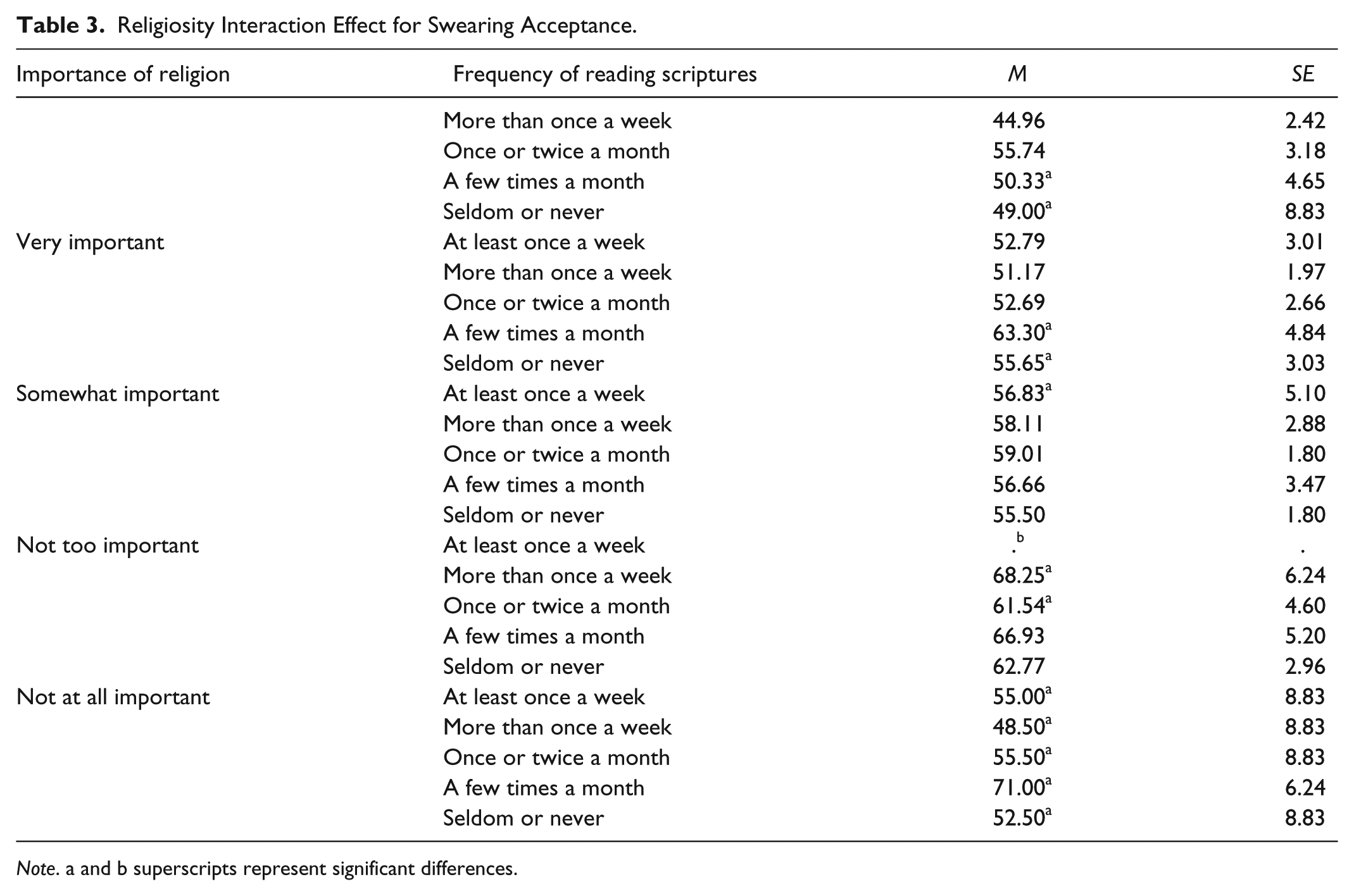
Note. a and b superscripts represent significant differences.
Media and Family Exposures Predicting Swearing Acceptance
Hierarchical multiple-regression analyses were conducted for swearing acceptance. Participants’ age and gender were entered first as control variables, followed by media exposures to swearing (music artists, song lyrics, movies), family exposures to swearing (mother, father, siblings), and social exposures to swearing (friends, peers). Interaction terms of interest were then entered (Gender × Media Exposures, Gender × Family Exposures, Gender × Social Exposures, Family Exposures × Media Exposures, and Social Exposures × Media Exposures). Results can be found in Table 4.
Predicting Academic Swearing Acceptance: Hierarchical Regression Analysis.
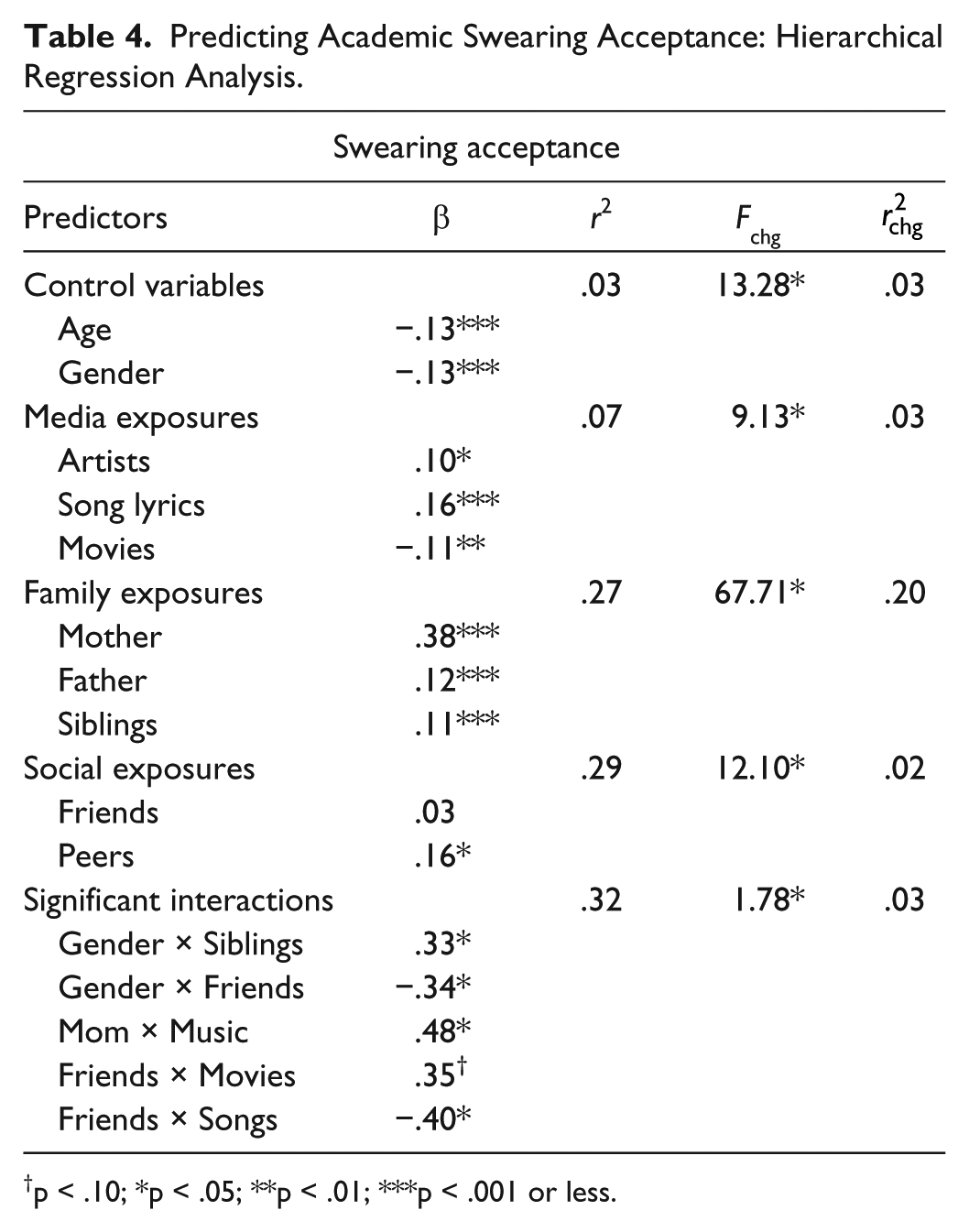
p < .10; *p < .05; **p < .01; ***p < .001 or less.
For swearing acceptance, age and gender were significant predictors. Younger participants were more accepting of the use of swear words than older participants. Females also reported more acceptance of the use of swear words than males. The block representing media exposures was also significant. For exposure from music artists and song lyrics, as exposure increased so did participants’ acceptance of swearing. For movies, however, the reverse occurred. As exposure from movies increased, participants’ acceptance of swearing decreased. The blocks representing family and social exposures were significant. For all family exposures (mother, father, siblings) and social exposures (friends, peers), as the level of exposure increased so did participants’ acceptance of swearing.
Results indicated a significant interaction effect of gender and exposure from siblings, in that males who were exposed to swearing by their siblings reported more acceptance of the use of swear words than females who were exposed to swearing by their siblings. There was also a significant interaction effect of gender and exposure from friends, in that females who were exposed to swearing by their friends reported more acceptance of the use of swear words than males who were exposed to swearing from their friends. An interaction effect of swearing exposure from mothers and swearing exposure from music artists was also found. As exposure to swearing from mothers increased and exposure from music artists increased, so did participants’ level of swearing acceptance. Interaction effects of exposure from friends and exposure from movies and exposure from friends and exposure from song lyrics were also found. As friends’ exposure of swearing increased and exposure from movies increased, participants’ level of swearing acceptance also increased. However, the reverse occurred for the exposure from friends and exposure from song lyrics. As friends’ exposure increased and exposure from song lyrics increased, the swearing acceptance of participants decreased.
Structural Model of Paths Through Which Media and Family Exposures Relate to Swearing Acceptance
The extent to which media exposures related to swearing acceptance through the hypothesized mediating factors (personality characteristics, religiosity measures) was assessed with SEM using AMOS 17.0 software. Data were analyzed first for outliers and nonnormality. Multivariate normality was evaluated using Mardia’s test for multivariate normality. Univariate indices of skewness and kurtosis were also examined to determine whether the absolute value of any of these indices was greater than 2.0. In the current study, nonnormality was an issue. Therefore, bootstrapping with 2,000 iterations was utilized to remedy the problem.
Although not shown in Figure 1, participants’ age and gender were included in the model as exogenous control variables. The proposed model was a good fitting model for the data set, with a chi-square value of 4.37, df = 4, p = .36, Comparitive Fit Index (CFI) of 1.00, Root Mean Square Error of Approximation (RMSEA) of .01, and p of Close Fit (PCLOSE) of .91. Inspection of the residuals and modification indices revealed no ill-fit in the model. Figure 2 is a simplified model highlighting the significant paths from media and family exposures to swearing and swearing acceptance; it includes parameter estimates for the structural coefficients in the model. Standardized coefficients appear on each path, with unstandardized coefficients in parentheses. Standardized coefficients for all paths in the model and significance levels can be found in Table 5.

Significant paths from media and family exposures to swearing acceptance.
Standardized Path Coefficients for the Model.
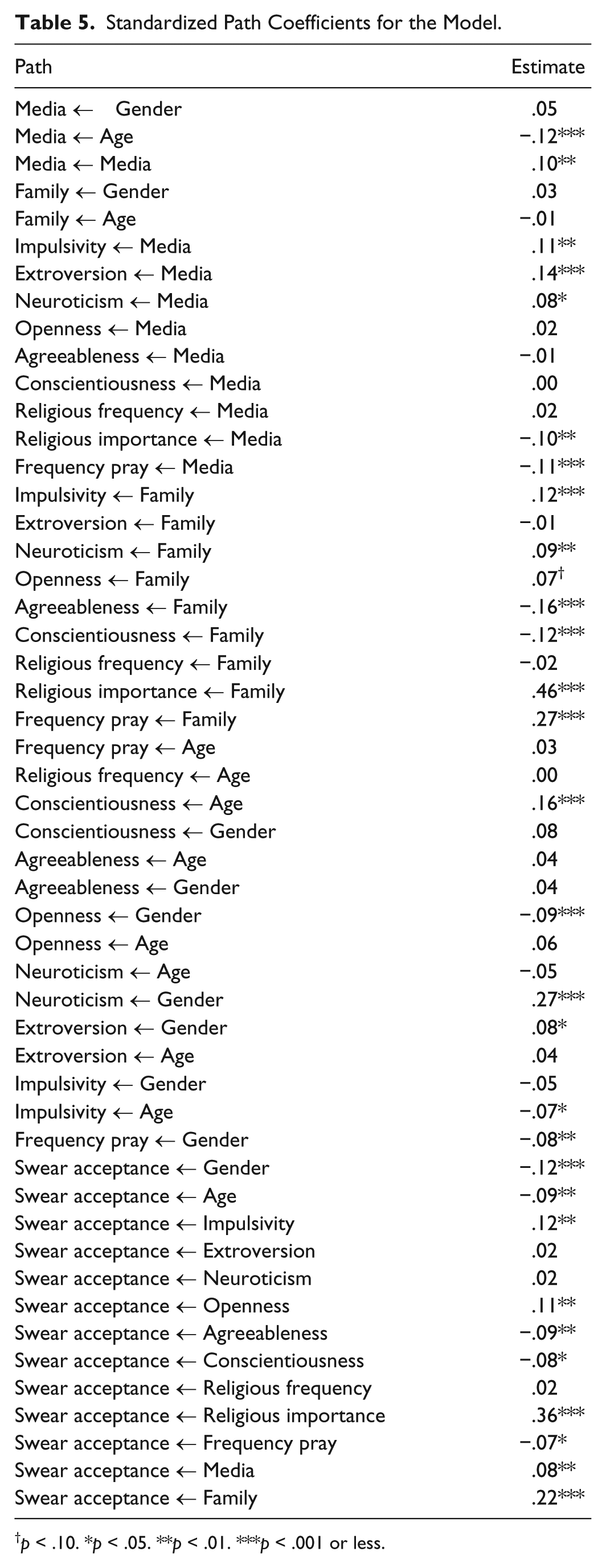
p < .10. *p < .05. **p < .01. ***p < .001 or less.
Among the individual paths, media exposure and family exposure were both related directly and indirectly to swearing acceptance. The impact of media exposure to swearing acceptance was mediated by family exposures, personality characteristics (conscientiousness, agreeableness impulsivity), and religiosity measures (religious importance, frequency of praying).
Among the control variables, age was associated with media exposure, conscientiousness, impulsivity, and swearing acceptance. Younger participants reported more exposure to swearing via media sources than older participants. Younger participants were also more impulsive and more accepting of the use of swear words than older participants. Older participants were more conscientious than younger participants. Gender was associated with openness, neuroticism, extroversion, frequency of praying, and swearing acceptance. Female participants reported more openness, frequency of praying, and more acceptance of swearing than males. Male participants reported higher levels of neuroticism and extroversion than females.
Discussion
In the current study, effects of media and familial exposures to swearing on accepting attitudes toward swearing were examined as a function of participants’ age, gender, and social influences on swearing. The study aimed at determining (a) sources of swearing exposure, (b) the influence of personality characteristics and religiosity on swearing acceptance, (c) the relation between media and family exposures to swearing acceptance, and (d) how media and family exposures relate to swearing acceptance through potential mediating factors (i.e., personality characteristics, religiosity).
Swearing Exposures
Results indicated that the majority of participants reported their mothers to be the highest source of exposure to swear words over external sources, such as the media influences. These findings support Jay and colleagues’ (2006) results that participants reported learning to swear from peers and people in their social circle, not through various forms of media, such as television or music. This is not surprising considering that according to the social learning theory, parents serve as role models and provide the main source of observational learning (Kohn, 1969, 1983). It is ironic, however, that exposure to profanity within media is a determining factor in parental monitoring in Western culture of media sources, when exposure to swearing occurs primarily from the mother (Jay & Janschewitz, 2012). It is also ironic that mothers are the primary disciplinarians when it comes to the use of swear words by their children (Baruch & Jenkins, 2007; Jay et al., 2006).
In terms of media exposures to swear words, results of the current study found that participants reported exposure to swear words more from song lyrics than from movies or music artists (outside of their song lyrics). This was not surprising as previous research has found song lyrics to contain swear words, especially rap music lyrics (Jones, 1997). The current study, however, did not examine swear word exposure in song lyrics based on music genre. It was interesting, though, that swearing exposure from music artists (outside of their song lyrics) was more frequent than reported exposure from movies. To date, no other study has identified exposure from music artists outside of their song lyrics. However, with increases in technology and various forms of media outlets (e.g., Twitter), listeners are more frequently exposed to the opinions and attitudes of music artists outside of their song lyrics. There is also censorship in broadcasting from the Federal Communications Commission (FCC) and other organizations, which may explain the reduced amount of reported swearing exposure from movies.
Personality and Religious Influences on Swearing
The current study also examined how the Big Five personality traits and level of religiosity influenced swearing acceptance. Research that has examined aspects of personality in relation to swearing has focused on impulsivity and Type A personality types (Janschewitz, 2008; Jay, 2009; Reisig & Pratt, 2011). No research to date, however, has examined the Big Five personality traits.
Results of the current study indicated that those who were high on openness, conscientiousness, and agreeableness were more accepting of the use of swear words. However, those high on extroversion and neuroticism were less accepting. Although the analyses were exploratory in nature, some of the findings were not expected. For instance, those who were high on conscientiousness tend to show self-discipline and are less likely to be spontaneous (Atkinson, Atkinson, Smith, Bem, & Nolen-Hoeksema, 2000). Their accepting attitudes toward the use of swear words were unexpected, considering that swearing often occurs as an impulsive expression of anger or frustration (Jay, 2009). It was also surprising that those high on agreeableness, who are generally well tempered, reported more favorable attitudes toward swearing. The nonsignificant results regarding those who were extroverted and high on levels of neuroticism were also somewhat surprising. Generally, those who are extroverted experience positive emotions and those who score high on neuroticism experience unpleasant emotions (Atkinson et al., 2000). Therefore, it was anticipated that those low on scores of extroversion and those high on scores of neuroticism would be more accepting of swear words. However, that was not the case in this study.
Other results were not surprising. Those who scored high on openness also had more favorable attitudes toward swearing. Generally, those who have higher scores on openness have an appreciation for emotion (Atkinson et al., 2000), and because swearing is an expression of extreme emotion (Jay, 2009), this result was not unexpected.
Results of the current study regarding the influence of religiosity on swearing acceptance were expected. Those who placed high importance on religion and who read their religious texts regularly were less accepting regarding the use of swear words. Participants who did not place much importance on religion and seldom read religious texts were more accepting of the use of swear words. Results confirm that religious teachings view profanity as unacceptable. Participants who are active in their religion may try to avoid using swear words and are less accepting of their usage due to social sanctions that they may receive by others within their religions community (Sherkat & Wilson, 1995). They may also be less likely to accept the use of swear words as a result of behavioral monitoring from others within their religion (Sherkat & Wilson, 1995).
Media and Family Exposures and Swearing Acceptance
Exposures to swearing from media, family, and social sources were associated with participants’ level of swearing acceptance. Participants were exposed to swearing from music artists (outside of their song lyrics), song lyrics, as well as movies. Media exposure from both music artists and song lyrics increased level of swearing acceptance, whereas exposure from movies decreased level of swearing acceptance. This may be a result of tight censorship on movies from the FCC along with modern advances in technology and media sources (e.g., Twitter), exposing listeners to music artists’ opinions and attitudes outside of their song lyrics. Familial sources of exposure included the mother, father, and siblings, with all three sources increasing the level of swearing acceptance. Considering that the family unit is the main source of observational learning, this was to be expected (Kohn, 1969, 1983). While peers served as a significant source of swearing exposure and increased level of swearing acceptance, friends were not. This was somewhat surprising as friends are a strong socializing tool.
Male participants were more influenced by the swearing of their siblings than were female participants. This may be because of the close-knit relationship male siblings experience (Brody, 2004). It would be interesting to determine whether the sex of the sibling influenced how male participants were influenced by their siblings. Unfortunately, the current study did not access the sex of siblings. It could also be that males are more likely to be more accepting of swearing as a result of parenting practices. Males are often given more freedom in terms of expression, actions, and behaviors than females (Carillo, 1982). Female participants, on the contrary, were more influenced by the swearing of their friends than male participants. It may be that female participants were more influenced by their friends for fear of rejection or acts of relational aggression (Crick et al., 2006; Underwood, 2003), whereas male participants were not as concerned about being rejected by their friends.
Of particular note is the interaction between swearing exposure from the mother and swearing exposure from music artists. As swearing exposure from mothers increased and exposure from music artists increased, so did participants’ level of swearing acceptance. Results of the current study indicate that the impact of media exposures on level of swearing acceptance is both moderated (i.e., hierarchical regression analysis) and mediated (i.e., SEM) by family exposure. This is an interesting relationship because mothers reportedly tend to be the primary disciplinarian with verbal punishment (Baruch & Jenkins, 2007; Jay et al., 2006) and that exposure to profanity within media is a determining factor in parental monitoring in Western culture of media sources (Jay & Janschewitz, 2012). Considering that mothers are the primary source of swearing exposure, it may be that mothers do not want to take the blame for the behavior of their children and blame media influences as an outside source.
Interaction effects of exposure from friends and movies and song lyrics were also found. As friends’ exposure of swearing increased and exposure from movies increased, participants’ level of swearing acceptance also increased. It could be that movies serve as a model for the use of swear words and that viewers have selective friends with views of swearing that increase their own acceptable views toward the use of swear words. Friends often watch movies together. Movies may be a significant socializing tool that may connect swearing use habits and attitudes among friends. However, the reverse occurred for the exposure from friends and exposure from song lyrics. As friends’ exposure increased and exposure from song lyrics increased, the swearing acceptance of participants decreased. Here, it may be that friends serve as a protective factor against the exposure to swear words from song lyrics, rather than promoting the use of swear words.
Mediating Factors Between Media and Family Exposures and Swearing Acceptance
The paths through which media and family exposures relate to swearing acceptance were assessed with SEM. It was hypothesized that personality characteristics and level of religiosity would mediate the relationship between media and family exposures to swearing and acceptable attitudes toward swearing. Overall, the model was a good fit to the data.
Among the individual paths, media exposure and family exposure were related both directly and indirectly to swearing acceptance. For both media and family exposures, as exposures increased so did participants’ level of swearing acceptance. The impact of media exposure to swearing acceptance was mediated by family exposure, personality characteristics (i.e., conscientiousness, agreeableness, impulsivity), and religiosity (i.e., religious importance, frequency of reading religious scripture).
Results indicated that as media exposure increased, so did family exposure. Family exposure, then, linked to swearing acceptance through conscientiousness, agreeableness, impulsivity, religious importance, and frequency of reading religious texts. Participants who were high on levels of conscientiousness and agreeableness were less likely to report acceptable views of swearing. Those who were impulsive were more likely to view swearing as acceptable, agreeing with the findings of Reisig and Pratt (2011). Participants who placed less importance on religion reported increased acceptance of swearing, whereas those who read religious texts regularly reported less acceptable views of swearing. Media also linked to swearing acceptance through impulsivity, religious importance, and frequency of reading religious texts.
Limitations of the Study
There are some limitations of the current study that merit discussion such as the modest size of some effects, limited generalizability of the findings, directionality issues of findings, and the use of retrospective data. With respect to effect sizes, although the overall hierarchical regression analysis was significant, some specific hypothesized links were marginally significant, such as the interaction effect of swearing exposure from friends and movies on level of swearing acceptance.
The sample used in this study was a college population, representing a distinct group of emerging adults, causing problems for generalizing the findings of this study to emerging adults who are not attending college. Also, the survey was administered online. This may have interfered with how participants responded to questions. Almost 7% of participants were discarded from analyses because their responses indicated that they were not involved with the survey or they did not answer important questions in the study. Better participant monitoring and control over data collection could have minimized this effect. Future research should include a social desirability question to help assess the honesty of participants in regard to their swearing histories and swearing acceptance.
The data analyzed in the current study consisted of single-item, retrospective data. Also, the current study could not assess change in participants or establish a cause and effect relationship between variables. It should also be noted that due to the nature of the data and the manner in which variables were assessed and measured, a directionality issue exists, which should be taken into consideration when interpreting the results. Because of the retrospective feature of the data, participants may have had difficulty with accurate recall of their past experiences and exposures to swear words.
Significance of the Study and Implications for Further Research
The current study provides a closer examination of the influence of media on acceptable views of swearing. The study has identified that the exposure to swearing comes from media, familial, and social sources. Results also indicate that both media and family influences on swearing acceptance are mediated by personality characteristics and religiosity. Of particular interest is the finding that media exposure to swearing is both moderated and mediated by family exposure. This information should be helpful to those involved in the censorship and monitoring of media content among children and adolescents, considering that many effects of media are assumed to be harmful (Jay & Janschewitz, 2012).
Although the results of this study help to answer questions regarding the impact of media exposures to swearing and level of swearing acceptance, they also pose implications for future research directions within this domain. In particular, future research should examine the relationship between personality characteristics and swearing acceptance more thoroughly. Research in this area is quite limited, and this is the first study to examine the Big Five personality characteristics to the level of swearing acceptance. In addition, future research should examine the relationship between media and family exposures to swearing more closely. The majority of research examining media influences omits the fact that media exposure is dependent on the context of exposure. The family unit is the main context in which media content is emitted to children and adolescence, and the family unit can both hinder and enhance such exposure. In agreement with the social learning theory, the family unit is the main source of observational learning when it comes to swear words and parents serve as primary role models for the use of swear words (Bandura, 1977; Kohn, 1969, 1983).
Footnotes
Appendix
Authors’ Note
The data presented, the statements made, and the views expressed are solely the responsibility of the authors.
Declaration of Conflicting Interests
The author(s) declared no potential conflicts of interest with respect to the research, authorship, and/or publication of this article.
Funding
The author(s) received no financial support for the research and/or authorship of this article.