




Abstract
In this study, we investigated the effects of primed power on sexual objectification of Caucasian and Asian men and women. As in previous studies, sexual objectification was assessed using an inversion paradigm with face–body compound stimuli. Previous work has shown that participants primed to power do not show the typical drop in recognition performance for inverted face–body compound stimuli, suggesting that they process these stimuli in terms of their individual features, in a manner akin to objects, and quite different from the way in which faces and bodies are normally processed (i.e., configurally). Caucasian male and female participants were primed to high or neutral-power before engaging in an old/new recognition task involving sexualized face–body compound images of Caucasian and Asian men and women. Participants primed to high-power showed a decreased inversion effect for Caucasian models of the opposite gender, but not for Asian models. Thus, power exerts different effects on this specific type of social perception, depending on the ethnic origin of the target. We discuss our results in the context of the extant literature on power and with reference to media stereotyping of Caucasians and Asians.
Objectification Theory
Objectification theory (Fredrickson & Roberts, 1997) provides a framework for understanding the experience of being a woman in a sociocultural context that sexually objectifies the female body. Sexual objectification refers to the situation where a woman’s body is separated out from her person, and reduced to a mere instrument (Bartky, 1990). When objectified, women are treated as bodies that exist for the use and pleasure of men (Stoltenberg, 1989). One of the most ubiquitous ways of sexually objectifying a woman is through visual inspection of her body (Chen, Teng, & Zhang, 2013). Visual media portrays women’s bodies in various contexts including advertisements, television programming, visual arts, music videos, sports, and photography. (Reichert & Carpenter, 2004). The widespread portrayal of women as objects has many negative consequences including decreased mind attribution (Loughnan et al., 2010), dehumanization (Vaes, Paladino, & Puvia, 2011), and decreased agency perception (Cikara, Eberhardt, & Fiske, 2010). For example, when focusing on the appearance of people rather than their personality, male participants attributed fewer human characteristics to female targets, but not male targets (Loughnan & Haslam, 2007). Moreover, there are several adverse psychological consequences that sexual objectification has on women. Some of these are feelings of shame, anxiety, depression, and internalization of the observer’s perspective, which can lead to self-objectification (Calogero, 2004). This can sometimes push women to treat themselves as objects to be looked at and evaluated based on their body parts (Bartky, 1990; Fredrickson & Roberts, 1997; McKinley & Hyde, 1996). Although the negative effects and consequences of sexual objectification have been widely investigated, the cognitive processes involved in the perception of sexualized men and women were first investigated just a few years ago. The current study is focused on improving our understanding of these cognitive processes and not with directly testing any downstream consequences of objectification.
Featural Versus Configural Processing of Sexualized Men and Women
The terms featural and configural processing were first introduced in the face and object recognition literature. It is well known that to recognize a familiar face, we exploit the spatial arrangements among the features (nose above the mouth, eyes above nose, and so on) in a manner known as configural processing. Conversely, in featural processing, objects are recognized by their individual features perceived in isolation (for a review, see Maurer, LeGrand, & Mondloch, 2002). The marker of this difference in the perceptual processing of faces and objects is the face inversion effect (FIE; Yin, 1969). The FIE refers to an impairment in recognition of familiar faces that have been turned upside down. The common explanation of this phenomenon is that when a face is inverted, the configural information is distorted, and as a result, recognition of the face is disrupted (Maurer et al., 2002). Recently, a similar FIE has been found for images of isolated bodies, suggesting that both faces and bodies are perceptually processed configurally—based on the spatial relationships among the main features that constitute a face or body (Reed, Stone, Grubb, & McGoldrick, 2006; Seitz, 2002; Tanaka & Farah, 1993). However, similar effects of inversion have not been found for objects (e.g., airplanes, houses, cars) suggesting that configural processing is more typical of face and body stimuli, whereas featural processing is more important in object recognition (Maurer et al., 2002).
Gervais, Vescio, Förster, Maass, and Suitner (2012) extended the notion of configural and featural processing from the face/body and object recognition literature to sexual objectification. These concepts have highlighted differences in the perception of male and female sexualized stimuli at a basic cognitive level. Critically, images of women’s body parts presented in isolation were recognized (by male and female participants) better than when presented within the context of the full body. However, the opposite pattern was true for images of men’s body parts, in which male body parts were recognized better within the full body context than when presented in isolation. These findings suggest that female bodies are processed in terms of their individual parts, that is, via featural processing, whereas male bodies are processed holistically, that is, via configural processing. Bernard, Gervais, Allen, Campomizzi, and Klein (2012) showed that when both male and female participants were presented with inverted sexualized images of men, they were affected by inversion resulting in impaired recognition performance compared with when they were presented with upright sexualized images of men. This inversion effect suggests that sexualized images of men are perceived in a configural way. In contrast, both male and female participants showed a reduced not significant inversion effect for sexualized images of women (similar performance in recognizing upright and inverted sexualized images of women) indicating that sexualized women are processed featurally just like objects. These new findings reported by Bernard et al. (2012) suggest that individuals process male and female sexualized stimuli in a configural or featural manner. Importantly, Gervais et al. (2012) and Bernard et al. have provided the first piece of evidence that sexual objectification can be measured empirically (through adaptation of cognitive tasks) through the examination of the cognitive perceptual processes behind it. This suggests that the sexual objectification showed by the increased object-like perceptual processing (i.e., featural processing), might be of kinds of objectification often discussed in contemporary sociocultural theories (e.g., Fredrickson & Roberts, 1997).
Social Power and Sexual Objectification
In recent work, Civile and Obhi (2015) adopted Bernard et al.’s (2012) notion of sexual objectification operationalized as lack of a significant inversion effect to investigate how objectification interacts with the sense of power of the perceiver. Power can been defined as the ability to influence the behavior of others by having control over their outcomes (Fiske, 1993). The authors recruited men and women and primed them to either high or low-power (Civile & Obhi, 2015; Experiment 2). In the high-power condition, participants were asked to write a narrative essay about a particular incident in which they had power over another individual—the ability to control others to get something they wanted, or being in a position of evaluating others (Fiske, 1993). Conversely, for the low-power condition, the participants were asked to write a narrative essay about a particular incident in which someone else had power over them. This procedure for priming power has been used often in the social power literature and has shown a deep impact on participants’ abilities to recognize emotional facial expressions (Galinsky, Magee, Inesi, & Gruenfeld, 2006), to discriminate objects (Weick, Guinote, & Wilkinson, 2011), to take others’ perspectives (Galinsky et al., 2006), and to mirror others (Hogeveen, Inzlicht, & Obhi, 2013). The main finding from Civile and Obhi’s (2015) study was that high-power priming of both men and women reduced the inversion effect on sexualized images of the opposite gender, but increased the inversion effect for same gender stimuli. This indicates featural processing, thus objectification of the opposite sex, but configural processing and no objectification of the same sex. Together with Gervais et al. (2012) and Bernard et al., the results from Civile and Obhi contribute to a better understanding of the cognitive processes underpinning sexual objectification of both men and women. Moreover, these results along with some previous studies (Gruenfeld, Inesi, Magee, & Galinsky, 2008; Kunstman & Maner, 2011) suggest that priming individuals to high-power may activate a mating goal that could lead to objectification of others when presented within a sexualized context (Civile & Obhi, 2015).
Ethnic Origin and Gender Comparison in Models in Advertising
Although the studies described above theorize about sexual objectification as it applies to all women and in the context of men in power, they focused almost exclusively on Western Caucasian women (Fredrickson & Roberts, 1997). Presently, there are very few empirical studies that have looked at the cognitive bases of sexual objectification of women and men from different cultural groups. Some studies have examined how Western Caucasian female models are more objectified in advertisements compared with Asian female models (Arima, 2003; Busby & Leichty, 1993; Cheng, 1997). In mainstream Western magazines, Caucasian female models are often depicted standing in stereotypically suggestive poses and making eye contact with the camera, so as to effectively convey intimacy and seduce the consumer (Goffman, 1979; Shields, 1990; Soley & Kurzbad, 1986). Cheng (1997) compared women in Chinese and American television commercials and found that, compared with women in Chinese television commercials, American women wear less modest and more suggestive clothing. Moreover, it has been found that images of Caucasian female fashion models are often used to advertise intimate or romantic products such as lingerie and provocative dresses, whereas images of Asian female models are more often used to advertise household or domestic products (Davis, 1999). In addition, Frith, Cheng, and Shaw (2004) showed that hair and facial beauty products comprise the greatest proportion of advertisements featuring Asian female models (55.2%), whereas Caucasian female models are more likely to be seen advertising clothing (46.8%), suggesting that Caucasian women are perceived with greater reference to their bodies. These studies indicate that objectification of women in the media varies across different ethnic origin models. Caucasian models are more often represented in body-related products, whereas Asian models are used more in advertisement for facial beauty and domestic products.
Less research has been conducted on differences in advertising for male body images between the West and the East. A key study ran by Yang, Gray, and Pope (2005) showed that Asian and American magazine advertisements portrayed nearly half of Western Caucasian men in a state of undress, whereas Asian men were showed in such as state in only 5% of cases. This is likely driven by the Western Caucasian ideal of masculinity as a breadwinner, whose muscular body symbolizes attributes such as production, work, and responsibility (Shaw & Tan, 2014). Since Roman and Greek ancient history, masculinity has been illustrated as male athleticism and fitness (Bordo, 1999; Pope, Phillips, & Olivardia, 2000). However, it is not possible to find an equal historical focus of male athleticism and fitness in Asia. The traditional Asian ideal of masculinity focuses more on literary and cultural traits (Louie, 2002). In Chinese traditions, for example, masculinity includes more mental and civil personality characteristics (Larson, 2002; Louie, 2002; Louie & Edwards, 1995). Taken together, studies on gender and ethnic origin in advertisements show that Caucasian men and women are often portrayed in an objectifying manner by focusing on their body parts (in the case of women) and body strength (in the case of men). Instead, Asian men and women would seem to be represented in a way that focuses more on their facial characteristics and cultural traits. By portraying each ethnic origin differently, the media appears to have created a stereotype of Caucasians as more physical and body centric, perhaps even more “sexualized,” than their Asian counterparts.
The Current Experiment
In line with recent studies, the current experiment aimed to investigate differences in the cognitive processes of sexual objectification for own and other ethnic origin sexualized men and women. Civile and Obhi (2015)’s study revealed that high-power priming of men and women increases sexual objectification of the opposite gender. To replicate these findings of Caucasian sexualized men and women, and to extend them to Asian sexualized men and women, we primed male and female Caucasian participants to high-power. In addition, we recruited another sample of participants and primed them to neutral-power to control for any effect of power on objectification. The inversion effect paradigm was selected as the experimental paradigm because it has consistently been used to investigate cognitive processes of sexual objectification (Bernard et al., 2012; Civile & Obhi, 2015). It also allows for a robust and clear interpretation of the perceptual processes involved in the task. Less objectification is associated with configural processing typical of face and body recognition and thus the inversion effect. In contrast, more objectification is associated with featural processing used in object recognition and so the reduction of the inversion effect. We investigate whether high-power priming will induce greater sexual objectification of opposite gender Caucasian and Asian models. Furthermore, we hypothesize that the effects of objectification of Asian sexualized women would be smaller compared with that for Caucasian women in the neutral-power group. Based on the literature on gender and ethnic origin in advertisements, Asian women are often portrayed in a more humanized way than Caucasian women. A recent study by Bernard, Gervais, Allen, Delmee, and Klein (2015) showed that providing information about human characteristics reduces objectification—greater inversion effect—of sexualized women targets because they are perceived as humans rather than objects. Thus, the key question explored here is how induced power influences objectification of sexualized images of men and women who differ in ethnic origin, that is, are from Caucasian or Asian racial backgrounds.
Method
Materials
For the Caucasian stimuli set, we used the same images used in Civile and Obhi (2015). Following Bernard et al. (2012) and Civile and Obhi (2015), an online search was conducted for pictures depicting the body and face of Asian models wearing a swimming suit, or similar clothing (Figure 1). In total, 64 pictures of Caucasian models (32 females and 32 males) and 64 pictures of Asian (32 females and 32 males) models wearing black clothing in front of a gray background were selected. Finally, as in Civile and Obhi (2015), the picture sizes were standardized to 500 × 750 pixels.

Example of the Caucasian and Asian sexualized stimuli for each gender and orientation condition: male upright, male inverted, female upright, and female inverted.
Participants
Only Caucasian participants were recruited for the purpose of directly comparing sexual objectification of own ethnic origin sexualized stimuli with other ethnic origin, and specifically Asian sexualized stimuli. Just like Civile and Obhi (2015; for other examples of strong effect of the power prime on samples of 15-18, see also Hogeveen et al., 2013; Obhi, Swiderski, & Brubacher, 2012), we recruited 17 participants for each sample group: Male High-Power, Male Neutral-Power, Female High-Power, and Female Neutral-Power. In addition, a post hoc power analysis using G*Power software (Faul, Erdfelder, Lang, & Buchner, 2007) revealed a statistical power of 0.97 for an overall sample of 68 participants (split by fours groups of equal number) and three measurements (image ethnic origin, image gender, image orientation). This is in agreeing with the recommended 0.80 level of power (Cohen, 1988).
All participants were university students (Mage = 21, range = 18-24) with normal or corrected-to-normal vision who participated in the experiment for CAD$20 compensation or course credits. They provided written informed consent, and the procedures were approved by the institutional ethics review board. An end of study questionnaire revealed that none of the models appeared familiar to the participants, and all participants were heterosexual.
The Power Prime and Experimental Procedure
Prior to the old/new recognition task, participants in the high-power condition typed a narrative essay about a particular incident in which they had power over another individual, including a description of how they felt in that moment (Galinsky, Gruenfeld, & Magee, 2003; Galinsky et al., 2006; Guinote, 2007a, 2007b; Hogeveen et al., 2013). The experimenter left the testing room to give the participants 10 min to write about the past event. A similar procedure was applied to participants in the neutral-power condition, however, they were asked to write about what they did the day before they came in for the study (Civile & Obhi, 2015; Hogeveen et al., 2013).
After completing the essay, participants were asked to perform a seemingly unrelated old/new recognition task. We used the same inversion paradigm previously used in Civile and Obhi (2015) so we could replicate their findings of power on sexual objectification of Caucasian sexualized stimuli and compare them with Asian sexualized stimuli. The task consisted of a “study phase” followed by an “old/new recognition phase” (Civile, McLaren, & McLaren, 2014; Civile & Obhi, 2015).
In the study phase, each participant was shown eight photos from each of the eight image types: Caucasian Male Upright models, Caucasian Male Inverted models, Caucasian Female Upright models, Caucasian Female Inverted models, Asian Male Upright models, Asian Male Inverted models, Asian Female Upright models, and Asian Female Inverted models. In this phase, participants were instructed to memorize the images they sequentially viewed. In the old/new recognition phase, participants were shown the 64 images from the study phase, as wells as 64 novel images split into the same eight stimulus types. By display of directions presented on the computer screen, participants were instructed to judge whether they had seen the images during the study phase or not.
The images were presented sequentially in random order, and once per participant. Old and new stimuli, as well as upright and inverted stimuli were randomized across different participants. Participants pressed one key if they had seen the image before (old) and another key if they had not seen it before (new). Response keys were counterbalanced across participants.
Trial Structure
In the study phase, participants memorized a set of stimuli presented sequentially. Each trial began with a fixation cross presented in the center of the screen for 1 s followed by a picture stimulus presented for 3 s. After all 64 images had been presented, the program displayed another set of instructions, explaining the old/new recognition task. During the old/new recognition task, the stimuli (the 64 ones seen in the study phase and 64 novel ones split by the four stimulus conditions) were displayed for 3 s during which time the participants had to respond (see Figure 2). The experiment was designed using SuperLab 4.5 (Lecarme & Delvare, 2013) installed on a PC.
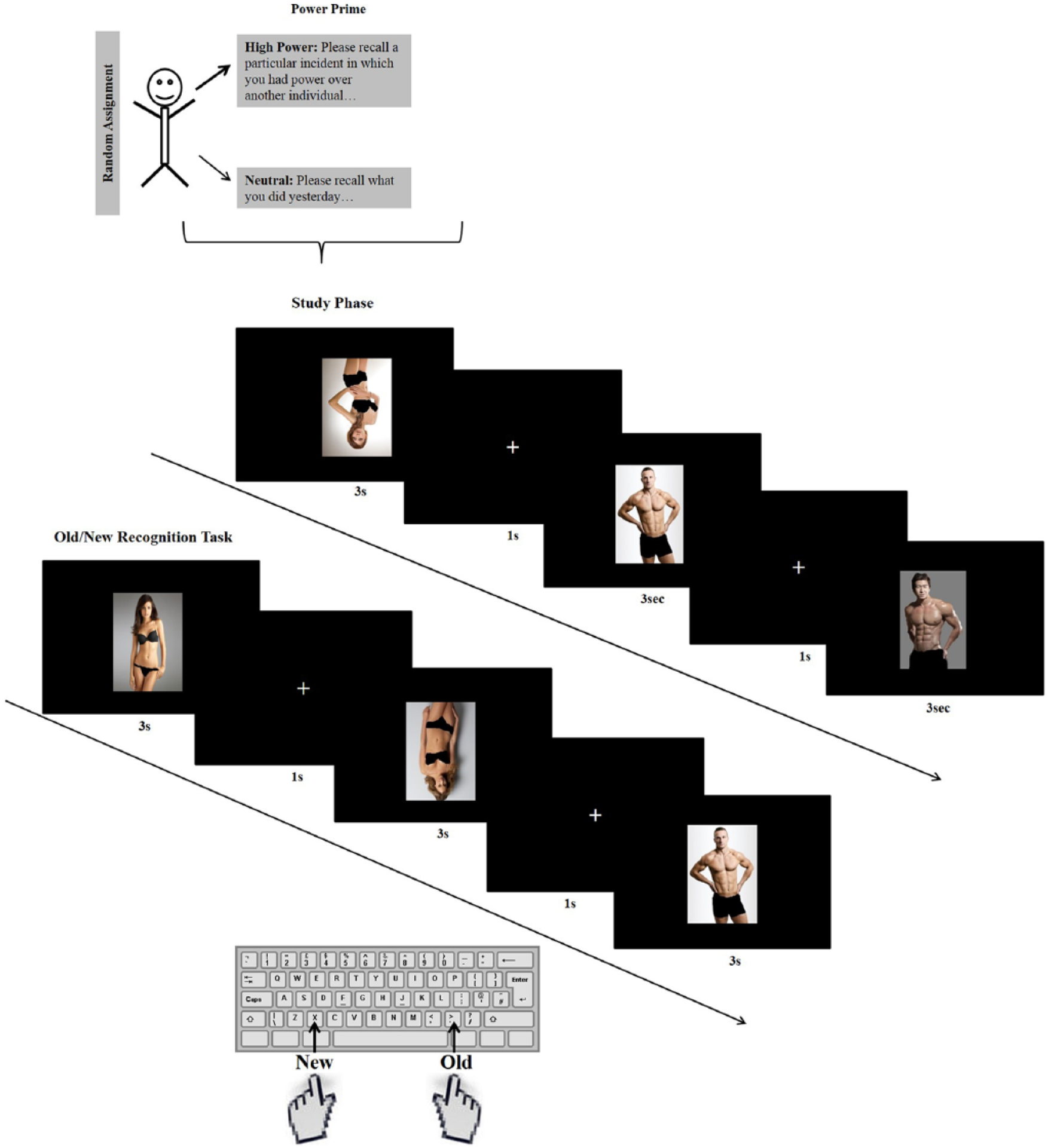
A schematic representation of the experimental procedure used in our study.
Results
The data from all the participants were used in the signal detection d’ analysis of the recognition task (seen and not seen stimuli for each stimulus type) where a d’ = 0.00 indicates chance-level performance (Stanislaw & Todorov, 1999).
Power Manipulation Check
Two independent evaluators outside the psychology department were recruited to rate each essay from the power prime. Evaluators were instructed to rate the power held by the participant in the essay on a scale from −3 (least power) to +3 (most power) (Civile & Obhi, 2015; Hogeveen et al., 2013; Obhi et al., 2012). The ratings given by the evaluators validated the effectiveness of the power prime. Evaluator 1 rated the high-power essays (M = 1.94, SD = 0.64) significantly more powerful than the neutral-power essays (M = 0.70, SD = 0.83), t(66) = 6.807, p <.001. A similar result was obtained from the ratings given by Evaluator 2. The high-power essays (M = 1.94, SD = 0.69) were rated more powerful than the neutral-power essays (M = 0.26, SD = 0.70), t(66) = 9.850, p <.001.
Recognition Task Accuracy
We conducted a five-way mixed-model ANOVA (2 × 2 × 2 × 2 × 2) using the within subject factors, Image Racial Background (Caucasian, Asian), Image Gender (male, female), Image Orientation (upright, inverted), and the between subjects factors, Participant Gender (man, woman) and Power (high, neutral). A significant five-way interaction was found, F(1, 64) = 7.580, p = .008,
High-Power
The factors Image Racial Background (Caucasian, Asian), Image Gender (male, female), Image Orientation (upright, inverted), and the between subjects factor Participants Gender (man, woman) were used in a 2 × 2 × 2 × 2 ANOVA revealing a significant four-way interaction, F(1, 32) = 11.089, p = .002,
Male group: Recognition accuracy
A 2 × 2 × 2 ANOVA using as factors Image Racial Background (Caucasian, Asian), Image Gender (male, female), and Image Orientation (upright, inverted) showed a significant three-way interaction, F(1, 32) = 6.105, p = .025,
Caucasian stimuli
A 2 × 2 ANOVA using as factors Image Gender (male, female) and Image Orientation (upright, inverted) showed a significant interaction, F(1, 16) = 6.402, p = .022,
Asian stimuli
A 2 × 2 ANOVA using as factors Image Gender (male, female) and Image Orientation (upright, inverted) revealed no significant interaction, F(1, 16) = 1.075, p = .31,
We conducted an additional analysis on the recognition performance for sexualized women. A 2 × 2 ANOVA using as factors Image Ethnic Origin (Caucasian, Asian) and Image Orientation (Upright, Inverted) shows a significant interaction, F(1, 16) = 10.49, p = .005,
Female group: Recognition accuracy
A 2 × 2 × 2 ANOVA using as factors Image Racial Background (Caucasian, Asian), Image Gender (male, female), and Image Orientation (upright, inverted) showed a significant three-way interaction, F(1, 32) = 5.071, p = .039,
Caucasian stimuli
A 2 × 2 ANOVA using as factors Image Gender (male, female) and Image Orientation (upright, inverted) showed a significant interaction, F(1, 16) = 10.103, p = .005,
Asian stimuli
A 2 × 2 ANOVA using as factors Image Gender (male, female) and Image Orientation (upright, inverted) revealed no significant interaction, F(1, 16) = 0.018, p = .89,
Furthermore, we conducted an additional analysis on the recognition performance for sexualized women. A 2 × 2 ANOVA using as factors Image Ethnic Origin (Caucasian, Asian) and Image Orientation (Upright, Inverted) shows no interaction, F(1, 16) = 0.95, p = .76,

Results of the old/new recognition task from the high-power men and women sample groups.
Neutral-Power
A 2 × 2 × 2 × 2 ANOVA using as factors Image Racial Background (Caucasian, Asian), Image Gender (male, female), Image Orientation (upright, inverted), and the between subjects factor Participants Gender (man, woman) did not reveal a significant four-way interaction, F(1, 32) = 0.643, p = .43,
Male group: Recognition accuracy
A 2 × 2 × 2 ANOVA using as factors Image Racial Background (Caucasian, Asian), Image Gender (male, female), Image Orientation (upright, inverted) showed a significant three-way interaction, F(1, 32) = 10.963, p = .004,
Caucasian stimuli
A 2 × 2 ANOVA using as factors Image Gender (male, female) and Image Orientation (upright, inverted) showed a significant interaction, F(1, 16) = 8.248,p = .011,
Asian stimuli
A 2 × 2 ANOVA using as factors Image Gender (male, female) and Image Orientation (upright, inverted) revealed no significant interaction, F(1, 16) = 0.138, p = .71,
Female group: Recognition accuracy
A 2 × 2 × 2 ANOVA using as factors Image Ethnic Origin (Caucasian, Asian), Image Gender (male, female), and Image Orientation (upright, inverted) showed a significant three-way interaction, F(1, 32) = 7.799, p = .013,
Caucasian stimuli
A 2 × 2 ANOVA using as factors Image Gender (male, female) and Image Orientation (upright, inverted) showed a significant interaction, F(1, 16) = 11.841, p = .003,
Asian stimuli
A 2 × 2 ANOVA using as factors Image Gender (male, female) and Image Orientation (upright, inverted) revealed no significant interaction, F(1, 16) = 0.651, p = .43,

Results of the old/new recognition task from the neutral-power men and women sample groups for the sexualized stimuli.
General Discussion
Here, we investigated how power influences the cognitive processes associated with the sexual objectification of Caucasian and Asian men and women. Our main finding is that high-power Caucasian participants do not show a significant inversion effect for Caucasian sexualized models of the opposite gender, but do show a significant inversion effect for Asian sexualized models. According to interpretations of the inversion effect paradigm in studies of sexual objectification (Bernard et al., 2012; Bernard et al., 2015; Civile & Obhi, 2015), the lack of a significant inversion effect suggests that Caucasian models of the opposite gender are processed featurally in an object-like manner, whereas the strong inversion effect obtained for Asian models suggests configural processing, more typical of face and body recognition.
Previous work has shown that Caucasian men and women primed to high-power did not show a significant inversion effect for sexualized Caucasian models of the opposite gender, supporting the claim that both men and women objectify each other (Civile & Obhi, 2015). The present study extends our understanding by demonstrating the importance of the model’s ethnic origin on this basic effect. The literature on ethnic origin and gender in advertising indicates how Caucasian and Asian women are portrayed differently in the media, with Asian women associated with home roles (e.g., housewives and mothers) and Caucasian women associated with sexualizing roles focused on the body (e.g., lingerie, provocative dress, etc.) (Cheng, 1997; Frith, Shaw, & Cheng, 2005). Similarly, the portrayal of Caucasian men in the media (even if not as much as Caucasian women) is more focused on their body as an index of masculinity, compared with the portrayal of Asian men, where the focus is more on mental and civil abilities (Yang et al., 2005). Our results from the high-power group are consistent with the idea that power, in conjunction with stereotypes of different ethnic origins influenced by the media, might lead to featural processing of Caucasian sexualized stimuli of the opposite gender. In contrast, a more configural processing strategy appears to be used for Asian sexualized stimuli, suggesting that they are processed more akin to how human faces and bodies are normally perceived. The practice implication of these findings is that by shifting the focus of the media from the bodies to the faces aspects of Caucasian men and women, we (intended as a society) might be able to reduce sexual objectification. Accordingly, promoting in the media an image of Caucasian men and women based on their caring, civil and mental abilities might also contribute to decrease sexual objectification.
There is a large body of literature on social power showing the interaction between power and stereotyping, mediated by attention (Fiske, 1993). High-power individuals are believed to pay less attention to others, and so are more influenced by stereotypes. (Depret & Fiske, 1993). In the case of sexual objectification, when individuals are primed to high-power, not only are they primed to seek out a potential mate (see Civile & Obhi, 2015; Kunstman & Maner, 2011) but are also more likely to rely on stereotypes in identifying a potential mate. It could be argued that the media has created stereotypes of Caucasian women and men that are more sexualized than stereotypes of their Asian counterparts. Again, Caucasian models are portrayed with more focus on their body, whereas Asian models are portrayed with more focus on their faces, their role at home (in the case of women) and their intellectual abilities (in the case of men) (Cheng, 1997; Frith et al., 2005). Considering that high-power priming may activate a mating goal and that power increases stereotyping, powerful people with a mating goal might be biased to see Caucasians as more instrumental to obtaining their goal and might therefore objectify them more. Again, with images of Caucasian models, participants primed to power seem to have focused their attention on individual features, and as a consequence showed no significant inversion effect. However, when presented with Asian models, high-power individuals (both men and women) continued to show the inversion effect. This finding is intriguing and important, but the reason why the effect emerged requires further investigation. There are several interesting possibilities that we discuss below.
Experts in face processing may argue that the results obtained in the high-power group could be explained by different levels of perceptual expertise in exploiting the configural information of the own and other ethnic origin images. The other-race-effect (Rhodes, Tan, Brake, & Taylor, 1989) refers to the ease of recognition for faces of one’s own ethnic origin. As a result, the inversion effect for other ethnic origin faces is usually smaller than that obtained from faces of the own ethnic origin (Fallshore & Schooler, 1995). The common explanation is that our expertise with the configural information for our own ethnic origin faces is more than that for other ethnic origin faces. When other ethnic origin faces are inverted, there is less expertise to disrupt and so that leads to a diminished inversion effect (Murray, Rhodes, & Schuchinsky, 2003). Our results for high-power groups clearly (see additional analyses) show that the inversion effect for Asian stimuli is not smaller than that for the Caucasian same gender stimuli, suggesting that the other-race-effect is not in play here. Also, the inversion effect for Asian opposite gender stimuli, is greater than the inversion effect found for Caucasian stimuli, which is opposite of what would be predicted based on the other effect. We suggest an explanation based on power-induced differences in perceptual processing of Caucasian and Asian stimuli, which could be due to the stereotypical portrayal of these different ethnic origins in the media.
Our findings suggest that when recognizing bodies of Caucasian targets of the opposite sex, participants processed them more featurally (i.e., more akin to how objects are typically processed), which resulted in no significant inversion effect. Researchers using the inversion paradigm to study objectification have not yet carefully determined whether processing of the face is relevant for the types of objectification we observe here, or whether the effects are completely driven by processing of the body. This is an important question for future research—one that we are currently pursuing. In general, further work is needed to verify the reason for the observed differences in the inversion effect for Caucasian versus Asian stimuli, in individuals primed to power. In addition, it would seem worthwhile to directly manipulate the stereotypes surrounding a specific ethnic origin to assess how such manipulation affects objectification.
Interestingly, Bernard et al. (2015; Experiment 3) showed that when participants were provided with information about the human characteristics of the sexualized models, objectification was significantly reduced resulting in a greater inversion effect. This suggests that sexual objectification, at least as indexed by a lack of a significant inversion effect, can be reduced by providing information about a model’s human characteristics. It is an open question as to what other types of top down information could modulate the effects we observe. Finally, additional techniques such as eye tracking could help in defining where exactly high-power individuals focus their attention when recognizing sexualized images.
The results from the neutral-power group highlight a significant issue that women face in Western society. That is, not only men but also women objectify other women as indexed by no inversion effect when recognizing Caucasian women. Several other studies have shown this effect in the past (Bernard et al., 2012; Bernard et al., 2015; Civile & Obhi, 2015; Haslam, 2006; Heflick & Goldenberg, 2009). Vaes et al. (2011) have suggested that men and women objectify women for different reasons: Men objectify women because they perceive them more like objects that are instrumental to their mating goals. Women, however, see sexualized women as negative exemplars for their category, thus they dehumanize and distance themselves from them by perceiving them as objects. Our results are consistent with this suggestion but moreover, we provide the first evidence that this self-objectification effect in women does not occur for Asian sexualized stimuli. We suggest that Caucasian women may not feel as though they belong to the same group as women from a different racial background, and therefore do not attempt to distance themselves from these women as suggested by Vaes et al. In the future, it is important to investigate this effect further by priming Caucasian women to feel as if they are part of a common category with targets of a different ethnic origin (e.g., both studying in the same department, or both part of the same sports team).
Finally, experts in social power may interpret our results as related to the enhancement in performance that high-power priming elicited in participants. Studies showing that priming people to high-power often improves their performance in cognitive tasks (Guinote, 2007a, 2007b) would predict that high-power participants show no inversion for all the sets of stimuli as a consequence of an improved recognition ability given by the prime. Based on our results and Civile and Obhi (2015), we can firmly exclude this notion. Our findings show that the lack of an inversion effect in the high-power group only occurs when participants were presented with Caucasian sexualized images of the opposite gender and not for the same gender and other ethnic origin stimuli.
One limitation in the current and other work adopting the inversion paradigm to study social perception of sexualized stimuli relates to understanding why featural processing might be useful for powerful agents recognizing sexualized targets. That is, what advantage, if any, does a switch from configural to featural processing confer on a powerful agent? We suggest that, if power primes a mating goal, then a switch to featural processing may assist in discrimination between different potential mates. This idea is in line with perceptual learning theories that emphasize a role for configural processing in learning category exemplars (Gauthier & Tarr, 1997; McLaren, 1997). That is, when categorizing an exemplar, there is a focus on prototypical configurations of features that the exemplar shares with all other exemplars from the same category. However, when differentiating one exemplar from the rest, a focus on the unique features of that exemplar is required—that is, what makes that exemplar unique (Civile et al., 2014). This idea that featural processing may aid in mate selection is also in line with evolutionary psychology theories. Studies have shown that both genders favor mates who display high-quality fitness reproductive indicators (Sefcek, Brumbach, Vasquez, & Miller, 2007). Thus, for successful mating, sexualized targets may be perceived featurally by individuals seeking for particularly relevant body parts that indicate reproductive fitness (e.g., hip-waist-ratio in the case of women, waist-to-chest ratio in the case of men). Power may be the trigger that motivates individuals to seek for a mate and this would lead them to process featurally sexualized stimuli of the other gender.
A potential issue with our study is about the stimuli used. Tarr (2013) and, more recently, Schmidt and Kistemaker (2015) suggested that gender asymmetry (i.e., differences in physical forms) of male and female images, could have accounted for the pattern of results Bernard and colleagues (2012) observed. However, we have three reasons to believe our study not to be affected by this criticism. First, whereas Bernard et al. used a direct recognition task based on left- or right-mirrored stimuli (strengthening the problematic impact of symmetry cues), we adopted an old/new recognition task that does not rely on symmetry cues contributing to the inversion effect. Second, for the Caucasian stimuli, we used the same set of stimuli used in Civile and Obhi (2015) which showed a reduction of the inversion effect for both male and female sexualized images depending on the sense of power of the participants. For example, low-power male participants (Civile & Obhi, 2015; Experiment 2) showed a significant inversion effect for sexualized women. Critically, high-power male participants showed a reduced not significant inversion effect for the same images of sexualized women. Finally, the current study shows in the high-power groups the inversion effect for sexualized men and women changing depending on the gender of the observer. Thus, this excludes that sexualized images of women could at priori elicit a reduced inversion effect because of their more salient body features (e.g., hair length or style).
In conclusion, we investigated how power affects cognitive processes in the recognition of sexualized women and men of Caucasian and Asian descent. We provide the first evidence to date that sexual objectification, at least when indexed by the lack of an inversion effect, does not affect Caucasian and Asian models in a similar manner. Our results are far reaching because they highlight the role that power has in sexual objectification and how power might interact with stereotypes about the target being objectified. Our study also suggests several new questions about power and objectification across different cultures. Addressing these questions will be an important goal in future studies.
Footnotes
Declaration of Conflicting Interests
The author(s) declared no potential conflicts of interest with respect to the research, authorship, and/or publication of this article.
Funding
The author(s) disclosed receipt of the following financial support for the research and/or authorship of this article: This work was supported by an Ontario Early Researcher Award, and a Social Sciences and Humanities Research Council, Insight development grant held by Sukhvinder S. Obhi.