



Abstract
This study proposes a model of interwoven careers. This topic stems from interviews that showed that although future deck officers expect their future career at sea to last from 10 to 15 years and that the rest will be spent on shore, the maritime transport industry’s only goal is to attract and retain them as seagoing officers. This ambivalent situation leads us to develop a model of interwoven careers that is new. It takes into account both the individual and the organization. This is neither a traditional career model nor a boundaryless model. We used Morin’s complexity theory to understand boundaries, which move “within” organizations when, for instance, maritime industries offer deck officers to work on shore and sometimes at sea, and “across” organizations when they develop partnerships to help their employees attain their goals as well as retaining them in their organization.
Even though we cannot say that there is a universal lack of workers, depending on the occupation, region, and industry, we can say that there are some skill shortages (Bryant & Jaworski, 2011; Bryant & King, 2007; R. Hall & Lansbury, 2006). These skill shortages lead employers to want to retain the employees that they need. Retention management uses HR strategies that are effective to reduce voluntary turnover of employees, which organizations find undesirable (De Vos & Meganck, 2008).
The issue of retention is the opposite of the intention to leave. Mobley, Horner, and Hollingsworth (1978) show an increase in dissatisfied employees at work wanting to leave their job. There are many studies on the relationship between causal variables and the intention to leave (or turnover): studies focusing on remuneration (Dale-Olsen, 2006; Griffeth, Hom, & Gaertner, 2000; Min, 2007; Myers & Dreachslin, 2007; Shaw, Delery, Jenkins, & Gupta, 1998), training (Davies, Taylor, & Savery, 2001), the selection process (Barrick & Zimmerman, 2005, 2009; Myers & Dreachslin, 2007; O’Connell & Kung, 2007), company size (Min, 2007), work life balance (D’Annunzio-Green, Maxwell, Watson, & Deery, 2008), the relationship between workers and their superiors, and commitment to supervisors (DeConinck, 2009; Paillé, 2009; Vandenberghe & Bentein, 2009). Other researchers tackle factors that may predict turnover. Griffeth et al. (2000) point out in their meta-analysis that the best predictors of turnover are job satisfaction, organizational commitment, job search, the comparison of alternatives (compared with the baseline), withdrawal, and intention to leave.
When employees leave their organization, this has an effect both on individual careers and on the organization. In a labor market marked by skill shortages, there are individuals who have no organizational boundaries and there are organizations which want to retain employees inside their boundaries. The maritime transport industry is currently experiencing some skill shortages especially among deck officers despite their efforts to retain them. Our research question stems from interviews showing that future deck officers expect their career at sea to last from 10 to 15 years. We therefore wish to know the possible consequences of this on the maritime transport industry and propose a model of interwoven careers, that is, mixing careers within and across organizational boundaries. In this article, we start by reviewing career literature, the maritime context, and some complexity theories. We continue with our methodological and epistemological choices, and finish with our results and a discussion.
Careers
Although traditional careers within an organization, often focusing on the same job, are characterized by hierarchical advancement without taking into account individuals’ environment, new forms of careers focus on individuals’ mobility within a professional field or the labor market (DeFillippi & Arthur, 1996). Since D. T. Hall’s (1976) article, career studies have often referred to the concept of the Protean career. D. T. Hall describes it as the opposite of a traditional career, in which the person is in charge (whereas, traditionally, it is the organization), the degree of mobility is high, and the core values are freedom and growth rather than advancement. DeFillippi and Arthur (1994) are among the first authors to speak of “boundaryless careers” based on the individual and not on the organization. This kind of career would replace the traditional one (e.g., Arthur, 2008; Arthur, Inkson, & Pringle, 1999; Arthur & Rousseau, 1996; Hassard, Morris, & McCann, 2012). Even for Gunz (1989), it is important to manage careers both at the individual and at the organizational levels. To Gunz, Bergmann Lichten, and Long (2002), boundaries could enclose several kinds of social systems, such as organizational, regional, or industry. Dries, Van Acker, and Verbruggen (2012) explain that contemporary career literature makes three general assumptions: First, the best people are in boundaryless careers; second, these kinds of careers are usually more satisfying; and, third, the emphasis is placed on career self-management rather than organizational career management (Forrier, Sels, & Stynen, 2009). Employees have the ability to manage their careers as “free agents” (Tulgan, 2001). In recent years, this concept has been more criticized and more nuanced: Organizational careers are not completely extinct, and boundaryless careers are not necessarily better for people (Dries & Verbruggen, 2012). Hassard et al. (2012) show that “new careers” may increase insecurity and anxiety among employees. These authors do not find proof that boundaryless careers exist. Their sample included managers who were bound by many factors, such as location, spouse’s occupation, family obligations, and so forth.
Super’s (1957) model shows that individuals go through four stages of career development during their professional lives: exploration, establishment, maintenance, and disengagement. Recently, research has shown that the maintenance phase can be shortened, that exploration and establishment can happen several times, and that there can be multiple occurrences of disengagement instead of just one at the end of a career. Other researchers have shown that the priorities of individual careers change. The theory of career anchors proposed by Schein (1978, 1996) shows that the self-concept (talents, skills, values, motivation, and needs) developed by individuals throughout their professional experiences can be articulated around eight anchors among which only one would be dominant. The “technical” anchor refers to individuals who are mainly interested in the technical side of their work; the “managerial” anchor refers to individuals who prefer skills related to management; the “autonomy/independence” anchor refers to individuals who wish to become their own boss and work at their own pace; the “security/stability” anchor refers to persons seeking a career that gives them stability and a long-term employment; the “creativity/stability” anchor refers to those who have entrepreneurial attitudes and want to work in an environment that allows them to be creative; the “dedication to a cause” anchor is found in individuals who wish to help others; the “pure challenge” anchor refers to people who like challenges and want to solve problems considered intractable; and finally, the “quality of life” anchor refers to individuals looking for satisfaction and harmony between work and family life.
However, the theory of career anchors is challenged by more recent studies, including those of Lévy-Leboyer, Louche, and Rolland (2006); Martineau, Wils, and Tremblay (2005); and Lazzari (2012) who believe that individuals can change their anchors during their work life and that many anchors can coexist in the same individual. Indeed, as noted by Feldman and Bolino (1996), this multiplicity of anchors is due to the fact that some anchors respond to career choices, while other anchors characterize the individual’s needs and values at a given moment of a career. According to Super (1980) and Williams and Savickas (1990), balancing professional and personal life also seems to be an important element for individuals in the maintenance phase; for other individuals, it is a priority (Ng & Feldman, 2007).
Finally, it is important to note that historically the theory of careers is constructed from models based on male participants (Sullivan, Mainiero, Perrewé, & Ganster, 2007). Thus, whether we are talking about traditional or new, these career models do not seem to fit with the complexity of women’s careers. Moreover, studies are increasingly focusing on challenges faced by men to reconcile work and family. All these theories reveal turning points in careers often related to family responsibilities. It therefore seems desirable that organizations implement a human resources management (HRM) that focuses on each individual for the purpose of job retention. There is tension between individuals who aspire to careers without organizational boundaries and organizational goals which seek to retain employees, as explained in the following section.
The Maritime Context
When maritime studies turned to career issues, they historically tended to frame the problem in terms of the supply and demand of manpower. For example, McConville (1979) ponders on the threats posed by the decline of British seafarers in the wake of the raise of open registry flags. Most influential in this trend are certainly the surveys led by the Baltic and International Maritime Council (BIMCO) and the International Shipping Federation (ISF). This exercise is made of a series of national surveys supported by both employers and unions, first conducted in 1990 and updated every 5 years, evaluated the number of ratings and officers available to man the world fleet, as well as their nationality and their age profiles. The surveys gave rise to a number of critics among researchers (Obando-Rojas, 1999) but were nonetheless instrumental in documenting upcoming skill shortage, in particular for officers. They contributed to establishing the feared shortage as a central issue for many shipping advocacy groups worldwide (Fei & Lu, 2015; Leggate, 2004; Obando-Rojas, 1999; Thai, Balasubramanyam, Yeoh, & Norsofiana, 2013). In the French–Canadian context, the manpower shortage paradigm is one of the dominant rationales of the Comité sectoriel de main-d’oeuvre de l’industrie maritime, which recently commissioned a new study to evaluate the future balance between supply and demand for job positions in the St. Lawrence maritime industry (Zins Beauchesne et associés, 2013). This focus on the number of available certified seafarers not only frames the debate in research circles but also orients policy responses toward recruitment. Public awareness campaigns—aimed at young people completing their high school studies, and sending the message that seafaring offers great career opportunities with high salaries and technology-filled tasks—appear as the most frequent response to avoid the apprehended skill shortage in Canada and in Europe (Langevin, Beaudry, Guy, & Frenette, 2009). The immediate goal is to increase the number of cadets in training. In contrast, recent non-specific industry contributions to HRM frequently adopt a more qualitative approach focusing on personal motivation and satisfaction at work. The argument is that in a competitive context in which skilled workers are rare, employers should pay greater attention to the retention of current employees. A few recent contributions take this perspective with respect to the maritime industry. Cahoon, Caesar, and Fei (2014) and Caesar, Cahoon, and Fei (2015) expose how proactive HRM can develop and maintain a sustainable seafarer workforce. De Silva, Stanton, and Stanton (2011) show the importance of long-term career prospects, smooth and fair recruitment process, employee-friendly organizational culture, and a better relationship with maritime authorities for seafarer retention. Moving from seagoing to shore-based employment is recognized as an important phase in this perspective. Haka, Borch, Jensen, and Leppin (2011) explore difficulties involved in this transition and where they originate. In the recent past, seagoing careers stopped when children (often at the second one) were born or when a shore-based job opportunity appeared (Honoré, 2010). Thomas, Sampson, and Zhao (2003) show the impact of work conditions on seafarers’ families and explore how companies could minimize the impact of a seafaring lifestyle.
Ship officers also seem to be drawn to boundaryless careers. Indeed, the careers of ship officers begin by training at sea, allowing sailors to access all careers in the maritime industry, as well as structuring individual careers in two stages, that is, one at sea and one on land. As we will demonstrate with the empirical material presented in this article, deck cadets who we interviewed envisioned working at sea only for a few years (for different reasons). Some complexity theories helped us better understand the tension between the expectations of cadets and those of the industry.
Some Complexity Theories
Etymologically, the word complexity comes from the French word complexité, which comes from the Latin complexus which mean interwoven (Edmonds & Gershenson, 2013). Alhadeff-Jones (2008) describes three generations of complexity theories. In the first generation, we can find some information and communication theories, or cybernetics, that emerge from the Second World War. In the second generation, there are studies developed during the 1960s such as Simon (1962). Two kinds of paths are distinguished for the third generation (1980s). The first path is often encountered in the English-speaking field of non-linear dynamics, evolutionary biology, and artificial sciences. The second path is linked to French thinkers such as Le Moigne or Morin. For the purpose of this study, we have aligned our concept of complexity with the latter group.
Morin (2007) proposes a difference between two kinds of complexity. He calls the first one “restricted complexity” because it is limited to systems that are empirically complex since they come in a variety of processes with multiple relationships, which are interdependent and associated retroactively. In fact, complexity is never questioned nor thought of from an epistemological perspective. In the restricted complexity, scientists want to “decomplexify” to find universal principle. On the contrary, generalized complexity “relates to our knowledge as human beings, individuals, persons and citizens” (Morin, 2007, p. 21). We based our choice of epistemological paradigm on the generalized complexity. Complexity is not merely composed of indicators of tension or conflicts occurring within organizations. If this was the case, it would only be difficulties—albeit complex ones—needing to be clarified for good decision making to occur. They can neither seem to be reduced to a simple source of uncertainty that should be factored in by good practices of organizational risk management, nor should they be seen as solvable by improved communication practices. In other words, as a conceptual framework, we refute considering complexity as a negative problematic dimension. Rather, we propose to view it as fundamental characteristics of managerial situations. At individual, organizational, and institutional levels, complexities exist and are ever present. Therefore, the challenge faced by researchers appears to be integrating in their thinking the ambivalent nature of their object of study as opposed to study factors causing complexity, to explore ways around it. Hence, this simple theoretical posture has important methodological implications that we will discuss in the next section.
Epistemology and Method
The paradigm of pragmatic constructivism is based on radical constructivism as conceptualized by von Glasersfeld (2001), Le Moigne, as well as Dewey and Piaget (Avenier, 2010). In this epistemological paradigm, knowledge neither claims to reflect an ontological reality (for nobody could rationally prove its existence) nor does it reveal its characteristics when this reality exists. The pragmatic constructivism is not so extreme that it rejects the notion of essence entirely (Grint, 1998). In this paradigm, while knowledge is being constructed, there is no disjunction between the inquirer and the phenomenon being inquired into (Avenier, 2010). They simply cannot be separated because what results from the observer’s viewpoint (an explicit or implicit theoretical hypothesis) is that which influences observations. Pragmatic constructivism considers that Truth is meaningless because of the way knowledge is built from human representations to give meaning to situations in which people are involved. Therefore, producing knowledge does not mean having a true representation of reality but rather possessing ways and means to understand life.
Reflexive work is what researchers do when they behave as reflexive practitioners of scientific research. It consists of tracking what seems self-evident and digging into both the implicit assumptions and the deep meaning of the notions that are used or newly introduced. The researcher often uses a large body of academic literature to understand local knowledge, not to seem scientific but to stand back and understand it differently (Albert & Couture, 2015).
This methodological process is schematized in Figure 1. It starts with the definition of the research topic. With their practical experiences and their theoretical knowledge, researchers can build an initial model (pre-model). Some experiential testimonio (Albert & Couture, 2014) from practitioners have been iteratively investigated, reformulated, and interpreted in literature. This process makes it possible for researchers to highlight theoretical gaps. In interpreting local knowledge, researchers can build generic knowledge that can be communicated to the scientific community and to practitioners. This knowledge can be appropriated by practitioners and contextualized again to become guidelines for action. Some feedback on this possible activation may help to improve this knowledge. This research therefore represents an abductive process, that is to say, a constant back and forth motion between empirical information and the theories and concepts used to understand this process.
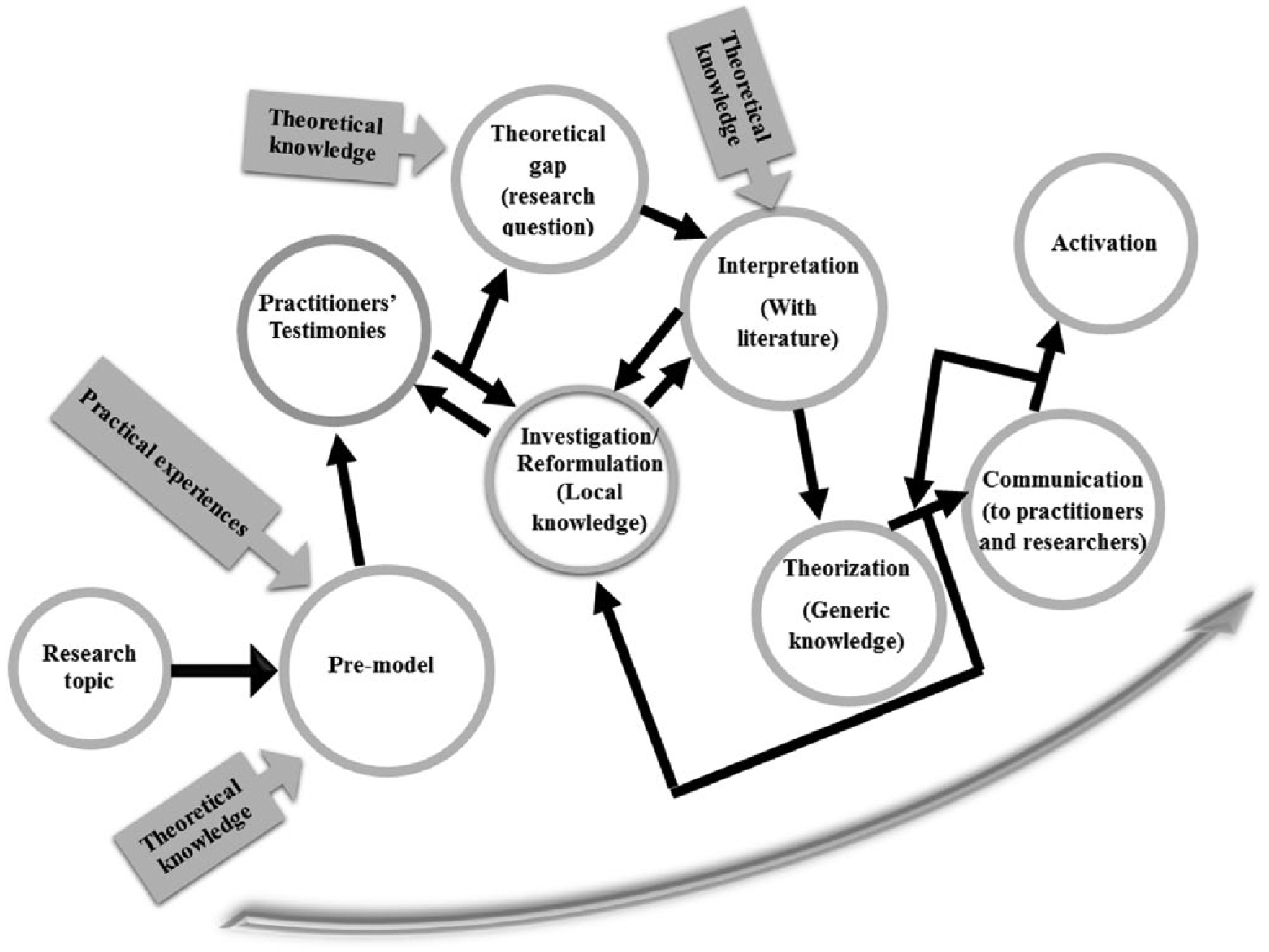
Methodological process.
In this article, we present the first loop in this process. We investigated some testimonies and interpreted them with literature. We produced some generic knowledge and communicate them. This knowledge allows us to pursue our investigation and start a second loop. For the exploratory step of the research, we interviewed five deck cadets and three professors from a maritime institute in the hopes of understanding how to manage the careers of future deck officers. Participants had completed about two thirds of their sea time and courses. Teachers were deck officers who go back at sea every year. Interviews were conducted with a guide (Patton, 2002). Some issues to be explored have been listed (how deck cadets expect to live their future career at sea, if they anticipate a boundaryless or a more traditional career, how teachers choose to stop their seagoing career, and how they expect their future career at sea or ashore). They are similar to the informal conversational interview (Patton, 2002) on career choices of the participant and their career aspirations. This kind of interview resembles more like a chat, during which the participants may sometimes forget that they are being interviewed. Most of the questions asked flow from the immediate context.
This kind of instrument provides more complex information than standardized open-ended interview, which is more consistent with our paradigm choice. We are aware that it is impossible to make generalizations as our sample was small. This was a first loop in our process. However, this is not a validity criterion in the paradigm of pragmatic constructivism. The epistemic work related to each interview is more important than the number of participants. The objective is not to validate and generalize a model, but to build knowledge that can make sense and be reinterpreted by others. We presented the results of this study to practitioners who were interested. In pragmatic constructivism, this pragmatic interest is a quality criterion.
Results and Discussion
We interviewed cadets who had completed about two thirds of their sea time and courses, and who wished to continue in this career. We know that many cadets do not continue in the seafarer career (Cahoon et al., 2014; Gekara, 2009; Gould, 2010); they usually graduate knowing they will not work at sea.
In the words of an experienced teacher: And I think that those who don’t see themselves in the process, quickly, from the moment they come on board as officer cadet, will know if they like it or not.
Participants said they enjoyed life at sea but were not sure they wished to continue as deck officers until their retirement.
A cadet who expected to work about 15 years at sea: Well, I’m finishing my course next year, and I really intend to sail. Mainly locally, I think. I think I would like to do one or two foreign going trips. But I prefer the Gulf, the river, maybe the lakes too. I really liked my experience on lakes, too, the seaway. I prefer coastal navigation, maneuvering, berthing, loading/unloading. I find it . . . but the foreign going trip, we have to admit it, it’s the foreign going certificate that we’ll get. I’d still hope to use it one day. But, actually, to make a living professionally, I imagine myself more onshore, near the coast. . . . At least, it’s sailing to get my master certificates because it opens doors onshore too. It’s a certificate that allows you to work on smaller boats, yes, but always as a master. For me, the objective is to aim higher so that I have more options. At least 15 years, I hope. 15 years, maybe less, let’s say more or less 5%.
A cadet who wanted to continue, but just part-time: Up to now, I’m really happy with my internships and experience. Well, obviously, when I get there, I’ll be 39 years old. So if I work 15 years, that makes me 55 or 54, and I intend to work until I’m 65 years old. So, I’ll probably slow down when I reach 50 or 55. Often, as an officer, you get $100,000 for 6 months of work. A captain gets a lot more. Since I’ve been back at school . . . we’ve been able to live on $30,000 per year, my girlfriend, my daughter and me. So, that’s it, do I work to make money or do I work to save money to do more on my time off? In my case, I choose the second. So, instead of working 6 months making $100,000, maybe when I get to 50 I’ll work 3 months making $50,000. That way I’ll have enough to live on.
A cadet who wanted more opportunities: Do this [for my entire career]? Maybe not. Well, of course, over the years, you go up the ladder and get better jobs. You become chief officer, captain, and from there you can choose what you want to do because the doors are open to you.
A young woman cadet who wished to work only about 10 to 15 years at sea but was open to going back to sea after: Maybe 15 years, about. Until, well, right now I’m 21 years old. Well, I’m 20. So that leads to 30 or 35. At least 35, and after that . . . work in admin, most likely. In a company office. . . . the only reason to stop, right now, would be to have a family, to have children. So, I think, 30 or 35 is pretty much the limit. So, that’s mainly why. Maybe after having my kids, when we’re older, I could certainly get back on board.
According to Sullivan et al. (2007), it is important to offer other career models to women who want to reconcile work and family. Such new models may be interesting for an increasing number of men who also want to find a balance between their work and family life. This is consistent with the findings of Williams and Savickas (1990). For this reason, it is important to create new career models.
All of the cadets interviewed had established that they liked life at sea and expressed commitment to start a seafaring career. All voiced the wish to obtain their master mariner certification. However, all had already planned to stop working at sea in 10 to 15 years. As such, it appeared difficult to separate sea and shore-based careers. In a study on French maritime industries, Honoré (2010) shows that a seafarer’s career is usually a sequence of periods of activity at sea and ashore. He proposes to develop a model that creates career paths for alternating periods, in the more or less long term, spent at sea and spent ashore. Thus, it would be important for the maritime industry to manage these two kinds of interwoven careers. This is close to Morin’s (2001) dialogical principle that combines two notions or principles, whether antinomic or antagonistic, and therefore according to the Aristotelian logic, while they should exclude one another, in practice, they appear complementary, indissociable, and indispensable to understand a particular phenomenon.
Teachers could work both at shore and at sea.
An experienced teacher: It’s something [boarding once in a while] that I think is interesting because it allows me to keep a direct contact with the industry. It also allows me to keep my name in the network, which is a good thing, and allows me to stay up to date in the field regarding the various rules and regulations, and how one experiences being a seafarer.
A new teacher: I’ll go back to sail during the summer because I still love sailing.
However, it could be difficult to go back to sea after a few years spent ashore. For Barnett, Gatfield, Overgaard, Pekcan, and Graveson (2006), it is hard for a seafarer who has been ashore for more than 5 to7 years to adapt well to modern sea life. Even if there is a lack of officers and an interest in former officers, it may be tough for them to return to sea. However, this is contrary to a teacher’s experience: It depends on the person. Some will stop. I knew a captain who stopped for 4 to 5 years. He was completely out of the business, studied in accounting, was working in a small accounting office, when he noticed that his spouse had more free time that he’d thought. So, he decided to go back to the sea. But there are other people who retire or come ashore after a certain amount of time because they have to. The maritime industry being such a small world, word of mouth is all you need to find yourself on a boat. You ask, “Who needs a captain? Do you know a captain?” “Yes, captain so and so, he hasn’t worked in x number of years, but I don’t know if he still feels like it.” So, 3 or 4 phone calls later, people start coming out of the woodwork! There can be a culture shock for those who haven’t sailed in a long time because they haven’t kept their certificates up to date. They need to write their exams again. They start studying again, and learn the changes that were made. There is less culture shock for Canadian vessels than foreign vessels. Someone who has always sailed in Canada and goes to another country will find it harder. Someone who has sailed for other countries or here all there life will find it hard too if they end up here. It’s not the same reality, not the same mentality either.
This verbatim implies more than a bridge from seagoing to shore-based employment; it means recognizing that the two may be closely knit. Employers have to anticipate the second part of their seagoing staff’s career to be more productive. For some crewing managers this may seem counterproductive. It may be judged “dangerous” to suggest to seafarers to work ashore. However, interviews clearly show that cadets started their career already with this in mind. There is a need to take into account this reality and to manage it. Lesca (2008), based on Aguilar (1967), uses a radar metaphor to show the importance of looking ahead in business. Firms are like ships in storms. Ships need radars and firms need to look ahead. According to Lesca (2008), looking ahead or anticipating means detecting warning signs of a possible change in the environment, to act as soon as possible before the change is complete. To do this, firms must be active and not just wait for information to come to them. Without anticipation, a firm is like a ship caught in a storm without radar, it would probably be inefficient. Lesca (2008) distinguishes anticipation from forecast. With forecast, we expect a unique solution and certitude, and we are angry if what was predicted does not happen. By anticipating, we can prepare several plans and choose the most appropriate when the time comes. We are ready to act efficiently and not just react to the environment. Anticipation is really important in a complex environment. Human beings are complex. They are non-trivial machines, not only because the outside observer cannot predict all human behavior with certainty but also because humans carry in themselves a principle of uncertainty that is their freedom. They are non-trivial machines because they have the possibility of deviating from the norm, they have a potential for catalysis, they can discover, and they can make decisions. Each invention and creation reveals the non-trivial nature of the human mind (Morin, 2001).
Viljoen and Müller (2012) explore their understanding of relationships between seafarers and their families. These authors show how such relationships are complex and contradictory. Seafarers have to manage different purposes that seem to be opposed. So, their Self has integrated these contradictions, and the seafarer may or may not choose to prioritize them.
An experienced teacher: The other phenomenon is that those who sail for a long time will find that the people around them change a lot. We have students who keep their girlfriends all along. She may or may not understand that as a cadet you do go to sea, but once it’s done he’ll be home more often, or whatever. Except that when young officers start to sail, they try to get to sea as quickly as possible, and when the people around them are faced with this reality—that what they lived during training is what their career will be like—some couples find it hard and break up. Some survive it, but some don’t. So, then, this creates a change, and I think that it’s a determining factor, it’s the willingness to prioritize either family life, life onshore, or life at sea.
Employers cannot act on seafarers’ families or friends, but they can obtain information about them and learn about their feelings to better anticipate. In this way, they can discover the different career anchors for each seafarer. Indeed, deck officers (as other workers) can change their anchors throughout their working lives, and several anchors can coexist within them (Lazzari, 2012).
Each officer is a person. A person is both unique and multi-faceted, different from others. Hence, a person cannot be understood by observing only one facet, and though grasping all of them may seem difficult, researchers and specialists must keep in mind a person’s multi-faceted composition (Melé, 2012). Each individual lives his experiences as a singular subject (Morin, 2001). For instance, among the cadets interviewed, some liked routine work, whereas others avoided it. A unique optimal solution is therefore unlikely. Companies have to build several models to answer the needs of their seagoing workforce. Without HRM centered on persons—who they are and their aspirations—companies expose themselves to increased hidden costs associated with poor retention and the loss of precious operational expertise. Although management often only looks into the costs related to their division, there are numerous other hidden costs (Garman, Corbett, Grady, & Benesh, 2005). It may be less costly for the organization to consider all of the skills available in an organization as well as the individual’s aspirations, even if they are not measurable. Happy people are less stressed. Thus, the American Institute of Stress estimates that work-related stress costs American companies over US$300 billion per year (Bishara & Schipani, 2009). Thinking HRM differently in the maritime industry may help companies avoid a certain amount of recruiting and all costs related to training, absenteeism, and presenteeism (Cascio & Boudreau, 2010). As Cahoon and Haugstetter (2008) note, [C]areer options need to be explained at an early stage because Generation Y may make their career choices on those that provide the most opportunities. Perhaps at best, the shipping company should be intending on retaining the seafarer in the organization whether this is at sea or onshore. The second option is attempting to retain the seafarer within the shipping industry to ensure the industry retains valuable and experienced staff. (p. 8)
For these reasons, it is time for the maritime industry to propose new career models to attract young people and retain them in the industry as a whole and not only at sea. This involves getting to know people, their lives, their aspirations, their career anchors, and so on, to offer adequate training and manage with complexity cannot be managed, but it is possible to manage with ambivalence because a person is both rational and non-rational (Morin, 2001). If we want to put things in small boxes to put them in order, we cannot manage with ambivalence. The maritime industry should therefore manage persons by taking into account the importance of managing with ambivalence. It should be important to conceive of deck officer careers not as disjunctive but preferably as the management of interwoven sea and shore-based careers. This could be in the same organization or in a maritime industry network. Araujo, Dubois, and Gadde (2003) conclude with the notion of indirect capabilities of focusing interfirm networks to move conventional boundaries in organizations. Indirect capabilities are required to access complementary and dissimilar capabilities detained by third parties (Loasby, 1998). Trust among organizations plays an important role in multi-partner alliances and poses difficulties to its implementation (Thorgren, Wincent, & Eriksson, 2011). This construction of collective actions between organizations should be viewed in a dynamic way through the concept of “interaction” and not just the static concept of “sharing.” This dialogical mediation allows inter-organizational cooperation (Lorino & Mourey, 2013). So, cooperation between organizations should be seen as an alternative coordination mechanism to market and hierarchies (Araujo et al., 2003). Organization boundaries should change with cooperation mechanisms. Future deck officers expect boundaryless careers. Recruitment and retention policies for at sea work only are neither sufficient nor efficient. We need to move beyond traditional boundary career management. New models must be invented by maritime management to remain aligned with seafarers’ expectations and actions. This new boundaryless career model must not be organized by individuals or disempowered organizations; it should be managed by both organizations (and organization networks) and people.
Conclusion
In this article, we presented the results of our interviews and suggestions regarding how to manage the seagoing and shore-based employment of officers as interwoven careers. Our discussion enabled us to propose the development of new career models for future deck officers. These models need some changes. Employers should anticipate employees’ wish to change career paths. To do this, they must learn about their deck officers’ lives, aspirations, projects, and so on, and accept a type of management that includes ambivalence. If employers do this, they may limit some hidden costs and become more efficient. The interwoven career model that we propose is new. It takes into account both the individual and the organization. This is neither a traditional career nor a boundaryless career model. Employees could change within and across organizations. Ambivalent situations experienced by maritime industries are often unacknowledged and hidden because they are disturbing. Ambivalence cannot be deemed usual. These complex realities lead us to propose a complex solution where all factors are linked and interwoven even if this leads to a paradigm revolution. Indeed, this complex solution requires accepting to find solutions in non-traditional ways. For this solution to work, one agrees to being open to moving boundaries both within organizations (when, for instance, maritime industries propose that deck officers be on shore and sometimes at sea) and across organizations (when they develop partnerships to retain their employees as well as help the latter attain their goals).
Footnotes
Declaration of Conflicting Interests
The author(s) declared no potential conflicts of interest with respect to the research, authorship, and/or publication of this article.
Funding
The author(s) received no financial support for the research and/or authorship of this article.