




Abstract
This article investigates accrual, role, and impact of social capital of the southern Sudanese formerly known as the Sudanese refugee Lost Boys living in the greater Kansas City area. Since their resettlement in the United States in 2000, Sudan has seen a dramatic transition in its long geo-political conflict since its independence in 1956 ending up in cessation of the south from the north. This cessation has created the newest country in the world (South Sudan). Simultaneously, a group of refugee Boys commonly known as the Lost Boys of Sudan has renounced being called so. Instead, they prefer being called “South Sudanese.” The study uses semi-structured interviews to assess the degree of social capital of each refugee participant relative to types of “capital” valued in mainstream American society. An adjunct inquiry is finding what type of social capital endured by each of these Boys played a key role in helping them cope/integrate into American mainstream society.
Historical Background of North and South Sudan
Sudan has continuously sustained civil wars among its demographic/religious/racial groups for over four decades since its independence in 1956.
These wars mostly between the North (Muslim) and the South (Christian/Animists) came to a temporary end due to a referendum that lead to the secession of South Sudan from Sudan in 2011, creating the newest country in the world known as South Sudan (Sudan Tribune, BBC News, 02/2011). Many South Sudanese refugees dreamt of one day returning back to what most termed as their motherland. In this case, nothing was more important for the South Sudanese refugees than transitioning from being refugees to citizens of their new country: As a citizen, I don’t mind us having to crawl and take small steps in our progress. Development is not a race and for it to be sustainable it should be holistic. We’re starting from scratch and have a lot of ground to cover. (Duany, 2012, ¶ 4)
However, this dream was short lived. Before most could even step foot in their “motherland,” there emerged a major obstacle to their return. In December 2013, the newest country plunged into yet another conflict between the southerners themselves. This conflict has been termed as civil war by some international monitoring agencies (“The Descent Into Civil War,” 2013). Once again hope was lost.
Start of the Historic Journey of the Lost Boys
In the late 1980s, more than 33,000 Boys were forced from their homes due to outbreaks of violence in southern Sudan (Messina & Messina, 2007, ¶ 2). The International Red Cross that found them as they walked to Kenya named them the “Lost Boys” (after the characters from the Peter Pan story because they were unaccompanied by their parents when they arrived). Further, they did not know whether their families were alive or dead. The phrase “Lost Boys” was used to identify those who did not know where their families were. The international agencies took them to the Kakuma refugee camps in Kenya where they were housed, fed, medically treated, and modestly educated. By this time, they had walked nearly 1,000 miles and approximately 10,000 Boys of the original 33,000 arrived in Kenya (Messina & Messina, 2007, ¶ 2). In the early 2000s, about 3,800 Boys were resettled in the United States. Many of the Boys did not know their birth date and were assigned an age (minors or legal adults) by the U.S. government to facilitate their resettlement process in the United States (Messina & Messina, 2007, ¶ 2). The intention of randomly assigning them ages was to make them eligible to receive benefits under government programs for unaccompanied minors in the United States (Barry, 2000). The Homeland Security Act (P.L. 107-296) was enacted by the Senate and House of Representatives in 2002 that established a new status for refugee unaccompanied children under the term “unaccompanied alien children” (UAC). To qualify under this act, one had to be less than 18 years, lack lawful immigration status, and by the time of arrival in the United States one should be without parents or guardians who would take care of that individual. This seems to contradict the Refugee Act of 1980 as stipulated in the Congressional Research Service (CRS) Report for Congress that states, “(1) to provide a uniform procedure for refugee admissions; and (2) to authorize federal assistance to resettle refugees and promote their self-sufficiency”(Bruno, 2006).
Consequences of Arbitrary Assigned Age
The demographic age resettlement arrangements immediately raised unforeseen challenges. Whereas minors were placed under foster families where they received social and educational support, those resettled as legal adults had to secure employment immediately to fend for themselves; they were provided with apartments rent-free for 3 months but had to start paying rent thereafter. Acquisition of English language skills was primary to secure even a manual job in the United States. Another challenge that emerged was the lack of previous work experience as most had not worked in Africa. School-aged children rarely work in Africa as the vast majority depended on their parents as providers. In contrast, U.S. children as young as 16 years old are permitted to work. Orphaned and resettled in the United States, they soon discovered that nothing was free. This point was driven home when legal adults were informed that as soon as they started working, they had to repay the purchase price of the airplane tickets which allowed them to leave Africa as well as certain medical expenses (Bixler, 2005). Some Boys found it necessary to work two or three jobs to pay their bills and tuition, and to remit some money to family and friends back in Africa (Mabeya, 2011, p. 116). Securing jobs in America, the Lost Boys needed to accrue substantial valued social capital in their new host country which they lacked from Africa: being fluent in English language, working individually, keeping time, being efficient, working hard and becoming successful (Macionis, 2014, p. 57).
U.S. Refugee Policies and Utilization of Social Capital by the Lost Boys
The Lost Boys who reside in the Kansas City area moved there due to secondary migration reasons. Secondary migration refers to any circumstances that prompt immigrants to move from one location within the United States to another. According to the Office of Multicultural Affairs, it is very common for immigrants to relocate to other states and cities in search of better work, cheaper housing, safer neighborhoods, or to be closer to friends or family. The Office of Refugee Resettlement (ORR) is aware of secondary migration and has a clause that caters for this in Sec. 412. [8 U.S.C. 1522] (IV).
In their empirical research on why East African immigrants moved to live in Kansas City and Missouri, Janzen et al. found socio-economic reasons as the most important factors: Life was more straight-forward in the Midwest than in big cities of the East; educational and job opportunities were available more advantageously; raising families was possible. (Janzen, 2006, ¶ 8)
An Ethiopian immigrant, Daniel Fikru, who migrated to Kansas City, confirms the above assertion by saying, Kansas City is not a crowded place. There’s a lot of opportunity. Housing, education is affordable. (Beardsley, 2005, ¶ 6)
A participant in my study affirmed the above by saying, A lot of Lost Boys came from other states to Kansas City because of educational and job opportunities. Another thing is that if you have a Lost Boy who is your friend in another location, you can call him to come and live with you. (Mabeya, 2011)
Indeed Berger confirms Janzen et al. by explaining that Peter Nyarol Dut, one of the Lost Boys, left Houston, Texas, for Kansas because he was frustrated with trying to make ends meet and trying to get educated (Berger, 2004). More so, he felt discriminated against. He found it difficult to adjust to the urban environment in Houston. An article by Nancy Beardsley of Voice of America asserted that new waves of immigrants were transforming Kansas City and Missouri. This included African Americans moving from the southern United States to more northern states (Beardsley, 2005).
Demographics of the Lost Boys in the Kansas City Area
More than 100 Sudanese refugee Lost Boys were living in the Kansas City metropolitan area at the time of this study. The exact number of Lost Boys at any given time is difficult to verify because of constant undocumented migration that occurs; therefore, the accounted number of refugees varies between sources (Associated Press, March 29, 2007). When they arrived in Kansas City, they were received by St. James United Methodist Church and former Kansas City Mayor, Emmanuel Cleaver, who assisted in settling the Lost Boys. In other cases, early arrivals assisted later refugee arrivals (Gak, 2006). Gak, president of the Brothers’ Organization for Relief, says, in May 2000, nine Lost Boys arrived in Kansas City and were soon followed by 25 others. Later, 25 more Lost Boys arrived in Kansas City and by 2001 there was a total of 59 Lost Boys living in the greater Kansas City area. According to Gak, most of the Lost Boys who live in Kansas City relocated from other U.S. states (Gak, 2006). One study on East African immigrants living in the Kansas City area found an estimate of 200 to 300 southern Sudanese of the Dinka origin living in Olathe, Kansas itself (Myers, 2004). They were partly assisted in their resettlement by religious and charitable organizations.
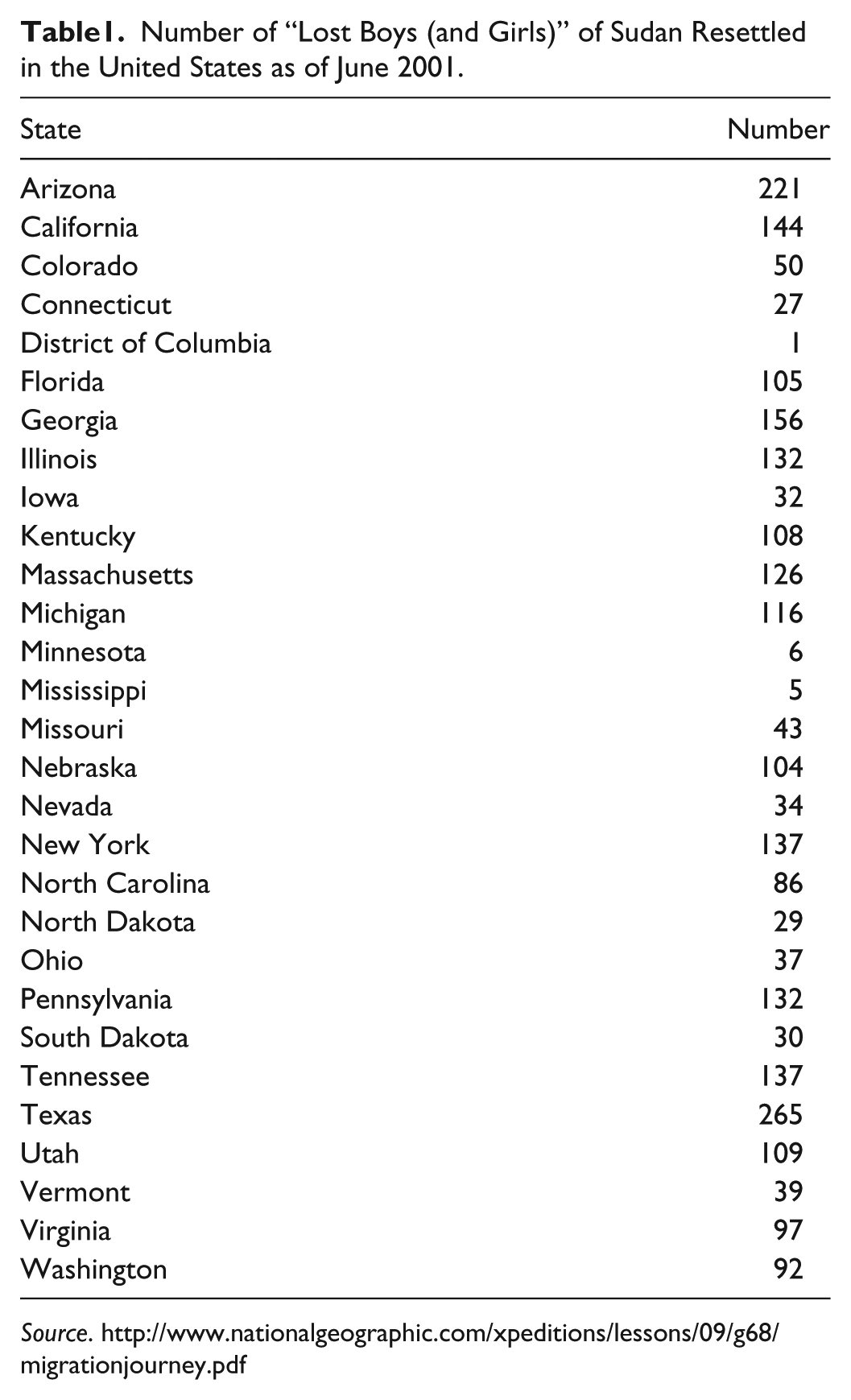
From Table 1, it is clear that the Lost Boys were not directly resettled in the Kansas City area in 2000. One political reason is that Kansas had been demographically viewed as White, mainstream Americana by the media for many years (Janzen, 2006). Indeed in 2003, Barnett reported that the then Kansas Senator, Sam Brownback (now governor), had opposed the resettlement of Somali Bantu refugees from Africa citing their huge populations and cultural differences (Barnett, 2003, ¶ 1). He later supported a bill that allowed resettlement of refugees from Africa to Kansas partly because states have no control over refugee resettlement programs according to the Refugee Protection Act of 2001. He has since met with some Lost Boys (Mabeya, 2011).
Number of “Lost Boys (and Girls)” of Sudan Resettled in the United States as of June 2001.
The Research Question
This study narrows down on a prior dissertation study on refugee Sudanese Lost Boys in the greater Kansas City Area, and seeks to address the following ethnographic and demographic research question through investigation: What factors and developments shaped the Lost Boys’ experiences in America?
Social Capital Theory
Sociologists have argued that it is important for people to acquire social capital, and that the acquisition of social capital can improve a person’s material and social circumstances. This assertion is supported by Coleman who argues that social capital can determine what kinds of resources are made available to individuals and/or group as it is defined by its function (Coleman, 1988). Coleman also argues that integration of people into a new society is done on an individual basis and not necessarily as a group because each individual has different amounts of social capital. For instance, in his study of migrants living in Europe, Castles found that some had “integrated,” some joined “multi-cultural” communities, and some were marginalized and experienced cultural “segregation” (Castles, 1993). In my primary investigations, like Castles, I found the Lost Boys had a fairly wide range of experiences during their more than 10 years stay in the United States, providing evidence of their segmented assimilation (Alba & Nee, 2003). Bol Biong Bol (executive director of the Sudanese Community Association, a San Diego-based organization that helps refugees assimilate in America) supports my assertion by explaining, The hard fact is that in the U.S., Social Darwinism is still the operating principle. As time goes by, we will have some Lost Boys who will be very successful, and we will have some people who will remain on the lower economic level, and we will have some people who will be frustrated. (Weddle, 2003, p. 11)
What constitutes social capital has generated varying interpretations and definitions among scholars and is ever expanding. For instance, Fukuyama says, “social capital can be defined simply as a set of informal values or norms shared among members of a group that permit cooperation among them” (Fukuyama, 1999, p. 16). Putnam defines social capital as the “connections among individuals, or social networks and the norms of reciprocity and trustworthiness that arise from them” (Putnam, 2000, p. 19). Bourdieu has it as “the aggregate of the actual or potential resources which are linked to possession of a durable network of more or less institutionalized relationships of mutual acquaintance and recognition” (Bourdieu, 1983, p. 241-258). Coleman’s definition is, “Any aspect of social structure that creates value and facilitates the actions of the individuals within that social structure” (Coleman, 1990/1994). Comparing the contributions to thinking about social capital of the above social capital proponents, what resonates from their statements still leaves room for more inquiries. For example, all the above thinkers treat social capital as a valued good thing. However, much is not said about lack of the “valued” social capital.
Perhaps a more in-depth analysis and synthesis of social capital is done by Woolcock (2003). After reviewing social capital theory, Woolcock distinguished and summarized social capital theory into three major categories: bonding, bridging, and linking. In the following section, I will explain each of them in detail and how they relate to the integration process of the Lost Boys.
Bonding social capital can be said to be horizontal, meaning it occurs among people who are homogeneous (the Lost Boys consider themselves brothers though most were not blood related). This is a “vital capital” that helps them in times of difficulty. Bonding brings and ties people of similar situations together (e.g., a family, an affinity group, ethnic group, club, or church). Horizontal bonding creates networks of individual or groups of refugees which enhance community productivity and cohesion that can become positive social capital asset. Putnam calls this productivity and cohesion the “Super Glue” of society (Putnam, 2000). It is the inward looking of social networks that mobilizes solidarity among a group. In some cases, immigrants/refugees relocate to areas where their own ethnic communities reside and thus will share both economic and social assets. According to Dustmann, immigrants are very rational when it comes to choosing their place of residence in a new country. They quickly become aware of favorable and unfavorable conditions in their new environment that are associated with deviancy and little social welfare (Dustmann, 1999, pp. 297-314). Therefore, immigrants/refugees who are resettled in unfavorable environments with limited social opportunities will relocate after some time to places where they think they will likely maximize their opportunities and more so be closer to their families and friends. The Lost Boys who participated in this study relocated from other cities/states because of availability of opportunities in the greater Kansas City area which had initially attracted a small number of them. As time went by, those who were already settled in the greater Kansas City area spread word about a welcoming environment in Kansas City area, availability of opportunities, and a an ever growing population of the Sudanese community. The new information started to attract more and more Lost Boys. One notable observation that I made was that those who relocated to the Kansas City area first were legal adults. Legal adults were free to emigrate from one city/state to another, whereas the movement of the minors was constraint for a period of time because they lived and were taken care of by foster families. They had to attain a legal adult age of 18 years and this is under the U.S. laws. This age-based resettlement had consequences in accrual of social capital. From the findings of my dissertation study of the refugee Lost Boys in the greater Kansas City area, minors who started off with little social capital had advantage over the legal adults in the long run. Minors received not only social and educational support from foster families, but as time went by, they created strong social bonds with those foster families that lead some foster families treat them as adopted children, thus enjoying the comfort of a real family. Those that were resettled as legal adults largely had to fend for themselves; they were provided with apartments rent-free for 3 months and banded together to minimize expenses and to provide stability in their new environment. More so they endured unique hardships, like caring for younger Boys during their exodus and in the refugee camps in Kenya. Trying to find employment immediately after resettlement without the benefit and care of foster families, acquiring English in a new country was a great challenge especially to those who had no working skills from Africa. Besides all these, the elder Boys felt obligated to remind the younger Boys of Sudanese culture, values, and ways of life, once again fulfilling a sort of parenting role that was critical for the development of normative behavior, though younger Boys differ in their receptivity to retaining Sudanese culture.
As opposed to bonding social capital that is horizontal, bridging social capital is vertical, where social networks occur between socially heterogeneous groups (Dolfsma & Dannreuther, 2003; Narayan, 2002; Narayan & Pritchett, 1999). Bridging social capital is outward-looking and provides for a better linkage to friends and relationships from other ethnic/racial groups in society. For Putnam, it is the strength between the segments of society or what he calls “Sociological WD-40” (Putnam, 2000). The agencies responsible for resettling the Lost Boys believed that dispersing the Boys would allow faster integration into American society (see Table 1). This is in accordance with the Refugee Act of 1980, INA: ACT 411 FN 1 Sec. 412. [8 U.S.C. 1522] (2)(A). Ironically, it turned out separating these Boys did not help them integrate faster; rather it increased their stress level and marginalization in America especially those who were considered legal adults. Donkor argues in her study of the Lost Boys that lack of proficiency in English for legal adults led some to socialize with fellow refugees as they feared marginalization by the host society (Donkor, 2008). To compensate for deficiency of bridging social capital, they often banded together in enclave communities to provide for mutual support and to minimize expenses in their new environment. Unlike those resettled as minors, legal adults were expected to successfully secure employment on arrival so that they could support themselves and repay the costs of their airfare and other expenses from Africa, and to start the integration process into the mainstream society with little assistance. To get them started, they were provided with apartments rent-free for 3 months (Mabeya, 2014, p. 131). Simultaneously, unlike the legal adults, those who were considered minors were placed in foster families. The foster families served as their surrogate parents by providing them with all the basic needs (clothes, shelter, and food). The foster families also facilitated their entrance into American learning institutions. Going to school helped minors acquire English language skills and integrate them into U.S. culture by participating in school-related activities and immersion in their home environments. They were in a situation where they could more easily learn English. Both at home and in school, they could complete their education in American schools, where they could establish social networks and friends (an important kind of social capital), and they could devote themselves to their studies and acquire the kind of skills that would make it possible to advance in school, complete high school, go to college, and in some cases, obtain advanced degrees (Mabeya, 2011).
Apart from bonding and bridging social capital is linking social capital. Linking social capital refers to unlike people in dissimilar situations, such as connections to people with authority/power, whether politically, socially, or economically. This enables minority and disadvantaged members to leverage access to a wider range of resources than might be available otherwise (Woolcock, 2001, pp. 13-14). Linking social capital includes vertical connections to formal institutions. These resources for immigrants and refugees include social welfare, host agencies, service providers, and other essential social services. Religious institutions in the United States, for instance, provided the Lost Boys with support they didn’t get from their parents. Coleman argues that parents are an important source of social capital to their children (Coleman, 1988). Indeed, nearly all the Lost Boys lacked parental guidance and upbringing Therefore, their experiences were shaped by religion which provided them with spiritual, social, physical, and material capital (though other government agencies provided for their safety, protection, and employment). Religious institutions also provided solace as well as an avenue under which the Lost Boys interacted with other ethnic and racial groups. Some Boys met their wives through religious organizations. Therefore participating in religious activities gave them the ability to connect and integrate with a wider population (Mabeya, 2011). Other than religious institutions, schools and familial structure provided a means in which the Lost Boys acquired necessary social capital needed for integration. Bourdieu argues that schools provide a source of transmission of America’s valued culture which is education (Bourdieu, 1996, 1997, p. 40-58). After acquiring education in schools, the Lost Boys were able to convert the acquired cultural capital into economic capital by securing employment and earning an income. This eventually assisted them into an upward social mobility (Mabeya, 2011).
Research Instruments and Procedure
This is a diversity-oriented study in which a multiple case study model largely provides the methodology for the collection of data from participants (Yin, 1994). Eisenhardt asserts that if all or nearly all the variables provide similar results, there exists substantial support for the development of a preliminary theory describing the phenomena (Eisenhardt, 1989).
This study draws from Ager and Strang’s demographic and cultural/ethnographic criteria in examining key human development indicators to elucidate the degree of social capital each Lost Boy participant had acquired since their resettlement in 2000 (see Ager & Strang, 2004, p. 3).
Data Analysis
After data collection, an analysis is done employing a thematic system in which common traits from the data are identified. A thematic system is utilized to provide confidentiality of individual participants. A multiple case study framework is used to analyze 40 cases. Common traits that emerge are given serious consideration since they reflect major indicators of integration and/or marginalization as well as the impact of the American society on the participating Lost Boys accrual of social capital. The common traits thus become the major themes of this study. They are as follows: education/professional skills, economic empowerment, and naturalization. These themes are further synthesized using three social capital dimensions: linking, bridging, and bonding social capital (Woolcock, 2003). Eventually after the analysis, a copy was sent to each participant for validation and accuracy verification.
Results: Laying Down the Three Major Themes
Interview data revealed that all participant Lost Boys consistently possessed similar forms of bonding and bridging capital, but varied significantly in linking capital. This can be attributed to the amount of social capital each Lost Boy participant possessed by the time of this study depending on the resettlement criteria (minors verses legal adults).
Education/Professional Skills (Bonding Social capital)
Education is viewed as crucial to successful living and is highly valued as a cultural capital in the United States, while it has been given low priority in countries such as southern Sudan. Brophy asserts, “The education system in Southern Sudan has always been under resourced” (Brophy, 2003, p. 2). The Lost Boys were acutely aware that education was the primary means of securing a good paying job. It remains one of the most important tools of societal development; it is through education that individuals and societies achieve economic and social progress (Mabeya, 2011). Collier’s investigation reveals that protracted civil war is concentrated in poorly educated countries and regions (Collier, 2000). He found that chances for conflict are drastically reduced in countries where a higher percentage of youth are attending schools. Sommers (2002) arrive at similar conclusions, observing that it is war that makes the case for providing educational responses to the needs of children and youth who are at risk of civil war more than any other circumstance as their education is a vital protection measure from child soldiering. (Sommers, 2002, Summary findings ¶ 6)
For the Lost Boys, education was the gateway to a successful life in the United States. The Lost Boys didn’t have a chance to get educated in Sudan, mainly due to a hostile environment and lack of resources. Furthermore, most families valued cattle over education and thus, many participants went to the fields to look for grazing land. At the time of the interviews, all participants in this study were either attending educational institutions or had graduated from a 2-year college.
Academic qualification was one of the requirements used as a criterion for resettlement in the United States. The first group was comprised of Lost Boys resettled in the United States with some education but not instructed in English while they were in Africa. Acquiring proficiency in the English language is a vital capital in the United States for immigrants. It doesn’t only enhance integration but is a necessary tool for securing a job. With the help of resettlement agencies, this group was placed in foster care and enrolled in schools as they were identified as minors according to U.S. laws. The second group arrived in the United States without any English language skills but was expected to work upon arrival in the United States because they were considered to be legal adults under the U.S. law. The third group consists of Lost Boys who arrived in the United States with elementary or high school education. While very few participants attended school in Sudan, all the participants in the third group received some education at refugee camps in Ethiopia or Kenya where they studied Arabic or English, respectively. Once resettled in the United States, some in this group pursued further education while others looked for jobs and began working.
The First Group
Eight participants were classified as minors upon their arrival in the United States and were subsequently placed in foster care. Five out of the eight had acquired some form of education in the refugee camps in Africa. More so, residing with foster families gave them an early opportunity improving their proficiency in English. Foster families also assisted them in paying tuition, provided housing, and helped them with other daily living expenses. The following participant stunned me with his level of language proficiency: I did get support from foster families, yes I did. They would take me to school; take me to my ummm . . . ,like if I had to run they would come and pick me up or drop me off until I had my car. And they actually gave me my third car, it was a Chevy Malibu ‘98. It was a very nice car and they paid for it till it was done. I am now independent . . . it’s not like I need help from them anymore. I’m living on my own. (Mabeya, 2011)
The Second Group
Eight participants in this study, considered legal adults, had not acquired English language skills prior to resettling in the United States. This group of Lost Boys went through the refugee camps in Egypt and was instructed solely in Arabic. This group faced great challenges in trying to learn English, obtaining work, and integrating with Americans and other African immigrants because they didn’t share a common language. They felt isolated from the rest of mainstream American society. Moreover, this group found it difficult to integrate with other African immigrants without a common African language with which to communicate. According to a United Nations Educational Scientific Cultural Organization (UNESCO) study on “Linguistic Diversity” published by UNESCOPRESS, there are approximately 1,400 dialects in Africa (UNESCOPRESS, 2007),
At the time of this study, nearly all the Lost Boys lacking significant proficiency in English were enrolled in English as a Second Language (ESL) courses in Kansas City. With some hard work in their studies with the English language, they hoped not only to communicate with Americans, but also with other nationalities present in the United States. From my observations and listening, the following participant described great challenges of speaking English proficiently: Yea, it is difficult to get job because people from Kansas don’t trust you. Some people, they don’t need somebody who don’t know English. That one is difficult. They are good people but problem is English. You don’t know how to speak good English, you don’t want to write good English, some people don’t trust you. That one is difficult. (Mabeya, 2011, p. 83)
The Third Group
Twenty-four participants, considered legal adults, went through the Kenyan refugee camps of Kakuma and had received English instruction in both elementary and high school subjects. This group of Lost Boys joined institutions of higher learning in Kansas City after resettling in the United States. Some of them have graduated from a 2-year program of study and were working, although they looked forward to furthering their education as one participant explained: You know what, whenever you have a higher level of education, it is almost guaranteed will have good living standards, having a house or raising a family, helping those back home. This is the important things that come with having high education level. That is how I look at it. (Mabeya, 2011)
Economic Empowerment (Bridging Social Capital)
For the Lost Boys and other similar groups of refugees, economic empowerment can only be attained through employment. Securing a job for most foreigners in the United States requires complex networking with Americans and established foreigners living in the United States. According to Halpern’s report prepared for the U.S. Department of Health and Human Services (see also U.S. Refugee Act of 1980), economic self-sufficiency is very important for successful resettlement of refugees (Halpern, 2008). Economic self-sufficiency is defined as the total earnings of a family that enables it to support itself without external financial assistance according to federal regulation (Halpern, 2008). McKinnon argued that the resettlement program for the Lost Boys in the United States was one of the most successful ever in U.S. history, given that nearly all the Boys of legal age were employed after resettlement (McKinnon, 2008). The ORR published the employment percentage of the Lost Boys at 85%, whereas that rate was 55% for other refugees in the United States in 2003 (ORR, 2014). Moreover, the ORR report found economic opportunity, language, and education to be important in economic self-sufficiency (ORR, 2007). A study done by Potocky and McDonald identified the length of residence, citizenship, and secondary migration to be closely related to economic self-sufficiency (Potocky & McDonald, 1995). However, some legal adult Lost Boys with minimal or no professional skills found mainly manual jobs with low wages that were unattractive and difficult to sustain. This affected the Boy’s ability to financially support themselves and attend college.
This section categorizes the participant refugee Lost Boys into four groups relative to the major theme of employment. Participants in the first group were resettled as minors, were legally barred from working and instead were placed in foster care and taken to American schools. The second group was comprised of Boys who were considered young adults upon arrival. The third group arrived in America with some skills and education accrued in Africa. The fourth group acquired employment experience and skills only after arrival in the U.S.
The First Group
Due to their young ages and scarcity of employment opportunities, 10 participants didn’t work in Africa. Although they were sent out to the fields to look after family cattle, this wasn’t generally considered a job, rather it was viewed as an obligation to the family and these children were not paid. This group of Lost Boys resettled in the United States under the legal care of foster families. These families received assistance from the government and other refugee agencies in support of resettlement programs including financial and food assistance, as well as tax breaks from state and federal government. These Boys weren’t allowed to work in the United States because they were considered minors according to U.S. laws. However, they attended school prior to attaining working age. At the time of this research, all Boys in this category had become young adults, moved out of their respective foster family homes, and were living on their own or with other Lost Boys. One participant said, When I first came to the U.S., I was placed in a foster family in California. I was told I was a minor by resettlement agencies. I did not know my really age though they said my age was thirteen years. The foster family took care of me. They paid for my school. They were nice people. They let me play with their children. They bought me clothes, books, and food. I really felt at home. When I become nineteen years, they assisted me to get a job. I got a job in a store and wanted to start living alone. So I looked for my own house and moved out. Live in California was too expensive and so I had to relocate to Kansas City where I have friends and life here isn’t very expensive. (Mabeya, 2011)
The Second Group
This group of eight Lost Boys were young adults when they arrived in the United States. They were required to start working immediately after resettlement; however, most of them possessed no working skills prior to their arrival as they lacked the opportunity to go to school in Africa. For those who managed to attend school, they were handicapped as they were instructed solely in Arabic in Egypt and spoke no English. This group had difficulty obtaining employment because they lacked work experience and English language proficiency. As a result, most of them could only secure temporary jobs as manual laborers. One participant said, I don’t have a job in Africa. I did not go to school in Africa. I only took care of my family cattle. My parents had a lot of cattle. I think the number was one to seven thousand. My grandfather gave my dad a lot of them before he died. I like cattle a lot. Now that I am in the U.S., I have to be on my own. I have to pay my bills. I have to go to school and pay tuition. Man, it is a lot difficult here. I can’t get a nice paying job because I don’t speak good English. But one day when I speak good English I will get a good job. (Mabeya, 2011)
The Third Group
This group of 10 participants possessed some education and working skills accrued in Africa. McKinnon would identify the resettlement of the third group of participants as “successful” because they secured employment and enrolled in post-secondary educational programs (McKinnon, 2008). Although their English wasn’t perfect, they were able to learn American English, and as a result employers were ready to hire them. Some had work experience from their days in Africa. In addition, this group received educational instruction in the Kenyan refugee camps, where English was a part of the curriculum. It was easy for participants in this group to fill out an application for employment on their own. Some of them had already earned 2-year degrees and were working. One participant described his work experience in Africa and in the United States in the following way (translation is word for word): In the U.S. it is difficulty here. You don’t have job, that one is difficult because no friends to go to live with. People don’t do that here because you can work and go to school and you go to do something good. You don’t have job, that one is difficult. In Africa, you don’t have job, it is good because some people don’t care about money. Your friends, your uncles, your aunties can help you. You know. You eat food free, you sleep free. You know. That one is different here. It is a nice place. Everything is good. But if you don’t have help, it is difficult. We agree. I don’t have English to write application because somebody is busy and don’t have time to fill my application. I don’t have to do anything. (Mabeya, 2011)
The Fourth Group
This group of 14 participants didn’t have work experience in Africa. Most of them went to school in Kenyan refugee camps, though they lacked work experience as job opportunities in refugee camps were limited. This group acquired working skills in the United States only after they arrived. This group did not have a lot of problems getting simple manual jobs because they could speak English and most of them received on-site job training. Six of these participants worked in nursing homes and were already trained as certified nursing assistants (CNA). Here is what one participant said, I did my high school in Kenya in the refugee camp of Kakuma. When I arrived in the U.S., I was advised that it was easy to get a good paying job at a nursing home but I had to have some training. So I took a three month course and graduated as a CNA. It was not hard for me to get a job because they need people to work in nursing homes. Many Americans don’t like doing this job. I like it and it pays so well. (Mabeya, 2011)
Naturalization (Linking Social Capital)
After attaining the required federal residency period in the United States, most of the refugee Lost Boys managed to obtain U.S. citizenship by naturalization. The Fourteenth Amendment of the U.S. Constitution provides the legal framework for individuals of foreign countries to be naturalized in the United States. The Refugee Act of 1980 allows refugees to be accepted into the United States on humanitarian grounds for unlimited stay so long as the countries of origin were still in conflict. Refugees accepted into the United States can change their status to permanent residents after physically living in the United States for 1 year (Congressional Report, June 1997). Permanent residents are allowed to reside in the United States for an unlimited period of time, and after 5 years, permanent residents can further change their status to become fully naturalized citizens. For the Lost Boys, becoming a naturalized American citizen was important because this allowed acceptance and integration into mainstream American society. It also provided them with access to important privileges accorded to American citizens, like traveling freely in and out of the United States, bringing their families to the United States, claiming unemployment benefits if they lost their jobs, access to student loans, and getting federal jobs like joining the military.
In this section I will categorize the participant refugee Lost Boys into three groups. The first group consists of those who had not become American citizens. The second group is those who had become U.S. permanent residents. The third group is naturalized citizens.
The First Group
Fifteen participants had not become U.S. permanent residents or citizens, and they cited different reasons as to why they hadn’t done so. Among some of the reasons they gave were the costs of processing the application to change their status. Some said it was not their first priority because no one forced them to leave, while others said they had not met the required stay period for them to change status. However, everyone in this group indicated that they were eager to change their status in due time. They were aware of the benefits of becoming a permanent resident or U.S. citizen. All participants in this group were resettled as minors. One participant said, I would have been long time ago but I was not able because I had a lot of financial problems. However I would like to become a citizen so that I can be able to fly to Africa and other places in the world. I don’t want to go to Africa and then get stuck over there. I don’t want to struggle coming back. I need to get my citizenship so that I can be a free man. (Mabeya, 2011)
These participants said they had not visited Africa because they were afraid they would be prevented from re-entering the United States. They heard from others who lived in the United States for a long time that their visas were not renewed and they were barred from America after visiting family in Africa. So, citizenship could guarantee their ability to travel freely to and from Africa, and to obtain other benefits, such as bringing their families to the United States.
The Second Group:
Composed of 15 participants, this group already successfully applied for and became permanent U.S. residents. They said life for them was a bit easier than when they were just refugees. They could get student loans, travel in and out of the United States, but they could not vote.
Man you need to understand what being a U.S. permanent resident is. Are you one or are you a citizen? Being a permanent resident is different from being a refugee. Refugees are treated like not really human beings. Now that I am a permanent resident I can do a lot of things like travelling in and out of the U.S., I can also claim unemployment if I don’t have a job. I don’t care if I don’t vote because I don’t like politics after all. (Mabeya, 2011)
The Third Group
This group had 10 participants who had become U.S. citizens. They looked more relaxed and talked more freely than other Lost Boys. They said they considered themselves like any other American. Among other things, they cited they could vote in federal elections like any American. One participant had the following to say: When I was living in Kakuma, there are those Americans who were working in the refugee camps. They were so proud of themselves. They put on everything American. I just felt like a very low class person as compared to them. Now that I am an American, when I travel to Africa, my friends in the refugee camps are jealous of me. I told them I am an American and I showed them an American passport (smile). (Mabeya, 2011)
Nearly all participants said they intended to stay in the United States for a long time after becoming U.S. citizens, though many of them said they were willing to go to Africa to visit family and friends. Some were reluctant to answer this question. One said, That is the same question senator Sam Brownback asked me when I met him 2007. I don’t know how long I will stay here but at some time in my life I will go back to Sudan. For now I am here to stay. (Mabeya, 2011)
What I found from these participants is that most of them did not care much about the responsibilities that went with American citizenship. Most of them said they did not want to serve in the jury, serve in the military, or vote. This participant summarized and said what he looked forward to by saying, I did not become an American citizen by coming here to charge Americans. Americans gave me a chance to come over and live with them. That is why they gave me citizenship. I am proud of that. I am not going to send Americans to jail. That is the work of Americans who were born here. I don’t even understand some of the American crimes. I also won’t want to serve in the military. I run from war and I did not come here to go to war nor do I want to vote. I don’t like politics at all. I just want a quiet life. Build myself and my family. (Mabeya, 2011)
Analysis
Research in this study identifies advantages and challenges associated with arbitrarily assigning resettlement ages to each of the Lost Boys and accrual of individual social capital over 10 years. One of the most significant findings of this study was that defining “experience” as a function of assigned age proved problematic for most of the Boys; younger Boys did not enter the job market at a “low” level. Legal adults had started earning an income from unskilled low paying jobs, to the envy of minors who were not allowed to work at the time of their resettlement. Interestingly, one can discern from this study how much more social capital is possessed by Lost Boys who were resettled as minors more than a decade ago.
As time went by, there is a reverse trend in terms of acquisition of social capital by the younger Boys. The minors placed under foster families’ became dependents, but ended up having a better opportunity of acquiring English language. They were also placed in schools where they socialized with American children, established social networks, and built friendships. This helped them greatly improve their English language skills, gave them the opportunity to acquire important kinds of social capital, and provided structure for immersion into American culture. Eventually, these Boys started to lose the social capital that they had brought with them from Africa and acquired social capital of the American society. They learned new cultural values of their new country as they settled and became Americanized. The ones who went to school found that the social capital they brought with them was not really valued by Americans and was insufficient at best (Donkor, 2008). In American schools, they learned to discard (what might be considered in America) low-value capital (working as groups, holding hands, and forehead cuttings—that is highly valued in South Sudan) and replaced it with higher-valued capital of the kind esteemed by educators, employers, and American society such as working individually, keeping time, being efficient, and becoming successful. Their degree of social capital accrual thus can be measured by the extent to which they were able to discard the values of their homeland and adopt American values. In this case, they increased their stock of American social capital, which made them more likely to integrate into U.S. society (Donkor, 2008). For instance, in schools they were told how important it was to shake hands with the people they met in interviews. They were told they could be fired for uncleanliness, if they had body odor, or missed work as time is important in America. Some companies fired refugees because of body odor, thus they were advised to use deodorant daily. They were also told to learn to speak good English and to work hard (Mabeya, 2011).
Because they became proficient in English, this group of Boys easily obtained better jobs after completing their college education. Some were even in supervisory positions, managing American citizens working under them. For instance, three participants joined the military and were training as officer cadets by the time of this study. After completion of their cadet training, they were expected to be military officers in rank. In athletics, Lopez Lomong, one of the Lost Boys though not a participant in this study, was chosen as the U.S. flag bearer of the U.S. Olympics team in China (Hersh, 2008). Some participants in this study like Lomong had joined college football and basketball teams as their physical height is advantageous in competitive sports.
Unfortunately, those Boys who were resettled as legal adults were immediately placed to work. This group of Boys seemed to struggle with balancing work and getting an education. Through their experiences and my observations, they had few opportunities to go to pursue a degree, or become proficient in English. Legal adults largely had to fend for themselves, thus reducing their chances of increasing their social capital in the new host society; they were provided with apartments rent-free for 3 months but started to pay rent thereafter. This forced most of them to band together in enclave communities to provide mutual support to minimize expenses to provide stability in their new environment. This greatly hindered their ability to learn the English language as they socialized only with fellow refugees rather than Americans. They feared marginalization by the host society (Mabeya, 2011). Donkor, in her study of the Lost Boys, argued that those Lost Boys living in ethnic enclaves were less assimilated into American society because of difficulty in developing social networks that included American citizens (Donkor, 2008). In other words, they lacked social capital.
Concluding Remarks
This study examined the accrual of social capital of the Sudanese refugee Lost Boys before and after their resettlement in 2000 in the Kansas City area. What emerged out of the age-based resettlement arrangement of the Lost Boys reveals that those considered minors and placed in foster families eventually became better integrated socially because those foster families became their surrogate families thus providing them with bonding social capital. For instance, minors received social and educational support from the foster families, though they were behind relative to employment when compared with the Boys settled as adults. Those Boys settled as legal adults’ endured hardships, like trying to find employment immediately after resettlement without the benefit and care of foster families, and acquiring English language proficiency in a new country that would have provided them with bridging social capital. This made it extremely difficult to secure employment because they lacked skills and/or were not proficient in English upon arrival, thus making it difficult to acquire economic empowerment. Therefore, as stated earlier, “experience” defined by age was a handicap once the amount of social capital of the participants of this study was analyzed. It was interesting from this study to find out how much extra social capital was possessed by Lost Boys resettled as minors relative to those resettled as adults, especially given the fact that all of these Boys are now legal adults living in the United States. Thus, resettlement by age contributed greatly to accrual of social capital for those resettled as minors and a barrier for those resettled as legal adults. The legal adults had the disadvantage of having to start working immediately, which impeded their integration into American society. Unlike the minors, they had no support from foster families and were unable to attend school immediately after resettling. In this case, the Lost Boys, though resettled at nearly the same time in the United States, had a wide range of accrual of social capital and integration experiences. However, one important aspect is that both groups benefitted from support given to them by the federal and state governments, church-based communities, and organizations. This provided them with necessary linking social capital that they needed to facilitate their integration process. Acquiring American citizenship/naturalization allowed the Lost Boys access to federal resources that are not easily available to other un-naturalized immigrants or refugees.
Footnotes
Acknowledgements
I would like to express my uttermost gratitude to Professor Robert Schaeffer of Kansas State University (sociology department) for the great interest and guidance he offered in enabling me transform the Lost Boys experiences in an academic work. I would also like to acknowledge the great help from Dr. David Rine (Professor Emeritus: George Mason University) whose comments shaped and influenced the structure of this article. He also assisted in contacting interest groups that assisted the Lost Boys and also arranged for the interviews for my study. My dad and mom for their encouragement, Mr. and Mrs. Mabeya. My sisters Vane and Elice for cooking chapati for me.
Declaration of Conflicting Interests
The author(s) declared no potential conflicts of interest with respect to the research, authorship, and/or publication of this article.
Funding
The author(s) received no financial support for the research and/or authorship of this article.