




Abstract
The article deals with the issue of bilingualism and performance of necessary communicative functions by the state language, when the official status of the language is in contradiction with the real communicative possibilities. The research is conducted on the example of state of language of north Kazakhstan represented by mass Kazakh–Russian bilingualism. The research techniques were worked out on the basis of questionnaires of situation analysis and differential technique with the calculation of the coefficient of preference of one or another language by ethnical Kazakhs. The article defines the reasons of the choice of the language in certain everyday situations. The choice of Kazakh as the main language is often motivated by ethnical self-identity of Kazakhstan residents. The language in which respondents were educated is also a decisive factor in preferring Kazakh or Russian in various situations. The research also determined a disturbing tendency of general preference of Russian by young respondents, loss of position of Kazakh in information space, and as a means of acquiring knowledge, wrong notion about the native language. Study of public functions of languages in the situations of bilingualism using differential technique, as it was done in this study, allows objectively estimating the state of language and defining the extralinguistic factor that determines this state and states the language problem correctly.
Introduction
State of language consists of many components: status of languages, language policy, language conflicts, linguistic competence, and value orientation, as well as functional distribution of languages in various social spheres. In the research into state of language, much attention is paid to determination of factors, the interaction of which influences its dynamics (Ayupova, 2000; Chernyshev, 1997). It is obvious that generation and modification of the state of language take place due to a complex network of objective (linguistic, cultural-historical, demographic, geographical, economic, social-historical) and subjective (sociological and political) factors (Galimyanova, 2007).
However, the fact that state of language has a procedural dynamic character means that the quality of functioning of two and more languages must be a leading indicator in the characteristics of states of language. Distribution of languages in the sphere of public education, mass communication, and culture shows not only demand of one or another language in a definite sphere but also the degree of coverage of communicative demand by the given language, the accordance of its development with communicative tasks. For instance, in the situation of mass bilingualism, there arises a problem of functional potential of each of the languages forming state of language.
When studying state of language, specifically determination of the status of languages, Ayupova (2000) and Baskakov (1994) proceed from the criterion of multifunctionality of a language. This criterion is defined by a group of social functions performed by the language and often does not correspond with the legal status of language. It refers to the former USSR republics when the republic’s title language gets the status of the state language but is not used to the full in such integrated state spheres as administration, industry, science, communication, and transportation. According to Baskakov, at the territory of the former USSR, only the Russian language complies with the criterion of multifunctionality, which is the reason of mass bilingualism in new post-Soviet republics (Baskakov, 1992).
Characteristics of State of Language in the Northern Region of Kazakhstan
Functioning of languages in modern Kazakhstan has its unique features. On one hand, we can observe the co-existence of a big amount of typologically and genetically different languages (more than 130 nations and nationalities live in the country); on the other hand, we can state the existence of two most wide-spread languages—Kazakh and Russian. But study of this situation rarely becomes the object of the research (Zhikeyeva, 2011) or is not conducted in a sociolinguistic aspect but within the theory of discourse, for instance (Amalbekova, 2013).
State of language of the northern region of Kazakhstan is characterized by mass Kazakh–Russian and Russian–Kazakh bilingualism (Zhikeyeva, 2011). According to the authors, state of language in modern Kazakhstan is the direct reflection of political, ethnical, demographic, social, and economic changes in society. Revival of national culture and spirituality is accompanied with strengthening the vitality of the state Kazakh language as well as support of the vitality of the Russian language that was acknowledged as the official language in Kazakhstan. Kazakh and Russian languages mutually function within the universal communicative space (Suleimenova & Smagulova, 2005). That is, as in other republics of the former USSR, the language of the title nation was recognized as the state language. As a consequence, there is a misbalance between the official status of languages and the real state of language when Russian is dominant in all socially important spheres of communication (even in the flow of documents, the share of the Kazakh language does not exceed 80%).
Ethnical Kazakhs living in the north of Kazakhstan are mostly bilingual; they speak both Kazakh and Russian, switching from one language to the other regardless of the degree of knowledge of these languages. A speaker joins the language of the interlocutor or answers a question asked in Russian using Kazakh; a conversation may consist of Kazakh and Russian phrases. On the example of dialogues of residents of Kazakhstan, it is possible to research all types and kinds of language interference. According to the 2009 population census, 99% of the entire population of Kostanay region understand Russian, 96% write fluently in Russian (1999 Kazakhstan Population Census, 1999).
However, various sociological surveys in which questions about language skills suggest yes/no replies do not reflect the objective situation. Ethnical Kazakhs understand a question of language skills in different ways: Some are satisfied with the fact of language fluency in everyday situations, others think that the conversation in common language cannot be equal to speaking literary language, so the latter do not consider they can speak Kazakh.
Therefore, the current statistical data do not reflect the real state of language, as they divide respondents into Kazakh-speaking and Russian-speaking, but in fact, northern Kazakhs use both languages. In any case, they understand Russian and Kazakh, and the preference in the choice of the language in a certain situation gives the idea of the real functioning of the language, including the state one.
In describing state of language in northern Kazakhstan, it is necessary to note the following. There is no dominance of Russian in communicative space. Communicative environment of Kostanay region was formed by the leading Russian language due to historical reasons: departure of Kazakhs because of mass famine in the 30s of the 19th century, territorial contacts of Kazakhstan and Russia, migration process in connection with deportation of peoples in the period of Stalin repressions, evacuation of Soviet enterprises during the Great Patriotic War, mass migration of the Russian-speaking population during cultivation of virgin lands, and so on. Ethnical Kazakhs comprised numeric minority in Kostanay region up to the beginning of the 21st century (according to 1999 census, there were 314,801 Kazakhs and 430,242 Russians). Due to these reasons, nowadays performance of the state language functions by Kazakh does not mean return to the previous state of language (which never existed) but formation of new communicative functions of Kazakh as the basic language in communicative space.
Method
It is language functionality, its integration in all social spheres, which must be the criterion of the status of a language in society. Which of the languages a bilingual uses in everyday communication when buying bread, bringing up children, working at the enterprise, and passing the time is the main indicator of multifunctionality of a language. Akhmetzhanova (2001) claims that the study of bilingualism of social-demographic groups of informants allows analyzing the dynamics of bilingualism development in Kazakhstan and making a prognosis about the direction of the process of mass bilingualism. Following Akhmetzhanova, such groups were distinguished. The objective of the research was to find the technique to state the level of the functioning of two languages in figures. To define the index number of communicative functionality of Kazakh and Russian languages, the differential technique was used.
The research into state of language with the differential technique conducted by the author allows stating the dominant language of routine behavior in the situation of bilingualism, defining language preference in social spheres, and determining the direction of expanding communicative possibilities of a language. When a bilingual uses either first or second language, the differential technique defines the coefficient of language preference.
A traditional questionnaire of situation analysis widely used in sociolinguistics was used in the research method (Karlinsky, 2009; Kondrashkina, 1995). But when compiling a questionnaire, we used the scaling technique that was developed in psychology and linguistics to get quantitative indicators when evaluating the attitude of test subjects to various notions, Ch. Osgood’s classical differential technique served as an example. Thus, instead of traditional yes/no answers for the questionnaire, the scaling technique suggests variants of answers (in this research, from “only Kazakh” to “only Russian”), which allows minimizing the level of abstraction in answers and reaching the accuracy of the experiment. For instance,
In which language do you read application instructions for household appliances, information about products composition?

To define distribution of communicative functions between Kazakh and Russian languages, a number of questions were worked out that cover various situations of the use of Kazakh and Russian languages. First of all, we proceeded from the statement about basic functions of the language (communicative and cognitive); therefore, we formulated questions concerning various situations of communication and information comprehension. Also, when making up questions about the choice of the language as a means of communication, we imagined a usual day of an average Kostanay city resident and decided to simulate situations in which he or she happens to be during the day. Furthermore, we generalized them according to the spheres of social communication (work, home, transport, street, etc.).
As the author and research participants (university students) live in Kostanay city, we took into consideration the peculiarities of communicative behavior of Kostanay region residents. As it was mentioned above, the Russian language in Kostanay historically has been the basic language of communication in all spheres; that is why ethnical Kazakhs, as a rule, speak to ethnical Russians in Russian (Kazakhs have Asian appearance, Russians—Slavic; ethnical identity is expressed externally). But they will try to speak in Kazakh to ethnical Kazakhs, especially if a communicant is older. (During the discussion, Kazakh students spoke about this as an obligation. There are even cases when they are not sure that their language skills will allow them to speak in Kazakh, and in such situations, a young person may even refuse to talk.) In the Kazakh mentality, respect to the elders and following the traditions are the leading concepts defining routine behavior. In the situation when it is possible to choose the language, addressing a person in the native language is a sign of respect, following the tradition. Therefore, we would like to find out to what extent Kazakh performs its communicative functions in situations when Kazakhs consciously choose Kazakh. Discussing situations for the questionnaire, we asked students to think when they spoke Kazakh during the day. As a result of interviewing students, there were stated questions such as, “In which language do you congratulate your relatives?” “In which language do you listen to songs?” and others. These questions cover the peculiarities of the Kazakh culture, such as musicality of Kazakh ethnos (there is a proverb: A Kazakh is born with a song and dies with a song), as well as importance of Word in Kazakh tradition. In the Kazakh culture, there are special words (bata; Shaymerdenova & Avakova, 2010), words for wishing good things, and in such a ritualized situation of communication variation in the choice of the language is possible (as distinguished, for example, from the situation of expressing condolences when a speaker is obliged to use the language of the addressee). Thus, the situation of congratulating relatives was reflected in the questionnaire.
The sphere of family communication was presented by the questions concerning communication with parents and with children. As in the children–parents line, there are laws of tradition and respect; as it was said before, we wanted to deduce to what degree communicants follow the same principles in relation to their children in their own families or in communication with younger relatives.
The question concerning communication with colleagues has a mark “with colleagues of Kazakh nationality” to check the degree of functionality of Kazakh in business sphere, as it is obvious that communication with Russian colleagues is conducted in Russian. The question, “In which language do you think and express your ideas fluently and naturally?” is connected with the preference of the language when forming thoughts and constructing new information.
The questionnaire of situation analysis has an introduction in which there is an address to respondents with specification of the purpose of the survey, degree of anonymity, sociodemographic data about the respondent (gender, age, native language, place of residence city/village, language of education).
As a result, the questionnaire of situation analysis is the following:
Which language do you use in communication with parents?
In which language do you speak to your children?
Which language do you use in communication with friends of Kazakh nationality?
In which language to you congratulate your relatives?
Which language do you use in professional activity (at work, study)?
In which language do you communicate with colleagues of Kazakh nationality?
In which language do you watch TV shows?
In which language do you read study literature (scientific, connected with profession)?
In which language do you watch (listen to) the news?
In which language do you read fiction?
In which language do you listen to songs?
In which language do you read application instructions for household appliances, information about foodstuff composition, instructions for drugs?
In which language do you speak in public places (shops, pay-offices, means of transportation, social services, etc.)?
In which language do you read newspapers?
In which language do you text messages, chat online, communicate in social networks?
In which language can you express your thoughts fluently?
How you do estimate the degree of your language skills? Russian: fluent/good, but not fluent/bad/understand, but cannot speak/do not understand. Kazakh: fluent/good, but not fluent/bad/understand, but cannot speak/do not understand.
As it can be seen from the questionnaire, situations can be generalized according to social spheres:
family communication (with parents, children, friends, in which language do you congratulate relatives);
business communication (in which language do you communicate at work, with colleagues, with colleagues of Kazakh nationality);
everyday communication (public places); and
ethnocultural communication (congratulating relatives, choice of the language when listening to songs).
A number of questions defined the function of the Kazakh language in getting knowledge and new information (information at labels, reading books, study textbooks, news, radio, television, newspapers).
Calculation of results was conducted in the following way.
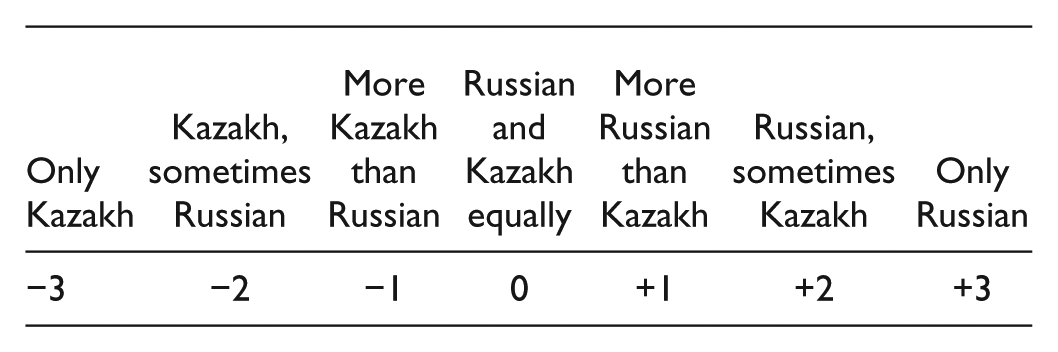
The coefficient is calculated by the technique of adding the indicator of each question and division on the total number of questions. The total amount of questions is 17, but the answer to the seventeenth question is studied separately. That is why the sum of questions indicators is divided by 16.
N is the sum of indicators in the questionnaire, for example, n = 3 + (−1) + (−2) + . . ., and so on.
K (coefficient of functionality) = n\16.
The closer K is to 0, the more respondent’s bilingualism is balanced. Symbol “−” or “+” of the total indicator shows general preference of the language: more Russian if it is +K, or more Kazakh if it is −K. It is possible to define both the coefficient of a separate respondent and total preference of the language in each sphere, in a certain situation.
Analysis of the Experiment Results
About 400 residents of north Kazakhstan (Kostanay city and its districts) took part in the survey; 162 of them are male and 234 are female. The ages of the participants are as follows:

The total results of the research were predictable in certain parameters, but some indicators turned out to be surprising. So the table 1 shows the coefficients of functionality in the sphere of family communication:
Close Circle of Contacts (Family, Friends).

All coefficients are marked with the symbol “−”, which means the choice of Kazakh as the language of communication. It is worth noting that the sphere of family communication is the obvious preference of Kazakh, but the language of communication with parents has a higher indicator than the language of communication with children. That is, the coefficient of Kazakh of those respondents who choose Kazakh more often when talking to parents is 3 times less in communication with children (the most frequent answer is “Russian and Kazakh equally”). This tendency was observed in all answers, but in no questionnaire sheet was the answer to the question about communication with children higher than in that about communication with parents (see Table 1). It was the same or lower. Even the coefficient of functionality of Kazakh in communication with friends is much higher than that with children. This confirms the opinion that the use of Kazakh is connected also with respect and following the traditions. However, it is surprising that respondents do not demand the same from their children.
Analysis of functionality of the Kazakh and Russian languages in the sphere of ethnocultural communication showed the following:
More preference to Kazakh turned out to be in the question concerning congratulating relatives (the most frequent answer, 150 of all respondents answered “only Kazakh” or “more Kazakh”) (see Table 2). Here, the coefficient is almost twice higher than in the indicator of communication with parents. It is accounted for by a big value of a word, parting words (bota) in Kazakh culture, especially pronounced on celebrations and family gatherings; in such situations, even a person whose Kazakh is bad tries to prepare a worthy congratulatory speech in Kazakh not to offend the older generation. Popularity of modern song creativity in Kazakh can be explained by attachment to ethnocultural traditions, even though the coefficient is closer to 0, the most popular answer (210 respondents) was “Kazakh and Russian equally.”
Ethnocultural Communication.

The Sphere of Business and Everyday Communication
The results show that in business and everyday spheres, both Russian and Kazakh are used with a slight preference of Russian (see Table 3). In variants of answers, it is expressed as “more Russian than Kazakh”; the coefficient does not exceed 1. The fact that, when communicating with Kazakh colleagues, respondents choose Russian more often is not favorable for Kazakh. These indicators confirm the suggestion that residents of north Kazakhstan use both Kazakh and Russian as a means of communication, preferring Russian.
The Sphere of Business and Everyday Communication.

Analysis of Questions About Getting New Information and Acquiring Knowledge
Nevertheless, Russian gets more preference in situations connected with the use of language as a means of acquiring knowledge, new information (see Table 4).
Functionality of Kazakh and Russian in Acquiring Knowledge and New Information.

The comparison of coefficients allows stating that Kazakh speakers perceive aural texts in Kazakh (songs, radio, TV) better than written ones (books, study literature, newspapers, magazines, chats). The results demonstrate that when watching TV shows and the news, they choose both Kazakh and Russian with the preference of the latter (“more Russian than Kazakh”). In situations of acquiring information and knowledge through reading, there is an obvious misbalance in favor of Russian. The role of Russian in information space may be considered as an implicit mechanism of globalization of the language; the situation is similar to the expansion of English in South Korea (Piller & Cho, 2013) and French in Morocco (Burdero, 2006).
A number of situations were aimed at defining functional load between languages in forming thoughts and text production, where final texts are compiled in Russian, with a slight preference of Russian in thinking process (see Table 5).
Choice of Kazakh and Russian in Text Production.

Random comparative analysis did not elicit much difference in gender distinction, place of residence city/village. However, the decisive factor of increasing multifunctionality of Kazakh was the language of education.
Influence of the Language of Education on the Choice of the Language in Communication
The comparison of the results of answers of respondents educated in Kazakh and in Russian shows the increase in the share of Kazakh in all situations (see Table 6).
Comparative Analysis of the Results of Answers of Respondents Educated in Kazakh and in Russian.
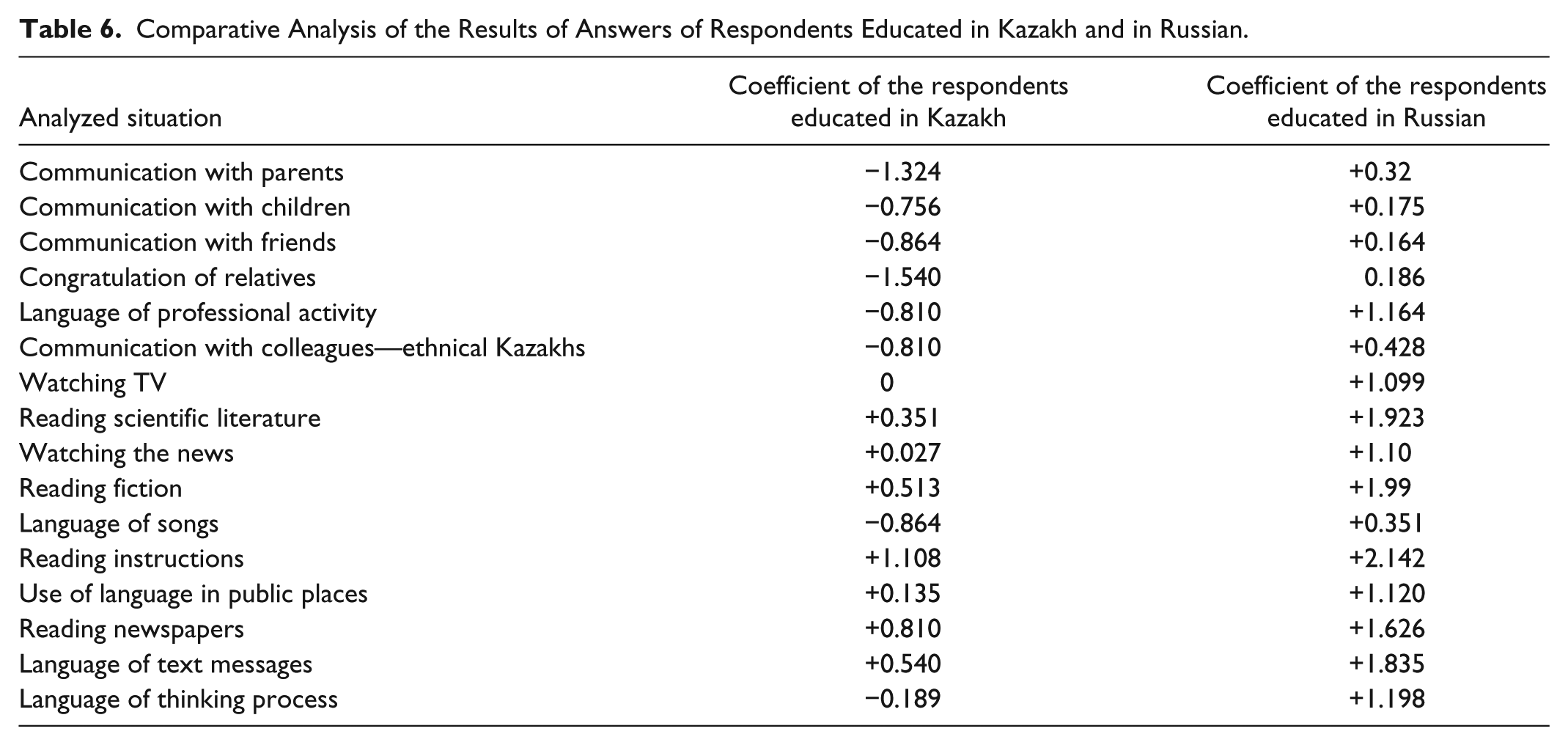
Besides increase in the share of Kazakh, the analysis of the results of respondents educated in Kazakh shows the keeping tendency observed in the grand total: decrease in the share of Kazakh when communicating with children compared with the coefficient of communication with parents, and preference of Russian for acquiring new information.
Indicators of the coefficient of professional activity and communication with colleagues—ethnical Kazakhs are equal; they are almost the same as the indicator of communication with friends. If respondents educated in Russian use more Russian in professional activity (+1.164) with their colleagues who are ethnical Kazakhs, they try to speak less Russian (+0.428), but the coefficients of respondents educated in Kazakh do not change at all.
Preference to Russian in acquiring knowledge and new information of respondents educated in Russian is accounted for the difference between colloquial and standard Kazakh, so they have difficulties in perceiving scientific texts in Kazakh. However, the analysis of the results of respondents educated in Kazakh also indicates preference to Russian, though to a lesser degree. According to the author, such results can be explained by the fact that Russian gives more access to information space in terms of both scientific literature and fiction. Students educated in Kazakh often say that they read textbooks in Russian but have to translate into Kazakh to prepare for lessons.
Influence of Age Differences on the Distribution of Functions Between Kazakh and Russian Languages
For this purpose, two groups of respondents were selected: the younger group and the group of respondents above 36, as we decided that the latter is more involved in public life than the group of people above 50 (see Table 7).
Comparative Analysis of Coefficients of Functionality of Two Age Groups.

Comparative analysis confirms that there is a decrease in the share of Kazakh in communication of young respondents according to all indicators. The coefficient in communicative situations ranges from +0.5 (communication with parents) to +1.3 (communication in public places), which shows that using both Russian and Kazakh with preference to Russian, young people do not see the difference between situations of communication and use both languages equally. The difference in indicators of respondents who are above 36 is much bigger: from −1.4 (communication with parents) to +2 (communication with colleagues). The difference in coefficients between “communication with parents” (−1.4) and “communication with children” (−0.12) of respondents above 36 is also surprising. Despite such a tremulous attitude to the native language, while communicating with their children, respondents do not try so much to speak Kazakh as they do it while communicating with their parents. Such indicators indirectly prove preference to Russian of respondents aged 17 to 25. The results of the survey of young people are depressing because they were born in a new state and grew up having obligatory lessons of Kazakh in kindergarten, primary school, and so on. The results raise questions about the effectiveness of language policy carried out by the government.
Definition of the Native Language According to Ethnical Feature
The results of the answer to the question in the introduction concerning “native language” arouse a special interest. Of 400 respondents, only 15 indicated Russian as their native language. The rest, regardless of the share of Kazakh in their speech, do not doubt saying that Kazakh is their native language. We studied questionnaires of respondents whose individual total coefficient is higher than +2 (from +2.13 to +2.85), which means most of their answers are “only Russian”; there are 48 of them, and to the exclusion of three questionnaires, all of them indicate Kazakh as their native language. The introduction also included the request to estimate language skills in Russian and Kazakh according to the scale “fluent–good, but not fluent–bad–understand, but cannot speak–do not understand.” So, out of the 48 respondents indicating Kazakh as their native language, 12 people (25%) chose “do not understand” Kazakh. On the contrary, of those who indicated Russian as their native language, 6 people (40%) chose “do not understand” Kazakh, and their individual coefficients range from +0.69 to +2.81, that is, the share of Kazakh is much bigger. These respondents are ethnically Kazakh and try to use Kazakh, study it, and include it in their life. It turns out that objective conception of which language is one’s native causes the desire to study the language of your ethnos.
Such results mean that in the communicative space of north Kazakhstan, the notion of “native language” needs deciphering. Indeed, there are several definitions of the concept “native language.” It is the name of a language acquired in infancy by imitating adults (O. S. Akhmanova), a language that was studied first (U. Weinreich; quoted by Avrorin, 1975). This approach does not clarify anything if we speak about bilingual communicative space, wherein the family adults choose either one language code or the other. Avrorin (1975) thinks that it is necessary to expand the content of the notion “native language” depending on the degree of language skills (pp. 124-148). The language in which the person or group of people speak fluently and actively in any case of life should be considered native—if they do not only speak and understand it but also think in it without using the mental operation of translation into the other language.
Nevertheless, the results of the research show quite the contrary situation. The concept of “native language” for residents of Kazakhstan is directly connected with the ethnical feature. A respondent with distinctively dominating Russian indicates Kazakh as the native language as it is the language of their ethnos. Thereat, none of the respondents hesitated about the choice of the native language, and no one (!) tried to indicate both languages. Avrorin notes that a person can call the language they know well their native language, not the language they are attracted to (Avrorin, 1975). Also, he says that if one should proceed from linguistic meaning of the term native language, a person may have two or three native languages, and in this situation of bilingualism in defining the native language, the ethnical feature becomes decisive. This choice of the respondents is explained by this.
On one hand, a person can only approximately give an objective estimation of their language skills. The questionnaire offered the scale of answers, but the results concerning this point are questionable. Respondents (42 people) answered “do not understand” to the question on the degree of language skills in Kazakh, but general indicators of the coefficient are from +0.73 (it is a relatively balanced bilingualism!) to +2.81, and among the answers, there is a variant “Kazakh and Russian equally” in the questions about the language of communication with parents and friends. Respondents may have answered “do not understand” thinking about grammar or its literary variant. In turn, the answers about language skills in Russian are more objective. There is a dependence between answers to the question about skills in Russian and the general coefficient: The answers “bad,” “understand, but do not speak” always correspond to the “−” coefficient, that is, there is misbalance in favor of Kazakh (there are no answers “do not understand” at all).
According to the ethnical feature, respondents sincerely think that Kazakh is their native language regardless of the degree of their skills. Most part of Kazakh in answers about songs and congratulations of relatives proves the attachment to this language; these situations indirectly reflect the priority of the language in its expressive function.
Ethnical self-consciousness distinguishes Kazakh as dominant regardless of communicative indicators. Self-identity as a part of the ethnos is reflected in respectful attitude to the language. Such a difference of coefficients of respondents of older and younger generations can be explained by this. For a young man, ethnical identity is accounted for by itself, they answer such questions automatically. Conscious comprehension of one’s own culture and following tradition come with age—and along with it, certain responsibility for their people and language. A a 17-year-old respondent is more involved in information space where Russian and English are dominating. Older respondents (36 and above) prefer Kazakh for communication becouse they speak Kazakh—it is both respect to the speaker and part of the ritual, and the way to establish trust with the interlocutor. An adult understands what in their personality is formed under the influence of ethnical traditions and which actions are approved in their culture; all these are expressed in the use of the language of their ethnos. That is why, those respondents in our research who answered “do not understand” about the language skills in Kazakh (42 people) aspire to broaden their knowledge; coefficients show that they often watch the news, TV shows, and read newspapers in Kazakh. These are the situations in which those who speak Kazakh fluently use more Russian.
Summary
Analysis of questionnaires shows that the choice of Kazakh is made in the direction of middle-aged generation to the elder generation. Even according to the age criterion, preference to Kazakh is given more by respondents who are above 30. Thus, the effectiveness of language policy aimed at younger generation (increase in lessons of Kazakh at school, universities, various events, measures of encouragement, etc.) is questionable.
The research demonstrates that the use of Kazakh by Kazakh-speaking residents of north Kazakhstan is obligatory and unconditional in situations when respect to the elders (parents, aksakals) and respect for family traditions (congratulations of relatives, congratulatory speeches at celebrations) is concerned. That is, Kazakh speech is also connected with ethnical self-identity and cultural identity. However, the older a person is, the more definite their plans for the future are. Connecting their further life with Kazakhstan, respondents of older generation better understand the necessity to know Kazakh (flow of documents, requirements at work) and consciously speak more Kazakh to improve their skills. We may suggest that for ethnical Russians, who are residents of Kazakhstan in the second, third, and generations thereafter, it will be possible to use Kazakh in case they realize their affiliation with Kazakh culture and the state of Kazakhstan. Propaganda of the Kazakh language as an inevitable part of the Kazakhstan nation (not only Kazakh ethnos); knowledge of the language as a sign of respect for values of a multiethnic state is also a long-term direction of language policy.
Study of public functions of languages in the situation of bilingualism allows estimating objectively the state of language and defining the extralinguistic factor that determines this state, which will allow us to reveal the language problem with its subsequent solution.
The proposed differential technique is also convenient as the questionnaire may be infinitely specified according to the types of communication in each sphere, defining the priority of languages in the informative, expressive, and other functions. For instance, business communication may suggest many questions; so the point “which language do you use at work” may be more specified into “communication with the employer,” “communication with employees,” “with colleagues,” “with Russian colleagues,” and so on. The necessity of a balanced language policy determines relevance of such kind of research. In this context, scientific study and description of the specific character of the northern region of Kazakhstan become topical.
Footnotes
Declaration of Conflicting Interests
The author(s) declared no potential conflicts of interest with respect to the research, authorship, and/or publication of this article.
Funding
The author(s) received no financial support for the research and/or authorship of this article.