




Abstract
Feng Shui, still popularly practiced today, was closely related to philosophy, natural science, geography, environmental science, architecture, metaphysics, and astrology in ancient China. It is basically divided into the Form School and the Compass School. The latter deals with numerology, calculation, orientation, and time. Luo Shu [洛書], associated with the eight trigrams [八卦], being an ancient Chinese magic square, forms the foundation of the Compass School. The original Luo Shu, a 3 × 3 magic square, was not unique in ancient China but the extension of it to a total of 18 to 36 standard charts was unique, which are still used by all Compass School Feng Shui masters. In this article, modern linear algebra, developed only in the mid-19th century, is employed to prove that there is a strong coherence between the 36 charts if they are treated as 36 matrices and such correspondences conscientiously agree with ancient theories of Feng Shui. This article may help to form a scientific base for the systematic understanding, development, and further research of Luo Shu–related applications.
Introduction to Luo Shu
In this section, the significance of Luo Shu to the Chinese culture will be discussed so that we could understand the reason why it is worth to take effort to study Luo Shu and related applications in a more scientific manner.
According to Joseph Needham (Needham & Wang 1959), probably the mostly renowned scientist and sinologist studying the history of Chinese science, one ancient Chinese interest was in combinatorial analysis, the construction of magic figures, where numbers were arranged in such a way the logistic operations could be performed. In the book, on page 57, two drawings were depicted, namely, He Tu (the River Diagram) and Luo Shu (Luo River Writing). Accordingly, these two names were mentioned in Lun Yu (Conversations and Discourses of Confucius) written in the fifth century BCE and then Yi Jing (Book of Changes). But there was no detail about the two diagrams mentioned in Lun Yu, that is, the exact arrangement of the dots on the diagram.
According to Ho (2003), in the Mingtang chapter of Dai De’s Da Dai Liji (Record of Rites by the Elder Dai), a work dated approximately to the year 80 CE showed the arrangement of numbers from “1” to “9” in three sets, that is, 2-9-4, 7-5-3, and 6-1-8. These three sets of numbers, as can be seen in a later paragraph, resemble Luo Shu closely. Prof. Ho had been a 40-year research associate of Prof. Needham, Head of Department of Chinese of The University of Hong Kong from 1981 to 1987 and later director of Needham Research Institute at Cambridge from 1990 to 2001. The purpose of these numbers was not explained in the Da Dai Liji, probably associated with the nine halls at which the Zhou emperors (1045 BCE-256 BCE) performed their ceremonial rites. It was generally agreed that the two diagrams had dominated Chinese thought since ancient times.
The first printed version of He Tu and Luo Shu appeared in the Song Dynasty, written by the famous Daoist Chen Tuan in the 10th century CE and then Cai Yuanding (1145 CE-1198 CE), disciple of the famous Confuciust, Zhu Xi (1130 CE-1220 CE), shown in Figures 1 and 2. Figure 2 is called the “Original Luo Shu” throughout this article. Ho (p.20, 2003) further said that, He Tu does not qualify as a modern magic square and has been put aside by modern scholars studying Chinese magic squares . . . . However, to the traditional Chinese mathematician, the two figures are of equal importance, both mystically and philosophically.
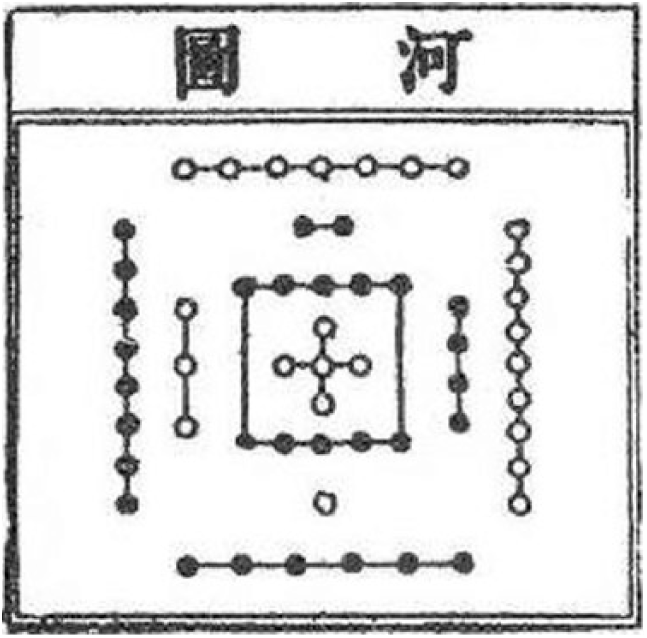
He Tu diagram.

Luo Shu writing.
In this article, the discussion is focused on Luo Shu.
In his book, on pages 5 and 6, Ho discussed the importance of the three cosmic boards (三式) to the Chinese history and pointed out two out of these three boards were mainly concerned with the Luo Shu magic square. It is because these boards were believed to be secretly manipulated by the Astronomical Bureau to assist the emperors to predict astronomical events as well as human actions.
The three cosmic boards are Tai Yi (太乙 or 太一), Dun Jia (遁甲), and Liu Ren (六壬). Tai Yi was the origin of the most popular Flying Stars method used nowadays. On page 25 of his book, Ho further discussed the principle of movement within the nine palaces, known to the practitioners of the art as feigong (flying palaces or flying stars in the modern term). The movement could either be in a clockwise direction (shunfei, that is, forward flying) or in an anticlockwise direction (nifei, that is, backward flying). In this way, 18 variations of the Luo Shu are produced, as detailed by Smith (1993), shown below in Table 1.
Eighteen Variations of Luo Shu.

These 18 charts, including the original Luo Shu—the first one shaded in Table 1—are called standard charts that are popularly used by contemporary Feng Shui masters of the Compass School. In some schools of Qi Men Dun Jia, 18 more charts are used, resulting in a total of 36 standard charts. But as seen in a later section of this article, 27 out of the 36 charts could be easily produced by the 9 standard “forward flying” charts developed from the original Luo Shu. One immediate observation of the original Luo Shu is that any three numbers along a row, a column, or a diagonal, when added together, give a sum of “15.” This fact was also well known in the western world.
The discovery of the original Luo Shu was not unique in ancient China. Magic squares were found in old Persia around the 10th century CE from the manuscript of Buzjani, a mathematician (Hogendijk & Sabra, 2003). They were also known to Islamic mathematicians in Arabia as early as the 7th century CE. These squares are not only limited to an order of 3, while orders of 4, 5, and higher are also available. The 3 × 3 magic square has been a part of rituals in India since Vedic times and is still used today; the Ganesh yantra of ancient India is a 3 × 3 magic square. The 4 × 4 magic square was displayed in the Parshvanath Jain temple by 10th century CE. However, it seems that there was no special application in terms of divination of such magic square outside China in the ancient times. And furthermore, as discussed in following sections, there are 35 additional variations of Luo Shu, and all these 36 variations are useful in Feng Shui study, though 18 of them are more popular nowadays. Nothing on such variations was found elsewhere except in ancient China. Once the Luo Shu is varied, the characteristic of “added together equals 15” immediately disappears. That may explain why variations did not draw attention outside China.
Regarding the exact date of existence of Luo Shu, a recent archaeological discovery in the spring of 1977 confirmed that it existed well before 80 CE as described in Da Dai Liji. Archaeologists discovered a tomb of the Western Han Dynasty built around second century BCE at the City of Fuyang in the province of Anhui, China. Inside the tomb, several of the oldest astronomical instruments were unearthed and Luo Shu was printed on one panel called 太一行九宮占盤 (Divination Pan of the Supreme Unity moving around Nine Palaces), shown in Figure 3. With the mentioning of Luo Shu in Yi Jing, we have confidence in believing that Luo Shu existed long before 500 BCE. Then, two modern applications of Luo Shu and the extended standard charts are to be briefly discussed.

Divination pan of the supreme unity moving around nine palaces.
Applications of Luo Shu and Its Extended Charts in the Compass School
The previous section was mainly on historical development from a cultural perspective. For Feng Shui study and applications, readers could refer to Skinner (2006/1976) and Walters (1991). The practice of Feng Shui could roughly be categorized into two schools, namely, the Form School and the Compass School (Mak & So, 2011, 2015; Skinner, 2006/1976). The Form School studies landscape and water flow. Mountains and ridges are believed to be the source of Qi, the name of energy or natural force in all schools of Chinese studies, including medicine, martial arts, and metaphysics. The Qi flows down from high mountains and is dispersed by wind and stopped by water. So, a good site, according to the Form School, should have tall mountains at the back and flowing river in the front. By the two sides, there should be low ridges, called azure dragon on the left and white tiger on the right. Air movement, but not strong, at the site is necessary and the river should be concave to the site with flowing water. In other words, a dead pond of water is not favorable. The Form School deals with the form only, and therefore, it has no temporal concern. The Compass School concerns both space, in terms of directions, and time. After a good site is selected, the Compass School directs Feng Shui masters to determine the orientation or facing direction of the building as well as the best time to erect the building. It therefore involves the extensive use of the compass, as the name tells, which is professionally called “Luo Pan” in Feng Shui study. The whole circle of 360ο is divided into 24 sectors, called mountains. Each mountain has a span of 15ο, as shown in Figure 4. Here, two applications of the Compass School are briefly introduced.

The compass—Luo Pan.
Flying Stars method is the analysis of Qi and the subsequent patterns generated in accordance with the geomagnetic directional patterns that affect the building structures in which we live and work. A detailed discussion on the Flying Stars method could be found in Skinner (2003). Although Qi may technically be more than merely a geomagnetic force, it is traditionally believed to be illustrated by geomagnetic and other physical forces, like air flow patterns and so forth.
To dwell in a house, it is essential to determine the best locations for all doors and the allocation of main rooms to harness the beneficial distribution of Qi. The stars referred to here are not real stars up in the sky; they are merely numbers of Luo Shu moving around the nine, 3 × 3, palaces. Fortune cycles, totally nine, of 20 years each are used to determine the number placed at the central palace. The seventh Fortune Cycle commenced on February 4, 1984 (The Year of Jia-Zi [甲子] in the Sexagenary cycle) and ended on February 3, 2004, to be precise. Now, we are within the eighth Fortune Cycle, from February 4, 2004 to February 3, 2024. Based on the sequence of numbers in the original Luo Shu, the proper sequence of placement of stars, or the flying trajectory, is according to a standard pattern, as shown in Figure 5. By comparing the first chart of Table 1 and Figure 5, readers could immediately notice the logic of this flying trajectory. Figure 6 shows the chart for the current eighth Fortune Cycle, which is created by putting the number or star “8” at the central palace, and other numbers are placed according to Figure 5. This chart refers to the period of time under study, called the Time Chart. The original Luo Shu’s arrangement with “5” at the central palace is called Earth Chart. Figure 5 shows the forward flying trajectory while a backward flying trajectory is also possible as shown in Table 1.

Placement of numbers (stars) in the nine-palace chart.
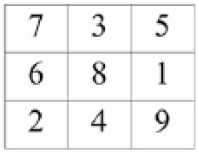
Time chart of eighth Fortune Cycle.
Then, the facing direction of a house built within the period of time and the sitting direction (180ο opposite to the facing direction) of that house generate two more charts. The original Luo Shu was associated with directions, with “9” pointing south, “1” pointing north, “3” pointing east, and “7” pointing west. It has been an established convention that “south” is always put at the top of a chart and “north” at the bottom, which is analogue to the emperor sitting in his palace in northern China, say at Beijing, and looking south over his own nation. Based on the facing or sitting directions, two numbers at the corresponding palaces will be put at the central palace and therefore two more charts are produced and merged together, like the one shown in Figure 7 where there are three stars in each palace.

Final flying stars chart of a house facing east built within the seventh Fortune Cycle.
Figure 7 shows the full Flying Stars chart (three charts combined together) of a house built within the seventh Fortune Cycle (from February 4, 1984 to February 3, 2004), facing east. The star “5” at the eastern palace of the Time Chart is brought to the upper right-handed corner of the central palace, thus forming the Facing Chart, and the star “9” at the western palace (sitting direction) of the Time Chart is brought to the upper left-handed corner of the central palace, thus forming the Sitting (also called Mountain) Chart. The logic of placement (forward or backward) of other stars in the Facing and Sitting Charts is beyond the scope of this article. Based on these three charts, Feng Shui masters could tell whether the house in general is auspicious or not and could even make comments on the use of every room corresponding to each of the nine palaces.
In the Flying Stars method, there are two types of charts that are believed to be auspicious besides other concerns, as shown in Figures 8 and 9. In Figure 8, all stars in every palace belong to one of three configurations, namely, “1-4-7,” “2-5-8,” or “3-6-9,” sequence being flexible. These three configurations are called “The Three Big Trigrams 三般大卦.” However, this is just one version, the most popular version, in fact, of the theory of “The Three Big Trigrams.” There are others, such as “1-2-3,” “4-5-6,” “7-8-9,” and so forth. In Figure 9, every star of the Time Chart when added to the corresponding star of the Sitting Chart always gives “10,” such configuration being called “Combined to Ten合十.” These two configurations are important in our further elaboration.
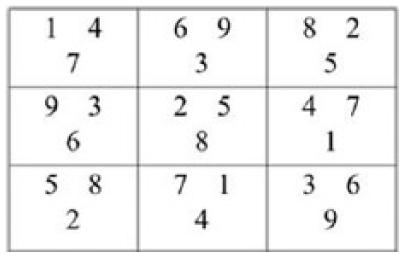
Facing south-west built in eighth Fortune Cycle.

Facing south built in seventh Fortune Cycle.
This article is not on the Flying Stars method. Readers are just reminded to pay attention to the 18 to 36 possible standard charts merged together, the special “Three Big Trigrams,” and “Combined to Ten.”
Another application of Luo Shu is called Qi Men Dun Jia, which was widely used in the war fields by generals in the ancient times to determine the best time and bearing to attack and retreat. In addition to the three charts in Flying Stars method, Qi Men Dun Jia uses four charts altogether, superimposed on top of one another or merged together as in Flying Stars method, called Heaven (天時), Earth (地利), Man (人和), and Spirit (神助). All the 18 standard charts of Flying Stars method are used while two more types are sometimes added for every forward flying chart. That is, to rotate the chart either +90ο or −90ο with the central star unchanged as the pivot of rotation. Figure 10 shows the original chart with say “4” at the central palace, that is, the Time Chart of the fourth Fortune Cycle; Figure 11 shows that rotated by +90ο; Figure 12 shows that rotated by −90ο. In this case, 18 more charts are added, with a total of 36 standard charts.

Original chart of fourth Fortune.
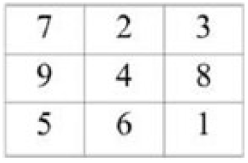
Original chart of fourth Fortune rotated by +90ο.

Original chart of fourth Fortune rotated by −90ο.
According to the method of Qi Men Dun Jia, every year is divided into 4,320 sets (局) under 18 categories, half belonging to Yin and half belonging to Yang. But the variation in sets is slightly different year by year. Each set can be represented by four charts, chosen from the 36 standard charts mentioned above, and Feng Shui masters refer to the charts to give comments and divine.
Readers are once again recommended to pay attention only to the configuration or structure of these standard charts as the discussion on them is the key issue of this article. These 18 to 36 standard charts have been used by Feng Shui masters for centuries. In this article, they are treated not as charts or grids or palaces, not as magic squares anymore, but as matrices of modern linear algebra. Before we discuss the results arisen from such treatment, let’s have a quick review on several characteristics of matrices, including determinants, eigenvalues, and eigenvectors, and their geometric meanings on a three-dimensional coordinate system.
A Review on Useful Techniques in Linear Algebra
Introduction to Determinants
In linear algebra, a determinant is a value associated with a square matrix, normally denoted by det(

Introduction to Eigenvectors and Eigenvalues
The eigenvectors and eigenvalues were developed by Cauchy (a French mathematician) in his study in quadratic form in 1826. He found that an eigenvalue problem had resulted from solving a quadratic problem. The eigenvectors and eigenvalues have been widely adopted in engineering problems. It has been adopted in the design of power system (Fereidouni, Vahidi, Mehr, & Tahmasbi, 2013), structural engineering (Kong & Huang, 2013), medical imaging (Hyvonen, Nandakumaran, Varma, & Vasu, 2013), fluid mechanics (Pochyly, Malenovsky, & Pohanka, 2013), and so forth. The eigenvectors of a square matrix have the property that multiplying the square matrix to its eigenvectors is equivalent to applying multiples to the eigenvectors. These multiples are called eigenvalues.
It can be mathematically described by the equation
Geometrical Interpretation of Eigenvectors and Eigenvalues
The eigenvectors and eigenvalues have been widely used in principal component analysis (Jolliffe, 2002). We consider a 3-by-3 matrix as the covariance matrix of a set of data scattering in the three-dimensional (3D) space. It should be noted that the covariance matrix must be a symmetric matrix. This approach uses a 3D ellipse to fit the distribution of such data in the 3D space. The three principal axes of the ellipse are in fact the eigenvectors of the covariance matrix. The square root of an eigenvalue represents the spread in the direction of the corresponding eigenvector. The geometrical meanings of the following three symmetric matrices are discussed.

Matrix (a) is a diagonal matrix of which all diagonal elements are identical. It means that the spreads of the data along the axes of the Cartesian coordination system are the same. Therefore, the geometry of the data spread estimated by the eigenvalue analysis is represented by a 3D sphere. Matrix (b) is also a diagonal matrix, but the elements on the diagonal of the matrix are not the same. It means that the data spread along different axes of the Cartesian coordination system are different. Therefore, the geometry of the data spread is represented by a 3D ellipse, but the axes of the ellipse are parallel to the axes of the Cartesian coordination system. Matrix (c) is similar to matrix (b) but some of the off-diagonal elements are nonzero. However, the matrix is still symmetric on both sides of the diagonal. The geometry of the data spread is still a 3D ellipse, but the three principal axes of the ellipse are no longer parallel to the axes of the Cartesian coordination system.
The origin of the three principal axes coincides with the origin of the coordination system but rotated around a pivot at the origin. The above geometrical interpretation from the eigenvectors and eigenvalues are restricted to a symmetric matrix only. However, the eigenvalues are not necessarily real. Sometimes, we may obtain imaginary eigenvalues as the roots of the equation
In a 3D space, the three roots (i.e., the eigenvalues of the matrix) are either all real numbers or one real number with two imaginary numbers, which are conjugate to each other. The eigenvectors can still be obtained from the eigenvalues although two of the eigenvalues may be imaginary numbers. By taking the dot product of any two eigenvectors, the result is not necessary to be zero. It indicates that the three principal axes are not necessary to be orthogonal to each other. Although the geometrical interpretation of the eigenvectors and eigenvalues with imaginary number(s) is not easy to interpret, obtaining the eigenvectors and eigenvalues of the matrices (i.e., the standard charts) may possibly form a basis from a mathematical perspective to analyze the relations between the charts.
Mathematical Basis of 36 Luo Shu Variations
Generating 17 Standard Charts From One Luo Shu’s Original Chart
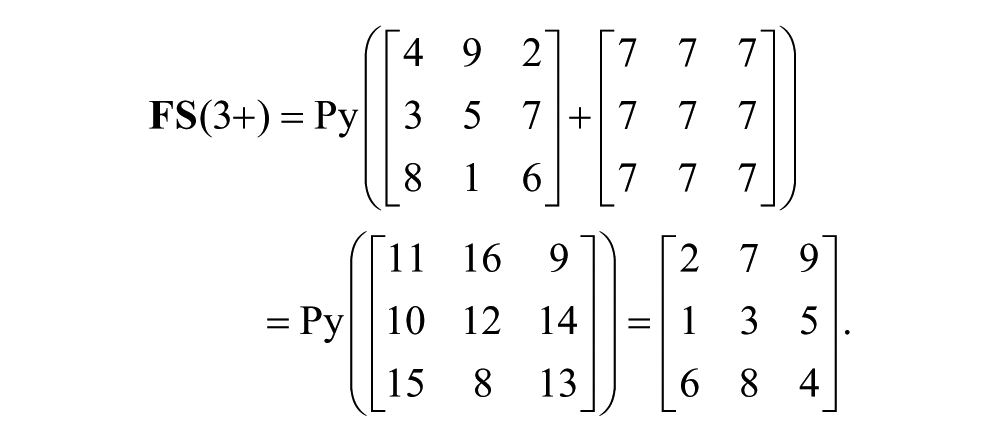
By revisiting Table 1, the 17 standard charts could easily be generated from the original Luo Shu in two simple equations. This was also mentioned in Ho’s (2003) book in plain text. One basic technique adopted by the famous Greek philosopher, Pythagoras, has to be used here. He reduced all higher numbers to the original 10 numerals by successively adding the digits together until a single digit was reached. Let’s build a function, Py(x or


As a numerical example, the chart of the third Fortune Cycle is given by
Determinant of the 36 Standard Charts
As discussed in the section “A Review on Useful Techniques in Linear Algebra” of this article, the determinant of a matrix has a very important meaning related to the behavior of the matrix. The determinants of the 36 standard charts are shown in Table 2. The following symbols are valid.
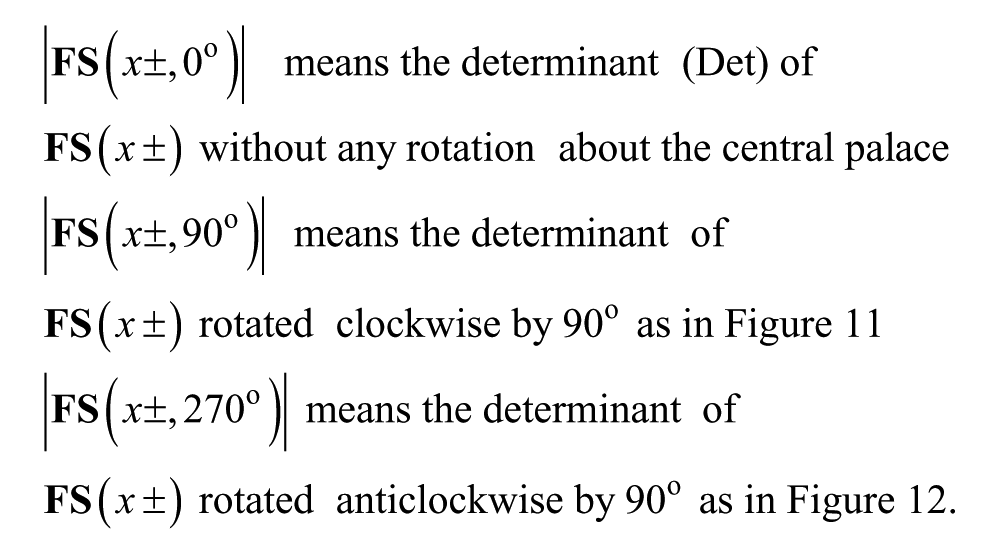
Determinants of 36 Standard Charts.
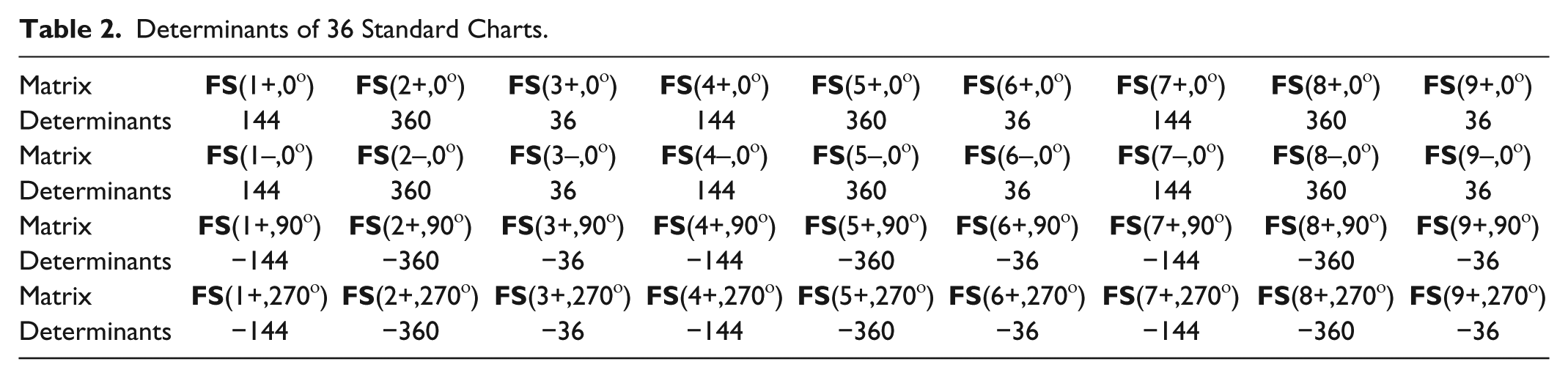
It can be seen that the determinants of all
One more observation is that the result is constantly equal to “9” when the function Py is applied to the absolute value of the determinant of any
To show that such equivalence is not generic with any matrix similar to
Determinants of Nine Standard Charts Rotated by 45ο Clockwise.

Table 3 is for reference only, showing that the equivalent and elegant values of determinants of the 36 standard Charts do not seem to be coincident or by luck because the properties of “1-4-7,” “2-5-8,” “3-6-9,” and “Py = 9” all disappeared in Table 3.
Eigenvalues and Eigenvectors
We would like to propose a hypothesis here. Suppose the matrices of the standard charts represent a geometrical space of independent vectors and coordinates, then, the eigenvalues and eigenvectors of all these matrices may give us some hints. As the numbers in the 36 standard charts are not symmetrical, a simple conversion is proposed here. All numbers are subtracted by “5.” In other words, the original system of {1, 2, 3, 4, 5, 6, 7, 8, 9} now becomes {−4, −3, −2, −1, 0, 1, 2, 3, 4}. It looks more symmetrical here. However, we do not mean that by doing so, the matrices will become symmetrical by themselves. After all, the numbers have long been called stars and that may mean Feng Shui masters have been treating them as symbols rather than pure numbers. We just propose to use a new set of symbols to replace the old symbols. Let’scall them
For example,
Table 4 shows the determinants, eigenvectors, and eigenvalues of
Geometrical Behavior of F

Geometrical Behavior of F

Geometrical Behavior of F

Geometrical Behavior of F

First of all, determinants are checked. It can be seen that in all four tables, there are just three values of determinants, much simpler than before, that is, −54, 0, and 54. Except 0, the Py of the other two, when taken absolute, is also equal to 9. The “1-4-7,” “2-5-8,” and “3-6-9” equivalence is also preserved in and across all four tables, regarding the determinants, from Tables 4 to 7.
Regarding the eigenvalues and eigenvectors, there are several observations.
In all four tables, there is an extremely high level of similarity between these two parameters of eigenvalues and eigenvectors, corresponding to the following pairs,
Such similarity is not only confined in individual tables. We can find cross-table similarity of “6-4” between Tables 4 and 5, for example,
By comparing Tables 6 and 7, it can be seen that the eigenvalues and eigenvectors of
Furthermore, besides the “2-5-8” similarity across Tables 6 and 7, a more extensive similarity with all “1-3-4-6-7-9” exists within and across the two tables.
Just for the purpose of illustration, the determinants, eigenvalues, and eigenvectors of nine matrices, still with −4 to +4 at the central palace but other eight numbers randomly placed, are shown in Table 8. As expected, all those behaviors of similarity disappear. That once again demonstrates that the 18 to 36 standard charts of Luo Shu were not arbitrarily created or produced by luck.
Geometrical Behavior of Nine Randomly Generated Matrices.

Conclusion
In this article, the importance and history of Luo Shu have been briefly reviewed, with an introduction to two methods within the Compass School of Feng Shui that heavily rely on the operation of 18 or up to 36 variations of the Luo Shu. Then, it is hypothesized that Luo Shu, as a magic square, could be viewed as a 3 × 3 matrix, and such matrix could be further extended to 18 or 36 variations. The significance of two types of variations possessing patterns, including “The Three Big Trigrams” and “Combined to Ten” was also highlighted. Observations on similarity between different charts in terms of determinants, eigenvalues, and eigenvectors have been confirmed and discovered. Such similarity may find its roots in ancient literature on the Compass School of Feng Shui. The authors are not certain how ancient Chinese knew about that as they would not have any knowledge on modern algebra.
The extremely high level of similarity between Tables 6 and 7 may explain why only 18 standard charts are popularly used in contemporary Flying Stars Method while the remaining 18 are only used in some limited schools of Qi Men Dun Jia Method. In fact, most modern Qi Men Dun Jia schools only focus on the first 18 standard charts. That may be due to the high degree of dependence between the additional 18 standard charts, resulting in a lower degree of freedom for applications.
One more simple and final observation is that all nine “backward flying” charts could be generated by the nine “forward flying” charts merely by rotation and vice versa. The general formulae are shown below.

Having recalled that the 36 standard charts were developed long time ago, it should not be something created just by luck or by chance. The main contribution of this article is to establish the mathematical basis of studying Luo Shu and its variations. With the use of the language of modern mathematics, the research of this area of ancient Chinese philosophy and metaphysics could be more conscientious and scientific.
Footnotes
Declaration of Conflicting Interests
The author(s) declared no potential conflicts of interest with respect to the research, authorship, and/or publication of this article.
Funding
The author(s) received no financial support for the research and/or authorship of this article.