




Abstract
A study of student satisfaction, needs, and learning outcomes was commissioned by a comprehensive university in Western Europe to provide a professional evaluation of student services and the co-curricular activities of students. Such a study had not been completed in the past and was needed to align student services with the mission, long-range goals, and strategic planning of the university. The research involved both qualitative and quantitative methodologies conducted through volunteers divided into five focus groups of 33 national and international students and a survey involving 104 national students, of whom 86 provided complete data. The results were analyzed using the Statistical Package for the Social Sciences (Version 22) and the constant comparison method. The study demonstrated that students view interactions outside the classroom as important opportunities to develop and hone a myriad of personal knowledge and skill sets important to becoming global citizens and internationally competent professionals.
Keywords
As part of a teaching/research Fulbright award, a private, selective, comprehensive university of 23,000 students commissioned a study of the satisfaction, needs, and learning outcomes of students relative to student services and other outside-the-classroom activities. Such a study had not been completed in the past and it was considered important to gather data and receive recommendations from an external source to integrate this area of university administration with the mission, long-range goals, and strategic planning of the university.
The subject institution serves the university system in the European Union and higher education throughout the world through diversified study abroad and international student programs. The university consists of faculties, schools, and institutes (academic units) facilitating the needs of students pursuing a broad range of discipline-specific programs including medicine and health sciences, engineering, law, economics/business, science and technology, arts and humanities. The campus lies in an urban setting allowing students to take advantage of the educational, social, and cultural amenities of a major metropolitan area of over one million people. The campus infrastructure includes a mix of stately historic buildings and carefully integrated modern architecture. Two university hospitals and a recreation/sports complex outside the city limits complement the main campus.
Background
European universities in general and the higher education system in Western Europe have paid little attention to approaching student learning with an emphasis on activities that occur outside the classroom (Osfield, 2008). The idea of “holistic” education is more closely related to the American tradition that places significant emphasis on “student learning and development” outside the classroom. Students throughout the world find ways to spend their time outside of class in activities that complement the formal academic curriculum as well as the mission and goals of the university. Student unions, associations, clubs, and organizations have a long history of providing some outlet for the student need to socialize, organize, recreate, volunteer, and sometimes worship together. Students reside in residence halls and off-campus apartments, dine at campus restaurants, attend plays and concerts, and plan and administer a myriad of activities both formally and informally. European tradition offers a philosophy that co-curricular activities are merely ancillary to the mission of the university, which is research, classroom teaching, and academic learning. Responsibility for the personal and social development of the student does not fall to university administrators and faculty. Instead, it is left to developments made prior to university attendance, acquired accidently during their stay, or left to parents that may still have an influence on character and personal development. The essential issue to consider is whether student interactions outside the classroom should be more intentional, giving the university experience greater impact by complementing the goals of the higher education system to produce ethical and capable citizens to lead a region in a competitive, globalized world.
Adopting a more intentional approach to educating outside the classroom is an appropriate solution to one of the major challenges mentioned in the mission of the case study institution which indicates that the university is not only for classroom teaching and research, but also educating for life and making students grow as human beings.
Literature Review
There is a paucity of available literature on international student services in Europe as the topic has only recently received attention (Dalton, 1999). One of the most exhaustive books on the topic is an edited volume titled Internationalization of Student Affairs and Services: An Emerging Global Perspective (Osfield, 2008), which proposed to “produce a comprehensive book on the development of student services around the world to show how student services are actually delivered . . . and to give students an opportunity to learn about worldwide delivery models” (p. ix). As with many research studies, the work unveiled as many questions as it supplied answers to the current state of supporting students outside the classroom. It was important then to review previous research through a number of themes that emerged from the literature to define and clarify ideas that developed from the current case study of a European university. The themes include; higher education reform and changing expectations; assessing student satisfaction, needs, and learning outcomes; and the importance of outside-the-classroom activities and student services.
Higher Education Reform and Changing Student Expectations
The priorities of European higher education were redefined with the Bologna Declaration in 1999 and subsequent efforts to transition an autonomous system into a regional and dynamic process. Terry (2008) and Gruber, Fuß, Voss, and Gláser-Zikuda (2010) suggested that key efforts in the process were to establish a harmonized system of quality assurance in higher education across Europe and to become competitive in the global economy. The Bologna initiative developed a unified higher education system that allows credit transfers between European universities. With increased options for transfers and a prioritization for internationalization, Gruber et al. (2010) and Osfield (2008) concluded that universities need to address the needs of a changing and diverse student body. In addition, some countries recently introduced fees and tuition charges while also witnessing a change in student expectations regarding availability and satisfaction of services. As the student becomes more of a consumer, universities that only focused on classroom learning and research will have to be more aware of student satisfaction (Gruber et al., 2010). Machado, Brites, Magalhães, and Sá (2011) referenced the report by the Commission of the European Communities (2006) which emphasized that higher education institutions need to embrace change if they want to be competitive in the modern world.
Machado et al. (2011) also reported on student satisfaction, indicating that meeting student needs to retain them is a challenge worldwide. Bateson and Taylor (2004) suggested that the countries of Central and Eastern Europe should look to the United States and the emphasis on student involvement theories as a “starting point in our understanding of our contemporary students’ behavior” (p. 478). Traditional European universities tend to maintain the idea that higher education is for research and inside the classroom learning, but Ping (1999) concluded that “what the contemporary campus requires are patterns and structures that allow people to live together, to learn together, and to educate one another” (p. 14). Machado et al. and Gruber et al. (2010) carried the argument further suggesting that the need for European institutions to meet the expectations of students is a matter of survival. In turn, there is a need for universities to assess student satisfaction, bringing them more in line with what is perceived to be quality service.
Assessing Student Satisfaction
The movement to accept qualitative research has a long history in American higher education dating back to the 1960s. There is currently general agreement that concentrating on participant viewpoints and the meaning individuals attach to educational issues is not only valid, but even preferred in specific cases, over quantitative methodologies (Creswell, 2008). The movement to focus on student satisfaction and needs eventually led to qualitative methods of evaluating student services and the impetus to justify the cost of co-curricular activities led to the current focus on learning outcomes. Many scholars in the literature of American higher education have found the assessment of student satisfaction not only appropriate but “necessary due to pressures from decreasing enrollment, budget cuts, shrinking fiscal resources, and increased competition for government funding and private support” (Li, McCoy, Shelly, & Whalen, 2005, p. 176). Bean (1980), Hendel (1985), Lenning and Ebbers (1999), Schuh (2009), and Schuh and Upcraft (2001) have supported the argument that satisfaction is “one of the most direct tests of postsecondary success, and a positive relation has been established between academic satisfaction and retention (Li et al., 2005, p. 177).
Although there has been some effort to assess student satisfaction at European universities, Bateson and Taylor (2004) found that university decision makers only receive sporadic student feedback although it is critical to planning the appropriate implementation of programs. A more systematic and comprehensive effort of assessing student life is prepared every 3 years by the Social and Economic Conditions of Student Life in Europe report, which analyzes the changing trends in European higher education (Orr, Gwoce, & Netz, 2011). Although the study produced essential information on academic effectiveness, it failed to address outside-the-classroom learning. The analysis was divided into three categories including student/faculty contact, personal study time, and paid jobs. It made no mention of key terms such as student development, outside the classroom and experiential learning, student affairs, learning outcomes, and co-curricular activities. In addition, learning-related activities were defined only as either formal pedagogical time or personal study time. As Akil (2011) noted in the commentary on the Orr et al. (2011) report, “ . . . student support has been considered tangential to institutional strategy because, from this perspective, students should largely be able to take care of themselves” (p. 298).
This idea of student self-reliance and student services being tangential to the institutional mission has been challenged by additional findings, indicating that the opposite conclusion might also be reached. Akil (2011) suggested that European universities need to be aware that “eighty percent of students [surveyed] indicated that the availability of services at the host institution were either very important or partly important in their final decision about where to study” (p. 298). The Social and Economic Conditions of Student Life in Europe report also concluded that an overwhelming majority of students consider a foreign enrollment phase as a way to develop personally (Orr et al., 2011). Machado et al. (2011) concluded that students would also prefer improved access to interactions with faculty outside the classroom as well as quality academic advising. They also suggested that being involved in social aspects as well as the academic realm retains students and an institution must recognize “that the social dimension in learning activities is critical” (Machado et al., 2011, p. 420).
Bateson and Taylor (2004) agreed with this point, suggesting that “the learning process in the university goes beyond classroom interactions between student and professors, reading, writing, and taking examinations” (p. 479) and there must be further effort to address this. Osfield (2008) recognized that there is a “blurring of boundaries” between academics and support in higher education that requires more focus on the co-curriculum and, in turn, develops a need to better understand how and where learning occurs and how it is assessed.
Importance of Outside-the-Classroom Activities and Student Services
Research has demonstrated that student participation in activities outside the classroom is not only important but also highly desired by students. Osfield (2008) suggested that students need to be educated as “citizen leaders” and that experiential activities and reflective learning will aid in achieving these skills. Although significant advances have been made in the recognition of the importance of student services in European countries and across the globe, subtle differences remain in the funding and delivery of these services and the preparation of professionals responsible for ensuring quality. The historic European model of providing student services through autonomous, non-profit entities that are financially independent of the university may continue indefinitely. According to Tejido (2008), “There can be no universal, all-embracing standard of excellence of student affairs and services applicable to all colleges and universities throughout the world” (p. 213). Nevertheless, the many dynamics of the Bologna Declaration as well as globalization and interdependence in higher education may yet contribute to significant change (de Wit, 2002).
The following study of student attitudes concerning the co-curriculum clearly demonstrates that both European and non-European international students want to develop both personally and intellectually. Student subjects were consistent in expressing satisfaction, needs, and learning outcomes relative to experiences outside the classroom. Their perceptions mirrored ideas found in previous research and specifically identified in the literature review. The current study focuses on the following research questions:
Method
Participants
Students were recruited to participate in focus groups with the assistance of faculty and academic administrators. To diversify the groups, support was also provided by other members of the campus including the international and student services offices in various academic units of the university. Of the five focus groups, three were conducted with national students whereas another two included international students for a total of 33 participants (see Table 1). The focus groups averaged 6.6 participants per group as each session included at least 5 and no more than 8 participants.
Focus Group Totals—Demographics (n = 33).

Note. Schools represented: science/tech., engineering, health science, economics/business, arts/humanities, law; countries represented: Brazil, Mexico, China, India, Slovakia, United States, France.
The data indicate that more male students volunteered to participate in the focus groups. Part of the dynamic was likely due to the gender spread across academic majors and the fact that 60% were recruited from International Business, a program which generally attracts a larger percentage of male students. The typical student participating was 18 to 22 years of age, Caucasian, a master’s level student, and majoring in business although other academic concentrations provided significant diversity.
Additional students were asked to complete a survey in four special lectures offered by the researcher (see Table 2). The classes included economics and law students. A faculty member from the history department distributed surveys to students in one class and an additional opportunity to survey students from the Chaplaincy program was also pursued. The total number of completed questionnaires was 104, with demographic information available on 86 students. Participants in the history class were not asked to complete the demographic section of the survey nor did they receive directions similar to other groups resulting in a large number of “neutral” responses. Consequently, the results from these 18 students were not included in the totals.
Quantitative Survey—Demographics (n = 86).

Table 2 indicates the percentage of surveyed students by gender, age, race, religion, academic level, and major. The typical participant was 18 to 25 years old, either an undergraduate or master’s level student, and majoring in economics/business or law.
Procedure
To provide relevant data for the study, it was deemed important to gain perspective from those directly experiencing the phenomenon under consideration. This constructivist view, linked with hermeneutic phenomenology, or the science of interpretation, formed the theoretical perspective of the study (Jones, Torres, & Arminio, 2006). A mixed method approach to data collection was used, including both qualitative and quantitative methodologies, to investigate the relationship between the university environment and student perceptions of satisfaction, needs, and learning outcomes. A case study was appropriate as “an in-depth exploration of a bonded system (e.g. an activity, event, process, or individuals), based on extensive data collection . . . separated out for research in terms of time, place, or some physical boundaries” (Creswell, 2008, p. 476).
The research procedures followed a systematic and traditional approach to deriving significant information from students by conducting meetings with three to five focus groups until redundancy and comparing the results with quantitative measurements such as a survey using a 5-point Likert-type scale (Schuh, 2009). This type of approach produces both qualitative and quantitative data that are then compared for participant consistency. Students from the university responded to the focus group questions and written survey with consistency indicating that the sample was representative of the student body at the university. Exceptions were found with those students enrolled in special university institutes such as law and engineering, where resources were considerably more substantial. These students demonstrated overall satisfaction with services and outside the classroom opportunities. Despite this obvious disparity, the major conclusions from the other academic centers were remarkably uniform.
Results
Satisfaction—Focus Groups
The focus groups were completed over a period of 3 weeks for a total of 8 hr of testimony from students. Notes were taken and the sessions were recorded to ensure better comprehension of the responses. The data were then divided into the major areas of the study including student satisfaction, needs, and learning outcomes relative to student services and outside the classroom experiences. The results indicated that students were relatively satisfied with services and campus life. Students that were involved in campus activities such as student associations, chaplaincy, sports and recreation, and social life reported a greater degree of satisfaction than peers who did not use the services or interact socially with fellow students. Students well served by their academic unit reported a higher degree of satisfaction although not necessarily with the university. Examples of quality service and well-organized programs were the aforementioned special and well-financed institutes of law and engineering.
Students felt that the international emphasis of the university was one of its exceptional, noteworthy, and distinguishing characteristics. Meeting students from across the world as a result of the international programs and the personal growth opportunities from study and internships abroad were frequently mentioned as transformational and highlights of a university education. Weekend and holiday trips to major cities and contiguous countries for international students, inexpensive food and health services, and formal/informal social gatherings sponsored by student associations were viewed positively by students. The opportunity to interact more directly with faculty and receiving excellent service from staff in some of the academic units were also frequently mentioned. Transfer students, in particular, noted the difference between public and private universities, indicating the positive aspects of personal attention and small classes.
Needs—Focus Groups
In terms of student needs, strong concerns existed about the academic units of the university becoming more integrated and united. Students wanted an opportunity to meet as many of their counterparts as possible for intercultural learning and networking. Students also felt that at least some elective classes could be shared, bringing engineering, business, law, and art students together in intellectual discourse.
Students also indicated discord about the perceived differences in the status and resources among the different academic units of the university. Improved registration procedures, more organized websites, financial resources for student associations, more updated course descriptions and syllabi, attentive and conscientious support staff, engaging faculty, and enjoyable/interactive programming greatly affected student satisfaction and perceptions of the university. Students questioned why the university does not have more influence on resolving these obvious differences in academic delivery systems, especially in light of how clearly the university administration understands the impediments to attaining the desired goals articulated through the mission statement.
Each focus group emphasized the need for improved internal communication at the university where even staff may not know what is available and where services are provided. In addition, some staff reportedly viewed their responsibility to students as ending at the door of each academic entity. In such a subdivided university, communication is an inevitable challenge, and the university has made a tremendous investment in facilities and personnel that cannot reach full potential under current conditions.
Students expressed the need for sports/exercise in their routine and learning experience while attending the university. Many felt that the Sports Complex located off the main campus was too great a distance to negotiate and students were unaware of both the transportation possibilities and operating schedules. The fee structure was perceived as unaffordable and a required physical exam an impediment to usage. The male students, in particular, expressed the greatest interest in university-organized sports activities rather than those simply left to the individual academic units. Students preferred competitive sports such as soccer, basketball, volleyball, and rugby and envisioned teams representing each academic unit competing in an intramural league. Resident students seemed to be aware of the weight and exercise/aerobics room in one housing unit but questions remained about payment of fees, eligibility for usage, and schedule.
Students felt strongly about the library being restricted to certain schools. There was a general feeling that a university library needs to be accessible to all students. It should have expanded hours to accommodate evenings and weekends and not involve additional fees or restrictions. There was also an interest in additional academic help beyond what the professor might be able or willing to provide. A tutoring center staffed predominately by students, as in the English language institute, was suggested. The need for additional help with job placement and internships and better links between the university and business/service organizations was also mentioned by students in certain academic areas. There were also concerns about additional lounges and meeting space where students could interact informally between classes and across schools. Finally, students expressed concern about the need for a general orientation to the university and its services and physical facilities beyond what is offered by individual schools.
Learning Outcomes—Focus Groups
Students were asked to explain what they may have learned from interactions outside the classroom and involvement with student services. They mentioned a number of growth-producing results that complement the formal academic curriculum by assisting personal as well as intellectual growth. Learning about other cultures, improving character and establishing a sense of autonomy, greater tolerance and appreciation of individual differences, learning to manage a team and gaining self-confidence and adaptability, becoming more open minded, and having a new attitude toward different cultures were mentioned. Learning the importance of volunteerism and reflecting later on their personal good fortune were further considered. Additional examples provided during the feedback sessions included how to be more focused, how to share with others, and reflecting on some of the narrow thinking and perceptions one might have since childhood.
Focus Groups IV and V—International Students
International students were an important group at the university numbering nearly 3,000, justifying their inclusion in Focus Groups IV and V. These students, from many corners of the world, enhance the reputation of the university as an international student destination of strong standing and status while providing the campus community with a unique opportunity for intercultural learning and interaction. In essence, they are an extremely important resource for the university in multiple ways.
These two focus groups consisted of international students from seven academic disciplines and six countries across four continents including North and South America, Asia, and Europe. Participants were extremely bright, articulate, and insightful about experiences with academic programs, residential living, and outside the classroom experiences. They made it clear that the decision to study abroad was motivated by academic, intellectual, and professional reasons as well as personal growth and social/cultural opportunities. Their perceptions of the student experience at the university closely mirrored those of their local counterparts, providing support for the representative nature of the focus groups.
International students were informed of the university and academic coursework through exchange programs sponsored by their home university, referrals from family, friends, and language teachers, as well as the university website. Their first comments reflected not only on the location and facilities of the university, but also on the differences in delivery of academic and co-curricular services and the overall nature of the university. International students agreed that the separation of academic units makes it difficult to meet and socialize with students outside their particular concentration of study. They did not come to an international university merely to learn more about an academic discipline, but also to grow and develop socially, intellectually, and globally. The organizational nature of the university made it challenging to accomplish some of those goals, but this depended greatly on the level of support received in each individual school. Students in the engineering and economics/business institutes reported a greater degree of overall satisfaction in terms of social and cultural opportunities provided through their academic units including intentional programming, effective student associations, lounges and facilities for cross-cultural interaction, encouragement for personal growth and development, and informed professional staff.
International students had numerous concerns about their academic experiences, including the number and frequency of courses offered in some programs, different teaching styles, and organization of individual courses, all of which are beyond the scope of this study. It should be noted once again that student satisfaction with academic programs appeared to fluctuate significantly between individual schools, faculties, and institutes of the university.
Additional topics discussed by international students included the lack of communication across the university and the broad range of information flow from excellent to less than adequate. Although some of these students reported using the recreational facilities, others commented on the impediments to usage such as transportation, the physical exam, fees, and lack of organized activities including intramural/extramural teams. Students commented favorably on the social life available, including the many gatherings and trips sponsored by the International Relations Office at each individual school. They also reported general satisfaction with university residence halls but expressed a number of concerns about interacting with the Student Housing Office and certain personnel in residence and the undependable nature of the internet service. Despite their general satisfaction, they had real concerns about certain academic procedures and the lack of integration of the schools, faculties, and institutes, leading to vastly irregular levels of services, fewer intercultural opportunities, lack of overall communication, and residential issues.
Likert-Type Scale Surveys—Satisfaction
The Likert-type scale surveys were distributed to all students at the beginning of lectures provided by the researcher. A brief orientation was provided explaining the purpose of the research and directions on instrument procedures. Students completed the nine Likert-type scale questions and two open-ended written responses in 5 to 7 min. The results indicated that less than 50% of the students surveyed were satisfied with student services and outside the classroom learning opportunities at the university (see Table 3). Given the fact that many of these services and co-curricular learning opportunities were separate responsibilities of each academic unit, this study is as much a reflection on the effectiveness of these individual faculties/schools/institutes as the university in general. Students involved in the Chaplaincy program represented five different disciplines and reported being overwhelmingly positive about campus life and services. This result supports the idea that even if the number of opportunities provided by individual schools was below a certain level of student satisfaction, involvement in a meaningful organization such as the Chaplaincy program could enhance overall student perception.
Likert-Type Scale Aggregate Totals (n = 86).

Likert-Type Scale Survey—Needs
In terms of student needs, Statement 7 on the Likert-type scale surveys indicated that only 29% of the respondents felt that their social and holistic needs were being met by student services. This statement on needs was one of the bottom three areas in the survey with only the Chaplaincy students reporting a positive rating of 4 or 5 (agree or strongly agree).
Likert-Type Scale Surveys—Learning Outcomes
In Statement 3, students were asked to rate their perceptions of whether outside-the-classroom learning was an integral part of a university education. They were also asked to comment on whether or not these experiences were important to personal growth and development. Table 3 demonstrates that nearly 70% of the students felt that co-curricular learning was an integral part of the university experience and just over 40% considered the resulting learning opportunities important to personal growth and development.
Likert-Type Scale Surveys—Additional Responses
Responses to Statements 1 and 2 on the survey revealed that most of the students had learned about the university from family/friends, the website, or high school fairs and that initial impressions of the university were positive for nearly four fifths of the students. Less positive were the responses regarding understanding how to use student services to their personal advantage (41.9%), professional staff awareness to serve as mentors (23.3%), the university fulfilling social and holistic needs (29.1%), and experiencing an orientation to describe student services in detail (19.8%).
Survey—Open-Ended Questions
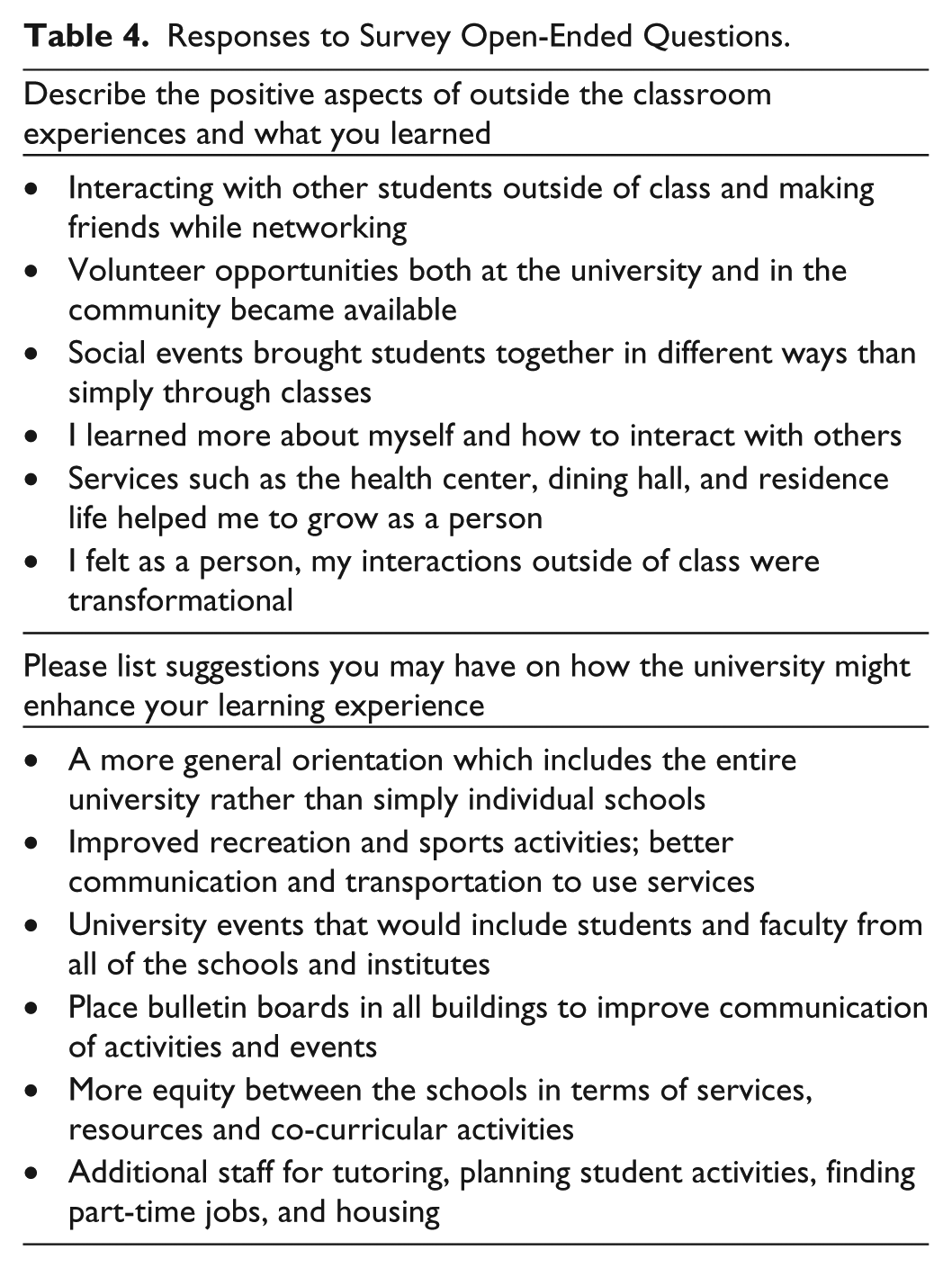
The survey included two open-ended questions to provide additional information to complement the quantitative data and facilitate comparison with the focus group responses (see Table 4). The results provided an excellent list of positive aspects of the co-curriculum that included interacting with other students outside of class, volunteer opportunities, living in university residence halls, student social events, and health and food services. When asked to describe what had been learned from these activities outside of class, they reported on social, personal, and developmental transformations. When suggesting ideas that might assist in improving the university experience, further items were offered that reflected many of the topics discussed with the focus groups: enhanced communication through better orientation; student bulletin boards in all academic buildings; announcements in class and through newsletters; university events that would provide an opportunity to meet students from various academic units; more equity in activities and services between disciplines; improved recreation and sports activities; and additional services and staff for tutoring, planning student activities, finding housing and part-time jobs, as well as facilitating orientation and communication.
Responses to Survey Open-Ended Questions.
Discussion
A comprehensive assessment of student satisfaction, needs, and learning outcomes at the subject university attempted to answer four research questions established at the beginning of the study in response to the university’s need for critical information related to its mission, goals, and strategic planning. Using both qualitative and quantitative methodologies from the focus groups and the general student population, respectively, information was gathered through a convenience sample of students currently attending the university.
Satisfaction
The results indicate that students consistently expressed their general appreciation for the university and had positive initial impressions of its history, reputation, buildings, and highly regarded academic programs. National students felt fortunate to attend a university with an obvious international focus and the presence of students from abroad to enhance the learning environment. They spoke highly of the growth-producing opportunities provided for international study and internships that were identified as the hallmark of a university education and the one common dimension that permeated the entire institution. A generally positive satisfaction regarding both the formal and informal life of the campus also recognized the opportunity for students to meet and interact with each other.
Needs
Although the general impression of the university was more than positive, students expressed concern about the organizational dynamics of the university and the inevitable consequences. The separate schools, faculties, and institutes operate so independently that some students fail to realize their education comes under the governance of the overall university. In terms of opportunities for “university life,” students perceived limits to their ability to take advantage of what a university education could and should offer. They hope to interact with as much of the human side of the university as possible for intercultural learning and networking to provide future opportunities.
The independence of various sectors of the university also appeared to lead to differences in the quality of the services available to students. As one student explained so aptly, “Some schools have everything, we have close to nothing.” Some academic units have limited financial resources, ineffective student associations, inattentive staff, poor organization, and lack library privileges. Other academic entities were noted for their leadership and more dynamic approaches to student learning and development. Students also expressed concern for the lack of an internal flow of information (communication) that perhaps is an almost inevitable result of independent schools. Students earnestly wanted to know about opportunities available to them, where these opportunities could be found, and how to schedule and pursue them. Many staff were reported to be as confused as these students about available services. The students expressed a desire for greater accessibility to recreational/sports facilities and visibility with organized teams for competition. They further identified the need for services such as finding accommodations, part-time job placement, tutoring, improved orientation, and more appropriate meeting places and lounges.
Learning Outcomes
Students also reported a list of personal growth issues that resulted from involvement with student services and outside-the-classroom activities. Learning about other cultures, autonomy, leadership, tolerance, volunteerism, time management, and adaptability were considered desirable characteristics to be honed during a university education. From the responses to the Likert-type scale statements, it was also evident that students felt strongly that learning outside the classroom is not only an integral part of a university education but also an important component of personal growth and development. As consumers of higher education, they reported searching for opportunities to reach beyond the classroom and the formal curriculum to test their hypotheses on human interaction and enhance the learning curve of self-knowledge and understanding of others.
Summary and Recommendations
Summary
Evidence from the present study suggests that the university has an unusual opportunity to forge a new path that differs from the general approach to higher education, which has historic traditions in continental Europe and throughout most of the world. As the data of this study demonstrated, both European and international students consider the university experience as a place and time when they not only prepare for a specific career, but also grow and develop socially, emotionally, physically, and spiritually. Steps in this direction can be taken through certain curricula in the social sciences and humanities, but for most students the process will take place (or not) outside the classroom through interactions with peers and in conjunction with a myriad of programs and services associated with the university. By making timely, incremental, thoughtful, cost-effective, and intentional initiatives, the university can cast a positive influence over a great academic center of higher learning by defining common ideals and practical objectives within its disparate parts. The university can accomplish the goal of developing a more uniform and consistent experience by providing greater equality and possibilities for interaction for its entire student body.
Recommendations
Institutions of higher learning, in general, have limited options in solving all of the issues identified in this study of student satisfaction, needs, and learning outcomes. Nevertheless, incremental changes could mitigate some of the issues raised by these students. Through greater awareness and commitment to change, large universities can work toward greater cooperation across their campuses. This interaction should include opening certain courses to universal registration, creating opportunities for all students to interact socially, sharing resources to modify inequities among students from different schools, faculties, and institutes, and greatly enhancing communication and mutual understanding.
To achieve a more integrated university, several major academic celebrations including convocation and commencement, and major social events should be ongoing highlights of the academic calendar. Other accommodations in response to the student needs that have been identified include a more generalized and effective orientation for incoming students; faculty and staff orientation; a more complete student handbook; a university fee to support services currently provided free for some but not all students; integrating the sports/recreational complex into campus life, and eliminating current barriers to its usage; creating a comprehensive student center with offices for all the student associations and campus clubs and organizations; professionalizing staff positions in student services especially in student housing; and accepting the idea that students involved in campus life outside the classroom creates more positive members of the university community and significantly more satisfied students and potential alumni donors.
Limitations and Future Research
Survey research and using a convenience sample subdivided into focus groups both imply a number of limitations to the study at hand. Sample size was affected by time restrictions and the magnitude of the university population. The sample did not include representation from all of the faculties, schools, and institutes although it did include students from each of the four major academic divisions of the university as well as a number of special schools and institutes. A more involved study would aim to consider additional institutions from a variety of geographic areas across the globe, include both public and private universities, and delineate students according to undergraduate and graduate status to ascertain if potential differences are negligible or of consequence and importance to this study’s understanding of the major issues. As the global network of advanced learning grows exponentially, research must be carried out to reveal the most functional methods to organize and manage institutions of higher learning. Although asking the very clients (students) how to approach the teaching/learning model may seem anathema to many higher educational professionals across the globe, educators have an imperative to find and implement best practices.
Footnotes
Declaration of Conflicting Interests
The author(s) declared no potential conflicts of interest with respect to the research, authorship, and/or publication of this article.
Funding
The author(s) received no financial support for the research and/or authorship of this article.