




Abstract
In the 1950s, the Norwegian sociologist Sverre Lysgaard investigated social relations at a pulp and paper mill, the result of which was his theory of the “worker collectivity.” This is an informal defense organization among subordinate employees against a company’s work organization and goals. Our research group returned to the same plant, which until 2012 was still a pulp and paper mill, with two questions in mind: Was the worker collectivity still present at the plant? What had happened since Lysgaard’s study when it came to the preconditions for the existence of the worker collectivity?
Introduction
“We?”—that’s we who are in the same position. All workers, that is—all of us are on par in that way. No, we are not on par with people in the offices, I couldn’t say that. We’re all alike, all under the foreman. What is a bad workmate? Well, that’s someone who is a company man—someone you have to be on a businesslike footing with all the time. That’s someone that you can’t be a mate with. It’s someone who gives too much information (to the company) about the individual’s weak and strong points. It can be economically profitable for individuals to be like that and it has suited management very well. As a rule we have put them right.
It was statements like these in interviews with workers in a pulp and paper mill that put the Norwegian sociologist Sverre Lysgaard (1961/2001) on the track of the phenomenon he later referred to as the worker collectivity. (We translate the Norwegian kollektiv as collectivity, as it has become an established term through Alan Fox’s [1971] analysis of what he calls the “employee collectivity.”) From very large amounts of data, Lysgaard created a complex and elegant theory about the informal culture in work organizations (for a comparison with relevant Anglo-Saxon theories, see Karlsson, 2015). Lysgaard’s way of theorizing may remind us of grounded theory—but Lysgaard’s work was carried out before this theory existed as a specific methodological approach.
Lysgaard’s study was carried out in the latter half of the 1950s, and our research group returned to the same mill to find out whether the worker collectivity was still there. The main objective of this article is, therefore, to discuss whether changing conditions since the 1950s have affected this kind of informal organization. This is investigated by comparing three moments during the period between 1950 and 2010. The investigation is, then, a historical comparative case study (Ackroyd & Karlsson, 2014). This kind of replication of a study is rare in working life studies. Aside from the relevance that lies in the focus on an interesting theory and important empirical descriptions, the relevance of our study therefore also lies in the replication itself.
Lysgaard’s Theoretical Approach
To analyze the worker collectivity, Lysgaard starts by making a distinction between the technical-economic system and the human system of employees at workplaces (see Figure 1).
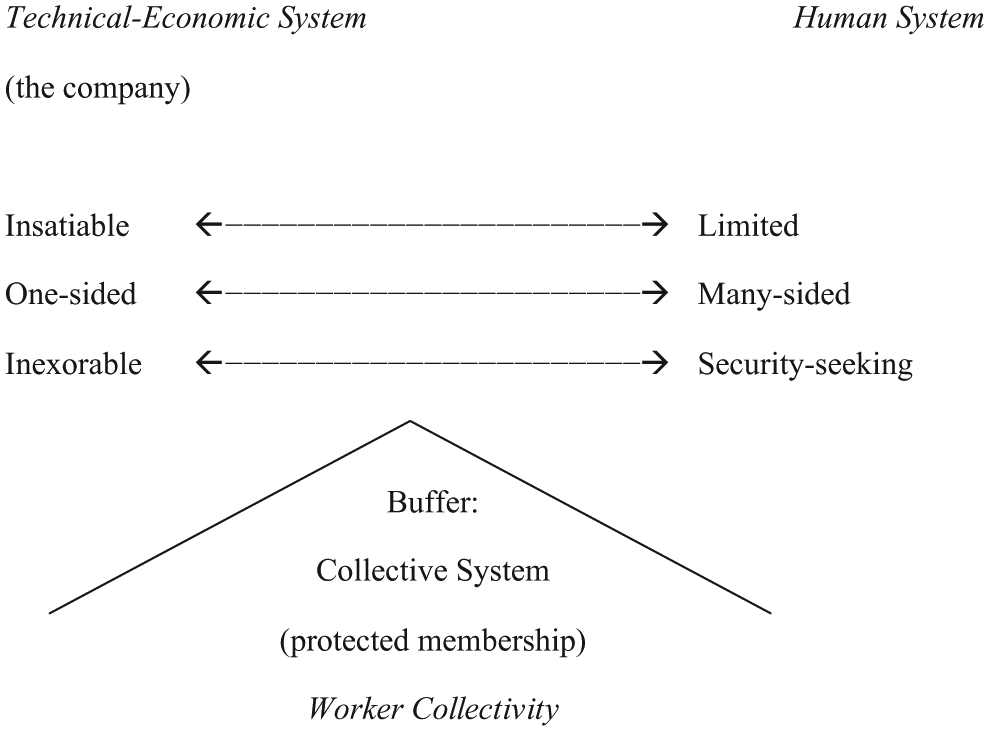
The technical-economic system, the human system, and the collective system.
The technical-economic system is made up of the work organization, its hierarchical structure of positions, and its goals. All employees are part of this system, which places heavy demands on its members in the drive to achieve high efficiency and profitability. The human system is defined by the way human beings are constituted. At stake here are the individual’s qualities as a human being, and as the bearer of labor power is a human being, he or she is also part of the human system. However, the relation between these two systems is complex, because it is infused by contradictions putting employees in a difficult position as they are members of both. According to Lysgaard, these contradictions are mainly related to the following conditions. To begin with, the technical-economic system is characterized by insatiability when it comes to the demands it places on the individual employee. Employees, however, cannot work indefinitely, nor do they have inexhaustible strength. Consequently, human beings are inevitably limited in their responses to the insatiable demands vis-à-vis the technical-economic system.
Second, the role that the technical-economic system assigns to each employee is specialized or one-sided. It is a rather narrowly delimited area, with which the employee is expected to be unceasingly occupied at work. At the same time, human beings are many-sided, having a lot of skills and development needs. If I am hired as a welder, the system’s only interest is that I keep on welding. It is of no importance that I am good at fishing, like book binding, or would like to learn to play the banjo. Finally, the technical-economic system is inexorable. It is not in the interest of the system to keep a certain person employed if he or she can be replaced by someone (or something) that may serve the system better. But such precariousness places heavy demands on employees, because they as human beings seek security.
All of this means that the insatiable, one-sided, and inexorable qualities of the technical-economic system collide with the limited, many-sided, and security-seeking qualities of the human system. For the workers, the dilemma is that to get a job, they have to join a system infused with conditions that go against being human. A solution to this dilemma is to make sure that they achieve protected membership of the technical-economic system by building a buffer between the two systems. They establish this buffer by constructing a self-organized counterculture in the form of a worker collectivity, which can be used as a weapon to defend their human dignity and rights and to gain some autonomy for them at work.
Through the use of power and threats of using power, which are more or less violent, the collectivity makes it possible to respond to the way in which the technical-economic system is practiced in the work organization. This power moderates the absolute realization of the technical-economic system, with the result that the work organization is not characterized to a too-threatening degree by this insatiable, one-sided, and inexorable system (Lysgaard, 2001, p. 148).
The formation of such a collectivity, Lysgaard says, does not occur at random or anywhere. In the first place, three conditions are decisive if it is to emerge at all. First, there has to be a formal organization characterized by efficiency and profitability, that is, a technical-economic system. Second, an employment relation has to be established, involving dependency between employer and employees. The dependency may be regarded as important to both, but it is generally most important for the individual employee, who is usually obliged to honor the relation, to earn a living. Third, there has to be a hierarchy of occupational positions involving superiors and subordinates. If all these conditions are met, the worker collectivity may emerge as a result and evolve into a viable and dynamic system of protection.
The evolution of this system may be summarized in the following way. The work that is done within the organization generally brings people together in a spatial sense. Some of them will meet regularly to carry out their work; others will meet randomly or spontaneously during meals, breaks, gatherings, and so on. During these different kinds of interaction, they get to know each other, both in superficial and in deeper ways. Furthermore, all this interaction takes place within the particular context embodying the constituting elements of the organization—the division of work, the relations of power, the skills and qualifications of the employees, the orders and demands coming from management—and the effect these may have on working conditions in general. In short, the organization—the technical-economic system—is characterized by a set of conditions that are related to questions of proximity, problems, and similarities. These conditions may in turn bring about the processes indicated above. To begin with, the condition of proximity leads to processes of interaction, either in a formal or in an informal way. Second, expressions of similarities or differences, such as dress codes, privileges, discriminatory practices, employment conditions, and working conditions, in general affect the way employees learn whom to identify with and whom to differentiate themselves from. The development of this is what Lysgaard refers to as the process of identification. Third, the problems related to work lead to processes of interpretation through which subordinates reflect and elaborate on their situation—the nature of their work, the relation with management, the legitimacy of management demands, the character of the discriminatory practice, and the sorting out of why things are as they are.
These three processes in turn affect each other mutually. For instance, those people who consider themselves to be equal to one another will be likely to interact more frequently than those who find themselves to be different. Those who share the same understanding will more easily identify with one another than those who see things differently. Conversely, the separating effect of this process will work in the opposite way and strengthen the common view held by the workers. In a corresponding way, employees with concordant opinions are apt to interact more than those who hold contrasting views. Again differentiation may take place, supporting the emergence of a predominant logic among the workers. The point is that the processes of interaction, identification, and interpretation have reciprocal effects on each other, either in supportive or in impairing fashions.
If the supportive part is sufficiently viable, collective norms may be the final outcome. These norms, Lysgaard says, make up an ideology that has a bearing on how workers act and construe their conditions. In fact, this is the very definition of what the worker collectivity is all about—it is an ideology embodying norms that tell subordinates how to behave and make sense of their situation. The norms act as tacit, mutual contracts that may be more or less strong, more or less binding for each individual worker. If this collectivity is to function efficiently as a buffer, workers all have to act in the same way toward management, which requires internal discipline. The norms include not doing more or less work than collectively decided on and not aspiring to become a foreman. One of the strongest norms is not to have any more than is absolutely necessary to do with superiors, which is part of the sharp distinction made between “us down here” and “them up there.”
If this is realized, we have reached a relation that Lysgaard refers to as the ideal state of the collectivity system (see Figure 2). Conversely, the ideal state of the technical-economic system involves a relation between this system and the worker who is individualized—where the collectivity does not exist or is unable to affect the interaction. However, these conditions ought to be considered as extreme cases; the daily relation will be somewhere in between, illustrating the power balance within the organization in question.

Ideal state, real state, and possible development of the technical-economic system and the collective system in relation to the individual worker.
This balance may then move according to changing conditions, and our main objective in the present study is to find out whether there have been some changes and how they have affected the balance during the period since the 1950s. Perhaps there have been changes that have altered the constituting conditions in ways that have led to movements toward the ideal state of one or other of the two systems; one possibility is that the worker collectivity has been weakened, as illustrated by the fourth part of Figure 2. In the text below, the following questions are therefore discussed: Was the worker collectivity still present at the plant in which Lysgaard made his study, up to the time of its closure in 2012? What had happened since his study when it came to the preconditions for the existence of the worker collectivity?
Method
To address these questions, we returned to the plant in which Lysgaard carried out his study in the 1950s. Some 60 years ago, Lysgaard and his team of four interviewers had full access to the workplace, and all of them worked for 1 or 2 weeks in different departments, participated in meetings, and so forth. They also conducted 252 interviews with workers, administrative staff, and managers. Our group did not have the resources required to follow up the study in this extensive way, and, lacking the specialized education and training required today, we could not work at the modern plant.
However, we were met with the same positive response as were Lysgaard and his team. We had free access to the plant, and, with the help of the local union and the personnel department, time was booked for interviews with employees. Up to the present, about 85 interviews have been conducted, mainly with workers but also with managers. The basis of the interviews is the published interview guide from Lysgaard’s original interviews, although we have modernized and extended it to some degree. Our interviews were taped and transcribed verbatim. The analyses of data were carried out according to established and accepted coding techniques, forming categories and relations between them (Maxwell, 2012; Saldaña, 2013). Codes and categories have on one hand been derived from Lysgaard’s theory, as, for example, in the case of “technical/economic system,” “human system,” and “collectivity”; on the other hand, they have been generated from our own data, as in the case of “horizontal interaction” and “vertical interaction.” Our discussion covers the period up to the spring of 2012 as the plant was closed down at that time—although we are still interviewing former employees.
In addition to this, we have data from a study conducted at the plant in the first half of the 1980s. These are data primarily based on observations, documents, and interviews with a large number of workers, managers, production engineers, and retired workers who had been employed during the period when Lysgaard visited the plant (Skorstad, 1987). The description below of the state of the process technology in 1950 and 1980 as well as the working conditions and the prevalence of worker resistance related to output restriction is therefore based on these earlier studies of the plant.
In the following discussion, particular attention is paid to the nature of the labor process. In Lysgaard’s own description, there are hardly any comments on the particularities of the work. Indeed, he refers to the workers’ interpretation of their situation—the demands they are met with, the kind of control they are subjected to, the freedom they experience, and the reasons why things are as they are—but he does so in general terms, without going into details. Neither does he indicate what counts the most: is it the work itself, is it the one-sided, incessant, and inexorable demands, or is it the lack of dignity related to powerless positions? Lysgaard does not answer such questions. However, working conditions do matter, not only for each individual employee but also for how a certain community of workers, as in the case of the worker collectivity, behaves (Ackroyd & Thompson, 1999; Edwards, Collinson, & Della Rocca, 1995; Fox, 1971; Hodson, 1995; Karlsson, 2012; Skorstad, 2002; Whyte & Dalton, 1977). In what follows, we will therefore concentrate on this, trying to uncover how changes in the labor process as well as the surrounding environment may have impinged on the way workers have reacted. The analysis will not, however, cover the entire plant but will be limited to the pulping part of the production, describing how the work may be characterized in three different time periods: the first one at the time Lysgaard made his study (in the latter half of the 1950s), the second one at the beginning of the 1980s, and the third one about 30 years later, around the beginning of the second decade of the 21st century. The following analysis is organized according to the main dimensions of Lysgaard’s analytical model in the sense that we focus on the processes of interpretation, interaction, and identification referred to above. By employing this approach, we may reach grounded reasons for the way in which changing conditions may have affected the production and reproduction of united, collective action. However, before embarking on this discussion, we briefly introduce the main steps involved in the production of pulp.
Setting the Scene
In the 1950s, pulp was produced mainly in two ways, either by chemical means or by mechanical means. Lysgaard’s mill was a chemical plant where pulp was manufactured by boiling a mixture of prepared wood chips and sulfate under high pressure to release cellulose from lignin, the binding agent of the wood. The mixture was then washed, the boiling (black) liquor was separated from the cellulose, and the black liquor and the cellulose were subsequently led into two separate processes for further treatment. In one of these, cellulose was subjected to processes of filtering, bleaching, and drying before being transported to the paper-producing part of the plant. In the other, black liquor was subjected to processes of recycling to make it ready for reuse in the boiling part of the process. In this way, pulp manufacturing was, and still is, an example of process production. The different stages of the process may, however, differ depending on the level of technology and the strategy of the particular firm. During the 1950s, Lysgaard’s mill invested heavily in new technology. This technology consisted, however, mostly in replacing old equipment with new, and not in changing the basic principles of production (Skorstad, 1987).
During this renovation, the mill was turned into a highly technology-intensive system, where materials were transported and transformed in closed and open systems with the help of varying temperatures, pressures, and chemical reactions. The workers were spread across this set of systems, attending to, monitoring, controlling, and operating their assigned stage of responsibility. This, then, was the general scene that Lysgaard and his colleagues were met with on their arrival at the plant.
The 1950s
Problem Conditions and the Process of Interpretation
The description given above may lead to the conclusion that the workers were in a favorable position, enjoying calm and agreeable days while operating the process at a distance on the basis of information presented on gauges measuring volumes, temperatures, and pressures. This, however, would be to jump to conclusions. Working conditions were certainly improved to some extent in the 1950s, but up to 1955, conditions were bad, to say the least (Skorstad, 1987). They could best be described as hard, hot, dirty, and dangerous. The pulp was produced in batches, and production processes were prepared, monitored, and operated manually by valves and so forth positioned on the different installations. Work intensity was at its highest at the beginning and the end of the production of each batch; the humidity and the temperature were very high in some sections; in part, the chemical recycling processes involved hazardous work; and other parts of the processes were dangerously noisy. Basically, the workers were in control of their work; they were spread around, working right up against the equipment; and they got their information not only from different kinds of gauges but also by observing, listening, smelling, and touching. They knew the potential effects of changes in pressures and temperatures on the installations. They knew how to handle disruptions and recurrent variations. In this way, they were better off than their supervisors, who did not have firsthand knowledge of the idiosyncrasies of the process.
Nevertheless, the supervisors were in the formal position to give orders or put pressure on the workers, for instance, for the purpose of increasing the amount of production. The demand for greater output was constant and two approaches were possible—the time of boiling could be reduced or additional, more spacious, digesters could be installed. During the 1950s, the old digesters were therefore successively replaced by new, larger, and more modern ones. Also other equipment was replaced during this period, and all these new installations turned the mill into a more up-to-date technological system. However, as mentioned, these changes were based on the same kind of technology as before, not on the introduction of new technological principles. The labor process, then, retained most of its original character, and the environment was still conceived of as mainly hard, hot, dirty, and dangerous.
As noted above, Lysgaard tells us nothing about the workers’ reactions to this particular environment. It is known from other studies, however, that there was widespread discontent with the workload at the time he visited the plant (Skorstad, 1987). It is also known that there was serious disagreement about the proper level of production. Management was, for instance, eager to increase production and argued that the installations would tolerate additional utilization. Workers disagreed. They claimed that the equipment was already employed to its limit, and that any further increase in its use would create dangerous situations. Both parties claimed to be right, but they were unable to convince each other. Management based its arguments on technological specifications, whereas the workers had firsthand knowledge of how the technology functioned. In addition, they could refer to serious accidents in the past, which of course strengthened their arguments.
Conditions of Proximity and the Process of Interaction
In his explanation of how collective solidarity emerges, Lysgaard refers to the necessity of keeping management at a distance. A bad workmate, his respondents say, is one who is the company’s man, who has too much contact with his superiors—a man who is “always running over and sucking up to the bosses” (Lysgaard, 2001, p. 114). One important reason for keeping management at a healthy distance is obvious: It gives employees at the bottom of the hierarchy the opportunity to construct and maintain their interpretation of their situation without any disturbing, alternative explanations from their superiors. In this sense, distance is imperative in the creation of a common ideology, both with regard to how to behave and with regard to how to make sense of the situation. At the time of Lysgaard’s study, conditions were particularly well suited to this. The two opposing parties, superiors and subordinates, lived their lives in two different worlds. Their scanty contacts were limited to direct orders given from above or information coming from below. The very asymmetry of this relationship demonstrated clearly who was sitting in the driving seat and the way in which power was distributed.
Distance was important not only in relation to management. Interaction with white-collar workers in general was equally distrusted and disliked by workers, and the reasons for this were most often related to overall working conditions or privileges.
Divisions?—Not among the workers. But when it comes to those at the level above—they may have their own interaction and their own views that are not exactly in line with our views. They try to stay one step above us. . . . They feel higher and better than anyone else, than the guy who is toiling with dirty work. (Lysgaard, 2001, p. 95)
In this way, the reigning rules of interaction were made relatively clear. Workers were expected to keep their interaction to their equals and renounce undue interaction across the organization. Furthermore, these norms were supported by the division of work and the physical arrangements. Workers mainly worked together in small teams, and all of them could easily meet during their shift. Management, technicians, engineers, and office employees were placed in separate buildings at some distance from the premises in which the process equipment was installed.
Conditions of Equality and the Process of Identification
Interaction is, of course, important in sorting out questions about differences from others and similarities to them. One obvious quality for judging this is dress code; the way you dress signals in a conspicuous way who you are, or who you would like to be. Anyone who entered Lysgaard’s mill in the 1950s could tell the difference between subordinates and supervisors: Blue-collar workers were literally different from white-collar workers.
But the differences involved more than this. Physical surroundings, job content, working time, reward systems, sick-leave payment, lavatories, and so forth, were all dependent on category or position. While white-collar workers, for instance, could enjoy indoor water closets, blue-collar workers were left to use outside lavatories. Not only were these lavatories outside but also they had seven seats and were placed in shelters built over the sea. Given such differences, Lysgaard’s respondents commented on issues that divided the workforce in a rather understated way: “It is about clean collar and clean hands, the possibility of washing up” (Lysgaard, 2001, p. 93).
There is even more to it than just dress code and discriminatory treatment. “We,” Lysgaard’s respondents stated, “are those who have no say.” This did not apply only to organizational matters in general but also to questions related to the running of production—issues that the workers obviously knew more about than their managers. Indeed, a committee of managers and workers was established to discuss such questions, but for the workers, the experience turned out to be discouraging. In spite of their firsthand knowledge, they felt neglected and not taken seriously: “Those [the workers] who participate in the committee say that they do not achieve anything at all. They are not being heard. A lot of what management talks about is incomprehensible” (Lysgaard, 2001, p. 104). Thus, workers were subordinated in every sense of the word, even in matters about which they knew the most. Management, however, seemed to ignore this knowledge.
The Worker Collectivity in the 1950s
The total outcome of these processes impinging on each other is what Lysgaard refers to as the worker collectivity: the collective norms for how to behave and make sense of your position as a subordinated employee. In the 1950s, we observe a united and powerful collectivity at Lysgaard’s plant. Workers had a common view of how to judge their work and relations; they were clear on where they belonged and on their specificities compared with those of the rest of the workforce. They kept to themselves and tried to keep their superiors at a distance. Collective behavior was regulated by a strongly enforced system of rules; those who did not fit in or opposed the regulation were sanctioned, both psychologically and sometimes physically. As a result, the power balance seemed close to the ideal state of the collectivity system as illustrated in Figure 2. However, the labor process and the working conditions were to change.
The 1980s
Problem Conditions and the Process of Interpretation
At the beginning of the 1980s, the mill had changed dramatically from the plant of the 1950s (Skorstad, 1987). This transformation had been realized through two major innovations. The first one, implemented in 1971, replaced batch production with continuous production. The second one involved a gradual transition toward increased automation. Both of these developments changed working conditions in profound ways. First, the implementation of continuous production put an end to the hard, hot work in the boiling and washing stages of the process. Second, increased automation made manual monitoring, handling, and operating obsolete. Workers no longer worked up close to the equipment in the plant. Their new roles consisted mainly of watching flow sheets and monitoring key figures presented on computer screens, assembled in newly constructed control rooms separated from the physical installations. The process was mainly self-operating through the principle of negative feedback regulation. Human intervention was needed only when key figures moved beyond preprogrammed levels.
Once these changes were implemented, working conditions in the new, continuous, and automated system appeared quite different from the conditions that had predominated when batch production was the order of the day. While batch production was characterized as hard, hot, dirty, and dangerous, the new production system could be characterized as easy, temperate, clean, and safe. This change, then, represented a major improvement in the quality of work. The demands on the workers changed completely, because output no longer depended on their effort. During the batch production era, the relation between output and workload had been a major subject of dispute. Management was, as noted earlier, eager to increase output and argued that this could be done by installing additional boilers, shortening boiling time, or both. Workers, on their part, argued against this, and collectively restricted output to make their position bearable. In particular, they took advantage of the extensive renovation of the boiling and washing part of the process in the 1950s. Until 1951, the established norm of production in this section of the process had been nine batches in each shift, and working conditions were on the verge of being excruciating. The renovation, then, offered an opportunity to reset the standards to a more humane level, and the workers took advantage of this. When the total replacement was completed, the number of batches was reduced and a new standard of three batches appeared as the norm for all shifts. No one produced more, and no one produced less.
The contest was, however, not over. Management continued its relentless drive to increase production, whereas workers held back to the best of their abilities. For some time, it looked like a stalemate, but in the long run, it turned out that the workers were fighting a losing battle. Through several kinds of clever interventions, management succeeded in its persistent campaign. First, the norm was raised to four batches per shift, and then to five, somewhat later to six, then to seven, eight, and finally nine, just before batch production was replaced by continuous production. However, to conclude that management turned out to be the winners would be to simplify matters. The workers may of course be regarded as losers, because in the end, they were forced to cope with the growing number of batches and the preposterous strain this entailed. However, management lost as well, in the sense that it provoked worker resistance that was effective enough to lower the gains that would otherwise have been reachable with the new installations. Indeed, the workers lost in the long run, but so did management and the company it represented. Calculations show that the 20-year battle over output led to a total loss of at least 5 years of production (Skorstad, 1987, 1988).
The change to continuous production put an end to this particular struggle, because output was no longer dependent on human effort. Instead, it was reduced to a matter of technological capacity and regulation. The process operators—as they were called from now on—acted mainly as controllers, while the automatic part of the process regulated itself. One of the most contested questions had simply disappeared and become part of history.
During this period, local conditions were also affected by changes taking place in society at large. These involved the emergence of a new industrial order, and the most prominent change was caused by the passing of the Worker Protection and Working Environment Act in 1977, which at that time represented a major strengthening of workers’ rights and conditions in general (Ramsdal, 2009). A similar effect was attained through the implementation of the General Agreement on Technological Development and Computerized Systems in 1975. Both challenged the unilateral prerogative of management and circumscribed the traditional scope of precarious treatment of subordinated employees.
Conditions of Proximity and the Process of Interaction
Conditions of proximity and processes of interaction were also affected by increased automation. Workers were no longer spread across the premises but gathered together in control rooms attending to the data presented on the computers. This, of course, made mutual interaction more feasible from a physical point of view. At the same time, however, shift members had been heavily reduced in numbers; although there were 15 people on each shift at the beginning of the 1950s, this was reduced to 7 at the beginning of the 1980s. These two changes may have affected the functioning of the collectivity in quite opposite ways, but most probably they were of relatively minor importance.
More important, most likely, were some changes affecting vertical interaction. These came about as consequences of the societal reforms mentioned above, as both of them also involved attempts at introducing democracy at work. Together, they may be considered as the main legacy of the well-known experiments with semiautonomous work groups within the Norwegian manufacturing industry in the late 1960s (Emery & Thorsrud, 1970). The Worker Protection and Working Environment Act and the General Agreement on Technological Development and Computerized Systems included statutory rights for workers to have a say in matters such as organizational change in general and technological implementations in particular (Klemsdal, 2009; Skorstad, 2002). Both also included prescriptions for how to inform and how to organize such participation, for instance, through bodies representing those who were expected to be affected. Today, this is considered to be the main pillar of what is often referred to as the Nordic or Scandinavian model of working life, which in addition to the arrangements mentioned above is characterized by coordinated collective bargaining and the existence of powerful bodies representing employers and employees who act as major agents for the development and maintenance of industrial order (Kasvio, Gonäs, & Skorstad, 2012).
The running of the mill was affected by this development, and the conditions of internal interaction were changed in two ways. The first one applied to frequency: Because of the prescriptions embedded in the new regulations, superiors and subordinates had to meet more often than before. The second applied to the process of interpretation: The increased frequency of interaction exposed both parties to alternative views; workers had to listen to the arguments of management and management had to pay attention to the views of the workers. Workers’ views were, according to the new order of industrial relations, expected to be taken seriously, at least formally, and this added a new dimension in comparison with the pre-participatory era, in which the manufacturing committee was considered as the tool of unilateral management action.
Conditions of Equality and the Process of Identification
The democratic or participatory arrangements referred to above may also have had an additional impact in the sense that they amounted to a sign of some kind of promotion. Indeed, these arrangements signaled that even subordinates had something to say, and this was a message that was quite contrary to the message contained in the workers’ own statement in the 1950s, when they referred to themselves as “those who have no say.” Thus, superiors and subordinates came closer together, at least at the formal level, during the period of the 1970s. Furthermore, some of the more visual differences between them also disappeared. Workers were no longer engaged in dirty work. They worked in more pleasant surroundings than before. They enjoyed the “luxury” of having indoor lavatories. They could wash their hands just as office workers did. They were no longer paid by the week but by the month like other employees. They dressed like their immediate superiors. Traditional privileges were downplayed. In short, the vertical differences—observable as well as nonobservable—had decreased: Superiors and subordinates were no longer as different as they had been.
However, new differences had been introduced in a horizontal sense. Blue-collar workers of the 1980s were no longer as homogeneous as they had been, and the main reason for this was the growing level of automation. This technology required a totally new kind of knowledge from the knowledge that had been needed in the old system (Skorstad, 1987). Or, to put it differently, the major part of the knowledge that had been necessary for running the process in the old way had become irrelevant or obsolete. This was another effect of the inexorable demands of the technical-economic system. For most of the older workers, automation turned out to be an insurmountable obstacle. They were simply confounded by the flow sheets and the computerized system in the control rooms. New workers with new qualifications were therefore recruited to operate the new technology. Thus, the automation divided the workforce into two categories—those who belonged to the past and those who belonged to the future.
The Worker Collectivity in the 1980s
In summary, all these changes suggest a development in which the constituting conditions of the collectivity seem to have been affected in such a way as to impair its functioning. Work in the 1980s was no longer as hard and unpleasant as it had been before, vertical interaction had become more frequent than in the 1950s, discriminatory measures had been modified, and maybe most important of all, those who earlier had had no say now had some influence. Together with the polarizing effect of the new technology, this implied a transition in which those who used to be different had become more equal, whereas those who used to be equal had become more different than before. The power balance had shifted its position toward the ideal state of the technical-economic system.
The Early 21st Century
Problem Conditions and the Process of Interpretation
The end of the 20th century saw a struggle for the survival for the firm. It was hit by the general economic downturn at the beginning of the 1990s and was on the verge of bankruptcy some years later. In 2006, a long tradition of family ownership came to an end as the third generation of the family finally gave in and sold its assets to new owners. This transfer in ownership introduced a new era of internal relations. While the old era had had an air of paternalism, the new owners were more informed by economic and rational considerations. They operated as if they were totally uninformed about the main tenets of the Scandinavian model, in particular about its cooperative nature. Hence, one of their first initiatives intended to improve the company’s economic situation was the unilateral announcement of downsizing affecting about 200 employees, both blue-collar and white-collar. This, they said, was imperative to save the company. Subsequently, committees were organized to decide upon questions of redundancies.
These initiatives, of course, introduced an element of uncertainty among the workers. The economic downturn was no longer a distant, potential threat. A worker tells us, A totally different atmosphere emerged in the whole company—quite unlike the previous one. People became very insecure. It was as if you continuously walked on a razor’s edge. You didn’t know—does this work, or does it not. And you never got any information about anything. Lately, it hasn’t been pleasant being here, after so many good years. . . . And people began to quit. They became insecure and found other jobs. . . . And ruthless exploitation of the remaining people started—an exploitation of the people who really could run the machinery.
The changes thus took material form in the organization through the departure of some employees. In parallel with this downturn, the plant was developed into a completely automated system during the 1990s. This meant that process monitoring was done by operators who were stationed in five different control rooms. Most of this work could be characterized as monitoring, including active handling in the case of abnormal occurrences. Thus, working conditions developed along the same lines as in the late 1970s and 1980s. Hard, hot, and dirty work was no longer a problem. It had been replaced by a new and more pressing problem—the question of whether the firm would be able to survive or not. The seriousness of this problem seemed to be accepted by all parties. The trade union, therefore, participated in the committees established to single out the downsizing measures that would be acceptable to save the firm. This kind of participation was not perceived as problematic by the workers, who judged it to be an arrangement that would work in favor of their interests. Their traditionally trustful attitude toward their union was not impaired: They knew from their experience that they could rely on the judgment of their formal representatives.
In a broader perspective, the necessity of downsizing was seen as justified by growing globalization; increased competition, it was claimed, made it imperative to be more efficient. This argument agreed, of course, with the dominant neoliberal sentiments at the time, and attempts were made to loosen up working life regulations, among them some of the restrictions embedded in the Worker Protection and Working Environment Act. However, these attempts met with heavy opposition, and the new version (2005) of the law preserved the original spirit of the 1977 law as an instrument protecting the rights of employees and its general focus on ameliorating working conditions.
Conditions of Proximity and the Process of Interaction
The physical surroundings and the mutual interaction presented a pattern in 2010 that was similar to that of the late 1980s. Workers mainly kept to themselves in their control rooms and preferred to avoid the company of visiting supervisors. They disliked, for instance, some of the new practices introduced by the new owners, who just after their arrival started to turn up randomly in the control rooms, even during night shifts. This was seen as a sign of direct management control and was not approved of. The owners, on their part, explained their presence as due to their need as newcomers to inform themselves about the peculiarities of the process. However, the workers were most probably right in their assumptions. One of the supervisors, for instance, claimed that the continuous presence of workers in the control rooms during the whole shift was a sign of overstaffing. Workers should not, he said, stay in these rooms all the time, but be out in the plant looking (and listening) for signs of malfunctions in the system.
Vertical interactions also occurred in participatory arrangements, as, for instance, in the above-mentioned committees where downsizing was discussed. However, apart from discussion of this pressing problem, the new owners were not prepared to continue the extensive participatory arrangements that had been in place since the latter half of the 1970s. Rather, they considered themselves as undisputed superiors who saw no point in consulting their subordinates. And this, some of the workers point out, “was a serious mistake.” They simply had “no understanding of workplace democracy,” one of them says, while adding, “My impression is that decisions were made without our participation. When we were invited into certain committees it was merely window-dressing.” Another employee says the following about the situation with respect to the new owners: “You understood that if you wanted influence and results you had to abandon the strategy of being a conversational partner.” In this way, the relation was in effect a return to the management regime of the 1950s.
Furthermore, informal interaction, both vertical and horizontal, is supposed to be encouraged by the establishment of a common cafeteria. Interaction in such a place may of course affect the processes of interpretation, but its potential impact in that sense is probably more prominent when interaction is forced upon participants in a systemic way, rather than being voluntary. This is neatly illustrated in the case of the common cafeteria at the plant. One of the administrative staff reported, “Engineers and coordinators are sitting next to the window, and we others are sitting a little bit spread out. But why? It is something old that remains, I think.” In spite of the intention in the cafeteria of breaking up traditional patterns, workers continued to sit with their shift groups, keeping to themselves; no workers sat with the office staff or managers. On the contrary, if workers arrived at the cafeteria and the only free chairs were at tables where office workers or managers were sitting, they went back to their jobs and waited until they could find a seat at one of the “workers’ tables.” Similarly, when a manager entered a control room, the workers started to talk about technical topics concerning the production line, the machinery, and so on; when the manager left the room, the workers interacted more freely, talking about their families, Internet games, and other interests.
Conditions of Equality and the Process of Identification
The control room workers of 2010 were different in several ways from the process workers of the 1950s. One major difference was related to qualifications, even though it may be hard to judge by comparison which of the two groups might be deemed the better qualified. The old process workers were highly qualified in the sense that they were in full control of the process as well as the installations. The workers of 2010 did not necessarily enjoy a higher level of control, but the technology they ran was much more advanced and complicated than that of the old system. So was the program of training, which had been dramatically improved over the training methods used in the 1950s and at the beginning of the 1980s. The members of the older generation learned their trade by working together with experienced colleagues and ended up as skilled workers who had absorbed a considerable amount of practical knowledge. This was for some years also the main training procedure during the period of transition toward increased automation in the 1980s. The workers of 2010 also enjoyed this kind of practical guidance, but in addition, they were trained for 3 years in theoretical topics. During this process, they reached the skill level of a process engineer, and their status rose accordingly. “To run this system,” one of the supervisors said, “is more complicated than flying an airplane.” “I usually refer to them as the control room aristocracy,” another said, to illustrate the attitude he was met with as a supervisor when he tried to approach groups of workers to propose alternative procedures.
Control-room operators had, then, become key actors in the running of the mill. Their activities were crucial for the course of the process and consequently for the economic situation of the whole firm. They had evolved into core workers in the sense that they enjoyed firm-specific skills that they could use in a multifunctional fashion. Their comparative authority seemed to be higher than ever. “There are a lot of managers here,” one of them said with an air of irony. “There are lots of them here, but nobody knows what they are doing.” He is pretty confident about his own value—he talks as if he sees himself as untouchable when confronted with the process of downsizing that had been announced.
Correspondingly, we can see several examples of how the workers opposed or ignored signals and initiatives coming from above. For instance, in a case related to a major organizational change, workers in the paper-producing section were asked to apply for their present positions. They simply ignored this as a silly idea coming from above. “What are they thinking?” one of them asked. “That they may find substitutes out there in the streets?” This sense of being indispensable also marks their attitude in cases of recurring disagreements with management on how to run production. Tasks and orders coming from above were not automatically obeyed if the workers found them unwarranted.
Furthermore, small struggles for advantages were fought continuously. One of these struggles concerned the possibilities for some time out in the control room. One worker said, for example, “There have been many intense discussions about that, about reading the newspaper, listening to radio or watching the TV.” Initially, management completely denied any possibilities for the workers to devote themselves to such activities, but in the end, the workers won a partial victory. The same worker reported, I can’t remember when it started, but eventually it was accepted that you could listen to the radio. The reading of newspapers became a recurring hot topic. You should not sit and read newspapers, but if necessary you could read technical guides or material.
Another worker commented on the use of computers and the Internet. Computers for personal use were not allowed at the mill, but the worker frankly told us that in spite of the regulations, private PCs were used for personal enjoyment in the control rooms.
However, hostile attitudes toward management—at least until 2006 when the plant changed ownership—were not confirmed in our material, and the workers were not inclined to think about “them” (managers) versus “us” (workers). In the interviews, we found views on the period before the change of ownership in 2006 that, apparently, are in direct contrast to Lysgaard’s findings. For instance, one of the workers claimed, “There used to be an environment and a culture for working together. . . . Management and employees cooperated in order to improve production and of course also profits.” “Mutual respect” was also mentioned by the operators. At least until 2006, there seems to have been some degree of mutual respect between superiors and subordinates, which appears strange in comparison with Lysgaard’s findings.
On the surface, therefore, conditions of equality and the process of identification in the years before the plant’s closure appear to have been very different than they were in Lysgaard’s days. However, on closer examination, it is possible to see some important similarities manifesting themselves in different ways. Furthermore, the similarities became more evident in the wake of the takeover by the new owners, who were described in the media as two risk capitalists. They introduced a new regime that in several ways was a return to the 1950s, illustrated by the growing tendency toward direct control as well as the suspension of the participatory practices that had become common procedure in matters related to organizational change. Interview statements show that the new style of leadership was considered to be unacceptable. The displacement of the traditional and trustworthy leadership by a new and less trustworthy regime seems to have revitalized the workers’ identity and paved the way for collective resistance.
During the last 6 years . . . we spoke of the newcomers [the new owners] as cowboys. It was a totally different type of management. But they were rather shocked, because they thought that they could do exactly as they had done in other companies. But it was not like that here. . . . No, there was an environment and a culture of working together here.
The comments on a “culture of working together” could of course be considered as a sign of a culture of subservience within the firm—and if so, it would be a condition differing completely from what is central to Lysgaard’s theory. However, we instead judge these—and other similar comments—as expressions of self-confidence. They also explain why the new managers were somewhat shocked by the unexpected attitude they met among the workers. This would hardly have been their reaction had the notion of a “culture of working together” been synonymous with a pliable workforce. We therefore judge the comment on working in a cooperative culture as a token of how “we”—the workers in a collective sense—could challenge the authority of their superiors and influence the conditions within which management had to operate.
The Worker Collectivity at the Beginning of a New Millennium
If changing conditions between the 1950s and the 1980s suggest an impairment of the preconditions for the collectivity, developments in the following period may have had the opposite effect. A crucial contribution to this development was the change in ownership in 2006, which turned power relations back to their original position. After this year, there was no longer any room left for discussions regarding quality of work: The focus was on the allegedly more pressing problem—how to reduce staff to save the firm.
The second important change in this period was related to skill. Now all of the workers—not only some of them, as in the 1980s—were sufficiently trained to run the operations. Moreover, the comprehensive practical and theoretical training they received had turned them into core workers enjoying a corresponding level of authority. Taken together, all these changes imply that we were witnessing the resurrection of a new and stronger collectivity. The power balance had changed and moved toward the ideal state of the collectivity.
Discussion and Conclusion
The worker collectivity still existed at the plant up to the time of its closure. Workers still tried to mark a distance from “them” and uphold worker collectivity norms. This was not self-evident, in light of the changes that had been implemented in technology and work organization. And the collectivity is in fact not easily seen on a superficial examination; a deeper analysis is needed to grasp its existence. A focus on the worker collectivity as a causal mechanism could help us to understand the “partial latency” of the collectivity (Elder-Vass, 2010). Even if the worker collectivity is not always clearly visible empirically, it is still there as a mechanism that can be activated when actions in defense of workers against the technical-economic system are required.
When the three conditions for the establishment of a worker collectivity—common problems leading to a common process of interpretation, the possibility of interaction through nearness, and the position of subordination leading to identification among the workers—are present, a collectivity can develop. But these conditions had altered radically since the 1950s. The most important of the changes were the improvements in working conditions from the 1970s onward, the decrease in vertical differences in such areas as the wage system and skill levels, and the increase in worker participation in committees. How could the worker collectivity still be in place in this plant, up to the time of its closure? We suggest an answer to this question in three steps: First, the changes in the technical-economic system were not radical enough to eliminate the threat to the human system; second, Lysgaard’s analysis includes an emergence-explanation of the self-reproduction of the worker collectivity. During emergence, an object materializes from the mechanisms of other objects, but when it has emerged, it is not dependent on those mechanisms any more (Danermark, Ekström, Jakobsen, & Karlsson, 2002; Elder-Vass, 2010); and third, the ideology of the technical-economic system (the company culture) was too weak to drive the ideology of the worker collectivity out of competition in the workplace.
The developments in the work environment and in the working conditions were dramatic, especially in the elimination, or at least the great reduction, by the new technology of the struggles over output connected to the batch production technology. Conditions changed from being hard, hot, dirty, and dangerous to being easy, temperate, clean, and safe—all, of course, relatively speaking. At the same time, a new threat to the human system was introduced, namely, to its security-seeking quality. During the last years of the family-owned period, there was a constant risk of bankruptcy, and when the new owners took over, they initiated dramatic reductions in the number of employees. Basically, it seems that the changes in working conditions had not eliminated the need for a counterpart to management, a buffer between the technical-economic and the human systems in the form of a worker collectivity.
Lysgaard provides us with a second explanation for the continuance of the worker collectivity. He claims that once the collective system has emerged, it acts back on the three processes, trying to control them, causing the system to uphold itself. The problem interpretation process becomes institutionalized through the ideology that workmates should be on guard against the company and not interact or identify with “them.” This ideology provides workers with norms to follow. Through it, a new process, a control process among the workers, is established, guarding the “correct” interpretation of problems, interaction, and identity. The worker collectivity has now entered the phase of self-reproduction—theoretically, of course. In practice, the processes of emergence and reproduction are in effect at the same time. The collectivity now, at least partly, controls its conditions of existence; it has become a causal structure for itself. Hypothetically, if management tried to reduce the gap between itself and the workers and increase contact, this would be met with resistance from the collectivity. It would also lead to conflict if management tried to differentiate between workers through, for example, new wage systems. Finally, the same reaction would meet career programs that threatened to change some workers’ problem interpretation into a plan for how to get ahead in the organization. Lysgaard (2001) concludes, “The notion of a conflict between ‘us workers’ and ‘the company’ becomes preserved in the collective ideology” (p. 221). These hypotheses are corroborated to a large extent in the present study. Management did not have any conscious strategy to differentiate between workers, but there were tendencies in that direction—although they were due more to technological changes and the results of worker collectivity and trade union demands—demands, for example, for a wage system built on monthly rather than weekly pay and more decent hygiene conditions. Despite these developments, we have found expressions of worker collectivity norms, such as avoiding too close contact with managers. This is especially clear in the case of interaction between managers and workers in the common cafeteria, or in the control rooms.
In this case, there was an additional mechanism supporting the self-propagating hypothesis, and that was the particular pattern of recruitment, which displayed conspicuous continuity. Generations tended to follow each other in the sense that sons followed their fathers, and this may of course be considered a positive sign. Workers would hardly have recommended their work to their nearest kin had they conceived of their conditions as unbearable. However, this also means that the interactive and interpretative part of the processes producing the collective ideology expanded into the private sphere of those who were affected. The importance of passing on messages was no longer confined to the working schedule and physical environment of the firm. Messages might be passed on at home as well, and in this way, messages might easily be transferred from one generation to another, thus making it more likely for the ideology to take on a life of its own, independent of the nature of the conditions on which it was based in the first place. Over time, it might add up to an accumulated storage of memories that might be consulted and be of help in producing order when contested measures appeared on the scene.
The points made above indicate, finally, that the worker collectivity must coexist—although seldom peacefully—with the technical-economic system (Lysgaard, 2001). The technical-economic system also tries to control the three conditions, but according to its own ideology with regard to its goals and norms. There is a possibility that the interaction and identification processes will unite subordinates and superiors, leading to workers regarding the problems of the company as their own problems. Therefore, the two systems collide in the interaction, identification, and problem interpretation processes, and from the point of view of the worker collectivity, there is a risk that the technical-economic system will infiltrate it. There is, then, also an ideological struggle between the systems about control over the workers with regard to the three processes. Still, even if the objective conditions for the existence of the worker collectivity are weakened, it can be upheld by the collective ideology—in the long run, it does not need the objective conditions of existence to exist.
Emergence-explanations of this kind are based on the idea that an emerged object has a relative autonomy. In this way, the worker collectivity is relatively independent from the preconditions of its emergence. When it has become a culture of its own, the loss of the three preconditions is not enough to destroy it. Other mechanisms would be necessary to do that, especially a strong and successful company culture (a technical-economic system ideology). A company culture has been defined as “a culture devised by management and transmitted, marketed, sold or imposed on the rest of the organization” (Linstead & Grafton-Small, 1992, p. 333). During the family-owned period at the mill, there were many signs of classic paternalistic arrangements, for example, company-owned vacation houses that employees could rent cheaply. The new owners, however, did not try to exploit this tradition, and they made no effort to implement a company culture. The technical-economic ideology was therefore not strong enough to eliminate the worker collectivity ideology or weaken it sufficiently to prevent it from influencing workers. We can even see a renaissance of the collectivity during the last years of the company, with a more brutal management at the head of the company. The workers showed that some of the methods that the new owners—“the cowboys”—had used at other plants simply were not acceptable, or even possible, at this plant. It took the closure of the whole plant to eliminate the common understanding held by the workers of how to behave and make sense of their conditions.
As a final consideration, what can we learn of a more general nature concerning workplace rights from this case study? First, one important feature is that harsh and inhuman working conditions provide a hotbed for collective consciousness and reactive resistance. Workers tend to defend what they consider to be their right to dignified work against such conditions (Bolton, 2007; Hodson, 2001; Karlsson, 2012). Second, the possibilities for companies to easily substitute workers are of great consequence. Workers who risk being sacked because the company has a supply of other workers to choose from are in a vulnerable position, whereas workers who are difficult to replace are much more powerful. Finally, labor laws and agreements in favor of workers have the same effect, in that they can result in more consolidated and aggressive worker collectivities.
Footnotes
Declaration of Conflicting Interests
The author(s) declared no potential conflicts of interest with respect to the research, authorship, and/or publication of this article.
Funding
The author(s) disclosed receipt of the following financial support for the research and/or authorship of this article: A research grant (2010-0487) from Swedish Research Council for Health, Working Life and Welfare.