




Abstract
This study analyses the association between the gender of managers and sickness absence in workplaces. It uses Norwegian administrative register data which are broadly representative of the private workforce. Previous research argues that the gender of managers affects a range of outcomes related to performance and productivity, but sickness absence has received limited attention. The analyses indicate a positive relationship between female managers and sickness absence rates. The results are in line with theories of a more lenient absence culture at workplaces managed by women.
Introduction
During the last decades, women have entered the labor market in growing numbers. They are still a minority in management positions but are gaining ground in this part of the labor market too. The gender composition of these positions is an important issue for researchers as well as policy makers and politicians. This concern is motivated by a goal of achieving equal opportunities for men and women, but also by the idea that having both men and women in powerful positions has positive implications for organizations and for the society as a whole. Especially in the United States and Canada, the “business case for diversity” has grown popular. According to this understanding, diversity in the workforce and in management will increase organizational performance (Kochan et al., 2003; Meriläinen, Tienari, Katila, & Benschop, 2009). Another line of research claims that women and men have different management styles and that these differences influence working conditions and productivity (Eagly & Carli, 2003).
This article examines the relationship between the gender of managers at the workplace and employees’ sickness absence. The outcome of interest is thus absence from work justified by notifications of illness. Previous research has revealed consistent patterns of substantially higher sickness absence rates among women than men, and also slightly higher rates in female-dominated workplaces. The association between the gender of managers and sickness absence has, however, received limited attention. One exception is a Danish study by A.-K. L. Nielsen (2008), which found that a male deputy head of department was associated with increased absence rates.
The lack of attention to this issue is surprising as the general concern in theory and research on gender in management positions is whether it directly or indirectly affects a firm’s performance and productivity. On a typical working day, 6% to 7% of Norwegian employees are absent due to sickness. The economic costs for firms and organizations are estimated to be 2,600 Norwegian kroner (NOK) for each day an employee is absent, which amounts to a total cost of about 20 billion NOK a year (Hem, 2010). Considering the substantial social and economic costs associated with sickness absence, this measure should also be of great concern in assessing a firm’s performance and productivity.
Using Norwegian register data, this study will address the following research question:
Norway is an interesting case regarding sickness absence for several reasons. The absence level is high compared with other European countries (Lusinyan & Bonato, 2007), and the national sickness pay scheme is very generous. All employees are entitled to pay during sickness, and short absence spell (up to 3 days) may be taken up to a maximum of 4 times during a 12-month period without certification from a physician. These benefits may allow for a greater impact of non-economic causes for absence because workers who are ill or unable to cope with the demands on their workplace maintain their income when they call in sick (Mastekaasa, 2005).
Theoretical Background
The Concept of Sickness Absence
Although scholars and researchers often use sickness absence as a health indicator (Marmot, Feeney, Shipley, North, & Syme, 1995), it is not a simple reflection of health or morbidity. In Steers and Rhodes’ (1978) much cited model, two major factors influence work attendance: ability to come to work (which is largely determined by the employee’s medical condition) and motivation. The employee’s attendance motivation is affected by satisfaction with the job situation and various external and internal pressures. The job situation includes characteristics such as job scope, job level, role stress, work group size, management style, relations with co-workers, and opportunities for advancement. Empirical studies show that sickness absence is related to job satisfaction (Böckerman & Ilmakunnas, 2008), well-being and health (Marmot et al., 1995), and job characteristics such as social support (Eriksen, Bruusgaard, & Knardahl, 2003; Melchior, Niedhammer, Berkman, & Goldberg, 2003), demands, autonomy (Laaksonen, Piha, Rahkonen, Martikainen, & Lahelma, 2010), and stress (Moreau et al., 2004).
There is no clear boundary between involuntary and voluntary sickness absence, but short-term absences are generally regarded as more voluntary and influenced by motivational factors, whereas long-term absences are more strongly related to health problems and ability to come to work (Marmot et al., 1995). However, physician-certified absence spells are in most cases also based on subjective judgment (Markussen, 2012). Physician’s decision of whether to grant sick leave or not is mainly patient-driven, based on the patient’s own story and self-judgment (Nilsen, Werner, Maeland, Eriksen, & Magnussen, 2011). Sickness absence also seems to be associated with psychological aspects such as self-esteem and self-confidence, but it is not evident whether lower self-efficacy is a result of the sickness absence itself rather than a precursor of it (Holmgren & Mårdby, 2014; Labriola et al., 2007). Either way, sickness absence should be regarded as a complex interplay between physical, psychological, social, and environmental factor. It may be seen as a form of illness behavior, which is defined by Mechanic (1983, p.101) as “the manner in which people monitor their bodies, define and interpret their symptoms, take remedial action and utilize various sources of help as well as the more formal health care system.”
My understanding of sickness absence is in line with Steers and Rhode’s model and Mechanic’s definition of illness behavior. In other words, I presume that the gender of managers on a workplace may influence sickness absence both through effects on health, on motivation and by affecting how employees interpret health problems and respond to them. This study cannot determine the relative importance of these factors.
The data only include physician-certified absence spells, which are generally of longer duration than self-certified sickness absence, and the results cannot be generalized to short certified spells. However, physician-certified absence makes up the vast majority of all sickness absence days. They account for 89% of the total volume of working days lost due to sickness (Statistics Norway, 2014).
Gender Diversity in Management Positions
The general idea in the diversity literature is that intragroup differences in characteristics such as gender, ethnicity, religion, and age produce diversity effects, which enhance organizational performance. The diversity concept has also broadened to include underlying skills which are more difficult to verify (Jackson & Joshi, 2001). The literature on diversity emphasizes that skills, competencies, and merits are attached to individual organizational members, and that diverse workforces should be embraced as a “melting pot” of different skills and competencies. It also implies the idea that diversity improves corporate image and service due to a better understanding of the company’s customers and their diverse needs (Meriläinen et al., 2009).
Within this literature, gender diversity in boards and management has received particular attention. Organizations are encouraged to employ both men and women in top positions. In Norway, public limited liability companies are even required by law to have at least 40% female board members. From a “business case perspective,” it is claimed that gender diversity in management has positive effects for the performance of an organization for several reasons. Diverse board of directors or manages will be able to make decisions based on evaluation of more alternatives compared with more homogeneous ones. Gender diversity in such positions may also improve the image of the firm. Moreover, recruitment of the most talented managers will only take place when selecting candidates regardless of gender. Finally, women at senior levels may have positive effects on the career aspirations of younger women in lower positions (Carter, Simkins, & Simpson, 2003). However, there may also be arguments against gender diversity in management positions. Heterogeneous boards may produce more opinions, critical questions, conflicts, and slower decision-making processes (Hambrick, Cho, & Chen, 1996).
A variety of labels including dispersion, heterogeneity, dissimilarity, disagreement, variation, and inequality have been used to describe the diversity concept. It is seldom explicitly defined as a certain collective distribution or a required compositional pattern, for example, the male/female ratio within a unit. However, one may agree that minimal gender diversity occurs when there are no differences in the gender of members in a unit. Gender diversity in management positions has been measured in several ways, for example, as the female proportion of chief executive officers (CEOs), of CEOs and vice directors, and of the board of directors (Carter et al., 2003; Smith et al., 2006) or by announcement of women in top management positions (Cook & Glass, 2011). The proportion of females in the organizations’ industry is sometimes explicitly taken into account when calculating such measures. If not, the studies usually include some sort of control for industry. Results from previous studies addressing this issue are ambiguous. Some claim that gender diversity in management positions increase firm value, stock prices (Carter et al., 2003; Cook & Glass, 2011; Smith et al., 2006), financial performance (Welbourne, Cycyota, & Ferrante, 2007), and greater innovation (Bantel & Jackson, 1989). Others find no effects on firm performance (Kochan et al., 2003), and some also find negative effects such as poorer firm performance (Bøhren & Strøm, 2007) and higher turnover rates (Jackson et al., 1991).
Although empirical studies give ambiguous conclusions, the general idea in the literature implies that gender diversity in management positions leads to better decisions, which have beneficial consequences for the firm or organization. Better organizational decisions should also imply better personnel policies, which may give reduced sickness absence rates. This gives rise to the following hypothesis:
Gender Differences in Management Style
The conceptual framework on diversity concerns the gender composition in a group of managers. In another line of theory and research, it is claimed that women and men have different management styles. This framework implies that the gender of the closest manager rather than the gender composition in a management group has implications for employees’ working conditions and well-being. In this literature, it is claimed that the masculine mode of management is characterized by qualities such as unemotional and analytical problem solving, task accomplishment, competitiveness, and hierarchical authority, whereas the feminine style more strongly emphasizes cooperativeness, collaboration with subordinates, intuition, and empathy (Loden, 1985). In a meta-analysis of 162 studies, Eagly and Johnson (1990) did not find support for gender differences in task accomplishment and interpersonal relations among managers in actual organizations. However, female managers had a more democratic and participative management style, whereas men were more autocratic.
A more recent meta-analysis of 45 studies on gender and management style contrasts transformational to transactional leadership (Eagly, Johannesen-Schmidt, & van Engen, 2002). Transformational leaders establish themselves as role models by gaining the trust and confidence of followers. They state future goals, mentor and empower their subordinates, and encourage them to develop their full potential (Bass, 1985; Burns, 1978). Transactional leaders manage in a more conventional way by clarifying subordinates’ responsibilities, providing rewards for satisfactory performance, and correcting subordinates when they fail (Avolio, 1999). Most managers engage in both transactional and transformational leadership behavior (Bass, 1985), but women’s typical leadership styles tend to be more transformational than men’s leadership styles (Eagly & Carli, 2003).
Several characteristics associated with the transformational and democratic management styles may enhance the employees’ health, well-being, and satisfaction (K. Nielsen, Yarker, Brenner, Randall, & Borg, 2008; Nyberg, Westerlund, Magnusson Hanson, & Theorell, 2008; Zhu, Chew, & Spangler, 2005). Managers who show consideration and allow their subordinates to control their work environment and to participate in decision making are likely to have more healthy and satisfied employees (Nyberg, Bernin, & Theorell, 2005). Female managers also seem to be better at managing employee discipline situations and disputes (Cole, 2004) and may be better at making workplace adjustments, which are beneficial for health and well-being. A Norwegian study indicates that firms led by women provide more family friendly working conditions measured by the availability of arrangements such as child care and cleaning services (Steen Jensen & Schøne, 2007). A.-K. L. Nielsen’s (2008) findings of increased absence frequency when the deputy head is a man can also be taken to support the idea that female managers enhance health, well-being, and job satisfaction among their employees.
The idea that female managers rather than gender diversity in management positions have beneficial effects for employees leads to a somewhat different hypothesis:
Gender Differences in Norms and Behavior Concerning Sickness Absence
As mentioned, previous research on sickness absence has revealed a remarkably consistent pattern with higher sickness absence rates among women than men (e.g., Barmby, Ercolani, & Treble, 2002; Laaksonen, Martikainen, Rahkonen, & Lahelma, 2008; Mastekaasa & Olsen, 1998). This pattern does not seem to be caused by gender differences in working conditions (Mastekaasa, 2005), by women’s “double burden” of combining the greater share of the responsibility for household and children with paid work (Mastekaasa, 2000; Rieck & Telle, 2013), or by health dynamics alone (Hendrix, Spencer, & Gibson, 1994). Patton and Johns (2007) claim that a plausible explanation for the female excess in sickness absence is the existence of a particular absence culture for women, which is based on general stereotypes and beliefs about women’s lower commitment to work, their “double burden” of combining responsibility for household and children with paid work, higher level of stress, and more fragile health. Johns and Nicholson (1982) define absence culture as “the set of shared understandings about absence legitimacy in a given organization and the established ‘custom and practice’ of employee absence behaviour and its control (e.g. predominant supervisory styles and worker beliefs about co-workers’ attendance behaviour)” (p. 136).
Empirical findings of a positive, but weak relationship between the female proportion of workplaces and sickness absence rates, have been taken as support for the idea of more lenient norms toward sickness absence and a more tolerant absence culture at female-dominated workplaces (Laaksonen, Martikainen, Rahkonen, & Lahelma, 2012; Mastekaasa, 2005; Melsom, 2014). As managers have influential positions in an organization, their opinions and attitudes to sickness absence may be particularly decisive for the absence culture at a workplace or within a work unit. If female managers have more lenient norms toward sickness absence than male managers, they may contribute to a more tolerant absence culture and higher absence rates regardless of possible effects of diversity and/or gender differences in management styles.
Analytical Strategy
The overall aim of this article is to examine whether the manager’s gender affects employees’ sickness absence rates. The hypotheses above are however based on theories and concepts with different implications for how the gender of managers should be measured. The conceptual framework on diversity concerns the gender composition in a group of managers, whereas theories on gender differences in management style primarily imply assumptions about the gender of the closest manager. Both the gender composition in management positions and the gender of the closest manager should be relevant for theories on absence culture. To test the hypotheses above, I used different samples and different measures of the managers’ gender.
For H1, I used workplaces with two managers or more and estimated the proportion of women in management positions. In a much cited study assessing the effects of both racial and gender diversity in a firms’ workforce, Herring (2009) ranged organizations on a gender diversity index from low (homogeneous gender composition) to high (gender parity) with a maximum score that corresponds to the gender composition of the population. In this study, I used a similar understanding of the minimum/maximum level of gender diversity among managers. Workplaces with less than 10% female or male managers were assumed to be at the lowest end of this scale with increasing diversity up to a maximum consisting of workplaces with 40% to 60% male/female managers. Thus, H1 postulating a negative association between sickness absence and gender diversity among managers implies expectations of a U-shaped relation between the proportion of female managers and absence rates.
Unfortunately, the data do not contain information on links between employers and managers, which means that on large workplaces with many workers and managers, one cannot deduce the gender of the closest manager. To test H2, I restricted the analyses to workplaces with only 1 manager and less than 10 employees to estimate whether the sickness absence rate was associated with the gender of this manager. Using this strategy, one may draw inferences of manager–employee relations and the gender of the relevant manager although the data do not contain direct information on such links. The disadvantage of this strategy is however that the results may not be generalized to larger workplaces. I used analyses with both of the mentioned samples to test H3.
The gender of managers is strongly correlated with both the gender mix of the occupations represented at that workplace and the gender composition among all employees at the workplaces. I have included detailed control for differences between occupational categories to estimate the association between the managers’ gender and sickness absence for employees in identical or at least very similar jobs. In addition, I have included control for the workplace gender composition. Without these controls, it is difficult to determine whether the managers’ gender is associated with sickness absence rates or whether the results only reflect characteristics with female-/male-dominated occupations and workplaces.
Data and Statistical Method
Sample
This study is based on administrative register data for the complete population of Norwegian firms, workplaces, and workers from 2007 to 2011. The data cover all employment relationships of 4 hr or more per week and provide information on workers (gender, education, age), jobs (absences, weekly working hours, occupation, job spells), and establishment characteristics (industry, sector). The analyses were limited to individuals between 20 and 67 years of age who were in a registered employment relationship on May 15 in any of the years between 2007 and 2011. For individuals with more than one active employment relationship on this date, the employment relation with the highest number of scheduled working hours per week was selected. In other words, the data used in the analyses include only one employment relationship per year and up to five annual observations per individual. The sample was further limited to employees covered by the International Standard of Occupations (ISCO). The ISCO system is a consistent hierarchical classification based on four-digit occupational codes, which makes it possible to easily identify managers. In Norway, ISCO codes are mainly used in private sector. The sample was also restricted to workplaces with at least one manager according to the ISCO codes.
In the regression models, the samples were further restricted as described above; the first set of analyses were based on workplaces with two managers or more (Sample 1) and the second set on workplaces with less than 10 employees and only one manager (Sample 2).
Variables
Sickness absence
Commonly used measures of sickness absence are binary indicators (at least one absence episode vs. no episodes at all), number of new absence episodes, or number of absence days. The data in this study contain detailed information on the length of each absence spell certified by a physician, and I used the total number of absence days each year as the outcome variable.
The gender of managers
Rather than limiting the analyses to the gender of top managers or CEOs of a company, the manager category in this study was defined as corporate managers, general managers, and senior officials of special-interest organizations according to ISCO codes. 1 Each establishment or workplace has a unique identification number. This number combined with occupational codes and gender was used to find the manager’s gender on workplaces with only one manager. This information was then assigned to each employee at the workplace as a contextual variable.
The same variables were combined to calculate and assign the correct proportion of female managers on workplaces with two managers or more. In models based on this sample, dummy variables were constructed for workplaces with female managers less than 10%, 10% to 20%, 20% to 30%, and so on. Workplaces with 40% to 60% female managers were used as reference.
Control variables
Gender of the employee was included in the model as a control using men as reference. Age was added as dummy variables of 4-year intervals with employees aged 39 to 43 years as reference. Level of education was also included as dummy variables for compulsory lower secondary school or less, university/college bachelor level, university/college master level, and PhD using upper secondary school as reference. The total number of days employed during the year was added as a continuous control variable indicating whether the selected employment relationship was part-time or registered only for parts of the calendar year. With this variable, I have taken into account the period the individual was under risk of sickness absence. The number of employees at the workplace was also included as a continuous variable and a second-order term was added to take non-linear effects into account. Working hours per week distinguish between less than 20 hr, 20 to 30 hr, and “more than 40 hr” per week using 30 to 40 hr as reference. Number of children was represented by dummy variables for 1 child and 2 children or more below 12 years. No child was used as reference. Year of observation was also added as a categorical variable omitting 2007 as reference.
As mentioned, the gender composition of the workplace is correlated with the managers’ gender and may also influence the sickness absence level (Hensing, Alexanderson, Åkerlind, & Bjerulf, 1995; Mastekaasa, 2005). This variable was included as a continuous measure of the female proportion of employees within each specific workplace and calculated by combining the identification number of the establishment with the gender of the employees. It was then assigned to each individual as a separate variable.
To include detailed control for occupation, I combined four-digit ISCO codes with year to make occupation/year categories. I then estimated fixed-effects models using these groups as the panel variable. This strategy corresponds to include all the categories as dummy variables in the model. In other words, I estimated the association between female managers and sickness absence among employees working in the same occupation within the same year. There are 1,800 occupation/year groups in Sample 1 and 340 groups in Sample 2.
Statistical Method
I used Poisson regression to examine whether the managers’ gender was associated with the number of sickness absence days per year. I started with a model using standard Poisson regression including all mentioned variables except occupational categories. These were added in Model 2 using conditional Poisson regression, which means that only variation within the same occupation/year category was used to estimate the association between female managers and sickness absence rates. Year of observation was omitted as a standard control variable, as this is an integrated part of the panel variable used to specify Model 2. A limitation with conditional Poisson models is that groups with no variation at all in the outcome variable are excluded from the analyses. In the present study this restriction implies that occupations with only one observation and also employees in occupations with no sickness absence at all within a given year are excluded from the samples used in Model 2. However, they constituted a very small number, only 391 observations in Sample 1 and 34 observations in Sample 2. The total number of observations was 4,558,871 in Sample 1 and 770,493 in Sample 2.
An important assumption in regression models is that observations are independent. However, the observations in these data are clustered, within individuals, within workplaces, and within occupations. Poisson parameter estimates are known to be consistent despite clustering, but clustered data may cause strongly underestimated standard errors (Cameron & Miller, 2011; Wooldridge, 2010). Robust standard errors were used to take clustering into account, but it is difficult to adjust for several clusters in the same model. As the main explanatory variable is a workplace characteristic, it is more important to take workplace clustering into account rather than clustering within occupations and within individuals (Cameron & Miller, 2011). Standard errors adjusted for clustering within workplaces were thus used in Model 1. As occupations were used as the panel variable in Model 2, the standard errors in this model were adjusted for clustering within occupations.
Results
Tables 1 and 2 give descriptive statistics both for the full sample consisting of all workplaces with at least one manager and the limited samples. Sample 1 consists of all workplaces with two managers or more, and Sample 2 is restricted to workplaces with only one manager and 10 employees or less. Sample 1 includes about 60% of all workplaces in the full sample, but all descriptive statistics are very similar. About 38% in both samples had at least one sickness absence spell certified by a physician, and the average number of sickness absence days per year was 21. Sample 2 only consists of about 10% of the observations in the full sample. The average number of sickness absence days was 21 in this sample too, but the absence probability was slightly lower. There was a lower proportion with education on university level and also a higher proportion with less than 20 scheduled working hours per week in Sample 2.
Descriptive Statistics.

All workplaces with at least one manager.
Workplaces with two managers or more.
Workplaces with one manager and 10 employees or less.
Proportion of Women at Workplace, Mean Absence Days, and Absence Probabilities.
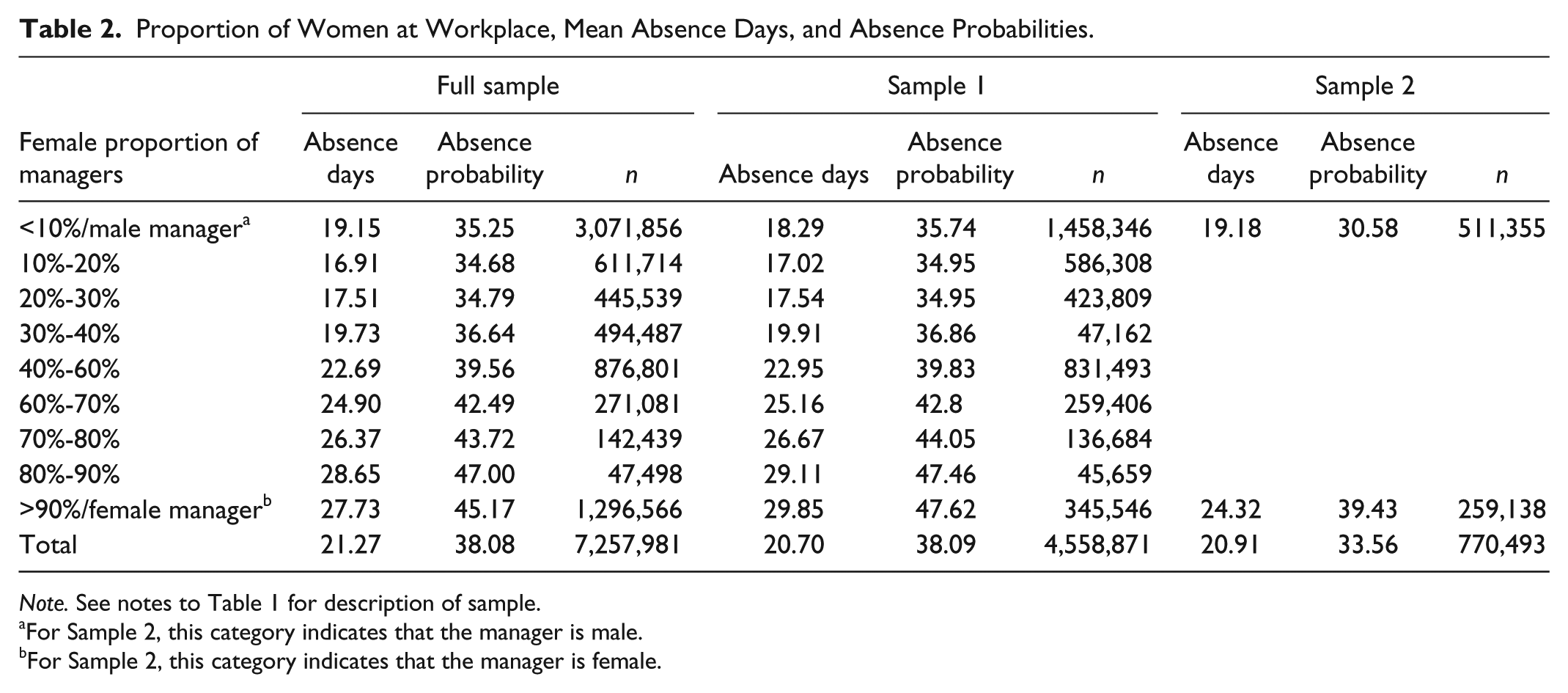
Note. See notes to Table 1 for description of sample.
For Sample 2, this category indicates that the manager is male.
For Sample 2, this category indicates that the manager is female.
For workplaces with only one manager, both the average number of absence days and the absence probability were higher when the manager was a woman. The absence rate also seemed to increase with the proportion of female managers. However, the relationship was not strictly linear, and these figures do not include control for other characteristics with employees, occupations, and workplaces associated with the gender of managers, which may affect this relationship. Such controls were included in the regression models given in Table 3.
Poisson Regressions on Number of Absence Days.

Note. For sample descriptions, see notes to Table 1. Model 1 is an ordinary Poisson regression with control variables as shown. Model 2 is a conditional Poisson model with detailed control for occupational categories.
Significance probabilities: *p< .05. **p< .01. ***p< .001.
In Table 3, controls for the employees’ gender, age, education, number of days employed during the year, proportion of females at workplace, working hours per week, number of children, and year of observation were included in Model 1. Detailed control for occupation was added in Model 2, which implies to only compare employees within the same occupational category.
The first part of the table is based on Sample 1 consisting of workplaces with two managers or more. According to Model 1, the workplaces with 10% to 20% female managers had the lowest sickness absence rate. For categories from 10% to 70% female managers, there was a positive relationship between sickness absence and the proportion of female managers. However, there were no significant differences in sickness absence on workplaces with more than 70% female managers compared with the reference category of 40% to 60% female managers.
When detailed control for occupation was added in Model 2, the association was slightly weaker for categories up to 70% female managers, but still remained significant. In this model, however, the absence rates at workplaces with more than 80% female managers were also significantly higher than in the reference category. In other words, the results indicate a positive association between sickness absence rates and the proportion of female managers at the workplace, and this pattern is not likely explained by occupational characteristics.
The results are given in incidence rate ratios (exponentiated Poisson coefficients) with confidence intervals in brackets. The estimates may be interpreted as increasing or decreasing rate ratios for sickness absence days. For example, according to Model 2, the sickness absence rate was 1.038 times higher in the category with the highest proportion of female managers compared with workplaces with 40% to 60% female managers. In other words, the average number of sickness absence days was 3.8% higher in this category. Correspondingly, the sickness absence rate decreased by a factor of 0.938 for workplaces in the category with the lowest proportion of female managers compared with the reference of 40% to 60% female managers. Thus, the average number of sickness absence days in these workplaces constituted 93.8% of the sickness absence days in workplaces with 40% to 60% female managers. Although the general trend was a positive association between the proportion of female managers and sickness absence, the association was not strictly linear. It is illustrated in Figure 1 based on the estimates in Models 1 and 2.

The association between the proportion of female managers and sickness absence days based on estimates in Table 3.
The second part of Table 3 was estimated on the sample restricted to workplaces with only one manager and 10 employees or less. These models were estimated with the same controls as mentioned above. In Model 1, the results showed that sickness absence rates were 6.3% higher on workplaces with female managers compared with workplaces with male managers. When only employees in the same occupation were compared, this effect was reduced to 2.6%, but still remained significant.
The results did not support H1 of a U-shaped association with higher sickness absence rates both at workplaces with a high proportion of male and female managers compared with workplaces with a more balanced gender composition in management position. They did not support H2 of lower sickness absence among employees working with female managers compared with employees working with male managers. The results are rather in line with H3 of higher sickness absence rates on workplaces with a high proportion of female managers compared with workplaces with a high proportion of male managers.
Discussion and Conclusion
The analyses above give the overall impression of a positive association between sickness absence rates and the proportion of female managers at the workplace. On small workplaces with only one manager, the absence rates were higher when this manager was female. The positive association between female managers and sickness absence rates was also significant when comparing employees with the same gender, age, educational level, number of days employed during the year, proportion of females at workplace, working hours per week, and number of children, working within the same detailed occupational categories. Thus, the pattern of higher sickness absence with female managers is not likely explained by any of these characteristics.
The results did not support the idea that gender diversity in management positions has positive organizational effects for the firm, which reduces sickness absence. They did not support the idea that women’s management style gives lower sickness absence because it is more beneficial for employees’ health and well-being. The results are rather in line with absence culture theory, that female managers have more lenient norms toward sickness absence contributing to a more tolerant absence culture at the workplace.
One possible explanation for these findings is that illness behavior is more or less unaffected by beneficial consequences of both gender diversity in management positions and by a feminine management style. Another explanation may be that such effects do not exist.
Although many studies and theories support the idea of a gendered management style (Eagly & Carli, 2003; Gardiner & Tiggemann, 1999), some also maintain that there are no such differences (Butterfield & Powell, 1981; Maher, 1997; Vecchio, 2002). They claim that stereotypical beliefs about male and female managers distort employee ratings and produce reported gender differences even when there are none. In these authors’ opinion, this happens when important contextual aspects such as power relations are neglected in studies of gender differences in management. When the research participants have limited information on context, they reveal stereotypical responses on gender differences. These stereotypical opinions are then interpreted as actual gender differences in management style.
When it comes to effects of gender diversity in management, previous empirical studies do not give any clear answers. Some findings indicate that gender diversity among managers gives increased innovation (Bantel & Jackson, 1989), but it does not seem to give increased productivity and performance (Kochan et al., 2003). The present findings thus add to the equivocal empirical support for beneficial organizational consequences of balance between men and women in management positions. However, benefits of gender diversity among managers on other outcomes than sickness absence may of course not be ruled out based on the findings of this study.
Although the findings did support an idea of a more tolerant absence culture at workplaces with female managers, there is also a possibility of selection effects, for example, that absence-prone employees are attracted to such workplaces. These might be employees with a higher family than work commitment or employees with adverse health conditions. The advantages with the register data used in this study are large samples and reliable registration, which should give small measurement and sampling errors. However, they do not give information on people’s attitudes, preferences, and thoughts. Further research using other sources of data is needed to more closely examine the idea that managers’ gender influences the workplace absence culture.
Future research may also address whether the findings in this study holds for other countries. As mentioned, Norway has high sickness absence rates and more generous sickness pay schemes, which may affect the relationship between sickness absence and the gender of managers.
Footnotes
Declaration of Conflicting Interests
The author(s) declared no potential conflicts of interest with respect to the research, authorship, and/or publication of this article.
Funding
The author(s) disclosed receipt of the following financial support for the research and/or authorship of this article: The author is grateful for financial support from the Research Council of Norway. This research received funding through the project “Friends or Foes: Understanding the role of firms and workplaces for worker health (Grant no. 187928/S20)