




Abstract
This article investigates the role of institutional isolation on the adoption of soil conservation technologies in Kenya. The study is based on the theory of induced technical and institutional innovations and on the literature on land tenure security and investment incentives. A multinomial logit model for adoption of various soil conservation investments (SCI) is estimated. To test whether institutional isolation affects soil conservation decisions, we evaluate the impacts of tenure security and market access, the impact of their interaction terms, and the significance of the joint impact of the two groups of variables and their interaction terms. The results show that the impact of development domains on soil conservation depends on the type of conservation investment. The results suggest that opening up of remote areas and educating farmers on appropriate land conservation technologies and farming systems suitable for different development domains are necessary for adoption of sustainable soil management practices.
Keywords
Introduction
Kenya is a low-income country that is dependent on agricultural production in several respects: as a key contributor to GDP (estimated at 25%); production of food for about 40 million Kenyans; employment of about 65% of the Kenyan population who live in rural areas, deriving their livelihoods directly from the natural resource base; provision of raw materials for the industrial sector; and generating foreign exchange earnings. Agricultural productivity is, however, constrained by a number of factors: first are the development domains of a locality, that is, the agroecological potential, population density, market access, and institutional setting, which are often unfavorable in remote areas; second, unsustainable land management practices; third, climate and weather variability among other factors.
Productivity is lowest in remote, marginally isolated regions of the country. Like in most African countries, some regions of Kenya can be classified as suffering from institutional isolation 1 and decay in that institutions do not work as expected due to weak governance, resource constraints, and market imperfections among other factors. With institutional isolation, purchase of inputs and sale of outputs are constrained by high information, contracting, and enforcement costs. Such costs prevent farmers from using purchased inputs in ideal quantities and thus hinder adoption of soil conservation technologies and reinforce the economic dysfunctionality of the system (Barrett & Swallow, 2007; Bromley, 2008). Adoption of soil conservation investments (SCI) is also influenced by development domains.
There is growing research on factors driving adoption of land conservation technologies (see Kabubo-Mariara, Linderhof, & Kruseman, 2010). There is also growing literature on the role of development domains on sustainable land management in Africa (see Pender, Ehui, & Place, 2006b). There is, however, no attempt to analyze the impact of institutional isolation on adoption of soil conservation practices. This study addresses this research gap. The study is based on the premise that institutional isolation leads to disincentives to invest in soil conservation. The study hypothesizes that although tenure security has been shown to be important for adoption of sustainable land management technologies, integration of market access and tenure security is particularly crucial in less favored areas. The study tests this hypothesis by carrying out case studies from two districts in Kenya—Machakos and Mbeere.
This article attempts to answer the following questions: What are the key factors driving and conditioning adoption of SCI in Kenya? What is the role of institutional isolation in adoption of SCI? What policy options can ensure adoption of sustainable soil management practices in Kenya?
The rest of the article is structured as follows: The second section presents the “Method,” the third section presents the “Study Setting and Data,” the fourth section presents the “Results and Discussion,” and the fifth section is the “Conclusion.”
Method
Conceptual Framework and Hypotheses
The analytical framework adopted in this article anchors on the sustainable land management framework. 2 This framework draws from the theories of induced technical and institutional innovations in agriculture that explain changing management systems in terms of changing microeconomic incentives facing farmers as a result of changing relative factor endowments (Boserup, 1965; Pender et al., 2006b). The study also draws from the literature on land tenure security and investment incentives (Besley, 1995; Kabubo-Mariara, 2007; Pender, Ehui, & Place, 2006a).
Based on the framework, theories, and the literature, the study hypothesizes that adoption of soil conservation practices/SCI is influenced by development domains, which determine the comparative advantage of a locality (Pender et al., 2006a). Other important factors include access to programs and services (such as agricultural extension and credit), households’ endowment of physical assets, human capital, social capital, and natural capital.
Market access is expected to affect SCI through increasing farmers’ access to credit and facilitating capital intensity of agriculture. Market-driven intensification may however reduce fallowing, leading to land degradation unless sufficiently offset by adoption of more intensive soil fertility management and SCI (Kabubo-Mariara et al., 2010; Pender et al., 2006b; Tiffen, Mortimore, & Gichuki, 1994). Market access may also influence adoption of SCI through access to information (Bromley, 2008). Information and awareness about benefits of soil conservation and better land management practices is also important (Ndah et al., 2015; Tesfaye, Negatu, Brouwer, & van der Zaag, 2013).
Secure land rights can have substantial effects on adoption of SCI by regulating land use and land management decisions, and by affecting households’ incentive and ability to invest in soil conservation (Besley, 1995; Kabubo-Mariara, 2007; Pender, Nkonya, Jagger, Sserunkuuma, & Ssali, 2004). There is however no universally accepted definition of tenure security as the literature offers a wide range of definitions (Arnot, Luckert, & Boxall, 2011). In this study, tenure security is defined as the interaction between content and assurance aspects of tenure, which Arnot et al. (2011) suggested are highly correlated.
Population pressure may cause households to intensify their use of labor and other inputs on the land and may also induce innovations in technology, markets, and institutions (Boserup, 1965; Kabubo-Mariara, 2007; Tiffen et al., 1994). Good soil quality and topography are expected to promote adoption of SCI through increasing the marginal return and/or reducing the risks of inputs necessary for intensification (Benin, 2006; Pender et al., 2004). Impact of agricultural potential on adoption of SCI could also be mixed (Kabubo-Mariara et al., 2010; Pender et al., 2006a). Favorable development domains promote adoption of SCI (Kruseman, Ruben, & Tesfay, 2006; Pender et al., 1999, 2006a).
Access to agricultural extension groups and credit programs provides farmers with information and may enable them to purchase inputs and increased capital, input, and labor intensity (Kabubo-Mariara et al., 2010; Pender et al., 2006a). Adaptation of machinery and seeds as well as the capacity of farmers to invest in complementary inputs are also crucial for soil conservation (Bizoza, 2013; Ndah et al., 2015).
Farm size and labor endowments affect through opportunities for intensification of SCI (Tesfaye et al., 2013). The impact of livestock on SCI depends on the interactions between crops and livestock. Farm equipment such as plows may contribute to soil erosion through tillage, especially if used on sloping lands. Farm equipment could, however, be used to help construct soil conservation structures or to apply inputs that help to prevent soil erosion, nutrient depletion, or other forms of degradation (Kabubo-Mariara, 2007; Pender et al., 2006a).
Empirical Model
To achieve the objectives of the study, descriptive statistics and econometric methods are used. First, we carry out bivariate comparisons of the two samples in terms of land tenure contents, tenure security, other aspects of institutional setting, and the socioeconomic characteristics of the households. We further carry out econometric analysis of SCI.
Based on the conceptual framework and hypotheses, adoption of SCI can be specified as

where SCI is a vector of current SCIs and α is a vector of parameters to be estimated. X captures vectors of factors influencing adoption of SCI and includes plot characteristics, tenure security of the plot, households’ endowments of physical capital, household human capital, financial capital, social capital, and village-level characteristics; ϵ is a random error term and “i” refers to the plot owned by household j. All other variables are as defined earlier.
Study Setting and Data
This study is based on primary data collected from Machakos and Mbeere districts of Eastern Province of Kenya. Machakos is historically referred to as a success story (Tiffen et al., 1994) and is thus assumed to be relatively less isolated institutionally compared with Mbeere in terms of tenure security and market access. Furthermore, Machakos is relatively accessible due to proximity to the capital city, Nairobi, and also the Nairobi–Mombasa highway, but Mbeere district is less accessible, located more than 200 km from Nairobi with most feeder roads virtually impassable during the heavy rains. The districts are, however, fairly comparable in terms of welfare, demographic characteristics, topography and climate, and agricultural potential.
Household and community questionnaires were used to collect the requisite data. The data were supplemented by secondary data on rainfall and village-level population density. To ensure adequate representation of the selected zones, the National Sample Survey and Evaluation Program (NASSEP IV) frame of the Kenya National Bureau of Statistics was used as the sampling frame for the field survey. Multistage random sampling methods were used to arrive at the final sample of households for each district. The first stage involved selecting administrative divisions within each district. A total of seven divisions were selected, three from Mbeere district and four from Machakos district. This choice was informed by diversity of the districts in terms of geography, agroecology, economic activities, physical size, and population density. The second stage involved selection of locations and sublocations, which were also based on agroecological diversity. Five locations from each district and four and five sublocations were selected from Mbeere and Machakos, respectively. The fourth stage involved selection of sample points (clusters) from the NASSEP frame, which was based on the total number of clusters (each corresponding to a village) within a sublocation and the number of households in each cluster. To arrive at the total number of households actually visited, we took a probability sample from each cluster making a total of 251 and 277 households from Mbeere and Machakos districts, respectively. In addition to the household survey, a community survey data set on sources of market information and access, village infrastructure, and prices of farm inputs and livestock was also used.
Results and Discussion
Descriptive Results
The sample characteristics of all households are presented in Table 1. The data suggest that differences between most of the household characteristics for the two districts are statistically significant. Notable differences are observed for education and the main occupation of the household head.
Characteristics of Household Heads.
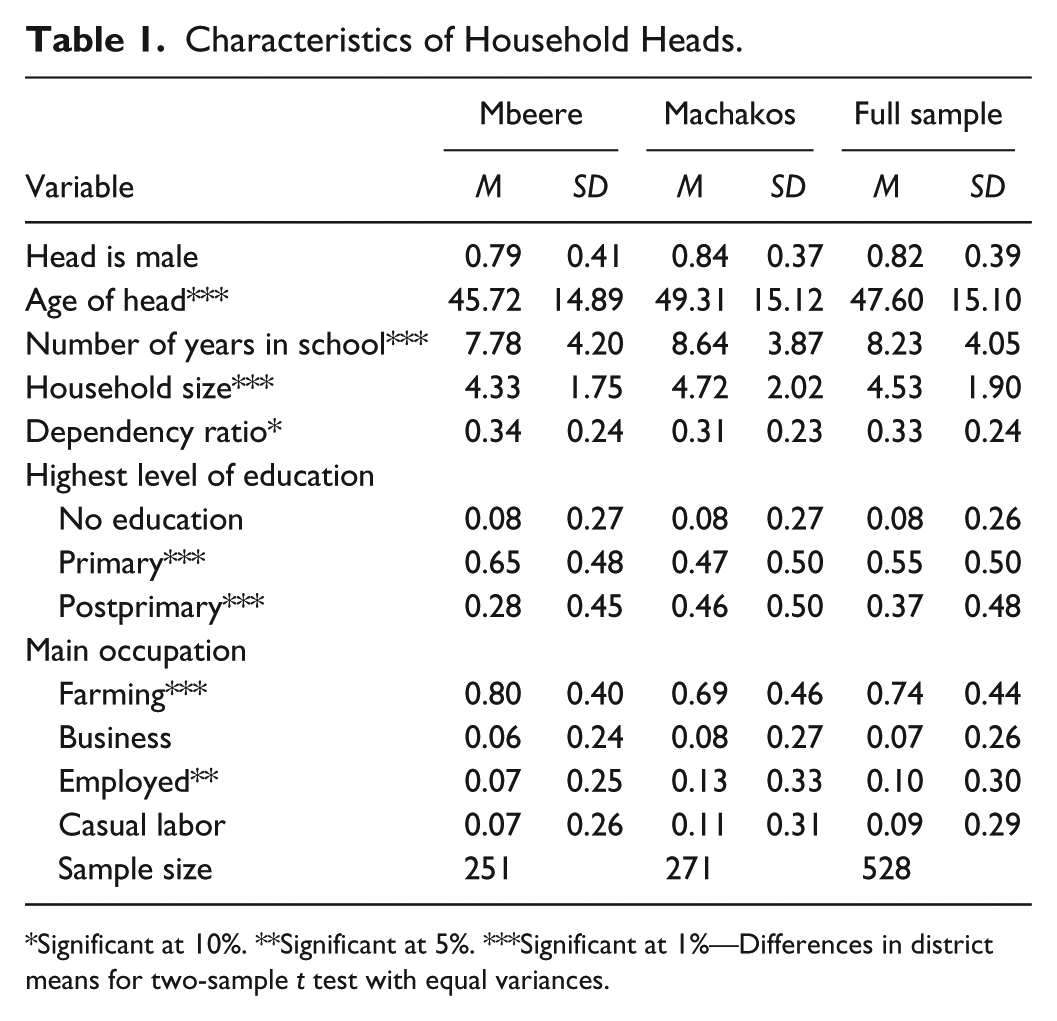
Significant at 10%. **Significant at 5%. ***Significant at 1%—Differences in district means for two-sample t test with equal variances.
The data revealed no significant differences in household assets in the two districts. Remittances were however higher in Machakos than in Mbeere, but a higher proportion of households in Machakos received extension services than their counterparts in Mbeere. On social capital, respondents were asked to indicate the proportion of villagers who are likely to provide assistance in case of emergency. The results indicate that, on average, households expect that about 67% and 56% of the villagers in Machakos and Mbeere, respectively, would assist (Table 2). Other measures with significant differences included whether the respondent would provide the same assistance to others, the number of confidants, and participation in community projects. The results suggest that households in Machakos are relatively richer in social capital than their counterparts in Mbeere district (Kabubo-Mariara, 2012, 2014).
Household Assets and Incomes.

Significant at 10%. ***Significant at 1%. Standard deviations in parentheses.
In this article, data collection focused on the content and assurance aspects of land tenure. Data were collected on the mode of acquisition and expected land rights on all plots owned, used, or rented/lent out by the household. The mode of acquisition probed on how the plot was acquired and in whose name it was registered. We also probed perceptions on transferability such as bequest and disposal rights and also for how long the land had been with the household. We also investigated perceptions on the likelihood of losing land to someone else and whether anybody else had some stake on household land.
The data suggest that the average farm holdings are about 2 acres in the two districts, though a higher variability is observed in Machakos. The average distance to the plot in Machakos was twice as much as that in Mbeere. On land acquisition, for the whole sample, 62% of the plots were inherited while 26% were purchased. Only 9% were rented. Patterns of land acquisition suggest more secure modes in Machakos than in Mbeere district while a significantly higher proportion of land is registered outside the family (landlords and other relatives) in Mbeere than in Machakos. Comparing all measures of land acquisition and expected rights, the data suggest that, in general, households in Machakos have stronger land rights than their counterparts in Mbeere district.
The study sought information on all forms of soil conservation efforts and whether the investments were current (seasonal), long-term, or permanent investments. Eighty percent of all plots had some form of SCI. The most common form of investment was grass strips and agroforestry (on about 58% of all plots for each), followed by terracing (44% of all plots) and ridging (23% of all plots). Thirty-eight percent (38%) of all investments were current, 32% were long term, and the rest 26% were permanent investments. On average, the adoption of SCI was higher in Machakos than in Mbeere (Table 3). A significantly higher percentage of plots had current and permanent investments in Machakos than in Mbeere, but the latter had more long-term investments. The most common types of investments in Machakos were terraces (59% of plots) and ridging (29%) while the most common types in Mbeere were agroforestry (70%) and grass strips (66%).
Soil Conservation Investments.

Significant at 5%. ***Significant at 1%. Standard deviations in parentheses.
This study also sought detailed information on soil characteristics; including the type, texture, depth of the soil, and the perceived quality of soil. The data suggest that the soils in the sampled plots were relatively deep and had relatively easy to work out fertile soils of fine texture, but were relatively highly erodible. Mean comparison tests suggest that soils in Machakos were significantly richer and more fertile than those in Mbeere. The study also investigated market access factors in the district, probing the distance and travel time to the nearest facility. Results for mean comparison tests for differences in distance to facilities between the two districts suggest that facilities and information are more accessible in Machakos than in Mbeere districts (Table 4).
Distance to Nearest Facility (Kilometers).

Significant at 10%. **Significant at 5%. ***Significant at 1%. Standard deviations in parentheses.
The results of the bivariate comparisons show that compared with Mbeere district, households in Machakos are better endowed in assets, have stronger land rights, and participate more in social capital formation. Furthermore, the results suggest higher agricultural potential and better market access in Machakos. There is also higher adoption of SCI in Machakos district. These results support the initial hypothesis of better integrated market and tenure security in Machakos relative to Mbeere. We use multivariate regression analysis to test whether these differences translate into differences in adoption of SCI and crop productivity outcomes.
Econometric Results
To carry out the econometric analysis, the article starts by examining the correlation between different measures of market access and soil variables. Factor analysis is then used to derive the final factors for inclusion in the regression models. For soil quality and characteristics, factor analysis is applied to responses on soil types, workability and texture of the soil, and topography. The factor analysis loaded into easily workable (easy and fine) soils. Two market access variables were derived from factor analysis: travel time and access to market information.
To assess the impact of the hypothesized determinants on soil conservation, a multinomial logit model for adoption of various SCI is estimated. This model is based on adoption of terracing, tree planting (agroforestry), ridging, and grass strips relative to nonadoption of any conservation measure. The study considered alternative estimation procedures for analyzing the conservation decision: multinomial logit models for adoption of various soil and water conservation measures, probit/logit models for the probability of investing in individual conservation measures, and ordinary least squares (OLS) models for indices of SCI. The multinomial logit regression is more appropriate than probit or logit models because the adoption decision, though nominal, consists of more than two categories and the responses are not ordinal in nature as in ordered probit/logit. The OLS model results are difficult to interpret because of the nature of the dependent variable. For these reasons, we retain the multinomial logit model results. To run a multinomial logit model, choice was made of the main type of investment on each plot to ensure that the investments are mutually exclusive. The study further made the assumption of Independence of Irrelevant Alternatives (IIA) property.
The average marginal effects from the multinomial logit model for adoption of SCI are presented in Table 5. The likelihood ratio (LR) χ2 value suggests that the model fits the data better than an intercept only model. All the results should be interpreted relative to the base category of non adoption of any conservation measure. For instance, the marginal effects imply that, on average, an increase in dependency ratio by 1 reduces the likelihood of adopting conservation practices, relative to nonadoption by between 0.03 and 0.07 points, other factors held constant. A higher education grade is associated with a 0.025 points lower likelihood that a household will adopt terracing but 0.09 points higher likelihood that a household will adopt grass strips, relative to nonadoption of any measure. Other marginal effects can be interpreted similarly.
Adoption of Various Soil Conservation Investments—Average Marginal Effects.

Note. LR = likelihood ratio.
Significant at 10%. **Significant at 5%. ***Significant at 1%.
The results suggest that age of the farmer is inversely correlated with all forms of soil conservation and significant for tree planting and adoption of grass strips. This is probably due to labor intensity of conservation, making them out of reach for older farmers. Possession of a higher school grade attainment reduces the probability of adoption of various conservation practices (except ridging) by about 0.02 points. The results further suggest that relative to household heads who are farmers, being employed reduces the likelihood of adoption of terracing by 0.04 points but increases that of grass strips investments by 0.09 points
In this article, tenure security is defined as an interaction of content of tenure (strongest right on land-sell right) and assurance (perception of low likelihood of expropriation). The results show that improved tenure security increases the probability of adoption of grass strips relative to nonadoption of any conservation investments by 0.063, all other factors constant. The effect on adoption of other conservation practices is insignificant. Relative to plots with difficult soils, presence of easy and fine soils increases the likelihood of adoption of terracing by 0.02 points but reduces the probability of adoption of tree planting by 0.035 points. There is a 0.031 higher likelihood of adoption of ridging on plots perceived to have low levels of soil erosion. Longer distance to plot increases the probability of adoption of terraces by 0.03 but reduces the probability of adoption of grass strips by 0.14 points.
Two asset variables are included to proxy the role of household wealth on investment in soil conservation. The assets also reflect the type of farming practices, which influence the type of conservation practices adopted. More farm equipment increases the probability of adoption of various forms of soil conservation measures by between 0.02 and 0.05 points. Only the marginal effect on tree planting is significant. Higher value of livestock lowers the probability of adoption of SCI, but the impact is insignificant for ridging and grass stripping.
The analysis uncovers no significant effect of remittances on adoption of SCI. Access to agricultural extension services, however, increases the likelihood of adoption by between 0.01 and 0.05 points. The marginal impact is significant for adoption of terracing and grass strips.
Social capital is captured by the proportion of households in a village that are likely to assist one another in cases of emergency and the proportion of persons participating in collective action. These two measures of social capital are exogenous as the household has no control over the proportion of households participating in social capital activities. 3 The results show that an increase in the proportion willing to assist in emergencies raises the probability of adoption by between 0.002 and 0.046 points. A higher proportion participating in collective action reduces the likelihood of adoption of tree planting by 0.096 but raises the probably of adoption of all other practices.
Village-level and market access variables are presented in the last panel of Table 5. The results show that higher population density increases the likelihood of adoption of all soil conservation measures relative to nonadoption of any practice by between 0.002 and 0.211 points. The highest marginal impact is on tree planting, while population density seems to matter least for adoption of grass strips. Rainfall increases the probability of adoption of tree planting and grass strips by 0.191 and 0.089 points, respectively, relative to nonadoption of any conservation practice. Higher rainfall is however inversely correlated with the probability of adoption of ridging relative to nonadoption, with an average marginal impact of 0.121.
Market access is measured by two factors: travel time and access to market information. Increased travel time, a measure of distance/remoteness, reduces the probability of tree planting relative to nonadoption of any conservation investment by 0.051. The marginal impacts on adoption of other conservation investments are insignificant. Access to market information has a positive impact, which is only significant for adoption of grass strips. An increase in access to information by one more unit increases the probability of adoption of grass strips by 0.028 relative to nonadoption of any conservation measure, all other factors held constant.
The main hypothesis of this study was that integration of tenure security and market access is important for adoption of SCI. Though individual impacts of some of the indicators of these two factors suggest that both tenure security and market access are important and significant determinants of conservation, we test for their joint impact by including interaction terms of tenure security and travel time, and also tenure security and access to market information. The results suggest that an interaction of tenure security and travel time to facility (remoteness) is inversely correlated with adoption of terraces and tree planting but positive for ridging and grass strips. Only the impacts for tree planting and grass strips are significant. The results of interaction seem to be driven by the relative strengths of the impacts of individual factors. For terraces and tree planting, the negative impact of travel time outweighs the positive impact of tenure security, while the reverse is observed for ridging and grass strips.
We further re-examine the key hypothesis of the study by evaluating the significance of the joint marginal impacts of tenure security, market access variables, and their interaction terms (institutional isolation). The results (Table 6) show that institutional isolation has a positive significant effect of adoption of all land conservation investments. The impact is relatively higher for adoption of terraces and grass stripping. The joint marginal impact of integration on terracing is 0.16. This suggests that a reduction in the extent of institutional isolation by 1% would boost adoption of soil conservation by about 16%, ceteris paribus. Other results can be interpreted in a similar manner.
Joint Impact of Institutional Isolation and Development Domains.

Significant at 10%. **Significant at 5%. ***Significant at 1%.
We test for the impact of development domains by carrying out statistical tests for the three groups of variables: agricultural potential, market access, and population pressure (last column of Table 6). An improvement in development domains by 1% would reduce the probability of adoption of tree planting by 0.34 % and that of adopting grass strips by 0.23%. A similar change would increase the likelihood of adoption of terraces and ridges by 0.01% and 0.30%, respectively. The impact on the likelihood of adoption of soil conservation in general is positive and statistically significant but quite modest.
Last, we include a dummy variable for Machakos district to test whether location in a particular district influences adoption of SCI. The results show that farmers in Machakos district have a higher probability of adopting terraces than their counterparts in Mbeere district. However, these farmers have a lower probability of planting trees than farmers in Mbeere. The results support the statistically significant difference in adoption of these practices in the two districts presented in Table 4. We uncover no significant effect of the district dummy on probability of adoption of ridges and grass strips (Table 5).
Discussion
This article investigates the role of institutional isolation on adoption of soil conservation in Kenya. The study is based on the expectation that integration of market access and tenure security is crucial for adoption of SCI. The results point at several key factors that affect soil conservation decisions: tenure security, market access, and development domains.
The results show that tenure security exhibits positive impacts on adoption of all SCI, relative to all other forms of conservation. This supports literature that has found tenure security to provide incentives for soil conservation (Kabubo-Mariara, 2007). Except for tree planting, there is a higher likelihood of adoption of SCI on plots with easy and fine soils, compared with plots with difficult soils. There is also a significantly higher likelihood of adoption of ridging on plots that are perceived to have low levels of soil erosion while tree planting is less likely to occur on nonerodible soils. The mixed results find support in Pender et al. (2006a), who argued of expected ambiguous impacts of agricultural potential on land degradation. Kabubo-Mariara et al. (2010) also found mixed impacts of soil quality on adoption of soil conservation. The negative significant marginal effect of distance to plot on adoption of grass strips suggests that increased production costs (time wise) will hinder adoption of sustainable land management practices (Gebremedhin & Swinton, 2003; Kabubo-Mariara et al., 2010; Kruseman et al., 2006).
On market access, the inverse relationship between travel time and adoption of conservation investments on one hand, and the positive impact of access to market information on adoption of grass strips on the other, suggests that institutional isolation will hinder adoption of SCI through higher transaction costs. The results suggest that an interaction of tenure security and travel time to facility (remoteness) encourages adoption of grass strips but discourages tree planting. Evaluation of the joint significance of tenure security and market access suggests that integration of tenure security and good market access incentivize adoption of soil conservation but favor more permanent investments (adoption of terraces and grass strips) in soil conservation. This supports the key hypothesis of this study. The joint impact of development domain dimensions is most pronounced on adoption of tree planting and ridging. Favorable development domains boost adoption of terraces and ridges but discourage tree planting and adoption of grass strips. This implies that the impact of development domains depends on the type of conservation practice. The impact on the likelihood of adoption of conservation investments, in general, supports the hypothesis that favorable development domains boosts adoption of SCI.
Population density exhibits positive significant impacts on adoption of all SCI. This supports Boserup’s hypothesis of increased agricultural intensification as population density increases (Boserup, 1965; Kabubo-Mariara, 2007; Pender et al., 2006a). The positive impact of rainfall concurs with the hypothesis that higher rainfall areas are associated with greater adoption of vegetative land management practices such as use of agroforestry, live barriers, and mulching because of higher biomass productivity in such areas (Pender et al., 2006a). The Machakos district dummy suggests that farmers in Machakos are generally more likely to adopt soil conservation practices than their counterparts in Mbeere district. The only exception is for tree planting where we find a negative significant average marginal effect. This result supports Tiffen et al. (1994) and our earlier hypothesis that Machakos district may be associated with higher adoption of soil conservation measures as it is less isolated institutionally relative to Mbeere district (Kabubo-Mariara, 2012, 2014).
The richer the social capital, the higher the likelihood of adoption of SCI. This supports development policy view that social capital is a productive asset that can be strategically mobilized by individuals for particular ends (Nyangena & Sterner, 2009). Literature suggests that collective action for natural resource management can mitigate the negative influence of population pressure on natural resource management as predicted by the Malthusian perspective (Kabubo-Mariara, 2012, 2014; Pender et al., 2006b).
Conclusion
The study investigates whether soil conservation responds to institutional isolation. It draws from the sustainable land management framework and the literature on tenure security incentives. The study is based on 793 plots from a sample of 528 households drawn from Mbeere and Machakos districts of Eastern Province of Kenya. A community survey is used to augment the household survey.
Descriptive and econometric methods are used to test the study hypothesis. Multinomial logit models are estimated for adoption of various SCI. To test the hypothesis that integration of tenure security and market access is important for adoption of SCI, three alternative approaches are utilized. First we evaluate the impacts of tenure security and market access. Second, we evaluate the impact of interaction terms of tenure and market access variables. Third, we evaluate the significance of the joint impact of the two groups of variables and their interaction terms.
The results show that tenure security positively influences the decision to adopt and also the forms of SCI adopted. Results for market access factors and distance to plot suggest that remoteness is inversely correlated with adoption of SCI, supporting our hypothesis on the role of institutional isolation in adoption of SCI. Integration of tenure security and market access boosts adoption of all conservation investments but has a larger impact on adoption of terraces and grass stripping. Population density exhibits positive significant impacts on adoption of all SCI, supporting the Boserupian hypothesis of increased agricultural intensification as population density increases. The impact of development domains depends on the type on conservation practice, favoring adoption of terraces and ridging but inversely affecting tree planting and grass strips.
The findings of this study suggest that institutional isolation is important for adoption of soil conservation technologies. It is therefore important to open up remote areas to facilitate adoption of alternative SCI. Enhancing security of tenure is also crucial for promoting long-term investments in soil conservation. The impact of development domains is found to be context specific. This requires dissemination of information to farmers on appropriate land conservation technologies and farming systems appropriate in different domains. Research into the relative differentials in the responsiveness of adoption of soil conservation to the components of development domains in different regions of the country should form an important source of information for dissemination to farmers. Experiences of what works/does not work in other regions should also be an integral part of this research and dissemination strategy.
This study makes an important contribution to the literature on institutional economics. However, given data limitations, there are some important issues that could not be drawn into this study. First, further research is needed to investigate the impact of institutional isolation on adoption of water conservation technologies in Kenya. Second, there is need for research that incorporates technological spillovers when assessing the impact of institutional isolation on adoption of SCI. Third, studies on adoption of SCI do not take into account land prices, yet it is probable that farmers practice soil conservation because their land is valuable and they want to maintain such land values. Future studies should try to incorporate land prices. Fourth, there is need to try to estimate the overall financial and time efforts by farmers for SCI.
Footnotes
Author’s Note
Comments from CEEPA resources persons are acknowledged. I am however responsible for any errors and omissions.
Declaration of Conflicting Interests
The author(s) declared no potential conflicts of interest with respect to the research, authorship, and/or publication of this article.
Funding
The author(s) disclosed receipt of the following financial support for the research and/or authorship of this article: This research was funded by the Centre of Environmental Economics and Policy in Africa (CEEPA).