




Abstract
In this article, we describe a knowledge translation symposium focused on rehabilitation research for older adults. The symposium consisted of presentations on rehabilitation research, followed by roundtable discussions designed to solicit perspectives of public stakeholders. Eighty-eight people attended the event, most with backgrounds in health care service provision. The participants evaluated the event and provided feedback on research topics related to rehabilitation of older adults. Lessons learned from this event may be useful in the design of future knowledge translation symposia and to facilitate involvement of public stakeholders in design, implementation, and dissemination of rehabilitation research for older adults.
Health care research agencies are emphasizing the importance of engaging the public in the development, implementation, and dissemination of research (Canadian Institutes of Health Research [CIHR], 2010; Watt, Higgins, & Kendrick, 2000). This process is known as citizen engagement and is integral to translating knowledge generated from research into health care practice and policy (Boote, 2011; CIHR, 2010). CIHR use the term citizens to refer to any individuals who are stakeholders in research, including patients, caregivers, advocacy groups, members of the general public, health care professionals, and other service providers.
At citizen engagement events, researchers and citizens come together to discuss, deliberate, and make decisions regarding research processes. This type of collaboration helps to ensure the outcomes of research will be relevant, widely disseminated, and readily implemented into policy and practice (CIHR, 2010). Through citizen engagement, stakeholders may have a sense of ownership in research. Also, research organizations may be better able to dedicate resources to priority areas identified by stakeholders (CIHR, 2010; Watt et al., 2000).
Older adults (i.e., individuals older than 65 years) are the fastest growing segment of the population in Canada and many other countries of the world (United Nations, 2002). As a result of this growth, age-associated health conditions that require rehabilitation are also more prevalent. Thus, health and rehabilitation research with older adults are receiving increased attention (Chappell, McDonald, &Stones, 2008). Citizen engagement can help with determining the direction of research related to older adults. From 2004 to 2006, CIHR engaged the public across Canada in discussions about directions for research for older adults during their Regional Seniors’ Workshops on Research. At these workshops, public stakeholders were primarily older adults (65+ years). In their summary document, CIHR reported the following topics as priorities among participants: access to health services (including rehabilitation), determinants of health related to lifestyle, transportation and mobility issues, and knowledge translation (KT) (CIHR Institute of Aging, 2007). The reported interest of older adults in rehabilitation research prompted an interdisciplinary group of researchers at University of Alberta to develop a citizen engagement event geared to stakeholders in Edmonton, Alberta.
Rehabilitation Research and KT
The ability to carry out basic activities of daily living (i.e., functional abilities) can make the difference in how, where, and with whom, people live their lives. Functional abilities determine the choices individuals have and the satisfaction they take in daily life (Chappell & Cooke, 2010). Rehabilitation disciplines, including occupational therapy, physical therapy, speech–language pathology, and recreational therapy, play key roles in the management of many chronic conditions experienced by older adults. Clinical research in rehabilitation of older adults is focused on functional issues arising from a wide spectrum of biomechanical, neurological, cognitive, and mental health conditions.
The findings of rehabilitation research can be used to support policy and guide practice such that interventions are evidence based, effective, and fiscally efficient. However, stakeholders (including older adults and professionals who work with them) first need to become aware of research findings and the role of researchers in knowledge creation. The dissemination, exchange, and application of knowledge are collectively referred to as KT (CIHR, 2013). To date, KT research in rehabilitation is still sparse and largely unexplored (Jones, Roop, Pohar, Albrecht, & Scott, 2014; Menon, Korner-Bitensky, Kastner, McKibbon, & Straus, 2009; Scott et al., 2012). The traditional practice of KT involves researchers focusing their dissemination activities toward other researchers and health care professionals through scholarly publications and presentations. Ideally, researchers should work toward KT models that involve a genuine collaborative process founded on valuing exchange among a variety of stakeholders through citizen engagement.
The primary purpose of this article is to describe the implementation of a citizen engagement event, the Knowledge Translation and Network Engagement (KTNE) symposium. This symposium was carried out by a group of researchers that comprise the Special Interest Group on Aging at the University of Alberta. The secondary purpose of this article is to present a summary of the participants’ perspectives on rehabilitation research gleaned from roundtable discussions and written feedback, as well as their opinions on the process and content of the KTNE symposium.
The KTNE Symposium
The Special Interest Group on Aging (SIGA) in the Faculty of Rehabilitation Medicine at the University of Alberta includes researchers from speech–language pathology, occupational therapy, and physical therapy, whose area of research specifically involves rehabilitation of older adults. The mandate of this group of researchers is research collaboration (i.e., “the working together of researchers to achieve the common goal of producing new scientific knowledge”; Katz & Martin, 1997, p. 7), trainee mentorship and consultation. Members conduct research in areas such as arthritis, sleep, pain, communication, swallowing, mental health, resiliency, health-related quality of life, and the use of technology to promote activities of daily living. Although diverse, these research areas are linked by an overriding theme: protecting, maintaining, and improving older adults’ functional abilities.
The KTNE symposium was focused on exchanging knowledge and ideas related to rehabilitation research involving older adults. The goals for the KTNE event were as follows:
Disseminate information—provide evidence-based information about recent advances in older adult rehabilitation to citizen stakeholders;
Exchange ideas—enable citizens’ access to information that is relevant and applicable to functional abilities and quality of life of older adults; solicit ideas from stakeholders to guide researchers in developing research hypotheses and objectives to meet the rehabilitation needs of older adults;
Develop collaborative partnerships—foster trust and mutual respect between researchers and stakeholders to ensure citizens will advise and collaborate to guide future rehabilitation research projects; and
Gather feedback from participants—collect participant feedback about meaningfulness and usefulness of the pilot activity to improve future KTNE events.
Symposium Format and Participants
The KTNE symposium was advertised to the public with the title “Seniors’ Rehabilitation: An Update on Research That Matters to You.” Researchers sent out notification of the event via email to local organizations who serve older adults and/or have connections such organizations. Ninety-one individuals preregistered and provided information about their backgrounds (see Table 1). The majority of the registrants indicated that they were health care providers or other service providers who worked with older adults. Eighty-eight citizens attended the event (including 1 member of the member of the general public). The event was held at a local community center and there was no charge for attendance.
Backgrounds of Individuals Registered to Attend the KTNE Event.
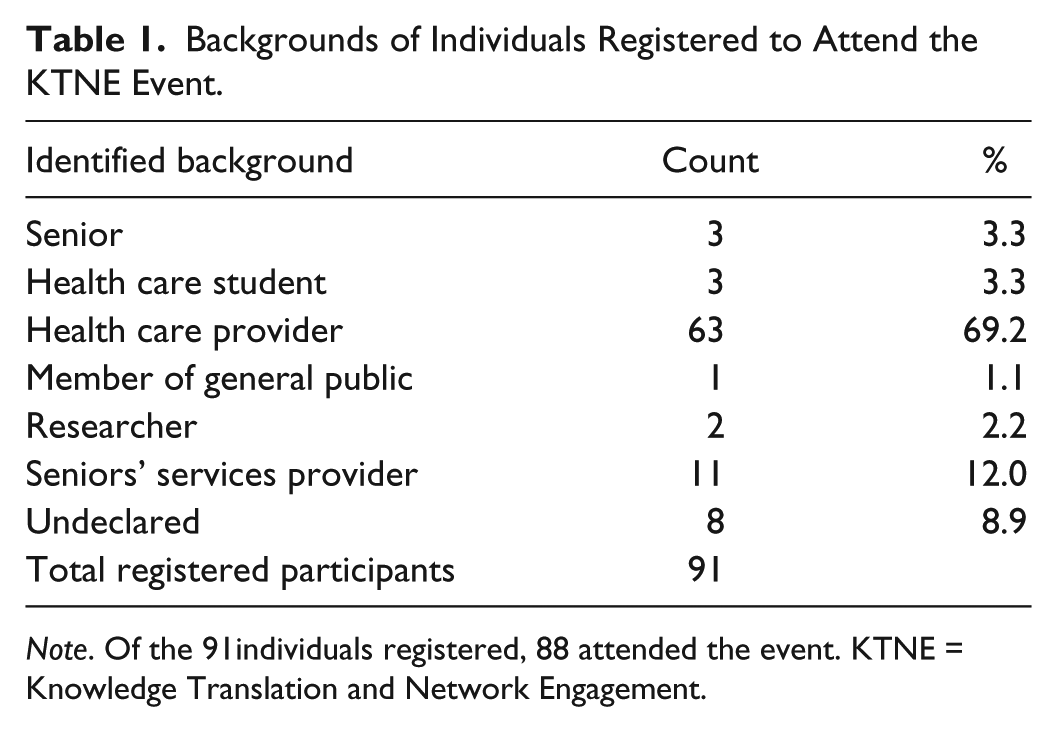
Note. Of the 91individuals registered, 88 attended the event. KTNE = Knowledge Translation and Network Engagement.
The symposium was approximately 3 hr in length. Researchers began with six, 15-min presentations in which they shared the scope and findings of recent research on older adult rehabilitation. After the presentations, attendees moved to round tables to work in groups of 8 to 10 people. The group members discussed their views on research priorities, as well as potential barriers and facilitators of rehabilitation research with older adults, using guiding questions (see Figure 1). Each group nominated a scribe who wrote responses to the guiding questions. After answering each of the guiding questions, each small group had a spokesperson who shared their responses in a large group discussion. Each group’s written responses were collected at the end of the symposium and then summarized according to guiding question.

Questions for guided participant discussions organized by topic.
At the completion of the event, participants were asked to complete individual rating forms related to the usefulness of the KTNE symposium on a scale of 0 (of no use) to 10 (very useful), and provide written feedback on the event.
Results
Participant Perspectives on Rehabilitation Research
Priorities for rehabilitation research
Participant groups were asked to create a list of important research topics relevant to older adults and subsequently identify three priority areas from the list they generated (Figure 1). Collectively, the groups generated more than 20 areas of priority for research including research related to specific populations of older adults (i.e., Aboriginal people), diagnosis groups (e.g., stroke, dementia), and symptoms (e.g., independence, resilience, quality of life, sleep, pain management and bariatric care). Transportation and driving were also reported as top priorities for research, as were health service issues such as factors that would support patient adherence with treatment programs, discharge planning, and falls prevention programs. Other categories of research priorities were as follows:
Seniors’ social participation in leisure/community activities (accessibility and engagement)
Health management outcomes and measurement
Building physical environments to meet seniors’ needs
Nutrition/hydration issues
Barriers to rehabilitation research with older adults
Numerous barriers related to the research process were identified, including complexity of aging and research topics (i.e., one participant wrote “It [aging] is a huge multifactorial area”), the multidisciplinary nature of rehabilitation research in older adults, and difficulty measuring outcomes. Others perceived barriers were limited research funding for rehabilitation research for older adults, lack of public interest to support such research, and the perception that few researchers seemed interested in conducting studies with older adults. Participants acknowledged that research with older adults requires extensive investments of effort and time by researchers, administrative and clinical staff in health care, and community contexts. They highlighted a lack of time for clinicians to partner in research; “How can clinicians participate in research/data collections with already heavy workloads?” Participants stated that their priorities for study differed from the priorities of researchers.
Participants also identified difficulties that they thought were common in research involving older adults with health and rehabilitation needs, such as recruiting individuals for research, obtaining informed consent, understanding the influence of diverse cultural backgrounds in the research process, varying literacy levels, the presence of multiple comorbid health conditions, and increased risk of mortality compared with other groups. Finally, attitudinal barriers related to the aging population such as stereotyping and public misperceptions were reported; “they’re going to fall anyway” and “it’s a part of normal aging.”
Potential solutions to barriers
Participants were asked to identify solutions to ameliorate the barriers they identified. Participants suggested that improving the quality and quantity of collaboration between researchers and health care providers/service providers could be a key strategy to overcome barriers to research with older adults. Participants stated that improved KT, through sessions such as the symposium, would be an effective approach to promoting collaboration. Participants also identified the need to obtain funding for research projects as a solution to cost-related barriers. Finally participants recommended improving public awareness through advocacy movements and more involvement of students in rehabilitation research for older adults during their training programs.
Participant Feedback on the Symposium
Thirty-four participants provided numerical ratings of the usefulness of the symposium, and 23 participants provided written comments. The median of the scores of participants’ ratings of the usefulness of the symposium on a scale of 0 (no use) to 10 (very useful) was 7 (mode = 8). Written feedback was positive and constructive, for example, “I think sessions like this will provide the link between research and practice.” Participants also indicated that information presented was relevant: “Loved the research updates—brief, concise, applicable to our population.”
Other Outcomes: Engagement
Attendees were invited to sign up to the Special Interest Group on Aging’s online database of stakeholders who wished to be informed about opportunities to be involved in identifying, developing, implementing and using research that matters to older adults. The invitation to join the database was provided on professionally printed postcards that briefly explained the special interest group, the purpose of the database, and provided the URL link to the registry. Attendees were encouraged to take and distribute extra postcards to their own networks. Of the 88 KTNE event participants, 32 joined the database to act as stakeholders in older adult rehabilitation research. Since the KTNE event, more than 50 other individuals have joined the database. Most of the registered stakeholders are health care providers.
Discussion
Findings from this preliminary citizen engagement and knowledge translation symposium were encouraging and members of the Special Interest Group on Aging are planning to continue with other KTNE symposia across the province of Alberta. The findings from this study provided researchers with knowledge of specific issues of rehabilitation and aging from a citizen perspective, thus extending the findings of the CIHR Regional Seniors’ Workshops on Research. This current KTNE symposium was attended by many people from a variety of backgrounds (health care students, health care providers, researchers, service providers). However, members of the public and seniors were largely absent from this event, which is a limitation of the current study. Future symposia will include modifications to ensure a breadth of stakeholders, including members of the general public. For example, advertising for the event could be conducted with guidance from communications and media experts, using strategies such as more frequent event notices over longer periods of time and the use of a variety of media outlets, including print newspapers and weekly news bulletins/publications for older adults. Also, family members/care partners of older adults may be more likely to attend if care programs were provided for older adults who could not stay alone while family members attended the symposium. Future symposia will also focus on specific issues of rehabilitation and aging as identified by the participants from this KTNE symposium (e.g., falls prevention).
In subsequent events, researchers may also collect data on the effectiveness of such gatherings in meeting the goals of citizen engagement in research. Data collected may also be used to compare responses on research priorities for older adults on the basis of stakeholder group affiliation (i.e., older adults, health care providers, policy makers). The format of the event may also be changed to ensure a wide reach to audiences in different geographical locations. Because it is not practical, nor cost-effective, to have several researchers travel to multiple rural and/or remote locations, the Special Interest Group on Aging is planning to develop prerecorded, multimedia presentations. These will be presented to audiences across the province of Alberta. Two trained facilitators will attend each of the sessions and guide the postpresentation small group discussions. The Special Interest Group on Aging will also be able to provide continuity between KTNE symposia so as to better understand the scope of issues arising across the province. This model is a relatively low-cost strategy to maximize opportunities for older adults and family members outside of large urban settings to have access to up-to-date research knowledge and provide input regarding future studies.
Conclusion
At the University of Alberta, a group of researchers interested in rehabilitation research in aging developed and implemented a citizen engagement symposium. The event was well attended although the diversity of citizens who attended the event was limited. Attendees provided researchers with feedback on issues in rehabilitation research for older adults, including priority topics for research and discussion at future symposia. Continued refinement and testing of this promising event will be the focus of upcoming citizen engagement endeavors.
Footnotes
Declaration of Conflicting Interests
The author(s) declared no potential conflicts of interest with respect to the research, authorship, and/or publication of this article.
Funding
The author(s) received no financial support for the research and/or authorship of this article.