




Abstract
This study aims to explore in detail the factors that affect the consumer behavioral intention to adopt broadband Internet in a developing country perspective. Various attitudinal, normative, and control constructs were identified and investigated for their possible influence on broadband Internet adoption. The empirical data for this study were collected using a self-administered questionnaire that included items related to various attitudinal, normative, and control constructs. Descriptive statistics and regression analysis were used to test these constructs for their possible influence on Indian consumers’ adoption of broadband Internet. The findings suggest that perceived ease of use (PE), social outcomes (SO), hedonic outcomes (HO), service quality (SQ), facilitating conditions resources (FCR), and self-efficacy (SE) were very significant predictors of Indian consumers’ behavioral intention to adopt broadband Internet. This study has multifold significance. The integrated research framework used in this study is an extension of previous well-established research models (such as Model of Adoption of Technology in Households [MATH], Diffusion of Innovation [DOI], and Theory of Planned Behavior [TPB]) and provides an enhanced comprehension of broadband Internet by the Indian household consumers.
Introduction
The Broadband Technology
Papacharissi and Zaks (2006, p-2) have defined broadband access as “all flavors of high-speed digital voice, data and video services, as well as the underlying infrastructure, clients and technologies that enable these services.” (p. 2). More specifically, speeds of at least 384 Kbps and packet-switched technology are used at the level of interactivity when adopting broadband access, and these can be allowed for the control and selection of content. Broadband is the new innovation high-speed Internet access technology that provides not only economic and public benefits but also improves people’s lives (B. Anderson & Tracey, 2001; Choudrie & Dwivedi, 2006a). Broadband Internet diffusion not only increases national competitiveness (thus increases Foreign Direct Investment [FDI] in the country; Bankole, Osei-Bryson, & Brown, 2013; Manzoor, 2012) but also helps increase international competitiveness by leveraging e-commerce activities (Armenta, Serrano, Cabrera, & Conte, 2012; Ayanso, Cho, & Lertwachara, 2014; Choudrie & Dwivedi, 2004; Dwivedi & Irani, 2009; Johnson, 2010; Wambogo Omole, 2013; Qureshi, 2012; Wei, 2004).
One of the significant changes in Internet technologies has been the replacement of narrowband (dial-up) connection by high-speed broadband connection (Choudrie & Dwivedi, 2004). Broadband is considered a technology that provides high-speed broadcast with greater bandwidth, higher data transmission rates, and always-on access to applications, services, and content (Qureshi, 2010; Sawyer, Allen, & Lee, 2003). The exponential growth of Internet technology has given rise to increased customer expectations (Wei, 2004). Many research studies have been conducted to look into various applications of broadband that have huge potential of increased revenues for communications industries (Crandall, Lehr, & Litan, 2007; Jung, Perez-Mira, & Wiley-Patton, 2009; Katz, Vaterlaus, Zenhäusern, & Suter, 2010; Kolko, 2012; Koutroumpis, 2009). Broadband, therefore, has a key role to provide an ever more-connected world to the consumer communities (Bell, 2008).
Broadband in India
First broadband connection in India was given in 1998. The projected number of broadband subscribers in India by 2007 was 9 million and it was expected that the number will cross 15 million by 2012. India is considered one of the largest and fastest growing major telecom markets in the world. Broadband Internet in India is growing mainly due to the rapid growth in Indian telecommunication sector. India’s growing economy, rapidly expanding middle class, low tariffs, and highly competitive market have further supported the continuous expansion of the broadband sector (ABIresearch, 2012).
Successive Indian governments introduced comprehensive reforms over the last decade that changed the landscape of telecommunication in India. Indian government has taken many initiatives, such as Indian PC program, e-governance, e-learning, and e-healthcare services, to spur the growth of broadband Internet. Broadband network expansion and upgrades are underway in India to match up with comparable Asian broadband markets. Indian government has made three priorities for its plans to increase broadband penetration and usage: lower cost-per-engagemen pricing, affordable broadband software and hardware, and cheap, consistent broadband interconnectivity among villages (Pereira, 2011). The Indian government has continued its policy of an open and competitive broadband market. Some of the key steps in this regard included issuing licenses to new telecom operators, allowing global operators to work with local companies, privatization of the country’s long-distance market, bandwidth sharing among Internet service providers (ISPs), allowing the use of Ku-band in both Indian and foreign satellites, and launch of mobile number portability (MNP; the Telecom Regulatory Authority of India [TRAI], 2010). In 2011, the fixed line penetration in India was 3% and around 98% of the Indian population had some form of access to a telephone (BusinessWire.com, 2011). During the last decade, heavy investment was made in telecom infrastructure. The Indian government continued to force completion of restructuring of telecommunications regulatory regime. The TRAI continued its structural reforms such as adoption of unified licensing, increased infrastructure sharing, and revised FDI policy, increasing foreign ownership limit from 49% to 74% (Press Trust of India, 2012). In 2012, Indian government approved a national broadband plan. The objective of the plan was to provide high-speed Internet access and e-government services to more than 160 million people by 2014. Under this plan, an open access countrywide optical-fiber-based broadband network will be established, which will provide connectivity to all areas with population of 500 and above by 2013 (TRAI, 2010).
Broadband Internet and Economic Development
There are many factors that boost economic growth, including product, process, and organizational innovations, and the distribution and generation of information and ideas. Technological changes result from small incremental improvements over a period of time. However, even a small improvement in technology can alter how and where economic activity is managed (Czernich, Falck, Kretschmer, & Woessmann, 2011; Majumdar, Carare, & Chang, 2010; Organisation for Economic Co-operation and Development [OECD], 2008).
OECD (2008) defines broadband as a general-purpose technology that when incorporated with other information communication technologies (ICTs) can change how and where economic activities are managed. This change is affected through many channels. A clear impact occurs from investing in the infrastructure itself and related ICTs. Indirect impacts come from all aspects of economic activity affected by broadband and which drive economic growth (Collins, Day, & Williams, 2007).
Ample academic literature is available that has examined the impact of broadband on firm-level productivity (Holt & Jamison, 2009). A central theme of the academic literature is the ability of broadband to create new business models, processes, and innovation. It helps in increasing the productivity and efficiency of the firm. The study of Allen Consulting Group (2002) reported results from a survey of Australian business on the cost saving obtained from using broadband Internet. The results of the survey showed that around 6.3% businesses experienced cost saving from the utilization of broadband Internet as compared with the 1.5% from the utilization of dial-up Internet. The research declared that for Australian businesses, the average cost saving would result in an overall output gain of approximately 0.32%. These results are consistent with the most recent research by the Australian Industry Group (2008) who claimed that more than 93% of the firms investigated showed that broadband has a positive influence on the efficiency and output.
A panel of 6,060 New Zealand firms was analyzed by Grimes, Ren, and Stevens (2012) in a study to find the effect that various forms of Internet access have on the firm’s output. The information collected from the surveys conducted by Statistics New Zealand permitted the authors to control for a range of firm characteristics including those factors that may determine a firm’s choice of Internet access. The two estimation approaches used were an instrument variable (IV) estimator and propensity score matching (PSM) estimator. The (IV) estimation results showed higher productivity impacts from the utilization of broadband. The utilization of broadband increased the productivity of firms by 21% to 25%. The PSM results showed that productivity increased by 6.9 to 9.7 due to broadband utilization. These effects were consistent across different types of firms with no significant differences across an urban versus rural split or across high versus low knowledge industries. Although the results firm IV estimation were greater than those gathered from PSM, the authors of the study favored PSM estimation due to their low confidence on IV results. This low confidence resulted from their lack of specific knowledge about the correct functional specification in relation to a firm’s labor productivity relative to its sector.
In addition to examination of broadband Internet on firm-level productivity, there is growing academic literature that examines the association between broadband and macroeconomic-level indicators such as economic growth and employment. Czernich et al. (2011) carried out a panel analysis of 25 OECD countries, using an instrumental variable model, to estimate the impact of broadband infrastructure on economic growth. Czernich et al. concluded that the broadband introduction and diffusion had a significant impact in the growth of gross domestic product (GDP) in the OECD countries included in the panel study. After the introduction of broadband, the per capita GDP of a country was on average 2.7% to 3.9% greater than before the introduction of broadband, controlling for country and year fixed effects. It was further concluded that an increase in 10% points in the diffusion of broadband raised annual growth per capita by between 0.9% and 1.5% points annually.
The effect of broadband penetration on the employment growth, rents, wages, business growth, and industry structure at the community, industry, and state level was analyzed in the study by (Lehr, Bauer, Heikkinen, & Clark, 2011)). Lehr et al. concluded that the take-up of broadband promotes the economic activity with major effects in the growth of job and business, especially for larger business and business in IT-intensive sectors. It was further concluded that the take-up of broadband had no substantial effect on the wages but that there was an important link between residential property values and broadband take-up.
Qiang, Rossotto, & Kimura (2009) used the Barro cross-sectional and endogenous growth model by using the data from 120 developing and developed countries to evaluate the effect that broadband has had on the long-term economic growth rates over the years 1980 to 2006. The findings from the empirical analysis recommend a strong and substantial growth dividend from broadband access in developed countries. Keeping other factors constant, in a developed country, a 10% increase in the penetration of broadband would result in 1.21% increase in the growth of economy. It was found that keeping other factors constant, a 10% increase in the diffusion of broadband in developing countries would cause a 1.38% increase in the growth of an economy.
The research by Koutroumpis (2009) used a macroeconomic production function with microeconomic model for broadband investment to estimate how broadband infrastructure investment contributed in economic growth in 22 OECD countries over the period of 5 years (i.e., 2002-2007). Findings showed a strong causal relationship between economic growth and broadband. The results also suggested that there are increasing returns to investment in broadband infrastructure. Countries with broadband penetration rates of more than 30% gained higher returns from broadband investments relative to those countries with lower broadband penetration rates.
The study by Crandall et al. (2007) assessed the impacts of broadband penetration on economic output and employment, in aggregate and by industry sector, for 48 states of the United States over the period 2003-2005. Crandall et al. concluded that non-farm employment in several industries was positively associated with broadband use. Particularly, for every 1% increase in broadband penetration in a state, employment increased by 0.2% to 0.3% each year. The study also concluded that employment in both manufacturing and service industries (especially education, finance, and health care) was positively associated with broadband penetration. Moreover, the state output of goods and services was positively associated with the utilization of broadband.
The Broadband Adoption
There exist both macro- (Choudrie & Lee, 2004; Feijoo, Gomez-Barroso, Ramos, & Rojo-Alonso, 2006; Garfield & Watson, 1997; Giovanis, 2011; Han, 2003; Hargittai, 1999; Nam, Kim, Lee, & Duan, 2009; Ooi, Sim, Yew, & Lin, (2011) ; Sim, Kong, Lee, Tan, & Teo, 2012) and micro-level (Chia, Lee, & Yeo, 1998; Choudrie & Dwivedi, 2006a, 2006b; Dwivedi, Lal, & Williams, 2009; Irani, Dwivedi, & Williams, 2009; OECD, 2001, 2008) studies on broadband Internet adoption and diffusion. Most studies have been conducted in the context of developed countries. There exist few studies in the context of developing countries (Dwivedi, Choudrie, & Brinkman, 2006; Dwivedi, Williams, Lal, & Bhatt, (2007) ; Dwivedi, Khan, & Papazafeiropoulou, 2007; Khoumbati, Dwivedi, Lal, & Chen, 2007; Ooi, Sim, et al., 2011).
There exists room for further research to better understand the current state of broadband Internet deployment, uptake, and diffusion in developing world and a research that may assist in explaining the factors that may hasten the process of broadband adoption. It is believed that broadband Internet can significantly boost Indian economy by enhancing the well-being of its people by assisting in the release of education, health, and telecommunications services at a more affordable rate to the masses (Dwivedi, Khan, et al., 2007). Given such perceived benefits, it is pertinent to gain an understanding of the factors affecting the consumption, acceptance, and usage of broadband among Indian consumers.
Many research studies have been conducted on broadband adoption in the developing countries such as Bangladesh, India (Dwivedi, Williams, Lal, & Bhatt, 2007)), the Kingdom of Saudi Arabia (KSA; Dwivedi & Weerakkody, 2007), and Malaysia (Ooi, Sim, et al., 2011). These studies identified different factors significant in determining the behavioral intentions (BIs) of consumers to adopt broadband. Table 1 lists the factors.
Factors Affecting Broadband Adoption in Different Developing Countries.
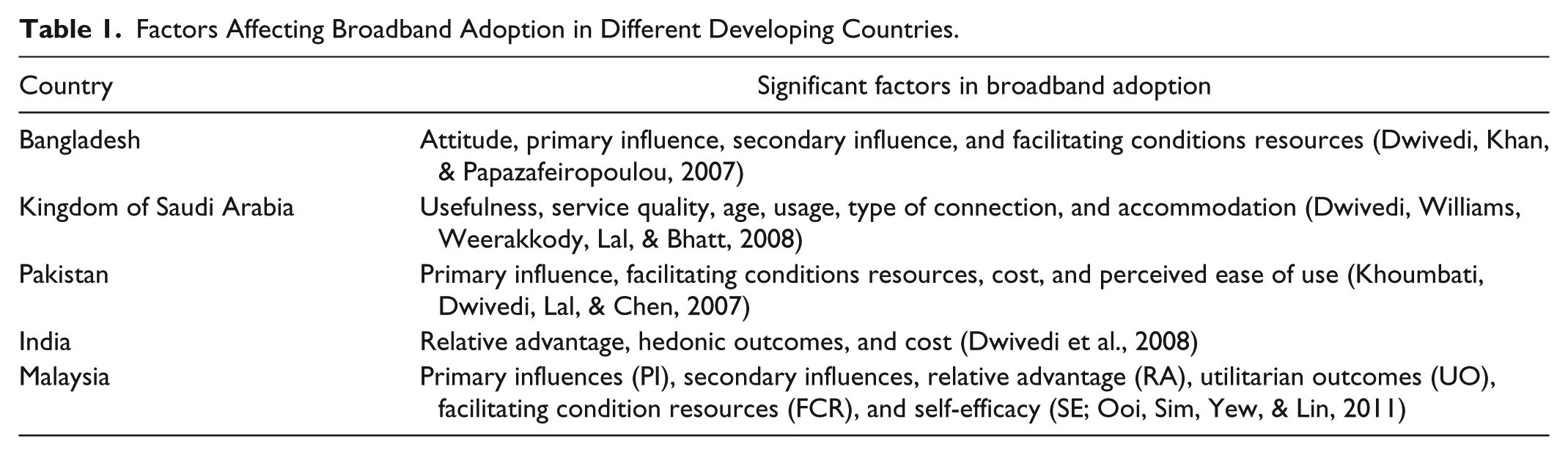
In the era of continued development of ICTs and emerging network economy, developing countries, such as India, are faced with various challenges as well as opportunities (Kapur, 2001). Inadequate broadband access may result in negative impact on Indian productivity and is likely to result in higher operational costs for a number of businesses. This not only affects the performance of existing Indian firms but also hinders the attractiveness of India as a potential investment place. Broadband is immensely important to India because it can accelerate the economic growth through ICT, which has been identified as a key factor to improve productivity performance. Considering the relatively low levels of broadband adoptions in developing countries, including India, a research in this area may be helpful in understanding and accelerating the process of broadband Internet adoption by consumers in India. It is essential to conduct an empirical study in India, given the slow rate of broadband adoption. This study extends the research conducted by Khoumbati et al. (2007) and Dwivedi et al. (2008) to gain an up-to-date and deeper comprehension of consumers’ perception and attitude toward the usefulness of broadband technology.
After witnessing the Korean broadband success and the resultant economic development (Jin, 2005), academicians, government telecom officials, and information technology experts around the world are interested in knowing how the Korean success story can be replicated by gaining an understanding of the factors that influenced such a quick embrace of broadband technology by Korea. This research would be a valuable addition to existing literature as the reasons for adoption of consumers can be understood in a more advanced level from a developing country that is situated in a strategic location neighboring China. The knowledge of such reasons would provide a good foundation for other developing countries that plan to deploy broadband services and to reap associated economic and development benefits.
Research Questions and Theoretical Model
This study addresses two research questions:
The factors to be studied in the theoretical model of this research have been derived from theoretical models of Diffusion of Innovation (DOI), Theory of Planned Behavior (TPB), and Model of Adoption of Technology in Households (MATH). Other factors might have an effect on the adoption of broadband and these factors have been taken into consideration to predict the intention to adopt broadband Internet. There are five sections of this study. The first section provides an overview of the research undertaken. The next section provides a discussion of the theoretical background and research model. This is followed by the discussion of methodology. After that, a discussion and detailed interpretation of findings will be presented. The last section provides a conclusion with implications, limitations, and suggestions for future research.
Theoretical Background and the Research Model
Theoretical Basis
This study utilizes some important theoretical models, such as TPB, DOI, and MATH, to examine broadband diffusion. According to TPB, the IT usage among individuals is driven by their BIs. These BIs comprised of Attitudes (personal belief about expected outcomes of the usage of IT), Subjective Norm (belief about personal behavior regarding IT usage with respect to other people expectations), and Perceived Behavioral Control (personal belief about degree of usage capability of IT). Many researches have used and adopted TPB to study the adoption and implementation of information technology (Aboelmaged, 2010; Ajzen, 1985, 1988, 1991; Ajzen & Madden, 1986; C. L. Anderson & Agarwal, 2010; Hernández, Jiménez, & Martín, 2010, 2011; M.-C. Lee & Tsai, 2010; Ortiz de Guinea & Markus, 2009; San Martín & Herrero, 2012; Schifter & Ajzen, 1985; Venkatesh, Thong, & Xu, 2012; Yousafzai, Foxall, & Pallister, 2010). Many studies have extended TPB to fit varying needs of researches such as the Decomposed Theory of Planned Behavior (Decomposed TPB; Cheon, Lee, Crooks, & Song, 2012; Choudrie & Dwivedi, 2006b; Hartshorne & Ajjan, 2009; Lin, 2010; Pham, Pham, & Nguyen, 2011; Püschel, Mazzon, & Hernandez, 2010; Ramayah, Rouibah, Gopi, & Rangel, 2009; Venkatesh & Brown, 2001; Yaghoubi, 2010). The MATH framework is based on three main elements, namely, attitudinal belief (consisting of utilitarian outcomes [UO], hedonic outcomes [HO], and social outcomes [SO]), normative belief (consisting of primary and secondary influences), and control belief (consisting of perceived knowledge [K], perceive ease of use [PE], and perceived cost). This framework has also been used in research considering it to be more appropriate and useful to study broadband adoption (Venkatesh & Brown, 2001). The Rogers’s DOI has been used to study the pattern of diffusion and adoption of new technology to predict the success of new technology invention. This model focuses on both the usage and subsequent usage aspect (Rogers, 1995). One element of DOI, relative advantage (RA), has been found to be easily applied and integrated with other constructs used to examine diffusion of broadband (Choudrie & Dwivedi, 2004). Against this backdrop, this research uses a modified framework that extends existing models to investigate the factors that affect the BI of consumers to adopt broadband Internet. The definitions of each variable are shown in Table 2.
Constructs Related to Broadband Internet Adoption.

It was found that constructs such as RA, UO, HO, primary influence, secondary influence, self-efficacy (SE), facilitating conditions, overall service quality (SQ), and service value and satisfaction significantly influenced BI to adopt broadband (Choudrie & Dwivedi, 2005; Dwivedi, 2005; Dwivedi et al., 2006; Dwivedi, Khan, & Papazafeiropoulou, 2007); Rogers, 1995). However, other constructs are yet to be applied to examine broadband adoption. For this study, we have divided the facilitating conditions variable into two variables, namely, facilitating conditions resources (FCR) and facilitating conditions technology (FCT). The purpose is to look separately at the impact of general facilitating conditions and facilitating conditions related to technology. This study postulates that BI to adopt broadband is influenced by several independent variables, which can be categorized into three broad groups (Choudrie & Dwivedi, 2004, 2005; Dwivedi et al., 2006; Dwivedi, Khan, et al., 2007; Dwivedi, Khoumbati, Williams, & Lal, 2007). These are as follows:
RA and UO have been found to be significant factors in determining broadband adoption (Dwivedi & Irani, 2009; Dwivedi, Khan, & Papazafeiropoulou, 2007; Venkatesh & Brown, 2001). Figure 1 shows the conceptual framework used by this research. This framework is adapted and modified from Dwivedi (2005) and Dwivedi, Choudrie, & Brinkman (2006). This framework takes broadband adoption as an independent variable that is affected by a number of independent variables that can be categorized as attitudinal, normative, and control factors. Because very few studies have examined the broadband adoption in developing countries (especially Southeast Asian countries), it was decided that all the possible and appropriate constructs (within the Indian context) from previous studies, as described in Table 2, would be included in this study.

Research model.
Hypotheses
Based on the literature review and the developed conceptual model, following hypotheses were developed for this study.
Research Method
Sampling and Data Collection
For the purpose of exploratory research, such as the current study, the survey is considered a suitable instrument for primary data collection (Choudrie & Dwivedi, 2005). A self-administered questionnaire was developed and used. Literature review provided the foundation for development of questionnaire. First, a draft questionnaire was prepared. The final questionnaire consisted of 21 questions. The Likert-type scale questions were adapted from Dwivedi (2005) and Dwivedi et al. (2006) and the demographic categories were adapted from Choudrie and Dwivedi (2006a). Each question was a statement followed by a 5-point Likert-type scale ranging from “strongly disagree” through “neither agree nor disagree” to “strongly agree.” Questionnaires were distributed both in hard copy format and via e-mails.
Profile of Respondents
Table 3 provides the breakdown of various residential consumers in our sample.
Frequency Distributions of Respondents’ Demographics.

The Sample Plan
Due to the uncertainty regarding the identity of consumers currently using the broadband facility and the nomadic nature of access, the snowballing sampling technique (Dwivedi, Khan, et al., 2007; Dwivedi, Khoumbati, et al., 2007) was used. The researcher sought help from his friends in India. Initial respondents from academia, the private sector, government, students, and the public within Mumbai city were first identified. They in turn referenced their friends and colleagues from other cities of India who utilized broadband. This progressively increased the sample size (Selamat et al., 2008; Ooi, Sim, Yew, & Lin, 2011)). This strategy led to the questionnaire being administered to 600 broadband users during the period of June to December 2013. Of the 600 questionnaires administered, 203 respondents returned completed and usable questionnaires. Thus, a response rate of 33% was achieved. This response rate is comparable with response rates in recent studies on broadband adoption (Dwivedi, Khan, et al., 2007; Dwivedi, Khoumbati, et al., 2007; Mugeni, Wanyembi, & Wafula, 2012; Ooi, Lin, et al., 2011).
Data Analysis
In the initial phase of data analysis, responses were checked and assigned a unique ID number (Fowler, 2002; Holmström, Ketokivi, & Hameri, 2009). SPSS software (Version 21) was used to calculate descriptive statistics. The same software was used for reliability testing and regression analysis of research data collected through questionnaires (Hinton, Brownlow, McMurray, & Cozens, 2004; Straub, Boudreau, & Gefen, 2004).
Reliability Test
Reliability of constructs was estimated using Cronbach’s coefficient (α; Table 4).
Reliability Values (N = 203).

Higher values of Cronbach’s alpha represent the higher internal consistency of the construct. Values of alpha greater than .9 represent very high consistency whereas values between .5 and .7 represent moderate consistency (Hinton et al., 2004). In this study, Cronbach’s alpha varied between .879 for SO and .911 for BI. The values obtained suggest that all constructs were internally consistent.
Testing of Multivariate Assumptions
Before data analysis, we checked the multivariate assumptions (such as multicollinearity; Fotopoulos & Psomas, 2009; Hair, Tatham, Anderson, & Black, 2005; V.-H. Lee, Ooi, Tan, & Chong, 2010). Table 5 shows the variance inflation factor (VIF) values of various independent variables. The values ranged from 1.120 to 1.914 and all values were less than 10 with tolerance value greater than 0.1. Thus, multicollinearity of data was not shown (Hair et al., 2005). There were no independent variables that had condition indexes above 30 coupled with 2 variance proportions greater than .50 (Tabachnick & Fidell, 2007). Hence, based on these basic assumptions of the multivariate model, it implies that there were no statistically significant violations (V.-H. Lee et al., 2010; Sit, Ooi, Lin, & Chong, 2009).
Multicollinearity Statistics.
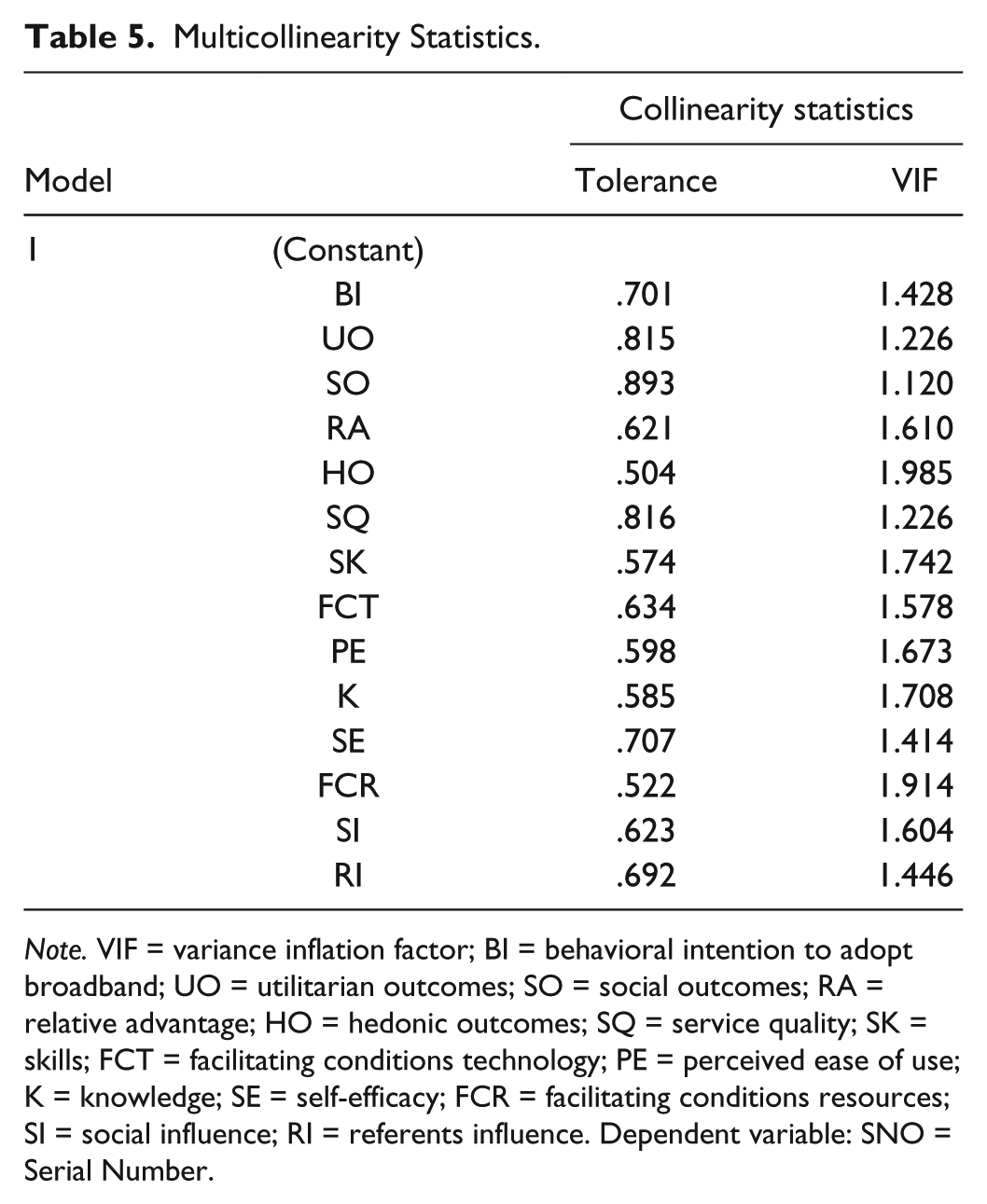
Note. VIF = variance inflation factor; BI = behavioral intention to adopt broadband; UO = utilitarian outcomes; SO = social outcomes; RA = relative advantage; HO = hedonic outcomes; SQ = service quality; SK = skills; FCT = facilitating conditions technology; PE = perceived ease of use; K = knowledge; SE = self-efficacy; FCR = facilitating conditions resources; SI = social influence; RI = referents influence. Dependent variable: SNO = Serial Number.
Descriptive Statistics
In this study, we used 14 constructs to measure the factors affecting broadband adoption in India. In this section, the means and standard deviations of the dependent variable BI and the items related to the 14 constructs are described.
Descriptive statistics for BI
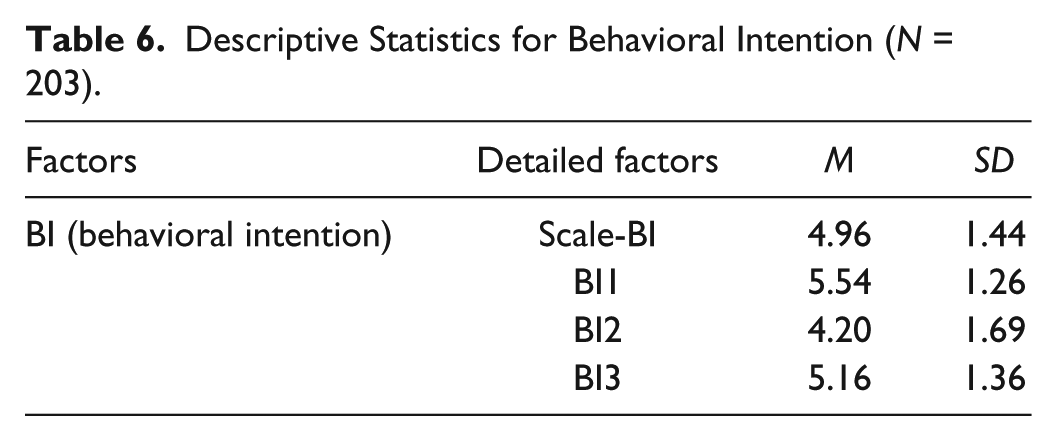
Three questions were used to measure the consumer’s BI to subscribe to broadband (Azab, 2009). Table 6 shows the mean and standard deviations of aggregate measures for the three constructs used to measure BI. Respondents showed strong agreement for all the items of the BI with average score of aggregate measure (M = 4.96, SD = 1.44). Item BI1 scored the maximum (M = 5.54, SD = 1.26) and Item BI2 scored the minimum (M = 4.20, SD = 1.69).
Descriptive Statistics for Behavioral Intention (N = 203).
Descriptive statistics for attitudinal factors
Table 7 shows the mean and standard deviations of aggregate measures for the five constructs used to measure attitudinal factors. Respondents showed strong agreement for all the constructs as evident from their mean and standard deviation values. RA showed the strongest agreement (M = 5.78, SD = 1.24) whereas SQ showed the least agreement (M = 5.29, SD = 1.47).
Descriptive Statistics for Attitudinal Constructs (N = 203).

Descriptive statistics for control factors
Table 8 shows the mean and standard deviations of aggregate measures for the eight constructs used to measure control factors. Respondents showed strong agreement for all the constructs as evident from their mean and standard deviation values. FCT showed the strongest agreement (M = 6.22, SD = 1.05) whereas FCR showed the least agreement (M = 5.37, SD = 1.61).
Descriptive Statistics for Control Constructs (N = 203).

Descriptive statistics for normative factors
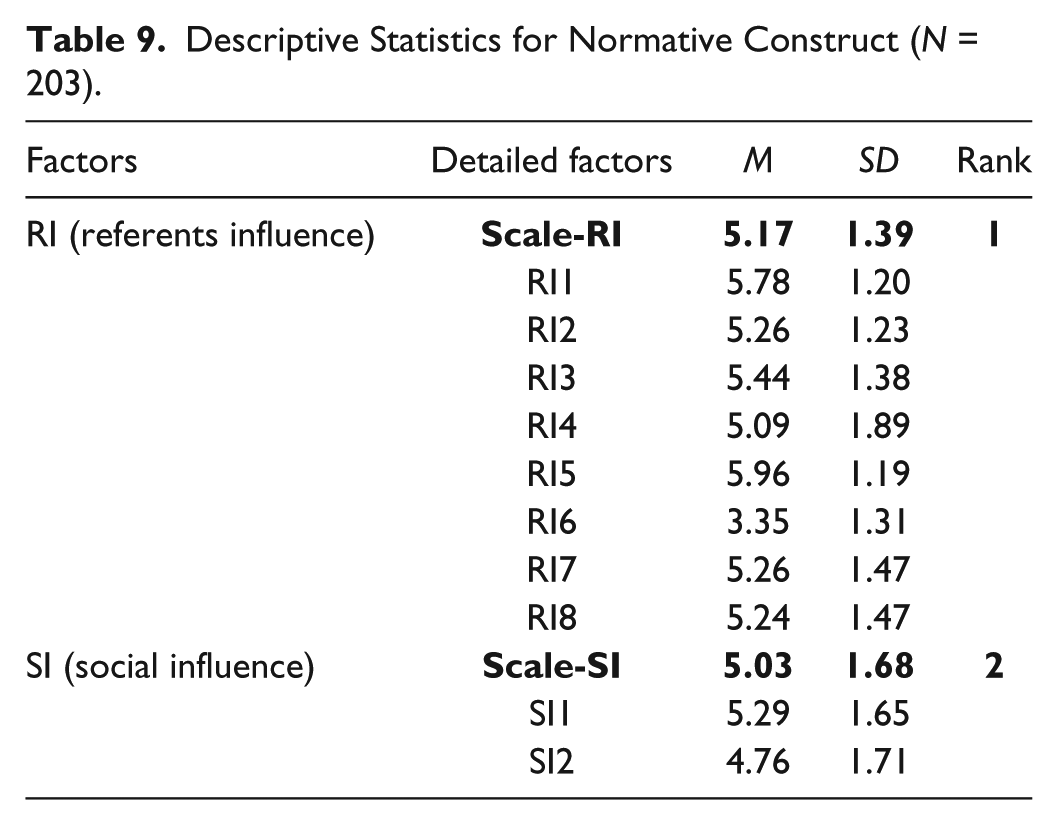
Table 9 shows the mean and standard deviations of aggregate measures for the two constructs used to measure normative factors. Respondents showed strong agreement for all the constructs as evident from their mean and standard deviation values. RI showed the strongest agreement (M = 5.17, SD = 1.39) whereas SI showed the least agreement (M = 5.03, SD = 1.1.68).
Descriptive Statistics for Normative Construct (N = 203).
Regression Analysis: Influence of Independent Variables on Broadband Intention
The study used ordinary least square regression analysis. BI was taken as dependent variable and 14 constructs as predictor variables. The adjusted R2 was .555 (F = 20.387, p < .001; see Tables 10 and 11).
Model Summary.

Note. Dependent variable: BI. UO = utilitarian outcomes; SO = social outcomes; RA = relative advantage; HO = hedonic outcomes; SQ = service quality; SK = skills; FCT = facilitating conditions technology; PE = perceived ease of use; K = knowledge; SE = self-efficacy; FCR = facilitating conditions resources; SI = social influence; RI = referents influence; BI = behavioral intention to adopt broadband.
Predictors: (Constant), SE, FCR, HO, UO, SQ, PE, SI, RI, RA, FCT, K, SO, SK.
ANOVA.

Note. Dependent variable: BI. UO = utilitarian outcomes; SO = social outcomes; RA = relative advantage; HO = hedonic outcomes; SQ = service quality; SK = skills; FCT = facilitating conditions technology; PE = perceived ease of use; K = knowledge; SE = self-efficacy; FCR = facilitating conditions resources; SI = social influence; RI = referents influence; BI = behavioral intention to adopt broadband.
Predictors: (Constant), SE, FCR, HO, UO, SQ, PE, SI, RI, RA, FCT, K, SO, SK.
The conceptual model of broadband Internet adoption presented in this study performed well as compared with previous studies on broadband Internet adoption. The adjusted R2 for previous behavioral models was .32 (Davis, Bagozzi, & Warshaw, 1989)), .51 (Davis, 1989), and .435 (Dwivedi, 2005). The adjusted R2 for the model presented in this study was found to be .555. It shows that the model presented in this study was able to explain an appropriate and comparable level of variance in BI. That means that predictor variables considered in the model of this study are significant in understanding the consumers’ BI to adopt broadband.
In this validated model, six predictor variables were found significant for explaining the variation in BI (Table 12). These predictor variables include HO (β = .249, p < .001), SQ (β = −.506, p < 0.001), FCR (β = .333, p < .001), SO (β = −.570, p < .001), PE (β = .922, p < .001), and SE (β = .433, p < .001). The regression equation for the validated model was found to be as follows:

Regression Analysis: Coefficients (Dependent Variable: Behavioral Intention).

Note. UO = utilitarian outcomes; SO = social outcomes; RA = relative advantage; HO = hedonic outcomes; SQ = service quality; SK = skills; FCT = facilitating conditions technology; PE = perceived ease of use; K = knowledge; SE = self-efficacy; FCR = facilitating conditions resources; SI = social influence; RI = referents influence.
The value of β suggests that the PE had the largest impact in the explanation of variations of consumer BI to adopt broadband, followed by SO, SQ, SE, FCR, and HO. RA, The variables UO, RI, SI, K, SK, and FCT did not significantly affect the BI.
Discussion
The aim of this study is to examine the significant factors that influence the consumer attitude toward broadband adoption and usage in India. India is progressing fast in IT infrastructure development and broadband adoption rate. In comparison with a study on Bangladesh (Dwivedi, Khan, & Papazafeiropoulou, 2007), a previous study on India (Dwivedi et al., 2008), the KSA (Dwivedi & Weerakkody, 2007), Pakistan (Khoumbati et al., 2007), and Malaysia (Ooi, Sim, et al., 2011). Our results show that four constructs—PE FCR, SE, FCT, and HO—have similar results with the previous studies. Meanwhile, the findings on SO, SQ, RI, SI, RA, K, and FCR were found to be contradicted as compared with the same studies. Following is the explanation of the comparison of the differences between our findings and previous studies in other developing countries.
The RI and SI were found to have no significant effect on consumers’ intention in adopting broadband. This implies that the influences perceived from social groups (such as family and peers) and secondary sources (news, newspaper, or magazines) have no significant effect on consumers’ intention in adopting broadband. This is a significant contrast compared with previous studies. The broadband usage in India is increasing although not at the pace comparable with its neighbor China. With this, the influence from reference groups should be a trusted information source for consumers deciding to adopt and use broadband. However, the results indicate a deficit of consumer trust on information provided by the reference groups. Therefore, the strategy of emphasizing on primary influence as a driver to increase broadband adoption in early stages may require rethinking.
For FCR, our results showed significant effect toward intention to adopt broadband. This may imply that the strategy to increase broadband adoption rate by providing facilitating conditions and supporting facilities (Rogers, 1995) seems to have significant impact. This is in agreement with previous studies of Pakistan (Khoumbati et al., 2007) and Bangladesh (Dwivedi, Khan, et al., 2007). The results suggest that facilitating factors (such as technical and support facilities) are important to facilitate and boost up the broadband uptake in nations. This finding has significant implication for ISPs in India investing significantly on enhancing their technical and support facilities.
For FCT, our results showed no significant effect toward intention to adopt broadband. Considering the various factors used to analyze facilitating conditions of technology (availability of electricity, reliability of broadband connection, availability of diverse access technologies, and choice of different service providers), we can explain this finding by looking at the current highly competitive landscape of broadband services in India. With the emergence of many service providers providing various broadband access technologies and low switching costs, consumers have liberty to switch service providers quickly.
From our findings, HO was found to be least significant in influencing broadband adoption, while UO was found to be not significant. It appears that consumers’ adoption of broadband is not affected by either hedonic reasons or utilitarian reasons. This finding has significant implication for service providers who invest millions of dollars in broadband services to satisfy the consumers’ emotional needs and pleasurable experiences. This finding is in contrast to experiences of developed nations, such as South Koreas and the United Kingdom, that successfully promoted and increased broadband adoption in the country by utilizing online games, real-time sport events, and on-demand video or music to attract consumers to subscribe to broadband (H. Lee, O’Keefe, & Yun, 2003). The authorities or industry players in developing nations may need to revisit this strategy of providing entertainment-based products in their particular national context to find out what application or content consumers prefer to subscribe to broadband.
From our results, SO exhibits significant relationships on intention to use broadband services. No previous study included this construct in their research model. The finding suggests consumers believe that use of broadband services enhance their social status. Combining this finding with the finding on RI and SI, we could explain by saying that consumers probably do not trust the information provided by reference groups but believe that use of broadband Internet is an aid to enhance their social status. This suggests that broadband Internet has a strong social connection with respect to consumer preferences. This has significant implication for broadband service providers. Service providers may need to strengthen the brand image of their broadband services.
The non-significant relationship between RA and consumers’ intention to adopt broadband is a significant shift because previous literature has consistently showed strong positive influence of RA on broadband adoption (Dwivedi, Khan, & Papazafeiropoulou, 2007; Holak & Lehmann, 1990; Tornatzky & Klein, 1982). Broadband service providers in developing countries have been focusing on providing their customers various advantages as compared with traditional dial-up connection (such as faster downloads, instant communication, always-on connectivity). The finding of this research suggests that perception of broadband is becoming less important as an aid to speed up the overall broadband adoption process. Service providers should not put too much emphasis on emphasizing broadband benefits to increase broadband adoption by consumers.
A significant positive relationship of SE with BIs was expected as mentioned by previous literature (Dwivedi et al., 2006; LaRose, Gregg, Strover, Straubhaar, & Carpenter, 2007). With higher level of confidence in technology, consumers are more likely to adopt broadband. The industry stakeholders may have to adopt a segmental approach to identify and provide relevant education and training to various segments of population that do not have access to opportunities to learn computers and Internet.
SK was found to have no significant relationship with BIs. It appears that most consumers already possess the requisite knowledge and skills to adopt broadband services. Currently, the government of India is following a push strategy by providing more facilitating infrastructure, such as skill-oriented courses, to motivate consumers learn and use new technologies such as broadband Internet. The research findings suggest that governments and industry players may need to revisit this strategy to make it meaningful for consumers and to increase broadband adoption.
From our results, knowledge (K) did not exhibit significant relationships on intention to use broadband services. It is in contrast with previous studies (Choudrie & Lee, 2004; Dwivedi, Khoumbati, Williams, & Lal, 2007)) that showed a significant relation of knowledge (K) with BI. PE exhibited significant relationship on intention to use broadband services. It was expected as suggested by previous literature (Dwivedi, Khan, & Papazafeiropoulou, 2007).
For knowledge (K), the consumers appear familiar in using computer and Internet technologies. The government of India has taken many initiatives to boost computer learning. This finding suggests that the computer learning initiatives need to be further emphasized by educational institutions (such as schools and universities) by offering different varieties of computer learning programs that best suit consumer needs. For PE, it could be explained that Indian consumers may lack the knowledge and skill to use Internet technologies. If we combine it with the finding on knowledge (K), a further explanation could be that even if the consumers feel that they have the requisite knowledge to use Internet technologies, they tend to have less desire in adopting new technologies and this may prove to be a barrier in using the particular services. Interestingly, this finding is in contrast with B. Anderson’s (2008) study of European broadband consumers. B. Anderson found that those users who had the knowledge and experience of using broadband were most benefited with broadband Internet, whereas those who lack the skills, knowledge, and perhaps self-confidence were left further behind. Therefore, successful broadband adoption requires further motivation of consumers about broadband usage and benefits to develop their positive attitudes toward broadband adoption and use.
From our results, SQ exhibits significant relationships on intention to use broadband services. This is in line with the previous study of the KSA (Dwivedi & Weerakkody, 2007). One reason could be that in the KSA, only one service provider provides broadband services and consumers have no liberty of switching in case of dissatisfaction with the service. In India, many broadband service providers are offering different packages to different consumer segments. The switching costs are low and consumers switch quickly if they are not satisfied with a service provider. In the past 5 years, many service providers, especially in the wireless Internet services, have emerged and created challenges to improve competitiveness among service providers by providing better quality of broadband services. To develop knowledge-based societies in developing countries, it is imperative to improve quality of broadband services.
Conclusion and Implications
Practical Implications
This study contributes in several ways to the research literature. At a methodological level, this study proposes and tests a new model for broadband adoption in a developing country perspective. Furthermore, it contributes to the ongoing search for policies that are more effective and strategies to increase broadband penetration by providing a more detailed examination of factors that possibly influence broadband adoption by household consumers. In line with other recent studies, we find that broadband penetration is positively influenced by broadband SQ, knowledge (K), and RA. In addition, this study identified a new construct SO, which is positively related with broadband adoption by household consumers.
The findings of this study generate a number of issues that may be helpful for various stakeholders in Indian broadband services, namely, service providers, policy makers, regulators, academia, general public, and so on, for informed decision making and developing a strategy for accelerated broadband diffusion in India. This informed decision making is important due to the established positive impact of increased broadband deployment on economic development of a country (Bauer, Madden, & Morey, 2014; Ng, Lye, & Lim, 2013).
The gradual adoption of broadband by the consumers in developing countries is a concern for both the industry and government due to the strong positive impact of broadband deployment on national economic development. Therefore, this research should offer a substantial contribution to all interested stakeholders including the ISPs and government. Practitioners could use the findings of this study when revising and restructuring their marketing strategy. Academicians could use the findings of this research to enhance their knowledge of broadband adoption in a developing but fast emerging economy. Such knowledge can provide a basis for further research in broadband adoption in other emerging economies.
This study provides useful guidelines for both ISPs and policy makers to understand factors that can influence consumers’ intention to adopt broadband technology. Service providers and policy makers can use this study to get useful guidelines and improve their strategies of increasing broadband Internet adoption rate. This research identifies many factors that stakeholders need to focus on to attract more broadband consumers.
The findings of this research suggest that RI and SI have no significant relationship with BI. RI has more significance than SI. Taking this into account, service providers need to rethink their customer communication strategy to make it more effective by creating a more effective impression toward consumers. This is essential so that customers are attracted to spread positive word of mouth in their social circles and attract more consumers toward broadband.
The significant influence of self-efficacy on the broadband adoption among Indian consumers suggests that service providers should invest in developing responsive and available technical support (such as in the form of user manuals, live streaming on the company website) to attract consumers who are likely to learn and are confident in exploring the broadband services.
With less significance attached to the RA, service providers need to think about some innovative RAs that broadband can provide, for example, developing content that is specifically available with broadband services. The more innovative benefits customers receive, the more likely they will subscribe or use the broadband service.
The significance of SO suggests that service providers need to think about ways to make their service a tool of social status enhancement, for example, by branding their service. It is similar to what happened with the cellular phone in developing countries. Initially, it was a communication device. Later on with proliferation of cellular phone devices, the prices fell and everyone had access to a cellular phone. The consumers started to make cellular phone a social status symbol, for example, by buying expensive branded cellular phones.
The least significance attached to HO has a significant learning for service providers. They need to look into HO from the consumers’ perspective and provide those applications to the consumers that could drive their adoption of broadband. Enhancement and upgradation of broadband service may improve consumer experience with broadband services. Finally, the high significance attached to the FCR suggests the need for service providers to invest more on providing customer-centric services.
Theoretical Contributions
This research, with its advanced and progressive standpoint, differs from previous research on broadband adoption. This research is similar to the work done by Venkatesh and Brown (2001). However, it differs in that it found subjective norm a non-significant determinant of broadband adoption. Tan and Teo (2000) and Anckar (2003) found attitudinal and control factors essential for technology adoption. Both studies found that attitudinal and control factors were highly significant predictors of technology adoption or non-adoption. On similar lines, this research found that subjective norm was a non-significant predictor of broadband adoption by Indian households. Anchor also suggested the differences between the critical barriers for e-commerce adoption and adoption of computers in U.S. households (Venkatesh & Brown, 2001).
By examining the relationships between BI to adopt broadband and the 14 constructs, this research provides an extended model based on three previous models. The model used in this research provides a greater understanding of consumers’ adoption of broadband in a developing country context. India is a fast growing Southeast Asian nation where consumers still value their traditions despite becoming urban and technology savvy.
Limitation and Future Studies
Every research has its limitations and this research is no exception. First, this study used a larger snowball sample size but it does not ensure the homogeneity of target respondents. Therefore, the results obtained may not be generalized for the population of India as a whole. Future research on broadband adoption may emphasize considering a cross-country or cross-cultural survey. Second, the study was conducted in four major cities of India. The findings may not be applicable across geographies and cultures. However, considering the embryonic stage of development of broadband in India, the selected cities still represent a good sample to investigate broadband adoption in India. Third, the study did not supplement the survey-based approach with interviews to have longitudinal data. Future research can use a longitudinal data collection mechanism to generate better statistical results. Fourth, this study did not take into account the correlation of factors and effect on others. Future research may consider including some moderating constructs to examine the inter-relationships among various factors affecting BI.
This research identified five factors—PE, SO, SQ, FCR, and SE—that influence consumers’ adoption of broadband in India. Therefore, the first research question has been verified. From the analysis done, it has been proven that PE has the most significant impact on BI to adopt broadband. Therefore, the second research question has been verified.
In summary, this research provides stakeholders of the broadband industry some very useful guidelines that would be helpful when industries plan to expand and provide high-quality beneficial broadband services to the consumers.
Footnotes
Declaration of Conflicting Interests
The author(s) declared no potential conflicts of interest with respect to the research, authorship, and/or publication of this article.
Funding
The author(s) received no financial support for the research and/or authorship of this article.