




Abstract
This study investigated perceptions of achieved criteria for adulthood (ACA) among emerging adult student samples from Austria (n = 210), Slovenia (n = 201), and the United States (n = 225). Controlling for parental education, students’ age (18-27 years), and gender, we aimed to explain between- and within-sample differences in the ACA by taking the students’ living situation, intimate relationship status, and expectations about their future perspectives into account. The participants indicated the ACA on the questionnaire based on criteria for reaching adulthood used in studies of adulthood conceptions. The students also provided information about when they think they will start the first full-time career, get married, gain financial independence, and become a parent. The Europeans indicated less ACA than the Americans; 20% of the variance in the ACA was, along with the country effect, explained by the intimate relationship status and future perspectives.
Keywords
The age period from late teens through the 20s has become widely recognized as emerging adulthood (Arnett, 2000; Buhl & Lanz, 2007). Emerging adulthood is distinguished from adolescence and young adulthood in terms of demography, that is, a great deal of change and diversity in living situation, education/work-related issues, and partnership arrangements; a sense of ambiguity in the perceived developmental status; optimistic views on one’s own future possibilities; and prolonged identity exploration (Arnett, 2000, 2006). The period appears in societies that postpone an individual’s entry into adult roles and responsibilities, particularly in postindustrial societies that emphasize the role of education, professional training, individual choice, and personal independence (Arnett, 1998, 2000). Along with rapid economic and social changes in those societies, traditional views on adulthood stressing adult role transitions seem to have been replaced in their importance by more individualistic conceptions (Arnett, 2001).
Conceptions of the Transition Into Adulthood
Research examining individuals’ conceptions of the transition into adulthood was initially conducted in the United States (Arnett, 1998, 2001, 2003). To investigate how adulthood is viewed, Arnett constructed a list of criteria for adulthood drawn from sociological, anthropological, and psychological perspectives. The items were theoretically organized into the categories of Independence, Family Capacities, Norm Compliance, Interdependence, Role Transitions, Biological Transitions, and Legal/Chronological Transitions (Arnett, 2001, 2003). The list (hereinafter called Arnett list) has been widely used in North American studies (e.g., Arnett, 2001, 2003; Cheah & Nelson, 2004; Cheah, Trinder, & Gokavi, 2010) and a growing body of research using the instrument has been performed in a variety of European countries (e.g., Macek, Bejček, & Vaničkovà, 2007; Nelson, 2009; Puklek Levpušček & Zupančič, 2010; Sirsch, Dreher, Mayr, & Willinger, 2009), Argentina (Facio & Micocci, 2003), Israel (Mayseless & Scharf, 2003), China (Badger, Nelson, & McNamara Barry, 2006), and India (Seiter & Nelson, 2011).
The findings obtained by the Arnett list across Western type societies (Arnett, 2001; Cheah et al., 2010; Macek et al., 2007; Nelson, 2009; Puklek Levpušček & Zupančič, 2010; Sirsch et al., 2009; Townshend, Gallaway, Friedlmeier, Puklek Levpušček, & Sirsch, 2009) suggest that taking responsibility for one’s own actions, making decisions, establishing a relationship with parents as an equal adult, and financial independence—all aspects of personal independence—are viewed to be the most important criteria for adulthood from perspectives of adolescents, emerging adults, and adults through midlife. The importance of family capacities (e.g., capability to support the family), norm compliance (e.g., driving safely), and interdependence (e.g., making lifelong commitments to others) are also widely stressed, whereas legal/chronological (e.g., age 18) and biological transitions (e.g., capability of bearing children) rank relatively low. Although this research suggests that little importance is attributed to role transitions (e.g., parenthood), an actual entry into family-related adult roles (Arnett, 2001; Marčec, 2012), intimate relationships (Reitzle, 2007; Zupančič, Komidar, & Puklek Levpušček, 2014), and work-related transitions (Zupančič et al., 2014) has been shown to enhance emerging adults’ perceived adult status.
Perceived Adult Status and Achieved Criteria for Adulthood (ACA)
The present study investigated how emerging adults perceive their adult status in a cross-national perspective. The perceived adult status has been predominantly studied by simply asking individuals whether they have reached adulthood. A majority of emerging adults have not responded affirmatively but rather viewed themselves in a transition toward adulthood (e.g., Arnett, 2001, 2003; Badger et al., 2006; Puklek Levpušček & Zupančič, 2010; Sirsch et al., 2009). Accordingly, 78% of the Austrian and 86% of both the Slovene and the American emerging adult students perceived themselves in-between an adolescent and an adult (Sirsch & Bruckner, 2009). However, Kins and Beyers (2010) suggested that the perceived adult status is a multidimensional construct, which cannot be fully captured by looking for an answer to a general question. They proposed each of the dimensions to be tapped separately by using criteria about the conception of adulthood from the Arnett list, which refer to distinct conceptual categories such as Independence (e.g., not deeply tied to parents emotionally), Interdependence (e.g., committed to long-term love relationships), and Family Capacities (e.g., capable of caring for children). In line with recent research (Kins & Beyers, 2010; Zupančič et al., 2014), we quantified the concept of the perceived adult status by using several criteria from the Arnett list in a modified response format, that is, asking individuals whether they think that they have fulfilled each of the criteria to gain better and more specific insights into young peoples’ perceptions of their own adult status.
Using a modified version of the criteria list, Kins and Beyers (2010) demonstrated that emerging adults’ perceptions of the achieved criteria for adulthood (ACA) are important as individuals’ success in the ACA is associated with their subjective well-being. Moreover, an increase in the ACA, particularly those criteria that refer to independence and interdependence, contributed to a positive change in emerging adults’ well-being over time. Literature in related fields further suggests that emerging adults show an increase of well-being with growing psychosocial maturity (Galambos, Barker, & Krahn, 2006) and after having successfully accomplished developmental tasks concerning autonomy, education, work, and intimate relationships (Schulenberg, Bryant, & O’Malley, 2004; Zupančič et al., 2014).
Only a few studies investigated the ACA (Kins & Beyers, 2010; Nelson, 2009; Puklek Levpušček & Zupančič, 2010; Zupančič et al., 2014) but none of them directly evaluated data across national samples, which would provide a broader insight into similarities and differences of the emerging adults’ perceived adult status. We compared perceptions of the ACA among university students in two European countries (Austria and Slovenia) and the United States (Michigan). We aimed to include two different European countries (both EU members) with same historical roots (differing from the United States) but different socio-economic system in the recent past. Slovenia as a part of former Yugoslavia underwent 45 years of so-called soft version of socialism after the Second World War, which was notably different than in Eastern European countries and thus, provided the people much more freedom and ties with the Western world. All three countries differ in the social-welfare regime, which may affect the young peoples’ pathways to adulthood (Douglass, 2007). Austria can be characterized as a conservative regime, Slovenia closely resembles the Southern European regime, and the United States may be placed within a liberal welfare regime. More importantly, these modern societies were selected as emerging adulthood is a general phenomenon of societies characterized by prolonged education, financial dependence, delay in leaving parental home, marriage, parenthood, and career start. We already know that emerging adults in these three countries share similar conceptions of adulthood (Townshend et al., 2009). At the same time, these three modern societies (Austria, Slovenia, and the United States) differ in average age of attaining these adult transitions, which may also create dissimilar pressures as to when and how individuals perceive themselves as adults. As suggested previously, the adult transitions appear to shape emerging adults’ perceptions of being an adult (Arnett, 2001; Marčec, 2012; Reitzle, 2007; Zupančič et al., 2014) in spite of the fact that the individuals place little importance on these transitions in their conceptualizations of adulthood.
Based on these former findings, we focused on features that may explain the individuals’ perceptions of the ACA within—as well as between—the national samples. Given that our population of interest was university students, we included their subjectively expected age of adult transitions (full-time career, financial independence, marriage, and parenthood) instead of actual transitions. In addition, the students’ living situation and intimate relationship status were accounted for as further explaining factors of the ACA.
Explanatory Factors of Student Perceptions of the ACA
Moving out of the parental home and involvement in an intimate relationship are considered important adult transitions, which positively affect developmental processes necessary for an individual to reach full adult status (e.g., Buhl, 2008; Larose & Boivin, 1998). Similarly, young people who anticipate fulfillment of personal plans about adult transitions earlier report higher levels of psychosocial maturity (Carroll et al., 2007; Kalakoski & Nurmi, 1998).
Living Situation
Residing out of the family home may enhance individuals’ attainment of several criteria for adulthood, in particular those related to personal independence, that is, taking over responsibilities of everyday life, relying on one’s own judgments, gaining financial independence, and restructuring relationships with parents in terms of relations among equals (Arnett, 2007; Kins & Beyers, 2010). In contrast, residing with parents has been suggested to inhibit individuals’ independence, well-being (White, 2002), achievement of psychosocial maturity, emotional autonomy, and self-reliant functioning (Beyers & Goossens, 2003; Beyers & Seiffge-Krenke, 2007; Zupančič et al., 2014). Recent studies also demonstrate that emerging adults living independently succeed better in achieving a number of adult criteria than those residing with parents (Kins & Beyers, 2010; Marčec, 2012; Puklek Levpušček & Zupančič, 2010).
We expected that the students living out of their parents’ home would report more ACA than those residing in the family home and that the students’ living situation would contribute to both within- and cross-sample variability in the ACA as the age of moving out varies among the countries of our inquiry. Austrian males/females leave the parental home at median ages of 27/25 years, Slovenes at 32/30 years (Eurostat Press Office, 2009), and Americans at around 26/24 years (U.S. Census Bureau, 2011).
Intimate Relationship Status
Along with a change in intimate relationships from companionships and friendships into attachment (Furman & Wehner, 1994), long-term partnerships, more characteristic for emerging adults than adolescents, lead to changes in connectedness with parents and to an increase in individuality (Buhl, 2008; Larose & Boivin, 1998; Masche, 2008). All these changes may contribute to emerging adults’ perceptions of the ACA, especially due to attainments in the independence (e.g., not being deeply tied to parents emotionally, establishing a relationship with parents as an equal adult), interdependence (long-term love commitment), and norm compliance domains (e.g., using contraception, having one steady partner only).
Research further suggests that emerging adults who were involved in an intimate relationship endorsed a greater number of ACA as compared with their single peers (Kins & Beyers, 2010; Marčec, 2012; Zupančič et al., 2014). Despite a postponement of partnership commitments and parenthood in favor of a single lifestyle, intimate relationships and parenthood continue to play an important role in young people’s perceptions of their developmental status (Arnett, 2003; Kins & Beyers, 2010; Molgat, 2007; Reitzle, 2007). We therefore expected that students who are involved in a longer lasting intimate relationship would endorse more ACA than their single counterparts or those with shorter lasting partnerships; it was also assumed that potential differences in the relationship status across our samples would contribute to cross-national variation in the ACA.
Future Plans
In explaining the ACA, we also focused on students’ anticipated timing of reaching occupational and family-related goals. Adolescents and emerging adults mainly focus on productive (education, career) and reproductive future goals (marriage, parenthood; Nurmi, 1991; Salmela-Aro, 2001), as they have relatively detailed conceptions of personal timing of achieving those goals and anticipate their lives as a sequence of finishing their education, starting a career, marriage, and parenthood (Crockett & Bingham, 2000; Nurmi, 2004).
Future-oriented motivation and behavior are channeled by socio-cultural factors and institutional structures (e.g., social expectations, demands, and opportunities), which create an opportunity space for individuals’ development. In addition, the individuals actively select their environments and construct future goals accordingly (Nurmi, 2004). It is therefore not surprising that the anticipated timing of adult transitions appears consistent with statistics of the median ages at which individuals experience the respective transitions (Crockett & Bingham, 2000; Malmberg, 1996) and that these anticipations predict individuals’ behavior before the transitions (Carroll et al., 2007; Crockett & Bingham, 2000; Nurmi, 2004). Young people who are closer to an expected adult transition report higher levels of exploration, commitment, or mature behavior in the respective domain (Carroll et al., 2007; Kalakoski & Nurmi, 1998). We thus proposed that the students’ expectations of earlier personal transitions (the first full-time job, financial independence, marriage, and parenthood) would contribute to endorsement of more ACA.
Consistent with cross-national differences in the population data available for marriage and parenthood, earlier mean ages of anticipated personal transitions were expected in the United States (i.e., the state of Michigan) than in Austria and Slovenia, which may also contribute to the variation in the ACA among the samples. The median ages of first marriages for men/women are 27/25 years for Michigan (Michigan Department of Community Health, 2010), 32.2/29.8 years for Austria (Statistik Austria, 2014b), and 31.5/29.2 years for Slovenia (Statistical Yearbook, 2013a). Related to marrying younger, U.S. women also gave birth at a younger age (25 years in Michigan; Mathews & Hamilton, 2009), compared with Austria (28.8 years; Statistik Austria, 2014a) and Slovenia (28.9 years; Statistical Yearbook, 2013b).
Potential Confounding Factors
As individuals gradually make their way to adulthood (Arnett, 2000, 2001), age effects can be expected for important transitions in emerging adulthood (moving out of home, establishing an intimate relationship), the anticipated adult transitions (e.g., financial independence, getting married), and the overall ACA. The study variables may be further confounded with the participants’ gender. Females move out of their parents’ home at a younger age (Eurostat Press Office, 2009) and marry and have the first child earlier than males (Michigan Department of Community Health, 2010; Statistical Yearbook, 2013; Statistik Austria, 2014a, 2014b), which could contribute to women’s earlier involvement in a long-term intimate relationship and feeling closer to adult transitions as compared with men. The mean age of adult transitions also varies by social class: A higher socio-economic class is associated with older ages of the transitions (Arnett, 2003; Crockett & Bingham, 2000; Šircelj, 2006).
Study Goals
The goals of this study were to explore cross-national differences in the student-perceived ACA and to explain between- as well as within-country differences by variation in students’ living situation, intimate relationship status, and anticipated age of adult transitions. Controlling for age, gender, and family background, two hypotheses were tested: (a) The U.S. students would endorse more ACA than their European counterparts; (b) the three study variables would explain both within- and between-country differences, that is, living out of parents’ home, involvement in an intimate relationship (including its length), and earlier expectations of achieving future plans (full-time job, financial independence, marriage, and parenthood) would contribute to perceptions of having achieved more criteria for adulthood. We also explored whether any of the explanatory variables shows a country-specific relation to the perceived ACA. Due to a lack of background evidence, we refrained from formulating hypotheses about possible moderating effects of country on the associations between the study variables and the ACA.
Method
Participants
Students at the State University of Vienna, Austria (n = 210); the State University of Ljubljana, Slovenia (n = 201); and Grand Valley State University in Michigan, the United States (n = 225) participated in this study, which is a part of a broader project on emerging adulthood in the three countries. A vast majority of the Europeans took courses in social science or humanities (Austria: 94.3%; Slovenia: 88.1%). The U.S. students were mostly split between the social sciences (42.8%) and the health sciences (33.3%). The Europeans were predominantly of Austrian (85%) and Slovene ethnicity (95%); 84% of the Americans were Caucasian; 7% African; 5% Asian; and 4% were Hispanic/Latino, Native American, or multiethnic.
The students’ mean age was 21.04 years, ranging from 18 to 27 years. There were significant age differences among the samples, F(2, 632) = 65.30, p < .001: Americans were significantly younger (M = 20.07, SD = 1.48) than the Slovenes (M = 21.40, SD = 1.38) and the Austrians (M = 21.72, SD = 1.89). Females predominated across the samples although the distribution by gender differed among countries, χ2(2) = 18.69, p < .001: The Austrian, Slovene and U.S. samples included 87.1%, 69.7%, and 78.7% females, respectively. Parents’ education was used as a proxy for family background by calculating the mean of both parents’ level of education (1—secondary/vocational, 2—secondary/academic, 3—incomplete college education, 4—complete college education, and 5—postgraduate degree). The education level differed across the samples, F(2, 631) = 53.22, p < .001: U.S. parents had a significantly higher level of education (M = 3.22, SD = 1.11) than the Slovene parents (M = 2.49, SD = 1.15) and both had significantly higher levels of education than the Austrian parents (M = 2.11, SD = 1.18).
Procedure
The students were approached in their classes or invited to a group test by research assistants who provided information of the purpose of the study, the participants’ rights, confidentiality of the research, and the procedure for completing the questionnaires. The completion of the paper-and-pencil questionnaires was anonymous and took approximately 45 min.
Instruments
Three questionnaires were relevant for this study. They were translated from English to German and Slovene and then back translated. Along with the questions about age, gender, study major, ethnicity, and parents’ education, the Background Information asked for students’ living situation (in or out of parents’ home), current intimate relationship status (single vs. in a relationship), and length of intimate relationship (1—in a relationship less than a year, 2—between 1 and 2 years, 3—more than 3 years). We created intimate relationship status by combining the two latter variables: “0” means “no relationship” and represents the zero point of the variable. This quantitative variable contains all participants and we assumed that the length of relationship is important because attachment, intimacy, trust, and eventually commitment develop over time. Furthermore, the qualitative variable “single vs. in a relationship” neither explained any substantial variance of perceived ACA (p = .28) nor in interaction with culture (p = .08).
A reduced number of items from the Conception of the Transition to Adulthood (CTA; Arnett, 2003) were applied in a modified response version labeled the Achieved Criteria for Adulthood (ACA). Instead of asking the respondents about the importance of criteria proposed for reaching adulthood (the CTA), the ACA asked the students to indicate whether they believe they have already reached each of the criteria in a yes/no response format. The 20 ACA items included criteria from the Independence (e.g., accept responsibility for the consequences of your actions), Interdependence (e.g., learn always to have good control over your emotions), Family Capacities (e.g., capable of running a household), and Norm Compliance (e.g., avoid drunk driving) categories of the CTA. Due to the respondents’ age, student status, the focus on the perceived ACA, and possible overlap with the control/explanatory variables, the CTA items belonging to the Biological, Legal/Chronological, and Role Transitions categories were omitted entirely. Three other CTA items were also ignored, namely, those concerning completed education, career settlement, and the item “No longer living in parents’ household” as the latter overlaps with one of the explanatory variables. However, some items that may appear at first glance to overlap with the explanatory variables (e.g., “Committed to a long-term love relationship” and “Capable of running a household”) were retained because they reflect subjective judgments. For example, one may be engaged in a relationship without being committed or live out of the parental home without feeling capable of managing his or her household properly.
The overall ACA score was defined as the percentage of “yes” answers to the items and separate item scores were computed in the same way (Table 1). The internal coherence of the 20-item overall ACA scores was relatively low (possibly due to the restricted dichotomous response format) but still acceptable, with Cronbach’s αs of .67 in Slovenia, and .56 in both Austria and the United States. In line with reports about low internal coherence of the ACA (Kins & Beyers, 2010) or CTA criteria categories (Arnett, 2001, 2003; Sirsch et al., 2009), and several unsuccessful attempts to replicate Arnett’s conceptually derived categories (see Kins & Beyers, 2010), our results showed very low αs for the category-level scores (e.g., from .26 to .32 for Independence). The category-level scores were thus not considered in the main analyses.
A Cross-National Comparison of the Item Scores: Percentages of the Achieved Criteria of Adulthood.

Note. ns for Austria, Slovenia, and the United States = 210, 201, and 225, respectively. Percentages that share superscripts do not differ significantly. The effects at the item-level analysis were identical with the reduced sample (with students reaching any of the adult transitions and the respective four ACA items excluded). ACA = achieved criteria for adulthood.
p < .05. **p < .01. ***p < .001.
The Future Plans questionnaire was constructed by the research team. The rationale of the questions was to get information about how close/far from the adult transitions the students view themselves at present. The participants were asked when they think that they would start their first full-time career, become financially independent from their parents, get married, and have a child. The ages were given in years. “Never” was a further answer option. The overall score was defined as an average age expected across the four transitions, with high values indicating later expectations. Students who reached at least one of the transitions (n = 85) or answered “never” (n = 81) were excluded; 2.52% of the total sample (n = 16) started their career, 12.1% (n = 77) reached financial independence, and 0.90% (n = 6) were married and had a child. Cronbach’s α was satisfactory for the total sample (α = .82) and within the countries: Austria (n = 136): α = .83; Slovenia (n = 143): α = .68; the United States (n = 191): α = .78.
Data Analyses
The analysis was divided into three steps. First, we computed an ANCOVA with control variables (age, gender, and parent education) as covariates to test country differences in the overall perception of the ACA, followed by looking into variations in specific criteria. Second, we analyzed the country differences in explanatory variables (living situation, intimate relationship status, and future plans) by ANOVAs. Third, we computed two models to test whether the explanatory variables explain variance of perceived ACA and reduce the variance explained by country: In the first model, we reanalyzed country differences—similar to the first analysis—with a reduced sample size. As the variable Future Plans had missing/inapplicable values, we tested model 1 with the reduced sample size (Austria: n = 136, Slovenia: n = 143, the United States: n = 191) to directly compare with the second model. The second model included the three explanatory variables to examine how much between- and within-country variance is explained by those predictors. We also included interaction effects between country and explanatory variables to explore potential country-specific effects of the predictors. Scheffé tests were applied for all post hoc comparisons.
Results
Analyses of Country Differences in Student Perceptions of the ACA
A one-way ANCOVA with country as independent variable and the students’ age, gender, and parents’ education as covariates was performed with the entire sample to test for country differences in the overall ACA. A significant but small country effect on the ACA scores, F(1, 626) = 6.48, p < .001, R2 = .020, was obtained (see Figure 1). The Americans perceived themselves as having achieved more criteria (est. M = 63.79, SE = 1.06) compared with the Slovenes (est. M = 59.99, SE = 1.01) and the Austrians (est. M = 58.51, SE = 1.13). Regarding the covariates, older students scored higher on the overall ACA than younger ones, F(1, 626) = 20.33, p < .001, but no significant differences were found by gender, F(1, 626) = 1.47, p = .19, or parents’ education, F(1, 626) = 2.00, p = .16.

Achieved criteria of adulthood as perceived by American, Slovene, and Austrian university students. The estimated means are presented (controlling for gender, age, and SES).
Kruskal–Wallis tests for independent samples followed by Mann–Whitney U tests for single comparisons were computed at the item level because the variables were not distributed normally in contrast to the overall ACA score. The results of the item-level analyses (Table 1) suggested that the U.S. students scored significantly higher than both European samples for the criteria of lifelong commitment to others (in the Interdependence category), capability of caring for children and capability of keeping family physically safe (the Family Capacities category), and driving safely and close to the speed limit (the Norm Compliance category; see Table 1).
Analyses of Explanatory Variables by Country
Living situation
Significantly more Slovene students (66.3%) lived in their parents’ home as compared with the Austrian (39.3%) and the U.S. students (39.5%), χ2(2) = 39.53, p < .001.
Intimate relationships
Similar portions of the Austrian (61%), Slovene (58%), and U.S. students (52%) currently had an intimate partner, χ2(2) = 3.74, p = .15, but there were sample differences in the length of the partnerships, F(2, 621) = 7.74, p < .005: The Austrians (M = 1.35, SD = 1.26) were involved significantly longer than the Americans (M = .97, SD = 1.12), whereas the average length of relationships of Slovene students (M = 1.22, SD = 1.24) was in between and did not differ from Austrian and American students.
Future plans
The one-way ANOVA for the overall future plans yielded a significant main effect of country, F(2, 467) = 81.52, p < .001: American students expected to reach the transitions significantly earlier (M = 25.17 years, SD = 1.65) than the Slovene (M = 27.19 years, SD = 2.11) and the Austrian students (M = 27.73 years, SD = 2.12) who did not differ significantly from each other (see Table 2). Separate ANOVAs were calculated for each future plan and all four analyses showed a significant country effect: Americans expected to reach each of the four plans significantly earlier than the Slovenes and the Austrians (Table 2). The European groups had similar expectations except for the career start and the first child: The Slovenes expected to fulfill these plans somewhat earlier.
Expected Mean Age of Fulfilling the Future Plan.

Note. Means that share superscripts do not differ significantly. Varying sample sizes for the four future plans and overall score are as follows: Austria = 199/169/170/189/136, Slovenia = 194/183/165/189/143, the United States = 218/200/220/216/191.
p < .001.
Analyses of Within- and Between-Sample Differences in Student Perceptions of the ACA by Explanatory Variables
One-way ANCOVAs were computed to test the impact of living situation, intimate relationships, and future plans of reaching the adult transitions on current ACA. Some missing/inapplicable values regarding future plans reduced the overall sample size as mentioned in the “Data Analysis” section. First, we reanalyzed the cross-country effect based on the reduced sample size (Model 1, Table 3) for a direct comparison with Model 2. Then, we included the three explanatory variables to test their effects on the overall ACA score and whether this model reduced the variance of the ACA scores explained by country variations (Model 2, Table 3).
Summary of the ANCOVA Comparing the Student Overall ACA Scores by Explanatory Variables, Controlling for Age, Parental Education, and Gender.
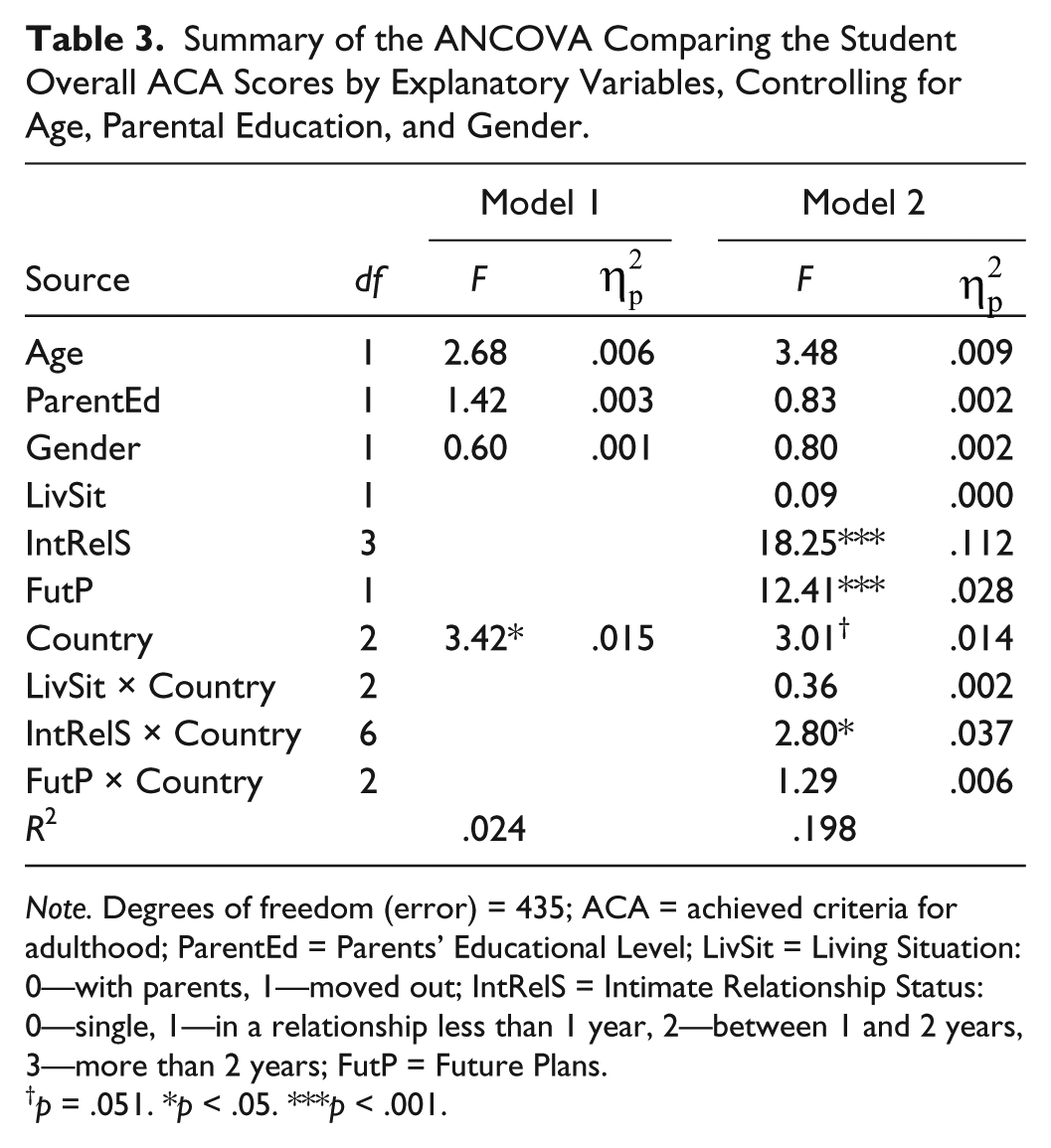
Note. Degrees of freedom (error) = 435; ACA = achieved criteria for adulthood; ParentEd = Parents’ Educational Level; LivSit = Living Situation: 0—with parents, 1—moved out; IntRelS = Intimate Relationship Status: 0—single, 1—in a relationship less than 1 year, 2—between 1 and 2 years, 3—more than 2 years; FutP = Future Plans.
p = .051. *p < .05. ***p < .001.
In Model 1, none of the covariates had a significant effect on the ACA and the significant differences by country were similar to those obtained with the total sample. The significant age effect for the total sample disappeared due to a more restricted age range of the reduced sample. The overall variance in the ACA explained was 2.4% and 1.5% of the variance referring to country differences. The explained variance is similar to the ANCOVA for the overall sample (2%) reported above.
In Model 2, the students in an intimate relationship (and a longer lasting one) attained higher ACA scores, F(1, 435) = 18.25, p < .001, and this effect was further qualified by a significant interaction, F(6, 435) = 2.80, p = .011. Single ANOVAs in each of the countries showed that the intimate relationship and its length had a significant positive effect on the ACA in Slovenia, F(3, 138) = 15.18, p < .001, and the United States, F(3, 182) = 8.26, p < .001, but was not significant in Austria, F(3, 130) = 1.94, p = .126. Finally, future plans were significantly related to the ACA, F(1, 435) = 12.41, p < .001: The earlier the students expected to reach the adult transitions in family- and work-related domains, the more criteria they perceived attained, r(470) = −.13, p = .005. However, the results do not preclude associations in the opposite direction, that is, the students who believe they have fulfilled more ACA may be more likely to engage in intimate relationships and feel closer to the adult role transitions.
The explained variance in the ACA increased from 2.4% (Model 1) to 19.8% after including living situation, intimate relationship status, and future plans (Model 2). The country effect became marginally significant, F(2, 435) = 3.01, p = .051, and the three explanatory variables did not reduce the country variation as evident from
Discussion
The study examined (a) perceptions of the ACA in university students from three Western type societies, and (b) between- and within-country differences in the ACA that could be explained by the students’ living situation, intimate relationship status, and personal future plans about adult transitions, while controlling for age, gender, and parents’ education.
Perceptions of the ACA in the Three Countries
In support to our first hypothesis, the U.S. (Michigan) students endorsed more overall ACA than their Austrian and Slovene counterparts. Country differences in specific ACA may, in part, provide an insight into those rather small overall differences. Relative to the Europeans, more of the U.S. students viewed themselves as having achieved the criteria of lifelong commitments to others (belonging to the interdependence domain) and family capacities related to keeping family safe and caring for children. The link between societal and personal expectations can also explain the advanced ACA scores of the American students. The mean age of marriage and birth of the first child is systematically lower in the United States (i.e., the state of Michigan; Mathews & Hamilton, 2009) compared with Slovenia (Statistical Yearbook, 2013) and Austria (Statistik Austria, 2014a, 2014b). In line with this societal characteristic, the American participants also planned to reach these goals earlier than the Europeans. This prospective may indicate American students’ take on more responsibilities (making long-life commitments, driving safely) or at least illustrates their perception of being more prepared to take over adult obligations (caring for one’s own family) and thus, consider themselves as having attained more criteria for adulthood.
The Slovene compared with the Austrian and American students felt similarly independent although most of the former lived in the parental household. They seem to counterbalance: In spite of residing with parents, partly due to a very short distance separating family home and university and lower family income (relative to Austria and the United States; Organisation for Economic Co-Operation and Development, 2012), more Slovene (a majority) than Austrian and American students reported not being deeply tied to parents emotionally and scored higher on egalitarian relationships with parents and independent decision making in comparison with the Austrians.
Explaining Differences in Student Perceptions of the ACA
The three study variables (living situation, relationship status, future plans) together explained a considerable portion of within-country variation in student-perceived ACA but did not account for between-sample differences, which appeared very modest. The results are partly consistent with the second hypothesis.
Inconsistent with our expectations based on related research (Beyers & Goossens, 2003; Beyers & Seiffge-Krenke, 2007; White, 2002), the students’ living situation (residing with parents or moved out) did not contribute to their perceptions of ACA. This may be due to the fact that we treated the “moved out” group of students as a homogeneous group, which may not be correct. Relative to residing in the parental home, living in a single household or sharing an apartment with peers has been shown to decrease the likelihood of feeling an adult in a German emerging adult sample, whereas cohabitation with a partner increased the participants’ perceptions of being an adult (Reitzle, 2007). If this was true for our samples, the presumably lower ACA scores of the students living in a dorm (single) or sharing an apartment could counterbalance the potentially higher scores of those cohabiting and show no differences in the ACA as compared with the students residing with parents.
The differences in the ACA scores by future plans were similar across the countries, suggesting that earlier personal expectations of adult transitions contribute significantly to the criteria for adulthood the students believed they had already achieved. However, the relation may run in both directions: The students expecting the transitions earlier may put more effort in development of more adult-like behaviors (Carroll et al., 2007; Kalakoski & Nurmi, 1998) and achieve more criteria as a consequence. Likewise, the individuals’ perceptions of having fulfilled more criteria for adulthood may promote their feelings and expectations of being closer to the adult transitions.
Students’ intimate relationship status also contributed to the interindividual variation in their ACA scores. Along with related findings (e.g., Kins & Beyers, 2010; Lanz & Tagliabue, 2007; Reitzle, 2007; Zupančič et al., 2014), our results suggest that emerging adults’ involvement in an intimate relationship appears important to their perception of becoming an adult in several modern societies. However, the associations obtained should be viewed bi-directionally due to the correlational nature of our study. It is similarly plausible that the students who indicated more ACA feel more prepared to form an intimate relationship, which could increase the likelihood of their intimate engagements and/or trying to maintain an already established relationship. In addition, the significance of the intimate relationship status effect varied slightly across the countries under our study. Leading a relationship (including its length) was less reliably associated with the ACA in the Austrian students compared with the Slovene and American students. The longer postponement of marriage in Austria and higher planned age to reach adult transitions, in particular becoming a parent, by the Austrian students may create opportunities to consider intimate relations more as ways of exploration and less as being determined pathways toward adulthood.
In spite of the impact of future plans and intimate relationship status on the ACA scores, these effects did not notably reduce the small country differences in the perceived ACA, although the differences dropped to marginal significance, which may be due to the somewhat smaller number of students retained in the analyses. Other characteristics need to be detected to account for the cross-national variation in the perceived ACA. Countries, for example, differ in structural conditions (educational systems, employment opportunities, housing market, social policy, cultural expectations concerning development in emerging adulthood) that may affect student perceptions of self as an adult (Molgat, 2007). A possible factor could also be that self-enhancement bias is stronger in the United States than in Europe (Silvera & Seger, 2004; Tilton Weaver & Kakihara, 2007), and by this, the Americans may tend to overestimate their ACA. An alternative explanation refers to differences in societal values. The higher individualism in the United States compared with Austria and Slovenia (Schwartz, 2007) cannot serve as an explanation because the differences in the ACA were mostly based on criteria related to family capacities and interdependence, in which the Americans reached a higher percentage of achievement. Perhaps family values have a higher relevance for students in the US (Michigan) compared with the Austrian and Slovene students. Beside the achievement of independence, the focus of the former may be stronger oriented toward starting their own family—which happens de facto earlier (see average marriage and child birth age)—and by this, they may put forth more effort to make sure they have achieved these capacities. In general, the assessment of students’ individual values (e.g., Schwartz, 2006) could be used to explore between- and within-country differences in the ACA further.
No differences in the ACA were found for gender, parental education, and age (with reduced sample size), although women and young people of less educated parents in general experience adult transitions earlier than men and individuals growing up in higher educated families (Arnett, 2003; Crockett & Bingham, 2000; Eurostat Press Office, 2009; Šircelj, 2006). It is possible that testing students might erase the respective group differences as female students and students coming from less educated homes may also postpone the adult transitions for later. This means that gender and family background differences might occur in older emerging adults, especially after graduation.
Limitations
The present study was cross-sectional in nature and focused on university students who represent a relatively homogeneous group of emerging adults, who perhaps share a global student sub-culture. Other same-aged groups may have a different timing of adult criteria achievement and the ACA in nonstudents may be linked to different factors than those contributing to the student-perceived ACA. Our respondents were predominantly female (although the ACA scores were not affected by gender) and sampled from one university per country. The generalization of the findings to student population in the United States (or even Michigan) is thus, quite limited; however, the two European samples were selected from the largest of a few extant universities.
Furthermore, the ACA was assessed by the list of criteria that were proposed to be relevant for adulthood from Arnett’s work. We only retained the items from the Arnett list that are relevant to the characteristics of our student samples and focused on several intrapersonal, interpersonal, family-related, and rule-abiding criteria for adulthood. Criteria linked to other domains of attaining an adult identity may also play a significant role in student perceptions of their developmental status, for example, those in the area of occupation, ideology, religion, politics, and taking over responsibilities for other societal matters. A qualitative analysis of freely generated reports on important criteria for adulthood would provide an answer of whether the Arnett list is exhaustive to investigate personal views on the ACA. To extend knowledge on subjective representations of the ACA, emerging adults’ beliefs about possible hindering or advancing factors to become an adult may prove beneficial.
Conclusion
Our results indicated that emerging adult students in Austria, Slovenia, and the United States (Michigan) differ in their subjectively perceived overall ACA, yet to an apparently modest degree. The Americans perceived themselves more adult, particularly due to their perceptions of achievements in the domain of family capacities, long-term commitments, and safe driving, in comparison with the European students. Although the participants’ age, gender, parental education, and living out of parents’ home were shown to play a negligible role in their ACA, engagement in an intimate relationship and planning earlier personal transitions in vital life domains of (re)production were demonstrated to be important contributors to within-country differences in the ACA across the student samples. Nevertheless, those factors did not provide a noteworthy account for between-country differences in the ACA.
In spite of several limitations, our findings add to the understanding of the emerging adulthood period in individuals who continue their education at a tertiary level. The Austrian and Slovene students’ responses were directly compared with those of their U.S. counterparts in Michigan; instead of looking at the conceptions of adulthood, we focused on the student-perceived ACA, and plausible demographic and individual contributors to between- and within-country variation in student perceptions of their ACA. Data from more countries and accounting for nonstudents would allow a country-level analysis, which can offer an insight into demographical, cultural, and psychological factors contributing to various pathways of becoming an adult in contemporary societies.
Footnotes
Acknowledgements
We would like to thank Michelle Sanchez from the Writing Center at Grand Valley State University (GVSU) for her careful language check of the final manuscript.
Declaration of Conflicting Interests
The author(s) declared no potential conflicts of interest with respect to the research, authorship, and/or publication of this article.
Funding
A part of our research was conducted in the framework of the Bilateral Agreement between Austria and Slovenia Nr. BI-AT/11-12-009 funded by the Slovene Research Agency and Nr. SI 21/2011 funded by the Federal Ministry of Science, Research and Economy (BMWFW) administered at the Centre for International Cooperation and Mobility (ICM) of the Austrian Exchange Service (OeAD). The US study was funded by a Research Grant-in-Aid at GVSU.
Author Biographies
