




Abstract
In New Translation Studies (NTS), cultural paradigm is of great importance to convey the approximate function of the source language into the target language context. Paradigm of culture is treated differently in accordance with its different definitions in that most of the studies carried out in this field show cultural diversification as the basic and rudimental part of this paradigm. In Translation Studies, the translator has to do with two kinds of situations so as to transmit the meaning and function of the culture. The first one is known as cultural diversification and the second one as cultural hybridity or homogenization. The former is aimed at Old Translation Studies era, which investigates source–target dispersion. And the latter alludes to source–target reconciliation. The present study seeks to investigate some void areas in translation and culture and proposes a new model in which it makes some efforts to reconcile translation and culture via cultural homogenization known as HomoKult Model of Translation in Gray Zone. The intended process consists of four subcategories: (a) Purposive culture, (b) Ameliorated culture, (c) Circulated culture, and (d) Diglossic culture expounded in detail throughout this article.
Keywords
Introduction
Translating culture is an arduous task in translation studies, an academic interdiscipline dealing with translation theories such as culture, philosophy, and applications of translation. The aims of translation studies are to approximate (reconcile) the source language (SL) to the target one, so as to create the mutual and complete environment between the SL and the target language (TL). Diverse cultures along with diverse rites, thoughts, creeds, and behaviors are the most challenging points in translation. But how can the renderer transfer the exact sense of the source culture into the target one? And does culture diversification really exist? To what extent can the renderer create or simulate the intended situation in the TL to be understandable? Is cultural homogenization the same as globalization? These are some pivotal questions to be answered.
Nowadays, cultural homogenization or ethnic cleansing is a vital aspect in translation studies. Translation seeks to discover some new ways in translation to integrate cultures and then establishes the stable framework of culture. Therefore, modernization is an asset in New Translation Studies (NTS). In this direction, every state or country compels its citizen to abide by some coherent rules for better living. Conversi (2009) defines cultural homogenization as follows: A state-led policy aimed at cultural standardization and the overlap between state and culture. As the goal is frequently to impose the culture of dominant elites on the rest of the citizenry, it consists basically of a top-down process where the state seeks to nationalize the masses. (p. 719)
This definition implies that translation is suffered from hierarchy of cultures and languages. It means that whenever the culture is in state of power, it ordains every rule, law, and order. In this direction, the robust culture annihilates the weak one; the process is called cultural genocide. However, the world is being changed. Modernization and globalization try to integrate and amalgamate the cultures to make a fixed and stable culture. The idea of culture homogenization conjectures the unified, solid, and organic connection among people. In this process, the identity of cultures will be changed and need to be revised. Every time, amalgamation of culture and identity has intrigued tourists, travelers, and researchers. Both culture and identity are able to elicit connotational feelings of the people. That is because religion is the rudimental aspect of every culture. People’s creeds and beliefs are an indispensable part of a community. But the problem is that culture and identity are not always integrated together. Many anthropologists have defined culture and identity differentially with diverse scopes. For instance, Cummins (1996) defined identity as follows: “affirmation of identity thus refers to the establishment of the respect and trust between educator and students” (p. 4), while Tylor (1871/1924) defines culture as a “complex whole which includes knowledge, belief, art, morals, low, custom, and any other capabilities and habits acquired by man as a member of society” (p. 1). It means that culture and identity are entering into the new epistemological era, and they are completely separated from each other. Identity is personal and individually oriented. However, culture is group- or congregation (1) The capacity of children whose vocabulary and cultural experience are limited. (2) The double standard of capacity of new literates, who can decode oral message with facility but whose ability to decode written message is limited. (3) The capacity of average literate adult, who can handle both oral and written messages with relative ease; and (4) the unusually high capacity of specialists (doctors, theologians, philosophers, scientists, etc.), when they are decoding messages within their own areas of specialization. (Nida, 1964, pp. 156-171)
Passing the red line means changing, playing, and annihilating with people’s creeds. Is the translator or interpreter allowed to pass this line? If she or he passes, what should be done to lessen the degree of anger? Totally, in the first place of culture homogenization, most of the people shun accepting this notion. That is because of the fact that their culture is going to be changed or amalgamated with unknown culture. Establishing a cross-cultural connection along with one stable or Mother Culture is an ordeal but a possible task. Before making the established framework of culture, a good definition of culture is of great importance. Griswold (1994) defines culture as “that complex whole which includes knowledge, belief, art, morals, law, custom, and any other capabilities and habits acquired by man as a member of society” (p. 8). This definition seems to be so vast that each section cannot be scrutinized separately. In this direction, one must depict the paradigm of this definition into several points: (a) Cultural substances involve the artifacts, buildings, implements, tools, and painting; (b) cultural non-substances include the way of dancing, song, garment, and special accent; (c) cultural environment involves flora and fauna such as Rampike and Panda; and (d) cultural behavior consists of beliefs, creeds, values, attitudes, and meaningfulness. These four categories are completely true for every culture and the way of performing is completely different. Culture can be investigated from the other angles such as politics, consumerism, and consumption. But the question is, “How vastly do the cultures differ?” Is there any light to shed on cultural homogenization?
Today, we live in a globalized era, and everyone speaks about progression. How will it be possible to progress without taking a step toward cultural integration? How will it be possible to live in an uncertain era? And how would it be possible not to consider any factors in integration of cultures? Answering such questions needs rudimental and pivotal studying in this field. Therefore, one must express that cultural homogenization diminishes existing cultures or rites to a superficial and non-fastidious period in which significant discrepancies will be reduced and become completely understandable for the bystanders in every culture. Finally, cultural homogenization is an open expression of culture, which is thoroughly applicable in every field of studies, especially in translation studies.
Last but not least, the rationale behind focusing on cultural homogenization stemmed from the condition that culture would be treated differently and one cannot build the stable framework of the intended term, particularly in the field of translation study, which concentrates on source and target language culture to see the similarities and differences. Therefore, the aim of this study is to scrutinize cultural possibilities in translation. Discerning these possibilities in translation requires some strategies or subcategories utilized by the translator to affiliate the bridge of the source to that of the TL culture. Finally, this study seeks to peruse four subcategories of HomoKult Model of Translation to amalgamate SL to TL and make the translation or interpretation homogenize so as to be completely understandable, especially for decoding ability.
Review of Literature
Definition of Culture
It is completely natural to say that all people by nature know the exact meaning of the culture. For the ease of the reader, it is better to clarify “culture” by an example. In 1995, all of the membership of the European Union felt depressed about the Britain’s referendum, and nearly one in two respondents expressed their dissatisfaction. It is because of the fact that they said we all did not belong to such culture. Defining the real and decisive meaning of culture is a difficult task in every field. Alfred Louis Kroeber and Clyde Kluckhohn (1952) define culture as follows: Patterns, explicit and implicit of and for behavior acquired and transmitted by symbols, constituting the distinctive achievement of human groups, including their embodiment in artefacts; the essential core of culture consists of traditional (i.e. historically derived and selected) ideas and especially their attached values. Culture systems may, on the one hand, be considered as products of action, on the other hand, as conditioning elements of future action. (p. 181)
The last part of this definition implies that, in future, the system of culture may change, and it will be ready to be replaced. This suggests that all culture may amalgamate with each other and then become one in this process. At that time, hierarchy of cultures is useless, and there do not exist any culture dominations. Ned Seeleye (1984) described culture as, “I know of no way to better ensure having nothing productive happen than for a language department to begin its approach to culture by theoretical concerns for defining the term” (p. 13). In this direction, Seeleye cannot define culture for the way it is, and he just utilized circumlocution. Finally, according to Encyclopedia of Language and Linguistics (Asher, 1994), defining culture is effortless: “Despite the century of efforts to define culture adequately, there was in the early 1990s no agreement among anthropologist regarding its nature” (p. 2001). It is better to say that Gail Robinson (1988) categorizes the definition of culture into two subgroups: (a) external and (b) internal culture. The former alludes to behavior such as language, gestures, customs, and habits. And then products belong to literature, folklore, art, music, and artifacts. The latter refers to ideas such as beliefs, values, and institutions. She then defines the term culture in accordance with some approaches such as behaviorist, functionalist, ethno-centrism, cognitive, and dynamism.
Theories on Culture
The term culture has been defined variously during the period of time. It is important to say that the definition of culture depends on the era in which people live. Therefore, depicting the stable definition is approximately impossible. Every time, nations expressed culture in accordance with their taste and it is not surprising to ponder the fixed and well-balanced meaning. Among all of the theories of culture, some of them are astonishing to scrutinize to make this study tangible.
The Iceberg Theory
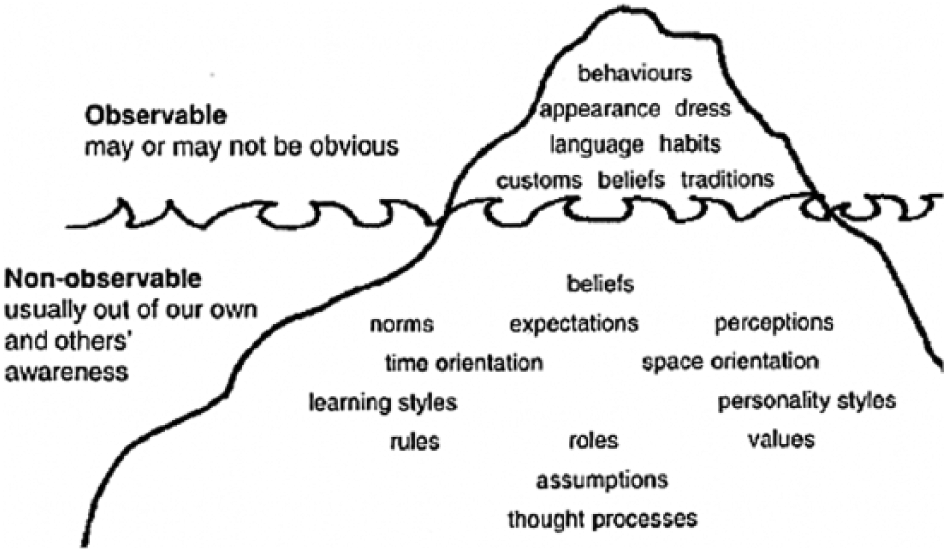
The Iceberg Theory defined culture many years ago. Hall (1990, p.2 ) worked on this area to corroborate the nature of culture directly. He then added that the most brilliant portion of culture was concealed, and all things in culture would be “just the tip of the iceberg.” The other distinction is related to Clyde and Florence Kluckhohn’s explicit and implicit, and Ralph Linton’s category between covert and overt. Explicit information in cultural studies refers to the surface layer of the culture while the latter alludes to deep structure of the culture. Every successful culture amalgamates the deep layer of language to the surface language, which completely exhaustive and comprehensible in this direction. Linton’s category covers approximately all the factors in culture in that covert culture covers all the discrepancies and similarities in raw form and the latter covers the practical aspects of culture in this regard. But, the most important factor is that when a translator, renderer, and the interpreter seek to deal with the covert aspect of culture, he or she should consider the red line in culture. It means that every culture has some limitations, which the renderer has to observe prior to the act of translating. Therefore, connecting the covert layer of culture to the surface layer will be an arduous task in translation studies.
The most recent amelioration of Iceberg Theory is related to the division of Brake, Medina-Walker, and Walker (1995): Laws, customs, rituals, gestures, ways of dressing, food and drink and method of greeting, and saying goodbye . . . These are all part of culture, but they are just the tip of the cultural iceberg. The most powerful elements of culture are those that lie beneath the surface of everyday interaction. We call these values orientation. Value orientations are preferences for certain outcomes over there. (pp. 34-39)
This definition suggests that the translator should consider the beneath and surface interaction in the text. Deep structure of the texts should be based on the common rudimental aspects that are completely understandable for all people. And the surface structure is going to trim text delicacies. Text delicacies in culture refer to some different aspects of culture that are thoroughly localized.
As can be observed in Figure 1, some rudimental aspects such as personality styles, assumptions, norms, expectation, and beliefs are pertained to the deep layer of the iceberg. And some aspects such as behaviors, appearance, dress codes, and customs are related to the other layer called the surface structure.
Iceberg Theory.
In NTS, there is nothing to do with differences. Everything can be scrutinized in the way of similarities and then the renderer seeks to institutionalize translation as the homogeneous act. In this regard, every model and theory that are against the Universal Translation must be eliminated or revised. All these processes are directly connected to the translator’s cognition to mix the SL culture to the approximate TL culture as well.
Formal culture
Formal culture is a kind of culture that is completely prevalent in one society. It can be stated that this sort of culture is exclusive of a particular region in this direction. Habits, customs, beliefs, and behaviors are the most important issues in the above-mentioned culture. Formal culture is no longer objective (Katan, 1999) in that it works on the surface level of the culture. The framework of this culture is thoroughly utilizable in rendering the TL superficially, and it scrutinizes the surface level of the unit of translation. For instance, Distinti Saluti in the Italian language can be rendered as “Yours faithfully.” In this regard, the renderer should resort himself or herself to formal and framework of target culture to transmit the exact sense of the SL directly. As another example, Spettabile Ditta will be translated as “Dear Sir/Madam” to show source–target overlap. In the above example, the renderer seeks to cover the overlap and then situates itself in gray zone or area. Formal culture should be taught to preserve rites, traditions, beliefs, and customs. Formal culture is devoted to trials and errors and is not pertained to the social conventions of the society. It is better to say that formal culture scrutinizes the norms of the society approximately as it has investigated the right or wrong, adequate or inadequate, and acceptable or unacceptable rules of the community in this regard.
Cognitive culture
Culture as a particular cognitive system is pertained to the anthropological aspects of culture, in that it inspects human interaction in diverse situations to depict one fixed and stable framework of the culture. In this connection, Ward Goodenough (1963) argued, A society’s culture consists of whatever it is one has to know or believes in order to operate in a manner acceptable to its member. Culture is not the material phenomenon; it does not consist of thing, people, behavior, or emotions. It is rather an organization of these things. It is the form of things that people have in mind, their models for perceiving, relating, and otherwise interpreting them. (p. 167)
This implies some elements of cultural homogenization such as perceiving, relating, and interpreting. These keywords seek to show the similarities among culture and then to amalgamate the intended culture, which is quietly ponderable for the target bystanders. Keesing (1974) sees culture as epistemologically in the same realm as language such as Saussure’s Langue or Chomsky’s Competence. Therefore, it can be stated that language is the subcategory of culture in that it expatiates human interactions, behaviors, rites, and creeds through threads of words. In this sense, to transmit the near meaning of the words, componential analysis (CA) will be an asset. In CA, the rationale behind the words will be revealed and the translator is able to conglomerate the SL to the target one.
Symbolic culture
Culture in this sense can be treated as symbols and meaning. Culture as a symbolic system has been under investigation since 1957. It is worth noting that the two precursors in this junta are Clifford Geertz and David Schneider.
Geertz sees culture systematically along with some well-defined procedures in accordance with humanistic scholarship. He made his effort to expound ethnographic peculiarities to connect and then to corroborate the real nature of culture. Therefore, he figures out these peculiarities in real people accompanied by real rites, customs, behaviors, and creeds. In this direction, he scrutinized the term culture under the semiotic field, which deals with signs and symbols in every culture. That is why he termed culture as “an assemblage of text” (Geertz, 1957, p. 26). Geertz is the opponent of integration and internal consistency of culture in that he explains only partial integration and often disconnectedness and internal contradiction exist (Katan, 1999). Therefore, Geertz (1964) makes one original metaphor, which states, The problem of cultural analysis is as much a matter of determining independencies as interconnection, gulfs as well as bridges. The appropriate image, if one must have images, of cultural organization, is neither the spider web nor the pile of sand. It is rather more the octopus, whose tentacles are in large part separately integrated, neutrally quite poorly connected with one another and with what in the octopus passes for a brain, and yet who nonetheless manages to get around and to preserve himself, for a while anyway, as a viable, if somewhat ungainly entity. (pp. 66-67)
Another pioneer in culture as a symbol is Schneider working on the Parsonian framework. The Parsonian framework scrutinizes the social system in culture by its direction toward the achievement of specific goals. The Parsonian framework in culture is explicit, comprehensive, and applicable in different layers of culture. The Parsonian model works on Adaptation, Goal Attainment, Integration, and Latency (AGIL), in that it peruses why communities are fixed/stable and functioning. According to Schneider (1972), culture is the systems of meaning and symbols. Symbols and meanings inspect the units and rules in behavior of the society to see the similarities and discrepancies among the intended factors. Therefore, Schneider extended the paradigm of culture as “how-to-do-it” rules and norms/conventions, and then he explains the navigation of the social world in this essence. Schneider (1972) peruses symbols and meanings in his models: By symbols and meaning I mean the basic premises which a culture posits for life: what its units consist in; how those units are defined and differentiated; how they form an integrated order or classification; how the world is structured; in what parts it consists and on what premises it is conceived to exist, the categories and classifications of the various domains of the world of man and how they relate one with another, and the world that man sees himself living in. (p. 38)
To cut the long story short, Schneider made his efforts in the social system, particularly kinship, politics, and economics and pure cultural analysis. He then addressed pure cultural analysis as “uncontaminated by the study of its social systems” (p. 38). In this connection, he also sought to connect culture, society, and psychological plans to perceive the social and standard life of people. And it is better to say that the renderer should put himself or herself in the other’s shoes particularly social life, standard of living, creeds, behaviors, and the beliefs of people, so as to admix the two isolated poles (source and target cultures) in translation studies and attract the decoding ability in his or her action.
The Translator as Mediator
In translation studies, the renderer, translator, and interpreter act like the mediator who wants to reconcile the source culture to the target one. According to George Steiner (1975), “The translator is a bilingual mediating agent between monolingual communication participants in two different language communities” (p. 45). This definition and the like are not new in translation studies. The translator as a mediator or “The Cultural Mediator” (Bochner, 1981) consists of two terms that make lots of discrepancies in translation in that the translator can mix all the traits of source and target cultures into the fixed and stable paradigm. Taft (1981) defines cultural mediator as follows: The person who facilitates communication, understanding, and action between persons or groups who differ with respect to language and culture. The role of the mediator is performed by interpreting the expression, intentions, perceptions, and expectations of each cultural group to the other that is by establishing and balancing the communication between them. In order to serve as a link in this sense, the mediator must be able to participate to some extent in both cultures. Thus a mediator must be to a certain extent bi-cultural. (p. 53)
It is clear that the main task of the translator is to attune the SL to the TL. Understanding of culture means homogenization of culture. Homogenization of culture causes people to interact well, and they can communicate with each other. Diminishing some aspects of culture in both SL and TL will be of great importance to depict the stable framework in homogenization of culture. Therefore, Taft (1981) argued that the mediator should have some traits such as (a) knowledge about society: history, folklore, traditions, customs, values, prohibitions; the natural environment and its importance; neighboring people, important people in the society, and so on; (b) communication skills: written, spoken, and non-verbal; (c) technical skills: those acquired by the mediator’s status, for example, computer literacy, appropriate dress, and so on; and (d) social skills: knowledge of the rules that govern social relations in society and emotional competence such as the appropriate level of self-control. Therefore, the translator should make his or her efforts to find some common ground among culture, so as to make translation universal and subject to uniformity.
Discussion
Culture paradigm both homogenized and diversified is so vast that no one can fully explain about the real nature of culture in every field such as translation studies, socio-cultural studies, and so forth. In this connection, culture is defined variously by everyone and in most of the cases; one cannot thoroughly rely on the nature of culture’s definitions. In the definition of cultural diversification, some shortcomings can be observed in that it is worth noticing to express and then make the stable and uniform culture paradigm particularly in translation studies. Unfortunately, there do not exist real criticisms on culture paradigm in translation. Therefore, preparing the real and clear criticisms will be of great importance to corroborate the nature of culture in translation studies. This article seeks to express the updated shortcomings of the previous definitions of culture, and then the researcher intends to propose a more comprehensive model of cultural homogenization known as HomoKult Model of Translation in NTS.
As described in the previous section, most cultural definitions utilize the wrong metaphorical meanings. A good definition should consider all aspects of the culture to convince and persuade the reader. For instance, the Iceberg Theory of culture simulates culture as a huge iceberg, in that it has two parts. One of the parts is beneath the water, which is called the non-observable culture, and the other part is on the surface, and it is called observable culture. This kind of definition is completely true of cultural diversification, in that all people behave differentially according to their language patterns and language sensitivities. But one has to ruminate that the physical shape of the iceberg is prone to annihilating and melting. In this kind of situation, the iceberg should not be considered as observable culture. Therefore, clarifying exact nature of culture requires considering every aspect of culture both physically and mentally. So, the translator cannot fully rely on Iceberg Theory in his or her translation.
Nowadays, most of the translators seek to find new ways to connect the cultures to render exactly, and they seek to ruminate on cultural homogenization. Therefore, combining the SL culture to TL culture in translation will be of great importance. The translators should ponder on the deep layer of the cultures, and then they should pay attention to the conveying phase-transfer-in translation. It is completely natural to say that all cultures share some common parts together in that they make translation understandable for all ilks of target people. For instance, the terms Norouz—New Year Eve in Iran—and Christmas in Western countries share some commonalities such as moving the earth, changing the weather, and changing people’s thought to start the new beginning. These factors show a deep layer of culture, and the translator has to transmit this kind of situation in his or her translation, so as to persuade the reader. But the important factor is that cultures will show some differences in their surface level. Surface-level translation in translation studies is just scrutinized for the people’s way of thinking. They show the observable facts of the people. Therefore, the translator should first translate the shared points, and after that, he or she devotes his or her time on differences.
The other note is that in cultural studies (CS), the translator usually inclines to the surface layer of the culture, which is completely wrong. Translator as the mediator should make the equilibrium side in translation. It means that both deep layer and surface layer in translation should be taken into account and treated similarly. For instance, the road between translation polarities will be treated as source–target amalgamation, and it is thoroughly utilizable in cultural homogenization known as HomoKult Model of Translation. Therefore, admixing the two poles in translation is highly acceptable to convince the reader.
HomoKult Model of Translation
To expound every culture, one must make the broader and accurate paradigm to corroborate every incoming and outcoming(consequence) factor in CS. CS deals with all issues that depict human background. Therefore, it is suggested that one must depict an accurate paradigm in CS in order not to insult any culture in this direction. It is tried to respect every culture and scrutinize most of the aspects of culture so as to create the stable cultural paradigm in translation and make translation homogenize which saturates every various tastes in this regard. The reason to opt for the term HomoKult is the prefix and partial wafting (Akbari, 2013), which is completely ruminatable in translation studies as cultural homogenization. According to Dictionary reference (2014), homo- as the Greek prefix combines from homós, one and the same, akin to Sanskrit Sama, which is completely ponderable in that it is utilized in this above-mentioned model. The prefix homo- is well upgraded, and approximately most of the languages utilize it in their texts. The other note is about the word Kult, which is derived from the real and exact word in the German language Das Kulture. German language is one of the leading languages that jot down every noun with capital letter, and it seeks to show the power of the above-mentioned language among others. Homo- plus Kult show cultural amalgamation in translation aiming at depicting no borderline in translation studies. In translation studies, no red lines should be defined, and all the problems in translation studies are derived from the viewpoint of the translator. The translator as the mediator is able to connect the source and the target text fully, which is called source–target reconciliation in HomoKult Model. However, when the translator peruses the discrepancies and differences between the source and the TL cultures, she or he is dealing with source–target dispersion. The former seeks to connect the prior knowledge of the translator to that of the new one and then determine the common ground. For instance, compliments in each language play semantic voids in translation. Should the renderer pay attention to the deep layer of the compliment in the SL, he or she can fully restructure the same situation into the target one. Therefore, it should be stated that the role of the translator is greater than those of the source and target texts. The latter case is due to the fact that the translator discriminates some of the exclusive rules either in the TL or in the SL. The translator acts like the annihilator who seeks to destroy the nature of the text in accordance with his or her taste and does not consider the role of the reader in translation. The latter case is specialized in deconstructionism, who believes authorless text and the death of the author (Pym, 2010). Therefore, the translator should make some checklists before the act of translating to translate correctly, and then he or she meets the needs of the reader in this connection. This checklist might be the determination of unit of translation. Unit of translation can be defined as “the linguistic level at which ST is recodified in TL” (Shuttleworth and Cowie, 1997, p. 192). Therefore, the translator should determine his or her scope in translation in that he or she should actuate the exact unit of translation. For instance, Vinay and Darbelnet (1958/1995, pp. 20-27) determine their unit of translation as “unit of thought,” or Catford (1965, p. 76) defines his unit of translation as “phoneme,” which carries the meaning of the utterance. However, these kinds of borders in unit of translation will not be very precise unless the translator considers all aspects of contextual factors in translation. Unit of translation should be beyond the discourse in the text. That is due to the fact that every word has the rationale behind it, and it is obligatory for the renderer to transmit this rationality in this regard. Therefore, HomoKult Model of translation actuates culture as the unit of translation. Culture consists of words, phrases, clauses, paragraphs, and discourse, and it seeks to peruse the workability of the intended factors in translation to make the Translation Universal (TU).
For the ease of the reader, HomoKult Model will be divided into four subcategories, which start from general to specific issues (top–down analysis). These four subcategories are as follows:
Purposive culture
Purposive culture is defined as any kind of rudimental culture scrutinized deeply in order to convey go togetherness and then amalgamates deep layer of culture to those of the others. Purposive culture seems like the foundation of the building to establish a well-balanced structure sense for the other parts. Purposive culture peruses conceptual items either in the SL or in the TL rudimentally. It is the lowest part but pivotal in cultural paradigm. Should the intended culture declare its priority over the other ones, it will devastate its nature and is not able to corroborate itself as to be stable in purposive culture.
Purposive culture consists of underlying aspects of culture, which is of great importance in transmitting the real and exact essence of the words, sentences, texts, and ideologies. These aspects are norms, conventions, values, perceptions, understandings, creeds, and so forth. In the case of rendering such aspects, the translator/renderer should pay attention to the deep layer of these items. For instance, Io sono il tuo sacrifico will be rendered as I am your sacrifice to show the deep value of the intended item in translation. It shows the hidden and underlying respect, which is completely agreeable in all cultures and languages. But the most important factor is to convey the real sense correctly without any exaggeration. Therefore, the role of the translator in this category is of great importance in that the translator is going to prepare the text to move to the next step. As another example, for making a polite request, one has to do with Excuse me, Entschuldigen Sie, or Scusi, in that they show the common deep ground in culture dealing with conventions or the norms of the society that are completely unanimous in every culture. In these contexts, the translator should first transmit the common sense behind the intended polite words through the techniques of reader attention, magnifying, eschewing dispreferred structure, and diminishing imposition (Akbari, 2014b ). Thus, he or she is able to embellish the surface structures of such polite request. In this direction, translator considers all ilks of people such as average illiterate, illiterate, and the specialists. Therefore, culture translation needs to investigate the underlying structure of the cultures and then prepare it for conveyance. Translation is not the matter of naturalizing, alienating, foreignizing, domesticating, and communicating. Translation is beyond these scopes. Translation is the conveyance of the hidden words of the culture. Translation or interpretation is not in the place of 0% or 100%. In some situations, translation will be in between. In some cases, the translator has to do with the lower incoming or low incidences of translational items in the culture. Therefore, he or she just pays attention to the source–target amalgamation to make an acceptable translation. But the problem is that translation puts itself in a gray zone with more inclination to higher incoming or high incidences of translational items in the culture. In most cases, the translator should first recognize the underlying sense of the source text such as norms, conventions, values (purposive culture), and then he or she should build a common connection between the two poles so as to remove any impossibility. Impossibility arises when the translator renders in accord with his or her taste/passion and does not seek to carry out the suitable and appropriate interpretation of the text. This situation puts him or her into mistranslation, in that some far-fetched concepts will be derived from the intended text. In this situation, the translator is the author of the target text, and it is better to label such issue as “Transcreation.” Translation should be regarded as an art that makes the impossible possible. Therefore, prior to the act of translating, the renderer is better to build up simulation (homogenization) in the TL so as to make the rendition more tangible and understandable.
To clarify the real essence of purposive culture in HomoKult Model, it is beneficial to make use of the intended case study:
Japan’s location close to China brought many aspects of Chinese culture to Japan. For example, Japan’s rulers claimed to be absolute emperor, like those of China. Buddhism and Confucianism also came from China and interacted with Japanese beliefs to create new values and beliefs. Confucianism taught loyalty to the ruler, while Buddhism taught the Japanese to reject the selfish desires. Japan also adapted Chinese characters to create their own written language. Chinese music, art, pottery, weaving, and cooking further influenced Japanese styles and tastes. (http://www.binghamsplace.com/uploads)
This case study implies that one has to understand that the Chinese culture plays as a purposive culture in that it distributes the fundamental parts of its own culture to the other cultures. It is not the way of modifying other cultures. However, it aims at enriching other cultures. In this connection, Chinese culture is regarded as mother culture, and other ones as adapted cultures. In translation, translator as a powerful mediator should seek to construct the fundamental situation by identifying the inner parts of cultures so as to create an eternal translation. According to the intended case study, translator can enumerate Chinese culture as the mother culture in his or her translation. It signifies that the deep layer of Chinese and Japanese cultures is the same and, progressively, they are spreading to the Western countries to show their homogeneity throughout the world.
Finally, it can be stated that purposive culture deals with void areas in translation which are completely invisible. Invisibility in the underlying structure of the culture needs to help decipher some clear and exact areas to simulate the void areas in the TL. Void and ambiguous areas should not be conveyed during the process of translation, in that they make translation superficial and commercial. Therefore, conglomerating the unclear spots in translation to those of clear areas puts the translation in the gray area, which is completely common in appropriate renderings.
Ameliorated culture
Ameliorated culture is defined as any sort of culture works on the superficial layer of culture. Ameliorated culture inspects the workability of the surface layer of culture and then connects the second angles of HomoKult’s web to see the common grounds with those of other angles.
Ameliorated culture is seen as the decorator among other HomoKult’s categories in that it pays special attention to the surface level of culture to inspect the degree of similarities and differences. To do so, one has to answer these kinds of questions. How can the renderer reflect ameliorated culture in his or her translation? And how can he or she approximate to the source–target amalgamation in this process? To answer such questions, the process of translation should appellate the reader to connect himself or herself to the various layers of the culture. It means that translation plays an appellative function in the SL and TL. In this connection, Bartoli (1981) argued, di persuasione alla conformita e di interiorizzazione di modelli culturali che la classe o i gruppi al potere ritengono necessari per i mantenimento dell’equilibrio del sistema sociale e che, in particolare nelle societa fortemente stratificate, determinati altri gruppi o classi sociali pongono al centro di una strategia di organizzazione del consenso attorno ai propri obiettivi e attorno alle proprie definizioni della realta. (p. 4) (Gloss): Of persuasion to conformity and of internalization of the cultural models (patterns) that the dominating classes or groups deem necessary for maintaining the equilibrium of the social system and which, especially in highly stratified societies, certain other groups or social classes put in the center of a strategy of organizing the consensus about the appropriate objectives and the appropriate definitions of reality.
The ameliorated culture seeks to investigate issues such as type of dancing, food, music, art, architecture, beverages, and so forth. It can be stated that the intended culture is progressive in nature. It will become complete through the time, and it is diachronically operationalized. For example, rendering Taglitelle ai porcini—an Italian food—as “Mushroom Stew” in the English language is superficially homogenized in that the English reader can understand the real nature of the intended food through the time. Or Porcellana in the Italian language becomes ameliorated and turns into “Porcelain” in the English language. In translation studies, ameliorated culture covers physical norms in which it scrutinizes the acceptability judgment of the source and the TL to depict the uniform framework between the two poles. Simulation of the SL culture into the target one is of great importance in this category. For example, transferring of the SL cuisine recipe into the target one requires simulating the intended cuisine system in the TL, so as to become homogenized for the target reader in essence. In this direction, the translator can replace the approximate food in the target culture, so as to create the same situation for the reader to understand the taste. Connecting the SL to the TL in ameliorated culture requires the sufficient knowledge in equivalence paradigm. Equivalence paradigm, in most of the cases, deals with superficiality of the rendering to saturate the needs of the reader. But the important factor in NTS will be to persuade the reader to know the vastness of translation. Therefore, the translator has to concentrate on the deep layer of culture first. Every text has the rationale in which it needs to be ruminated. This rationale is called culture. This is due to the fact that most of the renditions seem to be artificial rudimentally, and the reader cannot connect himself or herself to the text. In the field of translation, the translator should first render the culture for his or her own taste. Should he or she be able to connect to the rendering, he or she can publicize the intended rendering. In this regard, Hoffman (1998) argues, I have to translate myself. But if I’m to achieve this without becoming assimilated—that is, absorbed—by my new world, the translation has to be careful, the turn of the psyche unforced. To mouth foreign term without incorporating their meaning is to risk becoming bowdlerized. A true translation proceeds by the motions of understanding and sympathy; it happens by slow increments, sentence by sentence, phrase by phrase. (p. 211).
Whenever the translator has to concentrate on the understanding and sympathy of the translation, she or he is dealing with surface structure of the translation, and they are tied by ameliorated culture to see the differences and similarities in the SL and TL. For instance, Das Frittenporzellen in the German language has to be rendered as “Frit” in English. In this situation, the translator resorts to the process of Wafting Procedure (Akbari, 2013, 2014a ), so as to create the same equivalent situation/effect in the TL culture. Wafting is defined as follows: A direct and intense translation process, it has a connection with render or even transfer as the original SL by inserting or absorbing the SL words or phrase form into the RL’s in accordance to prestigious, frequency and intensity of the intended word. (p. 27)
In the other fields such as music, ameliorated culture will be worth noticing. For instance, the term pop songs was derived from the “popular songs,” in that people are willing to listen. This term enters other cultures as “pop” without any alternation. That is due to its homogeneity and prevalence of the intended style of music. To substantiate the nature of music in community and other fields as translation studies, Connell and Gibson (2003) have noted, Music does not exist in a vacuum. Geographical space is not an empty stage on which aesthetic, economic and cultural battles are contested. Rather, music and space are actively and dialectically related. Music shapes spaces, and spaces shape music. (p. 192)
From the above-mentioned definition, one can conclude that dialect alludes to the culture of either the source or the target one, and types of music are pertained to the culture. Therefore, the translator should interpret the intended culture and make this culture more tangible for the reader and then introduces the kinds of clothes, music, dances, and so forth.
European and Native American cultures encountered each other for the first time in 1492. This encounter, referred to as the Columbian Exchange, led to the introduction of new products to both cultures. European brought horses, goats, cattle, pigs, chicken, wheat, and goods like cannons, crossbows and steel to the Americas. At the same time, Native Americans had developed many foods unknown to European. An important result of the encounter was that the European diet was greatly improved by the introduction of new foods such as tomatoes, chocolate, potatoes, beans, peppers, pumpkins, squash, sweet potatoes, peanuts, and corn. European also learned how to smoke tobacco. (http://www.binghams-place.com/uploads)
In such cases, the best and drastic way to convey and transfer the main essence of the original text is to simulate the similar situation with the same equal value into the receptor language. For instance, potato first appeared in Columbian language, and consequently every language started making the exact equivalent of the intended term. French utilized the term pomme de terre, in that it means an apple growing from the ground. Consequently, Persian language stimulated the intended term Sibe Zamini to substantiate the same semantic component of “potato.” This transference shows that cultures are becoming approximate with each other. It is noteworthy that the translator as a mediator should observe the local color of the original and its stimulated term in the TL so as to put translation in middle ground between SL and TL. As another example, the local clothes of Japanese people are called Kimono. How can the translator render such term into Persian language? How is it possible to stimulate such situation into the TL so as to convince the reader on its feasibility? In this situation, the Persian translator exploits the similar term Rasuxi (local garment of north of Iran) in that it conveys the same deep layer of meaning. However, the only difference is in the way of its dressing. Needless to say, creating and constructing the same effect and situation will be highly recommendable.
Finally, it should be noted that the translator has to concentrate on equivalent potentials. Equivalent potentials allude to the potency of the words to approximately homogenize in the TL. Translators as the mediators are responsible for making and creating the same effect on the target reader so as to saturate their needs both deeply and superficially. There are other factors that are mostly important in cultural translation such as language sensitivity, language resistance, and SL–TL amalgamation, which play the key role in NTS.
Circulated culture
The third category in HomoKult Model of translation is circulated culture, which is defined as processes of temporal and spatial alternations in technologies, products, values, beliefs, and cultural characteristics from one place, state, and country to another. Circulated culture in translation will be regarded as the peripheral circumstance that subjects to alter and change. For instance, American culture spreads into most of the country especially Asian countries, which are on the verge of developing. Most of the changes are pertained to technologies, Western ideas as a way of clothing, dressing, eating, and behaving. The world turns to be multicultural, and it causes to approximate every culture together to decipher the points of similarities in this direction. Cultural approximation will influence the traditional culture and beliefs. Everything is being progressed, and one has to make his or her life updated in accordance with these upgraded regulations. As another example, democratic notions are prevalent in many countries. Democratic notions first emanate from the 1980s and 1990s, which affect the military dictatorships in some countries. Circulated culture consists of many contemporary factors in the entire world. But the question might be, “To what extent does this kind of culture lasts?” Or “Do people get along well with these changes?”
To clarify the whole idea of circulated culture, it is better to expound one case study so as to persuade the reader on making the stable paradigm in this regard.
American culture is the product of many influences, including those from Native American, English, French, Spanish, African, Asian, and other countries. In the early 20th century, a vibrant American Culture emerged with the new technologies, like the radio, record player, moving picture, and television. After the World War II, American popular music and movies became popular in Europe and later spread to every continent. Today people throughout the world see American movies and television programs, dance to American “pop” music, and use English as an international second language. Many wear American casual dress styles, such as Tee shirts with logos, and large number even eat at American fast food franchises, like McDonald’s and Taco Bell. American artists like Michael Jackson and Lady Gaga are international icons, known in almost every corner of the world. (see http://www.binghamsplace.com)
According to this case study, one can conclude that circulated culture is an indispensable part of human life that becomes progressed through time. In this connection, should the country seek to approximate to the cutting-edge rules, it must be a member of circulated culture to see real-technologized culture.
Circulated culture is an integral part in NTS. The translator plays an influential role in the source and target culture. He or she should act as the plug who wants to make the connection. Nowadays, some new terms along with new cultural traits come into the language showing the progressive nature in every country. In this situation, the task of translator is to homogenize the new terms in the TL, so as to introduce the progression and globalization. It is generally believed that most of the ilks of people in every country get accustomed to the new technological areas, and they are really eager to know the function of the new terms in this regard. Therefore, translator should transfer the surface structure of the circulated culture to prepare the situation for the target reader. Because of its periphery, the translator/interpreter is not required to bind themselves on the deep layer of culture in this category. Translation is available by means of its persuasion in the receptive culture.
To support the idea of circulated culture, Danilo Zolo (1997), in Cosmopolis: Prospect for World Government, expressed the Western as the globalized era: In fact goes no further than a network of connections and functional interdependencies which have developed within certain important sectors of the global market, above all finance, technology, automation, manufacturing industry and the service sector. Nor, moreover, does it go much beyond the optimistic expectation of affluent westerns to be able to feel universally recognized as citizen of the world—citizens of a welcoming, peaceful, ordered, and democratic global village—without for a moment or in any way ceasing to be ‘themselves’, i.e. western citizens. (p. 137)
Circulated culture also verifies the hierarchy of new culture but not the domination. It means that one of the new and progressive cultures acts as the mother culture that supports the others to make them progress. In NTS, one of the prominent sources of culture will provide some insights for the translator and the target reader. For instance, “iPad” and “iPod” are leading technologies in Western countries that affect many lives. Therefore, the translator should convey the real culture of the intended words via the process of the total wafting (Akbari, 2013) procedure in translation so as to transmit the exact influence on people’s lives.
Last but not least, circulated culture is pertained to the outer layer of culture, and it is not surrounded by the deep layer of culture. Sooner or later, some new elements in circulated culture will replace the old ones. Therefore, it is better to say that circulated culture is always progressing, and so is ameliorated culture. The differences between the circulated culture and the ameliorated one will be centered on their periphery. The former is always subjected to change, and after a while, some better elements will replace circulated culture, and everything is in the position of being forgotten. But the latter case might turn into the purposive culture and lasts for a long time. Culture is relative, and the human being cannot rely upon relativism. Everything should be in a stable and uniform position. If the translator observes such factors in his or her translation, it is better to say that his or her translation will be indelible in nature. Finally, the important note is that the translator is the messenger of the culture not the annihilator. Therefore, it is the duty of translator to prepare the common grounds in translation thoroughly and not bind himself or herself to the target level of language. The translator should be in between or the comparator in his or her renderings to affect the process of the translation.
Diglossic culture
The fourth category of HomoKult Model of translation is Diglossic culture. Generally speaking, Diglossic culture is defined as any culture in a society that consists of two related parts: (a) high variety of culture and (b) low variety of culture. The former refers to a special group of people such as elites, professors, families with high-class position, and nobles. However, the latter alludes to illiterate, average illiterate, laymen, and young generation. Some special groups of people seek to perform their daily works in accordance with their families’ backgrounds, and they bind themselves to the new high-class regulations. However, some ilks of people seek to build and provide the simple life, and they are willing to communicate easily with each other without ordaining some limitations in interaction. These sorts of groups mostly utilize special vernaculars in their daily conversation. Therefore, interacting with these two diverse sides is of great importance for linguists, socio-linguists, and translators. Of these groups, translators play the major role in reconciling these two different sides together. The translator should ordain some rules and regulations dealing with them. Translation in Diglossic culture might be sometimes nationalized or internationalized—nationalized in some cases that the renderer seeks to introduce and build the rapport chains among the people of the country in general. But the important problem arises when the translator seeks to introduce the Diglossic culture into international market. How can the renderer persuade the target reader not to endanger the source Diglossic culture in international societies? And how will it be possible to prepare the situation to introduce the target low variety of culture in the receptive-target-audience so as not to infer the inappropriateness of the source culture?
In Diglossic culture, two translation techniques might be used as persuasion in this essence. One is related to the nature of natural equivalence, and the other is pertained to the directional equivalent. According to Nida and Taber (1969), natural equivalence is defined as “reproducing in the receptor language the closest natural equivalent of the source language message” (p. 12). Therefore, the translator should consider natural equivalent in his or her renderings for particular situations. Natural equivalent might be used for the illiterate or average illiterate people. Persuasion of the target reader in this category will not be an ordeal in that the target reader is able to connect to the text without making much effort.
One of the leading factors in Diglossic culture and natural equivalent is translation of poetry, which Roman Jacobson (1959/2000) addressed as “creative transposition” (pp. 113-118). Poetry plays an important role in human life. Therefore, tangible translation of poetry is of great importance in translation studies. Prior to the act of translating, the translator should consider the Diglossic nature of culture and the types of decoding ability discussed before. Indelible translation causes to carve its suitability in target reader’s mind. For example, Umberto Saba’s poet known as All’animamia will be appropriate in scrutinizations of natural equivalents for average illiterate or illiterate people in a low variety of Diglossic culture.
Dell’inesaustatuamiseriagodi Tanto ti valga, anima mia, sapere; Sì che il tuo male, null’altro, ti giovi. O forseavventurantoè chi s’inganna? Nè a se stessoscoprirsi ha in suo potere, Nèmai la suasentenza lo condanna? Magnanimasei pure, anima nostra; Ma per quali non tuoicasit’esalti, Sì che unbaciomentitoindi ti prostra. A me la miamiseriaèunchiarogiorno, D’estate, quand’ogniaspettodaglialti Luoghidiscorpo in ogni suo contomo. Nullam’èocculto; tuttoèsìvicino Dove l’occhio o ilpensiero mi conduce. Triste ma sollegiatoèilmiocammino; E tutto in esso, finol’ombra, è in luce
The intended English translation of “Umberto Saba” by Mike Towler (trans.1998 ) is as follows: You delight in your unending misery Such, my soul, should be the worth of knowledge, That your suffering alone should do you good. Or is the self-deceived the lucky one? He who cannot ever know himself Or the sentence of his condemnation? Still, my soul, you are magnanimous; Yet how you thrill to phantom opportunities, And so are brought down by a faithless kiss. To me my misery is a bright summer Day, where from high up I can make out Every facet, every detail of the world below. Nothing is obscure to me; it’s all right there; Wherever my eye or my mind leads me. My road is sad but brightened by the sun; And everything on it, even shadow, is in light
In the above-mentioned translation, every element of the Italian poem was replaced by its natural equivalent to persuade the reader. Feasibility and practicality in natural equivalent are necessary so as to make the natural or one-to-one correspondent translation. For instance, l’ombra is rendered by “the shadow,” which shows the formal situation of the poem. The reason behind such translation stemmed from the type of audience in this poem. It can be expressed that translation consists of various equivalents in the TL, but the important factor is to satisfy your reader by the simple rendering, particularly in a special ilk of people. The other equivalents for the intended words are “afterimage,” “adumbration,” and “apparition,” which carry connotational meanings of the word “shadow,” in that the renderer cannot utilize it in a low variety of Diglossic culture.
However, directional equivalence refers to “the replacement of textual materials in one language (SL) by equivalent material in another language (TL)” (Catford, 1965, p. 20). Directional equivalence is utilized for the high variety of Diglossic culture, in that it scrutinizes the connotational meanings and trends of the translation. It is one-to-two correspondents in that one element in the SL covers two or more elements in the TL. Therefore, this kind of equivalent requires having special audiences in this regard. Most of the readers in this category consist of professors, teachers, philosophers, and so forth. Persuasion and saturation the needs of this category will be an arduous task in that the translation should cover every aspect of translation so as to connect the real and exact sense of the source text. For instance, “Chaos” by Gerard Nolst Trenitè (1992, http://ncf.idallen.com/english.html ) will be inspected in this category. To clarify the nature of high variety in Diglossic culture and directional equivalent, it is better to peruse some parts of this poem: Arch, archangel; pray, does erring Rhyme with herring or with stirring? Prison, bison, treasure trove, Treason, hover, cover, cove, Perseverance, severance, ribald Rhyme, (but piebald doesn’t) with nibbled Phaeton, paean, gnat, ghat, gnaw, Lien, psychic, shone, bone, pshaw. Don’t be down, my own, but rough it, And distinguish buffet, buffet; Brood, stood, roof, rook, school, wool, boon, Worcester, Boleyn, to impugn. Say in sounds correct and sterling Hearse, hear, hearken, year, and yearling. Evil, devil, mezzotint, Mind the Z! (A gentle hint)
In this poem, the translator encounters much trouble in that he or she should consider, first, the purposive culture of the source text into the TL context. Second, he or she should bridge the connection among the unconnected words in this poem to build the stable and well-balanced framework. Third, the translator should observe the rhyme and musical intonation of the poem, and finally, he or she should consider the particular bystanders in this poem. Every line of the poem covers a sea of discrepancies and similarities that are not easily treated in translation. The apex duty of the translator is to simulate the real and exact situation for a high variety in Diglossic culture. These kinds of poems belong to the special group of people in that they seek to impress the reader by their delicacies, dulcetness, and connotational aspects of semantic fields.
In the light of these explanations, natural and directional equivalences will be of high importance, in that they are perused to convince the reader about the vastness of culture. In this connection, bridging the gap between the SL and its counterpart will be highly recommendable in the NTS era. Therefore, translation studies should cover all aspects of translation and incline themselves to cultural approximation. Cultural approximation (homogenization) causes people to interact better, and it makes translation more tangible and finally more perceivable.
Conclusion
To sum, cultural paradigm or CS in translation will be in an unstable position, and one has to decipher a well-balanced paradigm to persuade the TL reader. But the important factor is how the translator can pave the way in CS and then reconcile this field to NTS. How will it be possible to approximate cultures so as to convey the main and exact sense of the SL context?
This article makes its effort to explain the characteristics of cultural paradigm in translation and then categorizes culture into four exact subgroups so as to prepare the situation for the translator to opt for the exact subgroup of HomoKult Model of translation in his or her rendering. Therefore, persuasion of the reader by the exact choice is highly recommendable in NTS. Four categories of HomoKult Model of translation were determined as purposive culture, ameliorated culture, circulated culture, and Diglossic culture. The intended categories are chronologically ordered at which they remove any hierarchy of cultural domination in translation. Therefore, should the translator observe the above-mentioned categories in his or her translation, the rendering removes any suffering from untranslatability in this regard. Untranslatability arises when the translator does not know how to determine his or her scopes and aims. To remove any vulnerable parts and inferences in NTS, the renderer should determine his scope of scrutinizations. This scope includes the unit of translation. Unit of translation causes the rendering to be more stable and equilibrium-sided, and the translator/interpreter can approximate to the target culture. In this direction, culture is an asset in translation to make the process of rendering possible. Culture causes the translation to be treated as an indispensable part of people’s lives. Every successful translation aims at depicting cultural homogenization in that it approximates the source reader to the target one so as to create natural interaction. It is possible when source and target cultures try to find and share their common grounds, and ultimately, they seek to eliminate the barriers so as to create the homogenized translation.
Footnotes
Declaration of Conflicting Interests
The author(s) declared no potential conflicts of interest with respect to the research, authorship, and/or publication of this article.
Funding
The author(s) received no financial support for the research and/or authorship of this article.