




Abstract
Recent investigations document a space number association effect in decisional processes of left-to-right reading cultures. Here, we expanded on this issue by studying motor decisional processes in a group of bilingual Iranians (i.e., which read text from right to left and numbers from left to right) and a group of monolingual Australians, submitted to four different numerical cues (i.e., digits written in Arabic, digits written in East Arabic, English number words, Farsi number words). According to previous evidence, we found that both Arabic digits and English number words affect the performance of the Australian participants; on the contrary, no effect has been reported for all four codes in the performance of the Iranian participants. The current findings are discussed according to the absence of a consistence in the reading direction between numbers and words (i.e., Iranian participants) as well as the specific Inter Stimulus Interval (ISI) adopted for displaying all four codes.
Introduction
The SNARC (spatial-numerical association of response codes) effect reflects the finding that numbers are spatially coded along a mental line ranging from left to right, from lowest to highest, respectively (Dehaene, Bossini, & Giraux, 1993). A consistent number of studies refer to the scanning (i.e., oculomotor) strategies linked to reading habits for explaining the origin of this phenomenon. Scanning strategies might determine an overall visuospatial bias (Chokron & Imbert, 1993), which might make a left-to-right or a right-to-left SNARC effect more likely to be observed.
The first evidence in support of this assumption is provided in the study by Dehaene et al. (1993). In this study, the authors performed nine experiments to examine how numerical magnitudes are associated with spatial response codes. The results of this work show that the SNARC effect did not vary with handedness, or hemispheric dominance, but was linked to the direction of writing. Specifically, a weaker SNARC was found in Iranian participants (i.e., which read words from right to left), which correlated to the number of years they spent in France.
Subsequent studies have explored the SNARC effect with other populations characterized by no left to right reading habit such as Mainland Chinese and Taiwanese (Chan & Bergen, 2005), Chinese (Hung, Hung, Tzeng, & Wu, 2008), Russian-Hebrew (Shaki & Fischer, 2008), Palestinians and Israelis (Shaki, Fischer, & Petrusic, 2009). These studies suggest that different notations of the same quantity have flexible mappings within space, which is plausibly shaped by the dominant context in which the numerical notations appear. However, the study by Shaki et al. (2009) showed that the SNARC effect is only present when the reading directions for numbers and words are consistent. In fact, the authors found a SNARC effect only on Canadian (i.e., from left to right) and Palestinian (i.e., from right to left) groups while they failed in finding this effect in the Israeli group, where the reading direction of words and digits are inconsistent (i.e., words are read from right to left and numbers from left to right).
SNARC seems also sensitive to finger counting strategies. In fact, several works (e.g., Fischer, 2008; Fischer & Brugger, 2011) have shown that sensorimotor practices, such as finger counting routines, do play a fundamental role in determining Spatial Numerical Associations. Interesting, there is evidence suggesting a difference in counting strategies between Western and Eastern populations. The recent study by Lindemann, Alipour, and Fischer (2011) showed that the 68% of the examined Western participants indicated to map the numbers 1 to 5 onto fingers of the left hand, whereas the 63.4% of the Middle Eastern participants reported an overall preference to start counting with the right hand.
A space number association (SNA) like-effect has been documented also at decisional level. For example, Loetscher, Schwarz, Schubiger, and Brugger (2008) showed that lateral head turning, which is known to affect spatial attention (Schindler & Kerkhoff, 1997; Vicario, Martino, Pavone, & Fuggetta, 2011), influences numerical selection in Western participants asked to perform a Random Number Generation (RNG) task. Specifically, while facing left, participants produced relatively small numbers, whereas while facing right, they tended to produce larger numbers. Further work on Western participants (Daar & Pratt, 2008; Vicario, 2012; Shaki & Fischer, 2013) have documented a SNA like-effect even in motor decision-making tasks, such as the generation of random movement sequences. For example, Daar and Pratt (2008) showed that low digits biased the voluntary selection of typing with their left hand, whereas high digits biased the voluntary selection of typing with their right hand. Similar results were found (Vicario, 2012) by using a random movement generation (RMG) paradigm (Jahanshahi & Dirnberger, 1998). All these findings demonstrate that both task-irrelevant sensory-motor manipulation (Loetscher et al., 2008) as well as the exposure to numbers (Daar & Pratt, 2008; Vicario, 2012) predictably shift both abstract (i.e., numerical) and motor decisional processes, against the participants’ efforts to be casual.
In the current study, we investigated the effect of the reading direction habit, suggested by a particular numerical code, to the execution of a motor decisional task such as the RMG. In particular, we tested the RMG (i.e., finger movement selection) performance in a group of bilingual Iranians, which are natively used not only to digits written in East Arabic and Farsi language but also to both digits written in Arabic and English (i.e., as their second language). In fact, Iranian people habitually read Farsi texts from right to left, but digits written in East Arabic from left to right. The choice of testing RMG in Iranian participants also allowed to investigate any eventual effect related to their counting strategy (i.e., right to left), which is the most likely in this culture (see Lindemann et al., 2011). Moreover, our Iranian participants were familiar with Arabic numbers and fluent with the English language (see the “Participants” section for more details), implying some familiarity with the left to right reading. This is particularly relevant in the light of a recent study (Rashidi-Ranjbar, Goudarzvand, Jahangiri, Brugger, & Loetscher, 2014) showing that lateral head turning does not affect the random number selection in Iranian participants with a low familiarity with the left-to-right reading direction habit (i.e., participants were “beginners” for the English language). We also tested, with the same paradigm, a group of monolingual Western participants (i.e., Australians participants). See Figure 1 for details about the visual codes used in the study.

The four types of numerical cues (Arabic, East Arabic, English numerical words, Farsi numerical words).
Through this study, we wanted to explore some theoretical aspects not previously addressed: (a) investigate whether the familiarity with the left-to-right reading direction habit, as might be argued from the results provided by Dehaene et al. (1993), affects the RMG performance of Iranian participants exposed to Arabic digits; (b) investigate whether the exposure to English number words influences the RMG performance as well as the exposure to number digits (Daar & Pratt, 2008; Vicario, 2012); (c) investigate whether the right-to-left finger counting strategy, which is more likely in the Iranian sample (Lindemann et al., 2011), influences the RMG performance, with a particular regard for the exposure to Eastern numerical codes (i.e., East Arabic code and Farsi number code). This last issue appears particularly relevant given the adopted experimental paradigm (i.e., finger movement’s selection).
Participants and Method
Participants
Thirteen right-handed Iranian participants (6 men, 7 women, M age = 27.92 ± 2.46 years) and 17 right-handed Australian participants (control sample, 8 men, 9 women, M age = 23.5 ± 3.22) with normal or corrected vision participated in the research after providing written informed consent. Initially, it was planned to recruit an equal number of participants for both groups. However, this proved to be unachievable due to the limited availability of Iranian participants at the International School for Advanced Studies (Trieste, Italy). Most of the Iranian participants were PhD students. All participants were born in Iran from Iranian parents and had initially studied in their own country of origin, before living in Italy. All participants were familiar with Arabic numbers and fluent with the English language (the average number of years elapsed since they started studying English was 19.54 ± 2.50). Moreover, three participants had “beginner” knowledge of the Italian language. The control group was recruited at the University of Queensland, Brisbane (Australia), among undergraduate and graduate students. We did not adopt statistical procedures for determining the sample size of Australian participants. We decided to test 17 participants in agreement of the previous study by Vicario (2012), which has adopted the same task. Verbal informed consent was obtained from all participants. The investigation has been conducted according to the principles expressed in the Declaration of Helsinki.
Procedure and Instruments
Iranian participants were positioned 50 cm from an Olidata computer 21″ monitor configured at a refresh rate of 60 Hz. Australian participants were positioned 50 cm from a Dell computer 21″ monitor configured at a refresh rate of 60 Hz. Visual stimuli were presented in four separate blocks (counterbalanced design) and were each composed of six numerical codes (low numbers: 1-2; middle numbers: 4-6; high numbers: 8-9; size: 0.8° × 0.1°) written in Arabic, East Arabic, English, or Farsi. Visual stimuli were casually presented according to an Inter Stimulus Interval (ISI) of 300 ms. This ISI, which marked the temporal pace for the random finger movements selection task, was chosen according to the evidence provided in a recent work (Vicario, 2012), showing that numbers affect RMG performance only when the ISI is set at 300 ms. Participants were explicitly asked to synchronize their responses with the visual stimulus displacement. In particular, they were asked to respond to numerical cues presented on the computer screen by pressing one among eight keys of the keyboard (left keys: A, S, D, F; right keys: H, J, K, L) with one of their eight fingers (the index, the middle, the ring, and the pinkie of both left and right hands). Thus, the “go” signal to move a finger was represented by the numerical cue itself. The numerical cue disappeared once the participant pressed the selected key. Each block consisted of a total of 60 trials (10 per numerical cue) displayed on the center of the computer screen. The dependent variable was the frequency with which a finger movement selection was made following the presentation of low (1, 2), middle (4, 6), and high numbers (8, 9). All participants were submitted to a training block of 30 trials before starting the experimental session.
Data Analysis
The amount of finger movements generated with the left and the right hand while looking at low, middle, and high numbers was analyzed via repeated-measures ANOVA. In particular, we were interested in investigating the effect of these four codes on the RMG performance of our participants. Thus, we performed a within-subjects analysis to address questions discussed in the “Introduction” section. In particular, the within-subjects analysis consisted of two separated ANOVA (one for each group), in which we compared the RMG performance for all types of visual stimulus. Thus, for each single ANOVA, we considered the following factors: the numerical magnitude (i.e., low, middle, high), the type of code (i.e., Arabic numbers, East Arabic numbers, English number words, Farsi number words), and the Response selection (left, right). Post hoc comparisons were performed using t test. For all tests, the level of statistical significance was set at p < .05. Data analysis was performed using Statistica software, version 8.0, StatSoft, Inc., Tulsa, OK, USA.
Results
Iranian Participants
The repeated-measures ANOVA did not reveal a significant main effect for the type of code, F(3, 48) = 1.00, p > .05, η2 = 0.058, α = 0.255, and numerical magnitude factor, F(2, 96) = 1.00, p > .05, η2 = 0.020, α = 0.219. However, the response selection factor was significant, F(1, 48) = 15.4, p = .001, η2 = 0.243, α = 0.970. In particular, participants used the right fingers more (M = 10.58) frequently than left fingers (M = 9.42). No significant results were reported for the Type of code × Numerical magnitude interaction factor, F(6, 96) = 1.00, p > .05, η2 = 0.058, α = 0.377, the Response selection × Type of code interaction factor, F(3, 48) = 0.41, p > .05, η2 = 0.025, α = 0.125, the Numerical magnitude × Type of code interaction factor, F(2, 96) = 0.90, p > .05, η2 = 0.001, α = 0.063, and the Numerical magnitude × Type of code × Response selection interaction factor, F(6, 96) = 0.44, p > .05, η2 = 0.026, α = 0.174. See Figure 2 for details about the average movement frequency detected for all codes.

The RMG performance of the Iranian participants for all four codes.
Australian Participants
The repeated-measures ANOVA did not reveal a significant main effect for the Type of code, F(3, 64) = 0.0, p > .05, η2 = −0.365, α = 2, and the numerical magnitude factor, F(2, 128) = 0.0, p > .05, η2 = 1.134, α = 2. However, the response selection factor was significant, F(1, 48) = 15.4, p < .01, η2 = 0.12, α = 0.856. In particular, participants used the right fingers more (M = 10.64) frequently than left fingers (M = 9.36).
Talking about the interaction factors, no significant results were reported for the Type of code × Numerical magnitude interaction factor, F(6, 12) = 0.0, p > .05, η2 = −0.409, α = 2, the Response selection × Type of code interaction factor, F(3, 64) = 2.34, p > .05, η2 = 0.099, α = 0.563. However, we detected a significant Numerical magnitude × Response selection interaction factor, F(2, 128) = 3.63, p = .029, η2 = 0.053, α = 0.662. Post hoc analysis reveals that the right fingers were used more frequently than left fingers when looking at high (p < .001) and middle (p < .001) numbers while this difference was not significant for low numbers (p > .05). Finally, we detected a significant Numerical magnitude × Type of code × Response selection interaction factor, F(6, 128) = 2.58, p = .023, η2 = 0.106, α = 0.830. Post hoc analysis shows that, in the Arabic digits block, left fingers were used more frequently than right fingers when looking at low quantity (p = .007); vice versa, right fingers were moved more frequently than left fingers when looking at high numbers (p = .007); a similar difference was reported also for the English number words block. In particular, left fingers were used more frequently than right fingers when looking at low quantity (p = .038); vice versa, right fingers were moved more frequently than left fingers when looking at high numbers (p = .038). No significant differences were detected for the other East Arabic and the Farsi number codes. See Figure 3 for details about the average movement frequency detected for all codes.
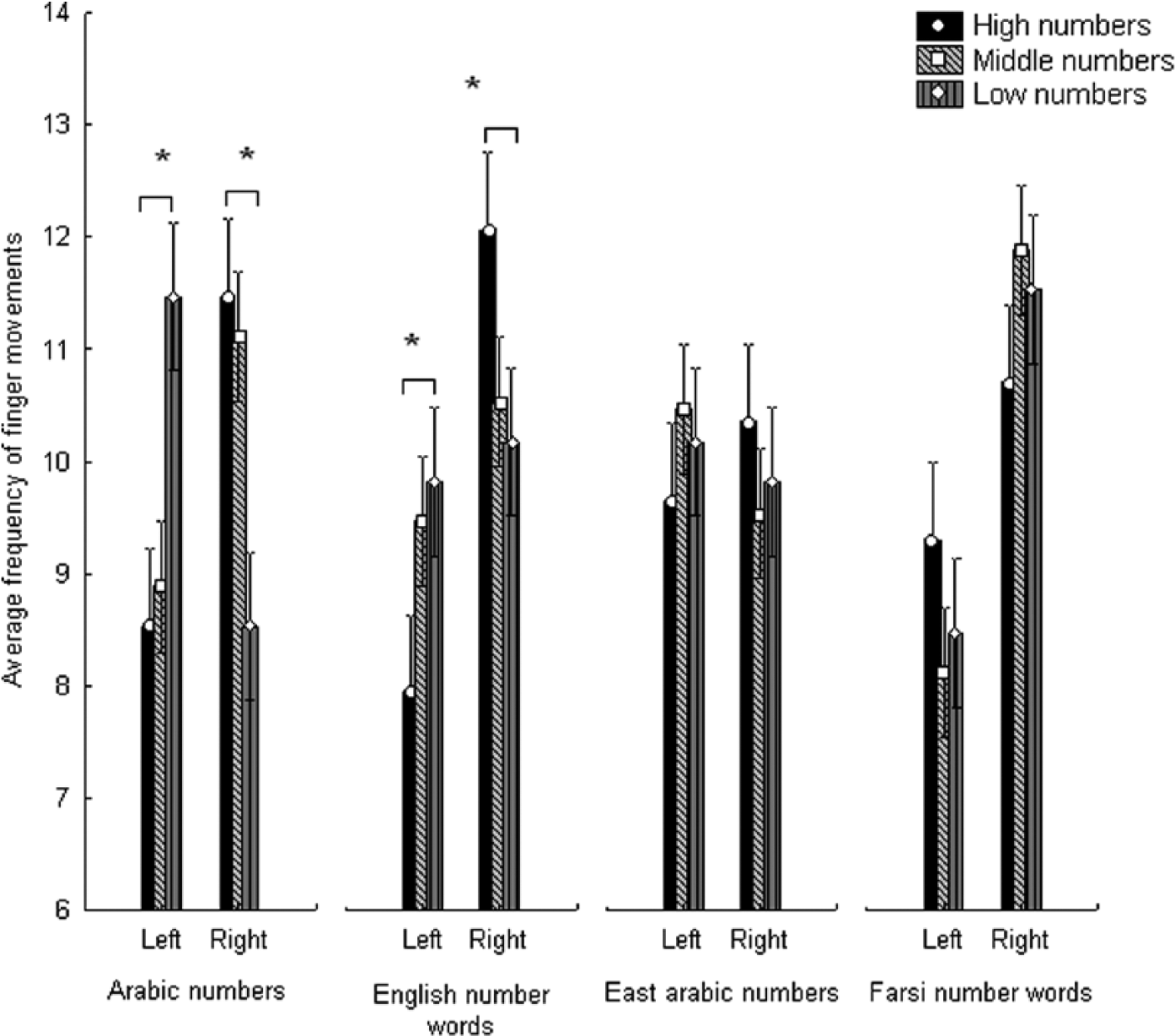
The RMG performance of the Australian participants for all four codes.
Discussion
Several works recognize a central role to the reading direction habit in the mental assessment of numerical magnitude. The SNARC effect has been considered the most relevant experimental evidence in support of this view. However, this role has been re-evaluated in the light of recent works (see Fischer & Brugger, 2011, for a discussion on this argument). For example, a recent study involving bilingual Russian-Hebrew readers (Fischer, Shaki, & Cruise, 2009) has shown that merely reading a single Cyrillic or Hebrew word, changed their SNA from 1 s to the next, clearly indicating that effects of reading are much more fragile than originally thought (Fischer et al., 2009).
Several studies have documented a strict interaction between motor system and numerical representation (Fischer, Warlop, Hill, &, Fias, 2004; Badets & Pesenti, 2010, 2011) as well as the relationship between quantity, space, and decisional processes (Loetscher, Bockisch, Nicholls, & Brugger, 2010; Loetscher et al., 2008; Shaki & Fischer, 2013; Vicario, 2013). In this regard, spatial attention mechanisms might play a key role in explaining these forms of interaction in the human brain (Vicario, 2011; Vicario, Bonní, & Koch, 2011; Vicario, Caltagirone, & Oliveri, 2007; Vicario & Martino, 2010; Vicario, Martino, & Koch, 2013; Vicario et al., 2008; Vicario, Rappo, Pepi, & Oliveri, 2009; Vicario, Rappo, Pepi, Pavan, & Martino, 2012). In fact, the mere sight of a number would induce a spatial attentional bias, which depends on its magnitude, with low numbers shifting attention to the left and high numbers shifting attention to the right space (Fischer, Castel, Dodd, & Pratt, 2003). This, in turn, could influence spatially encoded decisional processes.
In two recent studies (Daar & Pratt, 2008; Vicario, 2012), the authors investigated the random movement selection performance, respectively, in Canadian and Italian participants while looking at Arabic digits. The results showed that left hand/fingers were moved more frequently while looking at low with respect to high numerical digits. Vice versa, a higher frequency in moving right hand/fingers while looking at high with respect to low numerical digits was documented.
In the current study, we used a RMG task to explore the effect of four different numerical codes (i.e., Western vs. Eastern) on the motor decisional processes of two groups of participants (i.e., Iranians and Australians) to address the following arguments:
whether the RMG performance is affected by numerical words as well as by digits (Daar & Pratt, 2008; Vicario, 2012);
(for the Iranian participants only) whether the high familiarity with the Arabic number code and with a language characterized by a left-to-right reading direction (i.e., the English language) induces a SNA effect in the RMG performance while looking at Arabic numerical codes. This question is timely in the light of the results recently provided by Rashidi-Ranjbar et al. (2014) showing that the modulation of spatial attention focus, via lateral head turning, does not affect the RNG performance of Iranian participants with a low familiarity with the left-to-right reading habit, although previous evidence in Western populations (Loetscher et al., 2008);
investigate whether the right-to-left finger counting strategy, which is the most likely in Iranian sample (Lindemann et al., 2011), might exert some kind of influence in the current decision-making task, which involves finger movements.
Results suggest,
The interaction between numbers and motor decisional processes is specific for Western cultures and does not affect the performance of the examined Eastern culture (i.e., Iranians), despite their familiarity with the Arabic code and the English language.
Even numerical words affect RMG, although only in the Western sample.
The right-to-left finger counting strategy, which is the most common in the Iranian sample (Lindemann et al., 2011), does not affect performance in the execution of the current finger movements selection task.
In detail, talking about the performance of the Australian sample, we found that digits written in Arabic code affect the RMG performance, like in previous works (Daar & Pratt, 2008; Vicario, 2012). In particular, we found that left hand fingers were moved more frequently while looking at low quantities and right hand fingers were moved more frequently while looking at high quantities. This provides support to the reliability of the current quantity/motor decision-making interaction across different Western cultures (i.e., Canadian people, Daar & Pratt, 2008; Italian people, Vicario, 2012; Australian people, in the current work). Moreover, the effect sizes (i.e., medium effect size) reported in the current work lead to argue that the current effect of number on RMG has a fair reliability.
A novel result refers to the evidence of a similar effect on RMG performance in association to the exposure to English number words. This agrees with previous evidence showing visuo-motor effects of both digits and number words (Calabria & Rossetti, 2005) on the performance of healthy humans. No effects on the RMG performance were reported for the other two codes (i.e., digits written in East Arabic and Farsi number words).
Finally, talking about the RMG performance of the Iranian participants, no significant effects have been reported in association to all four codes. This result leads to argue the following remarks:
The familiarity with a left-to-right reading direction habit (like in the case of our Iranian participants) does not induce a SNA like-effect in the RMG, although previous evidence (Dehaene et al., 1993) shows that the familiarity with a left-to-right reading direction habit (like in the case of our Iranian participants) leads likely the occurrence of a SNARC effect;
the right-to-left counting strategy, which is the most likely in Iranian people (see Lindemann et al., 2011), results irrelevant in influencing the execution of the current finger movements selection task.
Overall, the absence of a numbers/motor decisional processes interaction in the Iranian sample corroborates the reading direction inconsistency hypothesis proposed by Shaki et al. (2009) documenting no SNA effect in populations (i.e., Israelis) characterized by a reading direction inconsistency for word and digit numbers. In fact, a similar reading direction inconsistency is also reported for the Eastern codes used by Iranian populations (i.e., digits written in East Arabic code are read from left to right; number words written in Farsi are read from right to left). Alternatively, the absence of effects in the RMG performance of the Iranian sample could be due to the particular ISI (i.e., 300 ms) selected for presenting the four different numerical codes in the computer screen. In fact, this particular ISI was chosen according to the result provided by Vicario (2012) with Western participants (i.e., Italian participants). In particular, one could hypothesize that Western codes (i.e., Arabic numerical codes and English number words) did not affect RMG of Iranian participants because the processing of these two codes might have required a longer ISI to affect the RMG performance. This suggestion is motivated by the relatively lower familiarity of the Iranian participants with Western codes (their exposure was limited to a school context) compared with the Eastern codes. In this sense, we cannot exclude that the current ISI might not be appropriate to disclose any eventual effect played by the exposure to Western codes on the RMG performance in the Iranian sample.
Future works devoted in the investigation of this research topic in right-to-left reading habit cultures might clarify this issue by using longer ISI. Moreover, it would be critical that the adoption of statistical procedures for determining, in advance, the size of the samples to be tested, to verify the research hypothesis. The absence of this procedure is currently a limit of our work.
Footnotes
Declaration of Conflicting Interests
The author(s) declared no potential conflicts of interest with respect to the research, authorship, and/or publication of this article.
Funding
The author(s) received no financial support for the research and/or authorship of this article.