




Abstract
We explored themes related to sexual desire (lust) and romantic desire (love) in the lyrics of popular music over the past 40 years. We examined whether there have been changes in the prevalence of lust and love themes and changes in how these themes inter-relate in music lyrics over time. The study sample consisted of the top 40 songs of Billboard Year End Hot 100 single songs for every 5 years from 1971 to 2011 (N = 360). There was a linear decrease over time in the proportion of songs with a love theme and in the proportion of songs with a combination of lust and love themes. In contrast, there was a significant increase in the proportion of songs with a theme focusing on lust in the absence of love. Themes of lust in the absence of love were especially prevalent in hip-hop/rap music, although music genre did not account for the changing themes over time. These shifts in themes found in popular music may both influence cultural norms and reflect a cultural shift toward acceptance of sexuality outside of love relationships.
Adolescents and young adults are exposed to portrayals of human sexuality through a broad range of media outlets (Wright, 2009). Although these media portrayals likely reflect current cultural norms related to sexuality, they may also help shape young people’s sexual attitudes and sexual scripts, especially given a lack of personal experience to draw upon (cf. Huston et al., 1992). In fact, U.S. teens rank mass media as one of the most important sources of sexual information (Sutton, Brown, Wilson, & Klein, 2002). Popular music contains more sexual content than other forms of media directed toward young people (Pardun, L’Engle, & Brown, 2005), and music is among the most popular forms of media for this age group (Rideout, Foehr, & Roberts, 2010). A 2008/2009 U.S. poll found that 8- to 18-year olds spent an average of 16 hr a week listening to music, a large increase over previous years (Rideout et al., 2010).
Studies have documented relatively high rates of sexual content in popular music. For instance, more than a third of popular songs in 2005 contained references to sexual activity (Primack, Gold, Schwarz, & Dalton, 2008). The sexual content of popular music tends to reflect stereotyped gender roles, with women presented as sexual objects for the pleasure of men. For instance, in music videos, women (both artists and secondary characters in the videos) are much more likely than men to be scantily clad, to be held to strict standards of physical attractiveness, and to be shown dancing in a sexually provocative manner (Aubrey & Frisby, 2011). Moreover, sexual content varies by musical genre, with rap music tending to feature the highest levels of sexual objectification of women and country music featuring the lowest levels (e.g., Aubrey & Frisby, 2011; Primack et al., 2008). Moreover, hip-hop and rap lyrics are more likely to display men as hyper-masculine and sex-focused than are other genres (Ward, 2013). Of particular concern, there is evidence that exposure to sexually explicit music and music videos is associated with more permissive sexual attitudes, behavior, and intentions among young adults (Pardun et al., 2005; Zhang, Miller, & Harrison, 2008). Moreover, some initial evidence suggests that exposure to objectifying and degrading music in early adolescence may increase the likelihood of early sexual activity (Martino et al., 2006).
Not surprisingly, popular music has changed over time within Western society. For example, since the 1960s, popular music has become sadder-sounding (Schellenberg & von Scheve, 2012), as well as louder and less variable in pitch and timbre (Serrà, Corral, Boguñá, Haro, & Arcos, 2012). Content analyses of music lyrics have indicated increases over the past 30 years in self-focused and antisocial words (DeWall, Pond, Campbell, & Twenge, 2011) and in references to alcohol and other recreational substances (Christenson, Roberts, & Bjork, 2012). However, just one study has examined long-term changes in the sexual content of popular music. Hall, West, and Hill (2012) examined sexualization, primarily defined as the sexual objectification of others, in the lyrics of popular songs from 1959 to 2009 (at 10-year intervals). The proportion of songs with sexualization content did not increase from 1959 to 1989, staying in the range of 6% to 11%; in contrast, there was a jump in the proportion of songs including sexualization to 27% in 2009 (Hall et al., 2012). Although songs performed by men and by non-White artists were more likely to contain sexualization than those performed by women and White artists, the 2009 increase in sexualization was observed independently of artist demographics.
Prior studies focusing on the sexual content of popular music have taken varied approaches to coding sexual content. Often researchers have coded whether song lyrics or videos contain references to specific sexual acts or specific body parts (e.g., Aubrey & Frisby, 2011; Hall et al., 2012). In some studies, researchers have combined any indications of sexuality (including presentation of dating, kissing, nudity, sexual intercourse, etc.), based on some findings that overall proportion of sexual content is more important than the particular form of sexuality shown (e.g., Brown et al., 2006; Pardun et al., 2005). In other studies, researchers have distinguished between objectifying or degrading sexual content and less offensive sexual content based on the expectation that it is objectifying content that is likely to have a more detrimental effect on adolescents’ attitudes, scripts, and behaviors (e.g., Martino et al., 2006; Primack, Douglas, Fine, & Dalton, 2009). However, sexualization, objectification, and degradation are conceptualized differently across studies and have often been defined quite broadly. For example, Hall et al. (2012) included evidence of a large sexual appetite as an indicator of sexualized lyrics (also referred to as degrading lyrics), and Aubrey and Frisby (2011) considered an artist engaging in provocative dance to be objectifying themselves. Moreover, there was a strong overlap between rating lyrics as degrading and as being about casual sex in Martino and colleagues’ (2006) study of teen music consumption, suggesting that casual and explicit sexual references were, with few exceptions, categorized as degrading.
Current Study
There is widespread public concern that sexual content is increasing in the media, and that this content may have harmful effects on impressionable youth (Hetsroni, 2007). Moreover, there is growing evidence that sexual content in popular media, including popular music, can help to shape viewers’ conceptions of sexuality and sexual behavior (e.g., Bleakley, Hennessy, Fishbein, & Jordan, 2008; Martino et al., 2006; Pardun et al., 2005). Therefore, a longitudinal study of sexual content in music lyrics can help provide a historical perspective on the current state of sexuality in popular music, as well as helping to anticipate future trends. However, there is limited information on long-term trends in the depiction of sexuality in popular music. Although a few studies have considered trends based on qualitative analyses and/or over just a few years (e.g., Bretthauer, Zimmerman, & Banning, 2007), only Hall et al. (2012) have systematically assessed sexualization in the lyrics of popular music over a period of decades.
We sought to conceptually replicate Hall et al.’s (2012) study of sexualization in the lyrics of popular music over 40 years, as well as to extend and build on this work. First, we took a somewhat different approach to coding the sexual content of music lyrics. Rather than coding specific sexual acts or making difficult judgments about whether particular lyrics are objectifying or degrading, we assessed the underlying themes presented in music lyrics. We examined whether songs included an expression of sexual desire for another person or persons, what we refer to as a theme of lust. Second, in addition to considering sexual themes in music lyrics, we considered whether there have been any shifts in the prevalence with which songs deal with themes of romantic love. By considering both lust and love themes in popular music, we were able to examine whether there have been changes in how these two themes inter-relate in music lyrics over time. Finally, we assessed music lyrics at 5-year intervals, rather than 10-year intervals, as done by Hall et al. (2012), in the hope that this would provide a clearer picture of any changes over time.
We also considered two potential mediators of any changes in the themes found in popular music over time: artist gender and musical genre. Based on previous research indicating that male artists are more likely than female artists to sing songs with sexualized and degrading lyrics (e.g., Hall et al., 2012), we examined whether artist gender was related to lust and love themes in popular music and, in turn, whether artist gender accounted for changes in lust and love themes over time. Based on previous research suggesting that sexual objectification is more common in some musical genres than others (e.g., Aubrey & Frisby, 2011), we examined whether genre was related to lust and love themes in popular music and, in turn, whether genre accounted for changes in lust and love themes over time.
To summarize our research questions,
Method
Procedure
We identified the top 40 songs from the Billboard Year End Hot Top 100 single Charts using Billboard Top 100 (n.d.). Billboard Charts rank songs according to sales and downloads, frequency of radio airplay in the United States, and frequency of digital streaming. The final sample consisted of the lyrics of the top 40 songs of the following 9 years: 1971, 1976, 1981, 1986, 1991, 1996, 2001, 2006, and 2011 (the most recent year available when data collection began). There were three song lyrics with non-English content: one in German and two a combination of English and Spanish. The non-English lyrics were translated into English with Google Translate, and a native speaker of each non-English language then reviewed the translations and made any necessary revisions.
Song lyrics were coded for references to the themes of lust and love. Two coders first reviewed lyrics from 40 songs not included in the sample to clarify the codes and establish an acceptable level of reliability. One coder (the first author) coded all lyrics in the target sample. A second coder coded the lyrics for 3 years (1971, 1986, and 2011; n = 120 songs) as a reliability check. Reliability for the categorical lust and love themes was assessed via percent agreement and Cohen’s Kappa.
Measures
Lust
The theme of lust was defined as expressions of sexual desire or longing for another person or persons. A lust theme may or may not include explicit references to sexual acts or to sexually attractive characteristics of the person of interest. As well, a lust theme could take place in a variety of relational contexts, including no contact with the desired person (e.g., observing the person dancing in a club), a casual sexual encounter with the desired person, and an ongoing romantic relationship with the desired person. Thus, the lust theme may or may not take place within the context of a loving relationship. Percent agreement was .88 for the lust theme (Kappa = .76).
Love
The theme of love was defined as expressions of romantic love or caring for a potential, current, or past romantic partner, as well as any content that involved a romantic relationship. The theme of love may or may not also involve expressions of sexual desire. Percent agreement was .94 for the love theme (Kappa = .88).
Secondary variables
To allow us to explore how lust and love themes may relate to one another over time, we derived three additional secondary codes based on the primary lust and love coded variables. Lyrics that contained the love theme, but not the lust theme, were classified as love only. For example, a lyric expressing love to a desired, actual, or past love interest without any expression of sexual desire would be classified as love only (see Table 1 for an example lyric). Conversely, lyrics that contained the lust theme, but not the love theme, were classified as lust only. For example, a lyric focusing on sexual desire toward a desired or actual sexual partner, with no accompanying expression of caring or loving, would be classified as lust only (see Table 1 for an example lyric). Finally, lyrics that contained both lust and love themes were classified as combined lust and love. For example, a lyric expressing a combination of both sexual desire and love for a romantic partner would be classified as combined lust and love (see Table 1 for an example lyric).
Examples of Song Lyrics With Varying Lust and Love Themes.

Gender of artist
Gender of the recording artist was coded as either male (for male soloists or all-male duos/groups), female (for female soloists or all-female duos/groups), or combined gender (duos or groups).
Musical genre
Because there are no sources that categorize all individual songs by genre, we used the genre of the performing artist as an indicator of the song genre. Artist genre was determined through iTunes 11.1.3. Each artist was categorized under one of the following genres: pop, rock, dance, hip-hop/rap, R&B/soul, alternative, country, jazz, musique francophone, reggae, electronic, foreign, Latino, singer/song writer, inspirational, vocal, and blues. Thus, artists were identified by their main genre only. Songs performed by multiple artists from different genres were given multiple genre codes.
Results
To analyze potential changes in the proportion of lyrics with various themes over the 9 years studied, we undertook a series of ANOVAs with year as the independent variable and theme codes as the dependent variables. We considered unweighted linear, quadratic, and cubic trends over time. In reporting results, we describe significant trends over time only.
Lust and Love Themes
Prevalence of themes
To clarify associations between the two primary themes coded (lust and love), we have presented the proportion of the music lyrics with each theme in Table 2. 1 Across the entire sample, 80% of lyrics contained themes of lust and/or love, with 39% of lyrics containing a theme of lust and 62% containing a theme of love (as indicated by the marginal proportions). The secondary classifications (lust only, love only, and combined lust/love) indicate how the two primary codes inter-relate. Specifically, 19% of lyrics showed lust only (with no love theme), 42% showed love only (with no lust theme), and 20% of music lyrics contained themes of both lust and love. Thus, about half of lyrics with lust themes also had love themes, whereas about one third of lyrics with love themes also had lust themes.
Total Proportions of Lyrics With Lust and Love Themes.

Note. N = 359.
Lust
The proportion of lyrics with a lust theme for each point in time is shown in Figure 1. There was no systematic change in the proportion of lyrics with a lust theme across the years studied.
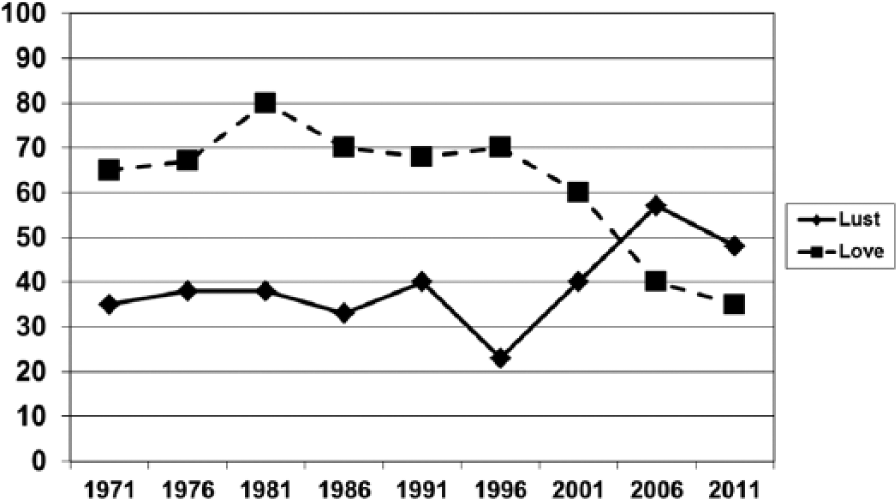
Themes of lust and love in music lyrics from 1971 to 2011.
Love
As illustrated in Figure 1, the proportion of lyrics with a love theme showed a linear decline over time, F(1, 350) = 17.16, p < .001, with a significant quadratic term indicating that lyrics with a love theme tended to rise through the 1970s, before beginning to decline, F(1, 350) = 10.99, p < .01.
Lust only
As illustrated in Figure 2, the proportion of lyrics with a lust only theme showed a linear increase over time, F(1, 350) = 24.29, p < .001. As well, a significant quadratic term indicates that the effect of year on the proportion of lust only lyrics becomes stronger from 2001 onward, F(1, 350) = 5.34, p < .05.
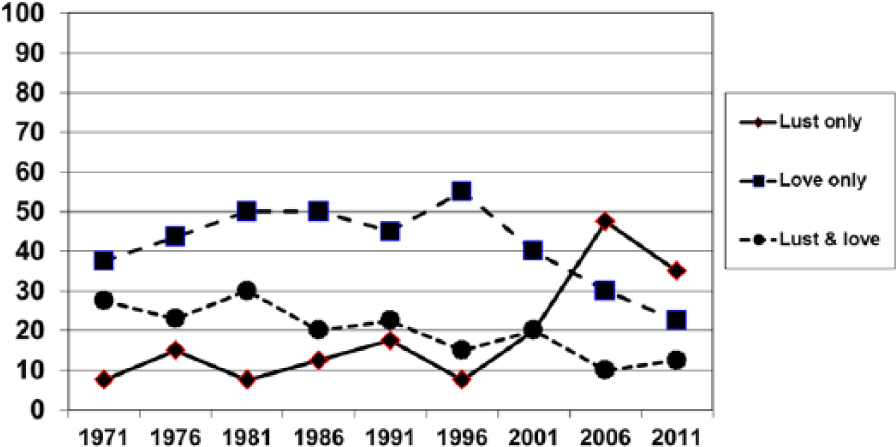
Themes of lust only, love only, and combined lust/love in music lyrics from 1971 to 2011.
Love only
As illustrated in Figure 2, there has not been a significant linear change in the proportion of lyrics with a love only theme. However, a significant quadratic term indicates that lyrics with love only themes increased through the 1970s and then began to decrease in the most recent periods, F(1, 350) = 8.82, p < .01.
Combined lust and love
As illustrated in Figure 2, the proportion of lyrics with combined themes of lust and love showed a linear decrease over time, F(1, 350) = 6.39, p < .05.
Gender of Artist
Across the entire sample, 57% of songs were performed by men, 30% were performed by women, and 13% of songs were performed by combined gender artists. There was a linear trend toward an increasing proportion of women artists, F(1, 351) = 7.81, p < .01, and a decreasing proportion of male artists, F(1, 351) = 4.11, p < .05, over the study period (1971-2011). However, there were no significant associations between artist gender and any of the identified themes (lust, love, lust only, love only, or combined lust/love). For instance, lyrics coded as lust only made up 19% of songs performed by male artists, 16% of songs performed by female artists, and 28% of songs performed by combined gender artists. We repeated all of the analyses examining changes in themes over time controlling for gender of artist and the findings remained unchanged. Thus, gender of artist did not account for the systematic changes in lust and love themes in popular music over time.
Music Genre
The breakdown by genre across the entire sample was as follows: 43% pop, 19% rock, 18% R&B/soul, 12% hip-hop/rap, 4% dance, 4% country, 2% alternative, and 6% other. 2 There were some systematic shifts in song genres appearing in the top 40 songs of Billboard Year End Hot 100 over time. Specifically, hip-hop/rap, F(1, 351) = 66.62, p < .001; pop, F(1, 351) = 5.92, p < .05; and alternative, F(1, 351) = 6.36, p < .05, became more common, whereas rock, F(1, 351) = 13.74, p < .001, became less common. Just two genres were associated with the lust and love themes. Hip-hop/rap was strongly associated with less love (24% vs. 67% in all other genres) and love only (5% vs. 46% in other genres) themes, and more lust (74% vs. 34% in other genres) and lust only (55% vs. 14% in other genres) themes, ts(357) ranged from 5.08 to 6.67, all ps < .001. In contrast, rock was associated with less lust (25% vs. 42% in all other genres) and lust only (6% vs. 22% in other genres) themes, t(357) = 2.65, p < .05 and t(357) = 3.08, p < .01, respectively.
We repeated all of the analyses examining changes in themes over time controlling for the hip-hop/rap and rock genres. We did not control for the other genres because they were not related to music themes and therefore could not mediate changes in themes over time. Rock had minimal impact on changes in themes over time, with all findings remaining unchanged. Although the hip-hop/rap genre accounted for significant variation in all themes other than combined lust/love, controlling for this genre did not alter the general pattern of previously reported changes in themes over time. Notably, all linear trends remained the same—with love and combined lust/love decreasing over time and lust only increasing over time. Thus, music genre did not account for the shifts in lust and love themes over time.
Discussion
We examined themes related to lust, the expression of sexual desire, and love, the expression of romantic desire, in the lyrics of the 40 most popular songs over the past 40 years. Themes of love were more common than those of lust, with 62% of lyrics containing a love theme and 39% containing a lust theme across the entire sample of songs. Contrary to the general trend in Western society toward an increased visibility and accessibility of sexual content across multiple societal domains (Attwood, 2009), we did not find that themes of lust increased systematically over the study period. However, the proportion of songs with a theme of love did decrease over the study period. Interestingly, moving into this century, the proportion of songs with themes of lust became comparable with, and even surpassed, the proportion of songs with themes of love.
The shift in lyric themes was clarified by examining how the themes of lust and love inter-related over time. From the 1970s through the 1990s, themes of love without any sexual overtures were most common, followed by combined themes of lust and love. From 2001 onward, we observed a shift toward themes of lust only becoming more common and outstripping themes of lust and love combined. Put another way, there was a notable shift from lust themes being presented in the context of romantic feelings toward lust themes being presented in the absence of romance. We suspect that these changes reflect a growing cultural acceptance of sexuality outside of the constraints of committed romantic relationships (Garcia, Reiber, Massey, & Merriwether, 2012).
Our findings are broadly consistent with Hall et al.’s (2012) study of sexualization in the Billboard Top 100 music lyrics from 1959 to 2009 (at 10-year intervals). Sexualization was defined largely in terms of sexual objectification, whereby a person’s value comes from his or her physical attractiveness and sexual appeal. We expect that sexualization would overlap substantially with lust only themes within our coding system because sexual desire in the absence of a relational context or romantic interest is most likely objectifying (that is, only physical attraction comes into play). Hall et al. (2012) found that sexualization did not increase from 1959 to 1999, then jumped substantially in 2009; consistent with this pattern, we observed a notable increase in lust only themes from 2001 onward. Our findings build on those of Hall et al.’s (2012) by suggesting that the increase in objectifying sexual content is not a function of a general increase in sexual content, but rather stems from a drop in romantic content and a disentangling of sexual content from romantic content.
Shifts in themes of lust and love in music lyrics likely reflect cultural changes in attitudes toward sexual and romantic relationships. We also considered other factors, specifically gender of the performing artists and changes in the popularity of musical genres, which might play a role. In the current study, artist gender was not associated with themes of lust and love. In contrast, Hall et al. (2012) found that male artists were more likely to perform songs containing sexualization, although this effect was modest (male artists 14%, female artists 7%, and combined artists 13%). It is difficult to directly compare the current findings with those of Hall et al. (2012) because of different coding methods, samples, and time points. As well, our smaller sample size (n = 360 vs. n = 600 lyrics) may have compromised the power of our study to detect small effects. Most importantly, however, in neither study did artist gender account for the observed changes in the sexual content of popular song lyrics over time.
There have been systematic shifts in the genre makeup of the top 40 songs of Billboard Year End Hot 100 over the past 40 years. Based on iTunes genre classifications, songs in the hip-hop/rap, pop, and alternative genres have become increasingly prevalent in the top 40, whereas rock has become less prevalent. However, just two genres were associated with lust and love themes. Most notably, compared with all other music genres, hip-hop and rap songs contained fewer love themes (both love and love only) and more lust themes (both lust and lust only). In fact, lust only themes were four times as likely to be found in hip-hop/rap music as in other musical genres. Consistent with this finding, previous research has documented more references to objectifying and degrading sex in rap music than in other popular genres (Aubrey & Frisby, 2011; Martino et al., 2006; Primack et al., 2008). In contrast, rock music tended to contain fewer themes of lust and lust only than other musical genres. However, in spite of the strikingly high incidence of lust-related themes in the hip-hop/rap genre, song genre did not account for the observed changes in themes of lust and love in popular music over time.
The current findings may have implications for research investigating the potential impacts of sexual references in popular music. Martino et al. (2006) found that teen consumption of music with degrading sexual references, a designation that largely overlaps with sex in a casual content as is common in hip-hop and rap music, was prospectively related to initiation of sexual activity. In contrast, consumption of music with non-degrading sexual references, largely sex within a relational context as is common in rock music, was not associated with earlier sexual activity (Martino et al., 2006). These effects can be understood in terms of observational learning (Bandura, 1977), whereby adolescents learn and internalize sexual attitudes and behaviors depicted in media. Moreover, according to cultivation theory (Gerber, Gross, Morgan, & Signorielli, 1994), adolescents can come to believe that media reflects actual normative experiences of sexuality. Thus, lyrics with lust only themes may influence the attitudes and behavior of some young listeners, perhaps normalizing casual sex and earlier sex. Moreover, our findings suggest that such non-relational sexual content has become increasingly prevalent in the most popular music.
On the other hand, experimental studies of the impact of degrading music on sexual attitudes have been inconsistent at best (e.g., Alcorn & Lemieux, 2011; Sprankle & End, 2009; Sprankle, End, & Bretz, 2012; Wester, Crown, Quatman, & Heesacker, 1997). As well, findings of other correlational studies indicate that adolescents’ exposure to sexual media content in general, regardless of the particular forms or themes of sexuality portrayed, is associated with their sexual activity, intentions, and normative perceptions (e.g., Brown et al., 2006; Pardun et al., 2005). If the prevalence of sexuality in any form is of most relevance, then concerns about the increased sexualization of popular music may be unfounded given that sexual themes have not increased systematically in popular music in the past 40 years.
Limitations and Future Directions
We assessed song lyrics every 5 years over the past 40 years to explore changes in the themes of popular songs. It is possible that some time-related changes between the chosen data points have been overlooked. Although 5-year intervals do provide a somewhat more detailed portrait than 10-year intervals (for instance, as used by Hall et al. [2012)] and Christenson et al. [2012]), it would be ideal to include popular songs for every year of the time period under study. In particular, more fine-grained analyses might help to clarify the major shift in sexual and romantic themes that appears to have taken place around the beginning of the 21st century.
We examined only the top 40 songs of the top 100 songs of each year. Inclusion of the top 100 songs would have allowed for greater generalization to all popular music. As well, this approach systematically underrepresented some genres of music that are popular with subgroups of the population, but that are not well represented in the Billboard charts. For instance, sexual objectification is quite rare in country music (Aubrey & Frisby, 2011; Primack et al., 2008), which accounted for only 4% of songs in the current study. Thus, we expect that a broader sampling of musical genres may have revealed a lower level of lust themes than we uncovered. On the other hand, the top 40 songs of Billboard Year End Hot 100 represent those songs that are most popular, and therefore potentially most influential, among adolescents and young adults.
More broadly, popular music is just one form of media, and other media such as television and cinema may differ in their depictions of sex and love over time (Wright, 2009). Interestingly, studies assessing changes in sexual content in teen-centered films and in prime-time television over the past three decades have failed to confirm the common assumption that sexual content is increasing across a range of media (Callister, Stern, Coyne, Robinson, & Bennion, 2011; Hetsroni, 2007), although these studies did not consider the social context of sexual content. Research examining the impact of media sexuality portrayals on youth sexuality outcomes is shifting from a focus on individual media in isolation to consideration of exposure to multiple media (Annenberg Media Exposure Research Group, 2008). Correspondingly, future research documenting shifts in media content over time would benefit from considering multiple media in combination.
We coded themes portrayed in popular music by analyzing written transcripts of music lyrics. A more holistic study of popular music themes would take into account contextual factors such as artist portrayals, music video features, and musical properties. As well, our coding of lust and love themes failed to capture meaningful variation within these themes. Although lyrics focusing on sex in a casual context are sometimes coded or interpreted as degrading (e.g., Hall et al., 2012; Martino et al., 2006), we noticed that most of the lyrics coded as lust only contained positive and even idealized images of the person desired. Only a small minority of these lyrics portrayed unwanted, disrespectful, or humiliating desire, often communicated through the use of derogatory words such as “ho.” Conversely, not all songs with lyrics of love presented positive portrayals of romantic desire; rather, a sizable portion of these lyrics portrayed unrequited love, infidelity, and romantic rejection. Thus, it would be helpful for future research to consider subthemes of lust and love. Given that individuals of different ages and backgrounds may interpret the same lyric in different ways, it would also be informative to consider how consumers of these popular songs interpret the lyrics.
Our goal was to examine changes in sexual and romantic themes in popular music over the past 40 years. We cannot address the reasons for the observed changes, although the findings suggest that these changes cannot be explained by shifts in artist gender or in the popularity of musical genres. Moreover, we did not address the potential impacts of the observed changes in the sexual and romantic themes found in popular music. We expect, however, that popular media such as music, both reflect changing cultural norms and influence change in cultural norms. At the individual level, we expect that there is a reciprocal influence between individuals’ sexual attitudes and their exposure to popular music with sexual content (cf. Bleakley et al., 2008). In addition to further research examining the potential impacts on individuals who consume music with particular themes, it would be valuable for future research to consider how popular music themes related to sexuality change over time in relation to normative changes in sexual attitudes and behaviors (cf. DeWall et al., 2011).
In conclusion, contrary to popular assumptions that popular music is becoming increasingly sexualized, our findings indicate that sexual themes in popular music have not increased systematically over the past 40 years. However, there has been a significant increase in the proportion of songs with themes of lust in the absence of love. Correspondingly, fewer songs portray sexual desire in the context of romantic feelings. Thus, by considering themes related to romantic desire as well as themes related to sexual desire, we were able to provide further insight into the changing portrayal of sexuality in popular music.
Footnotes
Declaration of Conflicting Interests
The author(s) declared no potential conflicts of interest with respect to the research, authorship, and/or publication of this article.
Funding
The author(s) received no financial support for the research and/or authorship of this article.