




Abstract
The present article reports on an approximate replication of D. Foster’s (1998) study on the negotiation of meaning. D. Foster investigated the interactional adjustments produced by L2 English learners working on different types of language learning tasks in a classroom setting. This replication study duplicates the methods of data collection and data analysis of the original study, but alters the conditions by exploring interactional modifications in the language production of English as a foreign language (EFL) students. It followed the three parameters set originally by D. Foster: speech production, comprehensible input, and modified output. It was thus carried out within the Benemérita Universidad Autónoma de Puebla (BUAP). The participants’ differences were seen as affecting the results of this replication where a corpus shows participants conducting significant amounts of meaning negotiation and producing modified output. This disparity in results is interpreted as deriving from a closer examination of interaction as suggested by Pica, Holliday, Lewis, and Morgenthaler.
El presente estudio es una réplica del estudio de Foster (1998) sobre la negociación de significado. Foster observó los ajustes conversacionales entre aprendientes del inglés como segunda lengua mientras resolvían diferentes tipos de tareas comunicativas. Este artículo duplica los métodos de recolección y análisis de datos pero, modifica las condiciones originales al explorar la interacción entre aprendientes del inglés como lengua extranjera en la Benemérita Universidad Autónoma de Puebla (BUAP). Sigue los mismos parámetros de Foster: producción de lenguaje, calidad del input y calidad del output. La diferencia en los participantes evidentemente afectó los resultados donde el corpus obtenido muestra una producción significativa de negociación e interacción. Esta disparidad coincide con el estudio de Pica, Holliday, Lewis, y Morgenthaler (1989) en donde la interacción negociada se reporta viva y benéfica cuando se usa en combinación con otros principios pedagógicos que promueven la adquisición del lenguaje.
Palabras clave: negociación de significado, calidad de input, calidad de output, tarea comunicativa, principio pedagógico.
This research project was carried out in Facultad de Lenguas Benemérita Universidad Autónoma de Puebla (BUAP), which is responsible for educating and training teachers for foreign language (FL) instruction. Its secondary mission is to provide a link between the communities within the state of Puebla through specific outreach programs such as the courses for modern languages. One such program is known as the “Cursos de Extensión Universitaria (CEU),” which are short courses mainly given to the general public. The focus of this research is located in the interaction occurring among English as a foreign language (EFL) students in this program. The purpose was to explore the ways classroom interaction inhibits or promotes interactional modifications in the language production of students. This study sets out to observe the extent to which EFL upper-intermediate learners produce comprehensible oral input in general and modified output, particularly as they engage in group- or pair-work in a natural classroom setting. It also seeks to see if task type and participant structure may affect speech production and interactional modifications.
Statement of the Problem
Following second language acquisition (SLA) research tradition, the study analyzes language interactions in controlled conditions, determined by “task type” and “participant structure” as accurately suggested by D. Foster (1998, p. 14). But, it goes beyond laboratory conditions situating the study in a “Mexican classroom.” The process of research is also controlled as it follows D. Foster’s (1998) original questions which address the three areas of Long’s (1980) interactional hypothesis exposure to new target language forms.
Given the implicit acquisitional prospective of negotiated interaction, the question arises as to how to best create a learning environment in which negotiation of meaning and interactional adjustments can occur. Since the 1980s, a significant number of studies have been carried out, which observe language learners solving specially designed tasks. These “referential communication tasks” have been used to prompt interaction (Gass, 1997; Gass & Mackey, 2000; Pica, 1994).
Such tasks have been investigated as to how they induce L2 production, the negotiation of meaning, and/or the modification of output (Gass, 1997; Gass & Mackey, 2006, 2007; Mackey, 2007; Pica, 1994). Nevertheless, studies have typically not been conducted in classrooms: The empirical immensity of task-based research in SLA has taken place under laboratory conditions rather than in actual classrooms.
Some classroom-based studies move one step further and analyze conversational group and dyadic interaction among L2 learners. Evidence from these studies shows that students’ interaction improves communicative use of the L2 (Long & Porter, 1985; Taylor, 1987). A question of interest to SLA researchers interested in the pedagogical application of their investigations is whether the results they have obtained can be replicated under “normal classroom conditions” (D. Foster, 1998, p. 6). Task evaluations performed by teachers, then, may serve as a way of testing the transferability of research insights (R. Ellis, 1997). D. Foster (1998) claims, Small group work in EFL classrooms is a widespread practice, enthusiastically endorsed in much of the literature. It is seen as beneficial in several ways: it increases the amount of class time available to an individual student to practise speaking the target language; it decreases the amount of time students spend listening (or not listening) to other class members interacting with the teacher; it avoids the anxiety and self-consciousness that prevent some students from speaking up in front of the whole class; it allows the teacher more opportunity for individual instruction. In sum, it can help to create a positive and relaxed learning environment. (p. 1)
Research of the language produced by small groups has intended to justify these hopes. It has been seen, for instance, that when interacting in small groups students talk more than they do in teacher-fronted activities, that they do not talk less accurately or carefully (Porter, 1983), and that they have the opportunity to practice a greater variety of speech acts (Long, 1996).
Other research has focused on whether students working in dyads or groups can provide each other with the Comprehensible Input (Krashen, 1982, cited in Gass & Varonis, 1985, 1989) that has been argued to be a crucial element in SLA.
In this vein, D. Foster (1998) questions the extendibility of laboratory results on negotiation for meaning in L2 classrooms based on her research findings. She goes on to describe negotiation in interaction and she comes to the conclusion that there was no significant evidence of interaction in the classroom she studied. Classrooms are not as easily controlled as laboratories; this characteristic of classrooms needs to be taken into account when, as D. Foster does, going beyond the laboratory to fulfill what she states as “if language acquisition research wants to feed into teaching methodology, the research environment has to be willing to move out of the laboratory and into the classroom’’ (p. 21).
Further classroom-research is needed to increase data typicality that would support “negotiation of meaning” as a likely construct for SLA (Eckerth, 2009; D. Foster, 1998). This study hopes to contribute to interaction and SLA inquiry through a replication of D. Foster’s (1998) “negotiation for meaning” study within a real classroom
Signification of the Study
Interaction, broadly stated, refers to communication among individuals, particularly when they are “negotiating meaning” or working to prevent a breakdown in communication (Gass, 1997; Gass & Mackey, 2000; Long, 1991a, 1991b; Pica, Doughty, & Young, 1986). Language learning may be seen merely as input, but it requires favorable conditions offered by an interactive context. As such, interaction is a necessary condition for acquisition, which outweighs input received in any other way (Eckerth, 2009). Within SLA research, input obtained via interaction has been conceptualized and researched in terms of “comprehensible input,” “negotiation of meaning,” and “comprehensible output” (Gass & Varonis, 1994; Kaplan, 2002; Lantolf & Thorne, 2006). The interrelatedness of these three notions is concisely expressed in Long’s (1983, 1998, cited in Kaplan, 2002; Lantolf & Thorne, 2006; Long, 1996; Pica, 2005) revised version of the Interaction Hypothesis. In other words, conversational interaction in an L2 forms the basis for the development of language rather than being only a forum for practice of specific language features.
This has been most recently expressed by Long (1996) as the Interaction Hypothesis: negotiation for meaning, and especially negotiation work that triggers interactional adjustments by the native speaker (NS) or more competent interlocutor, facilitates acquisition because it connects input, internal learner capacities, particularly selective attention, and output in productive ways. It is proposed that environmental contributions to acquisition are mediated by selective attention and the learner’s developing L2 processing capacity, and that these resources are brought together most usefully, although not exclusively, during negotiation for meaning. Negative feedback obtained during negotiation work or elsewhere may be facilitative of L2 development, at least for vocabulary, morphology, and language-specific syntax, and essential for learning certain specifiable L1–L2 contrasts.
A question of interest to FL acquisition researchers interested in the pedagogical application of their investigations is whether the results they have obtained can be replicated under “normal classroom conditions” (D. Foster, 1998, p. 6). Within SLA research, input obtained via interaction has been conceptualized and researched in terms of “comprehensible input” (Krashen, 1981, cited in Gass & Varonis, 1994; Lantolf & Thorne, 2006; Long, 1991a, 1991b, 1996), “negotiation of meaning” (Long, 1983; Şahin, 2009; Swain, 2005; Swain & Lapkin, 1995, 1998), and “comprehensible output” (Kaplan, 2002; Lantolf & Thorne, 2006; Swain, 1985, 1995, 2005; Swain & Lapkin, 1995). The interrelatedness of these three notions is concisely expressed in Long’s revised version of the Interaction Hypothesis.
From the middle of the 1980s onward, a large number of studies have been conducted which observe language learners working on specially designed tasks. These “referential communication tasks,” as they have been called (Kay & Jones, 2008; Lantolf, & Thorne, 2006; Pica, Kang, & Sauro, 2006; Yule, 1997), such as information distribution (information shared among vs. split between interlocutors) and information flow between interlocutors (one-way vs. two-way). Usually, then, such tasks have been investigated as to how they induced L2 production, the negotiation of meaning, and/or the modification of output (Gass, 1997; Gass & Mackey, 2000, 2006, 2007; Lantolf & Thorne, 2006; Loewen, 2002, 2005; Mackey, 2007; Pica, 1994, 2005).
Although research on task-based learning is primarily concerned with the cognitive and interactive conditions of language acquisition, such studies on negotiated interaction also argue to be directly or indirectly significant to SLA and L2 pedagogy. Tasks, although they were developed for research, are claimed to be of immediate applicability as a teaching tool in the L2 classroom (Eckerth, 2009; Loewen, 2002, 2005; Long & Crookes, 1987; Long & Porter, 1985; Pica, 2005; Pica, Holliday, Lewis, Berducci, & Newman, 1991). Conversely, these studies have typically not been conducted in classrooms: The empirical immensity of task-based research in SLA has taken place under laboratory conditions rather than in actual classrooms. A question of some interest to SLA researchers interested in the pedagogical application of their research is whether the results they have obtained can be replicated under normal classroom conditions. Task evaluations performed by teachers, then, may serve as a way of testing the transferability of research insights (R. Ellis, 1997, 2003, 2005).
Task evaluations performed by teachers, then, may serve as a way of testing the transferability of research insights (R. Ellis, 1997, 2003, 2005). D. Foster (1998) observed participants while they were working in small groups and in pairs (dyads/participant structure) on different language learning tasks (task types). D. Foster as teacher-researcher, could effectively gather three sets of oral discourse production data: (a) for the amount of speech production, she collected a corpus of 918 c-units; (b) as for comprehensible input (expressed in negotiation moves), she gathered a corpus of 87 moves (9.4% of the total corpus); and (c) for modified output, she collected 20 moves (2.1% of the total corpus). Her results inform no clear effect for task type or grouping on the frequency of incidences of student output in the three areas of the study.
Method
Following SLA research tradition, this study analyzes language interaction in controlled conditions, determined by “task type” and “participant structure.” But, it goes beyond D. Foster’s original research conditions by not only situating the study in a “Mexican classroom” but also using communicative tasks taken from English as a second language (ESL) books applied on an EFL context. The process of research is also controlled as it follows D. Foster’s (1998) questions presented below, which address the three areas of Long’s (1983) interactional hypothesis: (a) Comprehensible Input: To what extent do students in dyads and groups negotiate for meaning to make input comprehensible? (b) Modified Output: To what extent do students in dyads and groups modify their language to make it comprehensible to others? Given the implicit acquisitional prospective of negotiated interaction, the question arises as to how to best create a learning environment in which negotiation of meaning and interactional adjustments can occur. Since the 1980s, a significant number of studies have been carried out which observe language learners solving specially designed tasks. These “referential communication tasks,” have been used to prompt interaction (Doughty, 2000a, b)
The Research Tradition
The design of this study integrates methodological principles as Chaudron (1985) asserts that both qualitative and quantitative approaches to research on second language learning are considered, with the special case of second language classroom research being used for illustration. It is evident that both approaches are relevant to determine (a) the important variables to investigate and (b) the relationships those variables have to second language learning outcomes. Based on these principles, this study is mainly quantitative, but it includes some qualitative assumptions as Doughty’s (2000) accurately suggests, By hearing laughs and calm breathing, researchers, when transcribing and coding data in c-units, may assume that a relaxed atmosphere is being preserved so as to permeate their result with qualitative comments . . . the researcher’s qualitative comments enhance which otherwise would be raw numbers, percentages and statistics by enlightening numbers with meaning. (p. 110)
This study codes participants’ utterances in c-units (communication units) that generated frequencies which were interpreted on a qualitative basis following Doughty (2000) criteria of meaning negotiation.
Measuring Spoken Performance in Interaction
One of the interesting features within interaction research has been the different ways in which researchers have featured and measured performance (Skehan, 1998; Skehan & Foster, 1999; Yule, 1997). To a considerable extent, the different choices that investigators have made have reflected their theoretical positions. With respect to complexity, P. Foster, Tonkyn, and Wigglesworth (2000) argue strongly for the use of what they term the AS-unit (Assessment of Speech) through communication units (c-units). This, they argue, is more appropriate for a spoken language context, and provides a more appropriate measure than Text-units (T-units as described by Hunt, 1965, cited in P. Foster et al., 2000). In this vein, D. Foster (1998) and Eckerth (2009) articles analyze speech production through communication units (c-units) that are explained as Independent utterances which provide referential or pragmatic meaning . . . By excluding false starts but allowing for ellipses, c-units are arguably more sensitive to the transmission of meaning and a more appropriate measure for an investigation into oral language. (Brock, 1986, cited in D. Foster, 1998, p. 8)
Similarly, they are defined by Chaudron (1988, p. 45) as “an independent grammatical predication: the same as a T-unit; except that in oral language, elliptical answers to questions also constitute complete predications.” In other words, c-units account for multiple messages within each individual turn and, therefore, provide “a sensitive and accurate measure of the amount of language produced by the participants” (Abrams, 2003, p. 162).
The Participants
There are 10 students in an EFL upper-intermediate level class within the “Cursos Estacionales.” The participants are presently studying the 8th of 10th required English courses to obtain a diploma certifying their linguistic competences. They share the same L1 background in Spanish as well as their Mexican nationality. Their ages range from 20 to 36. Six are females and four are males.
Pseudonyms were used to identify learners: Nashielly, Rodrigo, Laura, Victor, and Karla have a master’s degree in business administration, whereas Francisco, Patty, Rocío, Dulce, and Alberto hold a bachelor in arts degree in management. Participants have been involved in business negotiations overseas (mainly in the United States and the United Kingdom). They have also carried out important projects with international companies such as General Motors and Volkswagen. In addition, the upper-intermediate students are to take Cambridge First Certificate. In that respect, students are trained in the communicative competences necessary to fulfill Cambridge language standards. In opposition to D. Foster’s (1998) participant election criterion where subjects “can be seen as highly typical of the very large number of part-time learners of English throughout Britain,” these learners were representing different social realities and professional profiles (p. 5). In this respect, such criterion is seen as a wider view of context, which acknowledges different social backgrounds. Thus, these are special highly trained business people who do not belong to the common random sample from the part-time learners in the United Kingdom. Besides, these ones are learning English within a FL context as opposed to D. Foster’s participants who were totally interacting in different L2 settings, not only in the classroom but also out there in the streets and suburbs. These 10 participants considered necessary to enhance their English competence through constant practice of language. That is one of the main reasons they took the course. The second reason was to be involved in an interactional course where spoken production was the priority. As the Facultad de Lenguas BUAP is working with spoken interaction competences as the Common European Framework of Reference (CEFR) established, participants saw in this program an opportunity to do so.
The Setting
The “CEU” were established to promote the acquisition of a FL through admitting students from different ages and backgrounds. The English program’s syllabus entails five levels of language attainment: intro, basic, intermediate, upper-intermediate, and advanced. This program runs two modalities: weekly and weekend courses. Weekly courses are taken twice or 3 times a week to account for 100 hrs of language learning, whereas weekend sessions are taken on Saturdays and Sundays to account for 50 hrs of language learning. A real classroom-environment was thus preserved in the weekend modality. In addition, the protocol of data gathering was scheduled 4 times according to the class routine. That is, recordings were taken within four normal classes while students were performing negotiation of meaning tasks adopted from two sources: the Cutting Edge upper-intermediate book (Cunningham & Moor, 1999), Tasks 2, 3, and 4 and the MacMillan’s teaching website, Task 1 (Kay & Jones, 2008).
At the time of data gathering, the class had been running for more than 3 months, and all students had been properly placed in the upper-intermediate level. Not only did the teacher conduct research himself but he also influenced students’ grouping arrangements so that the possible bias of “the observer paradox” (Labov, 1972, cited in Nunan, 1997) could have been significantly reduced. In other words, both the teacher’s and students’ common communicative task-based approach behaviors were exerted weekly as part of the class ongoing pace; nothing was altered during the whole research process. Thus, students were acquainted to work in dyads and groups to solve different communicative tasks during the entire course. In addition, their permission was granted to use the mp3 recorders to gather the data for this article.
The Tasks
This study used, as D. Foster (1998) suggests, four types of tasks: two for students working in dyads and two by students working in groups of five. Two of the tasks should only be carried out if the subjects shared “individually held information.” These are defined as “required information exchange tasks.” The other two tasks should supply similar information to all subjects. They are explained as “optional information exchange tasks.”
1. A conscious raising task-text repair: Learners were asked to decide on the meanings of some British idioms by selecting the correct option from three different choices within two given worksheets (A and B). Then, the dyads had to work out an appropriate version of the idiom to fill in some sentence gaps within Worksheet C, pointing out that each idiom appears only once and that it may be necessary to change the verb forms. Completing a text repair task involved inserting lexical items such as idioms in accordance with tense and subject–verb agreement. Although this task focuses on specific L2 features, it does not face participants with isolated, de-contextualized linguistic forms, thus having them make use of their own language resources. However, as there is no obligation to exchange information, this task is classified as optional information exchange.
2. Picture differences: Each affiliate of the dyads was provided either Sheet A or B of a photocopy of 12 small line drawings. Some of these drawings had slight discrepancies. Without showing each other their versions, the learners had to describe the pictures in their worksheet to the partner and decide on their correct order. In addition, dyads were required to create a coherent story line with those pictures. That could only be done by learners trading information, and was typified as “a required information.”
For the small group arrangement the tasks recorded were as follows:
3. Consensus, the great diamond robbery: This is a discussion task in which subjects were supposed to pose a problem and then they were given a number of possible courses of action. Once they had reached a consensus on which path to follow, they got a further piece of information which divulged the consequences of their alternative and set them a new problem to solve. They again had to reach a consensus, which entailed further problems and options until the task ended. Each group had to work out a plan to steal the precious diamond and escape without getting caught. As all the information was available to all the members of the group, this task was typified as “an optional information exchange.”
4. The Supersaver map: Each participant received a copy of a newspaper article about the construction of a new supermarket, a map of the possible sites where the supermarket could be built and an identity card specifying not only the role each participant had within the council of the town but also giving significant clues about the roles which the others in the group did not know.
Time was given for participants to familiarize with their roles. Then, the chairperson began the debate ensuring that everyone had anything to say. At the end of the debate, students took a vote on whether to allow the supermarket to be built. As this task could not have been carried out without subjects sharing their individually held information with the other members of the group, it was typified as “a required information exchange.”
Data Collection, Transcription, and Coding
The first 10 min of every interaction were transcribed and coded. The transcription system used was fairly standard. Three periods were used to indicate a longer pause. A question mark indicated raising intonation, an exclamation mark indicated noticeable emphasis, and quotation marks identified words that were read from the worksheet. Score transcription had been used to better account for pauses and overlapping turns. Doughty’s (2000) model was used for faster identification of breakdowns in communication and for revealing how the errors were followed up and repaired (see Figure 1). Triggers, signals, responses, and reactions were identified, classified, and coded. No effort has been made to select examples of interactional sequences systematically or to choose negotiation moves according to specific criteria, for example, their degree of “typicality.” The only principle that guided the selection was the desire to show at least one interactional sequence from each of the learners’ dyads and groups in the corpus.

Negotiation process.
Amount of Speech Production
Not only did the coding of the data include the number of turns and c-units (communication units) but also noted how many of these were produced during the completion of tasks. The definitions for these units were adopted from Long (1983), a c-unit is “a t-unit or isolated phrase not accompanied by a verb, but which has communicative value” (p. 1). This study used c-units as the primary units of analysis, as they most appropriately account for those utterances that might not be complete, lacked a verb, or are simply exclamations, but are used as elements for communication.
The Negotiation Model for Analysis
The negotiation model proposed by Doughty and Pica (1986) and used by D. Foster (1998) was adopted for this study (Figure 1). According to Doughty and Pica (1986), the essential feature of the negotiation sequences “is the opportunity that is provided to the learner to process utterances in the L2 which become more comprehensible” (p. 43). Her model incorporates a trigger, a signal, a response, and a reaction. A trigger is “an utterance or part of an utterance that is not understood” (p. 48). A signal is used by the interlocutor to express a lack of comprehension. A response then comes from the first speaker trying to repair the problem. A reaction is an extension or a response to the repair. In this article, direct and indirect responses are considered without further differentiation as both are part of the negotiation process.
To operationalized signals, Long’s (1983) confirmation checks, clarification requests, and comprehension checks will be used. These types of input modifications are used to negotiate meaning. Also following Long, the responses in the data will be identified as repetition, expansion, or reformulation. Along with the original study, negotiated interaction was coded for clarification requests (a request for further information from an interlocutor about a previous utterance), comprehension checks (the speaker’s query of the interlocutor(s) as to whether or not they have understood the previous speaker utterance(s)), and confirmation check (the speaker’s query as to whether or not the speaker’s [expressed] understanding of the interlocutor’s meaning is correct; D. Foster, 1998, referring to definitions from Chaudron, 1985; see the appendix).
Modified Output
Also in accordance with the original study and to measure modified output, the transcripts were coded using the definitions from Pica et al. (1989) for semantic modification moves (through synonym, paraphrase, for example), morphological modification moves (through addition, substitution, or deletion of inflectional morphemes and/or functors), phonological modification moves (the pronunciation of the phonemes /s/ in third-person singular and the use of /-t/, /-d/, /-ɪd/, /-əd/ suffix, also –d in simple past tense), and syntactic modification moves (through embedding and elaboration in clauses).
Results and Discussion
The replication sought to explore whether, insofar as D. Foster’s findings concerning transferability of laboratory results to classroom conditions, transferability of experimental research findings also applies to classrooms in a different socio-cultural context. In that, this study closely followed the research procedures adopted in the original study, further evidence will hopefully contribute to the claim that negotiation of meaning is not only a primary factor in FL acquisition but also the main trigger of SLA. In this vein, Eckerth (2009) contributed with differentiate findings, by using immediately stimulated recall interviews that reveal transcript turns where L2 German students noticed and recognized that they acquired a morphological, lexical, or syntactical item. In this regard, Gourlay (2005) and Harris (2005) posit that activation of negotiation of meaning through the task-based approach is thoroughly supporting the paradigm that selective attention and interpersonal communication generate SLA.
When students signal incomprehension about a lexical, morphological or complexity task item, a response from the other interlocutor is given trying to fill the gap . . . 15 conversational turns later the item is acquired by the speaker who asked for clarification ( in turn 7) by using it abundantly through the entire act speeches of the following turns. (Gourlay, 2005, p. 115)
As will be specified in the following sections, the relevant parameters such as participants, setting, tasks, data collection procedures, and data coding were identically or closely comparable with those in the original research. While observing task-based language learner performance in an actual EFL classroom, the coded data were presented in the form of simple totals and percentages. In the following section, the information derived from examination of students’ classroom performance is presented beginning with Table 1 where the composition of learner dyads and groups (e.g., 1a, 2b, 3a, 4b) and their distribution across tasks (indicated by numbers) are typified. Mp3 recorders are identified by letters (e.g., a, b, c). In the present study, it was generally the same students working together on the different tasks. This allowed for a performance comparison across learners as well as across tasks. The data will be presented according to the parameters aforementioned: The first category concerns language production, the second category examines comprehensible input, and the final one looks at modified output. Within each of these three categories, tables specify the performance of the dyads as numbers and percentages. (Quote deleted)
Students Included in Each Dyad and Group (Dyad and Group Identified by Number).

Language Production
The Table 1 shows that, in dyadic interaction, cross-talk clearly reveals a less speech production for Task 2 with required information exchange (30.75%), as compared with the grammar Task 1. Contrastively being the exception Dyads 2a and 2e that produced 159 and 158 c-units, respectively. As revealed by Table 2, this does not only hold true in terms of the total of c-units produced by all dyads, but mostly also in terms of percentages. Such a result is in conflict with D. Foster’s data, which showed an opposite ratio of participants’ c-units with less language production within the optional information exchanged Task 1. Furthermore, compared percentages across dyads are inconsistent with D. Foster’s study (1998) due to the fact that the overall amount of language production in this replica does not vary widely. This is fairly supported by the standard deviation, which is low (3.05) with all the scores clustered around the mean (131.8).
Number of c-Units Produced by Students in Dyads and Groups.

This table further suggests that group participant structure allows for the production of a similar score. For Task 3, participants’ scores vary slightly from Groups 3a to 3b with a difference of just three c-units. Moreover, for the group task with required information exchange participants’ language production is measured with a range of 53 c-units. The results summarized in Table 2 are similar to D. Foster’s original study where Task 3 is associated with more language production as well. Standard deviation is even lower (2.5) showing an index of minimum disparity among scores which assumes that scores do not vary widely in groups as well.
As described in the previous table, there is a slightly wider range of scores throughout all the tasks as a whole showing a mean of 144 and a range of 101 c-units. Furthermore, the standard deviation of 3.5 is also low indicating a narrow distance of the scores from the mean. There is a slight possibility that D. Foster’s (1998) claim that the conscious raising task-text repair (1) seemed to promote the production of an extensive number of c-units.
Comprehensible Input
Negotiation of meaning was measured by determining the number of negotiation moves (comprehension checks, confirmation checks, and clarification requests) made by each dyad and group. The scores for these variables are shown in Table 3. The least (9.23%) was produced by Dyad 1e doing the same task. The most negotiation moves (20.65% of c-units) were produced by Group 3b doing an optional information exchange task.
Number of Negotiated Input Moves as % of Total c-Units.

As can be seen in Table 3, a similar tendency indicates that the second highest score for negotiation moves (20.32%) was for Group 3a performing an information exchange task as compared with the second lowest (19.71%), which was Group 4a doing a required information exchange task.
This article shows students negotiating to a significant extent (16% of the total corpus of 2,016 c-units). In all, 313 negotiation moves were produced as a result of accomplishing all tasks as opposed to 87 signals of clarification in D. Foster’s study (9.5% of her total corpus). As required information exchange tasks were adapted to elicit participants’ negotiation by having them hold and give specific information, they were expected to elicit more meaning negotiation.
Contrastively, concise results reveal that optional information exchange tasks are generating as much negotiation moves as the required information ones. These insights are seen as a direct consequence of using different tasks and EFL participants within a different socio-cultural background. This outcome strongly contrasts with Eckerth’s (2009) and D. Foster’s (1998) findings that show participants producing more negotiation moves for the required information exchange tasks. Thus, D. Foster’s “pretend and hope strategy” is clearly not being used by the participants of this study that seem to engage vigorously in meaning negotiation when a breakdown in communication is produced. The significant amount of modified utterances indirectly supports this claim.
L2 D. Foster’s participants let signals of clarification pass without any modification due to the fact they felt was not necessary to negotiate meaning. A yes or no answer was enough to clarify a comprehension check. Conversely, the EFL participants of this study were highly involved in clarification because they perceived that engaging in constant communication would enhance their FL competences to the fullest.
It seems warranted to conduct research which would verify such predictions in real classrooms, in settings where learners share their mother tongue and have limited out-of-school exposure to the target language (Eckerth, 2009; D. Foster, 1998; Gass & Mackey, 2006; Kaplan, 2002; Mackey, Gass, & McDonough, 2000). The present article contributes to this line of inquiry by exploring the occurrence and value of “negotiated interaction” among EFL upper-intermediate Mexican learners prompted by optional and required information exchange tasks. It thus inquires to what extent “meaning negotiation” is attempted by these students in dyads and small group work.
Table 3 clearly reveals that students without the obligation to exchange information reacted rather similarly in the amount of negotiation they undertook. This evidence is contrasting with D. Foster’s (1998) findings that show participants reacting very differently during the completion of an optional information exchange task. In the same vein, the obligation to trade information, entailed by Tasks 2 and 4, produced similar results (both of them scored 176 moves), so as to show that negotiation of meaning is prolific when participants are engaged in required information exchange tasks (Doughty & Pica, 1986, cited in Doughty, 2000a, b).
As shown in Table 1, the instances of c-units these tasks generated from participants were within a much narrower range of 11.42. Despite the high frequencies of negotiation of meaning, the corpus is of 313 moves representing 16% of the total corpus compose of 2,016 c-units. Unlike D. Foster’s (1998) insights that show participants not engaging in meaning negotiation, this study shows most students at least negotiating to some extent. Table 4 shows that all of participants thus attempted some negotiation work.
Distribution of Negotiation Moves Within Dyads and Groups (Expressed as Number of Moves Students Made to Prevent a Breakdown in Communication).
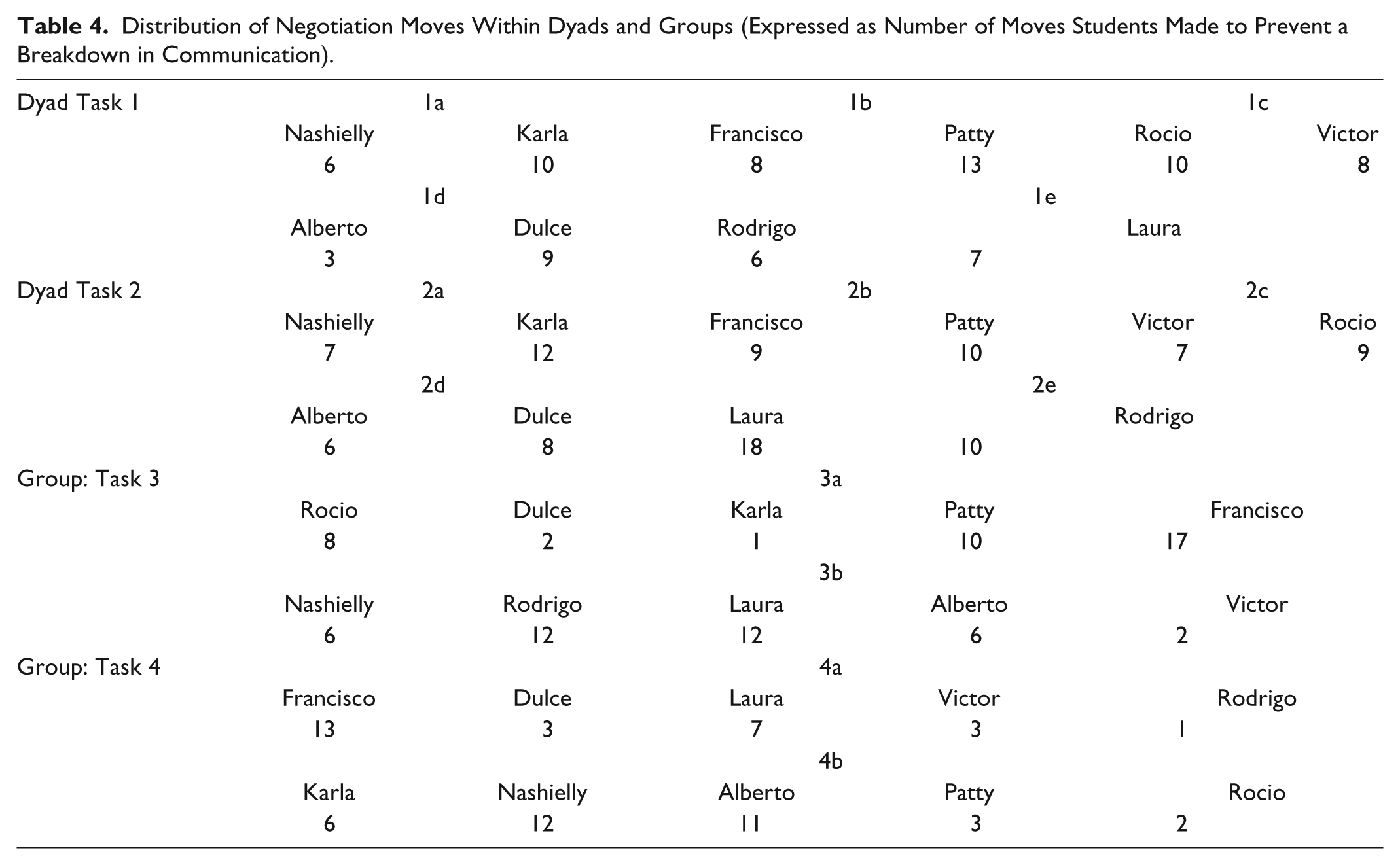
Table 4 illustrates the distribution of negotiation moves within dyads and groups. As can be seen, an analysis of the way that individual members shared the production of negotiation moves reveals, not surprisingly, that some shared more or less equally (e.g., Dyads 1c, 1e, and 2b, and Group 3b), others less equally (e.g., Dyads ld and 2e and Groups 3a and 4a), and yet others very unequally (e.g., Dyad 2a and Group 4b). It is important to note that the required information exchange task showed the shared responsibility for negotiation only in 2b, 2c, and 2d (three of them dyads) and Group 4b. On these occasions, one member was very dominant: In 2b, Patty produced 10 and Francisco 9 negotiation moves; in 2c Victor produced 7 and Rocio 9, respectively; in 4b, Nashielly is slightly exceeding Alberto with 12 and 11, respectively. A closer look at the data in Table 8 reveals how dyads shared the production of meaning negotiation moves as compared with the most reluctant interlocutor.
As compared with D. Foster’s (1998) original study, this article shows participants meaning negotiating to a great extent.
The incidence of modified output (i.e., utterances that were morphologically, semantically, syntactically, or phonologically altered in response to a negotiation move) was calculated for each dyad and group. Most modification moves were made by Dyad 2e doing a task that required agreement on sequencing some line drawings. Furthermore, Table 5 shows the other dyads closely following 2e (e.g., 2d with 14.61% and 2c with 14.58%). Interestingly, for Type 1 that was a conscious raising task-text repair, Dyad 1c produced 20 interactional modifications (14.60% modified output), closely followed by Dyad 1d that produced 15 instances of modified output (15.15% of the total of c-units produced by this dyad in particular).
Distribution of Negotiation Moves Within Dyads and Groups (Expressed as Number of Moves Students Made to Prevent a Breakdown in Communication).

Table 5 illustrates the distribution of negotiation moves within dyads and groups. As can be seen, an analysis of the way that individual members shared the production of negotiation moves reveals, not surprisingly, that some shared more or less equally (e.g., Dyads 1c, 1e, and 2b and Group 3b), others less equally (e.g., Dyads ld and 2e and Groups 3a and 4a), and yet others very unequally (e.g., Dyad 2a and Group 4b).
As can be seen in Table 6, figures are broken down to show the negotiation moves each interlocutor made within dyads. In the majority of cases, the reluctant participants’ ratio of negotiation moves varied widely from their interlocutors. In Task 1, Karla negotiated twice as vigorously as Nashielly. Similarly, during the completion of Task 2 Karla was the one who exceeded in the meaning negotiation endeavor. Francisco who has been seen as a dominant interlocutor in Task 4a producing 13 negotiation moves just produced 8 in Task 1 with a 62% as compared with Patty who contributed 38% more negotiation moves to the same task.
Number of Negotiation Moves Produced by Each Student in Dyads.
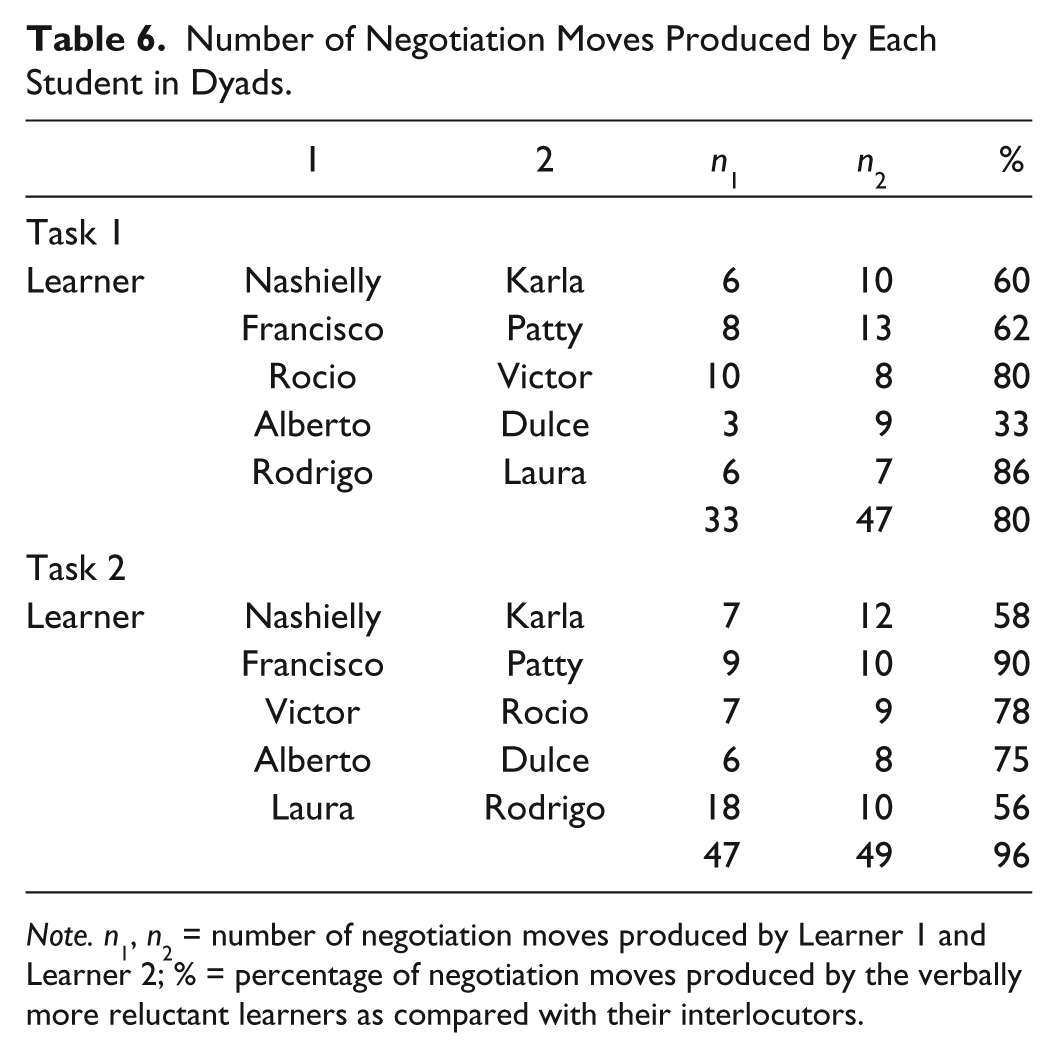
Note. n1, n2 = number of negotiation moves produced by Learner 1 and Learner 2; % = percentage of negotiation moves produced by the verbally more reluctant learners as compared with their interlocutors.
Table 6 shows that, in dyadic interaction, cross-talk comparison sheds light on meaning negotiation. Laura who was ahead with 14% of Rodrigo in Task 1 increased their dominance with a 44% in Task 2 with required information exchange. Almost the same ratio is kept by Rocio and Victor with Rocio being slightly above Victor throughout Tasks 1 and 2. Dulce also maintained the dominance of meaning negotiation with a 67% ahead in Task 1, but reducing her dominance to 25% during Task 2.
Table 6 reveals that the interlocutor who dominated in one dyad dominated all dyads and tasks. Karla exceeded twice as compared with their interlocutors when signaling incomprehension in both tasks. Similarly, Patty who dominated her interlocutor producing twice as many negotiation moves in Task 1 reduced his domination in Task 2. Furthermore, Rocio and Dulce slightly exceeded their interlocutors when asking for clarification in Task 2. It is important to note that interactants engaged significantly in meaning negotiation during Task 2 with required information exchange. This insight is partially in accordance with D. Foster’s (1998) and Eckerth’s (2009) study.
Modified Output
Table 5 summarizes cross-talk analysis through group interaction. Group 3b produced 43 frequencies of interactional modifications (23.37%), whose participants carried out a consensus task, nearly followed by Group 3a with a narrow range of 6. However, within the supersaver’s map task with required information exchange, participants produced a wide range of 13 modified outputs. Group 4b produced most interactional modifications (42 modified output moves or 22.11%). Participants produced a significant number of interactional modifications. A concise analysis throughout the scores is called for as students generated a significant amount of optional and required information exchange. This is seen as evidence of the occurrence of modified output that would be a direct consequence of cognitive processes (Pica et al., 1989). D. Foster’s (1998) claim that if one student dominated the conversation in one task, he or she tended to dominate across all tasks and group structures, is strongly proved by the empirical data of this article. Data within this study are showing participants negotiating to some extent with all signals of incomprehension triggering a significant quantity of interactional adjustments.
Tables 7 and 8 show participants eagerly engaged in task completion producing high frequencies of interactional adjustments. This insight is due to the fact that signals of incomprehension were not always directed at one individual, but many who took responsibility for answering. In contrast, 4a was the participants’ arrangement that produced less output adjustments. The score is also informing, a total of 29 interactional output moves were attempted as a response to Francisco exhaustive meaning negotiation. These interactional adjustments were highly semantic due to the fact that participants held individual informative roles that were crucial to the task completion.
Distribution of Types of Modified Output Moves Within Dyads (as Defined by Pica, Holliday, Lewis, & Morgenthaler, 1989).

Distribution of Types of Modified Output Moves Within Groups (as Defined by Pica, Holliday, Lewis, & Morgenthaler, 1989).

As can be seen in Tables 7 and8, the tasks with required information exchange provided most output modifications. Such results highly contrast with D. Foster’s (1998) study where groups and dyads were generally noisier and none of the participants took the responsibility of answering confirmations and clarifications. In addition, the absence of any strict requirement to fulfill the task inclined her students not to pay close attention to the form of their language.
As can be revealed in Tables 4, 7, and 8, the most notable feature is there were not any frequencies of zeros. That is, students remaining silent or applying D. Foster’s hope and pass strategy. Such an insight is definitely in conflict with D. Foster’s quantitative results: 28 scores were for 0, and a further 8 were for only 1. Nevertheless, this study is strongly related to the data reported by Pica et al. (1989), which showed that their 10 NSs made a total of 327 negotiation moves during the three tasks they were set, and that the 10 non-native speakers (NNSs) interlocutors made 327 responses, of which an impressive 116 were modified. Within this study, a total of 312 responses were interactional modified out of 313 negotiation moves. Furthermore, D. Foster’s claim that a NNS deciding that a breakdown in communication is the fault of his NNS interlocutor, might not feel obliged to attempt a repair is inconsistent with this study results. Overall participants were engaged in meaning negotiation to some extent with 99.6% of output adjustments being produced by more competent interlocutors.
Summary and Conclusion
This study contributes to the applied linguistics field through showing reliable data that support “negotiation of meaning” as an effective way of constructing Foreign Language Acquisition. However, it was carried out with a small sample that makes it hard to generalize to a wider Mexican population. In addition, by virtue of being a cross-sectional study where interactions had been recorded through four class sessions, a longitudinal study taking into account recalled sessions with participants was not possible to be accomplished. Although figures seem not to address a significant correlation between task type and participant structure, tasks with optional information exchange elicited a considerable amount of meaning negotiation and interactional adjustments.
(a) Amount of language production: Participants uttered an impressive corpus of 2,016 communication units as opposed to D. Foster’s corpus of 918 c-units. This in turn supports the fact that they were intensive language producers. None of them remained silent or shy. Even the ones who appeared to be at times hesitant contributed with substantial lexical items to the fulfillment of the four tasks. (b) Comprehensible input: A significant corpus of meaning negotiation was also gathered (313 negotiation moves) as opposed to D. Foster’s 7 moves. Participants seemed to be signaling incomprehension vigorously when a breakdown in communication was raised. (c) Modified output: A noteworthy corpus of interactional modifications was obtained (312 responses) as opposed to D. Foster’s 20 moves. In addition, all participants produced at least some output as a response to a signal of incomprehension. Being nearly all negotiation moves responded with interactional modifications. The consciousness raising task, with optional information exchange, generated morphological modifications throughout four of five dyads. That is, this study showed participants’ grammatical awareness by identifying the morphological inflection of the third-person singular in present tense when coping with some phrasal verbs such as “economical with the truth” in the conscious raising task-text repair (1). This research based on tasks taps into grammatical modifications and shows that learners can be manipulated into negotiations for meaning that involve verb tense and aspect.
In this vein, Pica, Kanagy, and Falodun (1993) accept that negotiation for meaning (when it occurs) is far more likely to be over lexical items than over grammatical morphology. Eight of 10 participants of this study nevertheless showed grammatical awareness by identifying the morphological inflection of the third-person singular in present tense when coping with some phrasal verbs in Task 1. Pica et al. (1993) calls for research based on tasks that will “tap into grammatical modifications” and which will presumably show if learners can be manipulated into negotiations for meaning that will involve, for example, verb tense and aspect. Again a close view of the data reveals that the conscious raising grammar task fairly answers Pica’s query by triggering most students’ signals of incomprehension that were morphologically modified by their interlocutors.
Implications for Teaching English for Students of Other Languages (TESOL): A Classroom Stance of Negotiation of Meaning
It is needed to explore why so many of the students in this study were motivated to initiate or pursue negotiation for meaning. It is not difficult to suggest possible explanations. According to D. Foster (1998), to hold up the interaction every time there is a problem utterance, and painstakingly to attempt to repair it is a sure way of making the task frustratingly slow. Similarly, indicating to others each time you fail to grasp their meaning is a sure way of making yourself look and feel incompetent.
Unlike D. Foster’s participants, the students of this study were willingly engaged in meaning negotiation. They did not seem to be embarrassed or incompetent due to the fact that they perceive negotiation on a different way. Such perception was strongly related to the practice of language. The more they negotiated, the further they accomplished their own stance of the tasks’ purposes. Contrary to Aston’s (1986, cited in Eckerth, 2009) assumption that those group-work tasks that are designed to maximize negotiation for meaning may end up de-motivating and discouraging students by making them feel unsuccessful and ineffective; the tasks adapted in this study had an opposite effect. In the same vein, Pica (1994) acknowledges that negotiating for meaning is a natural communication strategy that can be harnessed to promote SLA. The present study directly supports this claim.
Implications for a Task-Based Approach Within SLA
It is strongly acknowledged that the task designed procedures proposed by Pica (1994), Gass (1997), Gass and Mackey (2006), Eckerth (2009), and D. Foster (1998) to promote meaning negotiation. Students singular response to tasks, within this study, demonstrates that tasks of the kind commonly used in SLA research “are not just performed but rather are interpreted, resulting in activity that is ‘constructed’ by the participants in accordance with their particular motives and goals” (R. Ellis, 2003, p. 187).
Using transcript-based and individualized post hoc tests, some studies show in what ways learners exploit tasks beyond the pedagogical focus of the task, thereby adapting the task to their individual learning needs and goals (Adams, 2007; Eckerth, 2009; Loewen, 2002, 2005; Nabei & Swain, 2002; Swain & Lapkin, 1995, 1998; Williams, 2001). In this vein, studies such as Kumaravadivelu (1991, 2006), Coughlan and Duff (1994), Gourlay (2005), and Harris (2005) have revealed different activities emerging from the same task when completed by different learners. Thus, what has been called the “permeability of tasks” (Mondada & Pekarek Doehler, 2004, p. 512) or their “interactional reconfiguration” (Mondada & Pekarek Doehler, 2004, p. 510) points to major challenges in task-based research. There seem to be good reasons for bringing together qualitative analyses of contextualized task-based interactions with quantifications of isolated linguistic units when researching issues of SLA. Rather than perpetuating unproductive “paradigm wars” (Edge & Richards, 1998, p. 335), such a multi-methodological perspective seeks to connect different approaches “to link, but not reduce, one perspective to another” (Wertsch, 1998, cited in N. Ellis & Larsen-Freeman, 2006, p. 578).
Such an integrated approach might be one way to inform academics about potential gaps between “intended” and “actual” pedagogy (Seedhouse, 2005) and to improve the content validity of research constructs. If supported by further research, evidence of learners’ task adaptation, this author suggests, does not question the validity of interactional adjustments and its significance for SLA (Doughty, 2004; Gass, 2003; Gass & Mackey, 2006, 2007; Mackey, 2007; Pica et al., 2006). It also does not, as Skehan and Foster (1999, p. 117) suggest, prevent tasks and their range of influence from being researchable “at the level of
Combining a stimulated recall methodology with an analysis of task performance, a future study can try to show in what way learners’ task perceptions can influence their task-based interactions. This study will also attempt to contribute to the understanding of task-based EFL classroom learning as being perceived by the learners as a cognitive activity, a communicative event, and a social process. However, as the empirical base of these and related findings is still limited, they call for more classroom-based interventionist studies (Brumfit & Mitchell, 1990).
Footnotes
Appendix
Confirmation Check From Dyad 1b When Carrying Out the Optional Information Exchange Task: Deciding on the Correct Meaning of Some Phrasal Verbs
| Participant | Negotiation moves within the corpus | Participants’ negotiation moves | |
|---|---|---|---|
| → | Patty | Seven (6), “What does it mean if someone is ‘economical with the truth’” the letter A? “They deliberately leave out information in order to create a false impression of a situation.” | Signal: Confirmation check |
| Francisco | Mhh mmh (8) | Response: Exclamation | |
| Francisco | But the problem is the he (9) . . . | Neg_move 3: Lexical item | |
| → | Patty | I don’t know?(7) He? (8) . . . | Signal: Confirmation check |
| Francisco | He, (10) how you use this expression in this (11): I would (12) . . . | Response: Reformulation | |
| Patty | I would, I would (9) . . . | Reaction: Exclamation | |
| Francisco | Ok (13) because you use I!(14) | Neg_move 4: Trigger: lexical item | |
| →(i) | Patty | Yes, yes I would (10) mmmh? (11) | Signal: Comprehension check |
| Francisco |
I and he (15) . . . | Response: Reformulation | |
| Patty | I would . . . (12) | Reaction: Exclamation |

Declaration of Conflicting Interests
The author(s) declared no potential conflicts of interest with respect to the research, authorship, and/or publication of this article.
Funding
The author(s) received no financial support for the research and/or authorship of this article.