




Abstract
This article studies three short stories by Muhammad Ali Saeid (1950-), a writer and critic who lives in Tamrah, the Western Galilee. These stories are “The Delivery” (Al Wilādah), “Ḥayāt” (life), and “Devouring” (Iftirās), which appeared in Assadi’s Father and Son: Selected Short Fiction by Hanna Ibrahim Elias and Mohammad Ali Saeid. It examines the use of the artistic devices used in the selected short stories to highlight “female oppression” as well as the linkage between feminism and post-colonialism, in case of Palestine. Above all, this article confirms that the profound perceptions of Saeid are reflected in his success to control his narrative techniques so artistically that he offers new arenas for academic assessments and analysis. Saeid’s observations also brighten new terrains, where divergent powers can band tunefully to battle subjugation, prejudice, and occupation.
Keywords
Introduction
Feminism and post-colonial criticism share several common points. Both are believed to emerge in response to practices of injustice, oppression, and persecution. Just as feminism emerged from a status quo which depicted masculinity as universal and human, and femininity as the “other” and the “inferior” (Schweickart, 1984/1998, p. 210), so too post-colonial criticism developed in contradistinction to the European or White notion of Easterners as deviant, dark, seductive, lustful, desiring, and lacking in self-confidence (Said, 1978/1990, p. 236).
Both movements also have parallel developmental stages. Peter Barry cited three similar phases of development, which typify both post-colonial literature and feminist literature. In the first, called the “Adopt” stage, the movements focused on, respectively, European representations of the colonized and masculine representations of women to launch critical campaigns against their deficiencies and bias (Barry, 2002, p. 197). The second stage, known as the “Adept” stage, witnessed a trend in both literary movements whereby Easterners and women explored themselves and their societies. Their subject matter was the celebration and exploration of their “diversity, hybridity, and difference” (Barry, 2002, p. 197). In the third phase, both post-colonial literature and feminism declared their own independence and sought to affirm their own ideals. In the process, both movements witnessed a split. Feminist criticism experienced a divide between “theoretical” and “empirical” trends, and post-colonial criticism split into streams of deconstruction, post-structuralism, and liberal humanism (Barry, 2002, pp. 197-198).
Because of the unique case of the Palestinian people, living under difficult circumstances whether in the Diaspora, the West Bank, the Gaza Strip, or Israel, the concatenation between feminism and post-colonialism has been severely disrupted. Unlike their counterparts throughout the world, Palestinians including their intellectuals are still suffering under the yoke of colonialism, when most people of the world have past it. Yet this unparalleled relationship has not been institutionalized and, therefore, deserves special consideration.
The recent international feminist conference,
1
titled “Palestinian Voices: Feminist Thought as a Tool for Resistance” (held on June 28 and 29, 2007, at Al-Ein Hotel in Nazareth and at Ber-Zeit University), is surely a great step toward new horizons. Maintaining that Palestinians are at an early stage of articulating their feminist aspirations, Mairead Corrigan-Maguire, the international peace activist and Nobel Prize winner, sent a letter of support to Dr. Nadera Kevorkian, Director of the Gender Studies Program at Mada, in which she set up signposts to guide researchers to their final destination. She wrote,
It is important for the voices of the Palestinian women calling for nonviolent resistance to occupation and injustice, to be heard and represented at every local and international forum, particularly to media. This will not only empower many Palestinian women, both within Palestine and outside, but will give guidance and encouragement to many of us around the world who wish to join with you in solidarity in nonviolent resistance to the occupation . . . and support your work for justice, human rights, and the upholding of International Law for the Palestinian people. (MADA’s brochure, www.mada-research.org/archive/upcoming)
Interestingly enough, Palestinian writers (Mohammad Ali Saeid is an example) do acknowledge Corrigan-Maguire’s message of peace and the intricate correspondence between feminism and post-colonialism, but they have already revealed their own views and goals, thus outstripping their colleagues in the academy.
This article studies three short stories by Mohammad Ali Saeid: “The Delivery” (Al Wilādah; 1988), “Hāyāt” (1996), and “Devouring” (Iftirās; 1996). Using each short story to demonstrate the connections, it discusses the linkage between Palestinian feminist and post-colonialist thoughts and ideals. Above all, this article confirms that the deep perceptions of Saeid—who has managed to compel into unity the contradictions of being an Israeli citizen and a member of the Palestinian people—provide new fields for academic evaluations and critique. Saeid’s perceptions also illuminate new territories where opposing powers can cooperate harmoniously to fight oppression, injustice, and occupation.
“The Delivery”: From an Independent Participant to an Active Partner
Almost 20 years before the first international feminist conference was held to suggest “feminist thought as a tool for resistance” and before Mairead Corrigan-Maguire offered her solution of non-violent resistance to occupation and injustice, unarmed Palestinian women and their children joined the shabāb, who, as we have been told by (fiction or otherwise) writers such as Saḥar Khalīfah, Rīmah Hamāmī, and Sumayyah Farḥāt Nāsir, flowed into the streets to protest occupation and injustice starting what is historically known as the First Intifād.ah. Receptive of events in the field, Saeid wrote, “The Delivery” (1988), in which he celebrates the amazing role of a Palestinian young woman before and during the Intifād.ah, showing the development of her relationship with a young man fighting the occupation. In fact, in “The Delivery,” Saeid uses the medium of fiction to demonstrate his attitudes toward and ideas about post-colonialism and feminism. The short story details a woman’s ascending the scales of social, cultural, educational, political, and moral hierarchies within the context of two opposed patriarchal powers: the colonial and the national.
Believing that the Palestinian society is male-dominated, the colonial/masculine troops in “The Delivery” take the newly married husband, supposedly the dominating element, away leaving the bride, the female factor, unprotected, hopeless, and helpless. It is very likely that Mohammad Ali Saeid is writing under the impact of idealism and romanticization, or perhaps even political kitsch, but thanks to the Intifād.ah, the national atmosphere has become more tolerant of women’s activism. Society no longer limits a woman’s voice, mind, and movements. On the contrary, it supports, encourages, and welcomes this elevated position of the woman. But there are some questions to be asked: How does this young girl manage to play such an admirable role? How does she act after her marriage, initially when her husband is arrested, then later when she is pregnant? More importantly, are the artistic devices (narrative line, conflict, plot, language . . . ) employed by Saeid in “The Delivery” as advanced as the themes he discusses?
To answer these questions, let us consider the nine phases comprising both the plot and the chronological development of the story.
In the story’s first and second phases, readers see an angelic young girl who appears out of the blue to help save the young man’s life. In the third and fourth section, readers meet two young people who bear equal responsibilities and cooperate to perform the same tasks. In the fifth and sixth, the unnamed hero discovers that his female helper is actually higher than himself on the scale of leadership. The element of competition or struggle between the sexes has been disarmed by her unexpected seniority. The seventh and eighth phases show the continuation of her activities with full energy, despite the absence of the man, now her husband (the manly element) and her pregnancy (the excessively womanly element). And the ninth phase witnesses her absolute and distinct role. She gives birth to a daughter whom the father calls “Filastīn” (Palestine) before he is forced to disappear again.
The division of the story into nine phases is clearly intentional; it hints at the 9 months that each human being spends in the mother’s womb before seeing light and, in consequence, equality. Every human creature, regardless of sex, race, or religion, is endowed with the same biological and physical conditions at birth. Differences in intelligence and achievements are subject to individual efforts, endurance, and persistence as well as to political, social, racial, religious, or gender standards.
Readers are given the chance to meet a Palestinian girl who, despite religious clothing covering her whole body and head, has a beautiful appearance; she is multi-skilled, enjoys freedom of movement, thinking, and expression, and is open to her environment and the world. She plans and restructures all events related to her and her society. Nothing hinders her progress and activities. Conservative, social, and religious norms and patriarchal rule, supposedly natural enemies to women’s development, are in harmony with the heroine’s attitudes. In fact, her people recognize her various roles, admire her character and activities and, above all, pay homage to her superiority in more than one arena.
She is no longer “the other.” Nor is she an agent of man’s war against her gender. She is recognized by many people as an independent young girl who plans, leads, and takes part in demonstrations and unarmed protests, nurses the injured, and helps teach schoolchildren. She is also later appreciated as a married woman whose new social status does not turn her into a housewife limited by the walls of her home, especially because her husband is away. Her uniqueness is marked when she gives birth to Filastīn, a daughter who delights the mother, the father, and their relatives. The mother gives birth to a homeland and nation. Thus, comes the name of the story: “The Delivery.” Her function transcends the stereotypical instinctive dimension of the titular noun. The woman of the story is the gate which guarantees the genetic continuity for future generations. She is a superior partner.
Interestingly, the mother’s pleasure, shared by the father and relatives, is perhaps a hint to Saḥar Khalīfah and Sumayyah Farḥāt Nāsir, who unanimously point to the opposite—Saḥar Khalīfah in her “Mudhākkirāt Imraāh Ghayr Wāqi′iyyah,” where she depicts the spreading silence when a female baby is born. It is also reminiscent of a famous scene in American literature, which conveys exactly the opposite image. In F. Scott Fitzgerald’s The Great Gatsby, Daisy Buchanan meets the narrator Nick Carraway at her place after a long time. She tells him what she said upon her daughter’s birth:
It’ll show you how I’ve gotten to feel about—things. Well she was less than an hour old and Tom was God knows where. I woke up out of the ether with an utterly abandoned feeling, and asked the nurse right away if it was a boy or a girl. She told me it was a girl, and so I turned my head away and wept. “All right,” I said, “I’m glad it’s a girl. And I hope she’ll be a fool—that’s the best thing a girl can be in this world, a beautiful little fool.” (Fitzgerald, 1926/1994, p. 24)
The passage speaks for itself. Eight years after her daughter’s birth, the mother is still full of shame and frustration because she has given birth to a girl, rather than a boy. The mother’s feelings reflect the negative attitude of the patriarchal society against women. The father is away not because he is chased or jailed, but because he escapes his family responsibilities. He does not even try to ease the suffering of his wife, who receives no sign of sympathy from Nick either.
Conversely, the masculine element in “The Delivery” is not a deviant, lustful oppressor any longer, as the colonialists would like to think of the masculine colonized. On the contrary, both the woman and her partner cooperate and compete to perform accomplishments to benefit their society and defeat their mutual enemy.
What characterizes the heroine’s role is her many great deeds compared with little talk. Reading her discourse more deeply, one notices that it can be classified into two levels: the level of communication and the level of resistance.
As for the first level, it might be said that her communication with her husband shows a woman who masters the rules of good conduct and polite language. She tells him when she first appears, “Salām ′laykum!” After bandaging him she says, “May you recover soon, with Allah’s wish!” and then she wishes him goodbye, “See you soon” (Assadi, 2009, p. 87). Her good manners do not change with the passage of time not even when she and the man become husband and wife. So her discourse on this level indicates a person who is not only by nature polite but also aware and respectful of national customs and manners, especially those that exist between a man and a wife.
On the level of resistance where the heroine communicates with her fellow comrades, readers meet a young woman who knows how to use language and psychology for different purposes. She encourages demonstrators and fuels them with energy. In one demonstration, she composes rhymed slogans for her brethren. She shouts, “Here have a stone!/Here have a stone!/After the night comes the dawn!” She communicates with them non-verbally, too. We are told that she “imbued people with hope and taught the needy. At the bottom of her heart there was a deep faith; on her face there was optimism; in her eyes a dream and in her mind a studied plan” (p. 88). This presentation of the heroine and her actions tells much about the resistance and its tools and the nature of relationship uniting the children of one nation together. Furthermore, readers learn about the heroine’s political education, sense of national belonging, and her distinct role in the peaceful Intifāḍah—spheres which are normally believed to be the sole domain of man.
Thus, Saeid presents a society where all factors bond under the leadership of a grand female figure to combat the armies of colonialism—the messengers of darkness, destruction, and evil. These forces are still acting ruthlessly to protect their practices, first by maintaining the dominance of masculinity and the spread of outdated norms and traditions and, second, by attempting to neutralize the masculine effects. This policy is clearly reflected in the arrest of the husband. The assumption is that once the man is taken away, the wife is powerless. Nevertheless, this policy proves false and in fact gives an impulse to the rise of the woman as a leader.
The atmosphere of harmony between man and woman in the face of oppression and occupation is paralleled by a similar sense of congruency between plot and story, and between the narrator’s point of view and the characters’. But why does the plot of this tale copy the chronological development of the events? Why does this story lack the artistic complexity in the narrative point of view, language, tone, setting, and portrayal of characters that can be found in the Saeid’s other two stories discussed?
Perhaps this story is meant to focus on a very real character that becomes ideal because of the weight of reality. There is no need for artistic tools to help convey her various roles. The tale is designed to be free of decoration so as to give way for this female leader to stand out and celebrate her uniqueness. After all, a woman can be more beautiful when she depends on her natural beauty, personal traits, and intellectual abilities, rather than when she depends on cosmetics and false mannerisms.
“Ḥayāt”: A Life Lifesaver
In this two-page long story, Saeid delineates a woman’s prestige among one part of the Palestinian people—known today as Israeli Arabs—when Israel was established and the dream of Palestinians to have a state of their own transpired. Unlike the unnamed young woman who plays the main role in “The Delivery,” Ḥayāt, the heroine of the story which bears her name, has no major role in the actual occurrences described in the plot. However, she is not a secondary character; she is not absent because she is ignored by the masculine element. On the contrary, she is the goal of and the justification for the struggle of ‘Alī, the hero, to be recognized as a citizen in the newly established state. He is so dominated by his love for her that she becomes the determinant of what life is for him. Ḥayāt is the parameter by which he measures his personal integrity and honesty, his manliness and his unshakable faithfulness to friends and cause. The stereotypical view of women and their traditional role plays no part in the hero’s view of Ḥayāt. In the bathroom, the only scene she appears in, Ḥayāt, which means life in Arabic, indeed grants ‘Alī life. The bathroom and water intensify the suggestion of cleanliness, purification, re-birth, and new life. In giving such roles to ‘Alī and ḥayāt, Saeid not only celebrates and explores the “diversity, hybridity and difference” of his people but also affirms their own ideals, thus melding what Barry calls the second and third stages of post-colonial or feminist literature.
So it might be said that “ḥayāt” is the face of male consciousness of “The Delivery.” It tells the story of ‘Alī Al Maḥmūd, a rebel who is constantly chased by troops. One day he is discovered at the house of the Shaykh but manages to escape from certain death after the Shaykh tells him to enter the bathroom to hide—a bathroom where Ḥayāt, the Shaykh’s wife and ‘Alī’s love and soul, is bathing. But the acme of the plot does not lie here. The bathroom scene is one of two parallel scenes which combine to constitute the poetic texture of the story. An earlier presentation of ‘Alī says,
You often visited the Shaykh and exchanged talk, your concerns and religious and secular news. You stealthily looked at Ḥayāt and your gaze would glitter with lust. More often than not, your looks penetrated her modest clothes, took down one piece after another and rejoiced in seeing her naked. Your winged and teenage Oriental imagination would take you away where you kissed and courted her. And . . . ” (p. 127)
In the second scene, Saeid writes, “And you entered the bathroom, ‘Alī Al Maḥmūd! Ḥayāt was bathing naked. You saw her, yes, but, in spite of yourself, you saw her fully and modestly dressed” (p. 127).
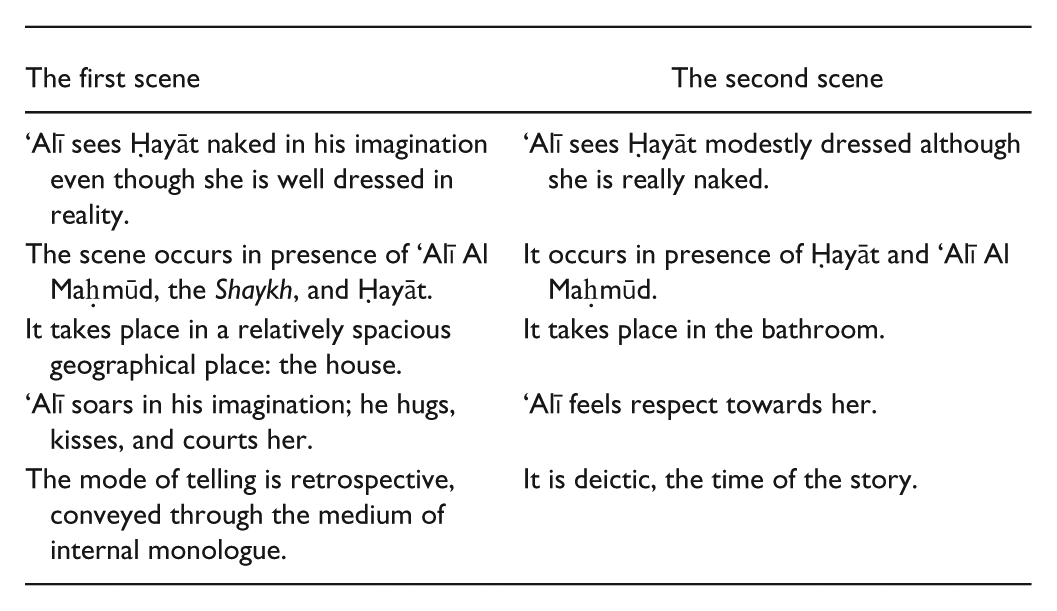
To get deeper understanding of the two scenes, let us examine the parallels illustrated in the following table:
The first scene offers an image which is more spacious, richer in details and deeds. In other words, there are more characters (the Shaykh is also there); the place is bigger and the imagination soars higher. In contrast, the second scene portrays a more intense and more compressed situation which is also more pregnant with meaning.
The relationship between the male characters, ‘Alī and the Shaykh, as well as their relationship with Ḥayāt, serves to add poignancy to the plot and its development. The men’s perspective is reflected in two circles of relationship: First, ‘Alī’s direct relationship with Ḥayāt before she is married to the Shaykh, and second, ‘Alī’s relationship with the Shaykh after the Shaykh marries Ḥayāt.
Although ‘Alī is sometimes possessed by a wild lustful imagination, his relationship with Ḥayāt before she gets married is characterized by innocence and honesty; his love is purely platonic. ‘Alī comments on his affair,
It was a pure relationship which did not go beyond looks, smiles and greetings. It was merely a relationship which reflected mutual admiration, pregnant with respect and appreciation. Ḥayāt was a beautiful and polite girl who descended from a good family. (p. 125)
The passage certainly presents ‘Alī’s perspective on Ḥayāt. Removed from gender, social, racial, intellectual, and political conflicts that often disrupt the smooth flow of life, ‘Alī’s love affair with Ḥayāt is based on mutuality of communication, appreciation, mercy, and love. In fact, ‘Alī, as expressed by Plato’s Symposium in a speech attributed to Aristophanes, is pining for the other half which he has lost. The relationship eventually becomes more serious and results in an engagement, but ‘Alī hesitates and changes his mind the next day owing to his fugitive status.
The second net of relationship is relatively complex. Looking at the table again, we can see that this relationship differs in its ending from its beginning. ‘Alī Al Maḥmūd’s character undergoes a drastic change. He moves from the position of an adventurous rebel who is full of life, energy, and mobility and who is not confined by place, space, time, thinking, or any form of restraint to the position of one who recognizes the power of reality, time, place, and space and yields to them.
Although Ḥayāt does not have the chance to let her voice be heard, she, nonetheless, is no less important than the heroine of “The Delivery.” She is not absented; nor is she treated as a person who is not there, to quote Erving Goffman (1959). On the contrary, her presence is strongly felt and has a profound impact on the characters and the development of the plot. In spite of the fact that she is placed in the bathroom where her privacy and nudity are invaded by ‘Alī Al MaḤmūd, Ḥayāt’s mere presence has a unique significance. It is Ḥayāt’s husband who imposes on both ‘Alī and Ḥayāt the difficult choice of hiding ‘Alī in the bathroom, but neither Ḥayāt nor ‘Alī is opposed to it, because it is the only guaranteed solution for ‘Alī’s plight. The police would not break into the bathroom where an Arab woman is taking a shower. They know that an Arab, whose personal sense of pride and honor comes from his ability to preserve his wife and daughters, would never let an outsider hide with his wife in the bathroom. That would be simply unthinkable and purely against logic.
Accordingly, Ḥayāt’s role is crucial and should not be perceived from the perspective of a conflict between the genders. This story should be read as showing the Palestinian political and educational atmosphere undergoing an important phase in the long process of its historical struggle. The story clearly points to the woman’s role in this struggle. This function is of utmost significance as it glorifies the woman instead of presenting her as a sexual object. But here she transcends all stereotypical and material images related to senses and physical pleasure, and becomes the highest aim that a man wishes to attain and for which he would give his life. With the emergence of national feelings, instinctive desires, represented by sexual longings, are eradicated, thus placing both man and woman high on the scale of morality.
Luckily, the troops, the messengers of the colonizers, cannot see the peaceful, healthy, and sensitive fabric of the cooperative relationship among men, that is, between the Mukhtār, the Shaykh (traditionally believed to be tools of the colonialists), and ‘Alī (the enemy), and between the men and Ḥayāt. Instead, these troops function under the mistaken belief that once ‘Alī, being a man, is caught, they can guarantee peace and end all signs of resistance. Hence, they are blind to Ḥayāt’s vital role in motivating the men’s activities as a whole, and ‘Alī’s in particular, and in saving the latter’s life.
Ḥayāt’s emergence as the target of ‘Alī’s internal monologue, which the writer presents as part of his exploitation of the narrative point of view, adds another dimension to the centrality of Ḥayāt’s character. The writer employs a third-person singular narrator, who in the fifth line of the story moves from his retrospective viewpoint as someone who knows how the story ends to a position where he merges with the perspective of the protagonist. As such, he reveals the main events in ‘Alī’s past by giving a disorderly rush of non-chronological facts about his adventures with the police combined with his love affair. Even more tellingly, rather than a third-person narrator who talks to readers through the protagonist, a first-person narrator addresses and scolds himself, thus adding a new element to the narration techniques: the internal monologue where ‘Alī is addressed as “you” (the second person) at the heart of events and narration.
Distinct from “The Delivery,” where the third-person narrator is engaged in the events from beginning to end, in “Ḥayāt,” the narrator’s transition to the protagonist’s point of view indicates not only the narrator’s solidarity with the protagonist’s cause and belief in its credibility and justice but also his trust that it can win the readers’ support. So the protagonist’s internal monologue gives the readers the opportunity to meet the narrator without mediation. Here and now they get inside his head; they become familiar with his dream to fight injustice and attain his love, his points of weakness and strength, his likes and dislikes, his wrongdoings and good deeds and, above all, his naked reality. Moreover, readers live the protagonist’s suffering and struggle and feel the troops’ threats, which from time to time interrupt the flow of his inner monologue. The readers, now active participants in the events of the story along with the “hiding” narrator, witness the profound impact of the inner dialogue on the protagonist. Through the technique of the interior monologue, the reader, with the protagonist, sees events from a different perspective. Surrounded by the threatening troops inside a room within the Shaykh’s house, inside himself and pressed by indecent thoughts which he fears will betray him and reveal his adventures with Ḥayāt (the Shaykh’s wife), the protagonist faces himself, sees his bad characteristics, and, as a result, becomes more certain of his motives, more aware of his choices and thus becomes more ready to accept all potential occurrences: He can meet the outside world despite its dangerous consequences. Once the process of self-reflection is over, ‘Alī’s plight is resolved; he has a clean soul capable of seeing in the nude Ḥayāt not her nakedness or femininity, but her humanity.
Significantly, the tone corresponds to the protagonist’s situation: The tighter the troop’s surrounding of the house, the harsher ‘Alī’s self-scolding, the quicker the pace of telling the events and the more serious and sensitive the information he provides.
The writer’s intelligent use of tone and his complex narrative style, where the first, second, and third persons are utilized—each speaker recounts a different phase of the story in a different tense—gives the reader a wide perspective. At times, the reader feels like an active participant, at other times like a distant observer or a close witness. These shifting perspectives enrich the reader’s experience and provide him or her with everything needed to see and learn about ‘Ali’s struggle and affair with Ḥayāt from different angles at different periods of time.
Devouring the Woman’s Spirit
“The Delivery” and “Ḥayāt” represent two faces of one coin: In the first story, man is relatively absent while the woman is dominant, and in the second man is very present while the woman is almost absent. In contrast, “Devouring” is the absence of all faces and options, even though a man and a woman are the only characters who appear in the story over and above a lion. Although all three works offer the story of a man and a woman joined by the bond of marriage or love, the relationship between these stories is complex in terms of content and structure. The couple in “Devouring,” as we shall see, lacks what their counterparts in “The Delivery” do have and what the couple in “Ḥayāt” dream to have. In addition, the two couples in “Devouring” and “The Delivery” are nameless and are meant to be archetypal. Still, while the couple in “Devouring” remain flat, unrecognized, and lacking in emotions, motives, and personal details, the newly married couple in “The Delivery” have clear ethnic identities, admirable personal traits, beautiful physical features, high ambitions, noble feelings, psychological conflicts, and a rigorous life full of sharing, cooperation, production, sacrifice and, above all, a rich past and a promising future. It can be said that ‘Ali and Ḥayāt, whose proper names and personal identities are clearly stated, have most of these features, too. In spite of this, they are forbidden to share life under the umbrella of one familial unit. So the anonymous heroine in “The Delivery” fulfills in the absence of her husband what ‘Ali, the hero of “Ḥayāt,” hopes to attain with his absent beloved, whereas the couple in “Devouring” never rise above stereotypical images of both man and woman.
In “Devouring,” Saeid seems to offer a patriarchal literature where the woman’s active presence is canceled. As a matter of fact, she has no will of her own, seems unintelligent, and has a featureless character that is externally and internally distorted. In short, she is deprived of her identity and spirit. Nevertheless, instead of rebelling against practices of oppression, as is the case when an individual is referred to as a “non-person” and treated as “someone who isn’t there,” to borrow Erving Goffman’s words, she does not show the slightest complaint. On the contrary, she submits her soul and body to man’s authority and commits herself to the conviction that she belongs to him. In other words, she complies with male texts and joins man’s endeavor to fight and deny her own gender. This is exactly what Patrocinio Schweickart means when she claims that the male texts take the woman reader through three phases. In the first, she is controlled by the text and, as a result, she “is immasculated”; she gives in to the structures of the male text and reads like a man. Subsequently, the female reader moves to the second moment where she functions as “the agent of her own immasculation.” However, unlike the woman reader, endorsing the third phase characterized by her “transfiguration” into a feminist who “embarks on a critical analysis of the reading process” and who “recognizes that the text has the power to structure her experience,” the nameless woman in Saeid’s story unconsciously volunteers to serve the male text (Schweickart, 1984/1998, p. 210).
The plot of this “very short story” is very simple. It presents a thirsty woman who draws herself furtively away from her husband and heads heavily toward the kitchen. Opening the door of the refrigerator, she is attacked by a lion. Alerted, the husband dashes toward his wife, saves her, and provides her with serenity and comfort. Then together they eat the lion and go happily back to their bed.
It is haunting that the story portrays a woman’s journey toward the accomplishment of the basic necessities of her life: drinking, food, and sex, as Abraham H. Maslow’s pyramid of needs confirms (Maslow, 1970). Her thirst stands for her sexual desires that are not satisfied within the frame of her legitimate marriage; the lion represents the difficulties, fears, and illusions, which confront her in the process of her search outside the house. But she fails and the husband appears as the savior, who pulls her away from the lion’s paws. Moreover, he is capable of understanding her needs and providing her with physical and psychological security, peace and comfort. Their joint return to bed seems to express their state of perfection and harmony.
Reading the story more deeply, however, one recognizes that the relationship between the man and his wife is perceived within a net of contradictory relations. On the physical level, the wife’s body parts do not function properly even though she is healthy: She “started to walk heavily,” “she saw” the lion “through her two half-closed eyes,” and she “was about to collapse” (p. 131). In contrast, the husband’s physical appearance is associated with health and smooth, rapid movements. We are told that he “flew out of bed.” “His gaze darted around,” he “dashed towards the sound and embraced his wife,” and he “smiled” (p. 131).
On the psychological level, the woman suffers serious deficiencies. She is “thirsty.” Upon seeing the beast, she “screamed her heart out,” and she is horrified. Conversely, the husband takes the initiative, knows how to function under difficult circumstances, and is always self-confident. Indeed, the responses of the couple to the threat are totally opposite. While the wife is associated with retreat, fear, horror, and screams, the husband is initially worried, but soon recovers his ability to smile and help the needy other.
The clashing differences between the couple indicate the wide gap present between them as characters. The woman suffers two distortions: an external one demonstrated in her physical powerlessness and an internal one manifested in her feelings of weakness and frightened responses. However, the husband enjoys a perfect character that functions with full energy, muscle and ideal discipline to successfully overcome the unexpected.
This intense dichotomy contributes a lot to the maintenance of the woman’s negative stereotypical image as reflected in her deeds and perspectives. Thus, her husband’s authority is given credibility. His deeds are so efficient and dynamic that he deserves to play the role of the life-savior.
Most importantly, this wide distance between the husband and the wife is comprehensive: cultural, intellectual, physical, social, racial, and class-related. It is reminiscent of Nancy Armstrong’s description of the constitution of the “Oriental” in contradistinction to which the “Occidental” is permitted to exist. In the process of defining what she means by “Occidentalism” (the effects of the practices of, what Edward Said calls, “Orientalism”), she notices that the “best accounts of cultural imperialism assume that power flows only one way-from the European ruling classes to the lower classes and out into colonies” (Armstrong, 1994, p. 538).
The woman accepts that man is the master, the provider, the knower, the protector, the colonizer, and the experiencer, and considers herself to be the servant, the parasitic, the ignorant, the colonized, and the weaker partner. Here lies the danger. She becomes man’s agent against herself.
The husband’s superiority, however, does not mean that his condition is better. Obviously, he is the product of the global village where personal specificities and individual diversities are deleted and where the supremacy of the male gender, the new colonialist, is equated with what is universal and human. So the unidentified husband becomes a tool which is meant to serve and protect the system of this global village through maintaining man’s dominance over his female partner.
The big gap between the husband and wife is intensified by the dimension of an estrangement given emphasis by the story’s language, compression of events, and narrative style. The language is precise, simple, direct, and almost empty of syntactical subordination such as adjectives and adverbs, enabling Saeid to convert an unornamented language into an efficient medium through which he presents his single-event story. It is this distinct use of language that gives Saeid the ability to attain a high degree of intensity and objectivity.
The lion, which gets out of the refrigerator and attacks the wife on her way to the kitchen, stands for danger, horror, and fear following the threat of illegitimate sexual adventures outside the frame of marital life. All together, the lion has always been a fierce, terrifying beast with intense sexual instincts.
As for the refrigerator, it represents the cold emotional atmosphere that characterizes the husband/wife relationship and, in consequence, motivates her to seek adventures outside her marriage. It may also connote that the wife lives in a desolate state of intellect strengthened by her strong emotions versus the husband, who, free of all emotions, enjoys unbeatable supremacy in the field.
The constituents of the world inhabited by the couple in “Devouring” are derived from a universe which has no relevance to real reality. In addition, both the husband and the wife do not bear names or show reference to a certain national, racial, or religious group. Although they presumably are young, their age is not declared, and their physical features are deleted. Instead, there is an element of a universal, Westernized modernity, drawn from the spheres of politics and economics. Hence, the context of the story, the plot, and the characters may reflect the relationship between any man and woman at every place. Within this sense of universality, however, the wife is the loser. She is presented through pronouns, mostly possessive, which perpetuate and reinforce the state of her belonging to man and of her being “devoured” not by the lion but by the husband.
The narrative style is harnessed to widen the distinction between the couple and maintain man’s dominion. The writer adopts a third-person narrator who tells the tale until the appearance of the lion when the wife shows her fright. Then, the narrator uses dialogue; alerting her husband, the wife cries “Look! A lion wants to dddddevoooour mmmmeeeeeee . . . why?” So the wife, who initially draws “herself furtively away from her husband,” is the one who eventually initiates the dialogue, reflecting not only her need for her partner, that is, man, but also her inability to be away from him. In fact, her separation from him becomes an act of amputating an inessential part (the wife) from the main body (the husband) or the failure of the slave to rid himself of the master.
The narrator does not try to persuade us to consider the husband/wife relationship a settled case with global extension. On the contrary, the wife’s suffering is perhaps a worldwide catastrophe, a universal conspiracy, caused, fueled, and perpetuated by politicians, men in power, the colonizers, and decision makers among local communities and ethnic groups the world over. Still, what does he get out of telling this short story, let alone telling it the way he does? The narrator, and hence, the writer, refuses to categorize his story under the “Adopt” stage, where he confines his subject matter to launching critical campaigns against man’s representations of women. Rather, in “Devouring,” the narrator offers a phase of his own where he diagnoses the illness, checks its manifestation, and defines responsibilities.
Conclusion
In his three short stories, Saeid offers three conflicting faces rather than phases of the incompatible relationship between feminism and post-colonialism. In both “The Delivery,” where man is relatively absent and the woman is dominant, and in “Ḥayāt,” where man is very present and the woman is almost absent, readers see two faces of one golden coin. Both options are commendable, for they both show a society whose factions are uniting, one time under the leadership of a super female figure and another under the leadership of a man, to round the forces of colonialism—the envoys of blackness, devastation, and wickedness. Both stories and, hence, both options do not admit the familiar conflicts between femininity and masculinity.
“Devouring,” however, presents the absence of faces and options. In it, the woman is deprived of a name, an identity and with them all personal features and individual specificities, and is therefore globalized. This distorted figure accepts man’s superiority and welcomes her inferiority. Nonetheless, this does not suggest that Saeid regards the husband–wife relationship an established case with an international reflection. Rather, the wife’s pain is a collective calamity, a global scheme, shaped, sheltered, and preserved by men in power and the post/colonizers amid native groups and ethnic sects throughout the globe. This is Saeid’s legacy not only to feminist and post-colonial movements but also to, as Edward Said (1991/1994) calls it, “the large, many windowed house of human culture as a whole” (p. 151).
What upgrades Saeid’s theme and short fiction is perhaps his skillful utilization of artistic devices (narrative point of view, tone, plot, and language) to draw the situation or his pictures. In “Delivery,” Saeid makes use of the mood of harmony between man and woman in spite of tyranny and occupation to reflect an analogous sense of agreement between plot and story, and between the narrator’s point of view and the characters’. In “Ḥayāt,” the writer intelligently uses the tone and a complex narrative style (the first, second, and third persons are utilized) to give the reader a broad perception of the story. And in “Devouring,” the dry narrative style, the ironical tone and the taken-for-granted plot are harnessed to illustrate the expansive difference between man and woman. These are probably Saeid’s real achievements.
Footnotes
Declaration of Conflicting Interests
The author(s) declared no potential conflicts of interest with respect to the research, authorship, and/or publication of this article.
Funding
The author(s) received no financial support for the research and/or authorship of this article.