




Abstract
This study explores Ghanaian women’s perception and voices about issues of gender equality in terms of exercising their political and decision-making rights in connection with political participation and governance in Ghana. The study uses demographic survey and six different focus group discussions to capture the views of a total of 68 women with different educational, socioeconomical, and occupational backgrounds, in two regions of the Ghana. The findings indicate that even though theoretically the constitution of Ghana gives women equal rights as their male counterparts to actively participate in the governance of their country, in practice, women face issues of gender-based power imbalance and discrimination in addition to other structural, institutional, cultural, and traditional barriers and roadblocks. These barriers expose women as being inferior and second-class citizens compared with their male counterparts in term of participation and inclusion in the governance of their country. The study discusses the social and policy implications of the issues of gender inequality and social exclusion of women in politics and calls for empowerment and organization of women and structural change in the system.
This is an explorative study that examines Ghanaian women’s perceptions on their lack of political decision making and participation in the political governance of their country. This study intends to contribute to the local gender and political discourse and knowledge by documenting the voices of women as they express their views and opinions on public issues that affect their everyday political experiences and lack of their political participation in their country. Despite substantial international progress and development efforts toward the advancement of women in all societies, a large number of women in developing countries, including Ghana, continue to be victims of gender inequality and marginalization (Kurz & Johnson-Welch, 2000). In Ghana, women have not been very successful in altering their political and economic locations and have not kept pace with their men in gaining much access to political decision making and participation.
In 1995, out of a total of 200 seats, women occupied only 16 seats or formed 8% of the parliamentary seats. This number has been increased to 10.9% or 25 seats out of a total of 230 seats in the national election in 2004 (Inter-Parliamentary Union, 2005). For example, Rwanda is one African country with the highest percentage of 49% of women parliamentarians in that country’s Parliament (British Broadcasting Corporation [BBC], 2008). Also, women in South Africa, Mozambique, and Seychelles hold one third of parliamentary seats in their respective countries and Swaziland has one third of seats in the upper house of Parliament, and Namibian and Ugandan women hold 42% and one third of local government seats, respectively (Hassim & Meintjes, 2005). The average number of women legislators in Africa has increased from 1% to 14.6%, with the biggest increase occurring between 1990 and 2004 (Tripp, 2005). According to Baden (1999), improvements in women’s political participation do not automatically mean that they will be effective in articulating their gender interests in public domain. However, given equal opportunity and access, women can effectively promote their gender and other related issues and interests. Also, processes of democratization, changes in institutional rules, and changes to the culture of politics and political parties that encourage inclusion and equality are necessary for women’s effective political participation.
Situation of Women in Ghana
Ghana is one of the first countries in Africa to ratify a number of international human rights treaties and conventions for women’s rights and gender issues such as the 1979 Convention on the Elimination of All Forms of Discrimination Against Women (CEDAW). Also, the 1992 constitution of the country enumerates certain fundamental human rights and freedoms for all people in the country. For example, Section 17, Subsections 1 and 2, and Section 27 of the constitution have a specific nondiscrimination provision that includes gender and women’s rights issues (Republic of Ghana, 1992). Despite these constitutional provisions and international treaties, customs and cultural practices continue to adversely affect the rights and lives of women in Ghana. According to the 2000 Ghana Living Standards Survey, Ghana has a total population of 18.4 million and 44.1% of women as compared with 21.1% of men have no formal education and therefore could not read or write.
Historically, women have been oppressed and dominated by the patriarchal society in Ghana. Since the attainment of independence in Ghana, women have increasingly moved into the paid labor force; however, women still lag behind men in all sectors. In most traditional Ghanaian communities, the inferior status of women was quite evident. Women were taught to accept their position through the socialization process, including their initiation rites. They were taught to be obedient wives and to respect their elders. They were told that a man could marry more than one woman (Manu 1984; Nukunya, 1969; Oppong, 1973). The inferior position of women in traditional Ghanaian society was reinforced by a number of factors, including social practices, religious beliefs, and the practice of polygamy, child marriage, and widow inheritance. Many of these practices are still found today in some places in the country.
Concerning access to education, the 2000 Population and Housing Census in Ghana indicates that 54.3% of female aged 15 years and above have never been to school despite efforts being made to increase girls’ education in the country. Gender parity between girls and boys has almost been achieved at the preschool or early childhood education level. However, the gap begins to widen from the basic or primary school level to junior high and high school levels. For example, at the junior secondary school or junior high school level, the percentage of girls and boys were 44.9% and 55.1%, respectively, in 1999 and 2000 school years. The gender gap still widens at both high school postsecondary levels, with female constituting only 33% at high schools and postsecondary institutions (Ghana Statistical Service, 2002). Despite the introduction of free compulsory and universal basic education policy (FCUBE) in 1994, girls’ enrolment in schools continues to be low, especially in the rural communities of the country. School taxes and indirect costs such as book user fees, school uniforms, and school supplies have made education costly, even though enrolment is free in the public schools.
Politically, women in Ghana are underrepresented in the sense that few of them hold political offices or participate in formal political organizations. Their invisibility can be documented at all levels of government. Two interrelated factors explain the political underrepresentation of women in Ghana. First, politics is viewed by most men and women as the quintessential male sphere of action, one in which women are both unwelcome and ineffective. Second, most politically active women are members of the elite group. Better educated and wealthier, these women often pursue a political agenda that reflects their class rather than their gender interests (House-Midamba, 1990).
Rationale of This Study
Lack of gender equality and women’s subordination in Ghana is the focal point of this study, and without equal participation by women in public decision making, policies are likely to be gender-blind, causing deleterious short- and long-term effects on women, children, and families. The premise of this study is that the Ghanaian society can function better for all its members when both men and women are equally included and involved in development processes, public policy making, and political decision making and participation. Therefore, hearing the voices of women concerning their views and perceptions of their lack of equal political participation is essential for the gender equality discourse.
Method
This study employs an explorative qualitative research using phenomenology as the primary research methodology. The essence of using phenomenology as a research methodology is to understand the phenomena, things, or events in the everyday world, from the viewpoint of the experiencing persons, and in this study, the views of Ghanaian women on gender and political participation. The data collection technique used in this study was focus group discussions and demographic survey. An interview guide consisting of open-ended questions on the phenomenon of gender equality was used for the collection of data from the focus group discussions. The demographic survey was utilized in collecting socioeconomic data concerning education, religion, occupation, age, and ethnicity as represented in Table 1. The study took place in two regions, namely, Greater Accra and the Volta Regions in Ghana. These regions were selected for a number of reasons. First, Accra is the national capital and has a total population of about three million people according to 2000 national census. In addition, the following factors were also taken into account: the size of the population; the sizes of the migrant population; the diversity of cultural, educational, economical, religious, and ethnic patterns; and the heterogeneity of the people and groups. The inclusion of the Volta region and the rural communities was meant to create some balance fairness to the rural setting, divergence, and variations. Volta region is more homogeneous as compared with Greater Accra region, thus, its inclusion.
The Sample (N = 68)
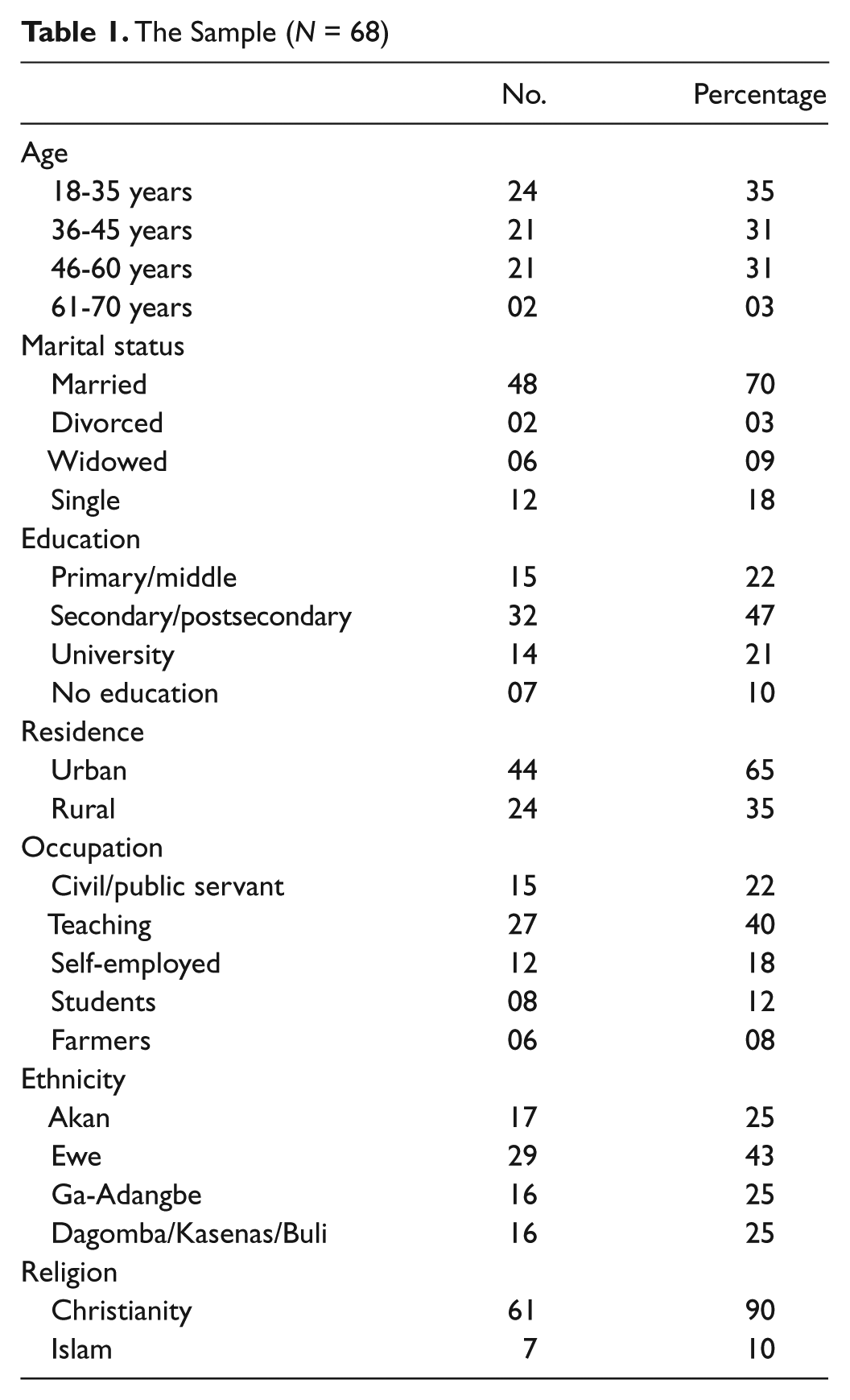
Two groups were identified and purposively selected through the Women Unit of the Department of Community Development in Accra as this department is responsible for organizing women groups for social development. The other four groups were selected by the use of snowball technique with assistance from teachers and university students identified by the researcher. In all, six focus groups, made up of 68 participants, were held in two rural and four urban locations within the two regions. The main purpose for choosing a focus group discussion as the data collection technique was to draw on the women’s attitudes, feelings, beliefs, experiences, and reactions in a way that would not be feasible using other methods, for example, observation, one-to-one interviewing, or questionnaires. These attitudes, feelings, and beliefs may be partially independent of the group or the social setting but are more likely to be revealed through the social gathering and the interaction of being in a group discussion.
The interview guide with the relevant questions concerning gender equality and related issues guided the group discussions. The main question that formed the basis of this study is “How do women understand the meaning and the concept of gender equality in Ghana?” Gender equality is taken to mean that men and women should have equal conditions and opportunities for realizing their full human rights and potentials. As gender equality is a broad concept and difficult to comprehend by the participants, the interview guide was constructed with a breakdown of the term of gender equality into concrete or specific relevant issues concerning women’s subordination and oppression. The participants were asked two specific questions concerning their perceptions about their political participation as women in Ghana. For example, the participants were asked to describe themselves in terms of gender equality and their political participation as women. Second, the participants were asked to discuss whether it is possible to have a woman as a president in Ghana. These questions were posed to explore women’s own knowledge, roles, and voices about their gender equality and political participation as women. A number of women have held political positions as women ministers and heads of departments, hence the need to explore the second question of a woman ever aspiring to become a president in Ghana.
The discussions took place in local classrooms, church halls, and a community center. Two research assistants with master’s degree assisted this researcher collecting data during the focus group discussions. They assisted with interpretation and translation of research questions from English to the appropriate local dialects to the research participants. The interpretation and translation were essential during the rural focus group discussions as most of the participants spoke only their local dialect. The other four focus group discussions were conducted in English as most of the participants were literates. All the group discussions were tape recorded and later transcribed verbatim by a paid transcriber, the research assistants, and the researcher. The transcriptions were supplemented by field notes taken during the group discussions. An Institutional Review Board (IRB) approval was sought and approved by the researcher’s institution and as a result, consent forms spelling out the reasons for the research and the essence of confidentiality and voluntary participation was read, signed, and thumbprinted by all literate and illiterate participants before data collection took place. To protect participants’ anonymity, only generalized descriptions of the groups, sites, and themes are presented in the findings.
Research Participants
Purposive sampling technique was used to select 68 participants to participate in six different focus group discussions. The participants were from a broad cross-section of the Ghanaian population in terms of ethnicity, age, family situation, economic situation, education, religion, and patterns of residence that is both rural and urban (Table 1). As Ghana is ethnically diverse, an effort was made to include participants from most of the major ethnic groups in the country. Two regions were selected for this study and the selection was based on the fact that one region has a very diverse and heterogeneous population groups from all parts of the country and the second region was more homogeneous and less culturally diverse.
Data Analysis
Phenomenological methods are particularly effective at bringing to the fore the experiences and perceptions of individuals from their own perspectives. Adding an interpretive dimension to phenomenological research enables it to be used as the basis for practical theory and allows it to inform, support, or challenge policy and social action. Therefore, the Interpretative Phenomenological Analysis (IPA) by Smith, Jarman, and Osborn (1999) was adopted as a guideline for this analysis. This analysis advocates an idiographic approach, where the researcher engages in close textual analysis of transcripts before moving on to begin to look for commonalities between individuals. By this process, an idiographic, case-study approach is outlined, where the analysis slowly builds from the reading of individual cases to claims for a group. The aim of IPA is to explore in detail the participant’s view of the topic under investigation. Thus, the approach is phenomenological in that it is concerned with an individual’s personal perception or account of an object or event as opposed to an attempt to produce an objective statement of the object or event itself (Smith et al, 1999). Hence, the interpretation of the phenomena in this study is to provide insight into how, through the human situation, the phenomena of gender equality or inequalities come to have personal meaning, a lived-through significance that may not always be transparent to consciousness.
The actual data analysis began with verbatim transcription of the focus group discussion tapes. The audio-recorded tapes were played repeatedly and transcribed verbatim. After the transcription, time was spent reading through the transcripts a number of times and making notes of interesting or significant words, statements, and key words that captured the essence of the topic. In addition, connecting themes that reflect connections with previous sections of the interview were searched for and noted. I took notice of similarities and differences in themes about what the participants said and also took notice of similarities and differences in the themes from both the urban and rural groups. I made a list of all the emergent themes and ordered them coherently. This form of analysis involved a close interaction between the text, myself, and an attempt to understand what a particular participant was saying and at the same time drawing on my own interpretative resources. To introduce some order and form into the analysis, I decided to use the master-theme list from the first interview to begin the analysis of the second and the subsequent ones.
I looked for more instances of similar themes identified in the first group discussion in the remaining discussions and also identified new themes that came up as well. The next process was the arrangement of the related patterns into coherent clusters, and this made it possible to identify emergent common themes. The decision regarding the selection of the themes was guided by the rule of two confirmations and no contradiction (Miles & Huberman, 1994). This means that at least two responses from the participants confirmed the themes as essential lived experiences. The analytical discussions of the themes are supported with direct quotations from the participants’ narratives. Direct quotations reveal participants’ depth of emotions, their experiences, and their basic perceptions of the issue.
Credibility and Trustworthiness
For Moustakas (1994), establishing the truth of things begins with the researcher’s perception. He also discusses verification using informant feedback. In this study, verification was carried out mostly by discussing the findings with some of the participants in an informal group discussion, after the initial transcription was done. The transcripts were read and interpreted to four groups of the participants for their comments and views. Three urban groups and one rural group were selected and convened again for this member check. These participants were satisfied with the report and readily accepted it as their own ideas or as their authentic voices. Another technique used in establishing credibility of this study was peer review or peer debriefing. This process involved the discussion of the findings with the research assistants who assisted with the fieldwork. This peer review provided the opportunity for us to discuss some of the emerging themes, the plights, and the everyday struggles of the participants and ideas for future research projects.
Research Findings
The study identifies three main themes, which are (a) We are relegated to the background, (b) we face cultural, educational, and financial barriers, and (c) we occupy the lower positions in political parties.
We Are Relegated to the Background
The discussion of these three main themes revealed that women in Ghana do not enjoy equal political participation in Ghana. According to most of the participants, they experienced gender inequality and discrimination even in the political parties they belong to as members. The findings discussed the opinions and admission of both rural and urban participants, educated and uneducated, about their lack of active political involvement and participation. A number of urban participants referred to their position as women as “being relegated to the background.” These participants were of the view that as women, the Ghanaian society does not give them equal chance as compared with their male counterparts and so they play second fiddle to the men. These opinions have been expressed in direct quotations as follows:
Tradition has a tremendous impact on the situation of the Ghanaian woman. A woman is always in the background and when a woman is outspoken, she is given all kinds of names. Our situation is difficult because of our entrenched traditional beliefs and norms. The traditional notion is that men are the heads and this notion is working through every sphere of life and including the political sphere. Men do not encourage us and they look down on us, and would not even vote for a woman as a candidate. They discount whatever we say as “women’s talk.” Even in parliament women are not allowed to exercise their rights. We do not often hear our female parliamentarians speak because the men take the floor all the time.
We Face Cultural, Educational, and Financial Barriers
The participants described their personal experiences as being characterized by negative, cultural, and traditional practices toward women; lack of adequate education; and structural financial barriers as obstacles that militate against their equal participation, even if they are interested in politics. Both rural and urban participants identified some of the barriers that prevent women from effectively participating in politics or daring to stand as a parliamentary or a presidential candidate in Ghana. For example, in terms of financial opportunities, a number of urban participants believe
For example, women do not have the necessary resources and capital to engage in active politics because politic is very expensive and most women are handicapped financially. The men for too long have dominated us both financially and I think women in this country are getting fed up with the situation.
The participants also discussed the negative effects of the cultural and social educational program that socializes young women from birth into roles that are removed from the world of public decision making. They asserted that the aim of girls’ training was generally to make them into good wives and mothers. On the contrary, a number of urban participants believed that if women are given the educational opportunities and proper training, they could become politically active and even stand for election as a president of the country one day. Some of the comments were as follows:
I believe that with time and the required education, Ghana could have a female president. However, for now, we women still believe that men are better endowed than women are. It is only possible for women if our cultural norms are relaxed to allow women to further their education. Before an individual can be totally liberated, the one must be educated because knowledge is power and if one does not know how to deliver herself when in difficulty, one cannot make progress in life. Therefore society has an obligation to help women and women must organize to fight for their rights.
Culturally, participants also expressed the barriers of marital obligations to husbands, children, and families as another obstacle to their inability to fully engage in politics. According to some of them, their husbands and family members are often reluctant to have their wives and women in their households in the public domain. The following comments were expressed by a few rural participants as follows:
Our husbands will not even encourage us and they will even tell us the political party we should vote for. One could get into serious problem with the husband should one vote for another political party and since women are so concerned about the stability of their homes, they tend to obey their husbands in matters like this.
A number of urban participants also believed that women as a group are not very supportive of each other when it comes to supporting women in politics. They believed that women would not even vote for a fellow woman. They expressed their views as follows:
Women would not even vote for a female president even if she has the courage to stand for the position. All depends on the women, if only we stop being each other’s enemy. We are in the majority yet we are the same people who will assassinate the character of the female presidential candidate. Women are their worst enemies because most women are jealous and do not do much to improve their lots and if a fellow woman decides to excel, we defame the person and do nothing to encourage one another. I do not think any Ghanaian woman would dare to stand for presidency because women in general look down upon themselves and do not support each other.
In examining the possibility of a woman being a presidential candidate in Ghana, this question was posed to the groups because, some women have held various ministerial positions in the country in the past and it is crucial to know their views on the possibility of Ghana ever having a female presidential candidate. This question generated an argument among a group of urban participants in relation to the type of woman who could dare put herself up for a presidential candidate in Ghana. Some participants believed a single woman or a single mother with no marital affiliations to man could be an effective political leader. Their assertion was based on the belief that as a single woman, she would not be burdened with marital obligations and conflict of interest or harassment from the husband.
A number of urban participants expressed their views as
It is possible to have a female president but it will not be easy to achieve because our traditions pose a stumbling block. Such a woman would be ridiculed and snubbed by the men and even by her own family members. Only a single mother or woman who has experienced the rough edges of life would want to venture into the presidency. This is so because she will have a tough personality that will enable her to organize women very well. I support the notion that a female president of this country must be a single mother because my sister who was a Member of Parliament in 1992 incurred the displeasure of her husband because of her political ambition. The husband threatened to divorce her but she however ignored the threat. I do not agree that only a single woman could become a president. A married woman could become a president too if women are able to get over petty squabbles, attitudinal problems and their inferiority complex and societal prejudices.
We Occupy the Lower Positions in Political Parties
This is the third main theme, and it relates to participants’ individual experiences and challenges concerning their membership in political parties. The urban participants asserted men have held national leadership positions in all political parties since independence in 1957 to date. They attributed the lack of political support for female candidates to lack of political experience, male norms, and structures that prohibited female participation. They also asserted that the negative cultural norms and attitudes toward women contribute to lack of leadership-oriented training programs and political education for women. According to them, these shortcomings are oftentimes reflected in voting patterns, media coverage of female politicians and political intimidation, and harassment of women politicians in the country.
A participant sums the low position of women in political parties as follows:
When one takes a look at the roles women play in the political parties, one would realize that women have not yet taken up the challenge to rise up to the top. The highest position the woman is given in a political party is that of a women’s organizer and not as a presidential candidate.
Discussion and Implications
The Fourth World Conference on Women in Beijing (1995) and the Beijing Platform for Action have provided new impetus for governments and civil society organizations to address gender inequalities in society at all levels. Gender mainstreaming is one of the approaches to advancing gender equality, and it involves addressing gender inequalities in all aspects of development, across all sectors and programs. Mainstreaming is not simply about ensuring that women’s position is improved within existing frameworks which are dominated by men. Gender is mainstreamed when the development process and frameworks are transformed in ways which ensure the participation and empowerment of women as well as men in all aspects of life, especially in political decision-making structures.
The findings of this study indicate that Ghanaian women are still on a long winding path to achieving gender equality and equal political decision making and participation in their country. An outstanding feature of these participants’ insight is the admission of their low political participation as women in Ghana and this admission did not significantly differ by education, income, and social class. Surprisingly, the majority of the participants in this study could be classified as being in the low-middle, socioeconomic class. Most of them had at least post–high school and some college education and they worked as professionals and semiprofessionals in their various occupations as teachers and public servants. These factors indicate their knowledge and awareness of the challenges they faced as women and the cultural and traditional blockades they have to overcome to achieve equal political participation. In addition, they identified their inferior position as women compared with the men and their own negative activities and lack of support for their fellow women as some obstacles. Other factors identified are the structural barriers of male domination of the political bureaucracy, institutional sexism, and the patriarchal system that imposed limitations on women and discount them as inferior and second fiddle to the men. They also discussed the cultural socialization and sexist attitudes and perceptions that put women in the gender box of being mothers, wives, and care providers for their husbands, children, and other family members. Lack of political training and education, poor access to financial resources, and preparation for working in the political arena were also discussed as other barriers to women’s political involvement and participation in Ghana.
The study has also revealed the display of tokenism in terms of putting a few women in decision making and political positions as showcases. The political system is one of the most powerful structures of gender inequality in Ghana. This is confirmed by the participants discussions on the negative attitude of harassment and hostility of men toward women who dared to enter into politics. It is evident that Ghana has experienced some modest increase in women’s participation in leadership and public decision making. The number of women in Parliament has increased from 16 in 2000 to 25 out of 230 members in 2004. Out of 20 cabinet ministers, only 2 are women and only 2 ministers of state and 5 deputy ministers are women. There are only 4 women out of a total of 45 members of the Council of State. This is the council that advises the president on national affairs of the country. For the first time in the history of the country, the chief justice of the Supreme Court is a woman and the speaker of country’s Parliament is also a woman. Likewise, at the local or the district level of the country, women’s participation has increased remarkably from 3% to 35.5% in 2003. That is, out of 1,843 district assembly appointments, 655 of them were women. This increase still falls short of the 40% target set by the national plan of action (Ministry of Women and Children’s Affairs, 2003).
The challenge facing Ghanaian women politically is not unique to women in Ghana alone. Several studies from other African countries indicate the same predicaments for women across the continent. Ferguson and Katundu (1994) discussed a number of negative reports about women who dared to enter into politics in Zambia. For example, they found that some Zambia women were threatened with divorce and forbidden by their husbands to enter into politics and even in national Parliaments; women have difficulties being accepted for who they are and are not taken seriously and/or even listened to. Tamale (1999) in her study of women in parliamentary politics in Uganda found that women parliamentarians are frequently subjected to humiliating sexual stereotypes and derogatory remarks and sexual harassment. Legislation for various forms of equality has been passed and continued to be in effect. However, the pace of actual change that will be beneficial to women is very slow. Even though women are becoming active in politics, they are still too often subordinates in the system. It is evident that educated women and gender activists who have shown interest in politics have been assaulted physically to teach them to stay out of politics (Nzomo, 1997). Politicians and political leaders view contemporary African women politicians as ambitious and as embodying interests that are antithetical to the interests of the state.
Ongom (1999) states that the belief that women are good as cooks, sex providers, and juniors are still persistent. For example, women are given ministries that are considered useless to the economy and therefore not so demanding. This is simply to prove the point that women cannot take on hectic jobs. For instance, out of the 26 cabinet ministers in Uganda, only 6 are women, and they occupy very silent ministerial posts that are considered not of utmost importance, and out of the total of 35 state ministers, only 11 are women. This means, out of 66 ministers in Uganda, only 17 are women signifying less than 1/3 of the total percentage (Ongom, 1999).
Ongom (1999) also states that women in Uganda, just like women in Ghana, lag behind in decision making. Although clear legal systems are in place to address women’s participation in policy making, the implementation of this policy is derailed by gender discrimination in all sectors. The dilemma women face today is how to change the attitudes and perceptions that they cannot perform or engage in full decision making that affect society. Namibia and South Africa have constitutions that provide for affirmative actions to enhance the numbers of women in policy- and decision-making positions. In South Africa, 20% of parliamentary seats and 50% of local governing councils seats are reserved for women (African Center for Women/Economic Commission for Africa [ACW/ECA], 1998). Angola, Tanzania, and Zimbabwe also have quota legislation guaranteeing certain numbers of women in legislative assemblies. However, vigilance is still called for to prevent backsliding and political manipulation (ACW/ECA, 1998).
However, six African countries are leading in terms of women’s representation in national assemblies due to affirmative action and quotas. These countries are Rwanda leading with 48.8%, Mozambique with 34.8%, and South Africa with 32.8% of women representation in parliament. Burundi has 30.5% of women in parliament and Seychelles has 29.4% of women in parliament. In addition, Namibia has 26.9% of women representation in parliament and Ghana has only 10.9% of women in parliament (Inter-Parliamentary Union, 2005). Also, for the first time in the postindependence period, a number of African women began to aspire to political leadership at the national and local levels. Female faces and voices are beginning to be seen and heard in some African countries even though their impact is still minimal and their obstacles daunting. The 1990s had been credited as a decade of beginning for women in politics in Africa. Until this period, it was unheard of for women to run for the presidency in Africa.
In 1998, two women in Kenya ran in the presidential election of that country and two other women in Tanzania and Nigeria also sought their political parties’ nominations in the presidential primaries in 1995 and 1998, respectively. Although they were unsuccessful in their struggle for political power, they have set an important precedence in their respective countries and have shown that given the chance, women can equally become presidents in their own right and Liberia has taken the lead by electing the first female president in Africa (Inter-Parliamentary Union, 2005). This is an indication that there is a chance for more female presidential candidates on the future horizon in Ghana and other African countries.
Conclusion
The attainment of full political participation of women in Ghana is more beyond mere tokenism and political party nominations. It is important to explore the issues surrounding the ideology of gender relations and power relations. The various institutions and structures, such as the family, the educational system, the religious institutions as well as the social, economic, legal, and political structures in the society must undergo major structural transformation that will stop reproducing unequal power and gender relations. According to Reynolds (1999), the sociocultural barriers to the representation of women can be overcome but the process evolves time and it also entails both male and female coming to accept the legitimacy of women in positions of power. That is, until every voter sees the election of women into political position as normal and not something unusual or just based on tokenism.
To overcome the institutionalized power relations and bring about total transformation in the system, actual processes of empowerment have to occur at several levels. The empowerment process must challenge and change the set of ideas, attitudes, beliefs, and practices in gender relations; in institutions and structures such as in the family, the household, the villages, the market places, and the churches; and in the local communities. Simon (1990) refers to empowerment as a series of attacks on subordination of every description such as psychic, physical, cultural, sexual, legal, political, economical, and technological. However, the empowerment of women is not only just an issue of women but also a gender issue, which necessitates the reexamination of gender relationships by both men and women together. It is also a development issue, in that women who become empowered must also become active not only in economic activities but also in exerting pressure and influence on political, social, and legal issues concerning women.
The full political participation of women in the sociopolitical development of Ghana is not just an issue of affirmative action and implementation of quota systems. It is a social justice and human rights issue that requires social transformation and change in the attitudes, institutional and cultural structures of the whole society. According to Mosse (1993), a successful women’s organization encourages in its members a capacity to interact with a wide range of public systems and structures, and in time, is able to transform members into active participants in the development of goods, services, and resources, rather being passive recipients or targets. She argues that the long-term growth of expertise and confidence within women’s organizations, and their increasing effectiveness in the public domain, are essential to the process of structural change.
Limitations
This study is a qualitative study that used purposive and convenience sample of only 68 participants in six focus group discussions. Hence, the selection excluded other women from other regions and higher socioeconomic social classes across the country. The data were collected through focus group discussions based mainly on self-reported personal experiences and opinions. Based on the study’s qualitative approach, small sample size, selection bias, and subjectivity, precautions should be taken in generalizing the findings of this study to other groups without further study. Given these limitations, however, the study provides direct evidence from Ghanaian women concerning their gender discrimination and call for action.
Footnotes
The author(s) declared no potential conflicts of interest with respect to the research, authorship, and/or publication of this article.
The author(s) received no financial support for the research, authorship, and/or publication of this article.