




Abstract
The purpose of this article is to identify and explain the barriers that prevented the case study organization, an Australasian university, from implementing a groupware package. This is an insider action research case study, using qualitative semi-structured interviews, group and individual training to look at users’ technological frames around the implementation and use of a groupware product. Technological frames were used to enable a systematic examination of the assumptions, expectations, and knowledge of technology; in particular, the use of technological frames reveals aspects of user resistance. While addressing criticisms of the technological frames genre, this study uses technological frames as a lens to examine the underlying drivers and impediments to information systems (IS) implementation. In this case study, changes to a groupware product failed to be implemented, not because of user resistance to the product, but because of organizational politics. This study demonstrates how the culture of an organization may stifle the implementation of IS.
Introduction
This article reports on a case study of resistance to change in an educational institute. The aims of the action research project were to identify what senior managers and their personal assistants thought of the communication, collaboration, and coordination process, and if and how it could be improved using groupware. Previously, manual diaries and forms had been used for these processes, and 1 day a week of each personal assistant’s time was absorbed in coordinating the appointments of their managers.
When we adopt and use information technology, we draw on cognitive structures to make sense of it. The use of cognitive structures is the domain of the socio-cognitive field in social psychology. Research has examined how people deal with decision making, relying on the schemas they have, which relate to the problem, if they have encountered similar problems previously. These schemas are also called frames, interpretive frames, scripts, or thought worlds. If a problem has been encountered before, a solution from past usage will be employed. However, reference to past solutions limits creative problem solving. Cognitive structures have also been examined in the organization field through organizational researchers such as Walsh (1995) and Senge (1990). Orlikowski and Gash (1994) discussed how groups within an organization share cognitive frames in relation to information technology. The technological frames of individuals may not be identical, but share sufficient assumptions for individuals to be treated as a homogeneous social group. In particular, Orlikowski and Gash (1994) examined the social groups of technologists and users. By analyzing a group’s technological frames, one can see how the group makes sense of technology. In this study, the interaction of technological frames was examined in a university; the frames and interaction of the frames help explain the adoption and use of technology over time, particularly the use of groupware by senior management and their personal assistants.
This article is structured as follows. “Technological Frames” section explores prior literature on technological frames and discusses the role that these play in technology implementations, particularly with regard to resistance to change. “Organization” section describes the case study organization and the changes in the organizational structure over time. “Research Methodology” section discusses the action research method; in particular, the reasons for adopting this method and the qualitative data collection methods used. “Data Analysis” section presents the results of the study and discusses the major themes that emerged from the research. The final section presents the study conclusions, outlines the major contributions of the study, links the findings to prior literature, discusses the research limitations, and provides suggestions for further research.
Specifically, the research questions that this study aims to answer are as follows:
Technological Frames
Technological frames were first used in the information field by Orlikowski and Gash (1994) in relation to information technology. The original work on frames (referred to as schemas) in social psychology was by Bandura in 1986 and studied how individuals learn. To solve a problem, individuals draw on their cognitive structures to make sense of their world. This enables them to solve problems, as the problem has been solved before and therefore provides a template to reduce ambiguity. Solution templates can be used to facilitate problem solving, but can also constrain solutions. Social psychology originally posited schemas at the individual level only, but organizational researchers have looked at group schemas/frames. These schemas/frames are shared among groups of individuals. Socialization at a workplace, department, or professional training fosters individuals to share frames. These frames are not identical for each individual but are reasonably homogeneous within each group, being sufficiently similar in content and structure.
Orlikowski and Gash (1994) applied frames to technology and defined technological frames as,
that subset of members’ organizational frames that concern the assumptions, expectations, and knowledge they use to understand technology in organizations. This includes not only the nature and role of the technology itself, but the specific conditions, applications, and consequences of that technology in particular contexts. (p. 178)
In particular, they focused on three technology domains: technology-in-use, technology strategy, and technology nature. Technology-in-use is defined as the assumptions and expectations about the technology that people currently use. Current use, in turn, is based on how people have used technology in the past. Use of new technologies is based on what a person knows about the technologies they currently use. Technology strategy refers to the strategy for technology use. This is of interest in that the technology strategy for what a person wants in the future is bound by current technology use. A person will not envisage out-of-the-box solutions for technology if it is not known what the technology is able to achieve. The final frame is technology nature, which is the understanding a person has of technology. This has been found to relate to how technology is currently used and views on how a particular type of technology might be used in the future. Technology-in-use, technology strategy, and nature of technology, as discussed by Orlikowski and Gash (1994), are not mutually exclusive categories. Orlikowski and Gash (1992, 1993) introduced seven alternative categories in their original literature, yet frames are best developed in situ. In the current study, the categories of technology-in-use, technology strategy, and nature of technology were sufficient to cover all data in the study and no additional categories were used. Even though no additional categories were needed, in situ development of categories may find additional codes in different organizations.
Frames are cognitive structures that reside in an individual’s brain and technological frames are being used in this study to equate to the cognitive structures, even though they are not equivalent (Davidson, 2006).
Nine applications of technological frames were discussed by Davidson and Pai (2004), who analyzed the first 10 years of research using technological frames (Barrett, 1999; Davidson, 1997, 2000; Gallivan, 2001; Khoo, 2001; Lin & Cornford, 2000; McLoughlin, Badham, & Couchman, 2000; Sahay, Palit, & Robey, 1994; Shaw, Lee-Patridge, & Ang, 1997). There have been more studies in the area of technological frames since Davidson and Pai (Acha, 2004; Bjørn, Scupola, & Fitzgerald, 2006; Chang, 2008; Conover, 2008; C. J. Davis & Hufnagel, 2007; Hsu, 2002, 2007; Iivari & Abrahamsson, 2002; Jensen & Aanestad, 2007; Karsten & Laine, 2007; Khoo, 2004, 2005; Lin & Silva, 2005; McGovern & Hicks, 2004; McLeod & Davidson, 2007; Mengesha, 2008; Mishra & Agarwal, 2010; Ovaska, Rossi, & Smolander, 2005; Puri, 2006; Sandford & Bhattacherjee, 2008; Sneddon, 2008; Sobreperez, 2008; Wang, Peng, & Quan, 2007).
These frame studies relate to different areas, such as introduction of new technology (Barrett, 1999; Chang, 2008; Conover, 2008; C. J. Davis & Hufnagel, 2007; Hsu, 2007; Jensen & Aanestad, 2007; Khoo, 2001, 2004, 2005; Lin & Cornford, 2000; McLeod & Davidson, 2007; Mengesha, 2008; Mishra & Agarwal, 2010; Puri, 2006; Sahay et al., 1994; Sandford & Bhattacherjee, 2008; Sneddon, 2008; Sobreperez, 2008; Wang et al., 2007), processes (Gallivan, 2001; McLoughlin et al., 2000), knowledge management attributes (Shaw et al., 1997), and requirements gathering (Davidson, 1997, 2000; Ovaska et al., 2005).
Evaluating each of the prior research findings, it is evident that the articles support the frame analysis categories according to the Orlikowski and Gash (1994) categories. Generally, the studies consider a snapshot in time, examine the technological frames, and indicate how the congruence, or lack of congruence, between group frames has affected IS implementation. If incongruence can be overcome, then development, adoption, and use of technology can be enabled. This article extends this stream of research and addresses the criticisms of past frame research with the aim of making technological frame research more useful. Criticism of frame research was articulated in Gal and Berente (2008) and Davidson (2006); research that has addressed some of these criticisms will be elaborated on shortly. Gal and Berente (2008) also discuss the limitations of technological frames, but rather than providing a way forward like Davidson (2006), they provide an alternative method known as “social representations” that they believe will address the limitations. Such limitations will be discussed from the point of view of how technological frames research and, in particular, how this study overcomes such limitations; it will be argued that the “social representations” method is not needed and that the technological frames genre can overcome these limitations.
The three limitations of technological frames provided by Gal and Berente (2008) are technologically centered (contextual focus), temporally bound, and individually focused (level of analysis), which are similar to those discussed by Davidson (2006). The technologically centered limitation suggests that frames exist in the wider social and organizational context that affects a study. Most prior studies research frames are at a snapshot point in time and then discuss frames congruence and incongruence, and provide an explanation for that. This study aims to add a longer, contextual focus in that the organization in this study is presented contextually over a 10-year period, and frames are examined in the context of the 10-year period. Frames are indeed a result of what has happened in the past, and a longitudinal study is needed to identify and interpret the frames that already exist, as well as predict what is likely to happen in the future. In this way, the processes that produce the frames are regarded with sensitivity.
The second limitation identified by Gal and Berente (2008) is that the frames are temporally bound as they are only examined at one snapshot in time in most prior studies (Barrett, 1999; Chang, 2008; C. J. Davis & Hufnagel, 2007; Hsu, 2007; Jensen & Aanestad, 2007; Lin & Cornford, 2000; McLeod & Davidson, 2007; Mengesha, 2008; Puri, 2006; Sahay et al., 1994; Sandford & Bhattacherjee, 2008; Sobreperez, 2008; Wang et al., 2007). Even the original work by Orlikowski and Gash (1994) examined frames over a short 5-month implementation period. Davidson (2000), however, looked at eight periods over a 2-year project. This current study addresses the issue of temporality by examining frames 4 times over the 7-month project, frames before the project started, then at the end of Phases 1, 2, and 3. In addition, this study is part of a larger project that examined technological frames at different time periods and thus the 7-month project is not the only frame considered. Frames are temporally bound in that they are dynamic and change over time, and therefore need to be examined at varying points in time.
The third limitation concerns level of analysis, which is individually focused. Frames are individually held, and relevant groups have frames in common or share frames. These frames arise out of the interactions with the technology that is employed. The main criticism by Gal and Berente (2008) is that prior frames studies have only used interview data to elicit frames, which neglects to consider how frames are formed and changed via social interactions. Both Davidson (2000) and Orlikowski and Gash (1994) used multiple sources of information, and though several studies have only used interview data, overall frames studies have employed multiple data sources. This criticism is not particularly salient as many prior studies have used multiple methods and not relied solely on interview data. The current study addresses this limitation by employing data from other sources, in addition to interviews; the study uses data from training sessions, e-mails, discussions, and observation of the subjects using the groupware software individually and in groups. Therefore, the method of action research enables greater understanding of how the frames within a social group, and the interactions between the social groups are formed, as the action researcher is a part of this interaction.
Therefore, in regard to the prior studies, this study is different in that the contextual information relating to how the frames are formed and change over a longitudinal period is reflected upon, multiple snapshots of frames are taken during the project, and more than interview data has been used. The need to use another method such as “social representations” as suggested by Gal and Berente (2008) to overcome the deficiencies of the technological frame genre is not necessary, as frame studies can address the said limitations. By addressing such limitations and considering issues beyond frames congruence/incongruence, this study contributes to the literature on frames.
Technological frames are also useful for understanding user resistance. User resistance has its base in a user’s prior interactions with technology. The term “resistance” does not imply as being good or bad, but rather describes user adjustment to new technology. By linking technological frames to user resistance, we can examine what aspects of user resistance arise. The action research method also enables user resistance to be addressed in the next cycle of action. Research on resistance to information technology lacks a comprehensive model. Hirschheim and Newman (1988) discuss the categories encompassed by user resistance as including, a lack of felt need, uncertainty, lack of management support, poor technical quality, personal characteristics of the designer, and other characteristics, such as training. IT implementation projects demonstrate substantial failure rates, but overall, the most important driver of failure is “threats by individuals” and “perceived loss of power” (Laumer & Eckhardt, 2010). Failure of major change initiatives is attributed to employees being unable to undertake work-related process changes. Resistance is also more common among “digital immigrants”—those not born into the digital world—such as the participants in this study, rather than among “digital natives”—those who have grown up in the digital world (Vodanovich, Sundaram, & Myers, 2010).
Organization
The organization that is being researched is an educational institute that has experienced many changes over a 10-year period. Given that frames are assumptions and expectations built up over time, looking at the past, and the context of the organization is important. The organization has moved from being a functionist structure with heads of departments, prior to 1993, to a matrix structure that requires joint accountabilities from individuals. Matrix structures, as discussed by Applegate (1994), require more communication and collaboration due to the double accountability of individuals. The organizational structure continued to change as the matrix structure changed from being a pure matrix in 1993 to a matrix with elements of an adhocracy in 1995, and then with key areas becoming portfolios in 1996. The adhocracy elements were related to where “experts unite in interdisciplinary teams to work on complex projects with longtime horizons. Most adhocracies adopt a modified matrix structure” (Applegate, 1994, p. 28). A hybrid organizational structure is a combination of any of the above structures. See Table 1 for a summary of the organizational structure over time.
Years and Organizational Structure.

The changes of structure impacted on organization communications become quite apparent from the comments made by staff (given below) relating to the communication and collaboration required, particularly with the multiple accountabilities that a matrix structure requires.
[There is] Confusion over roles, responsibilities and accountability. [There is not] Clear definition of roles and accountability for completion of tasks. Also some jobs do not get done because of role confusion. This saps morale and divests energy from teaching—this all stems from a lack of clarity in the definition of the respective roles of academic groups and programme teams. (Interview with staff, 1995)
A timeline of events is provided below in Table 2. This outlines how the organization began in 1992, without university status, and that offering degrees for the first time in 1993 changed the organizational structure. The changes made after 1993 were slowly refined over time, with reviews of the structure attempting to clear responsibilities and accountabilities. With these changes to the types of programs offered came redundancies for staff who were unable to up-skill to meet the new environment of degree level teaching and research.
Main Events Within the Organization.
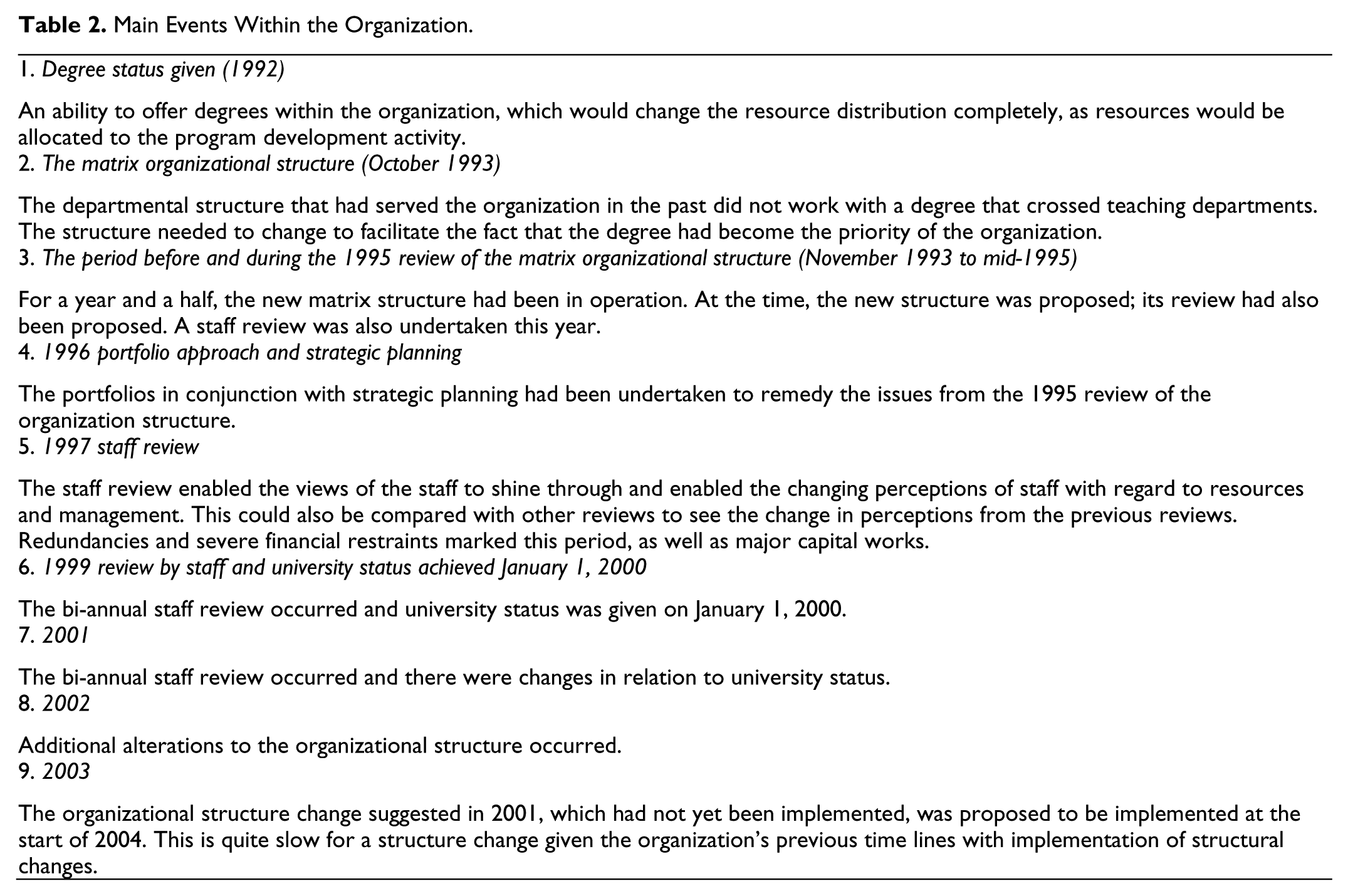
The changes in organization structure and events provided a useful context in which to place the action research project of 1997-1998.
Research Methodology
The researcher took an interpretive stance and was immersed in the organization for 2 days a week for 10 years. Originally, the researcher was employed by the organization, but left and continued to study the organization under the conditions of the ethical approval for the study. The 7-month period, from the end of the 1997 academic year to the start of the 1998 year, covers the action research project to implement groupware. The action research project was performed with 7 senior managers and 4 personal assistants in a business faculty of 350 members of staff. Using action research, the researcher set up and trained the users on the product. The researcher was seen as an expert in the use of the product. The users formed a work group that was required to communicate, coordinate, and collaborate with each other and with others within the organization, to perform the administrative functions of the organization. The system involved the use of Lotus NotesTM version 4.5 connecting to a Lotus DominoTM 4.5 server.
The action research project used Susman and Evered’s (1978) model of action research, with each phase consisting of diagnosing, action planning, action taking, evaluating and specifying learning steps. The results of the prior phase feed into the next phase. For example, Phase 1 involved initial interviews relating to what senior managers and personal assistants understood about groupware at that point of time. As a result of this phase, more information about what groupware is, was incorporated into the Phase 2 training session.
The nature of an action research project is that it enables the researcher to intervene in the organization, while generating knowledge about process. The action research project was motivated by a desire to understand more fully the relationship between the introduction of groupware and changes in work habits. Its target was to implement the new groupware product to facilitate communication, coordination, and collaboration among the senior management team, given that there was a real need for change as evidenced by 1 day a week being absorbed by the manual coordination of diaries.
Three cycles of the action research project were undertaken and the amount of data generated in phase is summarized below. In Phase 1, which related to what groupware was and what the participants could use it for, data collection involved initial interviews with all the participants, short conversations, participant observation, and notes-generated 8,400 words (41 double-spaced pages). The interview questions were extremely open ended and were designed to elicit each individual’s assumptions, knowledge, expectations about what they believed groupware was and how it could be used, the IT systems they had used previously and their perceptions of these systems. Discussions centered on the definition of discussion threads, document repositories, and work flow, and examples of how these could be used within the work practices of the organization. At the end of the initial discussions, the senior managers and personal assistants still did not really understand how work flow and document repositories could affect their work practices. They understood what they were, but had difficulty fitting them into their current needs. They seemed to view the groupware product as being only for e-mail. The personal assistants did recognize the need for more efficiency regarding their coordination of manual diaries and the senior managers agreed that this was an area that could be focused on. This result fed into Phase 2 planning, in that an electronic diary was the first implementation chosen (document repositories were to be the second), based on anticipated needs. Additional training and discussion on what groupware is, was incorporated into the Phase 2 training.
In Phase 2, data were collected during the initial training and consisted of questions asked during the training or through direct observation of the participant interacting with the groupware as training took place at a participant’s computer workstation. Information was recorded on those who had used an electronic diary before, and what reactions were voiced relating to the options of others viewing their diary, as well as a discussion of what options were appropriate for the organization. Field notes during the training sessions generated a 2,532 word (four pages) document. Observation played a major role, watching individuals interact with the product for the first time, when they received it in a training session, or when they had used it for several months. Difficulties in performing tasks were observed, as well as the additional ways users had of accomplishing tasks. Participants draw on their frames when they demonstrate how they believe a task should work, this enables the observer to see what assumptions participants have of the product, and what they believe it should or can do, which might be very different to what the product actually can do or how it works. In this phase, the training session was held with both a senior manager and their personal assistant, as they constituted the work group who would work together and would therefore have to agree on the customizable options of the groupware. The fact that the product was customizable to their needs was a definite change from their usual assumptions relating to the IT products prescribed to them by the IT group. The customizability of the product, and the fact that it was shared (not being a personal productivity tool), challenged the existing frames of the senior managers and personal assistants, but did not change these frames as they continued to use the product as a personal productivity tool. The results of Phase 2 regarding customizability, sharing of systems, and challenges to participants; understanding of what groupware is, were fed into Phase 3.
In the third phase, the use of the product, unstructured interviews, short conversations, participant observation, and transcripts of electronic activity were merged into a document indexed by date, participant concerned, and topic to give a historical view of the events that had occurred. The notes generated a 6,724 word (38 pages) document. Seventeen unstructured interviews were held during this phase. Three senior managers and three personal assistants were interviewed twice, once at the beginning and once at the end of the iteration, while four senior managers and one assistant were only interviewed once as they had operational deadlines they believed were of a higher priority. The interviewees were asked what they believed the groupware to be, how they envisaged using it, and how they were currently using it. This generally resulted in a discussion of 5 to 10 issues. Many of these discussion points involved participants demonstrating how they used the product, which enabled the researcher to see how they had appropriated the product.
Short conversations were initiated by the participants, through electronic mail and voice mail, or from seeing the researcher checking on participants in the workplace, regarding issues they were having with the use of the product. The researcher was also able to observe the use of the product and add to the participant observation notes. Eighty short conservations/trouble shooting sessions occurred, ranging from 5 min to 1 hr in duration.
Data Analysis
Technological frames were created from the data collected, classifying the data into social groups, then by technology-in-use, technology strategy, and nature of technology. The social groups that were particularly relevant were the senior management and their personal assistants. The IT group also interacted with the participants, so their frame has also been included. The researcher had her own frame as well, but this is not included in the analysis.
In the first phase, the technology strategy frame [what participants envisaged the product to do] was highly salient. Then, following this, in the install and use phases (2 and 3) the technology-in-use frame became highly salient. Orlikowski and Gash (1994) provide guidance on the aspects that are covered by the technology-in-use frame, particularly the “priorities and resources, training, ease-of-use and policies for security and quality” (p. 193). All data easily fitted these categories.
The technological frames that existed before the research project began were analyzed. Table 3 depicts the technological frames before the project started. They show that in the earlier years (1993-1997), senior management’s IT strategy frame related to multimedia, remote access, and achieving the maximum potential from technology. Their IT-in-use frame had relatively few data and related only to a hardware upgrade in the early 1990s. For senior management, technology nature related to getting the maximum potential out of the existing technology they had. The personal assistants’ technology strategy frame was IT as a medium used for communication. Their technology-in-use frame reflected that they were unable to work with the current systems and believed the IT network was on the point of collapse (IT group confirmed this in their annual report). Therefore, staff developed isolated systems to work around the inefficient systems; staff also complained about a lack of training. Their nature of technology frame centered on technology being an individual productivity tool.
Technological Frames Before the Action Research Project.

Data analysis for the action research project involved reading and re-reading all field notes, training notes, e-mails from research participants, pictures and observations collected during the 7-month project, then analyzing the data to look at the technological frames. In particular, Moch and Fields (1985) suggest that as we employ frames when we produce written work or speech materials, it should be possible to work back from these materials to identify and describe the frames, paying particular attention to language use and the context of interaction. Notes written during the training and discussion sessions were useful, as were the e-mails from participants. If the researcher had attempted to elicit frames directly, asking participants to articulate their frames in response to questions such as “What are your underlying assumptions about this IT application?” this is unlikely to have been effective. Even if informants are able to surface some of their underlying knowledge, assumptions, and expectations through self-guided reflection, they may not reveal them accurately. Giddens (1984) observes that humans are purposive agents “who has both reasons for his or her activities and is able, if asked to elaborate discursively upon those reasons (including lying about them)” (Giddens, 1984, p. 3). Therefore, the e-mails, the items written, and the speech of the participants were analyzed for identification of technological frames.
Grounded theory was used as a coding method to be able to move the data to a higher level of granularity to apply technological frames to. The description that follows is a summary of what the coding method achieves. Grounded theory begins with open coding, which “uses a form of content analysis where the data are read and categorized into concepts that are suggested by the data rather than imposed from the outside (Agar, 1980)” (Orlikowski, 1993, p. 6). Once open coding has been performed, axial coding is then performed on the data to assist in reorganizing the open-coded data into themes. Orlikowski describes the axial coding process as follows:
Once all the data was examined, the concepts were organised by recurring theme. These themes become prime candidates for a set of stable and common categories, which are linked to a number of associated concepts . . . this relies on a synthetic technique of making connections between subcategories to construct a more compressive scheme . . . that covered as much of the data as possible. (Orlikowski, 1993, p. 6)
Grounded theory was used primarily as a method of data analysis, to categorize the data into categories, which were then grouped into technological frames. These categories were then grouped into two types of technological frames: “technology-in-use” and “technology strategy.” “Nature of technology” would be shown from the “technology strategy” and “technology-in-use” frame.
Findings
First Action Cycle: Discussion of Products to Install
The initial phases consisted of discussing with senior management and their personal assistants what functions they wanted to have installed in the groupware. One personal assistant worked for four of the senior managers, while the remaining three senior managers employed another senior manager’s personal assistant for word processing and other tasks. Two personal assistants worked exclusively for their senior manager. Therefore, there were four personal assistants in total. This phase was particularly aligned with the technology-strategy frame in participants’ motivations for adopting the groupware, and how they would judge the implementation as a success. The phase also considered how participants understood what groupware was; a discussion that was intentionally discussed in this phase.
The functions of “discussion threads,” “document repositories,” and “work flow” were discussed, but rejected in favor of “diaries.” The current way in work was performed, which was that personal assistants had a paper diary and their manager had a different paper diary. When an appointment was made, the personal assistants made an entry in their diary for the senior manager, as well as in the senior manager’s diary that the senior manager kept. Keeping these diaries synchronized was a problem. If a meeting of multiple managers was to be held, the personal assistants for those managers met with their copy of their senior manager’s diary and tried to identify a timeslot that was free for all of their senior managers. Coordinating meetings of senior managers occupied about one working day a week of a personal assistant’s time. The personal assistants usually congregated around one assistant’s desk on Fridays to try to slot in meetings of managers that fitted all diaries. Certain standing meetings were fixed and entered in the diary at the start of the year. If a meeting was called at short notice, a memorandum, e-mail, or telephone call was initiated to try to negotiate a suitable time with the meeting participants. The time-consuming nature of this was probably due to the change in the organization from hierarchical to matrix organizational structure in 1993, which created a greater need for consultation and coordination. As the IS did not change to support this at the time, the process of calling meetings had become cumbersome and time-consuming.
The personal assistants wanted the groupware diaries installed as they could see a time saving through having one electronic copy of a diary. The other options such as “document repositories” and “work flow” were received enthusiastically; however, personal assistants only wanted the diary installed. The personal assistants wanted to see one function operational, rather than multiple functions that they were unable to use. The technological frame of the staff here is one of time saving from the use of electronic diaries. There were also problems in collaborating and sharing documents that needed to be worked on jointly, but this was given a lower priority, even though finding the latest version of a document could cause problems if the personal assistant who usually kept the master copy of that document was away.
The second technological frame of the personal assistants relates to training. They did not want to be given all the product options such as “document repositories” and “work flow.” They wanted one product (the diaries) and to be trained to use it. They specifically asked for training on the product. They made comments such as “are we going to be having training on this and not just be given the product and see what we can do.” These comments may have been a reflection of the approach to product rollout that the IT group had previously followed when implementing new systems.
The third technological frame of staff and senior management relates to the other products, such as “work flow,” and “document repositories.” Even though the potential use of these products was discussed, the senior managers and personal assistants did not understand fully how they could be used to improve their processes. They were clearer on the time savings to be gained from the use of an electronic diary. Their technological frame was related to personal productivity tools, rather than being related to the business processes they performed.
Another frame that was related more to how personal assistants work, was that of control of access to the senior manager’s diaries. As the diary was now going to be electronic, the way in which they used it needed to be discussed. The personal assistants did not want everyone in the faculty to have access to their senior manager’s diary. The default to view diaries was therefore set to read only. The trial only included had the senior managers and personal assistants in it, no one else could view their calendars. However, senior managers did not have an issue with anyone seeing their diaries. The personal assistants’ frame went against the idea that the product was for any staff member to be able to make an appointment without going through the personal assistant; however, the senior manager’s frame aligned with this aim.
The technological frame relating to system robustness and availability was an issue. As the normal fileserver software availability and robustness had been unpredictable in previous years, the researcher assured the staff that the software was on a different server and could still be accessed, even if the normal network failed. One of the staff had used Lotus NotesTM at a previous workplace and had lost all her data in a computer crash. The researcher explained the method of being able to keep a copy on her machine and a copy on the server, and synchronize these two versions. This meant that if one crashed, she would always have another copy. This reflects that the IT group provided poor and unreliable service at that time.
No resources were allocated by senior management to the project, except that they supported it verbally. This supports their technological frame of technology resource allocation. The IT group was not supportive of the trial and did not allow any of their technicians to be involved. They argued that they had not received funding for this. Possibly, they may have seen the removal of the groupware product from senior managers and personal assistants as likely to be a problem in the future, rather than experimenting with differing products as a useful way to gain IT knowledge, as they liked to dictate which products were available. Table 4 shows the summary of technological frames during the first action research cycle.
Summary of Technological Frames During First Action Research Cycle: Initial Discussions.
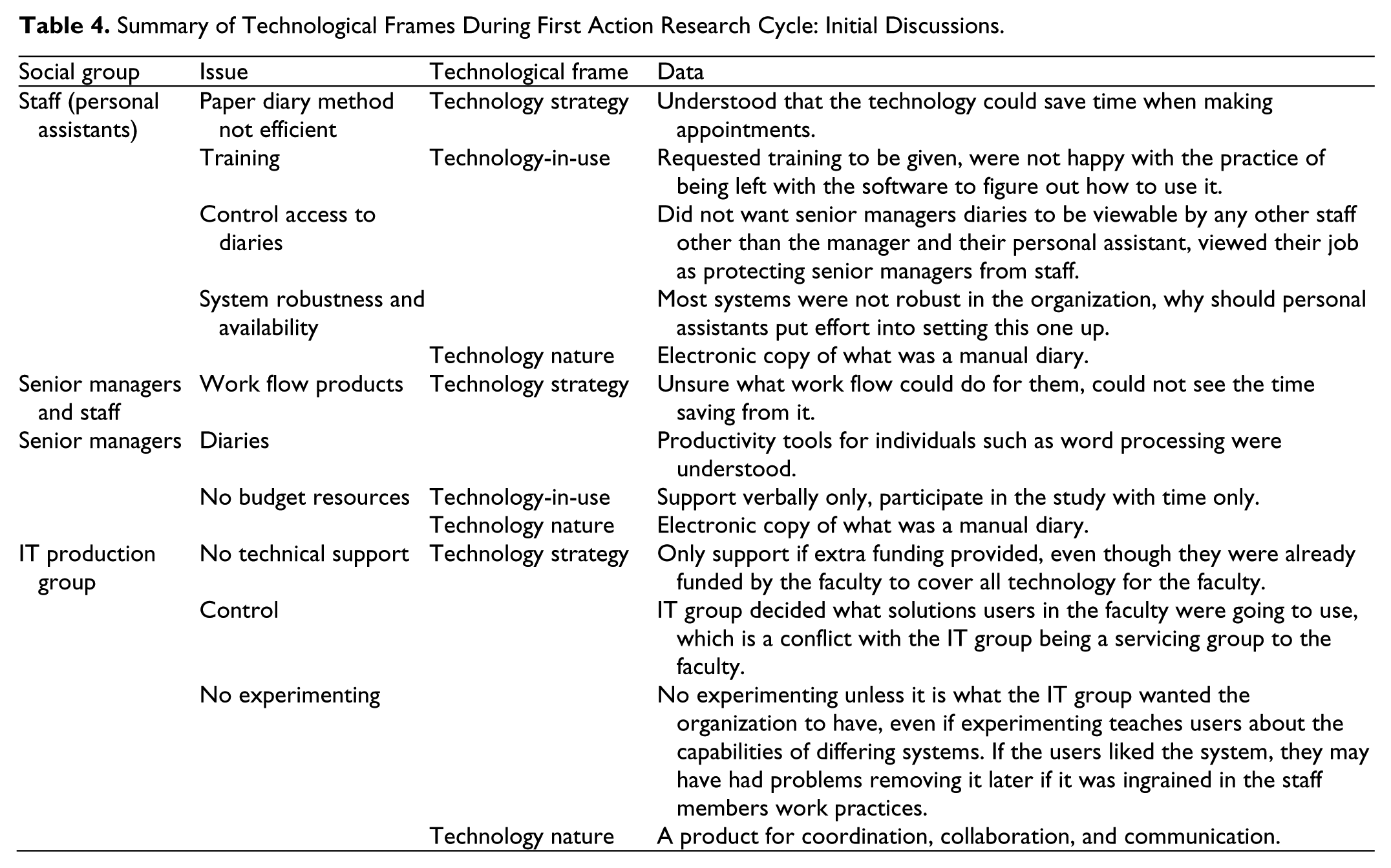
This begs a discussion of how the faculty senior management and employees expected any improvements in technology to occur. The IT group which had the budget with the funds for IT development, appeared to only support the specific projects they preferred and senior management did not allocate money toward alternative projects. Without the influence of the researcher, the trial of groupware would not have occurred. As Orlikowski and Gash (1994) say, it appears that technological frames become institutionalized, leading to cognitive inertia, which can inhibit change. The problem relating to the coordination of meetings was acknowledged and quantified by both senior management and personal assistants, yet there was no real impetus for change. The technological frames reflect mainly a technology-in-use frame; a technology strategy was not present as the users could only envisage future usage or benefits.
One senior manager was able to see how her personal assistant could benefit from the set up of a document repository, especially with the versioning ability of the product. However, the personal assistants as group wanted the diary first.
Second Action Cycle: Installing the Product and Initial Training
Installing the product involved about half an hour to load the client software onto the user’s desktop and to install an id file and a password for the user. Initial training involved a training session for all staff in how to use the product. Notes were taken on conversations with users during the installation process. The initial training also involved direct observation of the participant interacting with the product. Information was recorded on those who had used an electronic diary before, on choosing which options others could view, managing calendars, and which free-time options were appropriate in the organization.
In relation to installing the product, the staff requested training materials before training began. This was very pro-active of the staff. The training booklet was given in hardcopy to each participant, as requested. The technological frame of staff relates to their need to have documents in hardcopy rather than softcopy. This need to have a back-up copy in paper relates to the practice of the use of backups for all needed documents, in case the system was unavailable when required.
Since staff members were concerned about being trained before they used the product, they were not given access to the product until they had participated in a training session. This initial training covered the following:
An explanation of groupware and Lotus Notes™:
The full functionality of Lotus Notes™, such as document repositories, imaging, discussion threads, calendars, and resource scheduling.
The client/server architecture of Lotus Notes™, and that the Lotus Notes™ server was separate from the existing Novell, Inc. Netware file and print server.
Access to the system, password changes, access to electronic mail, calendaring, and to-do lists.
The Lotus Notes™ mail system and how it integrated with the diary and resource booking module.
Calendar entries along with recurring appointments.
To-do lists and assigning to-do items to other participants.
Calendar profiles and options relating to which individuals would be allowed to view their calendar, who could manage a calendar, and who would be able to read, send, edit, and delete mail on their behalf.
Who is given the option of setting arranging meetings with another participant in an available timeslot.
Most of the training was related to how to accomplish tasks. No real information on processes or changing the processes was given. This reinforced an existing technological frame at all staff levels relating to how the world is viewed with regards to technology. Staff thought that what was needed were instructions on how to use the product, rather than instructions on the capabilities of the product. The only part of the training that related to the product and capabilities was in the introduction to the training, in which a description was given of what groupware is and what functionality is included. The reason for this was because from the initial discussions in Phase 1, it became apparent to the researcher that there were very different interpretations of what the product was. The ability of the product to support the shared working environment was explained; however, individual staff focused on their personal productivity.
Training was performed with the senior managers and their personal assistants. There were differing frames around who could view the senior manager’s diary. Joint training sessions with the personal assistants and their senior managers meant that the defaults settings could be discussed and they could jointly discuss their differing frames and decide on options to set. The level of access that could be provided to the senior manager’s mail needed to be discussed. All senior managers chose to allow their personal assistants to manage their diaries, but e-mail was not to be read or sent by their personal assistants. The senior managers were made aware that they could change these options to allow more or less access to their electronic mail/diary as they wished. The option to allow the reading of everyone else’s diary was given in the first instance; however, this was later changed to no one else being able to read the senior manager’s diary, except via the personal assistant.
Several senior managers who did not have personal assistants claimed at the last moment that operational deadlines precluded them from attending training. They were trained within the following 8 weeks, as their timetables permitted. Their poor response to training is interesting. They also mentioned that they had not been provided with additional time resources to undertake training. However, the most senior managers attended training regardless of operational deadlines.
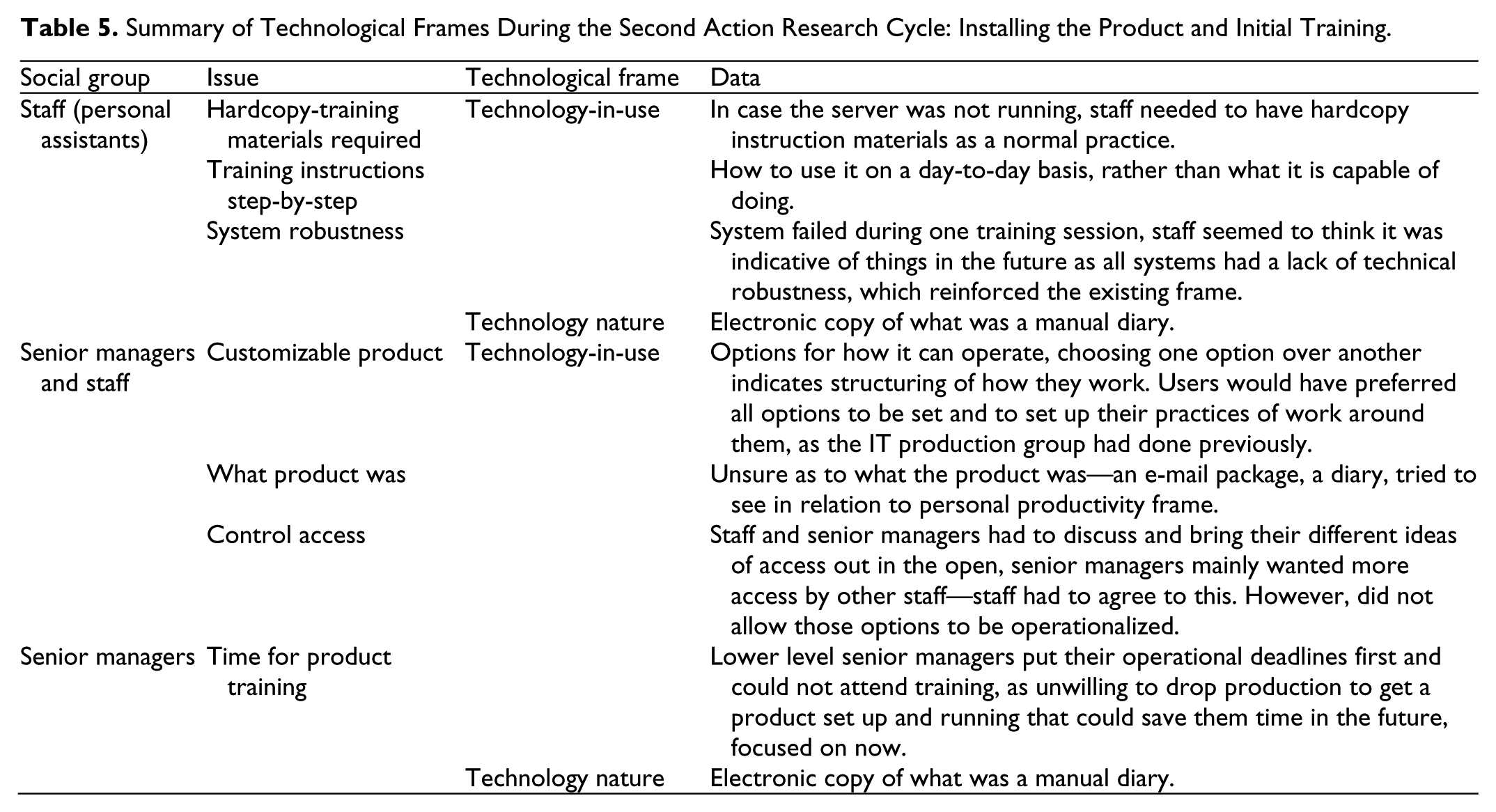
The technological frame relating to the customizability of the product was significant. The participants had difficulties in realizing that they had choices in customizing the product. Their inability to customize products was possibly a reflection that they had been provided with products in the past with options pre-selected by the IT group. The option of viewing everyone’s calendar was selected originally, then removed at the request of the personal assistants, but was then re-enabled for particular personal assistants only. This re-enabling occurred when a personal assistant went on leave and needed other personal assistants to be able to view and add entries to the diary. Table 5 shows the summary of technological frames during the second action research cycle.
Summary of Technological Frames During the Second Action Research Cycle: Installing the Product and Initial Training.
Third Action Research Cycle: Use of the Product
Frequency of use of the product differed among people within the study group. Several of the senior managers who did not have personal assistants did not set up their electronic diary. Their reason for not doing this was that they did not have time and placed a higher priority on meeting operational deadlines. The frame shown by senior management was that of meeting operational deadlines, rather than setting up IS that could create efficiencies. As discussed earlier, one of the practices of use of technology was not to reduce productivity to organize systems, particularly if operational deadlines were threatened.
The use of the product also involved a period of customizing the product to the needs of the users. These decisions were left to the staff members concerned.
How the users appropriated the product to structure their work was of interest to the research. This reflects a frame about use of the product and the process of structuring work. Users had the choice to integrate the diary with the current mail system, which several users opted for, while the remaining staff retained their current mail system. An advantage of opting for the integrated mail system was that if one received an invitation to a meeting via e-mail, the accept button could be pushed and it would automatically be slotted into the diary without having to type anything. It also enabled invitations to be sent to numerous individuals via the e-mail system, and invitations to be accepted easily.
To use the Lotus NotesTM as the primary server, a job request was lodged with the IT group. Most senior managers opted for this and used the replication functions. That is, their e-mails resided on the notes server and were copied onto their laptop hard drive. They could work on their e-mails without being attached to the server, and they could replicate their server with home mail whenever and wherever they wanted. This way of working was different from previous and they readily changed their practices to use this option. They worked on their e-mails and then connected and replicated with the mail server remotely.
The Lotus NotesTM server had already been set up and licenses were available. Therefore, no capital investment or high labor costs were needed. If there had been capital or labor costs, it is likely that the trial would not have gone ahead. When the groupware product was discussed with the personal assistants, they wanted to know how soon the product could be made available. Others within the organization heard about the trial and wanted to know why they were not being given the same groupware system as the senior managers and assistants. So there were expectations being established regarding the product.
Each personal assistant/senior manager configured the product in a slightly different way, according to how they structured their work. One senior manager later gave their personal assistant full access to their mail system. This allowed the personal assistant to filter the senior manager’s 200 daily e-mail messages.
The free-time option was discussed with the participants in training. This is an option that allows the user to select people to have a meeting with and to see what free-time is available. This meant the system identified the first available timeslot of all these people. This was an effective and efficient option that required all relevant staff to have the free-time option switched on. However, this feature was switched off by some personal assistants for their senior managers, causing it to be ineffective. When it was switched off, a manager was unable to have a meeting slotted in for them by other people without the personal assistant knowing. This was a way for the personal assistants to control their senior manager’s diary. This choice in their use of technology reinforced how they had worked prior to the installation of the electronic diary. In Phase 3, the sharing ability in the product challenged senior managers. In particular, the product enabled tasks to be set up by one person, and allocated to others in a group. One senior manager reacted badly when tasks had been placed on his to-do-list by the personal assistant of another manager. Previously, he had avoided doing any tasks that were not on his to-do-list; however, with this product, this practice could be overridden. Another senior manager started to put entries in her own diary that conflicted with entries that her personal assistant had already put in. Therefore, practices for how they would deal with conflicting appointments had to be worked out between them. The personal assistant noted that, over time, the senior manager entered fewer appointments and the personal assistant put in most of the entries.
The ability to view each other’s calendars was also useful; however, the personal assistants removed this option as they wanted to view and control their senior manager’s diary themselves. Therefore, the personal assistants imposed their personal productivity frame on the senior managers. Table 6 shows the summary of technological frames during the third action research cycle.
Summary of Technological Frames During the Third Action Research Cycle: Use of the Product.

Discussion
The research questions that this study aims to answer are as follows. How do organizational members (senior managers, personal assistants) make sense of a groupware product during its implementation? This is answered through looking at their technological frames. For the personal assistants (the users) of the system, this is particularly interesting in they did exhibit characteristics of user resistance as per Table 7, but overall they were positive to the systems implementation. The research findings in each phase were categorized by their user resistance to change factors; prominent factors impeding successful implementations are “threats by individuals” and “perceived loss of power” (Laumer & Eckhardt, 2010). In particular, the personal assistants perceived that the implementation of groupware would result in a loss of personal power, so they changed who would have access to the diary to protect their power. The other aspect of resistance to change which the researcher tried to mitigate was the poor support from the IT group.
Summary of Resistance to Change Aspects in Case.
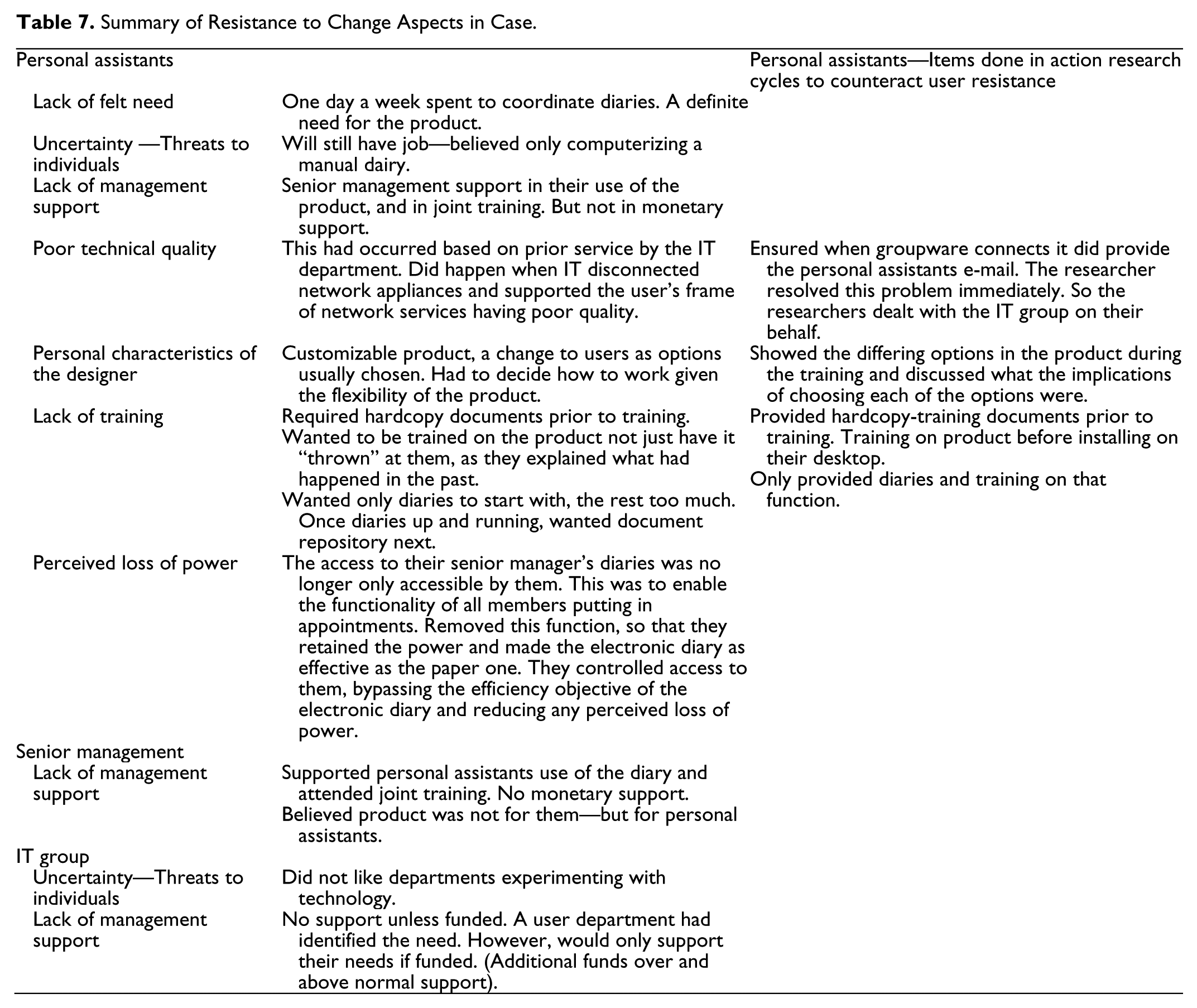
After several months of use of the groupware, the senior managers decided not to fund the continued use of the product, or to roll it out to others in the organization. It appears that they did not see significant benefits from the product, even though the personal assistants had become used to it and wanted to continue using it. Overall, the senior management felt that the groupware product was primarily a tool to help the personal assistants, and not themselves.
The second research question was, in what ways are organizational and social issues significant in explaining non-adoption of new technology? To answer this, we need to examine not only at the personal assistants but also at the relationship between senior management and the IT group. Even though the personal assistants exhibited aspects of user resistance, the failure of implementation relates to senior management and the IT group. This failure is due to existing power and organizational culture among the senior management and IT group, rather than resistance to use by the personal assistants. Analysis of these items will be examined with reference to the three criticisms to the technological frames genre, “contextual focus, temporality, and level of analysis.”
With reference to the first criticism, “contextual focus,” a broad examination was undertaken of how the frames relating to senior management and the IT group were formed over time, so that more than partial explanations can be provided. The frames of the IT group and senior management were formed prior to the groupware implementation project, and their relationship around IT development impacted on the project. The IT group would only support a system that was funded. The senior management group did not see the benefit of groupware to them and thought that as it was an IT system, the IT group should take care of its implementation. Their frames and relationships had been built up for many years and the implementation failure must be viewed in light of this. Existing frames concerned the historical relationship of who supplied IT services. The senior management believed this was the IT group’s role. The IT group believed that if senior management ascertained a need and supplied funds, then a new system would be implemented. They did not encourage experimentation with new systems by the user groups. Following implementation, the IT groups found a cheaper alternative system, Novell Groupwise, as Novell was already part of the networking system. Six months after the Lotus Notes project, the Novell Groupwise product was installed as, according to the IT group, it worked well with their IT network infrastructure. The personal assistants’ frame had expanded in that they now wanted diaries to be available online, and were able to discuss their choice of options for the product. As Novell Groupwise was not a full groupware product and was unable to do all the things that the Lotus Notes product could, the personal assistants were frustrated. They envisaged how they should be able to operate the Novell Groupwise product based on their Lotus Notes experience. Therefore, their technology strategy frame had definitely changed as a result of the Lotus Notes trial. So by looking at the future, the IT groups were installing a product that was part of their network system with no additional costs, and which could provide some of the functionality of a groupware product. In other words, the IT group decided what the user needs were and provided a system they deemed would meet those needs.
The second criticism of technological frames research is that it most often focuses on the frames at one snapshot of time, which corresponds with the beginning of the implementation project. In this research, frames were considered before the project started, and at the end of each of the three phases, providing a total of four snapshots. Given this span, the emergence of the frames is viewed and discussed particularly in relation to the personal assistants’ frames and their resistance to change. The action research project tries to address these perceptions and the frames in each subsequent phase to ascertain how well this was achieved. One of the issues that can be examined closely is the development in what the personal assistants view is the purpose of a groupware product is for. The personal assistants did not view the groupware product as a tool for coordination and communication; rather, they saw and operated it as a personal productivity tool. However, if one personal assistant went on leave, they shared that personal assistant’s senior manager’s diary with the other personal assistants. When the personal assistant returned to work, they amended those options so that they would only have exclusive access. Orlikowski and Gash (1992) suggest that for groupware to be successful, a collective frame is needed, rather than an individual frame. The personal assistants still had the individual frame, but if they had continued to use the product, their frame may have changed to a more collective frame. However, due to the discontinuation of the project, this was not observed.
The third criticism of the technological frame genre concerns sourcing most data from interviews and cognitions of the individual, rather than from the group. This project used training sessions of the workgroups, the senior managers, and their personal assistants, to see how they made sense of the project. In addition, the action research phases enabled close interaction with the researcher in solving problems and interacting with the product, which enabled the frames around the groupware product to be understood.
Therefore, this study addresses the criticisms of the technological frames genre by Gal and Berente (2008). The findings of the study can only be explained adequately by being viewed within the full context of a 10-year time span, with multiple frame snapshots based on interaction with social groups. The study provides new insights in the conduct of technological frames research.
Conclusion
The literature on development and implementation of IT solutions has shown much attention to user resistance to IT. However, this article reports on an empirical study from an in-depth action research project to implement groupware, which shows that the development of an IT system is more about how senior management and the IT group make sense of technology, than about user resistance. The implications of this are that information technology use was improving, but at a slow pace. The lens of technological frames was used to identify the factors around frame change. The researcher studied how technological frames change over time in the implementation of groupware; in particular, the technology-in-use, nature of technology, and the technology strategy frames. These frames were analyzed in light of the changes in organizational structure in light of the changes which occurred and the differing power and accountability relationships in the organization. The technological frames helped the social groups who were studied to construct meaning, which is reflected in their use of technology.
Technological frames is based on social cognitive theory and suggest that people construct meaning from the assumptions, knowledge, and expectations they hold about technology, which in turn can influence which types of information technology are developed, adopted, and used. However, the overall failure of the system studied related to the senior management and IT group frames, which had developed prior to the project and caused the project to fail. It was found that the senior managers’ technological frame did not change, as they did not see the groupware product as appropriate to them. They saw it as a tool for the personal assistants. Personal assistants liked the tool and wanted to keep it, but there were pressures from the IT group, who refused to support the groupware, and the senior managers, who saw no value in it. The groupware was discontinued as the IT group refused to support it. The IT group had complained about users’ lack of knowledge in IT, but when a project was implemented to increase user knowledge, the IT group opposed it. This is in marked contrast to what they stated about their technology strategy. Overall, computing was improving in the organization but at an extremely slow pace.
The technological frames literature focuses on surfacing frames to ensure congruent frames during development, adoption, and use. However, this study goes beyond this by addressing the criticisms of the frame literature by Gal and Berente (2008), which were contextual focus, temporality, and individual level. This study looks at the technological frame at multiple points in time during the implementation, to address the temporal time limitation; the study also brings incorporating the prior history and context of the organization to address the contextual focus. The level of interaction is examined via the action research project in that the training- and observation-enabled interactions to be captured. Overall, the most important limitation of the prior frames literature research that needed to be addressed, to answer the research questions, was the contextual focus. The relationship between senior management and the IT group was the reason that implementation failed. This relationship is based on their prior interactions and beliefs, which certainly would not have been elicited in a smaller study. Therefore, by addressing the criticisms leveled at the technological frames literature, technological frames research can be used to study IS implementations. Examining the technological frames of the senior management and IT group enabled the researchers to see that resistance to change by users was not the issue; rather it was the deeply embedded frames of the senior management and IT groups.
This study has contributed to further understanding of technological frames and their impact on IS implementation. Further technological frames research should be cognizant of the criticisms leveled at the genre.
Footnotes
Declaration of Conflicting Interests
The author(s) declared no potential conflicts of interest with respect to the research, authorship, and/or publication of this article.
Funding
The author(s) received no financial support for the research and/or authorship of this article.