




Abstract
This article focuses on religion and the embeddedness in civil society. We examine the relationship between religion and national identity (ethnic and civic). Our findings show that individual religiosity continues to play an important role in sustaining both forms of national identity. In addition to other studies, we examine the relationship between religion as a societal phenomenon and individual national identity and find the following: The stronger the relationship between state and religion, the stronger the ethnic identity; the more the religious homogeneity, the stronger the ethnic identity; and there is no relationship between aggregated degree of religious organizations and identity. We conclude that religion continues to play a major role in the making of civil society, but the specific circumstances vary according to the religious representation. In other words, religion can both make and unmake national identity.
The associational life of civil society is the actual ground where all versions of the good are worked out and tested . . . and proven to be partial, incomplete, ultimately unsatisfying. It can’t be the case that living on this ground is good-in-itself; there isn’t any other place to live. What is true is that the quality of our political and economic activity and of our national culture is intimately connected to the strength and vitality of our associations. Ideally, civil society is a setting of settings: all are included, none is preferred.
Religion as a Way of Understanding Civil Society
For a long time, the sociology of religion has suggested, on one hand, that religion supports social cohesion through shared symbols, rituals, norms, and networks (Fukuyama, 2001; Putnam, 1993, 1995) and that it has the power to transcend boundaries constituted by factors such as ethnic origin, gender, or age (Beck, 2008, p. 75), while on the other hand, it tends to be exclusive to those who are not part of the dominant congregation(s) (Bohn & Hahn, 2002; Gross & Ziebertz, 2010; Yuval-Davis, 2010).
We argue that religion—despite a longstanding discussion on the secularization of European societies—still is a constituent factor shaping affiliations as well as cleavages within European civil societies through creating and sustaining national identity. We examine religion as a multilevel phenomenon that comprises individual religiousness but is also embedded in the institutional and cultural setting of countries. While on the individual level, religiosity still effects feelings of affiliation to larger communities, religion as longstanding shared belief systems is inscribed into political institutions, cultural frameworks and social inequalities on the country level (e.g., Mau, 2002; Rokkan, 2000; Spohn, 2009). As a structural factor, religion influences individual perceptions, attitudes and actions.
In this article, we are interested in how religion on different societal levels affects individual feelings of national identity. More precisely, we want to know whether and how religion especially as a societal phenomenon (state–religion relationship, religious homogeneity, and aggregate membership in religious organizations) affects civic and ethnic national identity on the individual level. We are interested in how religious institutions matter for individual feelings of affiliation to a larger (national) community.
Social Cohesion, Religion, and National Identity—A Close but Not Too Close Relationship
The article’s question gains its relevance mainly from the sociology of religion and from national identity research. So far, both strands have generated a large body of literature and established a longstanding tradition in focusing on societal inclusion and exclusion as factors in the social cohesion of civil societies.
When it comes to social cohesion, the theory of civil societies draws attention to two main aspects of modern democratic societies. First, civil societies are often seen as providers of important conditions for civic engagement and the social space to articulate, negotiate, and organize the interests of citizens. In so doing, they help to maintain and legitimize democracy and redistributive governmental policies (e.g., Putnam, 1995). Civil societies inhere this capacity by their ability to generate and distribute social capital including trust, the willingness to contribute to the common good, and the morale of reciprocity on the individual level (Coleman, 1988; Putnam, 1993, 1995). Social capital can be understood as the “instantiated informal norm that promotes cooperation between two or more individuals” (Fukuyama, 2001, p. 7). It assures social community through shared basic cooperative orientations on the individual level. The production of social capital depends on volunteer organizations, associations, and groups, which empower people to fight their causes—even against powerful governments. Keane (2006, p. vii) defines civil society as “the community of associations, initiatives, movements and networks.” Second, civil societies not only create and sustain cohesion but are also still shaped by cleavages, political inequalities, and differences in the access to resources and social positions. Such cleavages are marked by group-related boundaries between “us” and “them”; it facilitates economic and social inclusion and exclusion and, thereby, different chances of political participation and of becoming an active community member. It seems that as individuals become involved in smaller communities characterized by interests and lifestyle, they interact less with people who are different, which affects inclusion negatively (e.g., Welch, Sikkink, & Lovelend, 2007).
In the following, we understand civil society as generated from individual social capital—its cohesion results from (aggregated) individual feelings of affiliation to a larger community. 1 We, thereby, follow Coleman’s postulation of methodological-individualistic explanations in social science (Coleman, 1994) stating that systemic or societal phenomena have to be explained through explanatory mechanisms on the micro level: While the explanandum has to be on the macro level (in this case social cohesion of the country), the explanation itself should be carried out on the level of its components (individuals and their attachments). We are interested in how religion influences such feelings and thereby creates, sustains, or changes cleavages within European civil societies.
Religion and Civil Society: Cohesion or Disjointedness?
The relationships between individuals, communities, and civil society become especially complex when religion is involved. The integrative impact of religion has been continuously analyzed since Durkheim’s (1912/2010) work on this relationship. For Durkheim, religion provided the necessary norms, meanings, rites and symbols and the opportunity structure that facilitate interpersonal attachment and, thereby, solidarity and social cohesion. More recent research argues that despite trends of secularisation, 2 there still is a positive correlation between religious membership, beliefs, and practices on the one hand and social capital and integration on the other. Religiousness seems to lead to a decline in delinquency (e.g., Hirschi & Stark, 1969; Stark, 1996; Stark & Bainbridge, 1987), anomic behavior (e.g., Bjarnason, 1998), and it increases social capital, as Fukuyama (2001, p. 19) states, “There are two [ . . . ] sources of social capital that may be more effective in promoting civil society. The first is religion” (see also Jagodzinski, 2009; Putnam, 2000; Smidt, 2003). 3 Individual religiousness seems to support the homogenizing and integrating effect of civil societies.
Nevertheless, religion has also been proven to have exclusionary powers against those who are not part of the congregations, churches, or communities in power: That is, the religiously induced trust does not necessarily encompass all citizens and religion may add to “bonding” within instead of “bridging” between societal groups (Welch, Sikkink, Sartain, & Bond, 2004, p. 318). At the same time as it integrates, religion may operate as a marker of group boundaries between “us” and “them” and thereby facilitate cohesion within the religious at the expense of the exclusion of nonbelievers, people of other denominations or different value systems (e.g., Bohn & Hahn, 2002; Gross & Ziebertz, 2010; Yuval-Davis, 2010). 4 The inclusive influence of religion is limited to only certain parts of society and engenders cleavages that can result in discrimination detrimental to the exercising of civil rights. On the European level, it has been argued that in particular Islam became the most prominent religious “other” over the last two decades while a-confessional people are barely discriminated against:
The first open, if not yet formal discussions of Turkey’s candidacy during the 2002 Copenhagen summit touches a raw nerve among all kinds of European “publics.” The widespread debate revealed how much Islam with all its distorted representations as “the other” of western civilisation was a real issue rather than the extent to which Turkey was ready to meet the same stringent economic and political conditions as all other new members. (Casanova, 2006, p. 70; see also Gerhards, 2004; Spohn, 2009)
Religion as a Multilevel Phenomenon
It is not only the concurrent inclusive and exclusive effect of religion that constitutes the complexity of its relationship to social cohesion: Religion is a multilevel phenomenon that comprises more than just the level of individual religiosity. On the different societal levels, religion can be expected to develop different kinds of influence on social cohesion.
(a) Theories of civil society and social capital call our attention to religious organizations, community work, and religious groups (e.g., Coleman, 1988, p. 99). Religious structures, similar to other forms of civic engagement, have the power to create general social capital: “The social capital generated by religious structures supports not only formal religious volunteering but ‘secular’ volunteering as well” (Greeley, 1997, p. 592). In modern societies, it is, however, an open question as to whether other civil society organizations create social capital in a similar way or if religious organizations are organizations of a special kind. Religious organizations provide particular norm systems and opportunity structures, but unions, sports clubs, or social movement initiatives may serve as functional equivalents in providing opportunity structures for civic engagement and the production of social capital (e.g., Putnam, 1995). (b) Religion also develops its influence through communal beliefs and shared systems of meanings, morals, and values that have the power to engage members’ allegiance through interpretations, norms and sanctions. In this way, religion shapes the understanding of civicness within a society and what constitutes acceptable social behavior. (c) Religion as an ideological system (as well as its absenteeism) is manifested within governmental structures as constitutions 5 and welfare policies (e.g., Manow, 2005; Stark, 1996; Welch, Tittle, & Petee, 1991). Such shared systems of understandings, customs, regulations, and laws manifest themselves potentially on the level of smaller regional communities, nation-states, or larger cross-border collectives such as the EU (e.g., Grötsch, 2009; Schnabel & Grötsch, 2012).
For the following analysis, we focus on societal aspects of religion on the country level as research evidence on this level is mainly qualitative and quantitative studies are still missing. The theoretical reason lies in the close relationship between the nation-state and religion in Europe. On one hand, national constitutions and policy systems are said to mirror Christian social teaching and are understood as the manifest result of conflicts between different religious and political groups over history (e.g., Knippenberg, 2006; Manow, 2005; Rokkan, 2000). On the other hand, the national educational systems are major transmitters (and homogenizers) of ideological and cultural perspectives and understandings (e.g., classical: Gellner, 1983) and the state–religion relationship is highly significant for religious practices (Fox & Flores, 2009). Distinguishing between such country-specific characteristics allows taking diverse governmental settings into account.
Religion, as a contextual phenomenon, has the potential to influence people’s attitudes and behavior. However, we can expect the influence of religion as a contextual phenomenon to vary according to the type of religious context. Both the way and the degree to which religion is intertwined in civic societies vary across these societies. We focus on the effects of three different aspects of religion as a contextual phenomenon, namely, the institutional interplay between the state and religion, the organizational degree and the actual degree of religious heterogeneity on the contextual level.
Nation, Religion, and Civil Societies
Why national identity—again? To Calhoun (1993), national identity is “one genre of answers to the question of what constitutes an autonomous political community capable of self-determination” (p. 387). Such communities always consist of individuals who identify themselves with other (alleged) similar minded people. National identity is first and foremost a trait of individuals. Only aggregated, it can become a property of collectives (Hjerm, 1998; Hjerm & Schnabel, 2010; Jones & Smith, 2001; Smith, 2000). It constitutes a basis for the trust among those who are considered “similar.” Therefore, if we are interested in country-specific degrees of social cohesion of civil societies (and their changes), we have to consider individual perceptions, beliefs, attitudes, and actions.
In contrast to other concepts of social cohesion (e.g., “generalized trust”), national identity provides an objectivation for individual identification. 6 Although the imagined community of the nation most often unites around underspecified ideas of similarity that may change over time, the nation constitutes an intentional object toward which people orient their imaginations, feelings, understandings, and actions. Nations form a “community, because, regardless of the actual inequality and exploitation that may prevail in each, the nation is always conceived as a deep horizontal comradeship” (Anderson, 1983, p. 7). This comradeship constitutes a social fact, in the Durkheimian sense, that has the power to rebuke people to overcome their egoistic individual interests. National identity—as realized by individuals—embraces the emotional dimension of loyalty, affiliation, and commitment that is far more specific than general trust because it is rooted in assumptions of similarities (whatever these assumptions are based on). With such central characteristics of identification and shared belonging, continuity, and stability, national identity in its aggregated form can serve as a proxy for—a special aspect of—social cohesion (e.g., Easterly, Ritzen, & Woolcock, 2006).
National identity is part of individual identity formation (e.g., Cohen, 1986; Jenkins, 1996) that provides a means for individuals to understand who they are in relation to others. National identity gains power by providing a clear distinction between “us” and “them,” or as Triandafyllidou (1998) states, “The nation thus has to be understood as a part of a dual relationship rather than as an autonomous, self-contained unit” (p. 594). This relationship exists irrespective of whether those “others” are situated within or outside the state borders. It establishes an inclusive but yet exclusive aspect of civil societies (some even argue that this aspect especially is a necessary precondition for the legitimacy and acceptance of governments; for example, Calhoun, 1993; Conversi, 2007; Miller, 1993; Weiner, 1997). National identity contributes to becoming part of a group relating to a particular territory with clear-cut yet negotiable borders.
There are two well-established dimensions of national identity (Jones & Smith, 2001; Smith, 1991): The ethnic dimension is characterized by ascribed/objective features such as country of birth or common ancestry. The civic/voluntaristic dimension includes a community referring to laws and institutions, a shared political will, equal rights for members of the nation, and a minimum of common values, traditions, or a sentiment. Empirically, they refer to two different dimensions of attachment that are realized at the same time rather than two mutually exclusive categories. Consequently, the population of countries can exhibit different aggregated strengths of national identity and the two dimensions can be mixed in different ways (e.g., Hjerm, 1998, 2007; Lilli & Diehl, 1999). It can be expected that different types of national identity are more prevalent in certain countries than in others.
National identity gives one possible and quite exclusive answer to the question of “who are the people?” that differs from the answer of governmental citizenship rules. The imagined community of the nation concurs with the citizens of the state (only) when nation and state coincide (Barrington, 1997). Often, however, nation and state are not identical, as in Belgium, the United Kingdom, or Spain.
For the following analysis, we understand national identity as an individual attitude that in its aggregated form constitutes the social cohesion of civil societies. By using the two dimensions of national identity as measurements of two different facets of the social cohesion in civil societies, we refer to a now-substantiated aspect of a community that relates to a territory and that aims to realize political self-determination.
We expect religion to play an important role in creating and sustaining individual feelings of national identity. According to Durkheim’s thesis of the integrative effect of religion, we expect that individual religiosity supports national identity (see also Jones & Smith, 2001). According to social capital theories, we expect a positive influence of active membership and of a higher organizational degree of religious organizations on the country level. The expected effects on religion as a societal phenomenon are unclear. Case study evidence suggests that a strong state–religion relationship may support individual national identity, like in Greece or Ireland (e.g., Halikiopoulou, 2008), while the role the state–religion relationship plays in forming (collective) identities seems to depend on the stronghold of the religious organizations and on the discontinuities of political regimes (Jakelic, 2004). From normative political theory, we may gain the insight that (religious) heterogeneity might be perceived as threatening the community (e.g., Miller, 1993; Wolfe & Klausen, 1997). However, systematic, comparative evidence is missing; therefore, we treat our analysis of the contextual aspects of religion as explorative.
The Model
To address the research question as to whether and, if so, how religion influences individual national identities in Europe, comparative data on both religious affiliation and individual national identity are needed. The European Values Study (EVS; Integrated Data Set ZA4800) is a large-scale, cross-national, survey research program that provides insights into beliefs, preferences, attitudes, and values of citizens in Europe. It is the only comparative European data set that includes questions concerning people’s religious beliefs, practices, and memberships as well as a list of questions on national identity. For the following analysis, we use the fourth wave of 2008, which covers the total of the 27 European member states.
We used the questions Q80.A to Q80.E of the EVS to measure national identity:
Some people say the following things are important for being truly [NATIONALITY]. Others say they are not important. How important do you think each of the following is?
To have been born in [COUNTRY]
To respect [COUNTRY]’s political institutions and laws
To have [COUNTRY]’s ancestry
To be able to speak [THE NATIONAL LANGUAGE]
To have lived for a long time in [COUNTRY]
The answers are coded between “1” and “4” where “1” indicates “not important at all” and “4” for “very important.” Although the list of questions comprises only five of the original eight items previously used in analysis of ethnic and civic national identity (Hjerm, 1998; Jones & Smith, 2001), a factor analysis indicates that these five items gather into two factors. The first factor comprises Q80.A, Q80.C, and Q80.E, the second factor Q80.B and Q80.D. These factors are similar to previous studies and correspond to (a) “ethnic national identity” comprising Q80.A, Q80.C, and Q80.E and (b) “civic national identity” comprising Q80.B and Q80.D. For our analysis, we use the factor scores for each dimension. The ethnic dimension of national identity mirrored in these questions emphasize the two aspects of time and space and refer to the individual being part of the autochthonous population, while the civic dimension comprises of feeing bound to institutions.
Contextual Level Variables
To tap into religion at the country level, we use three different measures. First, we include the institutional cooperation between the state and religion. We therefore use the mode of the state–religion relationship from the State-and-Religion Data Set by Fox (2004). These data describe the intersection between state and religion monitoring governmental policies in favor of or against churches, religious groups, and congregations worldwide. We include a measurement of the official state–religion relationship indicating whether a government has hostile (0), inadvertent intense (1), separatist (2), accommodative (3), supportive (4), cooperative (5) relationships or a civil religion (6), or a state religion (7). These variables refer to the degree of governmental secularization—The closer the relation, the less is the degree of secularization. 7 Second, we measure the countries’ religious homogeneity to capture the societal religious context (the Herfindahl-Index for religious heterogeneity is calculated from aggregated EVS data). 8 Because social capital theories consider volunteer organizations, associations, and groups to be important for social capital and therefore for social integration, we, third, included the degree of religious and nonreligious organizations. For this country-specific organizational degree, we use the percentage of people per country who are members of religious organizations and of nonreligious organizations. Nonreligious organizations include social organizations, political organizations, and leisure organizations.
We control for the national economic situation operationalized by gross domestic product (GDP), social spending, and unemployment rate (all Eurostat data from 2007). These data are indicators of the distributive situation within the country and its comparative wealth. They refer to the redistributive and thereby secular aspects of societal integration. In addition, we controlled for percentage of immigrants (Eurostat data) and for language fractionalization (Alesina, Devleeschauwer, Easterly, Kurlat, & Wacziarg, 2003). They refer to “cultural” cleavages in societies and have been shown to influence national identities in previous research (e.g., Hjerm & Schnabel, 2010). To avoid ending up with a “basket model” of all possible influences on national identity, we did not consider external, non–religion-related factors to the nation-state such as globalization (Hall, 1997), post-industrialization (Inglehart, 1997), or the involvement in military conflicts (Boehnke, Kindervater, Baier, & Rippl, 2007).
Individual-Level Variables
Individual religiousness is differentiated into belonging to a denomination (Roman Catholic, Protestant, Orthodox, other, and none, coded as dummy variables) and intensity of individual religiousness. To analyze whether the latter plays a role in forming national identities, we created a multiplied indicator “intensity” from the frequency of church attendance (Q26) and the importance of God in everyday life (Q36). 9 The indicator is standardized between 0 and 1 and captures individual religious behavior as well as the intensity of the belief. 10
In accordance with social capital theory, we want to know whether individual membership in civil society organizations influences feelings of national identity. We therefore created indicators for the individual membership in religious, social, professional, and leisure organizations. 11
For sociodemographic control variables we included the respondents’ sex, age, year of completed education, the annual household income, the political left–right self-assessment and their general trust in others. Although we are not especially interested in the effects of these variables, we control for them to ensure that variances in the dependent variables are not due to their influence and that the country-specific differences in trust do not depend on their country-specific distributions.
The Multilevel Approach
Although the article is about the social cohesion of civil societies, we are, strictly speaking, interested in whether (religious) institutions matter for individual attitudes and affiliations. This is because—following Coleman’s research program—we consider the degree of the social cohesion of a civil society as aggregated from individual affiliations and attitudes. In our interest in the feedback-effects of institutions, 12 we consider individuals as nested within larger institutional contexts—in this case: within countries. Hox and Kreft (1994) stated that “[i]t is important to note that individuals and the social contexts in which they live can be viewed as a hierarchical system of individuals and groups, with individuals and groups defined at separate levels of this hierarchical system” (p. 284).
Statistically, such multilevel problems cannot be solved simply by generalizing results from one level to another (Robertson, 1950). While wrong translations from a higher (macro)level to a lower (micro)level bear the risk of ecological fallacy because unobserved, intervening influences of higher-level properties can interrupt the relationship found on the individual micro level, atomistic fallacies are committed when correlations on the individual (average) level are wrongly generalized to the higher (country) level. 13 Besides the theoretical focus on the feedback-effects of institutions on individual-level national feelings and affiliations, statistically, the analysis of aggregated country-averages of national identity runs the risk disregarding the individual-level covariances and may lead to wrong conclusions about the underlying mechanisms.
Because we take country-level properties into consideration and because we assume that individual attitudes vary systematically according to these properties, a multilevel analysis (MLA) is the method of choice (Hox, 1995). This method is explicitly designed to avoid wrong-level fallacies and even if country characteristics are not explicitly tested, MLA provides the means to control for differences in country-specific distributions of individual characteristics (Steenbergen & Jones, 2002). We use multilevel regression that is, effectively, an ordinary least square regression (OLS-regression) which can handle nested sources of variability such as individuals in nation-states. Multilevel regression performs better than OLS-regression if macro variables are included. The variation within the dependent variable is due to two sources of variation: variation within groups and between groups. If a single-level model is performed, the assumption of independency of the error terms is violated because observations within a group can be expected to be more similar than between groups, and standard errors are underestimated (Hox, 2002; Snijders & Bosker, 1993). A minor problem is that the number (N) of included countries is only 27. We follow Snijders and Boskers (1993) arguing that if N is equal to or greater than 10, a random intercept model is preferable to a fixed model of regression analysis.
The Religious and National Landscape of Europe
First, descriptive analyses of the EVS data indicate that the religious and national landscapes of Europe look quite diverse (Figures 1 and 2).
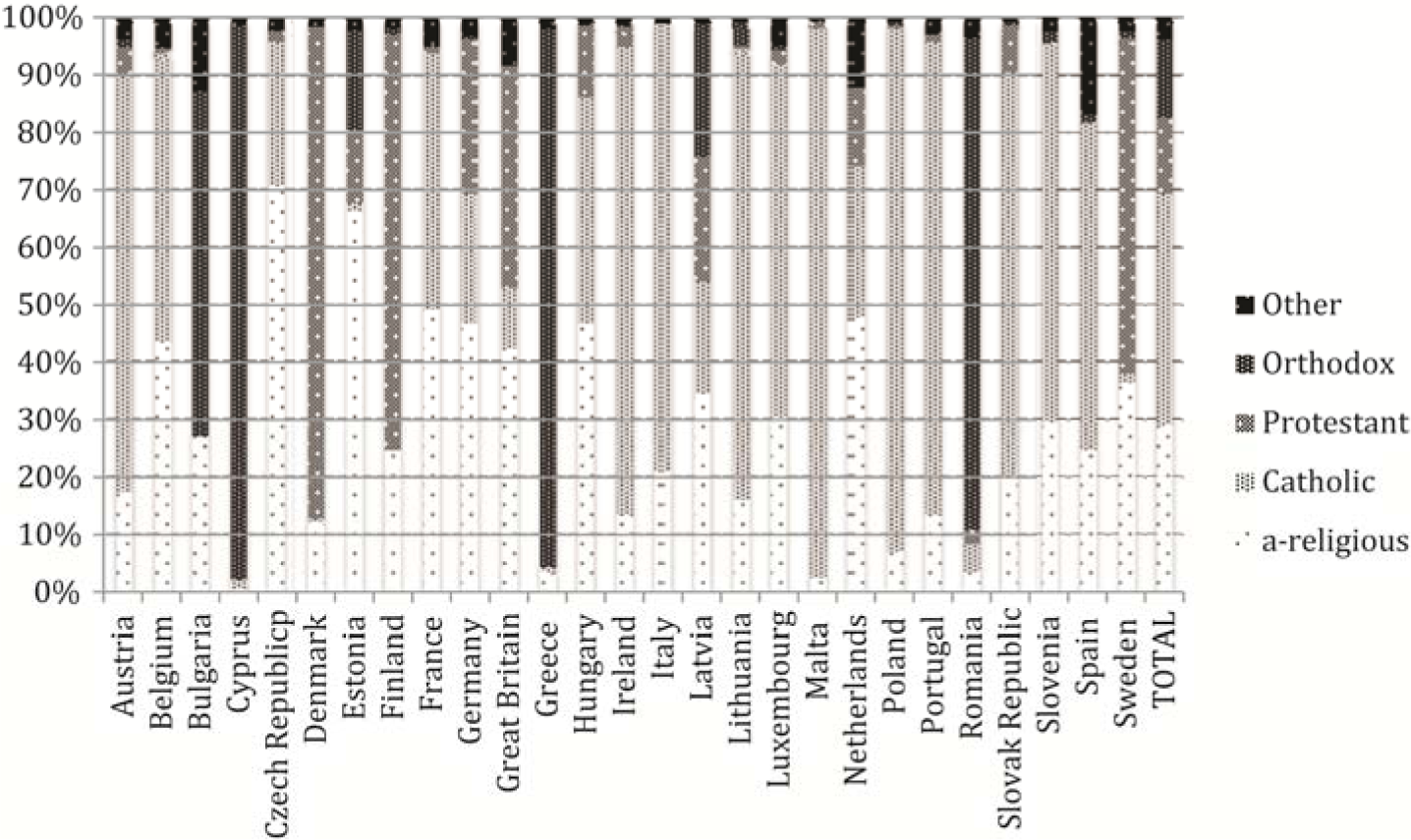
Religious landscape of Europe (denominational distribution per EU-member-state in 2008).

Aggregate national identity per country in Europe (ethnic and civic national identity per EU-member-state in 2008). 14
There are very few countries with a single clearly dominant majority denomination: Only Denmark has a Protestant majority larger than 75%, indicating that the Protestant North is less homogeneous than suggested. The Catholic monoconfessional bloc with more than 75% Catholics consists of Ireland, Italy, Portugal, Malta, Lithuania, Poland, and the Slovak Republic. Classical representatives like Spain are not in this group. Greece, Cyprus, and Romania are countries dominated by an Orthodox majority. Estonia and the Czech Republic have a-confessional majorities that are close to 70%.
It is important to note that the European member states are characterized quite differently concerning their population’s average values of the two dimensions of ethnic and civic national identity. In most of the countries, ethnic and civic national identities identified are in fact opposite dimensions. Only in Great Britain, Malta, Cyprus, and Slovenia both have a positive value. On average, ethnic national identity shows a higher (positive and negative) intensity than its civic counterpart. Cyprus, Bulgaria, Malta, Poland, and Romania score quite highly with regard to ethnic national identity, while Sweden, Spain, France, and Denmark show a high average score of civic national identity. The data so far confirm earlier findings by Hjerm (1998, 2007) stating that ethnic and civic national identities constitute two different dimensions of national identity and that their combination varies across countries.
The Multi-Level Analysis
Because these average data on the country level disguises what is going on at the individual level, we performed a MLA. This MLA showed that country-level properties matter for variances in national identities: The empty model (not reported here) shows that 15.5% of the total variance in ethnic national identity can be attributed to differences on the country level, while country differences are responsible for 10.4% of the variance in civic national identity. As the relatively small number of cases allow for only a restricted number of influencing variables, we eliminated variables from the analysis if they did not show significant influence and included the macro-level variables stepwise.
Because we are not interested in general individual influences on national identity, we are not commentating extensively on the individual control variables. They do not show any irregularities and are in line with former research on national identity (e.g., Jones & Smith, 2001): After controlling for country differences, women do not differ significantly from men regarding their ethnic and civic national identity, while age, education, a right-wing self-assessment and a higher general trust increase both types.
Concerning individual religiosity, the models show that, compared with a-confessional persons, Catholics and Protestants feature a higher degree of both types of national identity, while being a member of the Orthodox Church has a strong negative impact. The group of “other religious memberships” is too heterogeneous and too small to be meaningfully interpreted. However, we can assume that membership of a religious diaspora makes it harder to feel attached particularly to the ethnic dimension of national identity. Although the impact of religious denomination is straightforward in principle, there are some interesting details: Catholicism and Protestantism both have a stronger impact on ethnic than on civic national identity and Protestants have a stronger affiliation to civic national identity than Catholics. The negative impact of Orthodoxy on both forms of national identity can be explained by the Russian minorities in the Baltic states (Estonia, Latvia, and Lithuania) who do not develop a national identity in their host countries (cf. van Meur, 1999). They constitute a large enough minority in the sample of the EVS that is statistically responsible for a strong negative effect. This effect is not compensated by a weak positive impact of the orthodox people living in countries with an orthodox majority. 15
Independently of the denomination, intensity of individual religiosity increases both ethnic and civic national identity, with the increase for the latter being larger. Being a member of a religious organization increases the civic national identity (Model C5, Table 2), while it is not important for the ethnic dimension (Model E6, Table 1). Being a member of a social organization, however, affects this dimension significantly. All in all, the results on the individual level indicate that individual religiosity continues to play an important role in national identity formation in Europe and that—in accordance with social capital theory—national identity is influenced by membership in civil society organizations.
Multilevel Models for Ethnic National Identity.

Note. In addition, we tested for the share of immigrants and the language fractionalization, both came out as nonsignificant results. GDP = gross domestic product; PPS = purchasing power standards.
p < .05. **p < .001.
Civic National Identity.
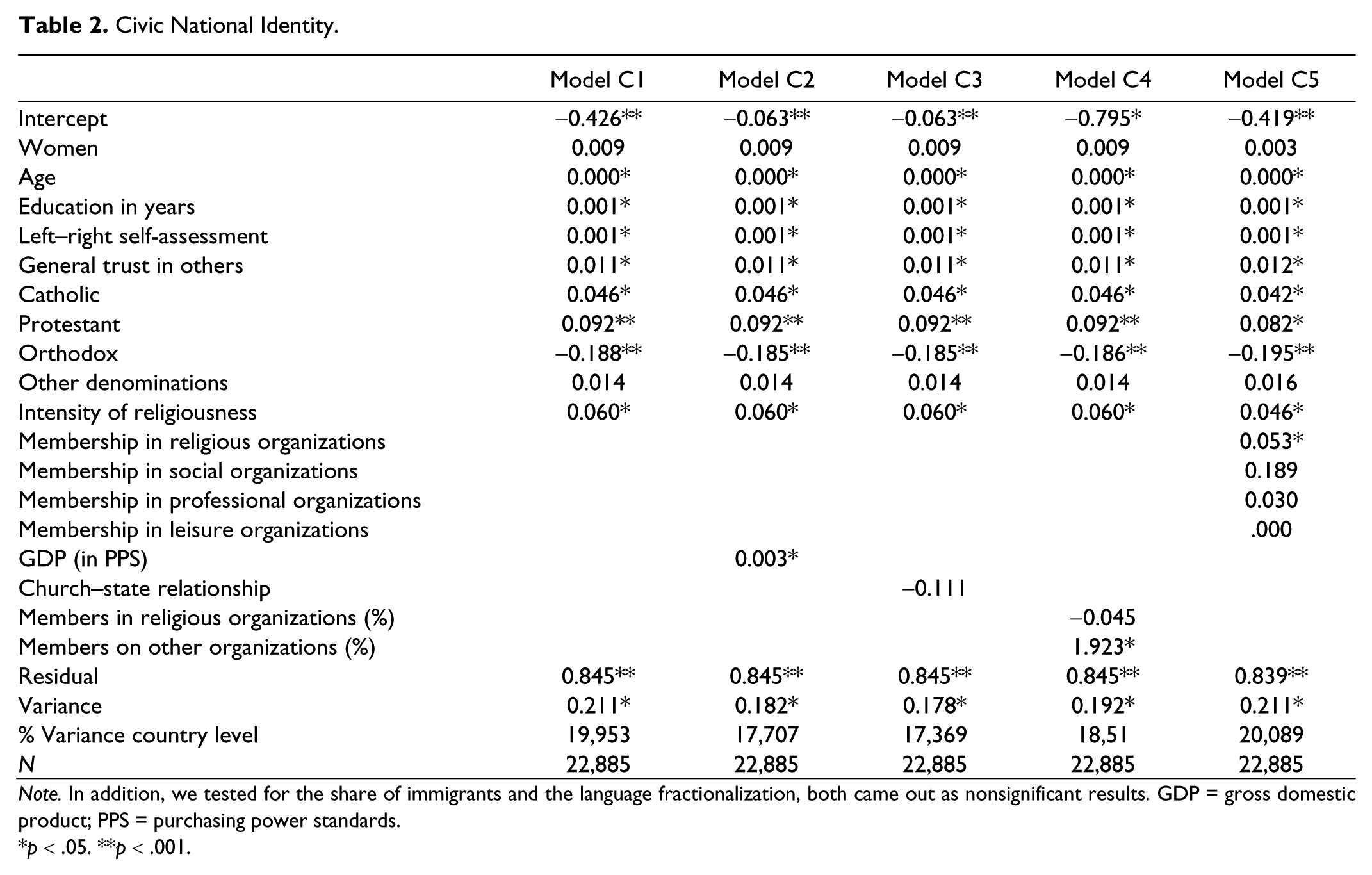
Note. In addition, we tested for the share of immigrants and the language fractionalization, both came out as nonsignificant results. GDP = gross domestic product; PPS = purchasing power standards.
p < .05. **p < .001.
The models E2 to E5 and C2 to C5 test for country specifics. Concerning the social policy-related control variables on this level, only the country’s GDP shows a significant influence 16 on ethnic and civic national identity; while the social policy-related indicators of secularity social spending and unemployment rate had no significant effect. 17 In addition, neither the share of immigrants nor language fractionalization shows any significant impact. 18 Insofar as the GDP indicates the wealth of the nation-state, we might conclude that the state’s wealth supports a strengthening effect on individual feelings of national identity.
While, on the individual level, religiosity influences both ethnic and civic national identities in quite similar ways, the country-specific religious contexts have a different impact on each dimension. Looking at the state–religion relationship, we find that the stronger the relationship is, the stronger the ethnic identity (if the tie between state and religion improves by one unit, ethnic national identity increases by almost 0.2 factor scores), 19 whereas civic identity is not affected by the general state–religion relationship at all.
Religious homogeneity results in stronger ethnic identity (Model E4); if the Herfindahl-Index increases by one unit, ethnic national identity increases almost by one factor score. At the same time, civic identity is not affected by the country’s degree of religious pluralism. While religious homogeneity can be related to societally shared systems of meanings, beliefs, morals, and values, the organizational degree of a country refers to networks and opportunity structures. The organizational degree of religious organizations affects neither ethnic nor civic national identity in a significant way. The organizational degree of other civic society organizations, however, influences ethnic national identity negatively and strengthens civic national identity.
The results of the MLA provided a systematic analysis of religion as a context for individual national identities. Not only individual religiosity but also religious institutions and religious heterogeneity on the country level continue to play a significant role in creating, sustaining, and shaping such identities. All over Europe, the state–religion relationship, the religious context, and the organizational degree are important for feelings of national affiliation. These factors, however, affect the two dimensions of national identity, the ethnic and the civic, in quite different ways, indicating that the two dimensions in fact relate to different mechanisms of identity formation.
Civil Society, Government, and Religion—Discussion of the Results
The results show that religion and national identities in Europe are still interlinked. The analysis indicates, however, that it is important to treat religion as a multilevel phenomenon whose influences reaches beyond the level of individual religiosity. Especially, when the feeling of social inclusion into the civil society is in focus, it is important to take individual beliefs and practices but also memberships and the institutional and societal contexts in which they flourish into account. Our comparative perspective makes it possible to consider these factors and it revealed that different dynamics between religion and national identification take place in Europe. The analyses help to understand that it is not the nation-state as such, but particular—in this case, religion-related—contextual factors that shape individual national identities. 20
Independently of country-specific differences, individual religious beliefs and actions are important for both dimensions of national identity. Compared with a-confessional people, Catholics and Protestants have stronger feelings of both kinds of national identity, with Protestants being even more strongly tied to the nation than Catholics, while Orthodox believers and people of other denominations have weaker national feelings. It seems that secularization on the individual level—at least with regards to Protestantism and Catholicism in Europe—weakens national identity with a stronger impact on its ethnic component and thereby affects negatively the aspect of social cohesion that concerns autochthony.
Our models suggest that, in principle, national identity in Europe does not overwrite religious cleavages but seems to follow them. For the debates on civil society, this means that religion still is an important maker of societal cleavages. It seems, however, that the differences between Protestantism and Catholicism are less important than the differences between Protestantism/Catholicism on one hand and a-confessional people and Orthodoxy on the other. With regard to the discussions that took place in Europe concerning the formation of European identity, one might add that there is an additional cleavage forming between Christianity on one hand and Islam on the other. Unfortunately, our data do not allow for testing this aspect.
Although the analysis shows that the influence of individual religiousness is effective all over Europe, the increased percentage of the total variance due to the country differences indicates that there are country-level differences among the member states despite the homogenizing tendencies of the European Commission concerning religion. 21
One factor that is responsible for these country differences is the state–religion relationship. Although it does not change the individual-level results, it is partly responsible for the country differences. Here religion and national identity overlap as well; a close relationship between state and religion constitutes more intense feelings of ethnic national identity. This can be seen as an indicator for the built-in character of religion: That is, religion in countries with a supportive relationship between state and religion may serve as an integral component of the self-understanding of the ethnic nation. This result supports case studies about the sometimes-close relationship between nation and religion indicating that this relationship is mediated by the governmental alignments (e.g., Halikiopoulou, 2008).
The social capital hypotheses suggest that civil society organizations create and maintain social capital and social cohesion. It is partly supported by the finding that the organizational degree of nonreligious organizations strengthens civic national identity and weakens its ethnic aspect. However, our results offer an even more detailed picture: The different impact on ethnic and civic national identity suggests that there are different forms of social capital—some of which seem to work more inclusively and others are more exclusive. Civil society organizations seem to “bridge” and to include only with regard to the civic aspects of political institutions and the national language while they emphasize differences and cleavages concerning the ethnic aspects of autochthony. Here, they seem to support feelings of belonging at the expense of “the other.” It seems as Welch et al. (2007) are right in their observations that not all kinds of civil society organizations support social cohesion to the same extend.
The results suggest that civil societies in Europe are neither homogeneous nor necessarily inclusive on the individual level. There are different degrees of social cohesion concerning the civil and the ethnic aspects of national identity, and both are differently supported by individual religiousness, civil society organizations and the state–religion relationship. Most importantly, the governmental sphere provides the institutional framework in which social capital can develop and social cohesion is created and maintained: A cooperative state–religion relationship lessens religious cleavages, which, in turn, tie in with feelings of ethnic national identity.
Civil societies are shaped by the history and design of the governmental context (as, for example, Jakelic, 2004, has shown for Bosnia, Herzegovina, Croatia, and Slovenia). Our data imply that it matters for the individual feelings of national identity how the organizational specification of religion is interlinked with the state. Civil societies might legitimize or control governments; their cleavages, however, are influenced by the state’s institutions. In this regard, institutions matter for individual attitudes and by this, for the way in which civil societies are structured. One might even say that the governmental settings facilitate exclusive and inclusive tendencies in civil society and thereby the possibilities of participation.
It is, however, not only the institutional framework that works as a country-level context for civil society cohesion or for the unfolding of its cleavages. Religious homogeneity indicating socially shared value, belief, and, perhaps, even lifestyle systems, is strongly tied to ethnic national identity. This suggests that when religious cleavages are not salient in civil societies because of their religious homogeneity, religion seem to be a silent (in the sense of a “quasi-self-evident”) component of the nation. While some researchers argue that religion and nation coincide mainly in the Protestant North (e.g., Riis, 1989; Rokkan, 2000), our results suggest that this is the case independently of the denomination, including Catholic countries such as Ireland as well as Orthodox countries such as Greece or Bulgaria, where religion is an integral part of what is considered as the nation. When, however, religious cleavages become salient through heterogeneity, religion as part of the nation becomes subject to societal negotiation and the relationship is no longer clear-cut. Civil society is then marked by these religious differences and distortions, and we may expect to find ethnic conflicts developing under these circumstances.
Footnotes
Appendix
Country-Specific Context Variables.
| In % |
||||||||
|---|---|---|---|---|---|---|---|---|
| n | A-religious persons | Roman Catholic | Protestants | Orthodox | Herfindahl | Social spending 2007 | GDP in PPS 2007 | |
| Austria | 1,510 | 16.99 | 72.66 | 5.64 | 1.19 | 0.771 | 27.01 | 32,800 |
| Belgium | 1,509 | 43.3 | 50.46 | 1.26 | 0.46 | 0.796 | 25.46 | 31,500 |
| Bulgaria | 1,500 | 25.44 | 0.2 | 0.2 | 60.54 | 0.669 | 13.68 | 4,000 |
| Cyprus | 1,000 | 0.4 | 1.5 | 0.1 | 96.8 | 0.945 | 17.8 | 20,300 |
| Czech Republic | 1,821 | 69.4 | 26.02 | 1.98 | 0.28 | 0.741 | 18.01 | 12,300 |
| Denmark | 1,507 | 12.03 | 0.53 | 85.91 | 0 | 0.954 | 28.06 | 41,700 |
| Estonia | 1,518 | 66.07 | 1.33 | 12.79 | 17.63 | 0.481 | 12.15 | 11,800 |
| Finland | 1,134 | 23.58 | 0.09 | 73.67 | 1.16 | 0.925 | 24.6 | 34,000 |
| France | 1,501 | 48.8 | 44.72 | 1.27 | 0.33 | 0.771 | 29 | 29,600 |
| Germany | 2,075 | 46.08 | 22.8 | 28.61 | 0.53 | 0.439 | 26.62 | 29,600 |
| Great Britain | 1,561 | 41.88 | 10.82 | 38.92 | 0 | 0.491 | 22.32 | 33,700 |
| Greece | 1,500 | 3.13 | 0.67 | 0 | 94.13 | 0.95 | 23.89 | 20,300 |
| Hungary | 1,513 | 46.52 | 39.83 | 12.39 | 0.07 | 0.609 | 21.97 | 10,000 |
| Ireland | 1,013 | 11.36 | 83.12 | 3.62 | 0.2 | 0.887 | 17.62 | 43,400 |
| Italy | 1,519 | 19.37 | 79.56 | 0.07 | 0.13 | 0.974 | 25.5 | 26,000 |
| Latvia | 1,506 | 33.69 | 19.88 | 21.95 | 23.28 | 0.326 | 10.94 | 9,300 |
| Lithuania | 1,500 | 13.88 | 80.48 | 0.48 | 4.29 | 0.887 | 14.08 | 8,500 |
| Luxembourg | 1,610 | 29.63 | 62.06 | 3.19 | 0.69 | 0.784 | 18.96 | 78,100 |
| Malta | 1,500 | 2.13 | 96.13 | 1.2 | 0.07 | 0.965 | 17.78 | 13,400 |
| Netherlands | 1,554 | 47.36 | 26.55 | 22.04 | 0 | 0.335 | 26.69 | 34,900 |
| Poland | 1,510 | 4.5 | 92.75 | 0.34 | 0.67 | 0.964 | 17.79 | 8,200 |
| Portugal | 1,553 | 12.96 | 82.79 | 1.35 | 0 | 0.908 | 22.65 | 16,000 |
| Romania | 1,489 | 2.02 | 5.06 | 2.43 | 86.37 | 0.792 | 13.19 | 5,800 |
| Slovakia | 1,509 | 19.73 | 70.6 | 8.33 | 0.53 | 0.786 | 15.41 | 10,200 |
| Slovenia | 1,366 | 28.47 | 66.45 | 0.44 | 1.84 | 0.873 | 20.76 | 17,100 |
| Spain | 1,500 | 24.15 | 57.39 | 0.27 | 1.27 | 0.616 | 20.49 | 23,500 |
| Sweden | 1,187 | 31.97 | 1.74 | 62.2 | 1.05 | 0.847 | 28.48 | 36,900 |

Note. GDP = gross domestic product; PPS = purchasing power standards.
Declaration of Conflicting Interests
The author(s) declared no potential conflicts of interest with respect to the research, authorship, and/or publication of this article.
Funding
The author(s) received no financial support for the research and/or authorship of this article.