




Abstract
The reason why the Trayvon Martin murder trial and similar court cases create a philosophical rift in our nation is due in part to flaws in the delivery of multicultural education. Traditional multicultural instruction does not prepare citizens for the subtleties and complexities of race relations. This study investigates critical strategies and practices that address multicultural missing gaps. I also seek to fill a void in the literature created by a lack of student input regarding teaching strategies that encourage lifelong learning. Students (N = 337) enrolled at a Midwestern university were asked to rate the efficacy of selected instructional strategies. Utilizing a 9-point Likert-type scale, students gave themselves a personal growth rating of 7.15 (SD = 1.47). Variables important to predicting that growth (R2 = .56, p < .0005) were a six-factor variable known as a non-color-blind instructional approach (t = 10.509, p ≤ .0005), allowing students an opportunity to form their own opinions apart from the instructor (t = 4.797, p ≤ .0005), and a state law that mandated multicultural training (t = 3.234, p = .001). Results demonstrated that utilizing a 35% traditional and 65% critical pedagogy mixture when teaching multicultural education helped promote win/win scenarios for education candidates hoping to become difference makers.
Introduction
Teacher education programs across the nation are being called on to prepare their graduates to serve an increasingly diverse student population. Most states have a mandate that requires teacher candidates to take one or more prescribed multicultural courses before certification is granted. But, teaching diversity at the college level can be tricky. This is due in part because there are definition problems, process and methodology issues, higher levels of emotions, self-esteem issues, opinions, religious and cultural differences, and politics that must be traversed compared with other fields of study (Banks, 2009; Nieto & Bode, 2012; Stockman, Boult, & Robinson, 2008; Sue & Sue, 2013). Adding to the confusion is the fact that Barack Obama, a Black man, was elected in 2008 to the Presidency of the United States and reelected again in 2012. Many White and conservative students use this as evidence that America no longer has a major race relations problem. Minorities and liberals, however, use the July 2013 acquittal of George Zimmerman for the death of Trayvon Martin as evidence that we are far from reaching optimal results.
Navigating the mine-laden field of multicultural instruction can be mentally and physically exhausting. A sampling of problems an instructor might encounter include dealing with administrators and curriculum specialists who agree to supplement the curriculum without truly transforming it (Freire, 2005; Jay, 2003; Nieto & Bode, 2012); instructors of color being disproportionately assigned to teach diversity course offerings (Ladson-Billings, 2005; Perry, Moore, Edwards, Acosta, & Fret, 2009); deciding which groups to eliminate due to a lack of instructional time (Boyer-Fier & Ramsey, 2005); wading through a plethora of typologies that appear to have little articulation (Castagno, 2009); students who insist on a non-threatening, color-blind style of curriculum (Gordon, 2005; Richardson & Villenas, 2000); dealing with students who desire a simple recipe approach as opposed to learning how to problem-solve (DiAngelo & Sensoy, 2010); students having difficulty accepting concepts such as White privilege (Campbell, 2010) and affirmative action (Heriot, 2011); dealing with a range of intense student emotions (Mio & Barker-Hackett, 2003); and adequately accounting for and explaining the emotional consequences of racism (Sue & Sue, 2013).
One of the ways students express resistance to multicultural education is through constantly bringing up counter-arguments and exceptions to the rules (Mio & Barker-Hackett, 2003). An example would be the student who resists comprehending problems that emanate from the abuse of power and privilege by making statements such as, “I treat all people with dignity and respect. All we need is love.” Educators need to do a better job of teaching students how to (a) go beyond the surface level of analyzing disadvantage and (b) release themselves from historic guilt so they can redirect wasted energy toward creating solutions to social problems. “Faculty members need to employ instructional strategies that empower students, rather than provoke defensiveness” (Anderson, MacPhee, & Govan, 2000, p. 39). The educator’s highest priority should not be discovering things that make our job easier or creating a classroom atmosphere where students feel safe and warm, but rather on maximizing the impact the experience will have on students becoming difference makers.
Despite potential setbacks, the instruction of multicultural education can be a rewarding and productive experience. This study seeks to highlight critical strategies and practices that encourage lifelong learning in multicultural education.
Student Input
Current debate regarding effective instructional strategies tends to exclude the views of teacher candidates. “Students are a viable and important (yet neglected) source of information about the impact of multicultural education” (Anderson et al., 2000, p. 52). Effective teachers are not only theoretically sound and challenging; they also find ways to include students as partners (Zeichner et al., 2001). Effective teaching must start from the students’ life experiences, not the teacher’s perspective (Gollnick & Chinn, 2013).
During the few times when a student voice is offered, it mostly comes from a primary and secondary education perspective. Gollnick and Chinn (2013), for example, offer these findings: Graduating high school students wanted their teachers to (a) be passionate about their work, (b) connect instruction to issues they care about outside of school, (c) give students choices when it comes to problem-solving activities, and (d) make learning more than just an academic, cerebral affair. Many high school minority students emotionally drop out of school because their voices and experiences are silenced or ignored.
Research that studies student opinion about multicultural education at the college level is sparse. Rudney and Marxen (2001) surveyed 25 graduates of an elementary teacher education program and identified the following correlates of good multicultural instruction: (a) adequate attention must be given to learning style differences, (b) emphasize on cross-cultural communication skills, (c) expose students to a variety of curriculum approaches, (d) promote the articulation of multicultural goals in all courses and not just in stand-alone offerings, (e) provide mandatory field placements in diverse settings, and (f) provide additional immersion opportunities (e.g., visits to social service agencies, ethnic churches, parades, etc.).
Anderson et al. (2000) surveyed current and former college students and summarized the following instructional correlates: (a) dynamic and thought-provoking lectures and discussions, (b) exposing students to facts and statistics that help address missing gaps, (c) readings and homework that force students to compare and contrast different theories, (d) reflective exercises and self-exploration activities, (e) simulation games, (f) collaborative research projects, (g) persuasive guest speakers, and (h) a diverse class composition. Outside of these two (and perhaps a few more) hard-to-find studies, there is little written about the multicultural views of college students. My study hopes to fill a portion of that gap.
Best Practices
The literature is replete with macro suggestions of what makes for good multicultural education. Most of it is from a theory, program, or political point of view, however. Conversely, there is not enough in the literature that addresses (a) missing gaps, (b) the art of multicultural curriculum delivery, and (c) how to deal with learner resistance.
James Banks (2009) offers foundational perspectives for multicultural teacher training. The following is a paraphrase of those suggestions:
A person’s cultural identity can and should be defined by more than just racial and ethnic factors. There are many components of cultural identity (pp. 15-16);
Because of our country’s history, the study of racism deserves to have its day in the sun without being watered down. Still, we must also acknowledge that the true study of multiculturalism goes beyond mere race (pp. 72-73);
The ethnic experience cannot fully be understood apart from a nation’s struggle for power. The abuse of power and privilege has as much to do with explaining racism as does skin color, culture, and beliefs (pp. 78-80);
While it is important to discuss global education, it should not be confused with multicultural education. While the former deals with interrelationships between nations, the latter deals with the interaction of groups within a nation (pp. 23-25);
The purpose of multicultural education is not to diminish the accomplishments of European culture, but rather to highlight the contributions of non-western and indigenous peoples. The accomplishments of ALL ethnic groups, whites included, should be celebrated (pp. 69, 231);
Sometimes it is better to teach multiculturalism from a theme base, as opposed to a specific event. For example, teaching about discrimination while using examples such as slavery, the Trail of Tears, and the Holocaust sends a stronger universal message about humankind’s inhumanity towards one another than just highlighting only one of those topics (pp. 92-94);
We must learn to investigate an event from multiple angles. The causes of WWI, for example, may be viewed quite differently by Europeans, as compared to that of populations from the Mideast. We should teach a wide range of perspectives, then allow students an opportunity to make up their own minds (pp. 23-24);
Ethnic studies must be conducted from an interdisciplinary perspective. A study of diversity utilizing only traditional inputs such as history, literature, and music will leave out important pieces of information that could help students see a bigger and more complete picture (pp. 33-38);
Teachers must understand the various levels of curriculum delivery. For example, the contributions approach focuses on low-level learning such as heroes and holidays. The additive approach adds to the curriculum without changing its structure. The transformative approach identifies missing pieces, while also creating new ways of viewing and defining truth. Unfortunately, too many diversity instructors teach at the two lower levels without promoting higher-order thinking skills (pp. 18-22);
It is not enough to just arm students with knowledge. Educators must provide opportunities for social action aimed at bettering society (p. 105); and
The teaching of race identity development theory greatly enhances minority self-awareness. It helps teachers understand why some minority students resist instruction. It also provides educators with a path for how to engage and encourage resistant learners (pp. 62-65).
Sonia Nieto and Patty Bode (2012) suggest a critical pedagogy approach to multicultural education—curriculum that seeks to reinvent the rules of how we live. The importance of not watering down racism, elevating the study of multicultural education to the level of other academic subjects, and the infusion of multicultural goals into all course offerings is highly recommended. Effective multicultural education is seen as instruction that leads to (a) social justice, (b) student reflection, (c) an equal emphasis on content and process, and (d) the acquisition of problem-solving skills.
Sleeter and Grant (2009) describe five approaches that curriculum specialists and school officials rely on when setting up a program of study: (a) teaching the culturally different, (b) human relations approach, (c) single studies, (d) multicultural education, and (e) social justice education. Each approach has its strengths and weaknesses, but any of the choices is better than the business-as-usual paradigm that is still popular in many academic circles.
Although John Farley (2010) writes from a sociological perspective, educators can learn a lot from his analysis of the role that ego defense mechanisms play in resisting multicultural messages. For example, some individuals may choose to hate Jews as a way of displacing their own personal and business failures. Other unconscious mental games that people play include the following paraphrased Farley examples:
If I can prove that I am a good person on the individual-to-individual level, then that gives me permission to ignore disparities that exist at the group level. Furthermore, if one of the “good minorities” made it out of the ghetto but others fail to do the same, I can safely assume that it is because they didn’t apply themselves properly (pp. 17-18).
If Koreans and Japanese come over to America and succeed despite the odds stacked against them and Mexicans, African Americans and Indians don’t do the same, it’s because the latter groups are lazy [i.e., a general problem of not understanding the differences between colonized and immigrant minority groups]. (pp. 141-145)
The many connections between multicultural resistance and ego defense mechanisms constitute a fascinating field of study that is vastly overlooked by multicultural instructors.
A Call for Dispositions
The practice of assessing the dispositions of pre-service educators has gained increasing attention among institutions of higher learning. Teacher dispositions strongly influence the impact educators have on student development (Collinson, Killeavy, & Stephenson, 1999; Notar & Taylor, 2009). Teacher preparation programs must help candidates develop the necessary dispositions to be effective educators (Rike & Sharp, 2008). Unless teachers are willing to explore beyond the familiar comfort zone of the majority culture, the education of students of color will be shortchanged (Dee & Henkin, 2002). Training for greater multicultural awareness is an often-overlooked part of teacher preparation (Gay, 2003; Tozer, Senese, & Violas, 2006).
The term dispositions has been used in so many different contexts that finding a working definition is hard to come by (Borko, Liston, & Whitcomb, 2007). For purposes of this study, the following Gollnick and Chinn (2013) definition will be used: Dispositions are “Values, commitments, and professional ethics that influence teaching and interactions with students, families, colleagues, and communities” (p. 379).
The movement toward greater professionalization of teaching through assessment-based accreditation was spearheaded by the National Council for Accreditation of Teacher Education (NCATE; 2008) as a way to determine whether a person was the right match for the classroom, thus the reinforcement of dispositions. This study is grounded in that recommendation. I concur with NCATE officials that the training of teacher candidates in the areas of skill and knowledge without the added inclusion of exploring mind-sets that enhance student learning results in incomplete teacher preparation. It is important to note that the call for dispositions by NCATE is at the overall professional level (Standard 1), as well as a need for teachers to become proficient in diversity issues (Standard 4; NCATE, 2008). From this perspective, the usage of dispositions becomes a best practice that I incorporate into my teaching.
Dispositions as formulated by the Interstate Teacher Assessment and Support Consortium (InTASC)—an agency that collaborates with state teacher licensing departments—provide another portion of the theoretical framework for this research. The following eight multicultural dispositions are gleaned from a broader set of 43 recommendations teachers should embrace to better serve our children (Council of Chief State School Officers, 2011, pp. 13-18). Effective teachers
Believe that all children can learn and persist in helping each learner reach his or her potential;
Realize that content knowledge is not a fixed body of facts but is complex, culturally situated, and ever-evolving;
Recognize the potential of bias in their representation of the discipline and seek to appropriately address problems of bias;
Constantly explore how to use disciplinary knowledge as a lens to address local and global issues;
Respect learners’ diverse strengths and needs and are committed to using this information to plan effective instruction;
Are committed to deepening awareness and understanding the strengths and needs of diverse learners when planning and adjusting instruction;
Value the variety of ways people communicate and encourage learners to develop and use multiple forms of communication; and
Are committed to deepening an understanding of their frames of reference, the potential for biases in these frames, and their impact on expectations for and relationships with learners and their families.
Not all writers agree that dispositions can or should be assessed. Damon (2007), for example, argues that (a) dispositions in teacher education risk becoming poorly defined constructs that are interpreted in open-ended ways to suit the subjective biases of the evaluator, and that (b) while the traditional scientific discussion of a disposition emphasizes a birth-to-adult process that impacts personality development, the NCATE definition focuses only on the candidate’s here-and-now, value-driven conduct. This can cause a misalignment of purpose between established research and current practice. There is also concern that loosely defined standards of dispositions can lead to the elimination of people who do not pass a political litmus test, which could potentially lead to intimidation and fear of being eliminated from teacher preparation programs (Damon, 2007; Dee & Henkin, 2002).
Some writers (Dee & Henkin, 2002; Gollnick & Chinn, 2013) call for a closer marriage between multicultural education and the dispositions movement. Aside from NCATE and InTASC standards, however, multicultural dispositions are less defined in the literature compared with the broader professional dispositions discourse. If pursued, this marriage will need to be more than just a symbolic exercise. It must contain a workable link between ensuring educator First Amendment rights of speech on one hand, while also acknowledging the efficacy of creative and non-traditional perspectives that ethnic groups identify as helpful to their development on the other hand.
Despite reservations, Damon (2007) believes that students deserve to be instructed by teachers who are ethics-driven, but only if educators can find ways to address the problems of definition and assessment. Borko et al. (2007) and Duplass and Cruz (2010) believe that despite the lack of metrically sound assessment measures, we must find creative ways to provide on-going constructive feedback for teacher candidates regarding dispositions. Other writers (Burant, Chubbuck, & Whipp, 2007; Diez, 2007) who are conflicted about dispositions agree that, if done correctly, students can benefit from instruction that encourages an educator code of ethics that can be assessed.
I strongly believe it is possible to define and identify multicultural dispositions in meaningful and operational ways. A viable example of how to accomplish this does exist (Thompson, 2013). It is also possible to assess dispositions in fair and equitable manner, especially if you have a design that (a) allows students to grade and monitor themselves and (b) counsels and encourages resistant students, as opposed to exiting them from their program of study (Thompson, 2009).
Non-Color-Blind Curriculum (NCBC)
In addition to the review of literature, this study will also pull from the 35 years of experience I have with teaching multicultural education. Over the years, I have developed a macro perspective called non-color-blind curriculum (NCBC). It is defined as a style of teaching that attempts to go beyond the feel-good, “I treat everybody like I would want to be treated” approach to instruction. NCBC builds on a collaborative, synthesis approach to teaching and learning. Although NCBC borrows elements from the critical race theory, critical pedagogy, and critical theory schools of thought, it does not abandon the underlying principles of the Western traditions of rational inquiry.
The tenets of NCBC agree with Max Horkheimer and the Frankfurt School that learning must accomplish more than just the promotion of knowledge—that we must use education to liberate ourselves (Ray, 2003). Likewise, NCBC agrees with Delgado and Stefanic (2012) that the phenomenon of white privilege is greatly understated in current discussions and that many civil rights advances made on the behalf of African Americans coincided with the self-interest of the white elite. Still, NCBC is hesitant to embrace fringe critical race theorists who call for such remedies as separatism and reparations.
The principles of NCBC also agree with the views of Joan Wink (2010) and other leading critical pedagogists that teachers must redistribute classroom power so that students take more responsibility for their own education. While it is true that sharing power encourages intellectual character and discourages the promotion of simple mimicry of the professional style, it is also true that many 20-year-olds require deeper levels of knowledge and guidance before they are able to make critical decisions about topics such as race, power, and privilege. NCBC acknowledges the need for a delicate balance between mentoring students and utilizing traditional teaching methods on one hand, while empowering learners to critically think, self-explore, and reinvent truth on the other hand.
In addition to the generalized description given above, the following is a more detailed listing of strategies and perspectives that underlie the NCBC approach:
Even though anti-racism still remains the central theme of multicultural education, its study must now include multiple examples of oppression. Addressing non-race forms of discrimination must not be done in trivial ways;
Giving all cultural groups equal time is unrealistic. Because it is impossible to cover all groups in a 17-week course, students will need to learn basic social justice principles from a sampling of diversity populations, then apply the general themes and principles learned to all groups;
A politically correct (i.e., color-blind) approach is viewed as insufficient. Its ultimate goal appears to make teacher candidates feel-good without adequately addressing real problems within our communities;
Multicultural education should never be an awareness-only exercise. The attainment of cross-cultural communication skills, greater levels of insight, self-efficacy for disadvantaged kids, and change agency are preferred goals;
Controversy should not be shunned, but rather embraced. Good learning happens when instructors face problems head on and skillfully address, not avoid, controversy;
Once traditional indices are accounted for, additional attention must be given to power and privilege issues, as well as the abuses that often flow from them;
Successful multicultural instruction must pay attention to both content and process. One cannot be sacrificed at the expense of the other;
In order for meaningful lifelong learning to take place, instruction must simultaneously be aimed at the head (academic), gut (feeling), and heart (social change) levels;
Effective multicultural education is greatly enhanced by engaging in interactive learning experiences. The lecture-only method is not good enough;
Multicultural education must take on an interdisciplinary mentality. It should include a synthesis of information gathered from many fields of study. It should not only investigate people, places, and events, but also pay attention to psychological forces that explain multicultural rejection and ego defense mechanisms that encourage learner resistance;
The instructor must become adept at releasing majority group students from historical guilt, while at the same time recruiting them to become change agents;
Effective multicultural education is enhanced when instruction highlights the pain and suffering of disadvantaged groups, as well as testimonials about how obstacles were overcome. A delicate balance between messages of pain and triumph is needed for the successful training of education candidates;
Partisan political pandering is viewed as counter-productive to the ultimate goals of a diverse society. Eclectic collaboration between political groups and competing ideologies is highly encouraged. Common ground can be found;
Student reflection and on-going self-assessment make for a better professional. Self-analysis is not our enemy; and
Educators who adopt a well-conceived dispositional mind-set will have a greater opportunity to bring about meaningful change in our schools compared with those who are dispositional critics.
To a large degree, this research investigates the efficacy of the NCBC approach that I have developed. But it also seeks to allow students an opportunity to weigh in on what works and what does not work for their personal and professional development.
Research Questions and Hypotheses
This study addressed the following research questions:
Going into the study, I rejected the null hypothesis for all three questions. I hypothesized that NCBC would positively impact students, that the 35/65 curriculum mixture would encourage deeper thought and greater analytical skills, and that factors such as race and political allegiance would have an impact on the findings.
Method
Participants
Participants who comprised a convenience sample for this study were teacher and counselor candidates (N = 337) who attended a Midwestern metropolitan university situated in an urban setting of 800,000 people. One hundred twenty-one students (36%) said that they had received no prior multicultural education. One hundred sixty-six respondents (50%) had taken 1 to 3 prior classes, while 45 persons (14%) had taken 4 or more classes. Eighty-eight (26%) of the individuals surveyed were male and 249 (74%) were female. Three hundred persons (89%) were Caucasian, while 37 (11%) were students of color. Of those 37, 15 were Hispanic, 13 were African American, and 9 were of Asian descent. A low percentage of race minority students applying to become an educator has been a long-standing issue for this and many other communities.
There were 206 persons (61%) who fell in the 18 to 22 age range, 67 persons (20%) within the 23 to 30 age range, and 62 individuals (19%) who were 31 to 58 years old. Two hundred thirty-one persons (69%) possessed only a high school degree, while 82 persons (24%) had obtained an associate’s or a bachelor’s degree, and 23 individuals (7%) had a post-bachelor’s degree. Two hundred twenty respondents (66%) were undergraduate education majors, while 59 (18%) were graduates studying to be counselors (35 school and 24 agency candidates). Fifty-two persons (16%) were non-education majors who took the class as an elective.
Politically speaking, 65 individuals (20%) classified themselves as being conservative, 70 persons (21%) as moderate, 36 (10%) as liberal, and 84 people (25%) said they were eclectic in their thinking. Seventy-seven (23%) were politically undecided, and 3 people (1%) refused to answer the question. The rationale for including political affiliation on the survey was to test the popular stereotype (accurate or not) that conservatives do not value the study of multicultural education. I will investigate that stereotype through the narrow lens of education majors.
The Survey Instrument
A copy of the survey is enclosed (see Appendix A). The first 2 items measure the impact that the treatment plan (i.e., instruction based on recommendations from the review of literature and NCBC principles) had on student personal and professional growth or lack thereof. As previously mentioned, a 35% traditional and 65% critical pedagogy approach to teaching multicultural education will be used. To better aid the reader’s understanding of what that means, a comparison of the two approaches is enclosed (see Appendix B). The remaining 13 survey items help the reader better understand the components of NCBC. They also help highlight the need for educators to emphasize both content and process when teaching multicultural education. Additional items that solicit demographic information round out the survey. The survey was cleared by the university’s institutional review board and administered at the end of the semester. It was included in addition to the end-of-semester evaluation students typically partake in.
Data Analysis
Utilizing the Statistical Package for the Social Sciences (SPSS) computer program, the following statistical analyses were conducted:
A summarization of descriptive findings;
Several ANOVA analyses to estimate relationships between selected survey responses and selected demographic attribute variables;
A factor analysis to help clarify the delineation between instructional and environmental impacts, and to ascertain which constructs pass statistical scrutiny for inclusion in a predictive model; and
A multiple regression analysis to determine which of the instructional variables help predict personal and professional growth.
Results
Descriptive Analysis
Descriptive results reveal interesting findings (see Table 1). On a scale of 1 to 9 with 1 being the lowest and 9 being the highest, respondents rated their personal growth as a result of experiencing NCBC instruction with a mean score of 7.15 and a professional growth score of 7.44. These are high marks for a predominantly White population from a mostly conservative part of the nation—students who were required to take a state mandated multicultural course. Nothing was rejected. Students rated all of the individual instructional strategies higher than the average (i.e., mid-point) score of five. The two highest instructional influences were (a) the class allowed me to form my own opinion independent of the instructor’s perspective (7.97) and (b) the instructor’s non-color-blind teaching approach positively impacted me (7.76). The two lowest instructional influences were: I was positively impacted by (a) information gained from the textbook and other readings (5.87) and (b) guest speakers who shared stories about personal trials and triumphs (6.97). Even these lower set of scores represent solid multicultural acceptance, however.
Student Ratings of the Impact Selected Strategies Had on Their Personal and Professional Growth: Utilizing a Likert-Type Scale of 1 to 9, With 1 Being the Lowest and 9 Being the Highest Impact.

Note. MC = multicultural.
Variables such as prior education, parents, religious training, and the individual’s sense of “personal goodness” (i.e., environmental mediators) were important in forming the multicultural worldview of students, but they did not have the same impact as the NCBC instructional factors (see Table 1). Of special note is the fact that prior education was the lowest score (5.39) of any of the variables. Also significant was the fact that students did not want the instructor to exchange his critical questioning, experimental style for a safer, more standard teaching approach (2.53).
One-Way ANOVA Analyses
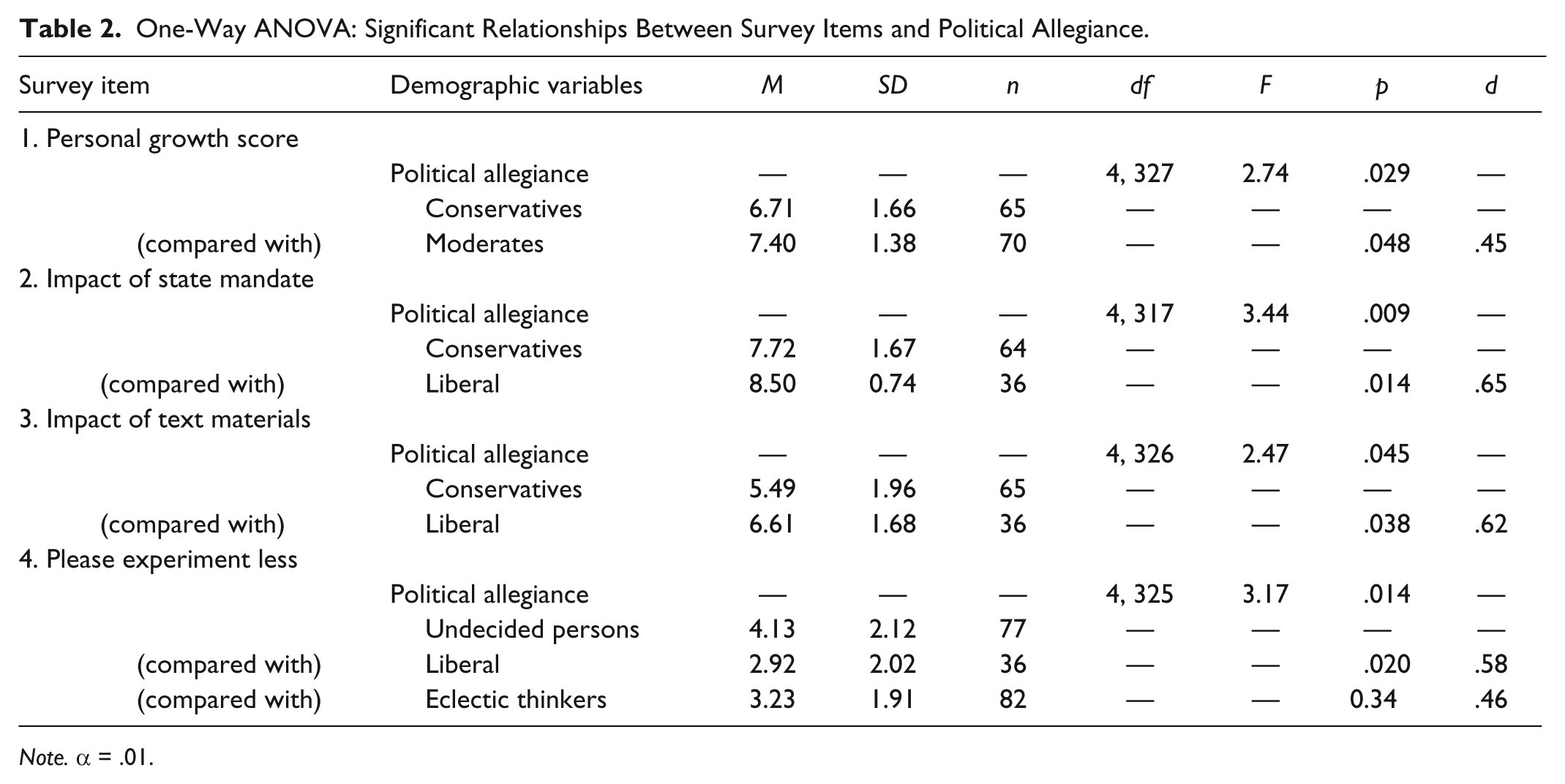
The hypothesis that significant differences would be found as a result of disaggregating the data by selected demographic variables had to be mostly rejected. By and large, scores were relatively independent of race, gender, class, and age (see Table 2). When looking at political allegiance, however, there were a few significant findings.
One-Way ANOVA: Significant Relationships Between Survey Items and Political Allegiance.
Note. α = .01.
For example, conservatives were more likely to have (a) a lower mean score (6.71, SD = 1.66) compared with moderates (7.40, SD = 1.38) when looking at personal growth, F(4, 327) = 2.74, p = .029; (b) a lower mean score (7.72, SD = 1.67) compared with liberals (8.50, SD = 0.74) when looking at the impact of a state mandate, F(4, 317) = 3.44, p = .009; and (c) a lower mean score (5.49, SD = 1.96) compared with liberals (6.61, SD = 1.68) when judging the textbook’s impact on learning, F(4, 326) = 2.47, p = .045. Effect size (d) scores were .45 (small), .65 (medium), and .62 (medium), respectively.
Students who did not know what their political allegiances were had the hardest time adjusting to the experimental teaching style. People who were politically undecided were more likely to have higher mean scores (4.13, SD = 2.12) compared with liberals (2.92, SD = 2.02) and eclectic thinkers (3.23, SD = 1.91) when it came to believing the instructor should have experimented less, F(4, 325) = 3.17, p = .014. Effect size scores were .58 (medium) and .46 (small), respectively.
Factor Analysis
The results of the factor analysis (see Table 3) indicate that two dimensions were being measured. The first construct was labeled instructional correlates. It consists of the following six teaching techniques: (a) a non-color-blind, critical style of teaching; (b) a message that is aimed simultaneously at both the head and heart; (c) the promotion of open dialogue that addresses tough questions; (d) the usage of videos that highlight human relations missing links; (e) guest speakers who share persuasive stories about human relations’ trials and triumphs; and (f) the impact of the textbook and other reading materials used for the course. These are the components of the six-factor non-color-blind instructional variable identified in the abstract of this article. Although each of the teaching strategies can stand on its own merit, it is more accurate to account for variances shared between variables. Therefore, the variables are included in the multiple regression model as a six dimensional construct. The reader will note that Cronbach’s alpha coefficient for all six variables was above the .70 acceptability rule, meaning the construct was reliable.
Factor Analysis Results: Post-Semester Survey Items With Factor Loadings.

A second construct was tabbed environmental influences. It consists of the following four correlates: The influence of (a) prior education, (b) parents and family upbringing, (c) religious beliefs, and (d) the “naturally good person in me.” Unlike the first construct, the coefficients for these four variables did not meet the .70 rule for establishing reliability. Kachigan (1991) argues that results in the .40 to .69 range should not be totally ignored because of the potential to understand important part influences. Because a .50 cut-off is only a guideline, however, each researcher must make his or her own judgment call. I decided to reject the environmental influences coefficients because they were not reliable enough to be included in my predictor model.
Multiple Regression Analysis
The results of the multiple regression analyses were encouraging (see Table 4). Variables important to predicting student personal growth were the six-factor NCBC instructional variable described above (t = 10.509, p ≤ .0005), allowing students the opportunity to form their own opinions independent of those of the instructor (t = 4.797, p ≤ .0005), and a state law mandating multicultural education (t = 3.234, p = .001). The linear equation for the three predictor model is Personal Growth = −1.139 + .714 (Critical Teaching) + .248 (Independent Thinking) + .161 (State Mandate), R2 = .56, p < .0005. The (F2) effect sizes were .17 (medium), .03 (small), and 0.1 (less than small), respectively, for critical teaching, independent thinking, and state mandate. It is important to remember that regression analysis does not establish causation, but rather primarily speaks to predictive correlations.
Multiple Regression Analysis of the Influence of Instructional Strategies on Student Personal and Professional Multicultural Growth.

Note. NCBC = non-color-blind curriculum.
Factors important to predicting students’ professional growth include the same variables as above but with a slightly lesser impact, namely, non-color-blind instruction (t = 9.485, p ≤ .0005), allowing students the opportunity to form their own opinions (t = 3.493, p = .001), and a state mandate (t = 2.947, p = .003). The linear equation for the three predictor model is Personal Growth = −1.44 + .647 (Critical Teaching) + .181 (Independent Thinking) + .147 (State Mandate), R2 =.49, p < .0005. The effect sizes were .16 (medium), .02 (small), and 0.1 (less than small) for critical teaching, independent thinking, and state mandate, respectively. Out of curiosity, I included the factored environmental construct into both models of the regression, but that move did not significantly improve the prediction.
Discussion
Regarding the first research question, students responded very positively to a non-color-blind, critical and questioning brand of multicultural instruction. On a scale of 1 to 9 with 9 representing the most positive experience, students (N = 337) rated their personal growth at 7.15 and their professional growth at 7.44 (refer to Table 1). These are high scores taking into account the level of emotion and controversy inherent in teaching this topic in a predominantly white setting.
The dimensions of the six-factor NCBC variable utilized for instruction include (a) a questioning, deep-seeking, exploratory, and critical brand of instruction; (b) a message that is simultaneously aimed at the head, heart, and gut; (c) instruction that promotes open and honest student-to-student, and student-to-instructor dialogue; (d) the usage of outside speakers who are adept at highlighting both challenges and ways to overcome obstacles; (e) the usage of videos that help make a head-to-heart connection about the struggle of disempowered people; and (f) written material and textbook readings that inspire reflection and enhance multicultural awareness.
Respondents also placed a high value on the importance of an instructor who encourages people to think about how we think. The promotion of independent thinking was one of the better received teacher strategies in this study. On one hand, students do not want instructors to water-down the material nor do they want us to handle them with kid’s gloves, on the other hand, they do not want to be told how to think. Today’s students appear to want educators to give them all aspects of a debated topic and then trust them to come up with their own conclusions. This is a good thing.
The null hypothesis regarding the impact of selected demographic influences was mostly accepted. By and large, scores were relatively independent of race, gender, and age. When looking at political allegiance, however, there were a few significant findings, albeit none of them were surprising. For example, respondents who did not know what their political allegiances were had the hardest time adjusting to the experimental instructional style. People who were politically unaware or undecided were more likely to have higher mean scores compared with liberals and eclectic thinkers when it came to believing the instructor should have experimented less. Likewise, conservatives were more likely to have (a) a lower mean score compared with moderates when looking at personal growth, (b) a lower mean score compared with liberals when looking at the impact of a state mandate, and (c) a lower mean score compared with liberals when judging the impact of written material on learning. Although the views of liberals and moderates were somewhat more pro-multicultural education than that of conservatives and undecided persons, those differences had small effect sizes. By and large, all groups were benefitted by the NCBC brand of multicultural instruction.
There were a couple of findings that I did not foresee going into this research. For example, I was quite surprised that nearly a quarter of my students did not understand the concept of political affiliation. A show of hands during class sessions also revealed that only 25% of them voted in the last national election and even less in local elections. This is an educational indictment aimed at the home, high school, and college levels. In addition, I was somewhat surprised that prior education and parental influence did not play a bigger role, although the impact was by no means marginal. Surprisingly, the highest score (8.07) on the post-survey was given for support of a multicultural state mandate. Contrary to popular myth, education candidates support the role of an intervening governmental body on behalf of multicultural education if it is explained and executed well. Whether or not the multicultural optimism found in this study can be duplicated for other non-education majors remains to be seen.
It is important to note that the goals of a traditional multicultural approach are not bad—they are, however, incomplete. The goal of the NCBC approach is to include important principles that the traditional approach embraces, while also extending the conversation into new areas that are often overlooked or minimized. Students often spoke about the need for teachers to “keep it relevant and keep it real.” My 35/65 traditional-critical pedagogy curriculum mixture appears to successfully accomplish this goal. When given a chance to state that they wish the instructor had taken a more standard and safer approach to instruction, students responded with a mean score of 2.53 representing a dissenting view.
Quantitative results appeared to be aligned with anecdotal commentary provided in the optional portion of the survey. A few student samples include the following comments: To be totally honest, I was dreading this class. Turns out I learned a lot about life and about myself. Thank you for teaching more than just me. Every time I learned something new in your class I shared it with my husband and the rest of my family. You have provided me with so much education. You have stretched my brain to think beyond the “Pollyanna” ways in which I normally think.
To be sure, not all students were happy. Listed below is an example of a negative review: I leave this class more confused than when I first entered it. Before this class I believed in treating everyone equal. Now, I feel guilty for being white.
This study is not without limitations. First, even though a multiple regression quotient of .56 is considered solid for the social sciences, there may be other factors not accounted for (i.e., student self-analysis, simulation games, self-disclosure, use of humor, etc.) that could potentially improve the prediction. Second, we are all aware of great curriculum designs that are poorly articulated by marginal teachers. It is quite possible then that poor designs can yield better-than-expected results because of the professional and personal qualities of teachers. More research needs to be conducted regarding the personal and professional characteristics that master teachers possess. Third, the study is also limited by the fact that until it is replicated, the results cannot be generalized to a larger population. Duplication of this work is sorely needed and welcomed.
Despite these limitations, the results of this study are important because they highlight two separate, but related gaps in the literature: (a) a set of user-friendly, critical-oriented multicultural instructional strategies can be identified and (b) there is a need to include more student input when defining what makes for effective multicultural instruction.
Implications for Educators
It goes without saying that permeating instruction makes a difference in student learning. Curriculum approaches that were formed during the 1960s and 1970s provided a solid foundation for multicultural education, but changing times dictate that methods of teaching be adapted to reflect a changing world. Since the early days of multicultural education’s inception, a true global society has emerged, and the definition of diversity has broadened. In addition, it is no longer acceptable to teach about personal possibilities without also investigating the roadblocks that keep individuals and society from reaching our full potential.
Many will say that the days of multicultural education are numbered; that society is moving toward a meritocracy and the need for such college course offerings is waning. While it is true that race and social conditions have improved, we are far from being out of the woods. Casual viewing of the evening news easily corroborates that conclusion. Misinformed folks will try to make a claim that the election of Barack Obama as President of the United States was a signal that class and socioeconomic factors have replaced racism and sexism as the main concerns of human relations. From my point of view, that kind of thinking appears to be about 50 years too soon. We cannot afford to mistake the positive changes taking place in our nation as evidence that our society no longer needs to be educated. Still, it is incumbent on classroom teachers to evolve with the times. Today’s students do not want the blame-game nor the feel-good brands of multicultural education indicative of yesteryear’s efforts.
While educators should never ignore the power of love and the wisdom of treating others like we want to be treated (i.e., a traditional approach), it is also imperative that we investigate the deeper factors that keep good people divided. The outcome of the recent Trayvon Martin murder trial is a good example of how well-meaning people on both sides operate from vastly different perspectives. In that case, conservative pundits failed to see how issues of power and privilege blocked Florida jurors from understanding how disempowered people communicate and react with authority figures. I believe that a 35% traditional and 65% critical multicultural curriculum mix taught in our schools can help create more opportunities for win/win results in cases like these.
Findings from this study appear to corroborate curriculum suggestions found in the literature. For example, they agree with Gordon (2005) that color-blind curriculum is insufficient; with Freire (2005) about the importance of dialogue; with Nieto and Bode (2012) that content alone is not enough—that the process of multicultural education is just as important; with Banks (2009) that it is important for teachers to critically teach many perspectives, and then trust students to form their own opinions, and; with Anderson et al. (2000) that including guest speakers who have a permeating story to tell helps give the message of diversity staying power. My study validates literature recommendations, but they also encourage the coupling of correlates in new ways that are seldom realized in the typical classroom.
My findings also address a concern by Perry et al. (2009) that the pedagogical skills necessary for the required diversity education classroom are, “ . . . complex, extensive and may be beyond the skills that are modeled in current classrooms or represented in typical instructional training and development programs on campus” (p. 100). There is not enough in the literature that addresses the art of multicultural curriculum delivery. Undoubtedly, there are many programs and paradigms that work, but we as educators need to get busy and share our successes with each other. Strategies outlined here in the review of literature, the introduction of NCBC instruction, and the 35/65 melding of traditional and critical pedagogy approaches (see Appendix B) provide one example of how the multicultural teacher training gap can be closed.
The NCBC approach utilized in this study asserts that there is more useful truth located somewhere along a critical spectrum, as opposed to what we typically find at the fringes of the political left or right. Criticism will undoubtedly emanate from both sides. Traditionalists and conservatives will hail the suggested approach as the end of national unity. Critical pedagogists and education liberals will say it does not go far enough—that hegemony and the abuses of the powerful and privileged will remain protected for the benefit of the elite. Both arguments have merit. One thing is clear: There is no argument that something new and different must be done. I believe that revolution is not always warranted; that established legal and constitutional methods have the potential to bring about meaningful social change. Many will disagree. In the meantime, there is a war being waged against children and many of them fall through the cracks of society while pundits continue the debate.
This research is significant because students from a typically conservative part of the country were positively impacted by a synthesis approach that 15 years ago would have been labeled as radical or over-the-top. The difference between now and then is threefold. First, students of all colors and backgrounds today want a more meaningful education that lines up with the everyday life they experience outside of the classroom. Second, putting more emphasis on the process and not just highlighting multicultural content is a key factor to greater multicultural awareness. Third, the adoption of a critical pedagogy which infuses discussions of power and privilege into the traditional conversation helps students better understand interference points that account for the missing gaps in our human relations efforts.
The art of managing social polemics is never an easy road to traverse. We as a people appear to be forever enslaved by a day/night, either/or, black/white, up/down, devil/angel existence. The critical middle is a hard place to find. This is especially true with regard to race and human relations. But, there is a remnant of young people that appear poised on the horizon to one day crash the gridlock convention. They sing a familiar song with its sacred chorus, but with new vigor and interpretation: “Yes, we are truly free at last!” The results of this study demonstrate that meaningful human relations do not occur by happenstance, but rather by the purposeful, critical, and creative efforts of educators to properly instruct and inform students.
Footnotes
Appendix A
Appendix B
A Comparison of a Traditional Versus a Non-Color-Blind Approach to Multicultural Instruction
| Traditional Multicultural Approach | Non-Color-Blind Curriculum |
|---|---|
| I. Foundational principles | (Note: NCBC incorporates many of the elements found in the traditional curriculum approach, while also attempting to extend student awareness into new awareness) |
| ● Regardless of ethnicity, culture, gender, and family background, I believe all kids can learn and they deserve my best effort.
● Do not fear diversity; we should celebrate it! ● A rising tide raises all boats. ● Education and dialogue will solve all social evils. |
● It is better to be color-respective than to be color-blind. It is good to sometimes question the status quo and political correctness.
● Unless you address the root of a “social weed,” when it sprouts back up it will be even more stubborn. ● Do not ignore the impact power and privilege has on disadvantage. |
| II. Probable multicultural worldview | |
| ● The United States electing a Black President shows how far are nation has come in race relations.
|
● Greed, abuse of power, and uncritical thinking are the real enemies.
|
| III. Probable instructional strategies utilized | |
| ● We must choose lessons and activities that create a safe, caring, and accepting classroom atmosphere.
|
● We must teach toward the gaps. Find the missing links. Teach both content and process.
|
| IV. Potential impact on majority teachers | |
| ● Now is the time to show how the other forms of discrimination are just as bad as racism.
|
● Yes our society has improved, but now is not the time to go soft on the impact of racism.
|
| V. Potential impact on minority students | |
| ● I did not realize that multicultural education is much bigger than race and gender issues. I now see all forms of injustice must be addressed.
|
● I don’t have to stay bitter about life. I can forgive. I can overcome. I can succeed. I can change my trajectory in life.
|
| VI. Potential impact on majority students | |
| ● I’ve always been a good person who means well. Now I can add to my resume the fact that I have taken “the class.” Love will conquer all.
|
● I can see clearer now. There is more to this multicultural thing than I first realized. I can now see that I did not understand the role power and privilege plays in creating disadvantage.
|

Declaration of Conflicting Interests
The author(s) declared no potential conflicts of interest with respect to the research, authorship, and/or publication of this article.
Funding
The author(s) received no financial support for the research and/or authorship of this article.