




Abstract
Deceit is a significant aspect of the misuse of power. This article demonstrates how to identify and redress a “preemptive” form of this misconduct through a case study of the Iraq Dossier. The media claimed that the Dossier was inconsistent with the original intelligence reports, which was not possible to verify. This analysis shows that the Dossier is inconsistent with itself, which was missed because the initial media reaction distracted attention from careful scrutiny. The Dossier’s main text does not make a substantive claim that Iraq possessed weapons of mass destruction. That claim was only made in altered phraseology within the title, foreword, summary, and conclusions. Relevant omissions within the formal inquiries are identified, and areas of redress are examined, specifically “misconduct in public office.” The case study is then discussed in terms of defining, conceptualizing, and teaching about “preemptive deceit.”
Keywords
Background
On September 24, 2002, the then British Prime Minister Tony Blair presented the “Iraq Dossier,” Iraq’s Weapons of Mass Destruction: The Assessment of the British Government, to the Parliament and to the public (The Stationary Office, 2002). This influenced Parliament to support British involvement in the United States–led invasion and occupation of Iraq. At first, it was seen by the British media and public as evidence of a significant threat from Saddam Hussein, but quickly it became viewed as misleading because of apparent “inserts” (Miller, 2003). Andrew Gilligan, a British Broadcasting Corporation journalist, claimed that the Dossier was a “sexed up” version of the original intelligence material (MacAskill & Norton-Taylor, 2003, p. 13; Morris, 2009a, p. 10). From an inquiry, Judge Lord Hutton concluded that Gilligan’s claim was wrong (Hutton, 2004, para. 467.1.viii). But the press and public still viewed the Dossier as unreliable and the Hutton report as a “whitewash” (Independent, 2004, p. 1). In 2003, the Foreign Affairs Committee and the Intelligence and Security Committee pointed to errors made by the government, but these were not reported as significant. A report by Lord Butler in 2004 was similar.
By 2005, no weapons of mass destruction (WMD) had been found, and Tony Blair had admitted that it would have been better simply to publish the original intelligence reports. But what was the truth? Was the Dossier misleading or misunderstood, or both? If deceit was involved, what form did it take, and what are the lessons for detecting this form of abuse of power?
This article proposes that the press, public, politicians, and official inquiries up to 2010 missed the important aspect. The main text does not make a substantive claim that Iraq possessed actual WMD. That claim was only made directly in altered phraseology within four focal points of the Dossier: the title, foreword, summary, and main conclusions. An uncritical acceptance of the media view that the whole Dossier was inconsistent with the original intelligence reports distracted from the more significant fact that the Dossier was made inconsistent with itself. The purpose of this article is to show exactly what was done and to demonstrate a methodology for identifying, redressing, and teaching about “preemptive deceit” by political leaders. The data and argument for this article were accepted as evidence by the Iraq inquiry and were judged by Brian Jones—who worked for the defense intelligence staff (DIS) from 1987 until 2002 and was Head of the WMD analysis branch of DIS until just before the Iraq war (Jones, 2009)—to be “a scholarly deconstruction of the most significant elements of the Prime Minister’s September 2002 dossier.”
Method
The methodology reflects retrospective—working backward—forms of analysis. For instance, “back-casting,” as used within military futures analysis, entails working back from a policy to identify “enablers” and “barriers” (Bhimji, 2009). From evolutionary psychology, Steven Pinker’s (1997) notion of “reverse engineering” is similar. In forward engineering, a machine is designed to do something; “in reverse engineering, one figures out what a machine was designed to do.” This is formalized as an analytical framework as “critical process analysis” (Williams, 2012, in press).
It should be axiomatic that, in a formal public document like the Dossier, the main text should be drafted first, and summaries and similar focal points should derive from this initial text and not alter its meaning. The preparation of an official document is therefore likely to entail the following:
writing the main text, that is, the data and other evidence
drawing conclusions, for sections or for the whole text
writing a summary
writing a foreword
deciding a title
Whatever the exact process, stages representing 2 to 5 must be based on the material in the main text. A conclusion can be descriptive or reasoned, but any reasoning must be explained, and the conclusion must still not exceed the data and logic of the reasoning. A foreword may include relevant material from another source, but it must be clear that this does not describe the main text (e.g., a quote from another book), and any representation of the main text must still be accurate. These are self-evident ground rules for good academics, and within any civil service, the principles of “consistency” for good drafting will be similar (Thornton, 1996, p. 72, 133). For example, if within a main text it was stated that “the President is willing to use special rendition and indefinite imprisonment without trial,” it would be improper to rephrase this as “America’s war crimes” for a title or summary, without additional evidence. Therefore, in the Dossier, the sentence “Saddam is willing to use chemical and biological weapons” (CBW; chapter 3, para. 5) should not have become “Iraq’s weapons of mass destruction” because “chemical and biological weapons” are not intrinsically “weapons of mass destruction,” and “willing to use” does not prove possession.
The methods used to detect the inconsistencies were straightforward.
An online search of the Dossier, for “WMD” and “destruction,” was made to identify the use of these words in the summary, foreword, and main conclusions.
The phrases identified were then matched with the original phraseology, through a similar search of the main text.
Other occurrences of “WMD” and “destruction” in the main text were also checked to see if they amounted to a direct claim that Iraq possessed actual WMD, that is, that they supported what was implied by the title, “Iraq’s Weapons of Mass Destruction.”
The whole text was then checked to see if any other statements directly supported this claim.
In this article, examples of altered phraseology are shown, with the altered wording next to the original version. Further examples are available online (Williams, 2008). The alterations to the phraseology of the main text are identified, and the reasons this changed the meaning in the main text are explained, sometimes through the use of analogy. The likelihood of a motive for the alterations is evidenced by showing that, had the writers of the main text intended the meaning implied by the altered text, they could have expressed this meaning in a clear and simple phrase in the main text.
The Evidence
Careful analysis shows that the title is not supported by evidence in the main text but by phrases in the focal points, which were not consistent with the main text.
The Title
Those who finalized the Dossier chose to use the title Iraq’s Weapons of Mass Destruction: The Assessment of the British Government to describe its content. The possessive phrase was repeated in the executive summary—”Iraq’s weapons of mass destruction are in breach of international law” (The Stationary Office, 2002, para. 8). The foreword states that “Saddam Hussein is continuing to develop WMD, and with them the ability to inflict real damage upon the region” (The Stationary Office, 2002, para. 3), and it also states that planning allows for “some of the WMD” to be ready within 45 min (para. 7). These phrases imply that Iraq certainly possessed extant WMD. But this phraseology does not appear in the same form in the main text of the Dossier, and there is no direct claim that Iraq currently possesses actual WMD.
Although the Dossier title implies certain possession of WMD, the relevant evidence in Part 1 is not under a heading, “Weapons of Mass Destruction,” but instead is headed, “Iraq’s Chemical, Biological, Nuclear and Ballistic Missile Programmes.” The introduction to Chapter 3 confirms:
This chapter sets out what we know of Saddam Hussein’s chemical, biological, nuclear and ballistic missile programmes, . . . and it also draws heavily on the latest intelligence about Iraqi efforts to develop their programmes and capabilities since 1998” (The Stationary Office, 2002, p. 17). (emphasis added).
The reader is therefore warned that there is no intrinsic implication that weapons exist, just “programmes” and “capabilities.”
A U.K. government briefing paper, used during the preparation of the Dossier in 2002, was carefully titled “Iraqi WMD Programmes,” and a later report about the Iraq Dossier in 2003 was called generically, “Iraqi Weapons of Mass Destruction,” not the possessive “Iraq’s” (Taylor, 2003). Similarly, earlier drafts of the Dossier, on the 16th and 19th of September, were titled “Iraq’s programme (emphasis added) for weapons of mass destruction: The assessment of the British government” (No. 10, 2002). Also, in the main conclusions, in earlier drafts, “maintain the capability” to use CBW becomes “are able . . . “ in the final version, and “may be able” to deploy CBW becomes “are able.” Although these documents appear as evidence on the Hutton inquiry website, Hutton made no comment about the significance of the changes.
On the website of 10 Downing Street, the index page concerning the Dossier has the header Iraq’s Weapons of Mass Destruction: The Assessment of the British Government. But for Parts 1, 2, and 3, the header changes to “Iraq’s Programme for Weapons of Mass Destruction: The Assessment of the British Government.” As Rangwala (2003) pointed out, someone forgot to update all the website headers, when the last-minute change to the title was made.
The existence of such “programmes” 1 and “capabilities” 2 is neither surprising nor alarming, as clarified by the U.K. Intelligence and Security Committee:
Having a WMD capability means that chemical, biological, and/or nuclear munitions could be produced if required. It does not mean they have been produced. WMD Programme . . . does not necessarily mean that WMD munitions have been produced, as only when the capability has been developed can weapons be produced. (Taylor, 2003, para. 24)
Most countries will have research or strategic security programs that relate to WMD, even if only for civil defense (e.g., Federal Bureau of Investigation, 2006).
In the seminal manual on legislative drafting, Thornton (1996) made the simple and relevant point that “the language used in the heading must be consistent with the remainder of the [document]” (p. 140).
Examples of Altered Phraseology
In Example 1, “chemical and biological weapons” becomes “weapons of mass destruction,” and Saddam’s apparent opinion becomes ongoing and current. Hypothetical weapons then become actual weapons in the title and summary.

Intelligence analysts would know that “chemical and biological weapons” are not always “weapons of mass destruction.” Some experts have even argued that CBW should not be considered as WMD and that the term should be reserved for nuclear weapons (Maerli, 2000, p. 109). This was clarified by the Central Intelligence Agency (CIA; 2004), and the Iraq Survey Group (2004) used the same definition:
Chemical weapons and biological weapons need to be of a certain size to count as WMD. Single chemical or biological artillery rounds would not be considered to be WMD because of the limited damage they could produce.
3
This definition is likely to be used in the United Kingdom (if not, the United States and the United Kingdom invaded Iraq to rid it of WMD, without a common agreement about what WMD were). Tear gas and herbicides can amount to “chemical weapons,” and a small amount of an infectious agent in a letter could be termed a biological weapon, as could plague-infected fleas and the proposal by Captain Eucyer in 1763 to give blankets infected with smallpox to Native American Indians. But it is generally accepted that a “WMD” must be “capable of causing mass casualties,” on the scale of the Hiroshima and Nagasaki bombs (Maerli, 2000). A WMD is not a means of mass killing with many similar weapons. Otherwise, knives and machetes would be classed as WMD, as in Rwanda, for example.
So, not all WMD are CBW, and not all CBW are WMD. The terms are not interchangeable. By analogy, “mass production” might embrace potteries, furniture makers, and jewelers, but many producers of pottery, furniture, and jewelry do not engage in “mass production.” The U.S.–Iraq assessment makes the proper distinction. It claims that “Iraq has continued its weapons of mass destruction programme” and separately states that “Baghdad has chemical and biological weapons as well as missiles” (CIA, 2002, para. 1). According to the Butler Report (2004, para. 334), the original Joint Intelligence Committee (JIC) Assessment (September 9) also stated (like the main text) that “Saddam attaches great importance to having CBW (emphasis added),” not WMD. The Report presents this alongside the version in the Part 1 conclusions—“continues to attach great importance to the possession of weapons of mass destruction.” Under this, Butler concludes, “The dossier fairly reflects the 9 September JIC assessment” (para. 335). He is correct concerning the main text, but not concerning the conclusions and other focal points.
The phrase “attaches/attach great importance to the possession of” does not necessarily imply actual possession. For example, to say that “Miss X attaches great importance to the possession of diamonds” does not necessarily imply that Miss X possesses diamonds. It is likely to mean that she would like to possess diamonds. If she already possessed them, the principles of accurate drafting would require “possession” to be preceded by “her” not “the.” In the main text version, “attaches . . . ” could represent a single comment in the distant past, for example, one line in one report. In the main conclusions “continues to” implies two or more reference points and a continuing instance between those points over a significant period of time. Had those drafting the main text intended the meaning implied by the main conclusions, title, and summary, they could have simply written, “Saddam continues to attach great importance to Iraq’s possession of its WMD.”
The Butler Report (2004) noted that
There is considerable and long-standing academic debate about the proper interpretation of the phrase “weapons of mass destruction.” We have some sympathy with the view that, whatever its origin, the phrase and its accompanying abbreviation is now used so variously as to confuse rather than enlighten readers. (para. 14)
The Report talks of “the definition at paragraphs 8 and 9 of United Nations Security Council Resolution 687.” But these paragraphs simply list and describe types of weapons—nuclear, chemical and biological, and ballistic missiles. The term “weapons of mass destruction” is not used in these paragraphs. It occurs only once in the Resolution, in a general statement at the end about “the goal of establishing in the Middle East a zone free from weapons of mass destruction” (Butler Report, 2004, para. 14). Resolution 707 requires Iraq to disclose details “of its programmes to develop weapons of mass destruction” in paragraph 3, but this Resolution concerns nuclear weapons, and again the words “programmes” and “develop” do not imply possession. The Butler Report also did not confirm its own definition of WMD and was seemingly unaware of the definition used by the CIA and Iraq Survey Group on which the action against Iraq would have been based.
Example 2 shows that generic “chemical and biological weapons” become extant “WMD,” and “able” to deploy becomes “ready.”
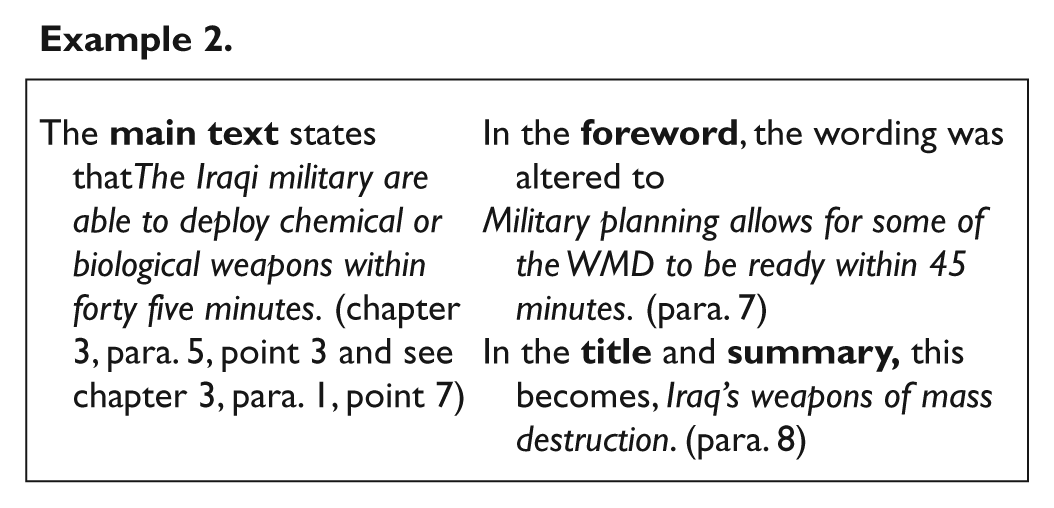
As above, CBW are not always WMD. The government subsequently admitted that this claim was misleading because it applied to battlefield weapons. In the main text, there is no definite article, CBW weapons are generic, but “
Like Example 1, the Butler Report presents the original JIC Assessment (September 9) alongside the Dossier version. Like the main text of the Dossier, the JIC Assessment talks of “CBW weapons” and “chemical and biological munitions” in relation to the 45-min claim. Despite the alteration to “WMD” in the foreword, Butler concludes that the JIC judgments “were reflected fairly in the dossier” (para. 339).
In Example 3, a past threat becomes a present one, the “capabilities” become “useable,” “facilities . . . capabilities” become “weapons capability,” and “the most immediate threat” in the past becomes an actual current threat. Again, CBW then become WMD.

In the main text, “former” affirms that the claim relates to the past, as does the past tense, “represent
In the context of this sentence (i.e., the past), the phrase “Iraqi weapons of mass destruction” describes generic weapons that may or may not be extant at the present time. This same phrase was used as the title for a subsequent report from the government’s Intelligence and Security Committee, when it was known that no weapons had been found (Taylor, 2003). This is not the same as “Iraq’s WMD.” “Iraqi” can mean “of or belonging to Iraq” (Oxford English Dictionary). In this context, it is more likely to mean “of.” The distinction is more evident in the negative, for example, if it were stated that “Iraqi WMD did not exist,” this would be a straightforward claim that this genre of weapons (“Iraqi WMD”) did not exist. But to say, “Iraq’s WMD did not exist” would be an oxymoron. Those drafting the main conclusions had three options when reusing the phrase “Iraqi weapons of mass destruction”: (a) use it unaltered, (b) change the wording but maintain its generic sense, or (c) change the wording to the possessive and consequently change the meaning. The latter option was used, and so other evidence should have been identified that confirmed that the possessive sense was correct.
The main text specifies that the “chemical and biological capabilities” relate to “warfare
Other examples and discussions are available online (Williams, 2008).
Standards and Redress
What are the standards by which this conduct should be judged? How might it be redressed?
The Maine Legislative Drafting Manual (2006, sec. 3) provides three rules about consistency: “(i) Don’t use the same word to convey different meanings; (ii) Don’t use different words to convey the same meaning; and (iii) Don’t use a synonym if you are trying to indicate a difference in substance.” Either the Dossier breaks rule (ii) or there was an intention to deceive. The alterations do not seem to be accidental, and they are clearly not just word-processing or editorial errors, and so professional standards of drafting have not been met. Even irrespective of which versions are correct, it is still professionally neglectful not to ensure consistency. This suggests other motives behind the alternations.
Those responsible have already identified themselves. Blair’s communications chief, Alastair Campbell, told the Hutton inquiry that his job was to ensure the Dossier “was a strong, clear, consistent document” (Hutton, 2004, p. 166, line 17). John Scarlet, Chair of the JIC, told the inquiry that he had prepared the entire Dossier, including the executive summary, except the foreword, which he had “approved” (Hutton, 2004, p. 100, line 17). He told the Taylor Committee that he had “checked and amended (the foreword) for factual accuracy and consistency with the text” (Taylor, 2003, para. 76). Yet, there are significant inconsistencies.
There are very few examples of legislation to redress deceit by leaders (Williams, 2006, pp. 132, 192). Leaders make laws and are disinclined to regulate themselves. But France provides an interesting exception. In June 2006, it was announced that Pierre Pellerin, who was head of France’s nuclear safety watchdog 20 years ago, was being investigated for “aggravated deception” for misleading the public about the Chernobyl nuclear industry disaster (Lichfield, 2006, p. 7). The “International Nonaggression and Lawful Use of Force Bill” proposed by the New Zealand Green MP, Kennedy Graham, which would make political leaders directly accountable for the “leadership crime” of international aggression, is a visionary example of how legalization may evolve (Graham, 2009).
In Britain, the means to hold political leaders to account for deceit are not well codified. There is a Civil Service Code (Cabinet Office, 2006), which states that civil servants must “set out the facts and relevant issues truthfully, and correct any errors as soon as possible” (para. 7). They must not “deceive or knowingly mislead Ministers, Parliament or others (The ‘deceit’ does not therefore need to occur ‘knowingly’)” (para. 8). They must “provide information . . . on the basis of evidence, and accurately present the options and facts” (para. 9). They must not “ignore inconvenient facts or relevant considerations when providing advice” (para. 9).
This Code was revised in 2006. At the time of the drafting of the Iraq Dossier, only the second requirement (above) was in place. There is also a Ministerial Code (Cabinet Office, 2001), which states that “ministers have a duty to Parliament to account, and be held to account, for the policies, decisions and actions of their departments and agencies” (principle 4), and that
it is of paramount importance that Ministers give accurate and truthful information to Parliament, correcting any inadvertent error at the earliest opportunity. Ministers who knowingly mislead Parliament will be expected to offer their resignation to the Prime Minister. (para. 1.5)
But these standards can only be policed within the government, and the prime minister is the final judge. Could he offer his resignation to himself? To bring accountable individuals to court, there is also a common law offence of “Misconduct in Public Office.” The offence is committed (Crown Prosecution Service, 2006) when :
a public officer acting as such
wilfully neglects to perform his duty and/or wilfully misconducts himself
to such a degree as to amount to an abuse of the public’s trust in the office holder without reasonable excuse or justification
Whether the alterations to phraseology described in this article are sufficiently serious, and the laws and regulations sufficiently strong to bring those responsible to account is hard to predict.
Learning to Understand Preemptive Deceit
Leadership studies serve two types of students: practitioners—those who aspire to become effective leaders—and observers—those who want to understand leadership and the use of power, often for the purposes of accountability to “speak truth to power” (Cary, 1955). Understanding leadership deceit relates to both. Aspiring leaders need to recognize when they might be guilty, or perceived as being guilty, of deceit. Those analyzing power and working for leadership accountability need to be able to detect, analyze, and explain deceit.
The Iraq Dossier represents a novel “preemptive” form of leadership deceit, which has not been conceptualized within leadership and political studies. The familiar perception of political deceit is that it is retrospective, that it is perpetrated to cover up past mistakes or wrongdoings, and that the deceit is within the content of the message, not the process. We do not expect the deceit to come before the act it is trying to obfuscate, nor for a deceitful process to alter the meaning of an accurate message. That is probably why the Iraq Dossier was not challenged effectively. Press, public, and politicians were not ready for a preemptive form of deceit. However, Kevin Smith (Smith, Larimer, Littvay, & Hibbing, 2007, p. 8) detected a change. He found evidence that “people are surprisingly attuned not just to outcomes but also to the procedures employed by decision makers . . . people crave ‘procedural justice’.” It seems important to develop this growing awareness.
Consider these four examples, in relation to “the truth, the whole truth, and nothing but the truth,” the presentation of uncertainty as fact, and Hart and Honore’s (1985) trust in the “common sense” underpinning decisions made by lay juries and magistrates.
Interestingly, U.S. secretary of state Donald Rumsfeld (2002) provided a relevant conceptual framework in his much derided discussion of “knowns”:
There are things we know that we know. There are known unknowns. That is to say there are things that we now know we don’t know. But there are also unknown unknowns. There are things we don’t know we don’t know.
Preemptive deceit plays on presenting “known unknowns” or “unknown unknowns” as “known knowns”—uncertainty as fact—in a way that affects the future, as in the examples above. Preemptive deceit can therefore be defined as follows:
An intentionally or recklessly incorrect or misleading statement or process, including the presentation of uncertainty as fact, which can preclude subsequent truth and/or obscure subsequent acts or omissions.
In relation to this definition, the Iraq Dossier therefore qualifies as preemptive deceit because
The focal points contained “incorrect statements”—principally that hypothetical CBW amounted to extant WMD.
Those who prepared the text obviously knew that the WMD claims were “known unknowns” or “unknown unknowns”—uncertainty was presented as fact.
These “incorrect statements” arose from a departure from established drafting “process,” that focal points should accurately reflect a main text.
There was seemingly intent to “preclude subsequent truth and/or obscure subsequent acts or omissions,” otherwise the “incorrect statements” would have been corrected publicly and the course of action based on them revised. Also, had WMD been found, the Dossier would still have amounted to preemptive deceit—recall the blue car example above. Similarly, the outcome of the occupation or invasion—successful or not—does not alter the fact of the deceit.
Journalists like Robert Fisk (2006) were not fooled:
We are supposed to look through the veil which . . . Blair placed in front of our eyes so that lies will become truth, so that what is true will become untrue. And thus we will be separated from the truth. (p. 41)
The temporal circumstances of the Iraq Dossier were also formally acknowledged from a surprising source, Dame Stella Rimington, former Secretary General of M15, who said in a press interview, “So, when you come to decide that you’re going to use intelligence to justify decisions you’ve already taken, I think you’re moving down the wrong track” (Mueller, 2006, p. 6).
Events surrounding 9/11 included other preemptive deceits (Miller, 2003), notably the claim that Iraq was connected with the 9/11 attack, which falsely justified the invasion and occupation (Williams, 2006, p. 63), claims that the occupation was being successful, and claims made by British politicians within a few hours of the London bombings in June 2005 that the attacks were not revenge for 9/11. In this latter example, in parallel with government preemptive deceit, groups falsely claiming responsibility for the bombing had already put up statements on websites saying that British involvement in Iraq was the rationale. This was seemingly an example of prescient preemptive counter deceit (Williams, 2006, pp. 121-122).
Beyond 9/11, other examples of preemptive deceit include a decade of unsubstantiated statements along the lines that “genetically modified foods do not harm human health” (Rowell, 2003; Smith, 2004), and obfuscation of countless other environmental victimization such as the mercury poisoning at Minamata Bay (Japan), the Union Carbide killings in Bhopal, and the nuclear power disaster in Chernobyl (Williams, 1996). Process deceits include tricks such as public officials stating that “the research shows no evidence of harm” when “the research” only includes research controlled by those public officials. Such a claim is likely to preempt any other study that may indicate harm.
The strength of first impressions and the degree to which we form firm judgments before thinking rationally or analytically is well known among cognitive scientists, and lucidly explained by Malcolm Gladwell (2005) in his book Blink. The old maxim “If you want to win an argument, shout first” is well founded. How might preemptive deceit evolve? Might we, for example, see politicians and business leaders playing up, and getting a diagnosis for, a minor mental health problem, in case they need to use the “Pinochet defense” of mental incapacity at a later date? Preemptive deceit relies greatly on the reach of global media to embed a desired version of the truth into so many minds that it cannot be reversed. It is an Information and Communications Technology (ICT)-enhanced “genie out of the bottle” phenomenon. Again, Donald Rumsfeld (2003) seemed to demonstrate a sound awareness of this:
You get told things every day that don’t happen. It doesn’t seem to bother people . . . it’s printed in the press. The world thinks all these things happen. They never happened . . . the world is constantly being fed things that haven’t happened . . . And the problem is that people think that news is something that is announced before it happens, as opposed to something that is reported when it does happen.
Conclusion—Preemptive Omission?
Preemptive deceit can be detected by noticing when uncertainty is presented as fact and by checking for inconsistency. In the Dossier, the crucial realization was that, within a formal document, focal points such as summaries and titles should be drafted after, and must not alter the meaning of, the main text. In the examples quoted above, the altered phraseology is always (in Lord Hutton’s words) “somewhat stronger” than the original wording in the main text, and this sometimes crossed the boundaries of significant categorical distinctions and added new unsubstantiated information. The two main upgrades were that CBW became WMD, and “programmes” and “capabilities” became extant weapons.
To change “CBW” to “WMD” is analogous to changing a communication reporting that “America has just used defoliants” to “America has just fired a nuclear missile.” Another simple analogy shows the impact of such changes. If police evidence reported that “Mr. Smith’s garage contained five pots of blue and five pots of yellow paint,” it could be correct to conclude, “Mr. Smith had the capability to make green paint.” But it would be incorrect to describe that evidence under the heading, “Mr. Smith’s massive tank of green paint.”
The Iraq Dossier was therefore both misled and misunderstood. The alterations in the Dossier are both blatant and subtle, and that is perhaps why the deceit in the underlying process was missed by public and press. Although the altered wording is obvious, the implications of the changes are hard to explain. Even if journalists noticed the inconsistencies, the explanations did not lend themselves to instant headline-grabbing stories. The problem is less that the apparent deceit is hard to detect, and more that it is hard to explain. Any explanation is therefore necessarily pedantic (as in this article) and hard work for an average writer or reader.
But why were the formal inquiries not more questioning? Gaps between data and conclusions represent significant omissions. The Butler Report presented some of the inconsistencies but seemed not to notice them. The Foreign Affairs Committee noted “a difference in wording between the body of the dossier and the Executive Summary” (Foreign and Commonwealth Office, 2003, para. 96), but seemingly not the most blatant difference, that the summary contained the possessive statement “Iraq’s weapons of mass destruction,” which was not in the main text. The Intelligence and Security Committee confirmed that “capabilities” and “programmes” are not actual WMD, yet it did not point out that the terminology of the Dossier’s main text, which carefully used such qualifiers, had been altered into statements of certain possession of WMD in the focal points. The committee also used a definition of “WMD” that does not seem cognizant of the definition of the Iraq Survey Group and CIA and does not clarify that such weapons must have a “mass” and “destructive” impact. The Hutton (2004) investigation only considered whether “inserts” were made that were not in the original JIC assessment. He concluded,
I consider that the possibility cannot be completely ruled out that the desire of the Prime Minister to have a dossier which, whilst consistent with the available intelligence, was as strong as possible in relation to the threat posed by Saddam Hussein’s WMD, may have subconsciously influenced Mr. Scarlett and the other members of the JIC to make the wording of the dossier somewhat stronger than it would have been if it had been contained in a normal JIC assessment (para. 228.7).
But Hutton still omitted the significant point. It is not that the Dossier might be inconsistent with the intelligence: It is that it is clearly inconsistent with itself.
This was not missed by Brian Jones, the former head of the nuclear, chemical, and biological branch of the Ministry of Defense’s DIS, who said, subsequently, that he was “surprised” that the inconsistencies in the Dossier had not been noticed by MPs (Morris, 2009a, p. 6). He continued, “I don’t think it needed someone of my expertise to look at the dossier and see the difference between the prime minister’s foreword and what was in the main body of the dossier.”
Footnotes
The author(s) declared no potential conflicts of interest with respect to the research, authorship, and/or publication of this article.
The author(s) received no financial support for the research and/or authorship of this article.
