




Abstract
Our hylomorphic attitudinal perspective is an alternate view of spirituality. Herein we posit a priori that spirituality is essential to human nature and it can be studied in a taxonomical sense. We argue that spirituality disposes us toward what is good and truthful as we live our lives; how we involve ourselves with our immediate reality imbues how we experience life. We argue that spirituality and religiosity are not congruently human phenomena. And, we disjoint spirituality from religiosity against the Diagnostic and Statistical Manual of Mental Disorders’ (4th ed.; merican Psychiatric Association, 1994) conflated codification of these constructs via loss of faith. We explain spirituality is inherent to humanity instead of religion, and it substantiates all human phenomena; organic and intellectual. We also report two studies. Study 1 established initial confidence of content validity of the Spiritual Typology Inventory (STI). Study 2 examined the STI’s emergent psychometric properties: acceptable internal consistency coefficients (α = .949), test–retest reliability coefficients (rxy = .759), and exploratory factor analyses (factor loadings > .30). These properties adduce acceptable stability and construct validity for our inventory’s conceptual scales (α = .910, rxy = .770; α = .917, rxy = .667) from an adequate sample (n = 1,080) and stability subsample (n = 619). These psychometric properties evince our theoretical assumptions that spirituality is fundamentally human and it can be viewed as complementary types of a fundamental spiritual profile. Our inventory stands as a useful assessment tool for research and clinical practices in health care disciplines.
Beginning with the codification of spirituality into the Diagnostic and Statistical Manual of Mental Disorders (4th ed.; DSM-IV; American Psychiatric Association [APA], 1994; Lukoff, Lu, & Turner, 1995), professional interests to study spirituality and its association with mental health grew exponentially. Other factors that contributed to the recognition of spirituality in mental health practices, during the last decade of 20th-century America, included professional competency and professional accountability. National and regional accrediting agencies, certifying agencies, and professional associations not only required curricular inclusion of spirituality in higher education, but also published ethical guidelines to regulate competent professional practices to promote clients’ welfare regarding their spiritualties. As the DSM medical model for treating spirituality imbued clinical practices, researchers not only conducted outcomes studies to examine correlations between spirituality and health, but also between therapeutic strategies and spirituality (Chiu, Emblen, Van Hofwegen, Sawatzky, & Meyerhoff, 2004; Lawler & Younger, 2002). Several limitations have emerged from the resulting conflations.
Other authors have dedicated their efforts to create measures of spirituality (Kilpatrick et al., 2005; MacDonald & Friedman, 2002; MacDonald, Friedman, & Kuentzel, 1999; MacDonald, Kuentzel, & Friedman, 1999; MacDonald, LeClair, Holland, Alter, & Friedman, 1995; Monod et al., 2011). But we have observed that most publications and measures have also conflated spirituality with religiosity into a “religious-spirituality” compound. This conflation has been true even when researching about spirituality and religion/religiosity (Belzen, 2009).
One noticeable exception to this conflation has emerged from personality theory (Vande Kemp, 1999). Focusing on aspects of what it means to be wholesomely human, personality theory has studied spirituality, which concerns itself with establishing an intimate relationship with the divine (Emmons, 1999; Foster, 1998). And examining the empirical evidence to support the Five-Factor Model of Personality, researchers have reported evidence that spirituality could indeed be considered as a sixth factor of personality (Piedmont, 1999, 2001; Piedmont & Leach, 2002; Piedmont, Ciarrochi, Dy-Liacco, & Williams, 2009; Rican & Janosova, 2010). Some of these authors even have suggested that “spirituality and religiosity cannot be [empirically] collapsed into a single construct” (Piedmont et al., 2009, p. 170). They have defined spirituality as an intrinsic, universal, motivational aspect of humanity that seeks for meaning in life upon realization of our finitude on this planet (Piedmont, 1999; Piedmont et al., 2009).
Conceptualizing spirituality has been difficult. It remains a multifaceted construct. Some researchers have supported its equivocation with religiosity, while others have advocated for their separation (Burgess, 1997; Elkins, 1995; Ribaudo & Takahashi, 2008; Seeman, Dubin, & Seeman, 2003; Van Ness, 1996). In this article, we endorse their denotative separation and move to redefine spirituality as intrinsic to human nature (Elkins, 1995). Indeed, we define spirituality as the essence of human nature, which precedes personality formation. We present a different view of spirituality, separate from religiosity, and, in fact, preceding religiosity in both ontological (what exists) and epistemic (what is knowable) respects; we move away from the DSM codification of spirituality and its suggestive conclusions that it could be “treated” in therapy though not as a pathological condition (Lukoff, Lu, & Turner, 1992, 1998; Lukoff et al., 1995; Turner, Lukoff, Barnhouse, & Lu, 1995); we report two studies dedicated to the examination of the construct validity and emerging psychometrics of a new measure of spirituality: The Spiritual Typology Inventory (STI). We intend our discourse may be relevant to the various professions that comprise the mental health paradigm in America. Finding acceptable language to achieve a successful communication is indeed our biggest challenge in this article. Yet, we do not limit ourselves to reporting only statistical figures, instead, we move forward and make theoretical inferences from our findings. We hope our appeal to multidisciplinary discourse is well received as we enter a new century.
Empiricism has imbued our contemporary sense of science by emphasizing quantification of constructs. That is, constructs not only have to be defined in perceptible (measurable) terms, but they also must have an ontological (perceptible existence) corroboration to be of scientific import. By and large, empiricism synonymous to dualism has affected psychology’s epistemic achievements regarding human nature. More specifically, personality theories must have empirical import and their constructs must not only make functional sense, but they also must be aligned within the DSM dominant diagnostic model for treatment purposes. Thus, for example, one’s spirituality not only has to be personological in nature, but it perhaps ought to be either endogenic or epigenetic, and it must also be codified (clinically recognized) for treatment purposes. And we observe that most efforts to study and to treat spirituality have followed this pattern since spirituality’s conflated codification into the DSM in the 1990s (Lukoff et al., 1992, 1995, 1998). Notwithstanding the ubiquitous physicalist literature on spirituality, we move away from such codification and argue that spirituality is essentially our nature and it does not need to be treated, just like we do not usually speak about being warm-blooded bipeds, or sexual beings, or melanin-skin-toned individuals, and seek therapy for these phenotypic features of our nature.
We have adduced (elsewhere, Del Rio & White, 2012) that the DSM codification of spirituality presumes that (a) religion and spirituality are equivocal constructs, (b) loss of faith is a spiritual problem, and (c) religion and spirituality are elements of cultural diversity. And (therein) we have apodictically disproven these presumptions: (a) because religiosity and spirituality do not entail (require of necessity) the same definitional criteria, it follows that religiosity and spirituality are not equivocal; (b) because only [moral] goodness and [epistemic] truth are the proper ends of human spirituality, faith is not the proper end of human beings’ spirituality; therefore, loss of faith is not a spiritual problem; and (c) because only religiosity but not spirituality is a cultural expression for some (not all) human beings, only religiosity and not spirituality is an element of cultural diversity.
What we do know from genuine efforts to study spirituality is a simple yet definitive distinction. Spirituality belongs to the human person (both cross-culturally and transgenerationally; Del Rio & White, 2012; Elkins, 1995), whereas religiosity belongs to communities of faith (because religiosity is a social convention of how spiritual living may look like; Del Rio & White, 2012). Our purpose is to recognize human spirituality and to openly speak about it in therapeutic encounters and in quotidian contexts. Hence, we call emphatically on the fifth edition of the DSM to remove spirituality qua spirituality from its current diagnostic codification. We simply must not codify something inherent to human nature, particularly when this something has never been considered to be pathological.
Purpose
Herein, we offer a different perspective on spirituality. We recognize human spirituality, so we can openly discuss it and learn more about its nature. We also contribute a framework and a typology to assess one’s spirituality. Our typology does not categorize individuals, but posits spirituality may be diverse as individuals are diverse. Our instrument does not imply that individuals’ spirituality may be different, but rather complementary. Our typology does not imply that spirituality is equivocal to religiosity, neither is it placed on a continuum presuming its absence on one extreme. Instead, spirituality is intrinsic to humanity and it enables individuals to build communities of faith but only if they wish to do so. Therefore, spirituality intrinsic to humanity belongs to every human being regardless of religious affiliation, and in spite of any religious affiliation, or absent any religious affiliation.
Below we introduce our conceptual framework of spirituality and our typological instrument by reporting two studies aimed at establishing its emerging validity and reliability. We close our discussion with theoretical implications and suggestions for applicability of our findings.
Conceptual Framework of the STI
As we have entered the 21st century, we have emphasized the necessity to separate spirituality from religiosity, so that each of these aspects of human living may be studied accordingly. We have opposed the codification of spirituality as a relational problem among individuals, or as a loss of faith that presupposes its dependency on dogmatic belief systems. Instead, we have adduced that spirituality is our natural attitude that predisposes each one of us toward life, toward making sense of life, toward relating to others, and toward seeking unity with goodness and truth. We have believed that our attitudinal conception of spirituality is amenable to (multiple) faith traditions and to non-faith traditions that recognize a human natural proclivity toward choosing among alternatives and finding what is indisputably truthful. We have thought of spirituality separately from religiosity and intrinsically related to humanity by virtue of its own nature: Spirituality is simply one’s attitude toward life by how individuals perceive reality, and how they experience reality; by means of personal involvement with reality.
Our position has taken us to a level of fundamental existence. Therein, we have found spirituality as the very essence of our humanity. Viewing spirituality as the very source of who we are and what we are refutes positions that conceive of spirituality as a psychological phenomenon, and our view places spirituality as a natural propensity that enables all psychological phenomena to take place. In this sense, spirituality is not purely solipsistic experience, but it enables us to engage in overt agency which is perceptible and intelligible among our kind. Our natural proclivity toward unity with (the essence of) what is transcendent is indeed a principle of our nature that empowers us to have psychological and organic functioning at all.
Spirituality precedes our functioning and enables us to make sense of who we are and what we are as a species. Spirituality is not simply an experience or a phenomenon of the human mind, it is the reason the human mind exists. Spirituality is not simply a construct that uncovers the mind or that enables us to understand the human experience, it is the purposive sense of our existence. Spirituality is the living force that enables us to engage in psychological events and organic expressions of our complete agency.
We have not suggested that spirituality must ultimately be assessed, so that we may simply understand our psychological constitution and its relation to health (organic wellness). 1 Rather we have believed that by embracing spirituality as the informing principle of our humanity and as humanity’s attitude toward life (and our life force for living life), which seeks unity with what is transcendent; we can, then, embrace a deeper understanding of our species and our existential purpose in this universe by focusing on spirituality as intrinsic to our humanity.
The mind–body interaction has been a conundrum for more than 400 years. Dualism has obfuscated our opportunity to resolve this principled interaction of our humanity. Yet, in our view, Hylomorphism and Thomism have already established reasonable foundations to resolve this apparent problem or interaction of our constitutive principles, our-bodies-and-our-souls. What remains to be explained is our immortality (Murphy, 1998). We do not engage in such discussion presently (but in a subsequent article). We only present here a way to view empirically how spirituality imbues our agency and how it distinguishes our diversity as a qualitative difference of our individual diversity or spiritual types.
Hylomorphic Attitudinal Spirituality (HAS)
Aristotelian Hylomorphism (posited by Aristotle of Macedonia, circa 384
Because human spirituality is an ontological proclivity (existential tendency) toward apprehension of goodness and truth, each human person seeks to find these natural ends in themselves. Different from other conceptions of attitudes as responsive tendencies toward objects of affective, cognitive, or behavioral perception/evaluation-response; our notion of an attitudinal, “natural tendency” precedes perception. It is rather by means of personal involvement that individuals ultimately perceive and experience reality on their quest for goodness and truth. This interaction with reality (the inner and outside worlds) we define as human agency. Hence, human agency is manifested attitudinally. We believe that an “attitudinal” predisposition (but never pre-determination) toward seeking goodness and truth finds various expressions as individuals interact with reality. These different manifestations of one’s spirituality are not better than one another, but simply complementary in a systemic, social context.
Taken together, these statements make up our conception of HAS. That is to say, spirituality is hylomorphic because it is the nature of the form that infuses the matter with identity and purpose; and spirituality is attitudinal because it is a corporeally expressed natural tendency of human beings toward finding goodness and truth in life’s diverse contexts. Fleshing out this view of spirituality has led to the development of the STI, a measure that is based on the presumptions that (a) all people are spiritual by nature, or have a Fundamental Spiritual Profile, and that (b) this profile varies by spiritual types or human adaptations to social, cultural, linguistic, personal, educational, and (just about in terms of every possible) relational (systemic) facets of human existence.
Fundamental Spiritual Profile
We premise that every human being is a substantial form (soul) and its essence is spirituality. Thus, human beings have a fundamental spiritual profile. This spiritual profile is relational because we do not believe that spirituality evolves in a social vacuum, and because human nature is gregarious naturally. Yet, this spiritual profile is primarily individual as it inheres each human being. An extensive review of the literature on spirituality has helped us reaffirm our initial operationalization of the human spiritual profile by listing 10 spiritual components (SC; themes) as predicates of a single subject: A spiritual person (a) welcomes reality and natural settings, (b) knows and trusts “all is well,” (c) considers self as spiritual, (d) cares for self, (e) cares for others, (f) is a sexual person, (g) forms or develops intimate relationships, (h) talks about spiritual topics and describes reality as it is perceived, (i) looks for or seeks the transcendent, (j) engages in spirituality-enhancing activities (Del Rio, 2001).
We theorize that these 10 SCs are inherent to human beings, regardless of cultural milieus, religious adhesions, or lack thereof. Constant interactions with the self and the outside world as well as with the intrinsic motivation (attitude) toward personal actions (whether from a sense of duty or from a sense of teleology) provide individuals with unlimited opportunities to experience life and express their spiritualties. This constant interaction with one self and with the world occurs by means of three fundamental processes of spirituality.
Fundamental Processes of Spirituality
We found four recurrent themes (awareness, detachment, openness, and welcomingness) in the works of Anthony De Mello (1978, 1984, 1985, 1986, 1988a, 1988b, 1990, 1991a, 1991b, 1992a, 1992b, 1993, 1998a, 1998b) and Thich Nhat Hanh (1987a, 1987b, 1988, 1991, 1992, 1997, 1999, 2001) that enabled us to explain below how each of the three fundamental processes of spirituality complements the attitudinal descriptions of the fundamental spiritual profile. These authors’ works convey in our view a complete and synthetic view of spirituality they have gathered from eastern and western cultures. Their stories are challenging and transformative. These stories depict messages other mystics have also conveyed in the history of humanity whether from religious traditions or outside them. Their insight is commendable because they do not suggest that spirituality is a unique experience, difficult to attain, or available to only religious traditions. Instead, these authors insist that spirituality is a unique human characteristic, a species’ feature perhaps available only to human beings.
How individuals perceive and experience reality by means of personal involvement with reality
We believe that individuals perceive reality either from a sense of awareness or from a sense of detachment. Neither term is better than the other; they are rather variations of perception. We also believe that individuals experience reality either with an attitude of openness or with an attitude of welcomingness. Whereas openness to reality means coping with reality, welcomingness to reality means embracing reality generously. And it is precisely individuals’ manner of involvement with reality what affects how they ultimately perceive and experience reality (see Figure 2).
We believe that individuals get involved with reality either from a sense of duty or from a sense of purpose. If from a sense of duty, individuals tend to remain as either present or participant with reality. If from a sense of purpose, individuals’ involvement requires either a cognitive or a phenomenological approach toward reality. Figure 1 depicts the interplay among these spiritual themes. Figure 2 depicts how the fundamental processes of spirituality influence one another around the notion of human agency as a natural attitude or tendency emerging from one’s spirituality. The tables in Figure 2 list the characteristics of detachment, awareness, and openness; their components and their subcomponents, and the descriptive terms/words in Figure 3 further express how characteristics of fundamental processes of spirituality become manifest through spiritual types.
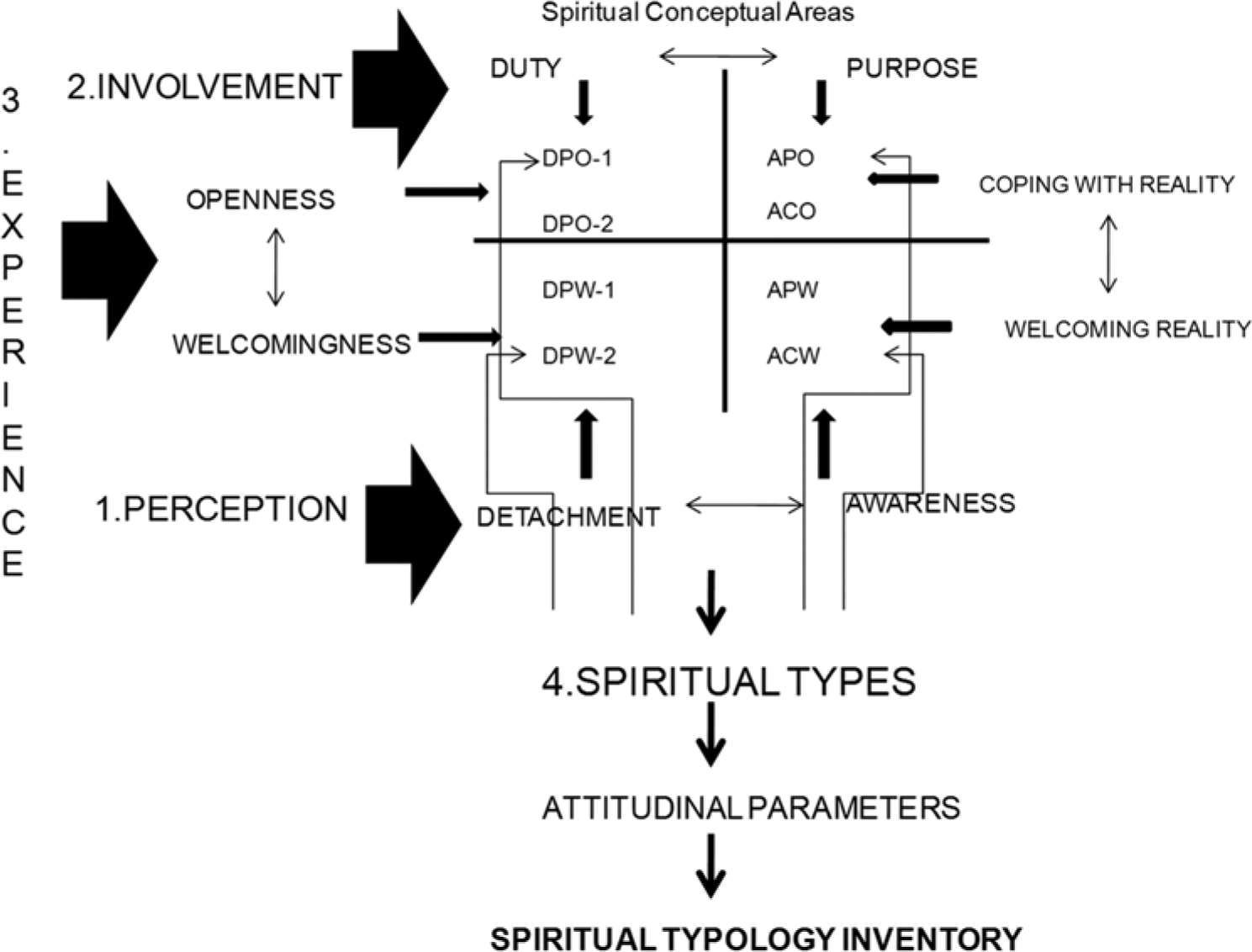
Spiritual conceptual areas and formation of spiritual types’ attitudinal parameters.

Spirituality’s fundamental processes and their components.
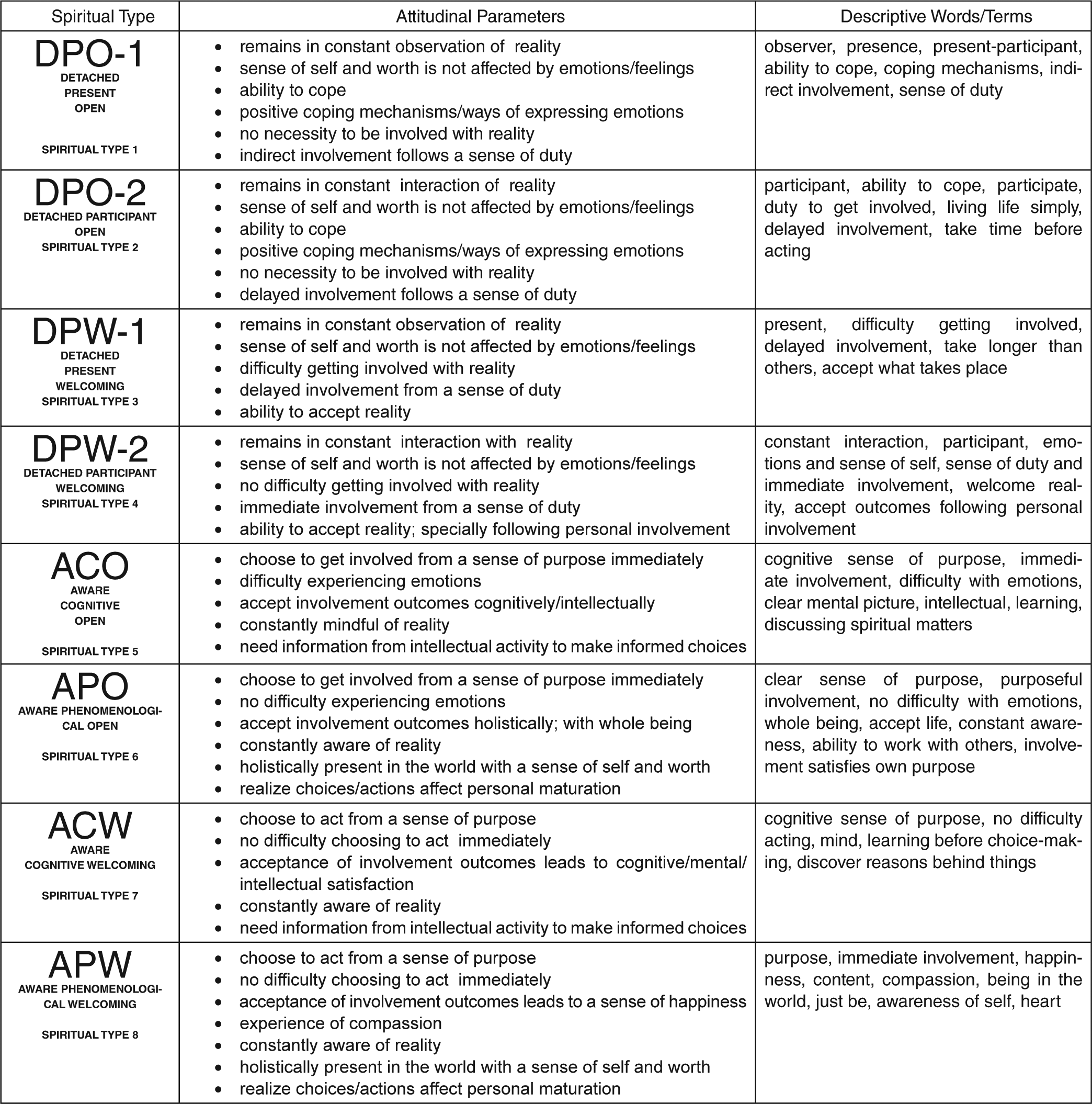
Spiritual types and attitudinal parameters.
Spiritual Types and Their Attitudinal Parameters
Once we accept the premise that the fundamental spiritual profile serves as a foundation to the notion of human agency (for all human beings), which in turn supports the fundamental processes of spirituality (by which we perceive and experience reality by how we get involved with reality); we are then able to understand the conceptualization of spiritual types (Figure 1). We recognize that there may be other types in the world; however, from the recurrent themes in our literary sources, we have only theorized eight types. Figure 3 categorizes each of these eight spiritual types and their respective attitudinal parameters. We believe that the fundamental spiritual profile is not deconstructed due to the diversity found in each of these eight spiritual types. Instead, our conception of spiritual types remains as a diverse manifestation of the 10 SCs (of the fundamental spiritual profile), just as manifestations of how individuals experience life in diverse ways.
Most important, human beings may exhibit particular spiritual types during their quest to find or unite with what is transcendent. For this reason, positioning along spiritual types is not static and may fluctuate during the life span in relevance to individuals’ awareness of their own spiritualties. This natural proclivity to unite with what is transcendental (goodness and truth) is beyond mere will, and it remains as potentiality in those whose capacity to choose is diminished either by life’s experiences or by organic or intellectual privations. In this sense, our taxonomy of spiritual types adumbrates attitudinal changes that build on each other as individuals live their lives and continue to make sense of them. Characteristics of the fundamental spiritual profile are found in spiritual types differently. We emphasize that spiritual types allow individuals to find attitudinal positions that represent their spiritual profiles at different attitudinal parameters (see Figure 3).
Study 1: Construction and Initial Validation of the STI
Item Development
Drawing from our careful review of the literature, we originally developed 205 items to conceptually describe the (a) attitudinal parameters of each spiritual type and the (b) components of the fundamental spiritual profile. These two conceptual scales contained 8 subscales and 10 subscales, respectively (see Table 1). We designed all items on a 5-point Likert-type scale (from 5 = strongly agree to 1 = strongly disagree). We described the 10 SCs of the fundamental spiritual profile through 88 items (grouped in clusters: SC1, 9; SC2, 10; SC3, 7; SC4, 8; SC5, 8; SC6, 10; SC7, 9; SC8, 8; SC9, 8; and SC10, 9 items), and described each of the eight spiritual types (Types) of the spiritual typology through 117 items (grouped in clusters: Type 1, 11; Type 2, 10; Type 3, 9; Type 4, 12; Type 5, 20; Type 6, 21; Type 7, 13; and Type 8, 21 items).
Scales, Subscales, and Item Distributions of the Spiritual Typology Inventory© (Del Rio, 2001).
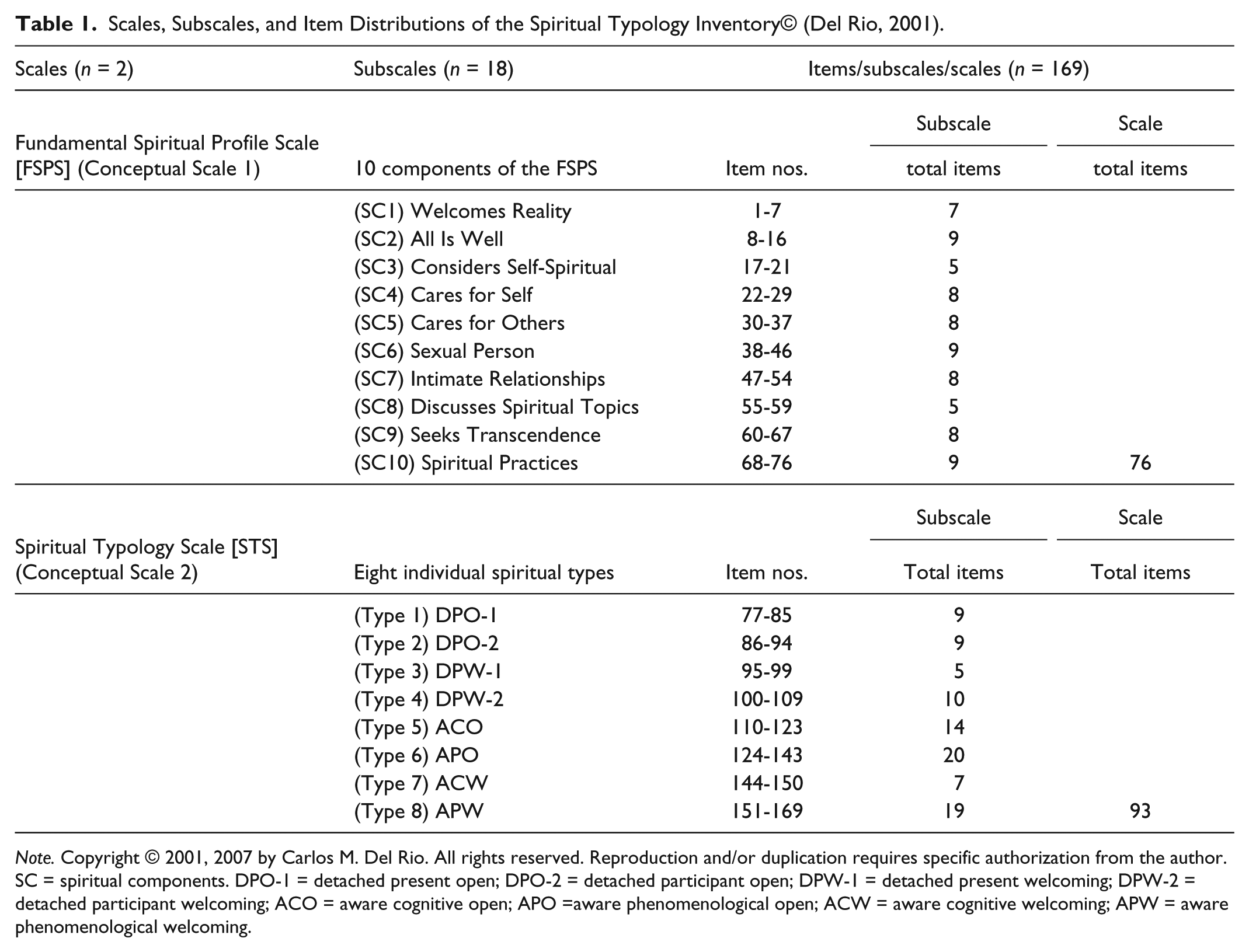
Note. Copyright © 2001, 2007 by Carlos M. Del Rio. All rights reserved. Reproduction and/or duplication requires specific authorization from the author. SC = spiritual components. DPO-1 = detached present open; DPO-2 = detached participant open; DPW-1 = detached present welcoming; DPW-2 = detached participant welcoming; ACO = aware cognitive open; APO =aware phenomenological open; ACW = aware cognitive welcoming; APW = aware phenomenological welcoming.
Procedures
Our study’s participants (a) matched items to spiritual types, (b) rated whether items described conceptually the two conceptual scales (one fundamental spiritual profile composed of 10 SCs or subscales and one spiritual typology composed of eight spiritual types or subscales), (c) rated whether items were readable, (d) rated whether items were understandable, and (e) provided suggestions for improving items semantically.
Three evaluation phases included (a) a preliminary evaluative phase that allowed for item modification; (b) a formal evaluative phase that allowed for item delimitation and item improvement; and (c) a group assessment that provided additional evidence of content validity by matching item sets to subscales. At each of the three evaluative phases, our participants read our conceptual framework before engaging in the required activities.
We asked our participants to make the effort to think of spirituality separately from religion, particularly regarding their own religious views or reservations toward religious experiences, and to think of spirituality separately from their professional disciplines’ fundamental assumptions. We asked our participants to pair item sets with subscales. We coded their identifications (correct = 1, incorrect = 0) to determine percentages of correct identification of items-subscales at each phase.
Participants and Results
The preliminary evaluative phase involved two doctoral candidates in philosophy at a Midwestern doctoral research university (one male and one female, ages 29 and 27; White ethnic, both were Christian). To determine items’ readability and understandability, evaluators used a 5-point Likert-type scale, respectively (5 = easy to read to 1 = very difficult to read; 5 = easy to understand to 1 = very difficult to understand). These two evaluators suggested how items could be improved semantically. We modified 10 items for Types and 13 items for SCs. These evaluators provided 47 suggestions to improve items semantically. These evaluators correctly paired items and subscales at a 75% rate.
The formal evaluative phase followed the same pattern as above but included six professionals. Three professionals were religious representatives (three males, ages 35, 49, and 52; two with master’s degrees, one doctorate; all three were Christian), and three were non-religious representatives (two males, one female; ages 39, 61, and not reported; all with doctorate degrees). We modified 32 items for Types and 33 items for SCs. These evaluators provided 112 suggestions to improve items semantically. According to these evaluators’ ratings, and to prevent duplicity and redundancy the original item pool decreased from 205 items to 169 items. These evaluators correctly paired items and subscales at a 69% rate.
The group evaluation phase involved 19 graduate students enrolled in an advanced seminar on psychometrics at a Midwestern doctoral research university (10 males, 9 females; ages 23 to 47; 14 White ethnic, one Black, one Hispanic, two Asian, one middle Eastern; 18 with master’s degrees, one doctorate; 12 Christian, one Muslim, one Hindu, 4 no religion, one spiritual but not religious). These evaluators correctly paired items and subscales at an 88% rate.
Discussion of Study 1
We dedicated Study 1 to establish confidence of validity of the STI. To ensure that items measured what they purported to measure, we used evaluators’ ratings and suggestions for items’ overall improvement. Following the preliminary evaluative phase, we only modified all 205 items; whereas following the formal evaluative phase, we modified some items, deleted some other items, and we generated still some other items to better describe the inventory’s 18 subscales. This process reduced the original item pool to 169 items.
Both (a) item modification leading to item reduction to better represent our conception of spirituality, and (b) identification of subscales through relevant item sets have established initial confidence of validity of our inventory’s conceptual scales. These conceptual scales make manifest a conceptual framework that explains how spirituality is available to all human beings via a fundamental spiritual profile (with 10 SCs), and that there may be variations or manifestations of spirituality via a spiritual typology (consisting of eight Types). Our two conceptual scales contain all terms relevant to our conception of spirituality not only because of a meticulous review of our concepts, but also because we have compared them with relevant literature, and to evaluators’ ratings in this study. In this fashion, we have established content validity of our inventory (see Del Rio, 2001).
We noticed three limitations. One, our evaluators reported difficulty when attempting to separate their conflated religious-spiritual thinking when making suggestions for item improvement.
Two, working environmental conditions surrounding the evaluators engaged in our first two evaluative phases remain unknown. It is unclear whether evaluators were able to work without distractions. We speculate that the amount of time required to complete their tasks (9.5 hrs.) may have been difficult to manage given their busy schedules, as some of them commented.
Three, we intended to include religious professionals representing major religious systems throughout the world. However, we were not able to find various religious traditions’ representatives. Our evaluators only represented segments of Christianity. Working with representatives of only one religious nomenclature was indeed a limitation other researchers have shared. We discovered that most Eastern traditions’ religious leaders are not interested in “standardizing” assessment tools regarding their conflated views of spirituality.
Study 2: Psychometric Properties of the STI
Method
Factor analyses sample (FAS)
Students from two Midwestern universities (n = 1,080 participants) voluntarily completed the STI during class periods; 423 males and 642 females, ages 18 to 62, M = 23.76, SD = 6.575. We used these participants’ responses to examine the factor structure of our inventory; they comprised the FAS (n = 1,080). FAS participants self-reported as White ethnic (86.4%), with a current completed undergraduate degree (93.3%), unmarried (71.8%), and Christian (48.2%). There were 20.2% more females than male participants in the FAS.
Measure of stability subsample
Only those participants who completed our inventory within a 3-week interval comprised the measurement of stability subsample (MSS: n = 619). MSS participants included 247 males and 366 females, ages 18 to 62 years, M = 24.32, SD = 6.941. MSS participants self-reported as White ethnic (85.6%), with current completed undergraduate degrees (91.8%), unmarried (71.4%), and Christian (46.7%). There were 19.2% more females than male participants in the MSS.
STI
Our inventory comprised 169 items on a 5-point Likert-type scale (from 5 = strongly agree to 1 = strongly disagree) and did not presume right or wrong responses. Table 1 lists each of the two conceptual scales and their 10 and 8 subscales, respectively.
Procedures
We designed Study 2 to examine whether the STI can measure our conception of spirituality (inherent to all persons through the fundamental spiritual profile, and varying among persons by eight spiritual types). We used test–retest reliability, Cronbach’s alpha coefficients; and iterative exploratory factor analyses (EFAs) to determine the inventory’s reliability (stability and internal consistency) and construct validity, respectively. Only undergraduate students in our samples received a one-time academic credit for completing our inventory at their faculty’s discretion.
Because of the nascent status of our inventory, and because establishing validity is an ongoing endeavor, we set some expectations for Study 2. One, we reasoned that a measure of temporal stability of scores ≥70 within a 3-week interval will determine our factor analyses. If our test–retest indexes for any of our 18 subscales (10 SCs and eight spiritual types) were ≤70, then we would use iterative EFAs to extract the least amount of factors per conceptual scale (fundamental spiritual profile and spiritual typology).
Two, we decided that item homogeneity coefficients must be ≥70 for each of the 18 subscales. If these coefficients were lower, an item to subscale analysis would determine what items must be deleted to increase their internal consistency per subscale.
Three, we used a principal axis factoring (PFA) method to extract the minimum number of possible factors (Henson & Roberts, 2006). We conducted iterative factor analyses thrice. First, we used a 60% randomized subsample of the FAS (n = 648) to extract items with loadings ≥30. Second, we used a 40% randomized subsample of the FAS (n = 432) to eliminate items with loadings ≤30. Third, we used a complete FAS (n = 1,080) to capture only items with loadings ≥30 to verify our inventory’s emerging factorial structure.
Results of Study 2
Stability: Measurement of temporal stability
Pearson’s product–moment correlations of Time 1 and Time 2 scores of the MSS (n = 619) with a two-tailed significance test (p < .001) and pairwise deletions revealed test–retest reliability coefficients of .770 for the 10 SCs of the first conceptual scale, and .677 for the eight spiritual types of the second conceptual scale, and .759 for the STI as shown in Table 2 (Fan & Thompson, 2001; Wilkinson & American Psychological Association Task Force on Statistical Inference, 1999).
Spiritual Typology Inventory: Emerging Psychometric Properties (Test–Retest Reliability, Internal Consistency Reliability, Factor Loadings).
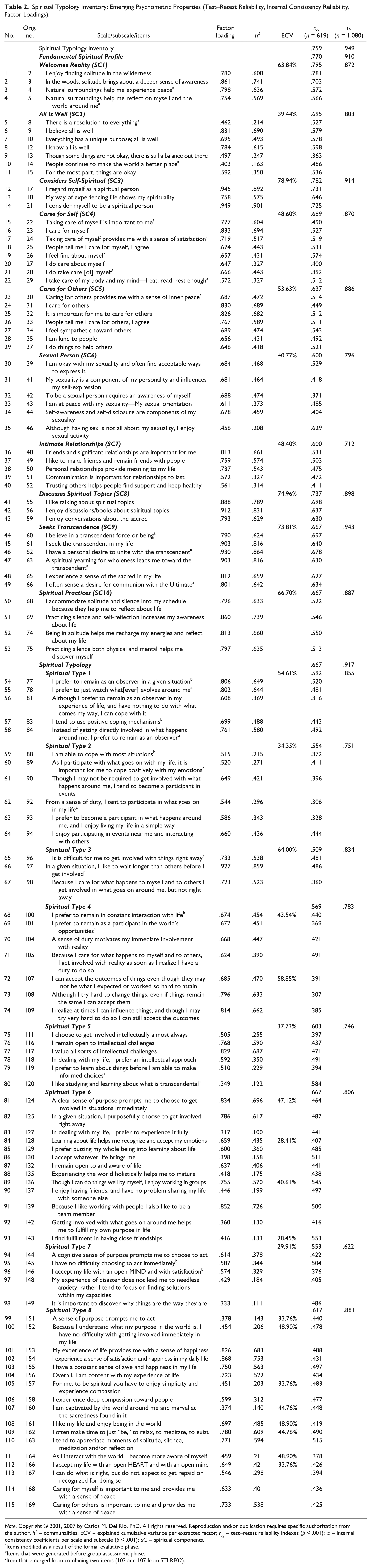
Note. Copyright © 2001, 2007 by Carlos M. Del Rio, PhD. All rights reserved. Reproduction and/or duplication requires specific authorization from the author. h2 = communalities. ECV = explained cumulative variance per extracted factor; rxy = test–retest reliability indexes (p < .001); α = internal consistency coefficients per scale and subscale (p < .001); SC = spiritual components.
Items modified as a result of the formal evaluative phase.
Items that were generated before group assessment phase.
Item that emerged from combining two items (102 and 107 from STI-RF02).
Subscales’ coefficients ranged from .509 (Type 3) to .795 (SC 1 [SC1]). These test–retest reliability coefficients fall within moderate (.500) and good (.700) designations of stability measures (Nunally, 1978). Yet, because at least one of these test–retest coefficients was lower than we predicted (and not ≥70), our iterative factor analyses were explorative.
Internal consistency: Item homogeneity
We computed internal consistency (congruence) coefficients to ensure items’ sets measured our 18 subscales (Henson, 2001). These coefficients enabled us to delete items to improve the overall internal consistency of each subscale. Iterative factor analyses (below) completed item reduction to 115 items.
Alpha coefficients for the eight spiritual types at Time 1 of administration for both the FAS and the MSS ranged from .855 and .853 (Type 1) to .881 and .881 (Type 8). Alpha coefficients for the 10 SCs at Time 1 of administration for both the FAS and MSS ranged from .872 and .859 (SC1) to .878 (SC10). Alpha coefficients for the two conceptual scales (Fundamental Spiritual Profile [FSP] and Spiritual Typology [ST]) and the entire STI at Time 1 of administration for both the FAS and MSS were correspondingly .910 and .905 (FSP), .917 and .918 (ST), and .949 and .947 (STI). All these coefficients were highly significant (p < .001) and two-tailed (see Table 2).
Factor analyses: Construct validity
We used EFAs to identify and isolate factors that conceptually represented our hypothesized subscales (Sass, 2010). Because we focused on identifying factors that best represented our subscales, we conducted a one-factor discovery method using PFA (Gorsuch, 1990; Tabachnick & Fidell, 1996). We extracted the best markers with loadings ≥3.0. We retained factors with eigenvalues ≥1.0 (Kaiser Normalization), with visual corroboration in respective scree plots (Costello & Osborne, 2005). These methods enabled us to identify easily interpretable factors. We named our factors according to our predicted subscales. Because our interest was to produce a pure simple factor structure, we conducted promax oblique rotations, as applicable, presuming the factorial structure could correlate (Schmitt & Sass, 2011).
We used a 60% randomization of our sample (n = 648) to conduct first EFAs to replicate the PFA single factor solution. We added percentage of variance prior to EFAs’ extractions, noted total variance per discrete subscale/factor, and computed Kaiser–Meyer–Olkin (KMO) measures of sample adequacy for each subscale/factor. We repeated EFAs to isolate a factor per subscale and to continue to reduce items using only a 40% (n = 432) randomized portion of our sample. A final set of EFAs ratified initially extracted factors and identified item loadings on these factors using our complete FAS (n = 1,080). We retained the best markers for each factor to be included in a final version of the STI consisting of 115 items (see Table 2).
Fundamental spiritual profile, Conceptual Scale 1
Item loadings remained greater than their initial extracted solutions and ranged from .403 to .930. Final explained cumulative variances ranged from 39.44% (SC2) to 74.96% (SC8). The communalities for these 10 factors ranged from .163 to .901. This EFA procedure did not identify any items with loadings below .30, but rather confirmed prior extractions with randomized sections (60% and 40%) of the FAS.
Spiritual typology, conceptual scale 2
First 4 spiritual types. Item loadings remained greater than their initially extracted solutions, and ranged from .515 to .927 with communalities among factors ranging from .265 to .859. Total explained cumulative variances also increased ranging from 34.35% (ST2) to 64.00% (ST3).
Second 4 spiritual types. Item loadings were consistently greater than their initially extracted solutions and ranged from .317 to .868 with communalities among factors ranging from .111 to .687. The final explained cumulative variances per discrete factor ranged from 28.45% (ST6 Open) to 48.90% (ST8 Aware-Welcoming).
Discussion of Study 2
We designed Study 2 to gather empirical evidence to establish emerging reliability and initial construct validity of the STI. Usually, it takes several studies to achieve an optimum level of reliability and validity of a new measure (Kerlinger, & Lee, 2000; Messick, 1995). This is the first study we have conducted to report the STI’s emerging psychometric properties. In principle, our results have subsequently confirmed our claim that spirituality is available to all persons, and spirituality’s manifestations vary through spiritual types.
In our conceptual framework, we posited our inventory was composed of two conceptual scales divided into 10 and 8 subscales, respectively (see Table 1). In this prediction, we hypothesized (a) the number of factors (18); (b) which variables should load together (SCs; spiritual conceptual areas, their components, and their subcomponents; see Figures 1 and 2); and (c) what variables (conceptual components) would dominate the factors (Armstrong & Soelberg, 1968).
Measurements of temporal stability for all items provided acceptable test–retest reliability coefficients for conceptual scales, their subscales, and the entire inventory (p < .001). Determination of congruence through alpha coefficients revealed high homogeneity of item sets per subscale, conceptual scale, and the inventory (p < .001). These statistics provided an initial sense of reliability and construct validity of our inventory. Moreover, because no empirical evidence existed about our inventory’s factorial structure, we used EFAs to (a) establish a more parsimonious item structure and (b) examine whether items grouped together consistently according to our predicted conceptual structure (Bannigan & Watson, 2009; Gorsuch, 1997).
We divided the participants’ sample into two random subsets at 60% and 40% of its size and performed similar extraction procedures with the entire sample (n = 1,080) to corroborate the first two sets of factors. This process provided a sense of factor reliability calculations (Armstrong & Soelberg, 1968). These iterative EFAs ratified our inventory’s theoretical structure and its multi-dimensionality. This ratification provided us with an advanced sense of construct validity for our conceptual framework as measured by our inventory (for an explanation of validity as the “meaning and interpretation” of a measure, see Bannigan & Watson, 2009; Messick, 1995).
Adding to Study 1, in Study 2 we (a) achieved a more parsimonious inventory reducing its items from 169 to 115 (see Table 2) and (b) corroborated the internal structure of our inventory as predicted in our conceptual framework.
Two limitations come to mind. First, convenience samples do not represent a population. Similitude among participants’ characteristics and backgrounds in this study limit its findings’ generalizability to other participants who may not share similar characteristics.
Second, three anomalies occurred during our iterative EFA procedures. Factors pertaining to three spiritual types collapsed into our notions of conceptual components and subcomponents of the same spiritual types, as we had predicted in our conceptual framework (see Figure 2). Spiritual types 4, 6, and 8 collapsed into 2, 3, and 3 components, respectively. Item sets loaded independently in each of these components and remained conceptually congruent with the spiritual parameters we originally predicted (see Figure 3). We decided not to report each collapsed component of these fractured spiritual types separately, but to keep them conceptually united pending additional reliability and validity examinations with different samples. We recognize that additional studies are necessary to review the conceptual areas and their specific items to avoid confusion between attitudinal parameters.
Implications for Theory, Research, and Practice
On one hand, our fundamental spiritual profile introduces an ontological perspective of spirituality: Spirituality is the nature of each human soul as described along 10 subscales. On the other hand, the spiritual typology introduces a hylomorphic attitudinal perspective of spirituality: Spirituality is one’s attitude toward experiencing life. This implies variations of spirituality as ontological (existential) tendencies conceptualized in spiritual types through attitudinal parameters which are permeable to one another.
Spiritual types allow for individuals to express their spiritualties in different and complementary ways. We do not suggest that spirituality is a psychological phenomenon or a construct of scientific import insofar as it is measurable. We have argued that spirituality is inherent to and qualifying of our nature, it distinguishes us as a species with an ontic proclivity toward what is transcendent (good and truthful). The overt manifestations our items convey serve to identify how spirituality varies among individuals, but it cannot be theorized to be an aspect of personality or an indication of psychological functioning; spirituality is our attitude toward life. It provides us with the abilities to experience life and to engage in psychological functions, and to manifest a personality as the perennial result of our human agency. In this sense, spirituality is present also in persons whose capacity to express it remains challenging either because of life’s vicissitudes or (intellectual, physical, emotional, financial) privations (e.g., being in a coma, or experiencing addictions, or being poor and destitute).
We presume that axioms that may facilitate permeability among spiritual types include, for example, life’s experiences, life-changing events, personal socialization experiences, or racial, ethnic, and cultural influences (for a discussion on attitudinal changes, see Ajzen, 2001; Tesser & Shaffer, 1990). Thus, undertaking additional longitudinal studies on spirituality may be useful to ascertain the stability or changes of one’s spirituality over time, as well as possible variation among spiritual parameters in individuals. In addition, convergent, predictive, and incremental validity studies are necessary to advance our inventory’s validity and reliability, particularly with other measures of our human experience of transcendence that have obtained some independence from already established personological constructs (e.g., Spiritual Transcendence Scale; see Piedmont, 1999).
Dualism, in all its reductionist forms, 3 has established a juxtaposition of psyche and soma, interacting “separately” as “constitutive” of human nature. As a result, dualism renders human beings as “aggregates” of more than one distinct substance, bodies-plus-souls. Bodies-plus-souls’ interaction is accidental and not optimal. It is as if body imprisoned soul, just as Socrates conveyed through Plato’s dialogue the Phaedo. In contrast, our perspective proposes the inseparable–organic interaction of soul-and-body-persons, rendering human beings as “substances.”
Some critical implications follow from the denotative difference between substances and aggregates. Aristotelian-Thomism defines substances as beings in themselves; and these do not inhere in a subject as in another, whereas aggregates do (Connell, 1988). This means that aggregates do not have motion from within and remain a collection of entities, perhaps as parts of a whole. Human substances, on the contrary, have motion from within and operate organically with intelligent-willful agency (a perfect form-and-matter harmony). Substances are living beings. Furthermore, rationality-and-will (intelligent-willful agency) distinguishes our human species among animals.
Yet some critics would argue that hylomorphism is in fact substance dualism because it recognizes the distinctive nature of body (material) and of soul (immaterial) interacting in human beings. We must simply clarify that our hylomorphic perspective does not argue for a separate consideration (juxtaposition) of form and matter natures in persons, they are what persons are. One does not exist without the other. We observe their interaction at birth, at the moment of death, and most certainly in its self-evident interaction during our life span. Intelligent-willful agency is human existence. It seems to end when we die. It is at death that HAS stops and the body becomes a corpse, an aggregate of organic parts that must decay (because decaying is its aggregate purpose when lacking life force). What happens at death requires a different discourse.
Here, we only emphasize soul’s essence is spirituality, and body’s essence is soul. Soul-and-body substances are human beings in a complete sense. Their existence is teleological, and it has an intrinsic theological value (because we have proclivity toward Theos—what is good and truthful). Persons exist to fulfill their natures. Human nature is ontologically spiritual. That is, psyche infuses soma and soma complements psyche with teleology made manifest as psyche-soma identity during the life span. In this sense, soul precedes mind and personality and all other constructs proper of psychological study.
We believe that attempting to reduce soul into psychological phenomena is erroneous. No amount of empirical evidence can exhaustively prove soul and its essence (spirituality) in tangible respects. For example, we may be able to deconstruct a human person into working systems (neural, nervous, endocrine, circulatory, chromosomal, etc.), but we may never succeed in explicating the integrated teleology of these systems, which is to support human life and consciousness. These are powers of soul as substantial form (Knight, 1920/2008).
Here, we have presented a framework that departs from personality and medical models and takes us to an ontological realm to study human spirituality. We have argued that because spirituality is the human soul’s essence, and human beings are substances with souls, spirituality is thus available to all human beings. Spirituality predisposes (but never predestines) them to seek unity with goodness and truth. And these are the proper objects of the human soul (intellect and will) and also the essential elements of that which is transcendent, and the proper ends (telos) of intelligent-willful agency. Evidence for spirituality is our conception of HAS in our conceptual framework. In it we have identified themes of experiences other authors have contributed in their extensive experience with human spirituality (Figures 1, 2, and 3). Their stories have helped us define spirituality as one’s attitude toward life.
A human quest for what is transcendent can be appreciated in all cultures and in all periods of our species’ historicity. For example, this quest for what is transcendent may be similar to nirvana, or enlightenment, or awakening, or awareness, or sublimation, or self-actualization, or holiness, or wholesomeness, or even the beatific vision. In fact, seeking unity with what is transcendent may also be likened to reaching therapeutic goals of all theories comprising the psychological and systemic paradigms. And the object of such achievement is what the proper end of spirituality is (goodness and truth).
We have posited a fundamental spiritual profile for all human beings, and some spiritual types that evince human diversity of life’s experiences. We stand against the notion that spirituality may be conflated or equated with religious affairs (based on faith), or that spirituality may be medically codified as a relational problem (based on loss of faith) or a psychological phenomenon. Spirituality is instead so intrinsic to humanity that it precedes one’s mentation, one’s personality, and one’s sexuality, for example. Yet, it infuses one’s mentation, one’s personality, and one’s sexuality with meaning and with purpose toward completion of our nature. Whereas we may certainly codify pathological behaviors, we may never succeed in doing so with one’s sexual identity qua sexuality, for instance. We are what we are. We are spiritual first and thus human. We are spiritual by nature (just as we are sexual by nature). Furthermore, our HAS (as the foundation for the STI) finds applicability in (therapeutic) relationships because it brings to light the “normal” aspect of being spiritual (while not necessarily deist). In our view, spirituality is inclusive of all religious expressions (and their absence) because it enables us to think of what is transcendent, but not vice versa.
Further research is necessary to test our inventory with other samples and other cultures. Its face validity has been established and its reliability is emerging. Both its validity and reliability must be further examined in terms of our hylomorphic perspective. Obviously, our inventory’s divergence from or convergence with the Five-Factor Model of personality is also desirable. New studies must be undertaken to explore other variables intrinsic to humanity and with more heterogeneous samples. A necessity to find resources to make this come to fruition is also a desideratum at this stage. Yet because what we have established is a set of emerging psychometric properties of an inventory based on a perspective that challenges the current codification of spirituality, we call upon the Diagnostic and Statistical Manual of Mental Disorders’ (5th ed.; DSM-5; APA, 2013) editors to revise such codification, as appropriate.
By and large, we envision a new practice in which spirituality may truly be welcome. For example, we usually do not shy away from our sexuality; we are sexual beings and our sexuality permeates everything we do. We envision that coming to a fuller awareness of spirituality as intrinsic to human nature may serve to identify spirituality’s diverse experiences or spiritual types, and their complementarity in terms of our gregariousness. We envision a concatenation of contributions from diverse disciplines that study human nature to illumine new frameworks to know human spirituality as we have entered the 21st century. We suggest that our inventory is an acceptable instrument to enrich discussions of what it means to be spiritual in health care services that utilize individual, couples, and familial therapies.
We believe that spirituality is the essence of what makes us human substances. Properly philosophy informs us about spirituality and psychology is, etymologically, its proper science. We hope that as we move forward (never again conflating spirituality with religiosity), we may evolve to understand all that it means to be spiritual by nature. Perhaps, then, we may find many answers to ontological and epistemological questions about our expanding universe and our role in it. Spirituality indeed seems to have led us on our quest for all that is transcendent (essentially good and truthful). We envision that as we focus on spirituality our hesitation to study it may vanish and our discoveries may strengthen our understanding of our own species. We call for dialog and language that advances a common understanding of spirituality within the health care–related disciplines and professions.
Footnotes
Declaration of Conflicting Interests
The author(s) declared no potential conflicts of interest with respect to the research, authorship, and/or publication of this article.
Funding
The author(s) received no financial support for the research and/or authorship of this article.