




Abstract
In the United States, 70% of all non-arrest domestic violence (DV) police investigations are rejected by prosecutors. Using DV investigation data, the routine work habits of two groups of police officers were compared across six measures. Cases submitted by routinely lower effort (RLE) officers are rejected 270% more often, sustaining an average of 4.00 criticisms each, compared to 2.21 for routinely greater effort (RGE) officers. RLE officers submit ambiguous investigations (58% v. 0%), and cases with insufficient evidence (74% vs. 36%). The Proficiency Score (P Score) quantitative monitoring method is presented and validated. This method identifies RLE officers, and also specific areas of deficient individual investigative practice in need of improvement. With improvement, rates of prosecution and conviction for DV crime should increase substantially.
The domestic violence (DV) reforms of the 1980s and 1990s were intended to compel police response to DV incidents and the arrest of suspects. And, in fact, those reforms were widely adopted in the United States and other countries with Western style systems of justice. What has remained elusive, to this point, are sufficient rates of case filing and criminal conviction.
Most Police Investigations, Including Into DV, Fail to Generate Criminal Cases
Generally speaking, most police investigations do not result in a prosecutorial decision to file criminal charges. As Stanko (1981) reports “ . . . many arrests which are made during routine police work are treated . . . as garbage cases,” adding “For the [prosecutor] . . . arrest represents the raw data from which to select felony cases” (p. 402, 404). More recently, Stanko followed 677 cases submitted for prosecution; of those, less than 25% resulted in the filing of criminal charges. Of those, the conviction rate was 31%. Assessing the cause of such a dismal rate of prosecution, Stanko (2007) concluded that lack of investigative thoroughness had a “massive impact on attrition” (Slide 17). 1
A study of 17,534 arrests for different types of felony crimes in Washington, D.C., in 1974 showed that more than half of all of the cases were rejected outright by prosecutors, and 15% more were dropped after the case was filed. Only 8.4% of the investigations resulted in a plea of guilt (Forst, Lucianovic, & Cox, 1977). 2 In 1982, the National Institute of Justice (NIJ/Forst, Leahy, Shirhall, Tyson, & Bartolomeo, 1982) examined the data from eight prosecutorial authorities, 3 finding an average, unweighted initial rejection rate of 29%, with another 14% 4 later dismissed by the prosecutor.
Things have not changed much since then. Using meta-analytical data specific to DV crime, Garner and Maxwell determined the baseline, non-arrest rate of prosecution for DV cases in the United States after 1995 to be 30% (2009, Table 5). In other words, on average, slightly more than two thirds of all baseline, non-arrest DV investigations are rejected by prosecutors. Overall, these data suggest that police officers in the United States are not doing a very good job persuading prosecutors to file DV criminal charges, a criticism long levied by advocates (e.g., Avakame & Fyfe, 2001; Bailey, 2010; Berk & Loseke, 1980; Buzawa & Buzawa, 2003; Dobash & Dobash, 1979; Hoctor, 1997; Stalans & Finn, 2000).
The academy has failed to comprehensively investigate the how and why of case rejection. As shall be seen, only a small amount of attention has been paid to a few reasons for rejection of cases across a range of aggregated crimes; but, to date, no study has examined the range of reasons that DV cases are rejected by prosecutors, upon their presentation by police. Therefore, the purpose of this study is to collect and analyze these data, focused particularly on a search for clues into the origins of “garbage DV cases.”
First though, in order to gain a better understanding of why prosecutors reject most DV cases, we must examine the information source upon which prosecutors mostly rely when deciding whether to file a DV criminal case, which being the written report of the first responding police officer (FRPO).
The Police Report
It is important to understand the heavy dependence of reviewing prosecutors upon the FRPO’s written report. It is true, prosecutors may interview the victim, or some of the witnesses, or perhaps have an investigator do more research; but, these subsequent actions follow onto the evidence an officer memorializes in her/his written report. If the FRPO did not interview a neighbor looking through a window, if an officer did not ask about broken table leg, and so forth—then the reviewing prosecutor may not gain actionable knowledge that can be relied upon for decision making or acted upon for further investigation. The prosecutor responds to the evidence (s)he is made aware of by the FRPO’s report.
It should not be assumed that reviewing prosecutors re-investigate crimes, because generally they do not. When prosecutors decide whether to file criminal charges, their primary source of information is the report written by the police officer who investigated the crime (Hinds, 1993, p. 87; Levie & Ballard, 1978, p. 13; Miller, 1993, pp. 1-2). This is verified by Stanko (1981) who, as noted, witnessed hundreds of prosecutorial reviews of presented police cases: Reports were read, sometimes officers were interviewed, and then the reviewing prosecutor filed or rejected a case. Since police reports are generally not admissible into evidence due to their hearsay nature (Fox, 2009; Giannelli, 2012; Grimm, Deise, & Grimm, 2010), it may be their greatest contribution to the prosecution of DV criminals is to persuade prosecutors to file charges, and to memorialize evidence that prosecutors can utilize during criminal proceedings.
Police Reports as Persuasive Argument
A police officer, in situ, gets a first and perhaps best look at the evidence, and (s)he also gets the first opportunity to question witnesses. If the officer concludes that a crime was committed, (s)he composes a written report in which (s)he strings together a set of facts, telling a story of what (s)he believes happened. It is not unreasonable, it is believed, to view the police officer’s report as a particular type of letter, written to whomever the reviewing deputy prosecutor might be, attempting to convince her/him that crime was committed, and that charges should be filed. Due to the general inadmissibility of police reports into courtroom evidence, it might be more accurate to reconceptualize police reports as a persuasive argument made by the FRPO to the reviewing prosecutor, outlining the merits of a criminal case.
Police Reports as a Data Warehouse
If a criminal complaint is filed, then the police report serves as a data warehouse for prosecutors as they organize and conduct a criminal case against the defendant(s). The report lists contact information for witnesses, and it summarizes the testimony they are likely to provide in the court. The former fact helps prosecutors locate witnesses so they can be served with subpoenas to testify, and the latter fact helps prosecutors evaluate their potential usefulness to the prosecutorial effort. The report describes evidence that was booked for safekeeping, as well as evidence which may have been left behind after being photographed. 5 Descriptions of evidence helps prosecutors evaluate its persuasive value, and also when and how to use it. The police report can include spontaneous statements such as “That’ll teach him to keep his damn mouth shut” or “Next time I’ll kill the bitch.” Spontaneous statements can be strategically employed by prosecutors to challenge the accuracy and truthfulness of testimony by the individual who said them, if their courtroom testimony is contradictory. 6 Reports have other benefits as well.
Relying upon the content of the police report, and sometimes other factors, the reviewing prosecutor considers the strength of the evidence, the general deterrence value a prosecution would hold, and the government’s enforcement priorities (Weaver, Abramson, Burkoff, & Hancock, 2008). Then, (s)he makes a decision about what to do.
Four Prosecutorial Options
The reviewing prosecutor selects one of four options. (S)he can file charges and proceed with a criminal case, or perhaps ask for additional investigation. 7 The prosecutor may also elect to place a first time offender in a program where, if (s)he complete a series of requirements and also remains violence free for a year, charges will not be filed and thus a criminal record will not be incurred (Garner & Maxwell, 2009; Visher, Harrell, Newmark, & Yahner, 2008; Weaver et al., 2008). The final alternative is to reject the case altogether, this being the fate of most baseline DV investigations (Garner & Maxwell, 2009, Table 5).
If low rates of DV prosecution are unacceptable, and if one wishes to investigate how rates of prosecution might be raised such that more batterers are held accountable to criminal law for their actions, a good place to begin such an inquiry would seem to be an examination of the stated reasons for case rejection, as listed by reviewing prosecutors.
Reasons for Case Rejection
From a sparse literature, we learn that prosecutors reject investigations for multiple specific reasons. Table 1 presents seven of them, documented by the NIJ/Forst et al. study, along with their frequencies of use (1982).
Frequency Distribution, Stated Reasons for Case Rejection.
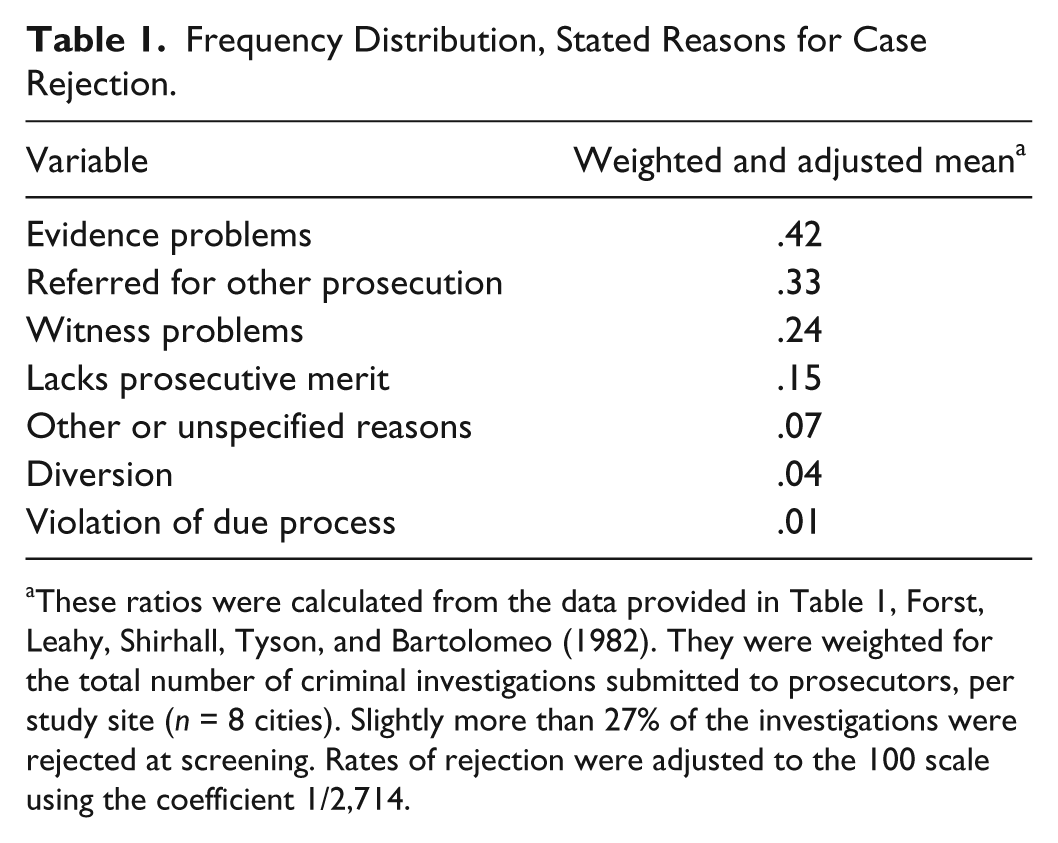
These ratios were calculated from the data provided in Table 1, Forst, Leahy, Shirhall, Tyson, and Bartolomeo (1982). They were weighted for the total number of criminal investigations submitted to prosecutors, per study site (n = 8 cities). Slightly more than 27% of the investigations were rejected at screening. Rates of rejection were adjusted to the 100 scale using the coefficient 1/2,714.
Though it might be reasonable to attribute some amount of blame to police for evidence problems, witness problems, and violations of due process, an unknown portion of blame is undoubtedly due to factors beyond their control. Delving into the genesis of case rejection, which is what the present study does, can be tricky. One way to try to measure the amount of prosecutorial potential under police control may be to compare officers whose investigations are routinely prosecuted with those who are routinely rejected. It is possible that these groups may differ on investigative methodology, and perhaps, these differences may account for variance in rates of prosecution. Only two studies have examined this possibility.
Routine Investigative Insufficiency
A year-long study of N = 4,500 police officers at a large municipal police agency, by the National Institute of Law Enforcement and Criminal Justice (NILECJ; Forst et al., 1977), showed that more than half of the criminal convictions resulted from the work of just 8% of the officers, and that more than half of all felony convictions were the work of 5.5% of the officers. Even more surprisingly, 46% of the officers did not make a single arrest over the course of the entire year. Since about two thirds of the police officers at any county or city police agency are assigned to patrol duties, the remaining assignments—some of which may have lower potential for making arrests—cannot explain these findings. 8
The NILECJ findings were replicated by Forst et al. (1982), who went further by distinguishing between two groups of police officers. Ineffective officers stood around at crime scenes “preserving the scene” and concluding “nothing could be done”; whereas, high conviction rate officers searched for evidence and witnesses. They were also observed to more effectively interrogate suspects and adhere to legalities of the investigative process, were more business-like in their procedures, were more persistent, and were better at establishing rapport with and trust of witnesses. Ewing has described officers of this type as “super cops” (Forst et al., 1977, pp. i-ii).
Purpose of the Study
Because the literature is silent on reasons why prosecutors reject DV cases, the primary purpose of this work is to fill that void. The second purpose is to assess the use of probability scores (P Scores) to quantitatively sort individual police officers according to their routine use, or non-use, of non-mandatory investigative techniques, drawing upon data collected from each DV crime report they write. It is believed that by separating officers according to their routine DV investigative habits, we can begin to investigate the origins of case rejection. Accordingly then, the third purpose is to compare routinely lower effort (RLE) officers, as measured by their lower use of the optional investigative techniques (OITs; these are explained further in the “selection of variables” section), and routinely greater effort (RGE) officers, who make greater use of the OITs, on rates of case rejection. Doing this comparison may illuminate a relationship between work habits and prosecution rates.
Criminology of the Study
The style and purpose of this study are intended to also serve as an appeal to criminologists to re-think the current direction and practices of the discipline, and to serve as an example of a problem-solving criminology (PSC) that responds to deficiencies in the criminal justice system. Criminologists themselves have identified two problems of great significance with regard to the current practice of criminology: Lack of impact upon public policy and lack of reach outside of the discipline. As Currie (2007) describes, Despite its accumulated theoretical and empirical heft, the discipline of criminology has distressingly little impact on the course of public policy toward crime and criminal justice . . . significant changes (are needed) in the inner culture of the discipline. (pp. 175, 176)
This lack of practical helpfulness might have its origins, at least partially, in what seems to be an excessive and predominant focus upon theoretical explanations, and a search for meaning regarding crime, the transmission and acquisition of criminal practice, differences in crime and victimization rates between different groups, and so on. Though meaning is illuminating, and the ability to predict successfully is respectable, neither type of explanation directly contributes useful methods for fixing current problems in the criminal justice system or society. Thus, PSC incorporates, fundamentally in its conception and design, the goal of using empirical methods to solve practical problems and to impact public policy. However, even if problems are solved, a second obstacle still exists, such that validated solutions may remain hidden from the public and from criminal justice practitioners.
Chancer and McLaughlin (2007) describe the second problem as follows: Criminologists have had to confront the embarrassing fact that in a society saturated with “crime talk,” they have (the) utmost difficulty in communicating with politicians, policy makers, professionals and the public. (p. 157)
One reason may be that traditional criminology journals tend to exist behind pay-walls, making them mostly inaccessible to criminal justice professionals. With download fees from about US$25 to US$40, 9 it is easy to see why chiefs of police, police academy trainers, sergeants and lieutenants and other police supervisors, prosecutors, judges, and so on might not be able to access, and thus put to use findings from the criminological study. However, there is a potential solution to this problem as well. In the last decade, a new type of journal has been gaining steady traction among academics, such that even major publishing houses are now offering them: the peer-reviewed, open-access journal. In addition to placing scholarly work in the hands of the public, for free, a number of studies have shown that publishing in journals of this type leads to greater citation of one’s work (Antelman, 2004; Gargouri et al., 2010; Xia & Myers, 2011). However, citation counts are of less importance to PSC, because they are a measure of the use of one’s material by fellow scholars. PSC is primarily concerned about its availability to non-academic practitioners. Thus, a measure of greater importance would be rates of download. As noted by Davis (2011), open-access articles are downloaded significantly more often, reaching a broader audience.
PSC, as it is proposed herein, responds to identified criminal justice shortcomings by employing the methods of criminology to seek empirically validated answers, and by making those findings available to criminal justice practitioners by presenting them in open-access journals. Undoubtedly, these solutions will ruffle the feathers of a few traditionalists. Doing so is not the intention of this work. It is hoped that criminologists will maintain an open mind, and consider the evidence and arguments in support of PSC. Just as the field of physics contains theoretical and applied scholarship, so also it is hoped and believed that the practice of criminology is large enough to welcome another form of practice into this important work. Like physics, where theoretical and applied forms can both gain useful material from the work of the other, so also it is believed that the phenomenological descriptions, as well as the quantitative empirical work of PSC, can provide much rich material for theoretical considerations and proposition of meaning by others. And, conversely, prior traditional work is an excellent source to consult when searching for prescient problems in the criminal justice system. It is believed that traditional criminologists should welcome the practice of PSC.
Changes in the manner of journal article production are inevitable, when a substantially different paradigm guides empirical work. That is true for PSC. Changes in the presentation style will be most evident in the tail ends of a scholarly paper. A review of the empirical and theoretical literature is replaced with an overview of the criminal justice problem, and a survey of prior work that frames it. The focus of the discussion section is re-purposed into a forum where potential methods for criminal justice practitioners to operationalize validated findings are presented. What remains the same are the middle parts: the empirical collection of quantitative data, and its statistical analysis and presentation in tables and figures. The present work is intended as an example of how PSC can be put into practice.
Hypothesis
The null hypothesis of this study is that there are no differences between RLE and RGE officers on any of the prosecutorial outcomes. Two alternative hypotheses are considered. The first is that rates of DV case rejection, by prosecutors, will be significantly greater for RLE officers when compared to their RGE counterparts. The second is that the rejected investigations of RLE officers will sustain significantly more criticism from reviewing prosecutors who reject their investigations, when compared to RGE officers.
Methodology
With permission, the author collected 16 types of data from N = 1,810 DV investigations, those representing the total number of DV crime allegations made by police, in the form of a written report, for the entire year of 2007. An additional 242 types of data were collected on each of n = 366 randomly selected investigations. 10 The police agency where the study was conducted employs several hundred officers and it serves a mid-sized city in California. Access to archival data was granted by the chief of police and also the District Attorney. All cases were matched at the prosecutor’s office by using police case numbers. Because both offices use electronic records keeping, the problem of searching for paper files was not encountered. Each investigation/case was reviewed in detail, several times, over the course of 2.5 years, and all data were coded by the author. Only the FRPO’s written report was used. The reason is because the interest of this article is to assess the relationship between the work of FRPO’s and the outcome of criminal case filing. It is possible that other factors also have a bearing upon the decision to prosecute, those being left to others to investigate.
Selection of Variables
Some components of a police report, when alleging a DV crime, are mandatory and thus will show no variance. 11 In order to measure performance differences between officers, one must therefore compare them on variables which are optional, because those types of variables are under an individual police officer’s control, at least to the extent that a given circumstance will permit their use. In addition, it would seem important to select variables that are relevant to the criminal justice process and specifically to DV crime. Six explanatory variables fitting these requirements were selected for the study. Each has been shown to significantly increase the odds of prosecution for DV crime. They are as follows: obtain an emergency protective order (EPO) 87%, obtain photographs 60%, locate additional witnesses 68%, find and arrest the suspect 94%, and list more than one criminal charge 284%. Survival analysis demonstrates that the slope for a sixth action, completing the written report the same day, is almost vertical at the onset, and it rapidly decreases after just a few days following the investigation, meaning if charges are to be filed the police officers report must reach the prosecutor’s office without delay (Nelson, 2013). In addition, 13 dichotomous outcomes were measured. The first is whether or not the prosecutor filed criminal charges, for a given investigation. The remainder are the 12 standardized reasons that prosecutors select to characterize a rejected investigation, and whether they were used. 12
Calculation of Proficiency Scores
Proficiency scores (P Scores) 13 were calculated for each police report in the random sample by assigning a whole number value of one (1) to each positive occurrence of an OIT, with one exception. A value of one (1) was added for each crime code listed in the police report. Doing so gives that variable additional weight, which seems reasonable in light of the fact that, as noted, the number of charges has significantly more influence upon the odds of prosecution. Because at least one crime is always listed in a police report, the range of P Scores is ≥1. Table 2 lists an example of how P Scores are calculated using raw data from two police officers, each of whom had n = 4 investigations.
Example of P Score Calculation (Case and Officer Numbers Anonymized).

Note. EPO = emergency protective order, CSD = written report completed the same day.
Segregation of Cases
Officers with ≥3 investigations within the random sample were segregated for a further study (n = 49). Under ideal circumstances, the selection threshold would be higher than three cases; however, the diminished group size which naturally attends random selection limits access to larger amounts of any individual’s work. P Scores were determined for each investigation, and from those, average P Score and standard deviation (sd) values were calculated for each officer.
If one assumes that average sd is, per officer, a direct measure of habit, with small sd indicating closely followed routines, then one can use an officer’s average sd as a sorting criteria. Among the segregated officers, average sd ranged from 0.52 to 3.61 (mean = 1.57, sd = .68), and P Scores ranged from 2.67 to 5.29 (mean = 4.09, sd = 1.57). Among those, n = 37 officers had an average sd <2.00 (mean sd = 1.35). Those officer were partitioned according to individual average P Scores, with n = 9 landing in the high P Score range, those officers demonstrating routine greater effort; n = 19 in the middle; and n = 10 in the low P Score range, those officers demonstrating routine lower effort. The mean sd of the excluded group is 2.38.
Comparison of Measures
Comparison of means and ratios was conducted using one-tail z tests. The z test is the appropriate choice because only two means or two ratios are compared at a time, and because the size of each group of investigative reports is n > 30. Probability values for z scores were obtained using an online calculator provided by WolframAlpha.com.
Limitations
This is a study of one police agency and one prosecutor’s office in California. It is likely that there are procedural differences in other locations; thus, generalizability may be diminished to an unknown extent. However, fundamental techniques for investigating, documenting, and proving DV crime in the United States are contained within bounds established by Constitutional law and also U.S. Supreme Court decisions; and so, it is felt that regional differences will not be large. Also, officers in the present study were not tested on their knowledge of law and procedure, and more specifically attitudes, motivations, and narratives regarding why RLE officers choose to investigate DV crime less thoroughly, and why RGE officers choose to routinely operationalize the OITs with significantly greater frequency.
Results
Of the 366 investigations submitted to the prosecutor, 48% were rejected (n = 178). Written reasons for case rejection were provided 93% of the time (165/178), with prosecutors choosing one or more reasons from the standardized list containing 12 categories. An average of 3.01 reasons were listed per rejected investigation (sd = 1.84). Table 3 identifies the reasons along with their frequency of use.
Frequency Distribution, Reasons for Domestic Violence Case Rejection.

As seen, two thirds of the investigations are labeled “no case”—which is, essentially, the twin to Stanko’s “garbage case.” In the prosecutor’s office under study, the “no case” designation is the “kiss of death,” meaning, the police department should not re-investigate and re-submit the case. It has been permanently rejected. 14 The frequency of “no case” rejections illuminates why police officers should be investigatively thorough the first time—odds are, there will not be a second chance to get it right.
Slightly more than 50% of the investigations were described as having insufficient evidence. This designation does not mean that a crime did not occur, it just means that there was not enough evidence to prove it happened in a criminal trial. 15 These findings indicate that prosecutors want more evidence, more independent witnesses, and more thorough investigations than they are routinely getting from the police. Table 4 compares RLE and RGE officers on rates of case rejection.
Comparison, RLE Versus RGE Officers, Frequency of Case Rejection.

Note. RLE = routinely lower effort officers; RGE = routinely greater effort officers.
As the data in Table 4 demonstrate, the rate of case rejection for RLE officers is about three magnitudes greater compared to their RGE counterparts 16 ; therefore, the first hypothesis is accepted. In addition, as seen, RLE officers sustain significantly more criticism from reviewing prosecutors compared to RGE officers; therefore, the second hypothesis is accepted as well. In light of the vast difference between RLE and RGE officers on rates of case rejection, the results displayed in Table 5 are not surprising. They are ranked according to the frequency as it applies to RLE officers.
Comparison, RLE Versus RGE Officers, Reasons Stated for Case Rejection.
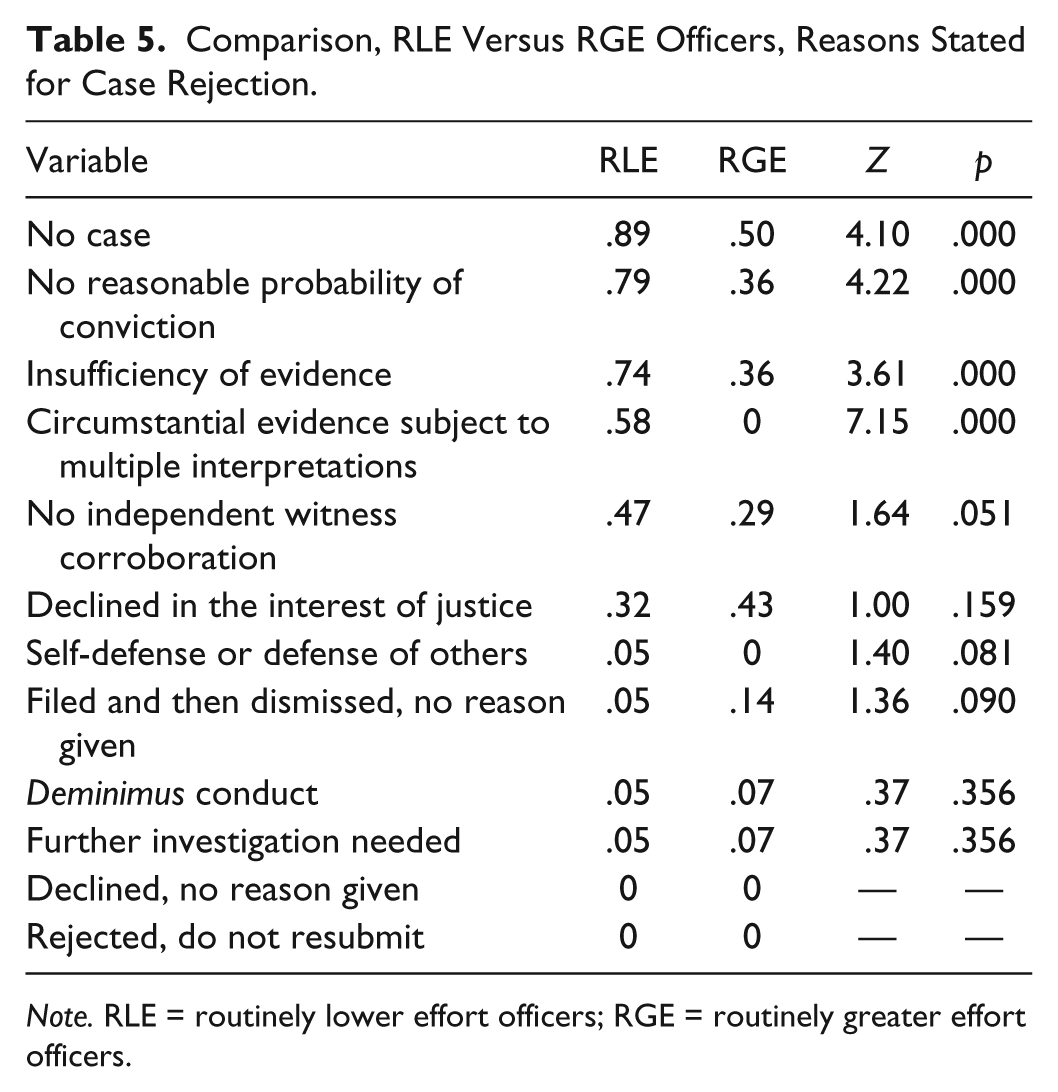
Note. RLE = routinely lower effort officers; RGE = routinely greater effort officers.
As the data demonstrate, there are significant differences in 7 of the 10 case rejection reasons actually used by prosecutors. The rejected investigations of RLE officers are seen as having a low likelihood of conviction, insufficient or ambiguous evidence, no witnesses, and possibly representing acts of self-defense. In two categories, RLE and RGE officer scores are the same, those being further investigation needed, and deminimus conduct. 17 Only one case rejection reason was directed toward RGE officer investigations more often, which being dismissed without a reason being given. Sometimes that is done to join the charge to another case, and sometimes it is done because a first time offender agrees to a diversion program. There can be other reasons as well.
Discussion
As the results demonstrate, prosecutors want understandable reports with sufficient evidence, witnesses, and charges. When they do not get what they need, which is what happens with most reports written by RLE officers, DV investigations are rejected. This is not a new finding. The NILECJ in 1974, Elizabeth Stanko in 1981, and the NIJ/Forst et al. study in 1982 all described the devastating effect of low effort officers upon the likelihood of prosecution; yet, almost four decades later little has changed, at least in regard to rates of DV crime prosecution. Perhaps this is because, until now, there has not existed a means by which each DV investigation and each police officer could be quantitatively scored and subjected to trend analysis. This article aims to correct that deficiency by equipping police supervisors, and others professionals, with the means to do so.
One might suspect that additional training of police is called for; however, there are at least four reasons that suggest that police officers, at least in California and probably elsewhere in the Western world, are already sufficiently trained and experienced in the operationalization of each of the six OITs. First, police officers are trained in the specifics of DV investigation, while they are in the police academy. In California, police recruits are trained on 21 topics related to DV crime investigation, those being explained in a 151-page training manual (California Commission on Police Officer Standards & Training [POST], 2006). 18 The training manual is supplemented by a 29-page field investigation guide that officers can consult when organizing a DV investigation (POST, 2004).
Second, rookie police officers cannot matriculate out of field training, until they have repeatedly and sufficiently demonstrated their ability to operationalize hundreds of police skills, including the six OITs. 19 Requirements such as these are seen in other states as well (Haarr, 2005; Sun, 2003a, 2003b). Third, in California and many places, police officers must undergo regularly scheduled refresher training on DV investigation techniques. In California it is every 2 years, with 17 mandated teaching points being required by law (California Penal Code §13519). 20
Finally, RLE and RGE officers do not operate in different spheres; probability theory insures that their work overlaps regularly. In the case of DV crime, it can be inferred that RLE officers are regularly exposed to the more thorough investigative methods of RGE officers. We know this to be likely for at least two reasons. Because of the risk of injury when responding to DV crime, it is routine police practice to have two or more officers approach the scene together (Hirschel, Dean, & Lumb, 1994; Meyer & Carroll, 2011; POST, 2001). Thus, RLE officers will sometimes provide protection for RGE officers assigned to investigate a particular DV crime, and vice versa. Doing so places RLE officers in a position to observe the investigative method of RGE officers. Also, the amount of exposure would be even greater when RLE and RGE officers are paired up as a patrol team, circumstances where each type of officer would have ample opportunity to observe the work habits of the other.
The assertion of global investigative competency challenges the position that additional training may be needed, instead suggesting what is actually needed is a means by which RLE officers—who know how to investigate DV crime thoroughly—can be compelled to do so. The global argument contends: Every police officer knows how to search for, locate, and interview witnesses. Finding witnesses is something police officers do across a wide variety of crimes, on a daily basis. So also, every police officer knows how to obtain photographs; make a detailed search for evidence; call a judge to seek an EPO; and search for and find a suspect for the purposes of obtaining a statement, serving an EPO, or to make an arrest. Every police officer knows how to ask detailed questions if they want to, of the type which will elicit important details not only about the present crime(s) but also those in the recent past that are still chargeable.
If the assertion of global investigative competency is correct, and at least in California the level of initial, field, and follow-up training suggests the supposition may be true, then so long as one assumes random distribution of investigative potential—that is, RLE officers are confronted with an equal amount of potential to operationalize the OITs as are RGE officers—then there seems to be no other testable explanation for why RLE officers operationalize the OITs significantly less often, other than by individual choice.
There is some evidence in the literature as to the origins of low effort policing. The problem can be seen as not only endemic to a subset of police officers but also to entire police agencies. A 2005 report by the California State Attorney General’s office describes how some police organizations are known, with regard to DV, to produce “inadequate investigations.”
More than half of the District Attorney’s Offices . . . and two City Attorney’s Offices explained that there was great variation in the quality of [domestic violence] reports submitted—from inadequate to excellent—depending on which law enforcement agency did the investigation. [Some] of these District Attorney’s Offices stated that they will reject a case, rather than request further investigation, if the initial report is inadequate and comes from an agency generally thought to do inadequate investigations. (California State Attorney General, 2005, p. 54)
If the findings of Stanko, the NILECJ, and the NIJ/Forst et al. are to be believed, minimal effort officers may constitute a substantial portion of the total number of police personnel, and if the California State Attorney General is to be believed, the problem is not only individual but also systemic. Thus, resistance to change—that being a mandate to always investigate every DV crime thoroughly—may exist at both the individual and organizational levels. Psychologists have amply documented at the individual level, and sociologists, economists, political scientists, and anthropologists have documented at the group level how challenging it is to effect permanent change of behavior. Thus, to solve the problem of low effort policing of DV crime, much difficult work may lay ahead.
Early criticism of this article suggested that it may not be appropriate to engage in a corrective discussion of this type: One that recommends specific changes to the methodology of individual police officers and also entire police organizations. The stated reason was because such a call for change broadens the discussion beyond the scope of the empirical findings presented in this article. In a traditional journal form that would probably be appropriate advice. However, as noted in the “Criminology of the Study” section (above), the present work is organized on the practice of a problem-solving criminology. The key nature of problem solving is to try to identify the genesis of a targeted problem, in this case the relationship between low effort policing and low rates of prosecution of DV crime, and then to propose solutions to the problem. Thus, it is essential to present potential solutions in this portion of the article.
One solution to the problem of low effort policing will undoubtedly be the creation of feedback systems which inform street-level police officers about the mistakes and insufficiencies of their work, as seen by reviewing prosecutors. In the city of the present study, no such system existed at the time of data collection. The same is true in many other locales (Forst et al., 1982, p. 34), though some jurisdictions have established prosecutor to police officer feedback systems (Smith, Davis, Nickles, & Davies, 2001).
The National District Attorneys Association is aware of the problem of low feedback. Highlighting the importance of prosecutorial input to police officers, the organization has stated “The prosecutor has a large stake in the training and professionalization of local law enforcement. Its handling of a case is often crucial to the prosecutor’s success” (National District Attorneys Association [NDAA], 2009, p. 23). To help remedy the problem, the NDAA recommends the following actions for prosecutors (2009, p. 22):
Seek to actively improve communication between prosecutors and law enforcement.
Implement a communication system which keeps police officers informed about cases they investigated.
Assist in the training of police officers.
Periodically provide briefings for police officers on recent court decisions, legislation, and changes in the rules of criminal procedure.
Request that each law enforcement agency establish a liaison with their office.
Advise police agencies on investigative policies which will withstand later judicial inquiry.
Ease of Implementation
To summarize, there are three potential solutions that may help to significantly and substantially increase rates of DV prosecution, actionable items that can be operationalized without delay—it should not be difficult to implement any of them. The first is to compel FRPOs to fully operationalize the best practices method for the investigation of DV crime, because doing so has been shown to substantially and significantly raise those rates (Nelson, 2013). Second, police agencies should use the P Score method to monitor the routine work habits of their police officers, with regard to DV crime investigation. Finally, the NDAA’s system of prosecutorial feedback—which is, in essence, a system of teaching—can help officers advance their investigative skills by telling them, in writing, what they are doing right, what they are doing wrong, and what is missing altogether. Taken together, it is believed and predicted that implementation of these three systems should substantially and permanently increase rates of DV prosecution and conviction, in jurisdictions where they are imposed.
At the officer level, the only equipment that is required to thoroughly investigate DV crime is a pencil and notebook, some paper bags in which to collect evidence and a camera. At the supervisorial level, the only equipment that is needed to track P Scores is a notebook or a spreadsheet, and possibly a calculator. At the prosecutorial level, all that is required for feedback is the means to write a message to an officer, such as by email. These are not burdensome methods to implement; so, arguments of expense and training are seen as unpersuasive. Religion, culture, political power, and individual habit are more likely to be the actual obstacles that could prevent full adoption of this program.
The use of P Scores is not limited to police supervisors. Victims and advocates may find the method to be useful when evaluating the content of a given police report for sufficiency. Police oversight bodies, including Attorney’s general and state departments of justice, can use aggregated P Scores to evaluate the response to DV by agencies they monitor. Government or private sources of grants can use P Scores as a means to assess change in the way a police agency responds to DV crime. Researchers can use the method for both within and between assessments of police agencies. Police academy instructors can use the method when grading cadets as they engage DV training scenarios, or when they participate in written examinations. Also, the P Score method is not limited to American style policing, or just to DV crime. Once the validity of additional explanatory measures is established, the method could be adjusted to fit other types of crimes and other types of legal systems as well.
Recommendations
Police agencies and political leaders are encouraged to consider mandating the use of the best practices model for DV investigation. It is possible that individual officers may not realize how significantly the OITs impact prosecution rates; and so, they should be informed about how important usage of those investigative techniques is to a case. Thereafter, officers should be required to document, each time they investigate DV crime, how they attempted to operationalize each of the six OITs. Police agencies should be encouraged to adopt P Score monitoring of officers. Minimalist officers identified by low aggregated P Scores should be counseled to increase their use of the OITs, and then monitored for compliance. It is felt that those who are unwilling or unable to do so should be, after sufficient warning, discharged from police service as unfit.
There is a historical reason to believe that implementation of these recommendations may produce a substantial and lasting increase in the rates of DV prosecution. When DV arrest was mandated by some states, and strongly encouraged by others, what followed was a permanent increase in the rates of DV prosecution for those cases that included an arrest (Garner & Maxwell, 2009, Table 5).
Footnotes
Author’s Note
The author requests correspondence from agencies and governments that implement this program in order to assist in proper records keeping and documentation, as well as to monitor results.
Declaration of Conflicting Interests
The author(s) declared no potential conflicts of interest with respect to the research, authorship, and/or publication of this article.
Funding
The author(s) received no financial support for the research and/or authorship of this article.