




Abstract
Over the past two decades, researchers have described many facets of forgiveness. Presently, we explore the mood regulatory properties of forgiveness. The mental and physical health benefits associated with forgiveness are well documented, and it has been suggested that these benefits may be due to the negative affect regulating properties of forgiveness. However, the relationship between forgiveness and negative affect has not been studied experimentally. We conducted three studies designed to explore the relationship between mood and forgiveness. Results showed that participants induced with a negative mood were more likely to forgive a hypothetical transgression than those in a neutral mood, a moderate level of negativity was associated with a greater likelihood of forgiveness, and participants who forgave a hypothetical transgression experienced less negative affect than participants who did not forgive. Implications of the present results and directions for future research are discussed.
Forgiveness is a funny thing. It warms the heart and cools the sting.
Ward’s quote suggests that forgiveness can not only induce positive feelings, but alleviate the psychological pain resulting from an interpersonal transgression. Although Ward was perhaps speaking metaphorically, there is a substantial body of research linking forgiveness to physical and physiological well-being (e.g., Hannon, Finkel, Kumashiro, & Rusbult, 2012; Lawler et al., 2003; Pargament & Rye, 1998; Witvliet, Ludwig, & VanderLaan, 2001; Worthington, Witvliet, Pietrini, & Miller, 2007). While forgiving is known to reduce negative feelings, resentment, and vindictive motivations toward a transgressor (Worthington, 2006; Worthington et al., 2007), much less is known about the relationship between forgiveness and negative affect more generally. It is important to fill this gap in the literature, because the nature of this relationship has important implications for not only how forgiveness is conceptualized, but also for understanding its origins.
Our primary objective in this research is to explore the reciprocal relationship between negative affect and forgiveness—specifically, to test whether experiencing a negative affective state increases the likelihood of forgiveness, and whether forgiving can reduce negative affect. After a brief literature review, we present a series of studies designed to answer three questions about the relationship between negative affect and forgiveness: First, are people in a negative mood more likely to forgive a hypothetical transgressor? Second, what is the affective range in which this effect occurs (i.e., does it occur with minor, moderate, and/or extreme bad moods)? Third, can forgiving improve a negative mood? In answering these questions, we aim to contribute to the forgiveness literature by expanding the range of constructs known to affect (and be affected by) forgiveness, advance the debate on whether forgiveness is altruistic, and to contribute to the discussion of the origins and purposes of forgiveness.
Forgiveness has traditionally been defined via dictionaries as ceasing to feel anger or resentment against an offender, or forgoing a desire for revenge or restitution for a wrongdoing (Merriam-Webster Online Dictionary, 2011). We, however, utilize the empirical and theoretically derived definition of forgiveness as a prosocial process whereby negative, resentment-based thoughts, emotions, and motivations toward a transgressor are reduced (Rusbult, Hannon, Stocker, & Finkel, 2005; Worthington, 2005; Worthington et al., 2007). This definition provides distinction from similar, but non-forgiveness-related constructs (such as pardoning, reconciling, condoning, forgetting, and excusing) while tapping into the motivational components of forgiveness (McCullough & Witvliet, 2001). Theoretically, forgiveness has been conceptualized as a transition from negative to positive affect, feelings, and behaviors toward a transgressor over time (Enright & The Human Development Study Group, 1991; McCullough, Pargament, & Thoresen, 2000). We argue that this affective transition need not be restricted to a specific target (i.e., a transgressor), but can occur more generally as well. Specifically, we suggest that the tendency to forgive is enhanced by negative affect, and that the act of forgiving can alleviate or lessen a negative moodstate.
We focus on two important conceptualizations of mood. First, mood is a person’s ephemeral, subjectively perceived affective state (Isen, Clark, & Schwartz, 1976). Second, mood is not directed at a specific person or situation (namely, the transgressor or the transgression; Clark & Isen 1982). There are theoretical grounds on which to hypothesize that experiencing a negative mood will increase the likelihood of forgiveness. The foundation of this supposition is that people are motivated to improve or repair a bad mood (Wegner & Pennebaker, 1993). Many of our behaviors and thoughts are rooted in the simple motivation to experience more positive than negative affect (Larsen, 2000). These behaviors need not necessarily be conscious or explicit. We describe some possible mechanisms through which the experience of a negative mood should increase the likelihood of forgiving.
People can improve a negative moodstate by pursuing strategies such as helping others or behaving prosocially. According to the negative state relief model, when people experience negative affect or emotions, they will behave in a prosocial manner in an attempt to repair their mood (Cialdini, Darby, & Vincent, 1973). Since its inception, numerous studies have supported the model (e.g., Cialdini & Kenrick, 1976; Cialdini et al., 1987). The generally accepted idea espoused by Isen (1984; Clark & Isen, 1982) and later echoed and amplified by Taylor (1991) is that positive affective states will be sought and maintained, whereas negative affective states will be avoided or repaired. The prosocial motivational component of forgiveness (e.g., McCullough, Fincham, & Tsang, 2003; McCullough et al., 1998) should render it a viable strategy for mood reparation or improvement.
Furthermore, Morris (1992) suggested that moods serve as an indicator of what is wrong or right with one’s internal systems, and those systems can be regulated by altering or changing the environment (Larsen, 2000). Negative moods suggest the presence of a stressor (Eckenrode, 1984), signaling the need for its elimination via environmental change. This type of regulatory behavior may explain the mental and physical health benefits of forgiveness. For instance, less forgiving individuals displayed stronger sympathetic nervous system activation and stress reactions than those who are more forgiving (Witvliet et al., 2001). Forgiving individuals also report better mental health than those who are unforgiving, including employment of better coping strategies (Pargament & Rye, 1998) and reports of greater life satisfaction (Maltby, Day, & Barber, 2004). Given the robust stress-reducing properties of forgiveness (Lawler et al., 2003), we suggest it is a likely candidate for the type of affect regulation mentioned hereinbefore. If this is the case, individuals in a negative mood should be more likely to forgive (given the opportunity) than individuals who are in a neutral mood.
Study 1
Overview
In Study 1, we experimentally manipulated mood to test the impact that a negative mood has on forgiveness likelihood. Given the stress- and negative affect–reducing properties of forgiveness coupled with the principles of negative state relief, we predict that participants induced with a negative mood will be more likely to forgive relative to those in a control condition (Hypothesis 1).
We also note that the relationship between personality and forgiveness has been extensively documented, revealing that forgiveness is positively related to agreeableness (Berry, Worthington, Parrott, O’Connor, & Wade, 2001; Brose, Rye, Lutz-Zois, & Ross, 2005) and negatively related to neuroticism (Berry et al., 2001). The relationship between conscientiousness and forgiveness is less well-established, with some researchers reporting a relationship between the two constructs (Balliet, 2010; Berry et al., 2001), and others reporting a weak or nonexistent relationship (e.g., Brose et al., 2005; Walker & Gorsuch, 2002). As such, we measure agreeableness, neuroticism, and conscientiousness to control for these factors in Study 1.
Method
Participants
We recruited 414 (160 males, 254 females) undergraduate students from a large Southwestern university who participated for partial course credit. To avoid problems associated with too much or too little statistical power, we encourage focus on effect size figures not affected by sample size, including Cohen’s d and regression betas. We additionally report conventional p values, per American Psychological Association (APA) guidelines. Ethnic makeup of the sample was 40% White, 49% Hispanic or Latino, and 11% of other or unspecified ethnicity. Mean participant age was 19.5 years.
Materials
The survey packet contained a demographic survey, a personality measure, a mood manipulation, and the dependent forgiveness measure. The personality measures consisted of the agreeableness, conscientiousness, and neuroticism scales from the Big-5 Personality Inventory (BFI; John, Donahue, & Kentle, 1991). The mood manipulation consisted of a set of news headlines established as effective by Trafimow, Bromgard, Finlay, and Ketelaar (2005). The neutral headlines consisted of news stories about an airport and a restaurant, and the negative headlines consisted of stories about a nation’s rampant starvation and a school shooting. Participants in the neutral and negative conditions read the respective set of headlines. To ensure participants read and understood the headlines, they were asked to write a one- or two-sentence summary of the headlines immediately after reading each one.
The dependent measure was the 10-item Forgiveness Likelihood Scale (FLS; Rye et al., 2001), in which respondents are instructed to imagine that they have experienced a variety of transgressions, and then indicate the likelihood that they would forgive the transgressor in each case. Sample items include, “A friend borrows your most valued possession, and then loses it. The friend refuses to replace it. What is the likelihood that you would choose to forgive your friend?” and “A stranger breaks into your house and steals a substantial sum of money from you. What is the likelihood that you would choose to forgive the stranger?” The scale uses a 5-point Likert-type format ranging from not at all likely to extremely likely, with higher scores indicating a greater likelihood of forgiving. The FLS was chosen due to an optimum balance of brevity, sound psychometric properties, adequate reliability, and strong convergent validity with other established measures of forgiveness (including the 60-item Enright Forgiveness Inventory [EFI; Subkoviak et al., 1995], which measures positive and negative affect, cognitions, and behavior toward an offender; Rye et al., 2001).
Procedure
On arrival to the lab, an experimenter gave participants a short overview of the study. After granting consent, participants read and summarized the condition-specific set of headlines, then completed the forgiveness measure. On completing the study, participants were fully debriefed, thanked, and dismissed.
Results and Discussion
In the present sample, reliability for the FLS was adequate (Cronbach’s α = .82). In the main analysis, an independent-samples t test on FLS scores was conducted. As predicted, participants in the negative mood condition (M = 2.82, SD = 0.72) were more likely to forgive than those in the neutral mood condition (M = 2.67, SD = 0.65), t(412) = 2.19, p = .03, d = .22, supporting Hypothesis 1 (see Table 1). Participant sex was not related to FLS scores.
Mean Forgiveness Likelihood by Mood (N = 414).

Note. CI = confidence interval.
p < .05.
Analysis of the personality variables revealed that forgiveness likelihood was negatively correlated with neuroticism (r = −.18. p < .001), positively correlated with agreeableness (r = .21. p < .001), and uncorrelated with conscientiousness (see Table 2). As such, we performed a supplementary analysis to test the effects of the mood manipulation while controlling for personality and other demographic variables. After confirming there were no violations of linearity, normality, and multicollinearity, a simultaneous regression was performed, with FLS score regressed on mood, personality (neuroticism and agreeableness), and demographic variables (ethnicity, age, and sex). The overall model explained approximately 7% of the variance in forgiveness likelihood, R2 = .07, F(6, 407) = 14.15, p < .001. Mood and both personality variables predicted tendency to forgive (see Table 3), suggesting that participants’ mood affected their tendency to forgive independent of personality and demographics. A subsequent hierarchical regression analysis on the same six predictors revealed no higher order interactions between mood and any of the predictors.
Correlations Between Predictors and Forgiveness Likelihood (N = 414).

p < .01.
Regression Analysis of Forgiveness Predicted by Mood, Personality, and Demographics (N = 414).

Note. CI = confidence interval.
p < .05. **p < .01.
The results of Study 1 support our hypothesis that the induction of a negative mood would lead to a greater likelihood of forgiving. Although this finding supports our hypotheses and establishes causation, the study has two limitations. First, the affective experience felt by the participants in the negative condition may have been closer to an emotional experience (resulting from the negatively valanced stimuli) rather than a more general affective state. Second, although we ensured participants read and understood the mood manipulation, we did not conduct a more overt manipulation check (out of concern that the manipulation check would prime mood) to ensure the participants were actually experiencing a negative mood. To address these two limitations, we conducted a quasi-experimental study designed to capture the likelihood of forgiving across a more naturally occurring (i.e., nonmanipulated) range of moods.
Because the disposition to forgive is negatively related to anger and hostility (Tangney, Fee, Reinsmith, Boone, & Lee, 1999), we predict that the effects of mood on forgiveness will be most robust at slight or moderate levels of negativity. Specifically, Tangney et al.’s (1999) finding suggests that forgiveness is not likely at high levels of negative affect. Based on this finding and the results of Study 1, it is unclear, then, whether the relationship between negative mood and forgiveness likelihood is strongest at low or moderate levels of negativity. If the effect is most robust at a low level of negative affect, the regression will reveal either a negative linear or a concave down J-shaped function (Hypothesis 2a) peaking at the low end of the negativity dimension. If the effect is most robust at a moderate level of negative affect, the regression will reveal a concave down, U-shaped function (Hypothesis 2b) peaking near the center of the negativity distribution. Although we do not make predictions related to positive affect, we include positive affect in the analyses for exploratory purposes.
Study 2
Method
Participants
We recruited 67 (22 males, 43 females, 2 unspecified) undergraduate students from a large Southwestern university who participated for partial course credit. Ethnic makeup of the sample was 26% Caucasian, 58% Hispanic/Latino, and 16% of other or unspecified ethnicity. Mean participant age was 19.4 years.
Measures
We assessed mood with the 20-item Positive and Negative Affect Schedule (PANAS; Watson, Clark, & Tellegen, 1988). The PANAS features 10 positive and 10 negative feelings with instructions to indicate the degree to which the respondent is experiencing each feeling at that very moment. The dependent measure was the FLS, and the dependent variable was the FLS score. We counterbalanced the order of issue of the FLS and PANAS across participants. Participants also provided demographic information.
Procedure
On arrival to the lab, participants received a brief, nonspecific overview of the study and granted informed consent. Participants then completed the survey packet and were subsequently thanked, debriefed, and dismissed.
Results and Discussion
Reliabilities for the FLS and PANAS positive and negative scales were adequate (Cronbach’s α = .80, .90, and .82, respectively). After confirming there were no violations of normality and multicollinearity, we conducted a hierarchical polynomial regression with the FLS mean as the outcome variable. To test for hypothesized curvilinear relationship, we entered linear (Step 1) and quadratic (Step 2) terms for both PANAS dimensions into the equation. In Step 1, the model explained 2% of the variance in FLS scores. In Step 2, adding the quadratic terms resulted in an 11% increase in variance explained, Fchange(2, 62) = 3.91, p = .025, ΔR2 = .11. The final model thus explained 13% of the variance in FLS scores, F(4, 62) = 2.27, p = .072, R2 = .13. The negative quadratic term entered in Step 2 was significant, B = −0.68, t(62) = −2.75, p = .008. See Table 4 for regression coefficients. These results reveal a concave down U-shaped function, with forgiveness likelihood peaking near 2 of the negative PANAS distribution (responses ranged from 1 to 3.2), supporting Hypothesis 2b and failing to support Hypothesis 2a (which predicted a negative linear or a concave down, J-shaped function, which the data did not fit).
Hierarchical Linear Regression Predicting Forgiveness Likelihood (n = 67).

Note. CI = confidence interval.
p < .05. **p < .01.
The results of Study 2 further support our claim that negative affect is positively related to forgiveness. Furthermore, the fact that mood was not experimentally manipulated supports the claim that sadness or anger that might have resulted from the negative condition stimuli did not drive the effect found in Study 1. The final question we aim to answer is that of whether forgiving can reduce negative affect. To answer this question, we measured participants’ baseline mood, instructed them to forgive or not to forgive, and then measured their mood postmanipulation. Given our earlier discussion of the well-documented health benefits associated with forgiving, we predict that participants who forgive will experience a reduction in (or comparatively less) negative affect relative to participants who do not forgive (Hypothesis 3). Although we do not make predictions related to positive affect, we include positive affect in the analyses for exploratory purposes.
Study 3
Method
Participants
We recruited 122 (40 males, 80 females, 2 not specified) undergraduate students from a large Southwestern university who participated for partial course credit. Ethnic makeup of the sample was 43% White, 45% Hispanic/Latino, and 13% of other or unspecified ethnicity. Mean participant age was 19.3 years.
Measures
Mood was assessed with the PANAS. A demographics section was included. The forgiveness manipulation consisted of a single item worded as follows (unforgiving text in brackets):
Please read the following situation, and try to imagine how you would feel if it happened to you: Your friend asks to borrow 250 dollars to pay off a debt. You tell him or her you cannot afford that much, but you give him or her 50 dollars. The next morning, you find that some of your belongings are missing. It turns out your friend took them and sold them to pay off the debt. Imagine that that person who did this asked for your forgiveness.
Suppose that you decide [not] to forgive the person
Take a moment to imagine yourself forgiving him or her [denying him or her forgiveness]. How would the person ask? What would you say? What would you feel? Take a minute or two to write about what you think this would be like.
Procedure
On arrival to the lab, a researcher gave participants an overview of the study, obtained informed consent, and randomly assigned participants to read the vignette with instructions to either imagine forgiving or not forgiving the transgressor. Participants then completed a demographics section, completed the premanipulation PANAS, responded to the forgiveness manipulation, and finally completed the postmanipulation PANAS. After completing the study, participants were thanked, debriefed, and dismissed.
Results and Discussion
Reliability coefficients for pre- and postmanipulation positive (α = .86, .89, respectively) and negative (α = .76, .80, respectively) PANAS scores were adequate. We initially conducted two independent-samples t tests comparing pre- and postmanipulation negative and positive scores. See Table 5 for descriptive statistics. There were no differences between the negative (d = .09) or positive (d = −.16) premanipulation scores of the forgiveness and nonforgiveness groups. Regarding the postmanipulation negative scale scores, participants who forgave reported marginally less negative affect (M = 1.53, SD = .45) than those who did not forgive (M = 1.70, SD = .57), t(120) = 1.82, p = .07, d = .33. There were no differences in postmanipulation positive scores between the two groups (d = −.27, ns).
Mean Forgiveness Likelihood by Mood (N = 122).
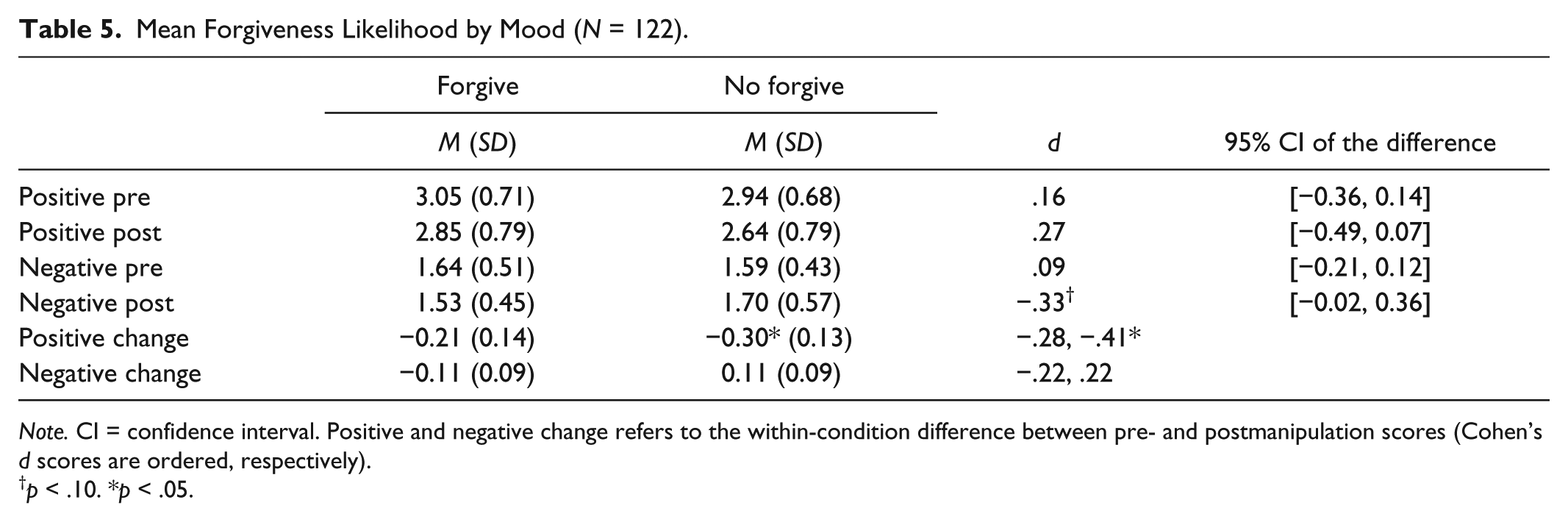
Note. CI = confidence interval. Positive and negative change refers to the within-condition difference between pre- and postmanipulation scores (Cohen’s d scores are ordered, respectively).
p < .10. *p < .05.
We also compared pre- and postforgiveness scores within condition to assess the degree of affective change associated with forgiving and not forgiving. For participants who did not forgive, positive PANAS scores decreased postmanipulation, t(124) = −2.30, p = .02, d = −.42. Negative PANAS scores did not change (see Figure 1).

Positive and negative affect pre- and postforgiveness manipulation.
Two noteworthy effects occurred in Study 3. First, in partial support of Hypothesis 3, participants who forgave reported marginally less negative affect than those who did not forgive. Second, regarding within-condition change, participants who did not forgive reported a significant decrease in positive affect following the manipulation.
At face value, the first finding implies that those who forgive will, after the decision point (of deciding to forgive or not), experience less negative affect than those who do not forgive. To more fully understand this effect, we must consider how the PANAS scores changed from pre- to postmanipulation. Participants who did not forgive experienced a decrease in positive affect from baseline. In sum, the results of Study 3 suggest that the effect of forgiveness on affect is twofold: Forgiveness reduces negative affect more than not forgiving, while simultaneously buffering against decreases in positive affect following a decision not to forgive.
General Discussion
Despite an increase in forgiveness research in the last two decades, the relationship between mood and forgiveness is still ambiguous. The primary objective of the present research was to address this gap in the literature by exploring the mood regulatory properties of forgiveness. In Study 1, participants induced with a negative mood were more likely to forgive compared with participants in a neutral mood. In Study 2, participants experiencing a moderate amount of negative affect were most likely to forgive. In Study 3, participants instructed to forgive a hypothetical offense reported marginally less negative affect than those who did not forgive, and did not experience a reduction in positive as did participants instructed not to forgive. Overall, effect sizes in the present research were small.
Altogether, the present results help support the claim that forgiveness has mood regulatory properties. This claim is compatible with theorizing that forgiveness is rooted in emotions (e.g., Worthington & Wade, 1999). Worthington and Scherer (2004) described a process called emotional forgiveness whereby the construct known as unforgiveness (the composite of negative emotions, feelings, and motivations toward a transgressor) is replaced with positive, other-oriented emotions like empathy or compassion (Worthington, Sandage, & Berry, 2000; Worthington & Wade, 1999). Unforgiveness is characterized as a stress reaction (Harris & Thoresen, 2005; Worthington & Scherer, 2004), potentially having health consequences similar to those caused by chronic stress (see Cohen, Janicki-Deverts, & Miller, 2007). Thus, one implication of the present results is that the stress-reducing capabilities of forgiveness may extend beyond the alleviation of transgressor-focused stressors, and apply to stressors more generally.
The conceptualization of forgiveness as having mood regulatory capabilities raises the question of the primary function of forgiveness: Is forgiveness primarily a means of repairing relationships through the overcoming of transgressions, or is it a self-preservation mechanism? In other words, do people forgive others because of primarily relational and personal reasons? Or do people forgive as a more implicit means of regulating their stress levels and maintaining their physical health? Although we note that these two functions need not be mutually exclusive, the veracity of the latter explanation is supported by the present results. This has implications for evolutionary perspectives on forgiveness.
Most contemporary evolutionary perspectives on forgiveness focus on the adaptive behavioral advantages offered by forgiveness, such as choosing the optimal response following a transgression (Godfray, 1992), or curtailing an escalating series of retaliations that might otherwise result in death or grievous injury to one or all parties involved (see Enright, 1996; McCullough, Kurzban, & Tabak, 2010; Newberg, d’Aquili, Newberg, & deMarici, 2000). However, another possible adaptive advantage of forgiveness is better health via the reduction of internal stressors. The suppressive effects of chronic stress on the immune system are well documented (see Segerstrom & Miller, 2004). Indeed, state forgiveness (the act of forgiving) is correlated with reduced stress and negative affect (Lawler et al., 2005). The present results lend experimental support to these findings, strengthening the claim that forgiveness offers better health via the reduction of stress reactions, not only in response to an offense, but more generally as well. In sum, forgiveness may not only have been physically adaptive in the environment of evolutionary adaptedness, but physiologically as well, benefits which continue today.
Taken as a whole, the body of empirical evidence gathered thus far raises the question of whether forgiveness is altruistic or egoistic. Some researchers have argued against the possibility of there being “true” altruism, as there are generally self-rewards (e.g., good feelings, avoiding negative feelings such as guilt) that occur whenever a person helps or assists others (see Batson, 1998, for a review). Our results suggest that the primary (or at least much of the) benefit in forgiving may be for the actor, and not the recipient of forgiveness. If one strictly defines altruism as selfless behavior with no benefits for the actor, it is logically impossible to define forgiveness as altruistic. Even if one defines altruism in a less absolute sense, such as a behavior in which the benefits for the recipient outweigh or are greater than those gained by the actor, it still may be a philosophical and empirical challenge to declare forgiveness as altruistic.
In summary, the present results contribute to the conceptualization of forgiveness as a rich, multifaceted system of behaviors, thoughts, and motivations that impact and interact with many areas of human life. In the debate concerning the nature, function, and purpose of forgiveness, there may be veracity toward most, if not all, of the ways that forgiveness has been theoretically conceptualized.
Limitations and Directions for Future Research
Although the present research provides a novel perspective with which to study forgiveness, there are several limitations that future research might address. The survey-based, hypothetical nature of the present research lacks context that may influence how individuals think about and cope with actual transgressions and transgressors. The severity of an offense, for instance, may be a strong determinant of whether forgiveness is granted. Other important factors may include the quality and nature of the relationship between the transgressor and the victim, the amount of time that has passed since the transgression, and the victim’s subjective perception of the offense. All of these factors may interact with each other to varying degrees as well. Future research should examine the degree to which these factors mediate or moderate the mood effects reported in the present research.
A further limitation of the present research was that the results were generally characterized by small effect sizes. One possible reason for this outcome is that the PANAS is a general measure of affect positivity and negativity. Such a measure may not fully tap into the mechanisms responsible for the effects in the present research. Future research might make use of more specific or specialized affect scales, such as the Positive and Negative Affect Schedule–Extended Form (PANAS-X; Watson & Clark, 1994), which measures 11 specific affects in addition to the two original higher order dimensions, or a specialized negative affect scale such as the State–Trait Anger Scale (STAS; Spielberger, Jacobs, Russell, & Crane, 1983). Also related to the measures, the FLS and the scenario in Study 3 contained hypothetical situations that may not have had the same impact as a genuine transgression. Asking participants to recall genuine transgressions that they have actually experienced may result in stronger effects, as well as increase internal and ecological validity.
Finally, our hypothesis that negative affect would be reduced by forgiving was not supported. There are at least three plausible reasons for this lack of support. First, it is possible that, beyond being instructed to do so, participants lacked motivation to forgive, thus attenuating any possible effects of forgiveness. Second, it is possible that a floor effect was present, whereby participants felt, on average, a low amount of negative affect before being presented with the scenario. Finally, perhaps a hypothetical transgression was not sufficiently strong to elicit the predicted effect. We felt using the hypothetical example was justified by the control it allowed us to exert over the experiment (i.e., all participants received a consistent stimulus). Future research should feature genuine, participant-generated transgressions, while controlling for such factors as the severity of offense and the participants’ relationship with the transgressor.
In conclusion, let us restate that the act of forgiveness clearly has many benefits, among them the reparation and maintenance of relationships (McCullough, Worthington, & Rachal, 1997), better physical and mental health (Pargament & Rye, 1998; Witvliet et al., 2001), and a higher degree of life satisfaction (Maltby et al., 2004). However, all of the mechanisms through which these benefits are reached have yet to be uncovered. The various factors involved may be processed by the victim of a transgression, allowing him or her to make the best judgment possible when deciding whether to forgive an offender. It is our contention that one function of forgiveness is an unconscious motivation stemming from the desire to reduce or eliminate negative affect. Our results suggest that there is a small yet reliable relationship between mood and forgiveness. We hope that the present research serves as an inspirational early step in the exploration of this phenomenon, and that it presents new opportunities to understand the nature, purposes, and outcomes of forgiveness.
Footnotes
Declaration of Conflicting Interests
The author(s) declared no potential conflicts of interest with respect to the research, authorship, and/or publication of this article.
Funding
The author(s) received no financial support for the research and/or authorship of this article.