




Abstract
One consequence of the advent of cyber communication is that increasing numbers of people go online to ask for, obtain, and presumably act upon advice dispensed by unknown peers. Just as advice seekers may not have access to information about the identities, ideologies, and other personal characteristics of advice givers, advice givers are equally ignorant about their interlocutors except for the bits of demographic information that the latter may offer freely. In the present study, that information concerns sex. As the sex of the advice seeker may be the only, or the predominant, contextual variable at hand, it is expected that that identifier will guide advice givers in formulating their advice. The aim of this project is to investigate whether and how the sex of advice givers and receivers affects the type of advice, through the empirical analysis of a corpus of web-based Spanish language forums on personal relationship difficulties. The data revealed that, in the absence of individuating information beyond that implicit in the advice request, internalized gender expectations along the lines of agency and communality are the sources from which advice givers draw to guide their counsel. This is despite the trend in discursive practices used in formulating advice, suggesting greater language convergence across sexes.
Introduction
In his book L’existentialisme est un humanisme, Sartre (1946) tells the following anecdote: During World War II (WWII), a former student asked his advice on whether he should join the Résistance and leave behind his widowed mother, or stay with her and neglect his patriotic duties. Sartre’s advice was, “You are free. Choose.” For Sartre, the moral of the story is that, when someone solicits advice, they have already chosen the answer they want, as the advice they wish to receive guides the selection of advice giver. If Sartre’s observation was ever right, in cyber communication it no longer holds. Increasing numbers of people go online to ask for, obtain, and presumably act upon advice dispensed by unknown peers, mindful or not of the potential risks involved in this practice (e.g., erroneous information, abusive language or content, dangerous emotional manipulation from the advice giver, or receiver, or both).
Just as online advice seekers may have to or may choose to ignore the identities, ideologies, worldviews, and other personal characteristics of advice givers, advice givers are similarly positioned with information about the interlocutors asking for advice, except for the bits of demographic information that are sometimes freely offered or given away in posts (e.g., age, gender, and some personal circumstances revealed in the questioning). The advice they offer is thus not guided by what they think the advice seeker wants to hear (as in Sartre’s interpretation of his experience above) but on what they think will be relevant or appropriate to an unknown interlocutor. Thus, advice is formulated on the basis of very limited contextual information and the few demographic factors their interlocutors reveal.
A number of researchers have shown that insufficient information about individuals or situations tends to trigger from others stereotypical inferences and responses. Thus, Kunda and Sherman-Williams (1993) propose that, “in the absence of other information, expectations about an individual will be guided by stereotypical beliefs about categories such as his or her profession, ethnicity, or gender” (p. 90). When it comes to online advice, given that the only piece of demographic information advice seekers provide is their sex, sex becomes a salient feature in the interaction. We can speculate that the salience of gender norms is likely to influence the nature of advice offered, and thus advice givers will formulate responses based on their internalized gender role expectations and stereotypes, which may be triggered unconsciously or automatically.
Gender Stereotypes
“Gender roles” have been described as society’s shared beliefs that apply to individuals on the basis of their socially identified sex (Eagly, 2009) and are thus closely related to gender stereotypes. Stereotypes can be conceptualized as the descriptive aspects of gender roles, as they depict the attributes that an individual ascribes to a group of people (Eagly & Mladinic, 1989). Stereotyping is often seen as necessary, as it is a way of simplifying the overwhelming amount of stimuli one constantly receives from the world (Ladegaard, 1998), constraining potentially infinite numbers of interpretations (Dunning & Sherman, 1997). Another line of inquiry extends the function of stereotypes from the interpretation to the rationalization and justification of social practices (Allport, 1954; Hoffman & Hurst, 1990; Tajfel, 1981). Common to these interpretations is the view that the resulting representation is usually selective, distorted, and often oversimplified.
Stereotypes of men and women commonly reflect Bakan’s (1966) distinction between two dimensions, often labeled agency, or self-assertion, and communion, or connection with others (Eagly, 2009; Jost & Kay, 2005; Rudman & Glick, 2001). Men are generally thought to be agentic—that is, competent, assertive, independent, masterful, and achievement oriented, while women are perceived as inferior to men in agentic qualities. Conversely, women are generally thought to be communal—that is, friendly, warm, unselfish, sociable, interdependent, emotionally expressive and relationship oriented—while men are perceived as inferior in communal qualities (Eagly & Mladinic, 1989). Empirical studies investigating the extent to which gender stereotypes apply have consistently found that their content is heavily saturated with communion and agency (Eagly & Mladinic, 1989; Eagly & Steffen, 1984; Langford & MacKinnon, 2000; Rudman & Glick, 2001; Spence & Buckner, 2000). Masculine and feminine stereotypes can be seen as complementary in the sense that each gender is seen as possessing a set of strengths that balances out its own weaknesses and supplements the assumed strengths of the other group (Cameron, 2003; Jost & Kay, 2005). The alleged complementarity of attributes serves to reinforce male superiority and female subordination as it naturalizes these beliefs, thus making them acceptable to men and women (Jost & Kay, 2005; Rudman & Glick, 2001). W. Wood & Eagly (2010) further suggest that these distinctions appear to be pancultural, a strong claim that requires empirical investigation.
Gender roles are descriptive and prescriptive (Eagly, 2009). The descriptive aspect, or stereotype, tells men and women what is typical for their sex in particular contexts and situations. The prescriptive aspect tells them what is expected or desirable (Rudman & Glick, 2001). Prentice and Carranza (2002) illustrate this claim:
The stereotypic belief that women are warm and caring is matched by a societal prescription that they should be warm and caring. Similarly, the stereotypic belief that men are strong and agentic is matched by a societal prescription that they should be strong and agentic. (p. 269)
Violations of gender role expectations are met with criticism and penalized (Prentice & Carranza, 2002; Rudman & Glick, 2001). Furthermore, societal gender prescriptions tend to be internalized and thus self-imposed to a certain extent (Postmes & Speares, 2002). Thus, W. Wood and Eagly (2010) suggest that the power of gender roles is their embeddedness “both in others ‘expectations thereby acting as social norms and in individuals’ internalized gender identities, thereby acting as personal dispositions” (p. 645). This explains, at least partly, the potency and stability of gender expectations that seem to endure despite changes in traditional gender relations we have experienced in recent decades, and the finding that gender stereotyping appears to be equally strong among women and men (Blair & Banaji, 1996; Rudman & Glick, 2001).
Kunda and Sherman-Williams (1993) claim that stereotypes affect impressions even in the presence of individuating information, by affecting the construal of that information. Similarly, Dunning and Sherman (1997) argue, on the basis of a series of experiments they conducted, that specific information about individuals does not reduce the impact of stereotypes, as stereotypes often lead people to make tacit inferences about that information. They found that these inferences alter the meaning of the information to affirm the implicit stereotypes people possess. Moreover, experimental research on stereotypical beliefs about social categories has shown the strong impact they have, even in the absence of conscious endorsement (Jost & Kay, 2005; W. Wood & Eagly, 2010). Dunning and Sherman poignantly refer to this phenomenon as an “inferential prison” and wonder whether stereotypes are “maximum security prisons, with people’s inferences and impressions of the person never escaping far from the confines of the stereotype” (p. 459), or whether people can escape these prisons as knowledge increases. 1
Language is one area where gender roles and expectations can be constructed and reproduced. The notions that through language women exhibit same-sex solidarity and “support” whereas men harass and “control” (Fishman, 1978) or that women talk to foment or enhance relationships, while men talk to solve problems, are among the most entrenched generalizations found in popular culture and are widely exploited by the advertising industry, among other media (Talbot, 2000). These views, however, have been challenged in recent language and gender literature. For instance, Eckert and McConnell-Ginet (1992) argue that these gendered portrayals derive from research on the American White middle class and are far from being universal. Verbal practices that contradict the stereotypical generalizations have been documented by Ochs (1992) in her study of Western Samoan households, by Bierback (1997) in her study of a Barcelona neighborhood association, by Morgan (1991) in a study of African American discursive practices, and by Macaulay (2001) in her study of political radio and television interviews, among others. Research on gendered practices in Computer Mediated Communication (CMC) has also yielded conflicting results; while some studies report correlations between gender and language used online (e.g., Herring, 1993, 2000, 2004), others do not (e.g., Huffaker & Calvert, 2005).
These contradictory findings suggest that gendered linguistic practices are highly context-specific, and that the context of the interaction may be more important than gender per se in determining linguistic behavior (Cameron, 1992; Rodino, 1997). Thus, rather than looking for binary categorizations of gendered behaviors, current scholarship focuses on localized instances, and on how gender is socially performed, co-constructed, and negotiated in interactions (Butler, 1990; del-Teso-Craviotto, 2006, 2008; Macaulay, 2001). The concept of Communities of Practice (CofP) has been particularly fruitful in examining the construction of gender through language. CofP has been defined as “an aggregate of people who come together around mutual engagement in some common endeavour. Ways of doing things, ways of talking, beliefs, values, power relations—in short, practices emerge in this course of mutual endeavour” (Eckert & McConnell-Ginet, 1992, p. 464). Participants in the present study do not constitute a community in the strict sense of the term as their interactions are usually limited to a single exchange, which is insufficient to develop common practices. It is likely then that in giving advice, participants are drawing on preexisting norms of how this speech act should be expressed, rather than on their knowledge of coparticipants in the interaction or the norms of the particular group.
Gender and Prosocial Behaviors
“Prosocial behaviours” are “behaviors consensually regarded as beneficial to others,” and include actions such as helping, sharing, comforting, guiding, rescuing, and defending (Eagly, 2009, p. 644). Advice giving, the topic of this article, can be considered as one type of prosocial behavior.
Although experimental studies on prosocial behaviors have shown that men and women readily help others in need, beliefs about gender roles lead to the expectation that differences in helping behavior would obtain across genders: Women will approach help in ways that are primarily communal, whereas men will have primarily an agentic focus. Outside of academia, these notions have been popularized by books such as You Just Don’t Understand (Tannen, 1990), which claim that men “report talk,” that is, they talk to solve problems, while women “rapport talk,” that is, they talk to foment or enhance relationships. Grey (1992), in the book that became probably the biggest seller in its category, Men Are From Mars, Women Are From Venus, endorses these distinctions and claims that these differences in communication across genders are universal. 2 Moreover, if these are internalized expectations, the sex of the advice seeker should have as big an effect on the type of advice offered as the sex of the advice giver, in particular, in situations where extragender variables are unknown and the only salient variable is sex.
One area where these expectations can be explored is in computer-mediated interactions among strangers. Following its wide expansion across all demographics, the Internet was initially hailed as an inherently democratizing medium that would enable access to all those with literacy skills and technological savvy, making social differences irrelevant or invisible online. Contrary to early expectations, however, claims of widespread gender equality have not been supported by most research on online interaction (Harp & Tremayne, 2006; Herring, 2000). Indeed, a growing body of research examining chats, forums, and listservs has found that certain phenomena associated with stereotypical characterizations of gendered linguistic behavior were not diminished but actually reinforced online. 3 Thus, if the type of advice is guided by implicit gender stereotypes, there is little reason to believe that the medium of interaction will impose dramatic departures from societal norms. Rather, it is expected that off-line gender dynamics will likely be reproduced online and that gender expectations found off-line will creep into online interactions.
The Present Study
To test whether the distinction between expectations of agency and communality obtains outside the English speaking environment, this study extends the discussion into Spanish language, by investigating whether there is a relationship between gender and the type of advice people give and receive online from unknown interlocutors. Its particular concern is advice on difficulties in intimate relationships. Previous studies on advice giving (online and off-line) have examined expert–nonexpert interactions (e.g., DeCapua & Findlay Dunham, 1993; Hudson, 1990; Locher, 2006), where issues of power, hierarchy, or expertise can play a significant role in advice givers’ linguistic expressions (Vine, 2009). Peer-to-peer advice among strangers has received significantly less attention.
The present study is part of a larger investigation exploring gendered linguistic practices in peer-to-peer online advice giving, focusing on the discursive formulation of advice tokens in the Spanish language (Author, 2012). It was expected that, if stereotypical characterizations of gendered behavior hold (e.g., Tannen, 1990), considerable differences between men and women would be found in the formulation of advice on relationships difficulties, with men being concise and direct and women being more emotionally expressive, exhibiting higher displays of emotional language and higher levels of indirectness to protect others’ feelings. These expectations were not supported, as no significant differences were found in the discursive formulation 4 of advice dispensed by males and females. Instead, the data showed that males and females were very direct in their advice, favoring bald directives over all other possible linguistic expressions. Furthermore, it was expected that the sex of the addressee would trigger different responses in terms of directness and politeness, with men receiving advice expressed in blunter, more direct formulations. Contrary to expectations, the sex of the addressee did not make a significant difference, as males and females were equally forward and direct when dispensing advice to either sex. Thus, the expectation that there would be marked differences in the language used online by males and females, as suggested by previous research (Herring, 1993 and subsequent work; Selfe & Meyer, 1991), was not met.
The lack of attested differences in the discursive formulation of advice in online interactions, however, need not correlate with lack of gender differences in the type of advice. As shown in the literature, implicit gender role stereotypes can be activated when identifying information is minimal (Kunda & Sherman-Williams, 1993). In the data analyzed in this article, the only demographic information that participants explicitly provided about themselves was their sex, and thus it is expected that the sex of the discussants will be a salient factor in the interaction. Thus, the present study seeks to contribute epistemically to this area through an examination of the effect of the sex of online interlocutors on the type of advice given to them, that is, what type of advice is given to males and females—not just what type of advice they produce—and to identify whether implicit stereotypes play a role.
Based on the above discussion, the following hypotheses were formulated and tested in the present study:
Methodological Approach
Computer-mediated discourse analysis (CMDA; Herring, 2004) was used to investigate production mechanisms of advice giving within a small corpus of online advice collected in web-based discussion forums. CMDA attempts to characterize how the properties of computer-mediated interactive written discourse are influenced by social and cultural factors. This method is particularly well suited to systematically explore the quality and quantity of particular properties of the language used online. This data collection method has a number of advantages over others: (a) it enables direct access to online behavior and socialization patterns in interactional settings; (b) as the data, although written, also exhibits features of spoken language (Soffer, 2010; Yates, 1996; Yus, 2010), researchers can tap into what speakers actually say or write rather than speculate about or infer from speakers’ intuitions or knowledge of prescribed norms, which are not always reliable indicators of behavior (one of the problems of surveys and discourse completion questionnaires); (c) it can yield a large number of linguistic tokens that can be used easily to create a corpus without the time and effort involved in transcribing oral interactions (one of the limitations of Conversation Analysis); and (d) it can accommodate text-based as well as graphic signs such as emoticons, which form a crucial part of the message.
The Data
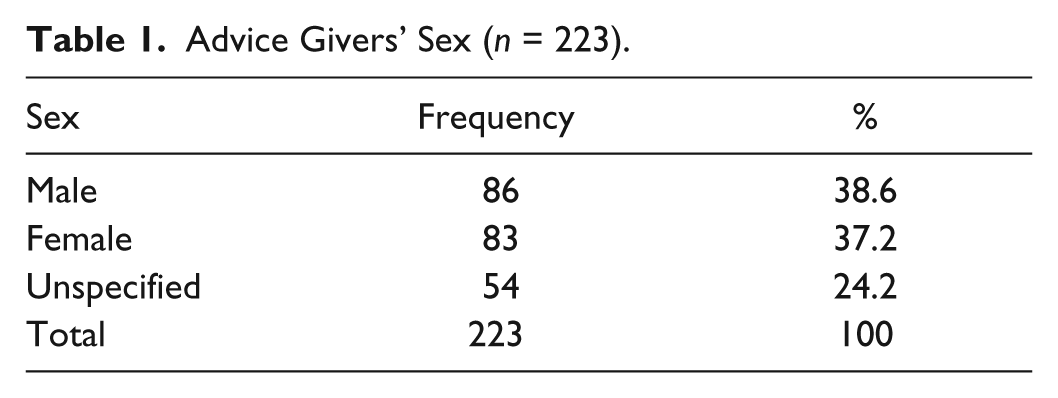
The corpus of advice offers analyzed in this article was collated from responses to 17 questions posted by males and females in 2008-2009 on eight public web-based Spanish language sites (the appendix lists the websites consulted). Two of these sites were primarily advice oriented (i.e., Acomplejados, PSICOFXP), while the others were open forums. In both cases, participants choose the topics of the questions and obtained responses from peers, not from professionals. 5 The questions posted asked for advice on how to break up with a boyfriend or girlfriend without hurting their feelings. A total of 223 responses were obtained from 185 contributors. In all, 169 of the posts indicated the sex of their contributor—86 from males and 83 from females—while for the remaining 54 posts the contributor’s sex was unspecified. With regard to advice receivers, 120 were males and 103 were females. These figures are shown in Tables 1 and 2, respectively.
Advice Givers’ Sex (n = 223).
Advice Receivers’ Sex (n = 223).

Procedure
The vast bulk of online posts included in the analysis were treated as advice on the basic criteria that the respondent has used (a) explicitly marked recommendations; (b) directives, which in Spanish are typically expressed through imperatives (“positive commands”) or subjunctives following negation (“negative commands”); (c) modal verbs of obligation; (d) value judgment or impersonal expressions; or (e) that the response included a personal experience that offered an implicit but unambiguous suggestion on a course of action to take. Examples of each type are shown in Table 3. The strategy type is given in the left column, followed by an example in Spanish and its translation.
Realization of Advice Offers Online.
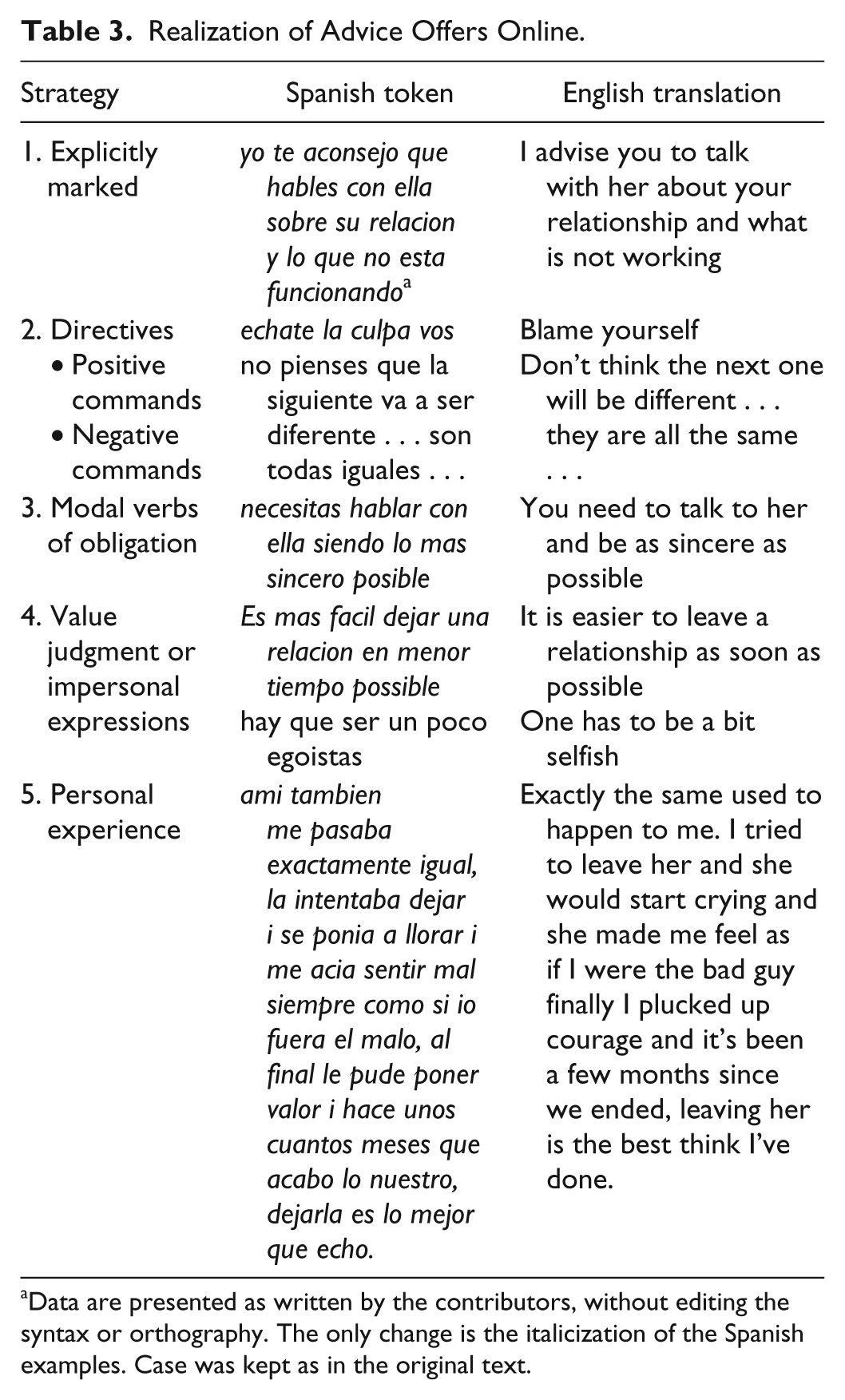
Data are presented as written by the contributors, without editing the syntax or orthography. The only change is the italicization of the Spanish examples. Case was kept as in the original text.
Responses limited to sharing an experience but that did not propose a solution, or where the focus was on criticizing or abusing the advice seeker did not qualify as advice following the strict criteria adopted for this study and were thus disregarded. All websites used, except for Yahoo Mexico and Vogue España, were from Argentina, as the list of sites in the appendix reveals. However, the respondents’ backgrounds varied more than the list suggests due to the global accessibility that the Internet affords. This was evident in the respondents’ use of regionalisms that are not typical of Argentinian Spanish, and whose origin could not be identified in some instances. For this reason, respondents’ geographical backgrounds, which could have yielded cross-dialectal differences, were ignored in this study.
Having identified the posts that fulfilled the criteria, the next step of analysis consisted of systematically classifying and coding each post according to the type of advice given. Three clearly distinct categories emerged, with the advice givers recommending that the advice seeker (1) embark on some sort of action or (2) talk with their partner, and this advice type involved either (2a) telling the truth or (2b) lying or giving excuse. Many responses in Category 2b show attempts at humor, either as a mitigating strategy or as a way of mocking the advice seeker. A third strategy involved presenting alternatives (y . . . si no hay más onda . . . deciselo . . . o desaparece [well, if there is no vibe . . . tell him . . . or disappear]). As very few posts used this strategy, the results were subsumed into the relevant first two strategies. Table 4 presents an example of each type of advice strategy found in the data. The response type is given in the left column, followed by an example from the corpus and its translation in the central and right columns, respectively.
Content of Online Advice.

The next step involved quantifying the frequency distribution of the different strategies. A total of six measures of advice (three to male advice seekers, three to female advice seekers) were examined in terms of the extent to which the frequency of these categories of advice differed when given by male versus female advice givers. Participants’ advice was reported in terms of sex of advice giver and frequency of advice giving per sex of advisee. Twenty percent of the posts were double-coded by a second coder to ensure reliability. The effect of sex of respondent on each of the measures of advice was further examined via chi-square tests.
Results
Advice Given by Males and Females (Hypothesis 1)
Table 5 displays the results for type of advice in online data as a function of advice givers’ sex, disregarding the sex of advice receivers. The number of responses presented here is smaller than in the previous posts, as the recommendation of advice givers whose sex could not be ascertained was not included in the calculation. Overall, advice givers’ most frequently recommended strategy to deal with the break up situation, mentioned by 63% of participants, was to “talk” with the boyfriend or girlfriend and either discuss the situation or explain why they wanted to break up the relationship. However, the examination of frequencies and percentages per strategy category reveals some interesting trends when the sex of the advice giver is taken into account. The type of advice dispensed by males seems evenly distributed between the two strategies, with a marginal but not significant trend toward “talk” (51% vs. 49%). But a significant difference was found in female responses: Predominantly, women preferred talk to action as a means of problem solving, with 106 respondents (75%) recommending this strategy. Thus, the proportion of men who advise respondents to act was significantly different from the proportion of women who advise respondents to act, as shown by chi-square tests conducted on the data (df = 1, n = 169) = 9.025, p = .003.
Distribution of Type of Advice as a Function of Advice Givers’ Sex (n = 169).

Advice Given to Males and Females (Hypothesis 2)
Table 6 summarizes the type of advice given to males and females, collapsing the responses produced by males, females, and sex-unidentified advice givers. While the table shows that talk was still the most recommended strategy, mentioned by 62% of participants, men and women received strikingly different advice: Women were advised to talk by most participants (i.e., 82% gave this advice with only 17.5% of responses advising them to act). The alternative advice was given to men, although the differences were not as blatant: % of responses advised men to act and 45% advised men to talk. A chi-square test conducted on these data confirmed that the differences in type of advice as a function of advice seekers’ sex were indeed significant (df = 1, n = 223) = 31.660, p = .000.
Distribution of Type of Advice as a Function of Advice Receivers’ Sex (n = 223).

Type of “Talking” Advice (Hypothesis 3)
Table 7 summarizes the type of talking advice given by men and women (n = 106), which the initial analysis classified as involving two main strategies: telling the truth or lying/giving excuses. As can be seen in the table, men and women strongly recommended telling the truth over lying or giving excuses. Although this tendency was more marked in females, a chi-square test conducted on these data reveals no significant difference between the type of talking advice given by men and women (df = 1, n = 106) = 1.894, p = .169.
Type of “Talking” Advice as a Function of Advice Givers’ Sex (n = 106).

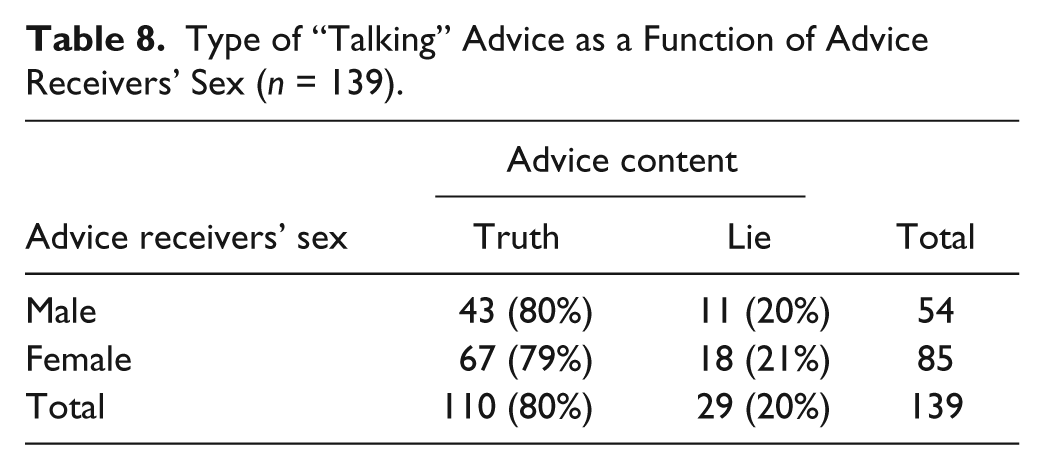
Table 8 summarizes the type of talking advice given to men and women by males, females, and gender-unspecified participants (n = 139). Males and females were both overwhelmingly advised to tell the truth (80%) rather than lying or giving excuses (20%). A chi-square test conducted on these data reveals no statistically significant difference in the type of talking advice given to men and women (df = 1, n = 139) = .000, p = 1.000.
Type of “Talking” Advice as a Function of Advice Receivers’ Sex (n = 139).
Linguistic Nurturing Behaviors (Hypothesis 4)
Hypothesis 4 predicted that females will conform to the expected communal orientation, and thus would exhibit friendliness, warmth, a high level of emotional expressiveness, and greater personal disclosure, while men would not. To test this expectation, a descriptive analysis was conducted on the data focusing on personal disclosure and affect expressions. Given the limited tokens found in the post, statistical analyses were not conducted on these data.
Personal Disclosure
A number of advice responses included sharing personal experiences of feelings similar to the ones described by the advice seeker, either as a means to establish solidarity or empathy with the advice seeker or to establish the respondent’s expertise to offer advice. Furthermore, in nine of the posts excluded from previous analyses and classified as “nonadvice,” respondents apologized for not being able to offer advice but shared past or current experiences with advice seekers, thus expressing empathy with their peer. An example can be seen in the following post:
la verdad que no te puedo dar ninguna solucion xq tenemos casos iguales . . . [The truth is that I can’t give you an answer as we are going through similar cases]
Drawing on stereotypical expectations about gendered interactions, it was predicted that females would share experiences and disclose personal information more readily than males. It was further expected that personal stories would more likely be shared with females than with males, as females are typically viewed as relationship oriented. Yet, these expectations were not met. Of the 56 instances of personal experiences shared by advice givers, 27 were produced by females and 29 by males. Interestingly, males and females seemed more willing to share experiences with males, who were the recipients of 43 (77%) of the reports on experiences.
Emotional Display
“Emotional display” refers to verbal and nonverbal reactions elicited in advice givers by the advice seekers’ predicaments. Based on stereotypical characterizations of gendered emotional display, it was expected that women would be more emotionally expressive than males, and thus their messages would exhibit greater expressions of empathy and sympathy. Expressions of sympathy online involve emotive reactions, such as reporting one’s own reactions and feelings about another’s troubles (nomas de leerte ya me rompiste el corazon [just from reading you [your post] you’ve already broken my heart]), using nicknames, greetings and farewells, tokens of encouragement, offers of additional help, and use of emoticons and graphical icons to represent emotions. However, as anger is believed to be more characteristic of males (Brody, 1997; Hutson-Comeaux & Kelly, 2002), it was expected that males would produce more tokens of abuse or flaming. Moreover, given the historical imbalance of power between men and women, more sexist remarks were expected from male than from female respondents. These expectations were only partly met. In the following discussion, I examine the use of some of these devices.
Nicknames and Terms of Endearment
Nicknames can be defined as informal names given to individuals in place of their given names. 6 Although nicknames can be humorous, disparaging, or affectionate, very few of the nicknames found in the data were derogatory. As participants do not know each other, using an affectionate nickname to refer to the addressee can be seen as either an attempt to establish solidarity and show empathy, or as an unwarranted—thus unwelcome—act of familiarity, as in the case of “street remarks” (Gardner, 1980). The expectation that, due to their nurturing characteristics, females would establish solidarity with other females by using a greater number of nicknames was not met. The total number of nicknames used was 35, of which 31 were used by males and only 4 by females. More remarkable is that males used nicknames predominantly to address other males (n = 27) and only 4 to address females. This seems to indicate that nicknames act here as a male bonding practice.
The attempt to establish solidarity with the addressee is evident in the nicknames used by males. The most frequently used nickname was amigo [friend] and its variants (e.g., compañero [mate], camarada [comrade]; n = 10); flaco (lit. skinny), loco (lit. crazy), chavón, compadrito, pibe, all roughly equivalent to “dude” (n = 10); family terms (papa [dad], hermano [brother]; n = 2); and references to masculinity (varón, macho; n = 2). There were only two female uses of nicknames for male advice seekers (niño, nene [boy]), which can be seen as derogatory and patronizing. Terms used by males to address female advice seekers included a title (señorita [young lady]) and terms of endearment (amiga [friend], amor [love], xica [chica] [girl]), but as indicated, these were extremely rare in the data.
Text-Based and Graphic Emoticons
A total of 34 emoticons were found in the posts, including four text-based (e.g., XD; =); =P; :() and 30 graphic. The most frequently used emoticon was the graphical smiley ☺
7
(n = 9), followed by thumbs up  (n = 7). Most of the graphic emoticons displayed positive messages, except for the angry
  (n = 3), sad
  (n = 2), and sarcastic
  (n = 2) tokens. Despite expectations to the contrary and consistent with Huffaker and Calvert’s (2005) findings, male respondents produced more graphic expressions of emotions than females. Moreover, while no differences were found in female use of emoticons according to the sex of the addressee, males used significantly more emoticons when advising females than when advising males. Table 9 summarizes these findings.
Distribution of Text-Based and Graphic Emoticons as a Function of Gender of Advice Givers and Receivers.

Greetings, Farewells, and Encouragement
Unlike greetings, which were not frequent (n = 11), farewells and expressions of encouragement were very common in the data, comprising a total of 115 tokens. Many advice seekers ended their posts with wishes of good luck, expressing the hope that the advice they offered will be useful, or that the advice seeker feels happier soon (ojala q result todo bien para vos pibe! [I hope it all works out for you boy!]). Expressions of affection toward unknown advice seekers were also frequent (e.g., un abrazo gigante [a giant hug], un besito [a small kiss], un besote [a big kiss]), as were positive evaluations of the advice seeker (se ve que sos una buena persona [it is clear that you are a good person]) and promises that the advice given will work. A few respondents ended the post by offering additional help (si le ha parecido mi consejo puede hacermelo saber o le puedo seguir ayudando mi e mail es . . . [if you think of my advice you can let me know or I can continue to help my e-mail is . . .]. Farewells and expressions of encouragement were grouped together because at times these could not be clearly separated; some expressions can serve the two functions (e.g., suerte [good luck]). These expressions were evenly produced by males (n = 56) and females (n = 59). The distribution across recipients was also balanced, with males receiving 57 of these tokens and females 58.
Flaming
Consistent with findings in previous studies (Herring, 1993, 2004; Selfe & Meyer, 1991), most of the abusive responses were in posts by males. A post was deemed as “abusive” if it contained an insulting or derogatory evaluation of the advice seeker or their partner, as in the following example:
Sos una basura. Ojala te pise un tren a vos [You’re rubbish. I hope you get hit by a train.]
Overall, there were 24 tokens of abuse in the responses (including nonadvice responses); some directed at the partner of the advice seeker, some at the advice seekers themselves as in the example above. Most of the abusive responses were produced by males (n = 17) rather than by females (n = 7), and most were directed at males (n = 17) rather than at females (n = 7).
Discussion and Conclusion
The aim of this study was to explore whether gender roles and expectations identified in the literature are reproduced in online interactions. The context chosen for this investigation was one particular type of prosocial behavior, peer-to-peer advice given in Spanish language forums. As advice givers ignore all demographic information about advice receivers except for their sex, it was expected that sex would become the salient factor in the interaction and impact on the type of advice, thus revealing implicit role stereotypes and expectations. The study explored advice as a factor of the sex of advice givers (when this could be ascertained) and of advice receivers.
Four hypotheses were formulated. The first two hypotheses addressed the expectation that there would be differences in the type of advice given by men and women (Hypothesis 1), and that these differences would correlate with expectations of agency and communality (Hypothesis 2). Furthermore, differences were expected in the type of “talking” advice given to men and women, with men expected to recommend offering excuses or lying more frequently than women (Hypothesis 3). Finally, Hypothesis 4 focused on whether the sex of advice givers conforms to the expected display of emotional expression in females’ response posts, and lack of emotion—other than anger—in males’ posts.
With regard to Hypothesis 1, significant differences were found in the type of advice dispensed by males and females and thus the hypothesis was supported. The data showed that, while men were evenly divided between the two main categories of peer-to-peer advice they offered, “act” and “talk,” women overwhelmingly preferred talk to action as a mean of problem solving. The results are consistent with the stereotypical view of women as communal and relationship orientated.
Hypothesis 2 was strongly supported by the data. While “talk” was the overall preferred strategy, the gender of advice seekers affected the type of the advice given to them: Women were advised to talk by the majority of respondents (n = 82.5%), while men were mostly advised to act (n = 55%). Although the difference in proportions between the “act” (55%) versus “talk” (45%) advice given to men were not as extreme as the differences in advice to women, these differences were still statistically significant. There was a strong correlation between the advice given to males and females and the two dimensions, agency and communion, proposed by Bakan (1966). The fact that men and women predominantly advised men to act and women to speak indicates the extent to which expected gender roles have been internalized and are spontaneously triggered when it comes to offering advice to unknown others. Thus, advice givers “perform” gender in formulating their advice, by positioning themselves and others through the interaction (conf. Butler, 1990).
Hypothesis 3 was not supported, as no statistically significant differences were found in the type of “talking” advice dispensed by males and females. The data showed that males and females were equally forward in their advice, favoring telling the truth over lying or giving excuses to the partner when dispensing advice to interlocutors of either sex.
Finally, Hypothesis 4 was unsupported, as the data showed that neither sex had a monopoly on affect display. While men produced most expressions of anger, when it came to “positive” emotions men were just as prone as women to display emotions online (e.g., through the use of emoticons, expressions of empathy, affections and encouragement, adulation, personal disclosure, nicknames and terms of endearment used to address other males), at times producing more emotional tokens than women did, and not just with other males but in their responses to females as well. The data showed conclusively that most respondents seemed genuinely interested in helping advice seekers, regardless of sex, at times offering additional assistance such as adding a phone number or email address in case the advice seeker needed to discuss their situation further. The expectation that the sex of advice seeker would affect the type and amount of emotion displayed, so that women would receive more tokens of emotional support from females while advice dispensed by and to males would be devoid of emotion was thus not met in the online data.
The findings that emerge from the analysis of the data point to an interesting dichotomy: With regard to the type of advice, it seems clear that gender roles and expectations are alive and well in online encounters. In the absence of any demographic information about interlocutors other than their sex, males and females offered advice that is consistent with traditional expectations of gendered behavior along the lines of agency and communality. While the data discussed in this article is limited to one context and one language, it contributes to the empirical investigation of whether the traditional characterization of gender roles proposed in the literature (e.g., W. Wood & Eagly, 2010) are consistent with those found in other cultures.
With regard to online use of language across genders, however, the picture that emerged is more complex than the stereotypically binary characterization of female versus male linguistic behavior would lead us to expect, as many of the differences identified in previous research (Harp & Tremayne, 2006; Herring, 2000, 2004; Selfe & Meyer, 1991) were not found in this study. Instead, the data pointed to a high degree of linguistic convergence, in particular when it comes to offering emotional support.
A few factors may explain the disparity of the findings. First, language and culture may play a role. Most of the previous studies on advice focused on interactions in English, which may explain differences in results when investigating linguistic practices operating in other languages. Second, many of the previous studies have focused on expert–novice situations, and thus findings may not transfer into peer-to-peer interactions where issues of hierarchy or expertise play no role. Another possible explanation relates to the characteristics of the communication medium. Previous studies on online exchanges focused on data collected from electronic bulletin boards, blogs, and discussion groups, which are not anonymous. The data examined in this article were collated from sites where the exchanges between participants are one-off events. It may be precisely the anonymity of online interactions that encourages men to “open up” and be more forward in expressing affect, not just abusive behavior and flaming, but also positive emotions.
Although the corpus on which this naturalistic study is based was small, the data still pointed to some interesting results. In particular, it provided further support to the claim that gendered roles and expectations are triggered spontaneously in the absence of individuating information, as these are the sources from which participants draw to guide their advice. This is despite discursive practices used in formulating advice suggesting greater language convergence across sexes. This discrepancy may indicate that the role of language in manifesting and/or constructing “agency” and “communion” needs to be further explored across types of sites, languages, cultures, topics, and tasks.
Footnotes
Appendix
Declaration of Conflicting Interests
The author(s) declared no potential conflicts of interest with respect to the research, authorship, and/or publication of this article.
Funding
The author(s) received no financial support for the research and/or authorship of this article.