




Abstract
One hundred thirty-three counseling professionals/paraprofessionals were recruited from adolescent residential treatment programs located in Michigan. Participants were assessed using the Community Attitudes Toward Sex Offender Scale (CATSO). Of the participants, 32.3% (n = 43) of the participants were female and 67.7% (n = 90) were male. Years of experience working directly with adolescent sexual offenders of participants ranged from 0 to 18 years (M = 2.48 years, SD = 3.48). The number of months participants received sexual offender training ranged from 0 to 60 (M = 3.44, SD = 9.48). No statistical differences in attitudes were found between females and males toward adolescent sexual offenders. No statistically significant relationship was found between years of experience and the four factors on the CATSO survey (Social Isolation, Capacity to Change, Severity/Dangerousness, and Deviancy). A significant relationship was found between experience and the Deviancy factor. No statistically significant relationship was found between months of training and attitudes. Overall, attitudes toward adolescent sexual offenders were positive.
Keywords
Introduction
Sexual crimes by adolescents are a serious problem in the United States. It has been reported that sexual victimization is widespread, with a lifetime prevalence rate of 25% for women and 15% for men (Barbaree, Marshall, & McCormick, 1998; Nelson, 2007). Public awareness and concern about the problem of sexual violence has increased because of the escalating incidences of sexual crimes (Brown, 1999; Sanghara & Wilson, 2006). The attitude of the general public toward sexual offenders appears to be highly negative (Carone & LaFleur, 2000; Nelson, 2007; Rash & Winton, 2007; Valliant, Furac, & Antonowicz, 1994). A significant number of adult sexual offenders began their criminal offenses during adolescence, and sexual crimes by children against children are contributing to the rising incidence of sexual crimes (Lakey, 1994; Van Outsem, 2002; Van Outsem et al., 2006; Verheij, 2000).
The U.S. juvenile justice system has responded to sexual crimes by imposing incarceration sanctions, emphasizing counseling rather than punishment (Nelson, Herlihy, & Oescher, 2002; Zimring, 2002). Consequently, a significant number of adolescent sexual offenders have been adjudicated to residential treatment programs. This situation challenges counselors working in residential treatment programs to examine their own feelings about sexual abuse and those who perpetrate this behavior (Nelson et al., 2002; Polson & McCullom, 1995).
Minimal attention has been paid to counselors’ attitudes toward adolescent sexual offenders working in residential treatment programs, and the relationship of these attitudes to counselors’ experiences, training, gender, and age. As Nelson et al. (2002) stated, “it is important for counselors to discover factors that influence their perception of sexual offenders because their perceptions may cause them to view sex offenders as criminals needing punishment instead of clients needing counseling” (p. 51).
In the recent years, there has been a limited amount of research into the attitudes of mental health counselors toward sexual offenders. Clinicians and researchers have noted the important role maladaptive attitudes and distorted thinking play in facilitating or justifying sexual offenses (Abel, Becker, & Cunningham-Rathner, 1984; Marshall & Barbaree, 1990; Murphy & Stalgaitis, 1987; Stermac & Segal, 1989). These attitudes and cognitive distortions function to avoid negative self-evaluation and social disapproval, and facilitate the disengagement of the offender’s inhibitions regarding sexual offending (Stermac & Segal, 1989; Ward, Hudson, & Marshall, 1995). Inevitably, professional attitudes toward sexual offenders, and other deviant populations, affect social service delivery and, in particular, the nature and the quality of services provided (Ward, Connolly, McCormack, & Hudson, 1996; Ward et al., 1995). According to Hogue (1993), assessment of the professional’s general attitude is necessary to successful therapeutic intervention, as it is likely to influence the client’s response to change. It could also be argued that professional attitudes toward sexual offenders significantly affect other services for victims of abuse and those associated with them, because such attitudes can become part of the framework of expert knowledge (Ward et al., 1995; Ward et al., 1996).
Research interest into professional attitudes and beliefs toward sexual offenders, while developing in recent years, remains limited. Stermac and Segal’s (1989) study into cognitive factors surrounding adult sexual contact with children generated considerable debate when it compared sex offender and professional attitudes in this area (Murphy, 1991; Ward et al., 1996). The study, while largely focusing on sexual offender cognitions, also suggested that some clinicians (social workers, psychologists, psychiatrists, and nurses) may view adult sexual contact with children to be a partial benefit to the child (Stermac & Segal, 1989). Murphy (1991) argued that if this finding is replicated, it raises serious concerns about the adequacy of education in the sexual abuse area. Hanson, Gizzarelli and Scott (1994) study of professional reactions to child molesters’ behaviors noted the need for professionals to be aware of offenders’ strategies for externalizing blame and generating sympathy. According to Ward et al. (1996), the failure to do so may result in inadvertent collusion with offenders’ cognitive distortions and ineffective therapy.
Other studies examining professional attitudes regarding child sexual abuse have generally considered comparisons between professional groups within the practice field (Murphy, 1991; Ward et al., 1996). Saunders (1988) compared attitudes toward child sexual abuse among social workers and professionals within the judicial system. Statistically significant differences were found across the groups. Social workers, the police, and district attorneys were found to be strong advocates for victims, while public defenders showed themselves to be strong advocates for alleged offenders, and judges held more neutral attitudes than any other group. Saunders concluded that conflict remains between professionals on the most appropriate way to deal with sexual abuse cases.
In a similar study, Trute, Adkins, and MacDonald (1992) found that there were significant differences in the attitudes of police in comparison to child welfare workers and community mental health personnel. Police officers did not think that sexual abuse was as widespread or affected victims as seriously, and viewed sexual offenders as a more deviant group than did the child welfare personnel. The police officers also viewed treatment as more ineffective in curtailing child sexual abuse than other groups. Interestingly, these differences were moderated by the gender of the various professional groups. Women tended to view sexual abuse as more pervasive, treatment as more effective, and sexual offenders as a heterogeneous group coming from all spheres of society (Trute et al., 1992). These findings raised the question of whether gender is active in shaping professional belief systems, or whether the professional role over time shapes perceptions and beliefs of the workers involved (Ward et al., 1995; Ward et al., 1996).
In a study conducted by Farrenkopf (1992), 24 mental health counselors between 10 and 30 years of experience counseling sexual offenders were surveyed following pilot interviews. Female counselors reported feelings of increased vulnerability, paranoia, and vigilance regarding male sexually aggressive behavior compared with male counselors.
Polson and McCullom (1995) conducted a qualitative study with several counselors who specialized in the treatment of sexual offenders. Counselors interviewed worked with sexual offenders and victims of sexual abuse. Four general themes describing counselor attitudes and behavior emerged from the interviews: (a) developing a positive view of perpetrators, (b) managing dysfunctional client behaviors and beliefs, (c) controlling personal reactivity, and (d) limitations of counseling. In developing a positive view, counselors described constructing cognitive frames that view sexual offenders as vulnerable, impaired, or human. It was also helpful to view the offenders as victims, realize that their families still loved them, defend their right to treatment, and view them as individuals with problems (Polson & McCullom, 1995). Polson and McCullom’s study confronted sexual offenders’ victim blaming and prodded them to accept responsibility for their actions. If the offender did not admit responsibility, the counselors worked to control their own verbal or nonverbal expressions of disgust. They also coped by co-counseling in-group work and tried to be nonjudgmental, control personal issues, and be appropriate role models.
Carone and LaFleur (2000) studied 236 student counselors enrolled in one of eight counselor education master’s degree programs. They found that sexually abused student counselors desired to see physically abused offenders more than they desired to see a non-abused offender. They concluded that counselors should understand how their own backgrounds influence their desire to see sexual offenders and the possible effect on the counseling outcome.
Nelson et al. (2002) conducted a study investigating counselors’ attitudes toward sexual offenders. There were 437 counselors participating in this study who were members of the Association for Mental Health Counselors and the International Association of Addictions and Offenders Counselors. The participants completed the Attitudes Toward Sex Offender Scale (ATS; Hogue, 1993) and provided personal background information. The results from this study indicated that counselors tended to have positive attitudes toward sexual offenders and that experience, preparation from training, and victim status were related to these positive attitudes.
More recently, Ferguson and Ireland (2006) conducted a comparison study, investigating the attitudes toward sexual offenders, using 139 participants (49 students and 90 forensic staff). The participants were provided with vignettes depicting specific sexual offenses and were asked to complete a scale assessing attitudes toward sexual offenders. The results of the study indicated that forensic staff were more likely than students to view sexual offenders in positive terms, viewing them as individuals who could be rehabilitated. Participants who reported being victims of sexual abuse, or that someone close to them had been abused, viewed sexual offenders less negatively than nonvictims. Men demonstrated less positive attitudes toward child incest and child indecent assault offenders than to stranger rapists. Women held more positive views toward sexual offenders than men, and this was consistent across offense type.
In a recent study, Balow and Conley (2008) used the Community Attitudes Toward Sex Offender Scale (CATSO) to examine the attitudes of 307 professional correction workers. The population sample for this study consisted of parole and probation officers, prerelease center workers, administrative staff, client advisors, licensed addiction counselors, and registered nurses and case managers. The results of the study yielded a representative portrayal of perceptions across diverse concepts of relative sex offenders. While the participants in this study perceived the sex offender population to be dangerous, they clearly agreed that offenders are amenable to rehabilitation. Participants did not differ in their responses regarding the severity of a sex crime based on whether the perpetrator knew the victim and perceived that emotional control is not substantially different than physical control. With regard to wearing tracking devices, most agreed that they should, but opinions on this item were not particularly strong (Barlow & Conley, 2008). It was likely that the real world logistics of this affected opinions. One limitation of this study was the lack of demographic information of participants. For example, no differences could be made regarding the differences in attitudes among male and females, types of correction professionals, experience, training, or within different parts of the region in which the study was conducted (Barlow & Conley, 2008).
The aforementioned studies focused on the attitudes counseling professionals and students had toward adult sexual offenders. However, no study to date known to the researcher has specifically examined counseling professionals/paraprofessionals’ attitudes toward adolescent sexual offenders.
Literature Review
Attitude of the Public
Levey and Howells (1994) asserted that the formal and informal sources of information such as schools, family, peers, and the media have a significant impact on attitudes toward sexual offenders. Early community notification strategies commonly included press releases, flyers, and door-to-door warnings about the presence of sex offenders (Levenson & Cotter, 2005; Matson & Lieb, 1997). Because states are now federally mandated to post their sex offender registries online, however, the Internet appears to have become the primary source of information about convicted sex offenders (Smith, Wampler & Reifman, 2005). The goals of sex offender registration and notification are to increase the public’s awareness of sex offenders and to help people protect themselves and their children from sex crimes (Proctor, Badzinski, & Johnson, 2002; Szymanski, 2009; Wright, 2003).
Research on public attitudes suggests that students (Valliant et al., 1994), police officers (Weekes, Pelletier, & Beaudette, 1995), and prison officers, not involved in sexual offender care (Hogue, 1993), hold negative attitudes toward child sexual offenders. Specifically, they are viewed as dangerous, harmful, violent, tense, bad, unpredictable, mysterious, unchangeable, aggressive, weak, irrational, afraid, mentally ill, and morally wrong (Valliant et al., 1994; Weekes et al., 1995).
A public opinion survey in Washington indicated that 80% of 400 residents surveyed in 1997 were familiar with community notification policies, commonly known as Megan’s Law, and that 80% of that group believed that the law was very important (Hindman, 1997; Valliant et al., 1994). The majority reported that they felt safer knowing where convicted sex offenders lived and speculated that community notification might help offenders better manage their behavior because neighbors were watching them. About half of the respondents acknowledged the potential for vigilantism and 75% agreed that notification might make it more difficult for sex offenders to reintegrate into communities with regard to housing, jobs, and social support (Valliant et al., 1994). Females were significantly more likely than males to be frightened or angry about sex offenders moving into the neighborhood. Age was also a significant factor in the level of fear reported, with 30- to 40-year-olds expressing more concerns than those over 50 or under 30 (perhaps because those in their thirties are more likely to have young children). Interestingly, however, more than half of the parents reported no change in their own behaviors with regard to supervision of their children as a result of community notification (Valliant et al., 1994).
According to Cochrane and Kennedy (2010), the News of the World surveyed a random sample of 558 young adults between the ages of 18 and 24. Respondents were overwhelmingly (86%) in favor of the public having access to information about registered sex offenders. More than half (57%) believed that the public has a right to know about all convicted child molesters living in the local area, while 29% believed that the public should be told only about those judged to pose a risk to children. Only 16% of those surveyed believed that convicted child molesters could live safely in a community without posing a threat to youngsters. Despite their support for community notification, only 11% indicated a belief that children are safer now than they were 5 years ago, and 69% did not believe that enough was being done to protect potential victims from sex offenders (Cochrane & Kennedy, 2010).
Parents and concerned neighbors often describe the goal of community notification as “providing as much information as possible to safeguard against any potential threats posed by sex offenders” (Hindman, 1997, p. 232). However, some residents have reported that notification actually increased their anxiety because information about offenders is not usually accompanied by information about protecting oneself or one’s children from assault (Caputo, 2001; Zimring, 2002). A telephone survey of 250 residents in Tuscaloosa, Alabama, who had experienced sex offender notification, found that females and parents of minor children were more likely than males and nonparents to feel that community notification was important (Caputo, 2001). Parents and women expressed more fear of crime, in general, and of sexual assault, specifically (Caputo 2001).
In 2005, after the widely publicized murder of 9-year-old Jessica Lunsford by a convicted sex offender in Florida, the state of Florida became the first to pass “Jessica’s Law,” increasing penalties for sex crimes against children and requiring electronic monitoring for child molesters who are released from prison. By June 2006, 24 states had passed a version of “Jessica’s Law,” often including mandatory minimum sentences, electronic monitoring, and residence restrictions prohibiting sex offenders from living near schools, parks, playgrounds, bus stops, or other places where children congregate (Caputo, 2001; Martin, Pescosolido, Olafsdottir, & McLeod, 2007). The San Francisco Chronicle reported that 73% of voters supported Jessica’s Law in California (Caputo, 2001; Martin et al., 2007).
Though the public and lawmakers are supportive of sex offender policies, scholars remain skeptical about the potential of these laws to protect children or prevent sex crimes (Cochrane & Kennedy, 2010; Freeman-Longo, 1986; Hindman, 1997). They suggest that community notification laws are driven by emotional responses to sexual violence rather than by empirical data and that they provide misguided reassurance to citizens. The majority (80%) of mental health professionals surveyed believed that registries would have no impact on reducing the incidence of child sexual abuse, and 70% thought community notification would foster a false sense of security for parents (Malesky & Keim, 2001). Another oft-cited concern is the potential for notification to create unintended consequences that interfere with offender reintegration by limiting opportunities for housing, employment, and social support (Levenson & Cotter, 2005).
Levenson and Cotter (2005) conducted a study on sex offenders living in Florida and Kentucky. From one third to half of the participants reported experiencing some type of adverse effect from registration laws such as loss of employment, loss of housing, harassment, threats, or property damage. Some participants reported that family members or roommates (19%) suffered from some type of physical assault.
Tewksbury and Lees (2007) surveyed registered sex offenders living on campus. Their findings showed that only one third of the offenders knew that their university retained a sex offender registry that listed their name. Some negative consequences of the campus registry included difficulties in student housing, employment, maintaining social relationships, harassment, and feelings of doubt and fear. The vast majority (79%) of student sex offenders were denied employment. Half of the offenders were treated rudely by the public and experienced losing a friend after they learned of their status as a registered sex offender, and 15.8% lost a significant other. Approximately 5.3% of offenders were assaulted on and off campus. Student offenders (15.3%) reported receiving harassing mail or phone calls. Just under a half (47.4%) reported being evicted or being denied campus housing. Only 26.3% admitted a decline in their academic performance (Tewksbury & Lees, 2007).
O’Keefe and Reid-Nash (1987) argued that the more a person pays attention to crime in the media, the more his or her fear and concern increases, thereby making him or her more attentive to the issue. A study conducted by Proctor and colleagues (2002) on media and Megan’s Law demonstrated this phenomenon. Their findings showed a pattern in how the media portrays Megan’s Law and how it affected public perceptions. The results indicated that exposure to all types of media and the positive attention given to Megan’s Law were strongly connected to the participant’s knowledge and acceptance of the law. Their results revealed that participants who pay attention to crime and the media were more likely to support criminal justice policies, and, in this particular study, the participants were highly supportive of Megan’s Law.
Proctor and Colleagues (2002) similarly found that Massachusetts’s community notification law increased the level of specific knowledge concerning the issues of Megan’s Law but did not improve the general knowledge of the law. Findings suggested that news media reinforces the public’s perception of Megan’s Law and their positive belief that it deters victimization. The media coverage also appeared to sway the public to ignore the shortcomings of the law such as its inability to reduce sex offenses and loss of support for developing more effective ways to rehabilitate sex offenders (Proctor & Colleagues, 2002; Schram & Milloy, 1995).
Attitude of Counselors
In recent years, there has been a limited amount of research into the attitudes of mental health counselors toward sexual offenders. Clinicians and researchers have noted the important role of maladaptive attitudes and distorted thinking in facilitating or justifying sexual offenses (Abel et al., 1984; Marshall & Barbaree, 1990; Murphy & Stalgaitis, 1987; Stermac & Segal, 1989). These attitudes and cognitive distortions function to avoid negative self-evaluation and social disapproval, and facilitate the disengagement of the offender’s inhibitions regarding sexual offending (Stermac & Segal, 1989; Ward et al., 1995). Inevitably, professional attitudes toward sexual offenders, and other deviant populations, affect social service delivery and, in particular, the nature and the quality of services provided (Ward et al., 1995; Ward et al., 1996). According to Hogue (1993), assessment of the professional’s general attitude is necessary to successful therapeutic intervention, as it is likely to influence the client’s response to change. It could also be argued that professional attitudes toward sexual offenders significantly affect other services for victims of abuse and those associated with them, because such attitudes can become part of the framework of expert knowledge (Ward et al., 1995; Ward et al., 1996).
The possibility that abuse supportive attitudes may be culturally reinforced is an additional reason for investigating counselor attitudes toward sexual offenders. Mental health counselors are also subject to social stereotypes and inappropriate cultural messages about sex and violence (Ward et al., 1995; Ward et al., 1996). Feminist theories view abuse as a pseudosexual act that is primarily motivated by male sociopolitical dominance (Burt, 1980; Donat & D’Emilio, 1992). During the 1970s, rape became a major issue for the feminist movement, at least in part, because this form of violence toward women was seen as a means of enforcing precisely the gender roles that women were attempting to change (Ward et al., 1995; Ward et al., 1996). Not only rape but also the fear of rape serves as a mechanism of social control (Brownmiller, 1975; Riger & Gordon, 1981). This view has had a significant impact not only on etiological theories by challenging the uncontrollable sex urge notion but also on the way in which sexual assault has been defined, the way in which rape victims are perceived and treated, and finally in identifying aspects of the culture that are rape-supportive (Ward et al., 1995; Ward et al., 1996). For example, Burt’s (1980) feminist theory of rape described how culturally derived attitudes might facilitate sexual aggression. Burt suggested that sex role, stereotypical beliefs, adversarial sexual beliefs, and acceptance of interpersonal violence were critical factors in mediating the link between culture and sexual aggression.
Research interest into professional attitudes and beliefs toward sex offenders, while developing in recent years, remains limited. Stermac and Segal’s (1989) study into cognitive factors surrounding adult sexual contact with children generated considerable debate when it compared sex offender and professional cognitions in this area (Murphy, 1991; Ward et al, 1996). The study, while largely focusing on sexual offender cognitions, also suggested that some clinicians (social workers, psychologists, psychiatrists, and nurses) may view adult sexual contact with children to be of partial benefit to the child. Murphy (1991) argued that if this finding is replicated, it raises serious concerns about the adequacy of education in the sexual abuse area. Hanson and Slater (1993) in their study of professional reactions to child molesters’ behaviors pointed to the need for professionals to be aware of offenders’ strategies for externalizing blame and generating sympathy. According to Ward et al. (1996), the failure to do so may result in inadvertent collusion with offenders’ cognitive distortions and ineffective therapy.
Other studies examining professional attitudes regarding child sexual abuse have generally considered comparisons between professional groups within the practice field (Murphy, 1991; Ward et al., 1996). Saunders (1988) compared attitudes toward child sexual abuse among social workers and professionals within the judicial system. Statistically significant differences were found across the groups. Social workers, the police, and district attorneys were found to be strong advocates for victims, while public defenders showed themselves to be strong advocates for alleged offenders, and judges held more neutral attitudes than any other group. Saunders concluded that conflict remains between professionals on the most appropriate way to deal with sexual abuse cases.
In a similar study, Trute et al. (1992) found that there were significant differences in the attitudes of police in comparison with child welfare workers and community mental health personnel. Police officers did not think that sexual abuse was as widespread or affected victims as seriously, and viewed sexual offenders as a more deviant group than did the child welfare personnel. The police officers also viewed treatment as more ineffective in curtailing child sexual abuse than other groups. Interestingly, these differences were moderated by the gender of the various professional groups. Women tended to view sexual abuse as more pervasive, treatment as more effective, and sexual offenders as a heterogeneous group coming from all spheres of society (Trute et al., 1992). These findings raised the interesting question of whether gender is active in shaping professional belief systems, or whether the professional role over time shapes perceptions and beliefs of the workers involved (Ward et al., 1995; Ward et al., 1996).
Polson and McCullom (1995) conducted a qualitative study with several counselors specializing in the treatment of sexual offenders. All the counselors interviewed worked with sex offenders and victims of sexual abuse. Four general themes describing counselor attitudes and behavior emerged from the interviews: developing a positive view of perpetrators, managing dysfunctional client behaviors and beliefs, controlling personal reactivity, and limitations of counseling. In developing a positive view, counselors described constructing cognitive frames that view the sex offender as vulnerable, impaired, or human. It was also helpful to view the offenders as victims, realize that their families still loved them, defend their right to treatment, and view them as individuals with problems (Polson & McCullom, 1995).
Carone and LaFleur (2000) conducted an experimental analogue study with 236 counselors-in-training who were enrolled in one of eight counselor education master’s degree programs located in two Mid-Atlantic States. The student counselors were asked to respond to demographic questions and were administered the Counselor Response Form (CRF) to determine the counselors’ judgment of adolescent sexual offender clients. The counselors were also given one of three case histories presenting different client personal abuse histories and instructed to respond to the CRF after reading the case history. For each case history, the sexual offender performed vaginal intercourse with a 10-year-old girl on two occasions (Carone & LaFleur, 2000).
The results of this study revealed that counseling students had a greater desire to work with a sexually abused adolescent sexual offender than with an adolescent sexual offender who was not abused. The results might be attributed to the idea that sexually abused offenders have learned offending behaviors. The counseling students may have perceived the sexually abused offender as a victim of abuse that caused him or her to learn the sexually offending behavior. Non-abused offenders may be less desirable to work with because a potential rationale for their behavior cannot be determined. In addition, non-abused offenders may be perceived by counselors as victims of medical or biological problems who may be perceived by counseling professionals who could provide more medically based types of treatment (Carone & LaFleur, 2000).
According to Borgers, Thomas, and Van Loon (1980), counselor judgments affect the counseling relationship, and the counselor’s desire to work with certain clients is a judgment that cannot be overlooked. As the need for juvenile offender counselors grows with the increasing rate of reported sexual offenses (Steen & Monnette, 1989), counselors will need to explore their judgments about working with offender clients to make informed decisions about their clients (Carone & LaFleur, 2000; Nelson, 2007; Sanghara & Wilson, 2006).
Because counseling students desired to see the sexually or physically abused adolescent sexual offenders more than they desired to see the non-abused offenders, the development of counseling relationships between counselors and non-abused offenders may be affected (Graham, 1980; Steen & Monnette, 1989). Graham (1980) found that reports of counselor desire to see a client affect the counselor’s prognosis of client treatment and the counselor’s predicted length of time the client will need counseling. Consequently, counselors should consider how the characteristics of non-abused adolescent sexual offenders affect the counseling relationship.
Nelson et al. (2002) studied 437 counselors who completed survey packets containing the Attitudes toward Sex Offenders Scale (ATS) and personal background questions. The findings of the study indicated that counselors tend to have slightly positive attitudes toward sexual offenders and, in addition, that experience, preparation from training, and victim status are related to positive attitudes toward sexual offenders. No relationship was found between counselor attitudes and sex, employment, parental status, or education.
One reason for the positive attitude of counselors, as contrasted with the negative attitude that prevails among the general public, may be related to the professional field. Counselors typically are screened before entering into counselor education programs. They are then trained throughout their degree programs to be nonjudgmental, respectful, and to believe in client change. In counseling education programs, the majority of beginning counselors have been exposed to and trained in Rogers’s person-centered counseling approach, which requires unconditional positive regard for clients. Thus, it would be expected that counselors would be less judgmental than the general public (Nelson, 2007; Nelson et al., 2002).
According to Scaletta (1995), another explanation is that the counseling field is growing and counselors are being placed in a wide range of professional settings. Therefore, counselors may be open to providing services to chronic or difficult clients such as sexual offenders. They may be confident that sexual offenders will receive medical or punitive interventions as needed.
Balow and Conley (2008) conducted a study with 307 probation, parole, and community correction workers. The study participants were administered the CATSO. The findings in this study yielded a representative portrayal of perceptions across diverse concepts relative to sex offenders. While respondents perceived that the sex offender population is dangerous, they clearly agreed that offenders are amenable to rehabilitation. They did not differentiate between the severities of a sex crime based on whether the perpetrator knew the victim and perceived that emotional control was not substantially different than physical control. With regard to offenders wearing tracking devices, most agreed that they should, but opinions on this item were not particularly strong. It is likely that the real world logistics of this affected opinions. They disagree with the idea that offenders should never get out of prison, indicating a mature acceptance of the fact that most sex offenders will be released at some point and will fall under their community-level supervision (Balow & Conley, 2008).
This study attempted to answer the following research questions:
Method
Participants
The target population for this research was from a selection of counseling professionals/paraprofessionals employed at a residential treatment program for adolescents in Michigan. The only criterion the study participants had to meet was that they had to be employed in a residential treatment program for adolescents. The residential treatment program employs 400 counseling professionals/paraprofessionals. Of the 400 counseling professionals/paraprofessionals, 150 employees responded to the recruitment flyer and 133 attended the study. One hundred percent of the participants who participated in the study completed the self-administered CATSO questionnaire and demographic form. The response rate of usable questionnaires was 100% (N = 133). A total of 133 participants were included in the analysis. For this study, 32.3% (n = 43) of the participants were female and 67.7% (n = 90) were male. Participants reported their current position to be treatment leaders (n = 19, 14.3%), followed by therapists (n = 13, 9.8%), youth care workers (n = 58, 43.6%), shift coordinators (n = 23, 17.3%), behavior management personnel (security; n = 13, 9.8%), and family workers (n = 7, 5.3%). The number of years the participants were employed in their current position ranged from 0 to 18 (M = 4.27, SD = 4.15). Years of experience working directly with adolescent sexual offenders ranged from 0 to 18 years (M = 2.48 years, SD = 3.48). The number of months the participants received sexual offender training ranged from 0 to 60 (M = 3.44, SD = 9.48).
Instruments (Measures)
The 18-item CATSO was used to collect data from the participants. The 18 questions measure four subconstructs including Social Isolation, Capacity to Change, Severity/Dangerousness, and Deviancy. All questions are scaled using a 6-point Likert scale. Respondents selected one of six responses: 1 = strongly disagree, 2 = disagree, 3 = probably disagree, 4 = probably agree, 5 = agree, and 6 = strongly agree. Higher scores on the survey reflect more negative attitudes.
Instrumentation
The CATSO was construct-validated using exploratory and confirmatory factor analysis with a population of 347 undergraduate students enrolled in several Introduction to Psychology classes at a major southern university (Balow & Conley, 2008; Church, Wakeman, Miller, Clements, & Sun, 2008). Specifically, using exploratory factor analysis, four factors converged from 18 items with eigenvalues greater than 1.0. These factors include Social Isolation, Capacity to Change, Severity/Dangerousness, and Deviancy. Confirmatory factor analysis was used to test it and the 18-item instrument was superior to the 30-item, original instrument. Results suggest that the 18-item, four construct model was superior, p < .05. Cronbach’s alpha was also used to determine internal consistency of the constructs. Results from the analysis indicated sufficient reliability where total CATSO = .74. Reliability coefficients greater than .70 suggest internal consistency (Tabachnick & Fidell, 2008).
Data Analysis
The data was analyzed using two statistical techniques, the Pearson product-moment correlation and analysis of variance (ANOVA). Mean scores were calculated to create variables to represent the four CATSO factors, Social Isolation, Capacity to Change, Severity/Dangerousness, and Deviancy. The mean scores were generated based on the factors and their corresponding items illustrated in Table 3. Once the values were generated for the four factor variables, descriptive statistics were run to determine whether there were differences in measures of experience, training, and gender. Means were then generated with experience, training, and gender representing the independent variables, and the four factor variables of the CATSO representing the dependent variables. The Pearson product-moment correlation was used to determine the extent to which the demographic variables, length of experience, and amount of training affected the participants’ attitudes toward adolescent sexual offenders. A one-way ANOVA test was conducted to determine whether females and males differed in their attitudes toward adolescent sexual offenders.
Results
A total of 133 participants were included in the analysis. As shown in Table 1, 32.3% (n = 43) of the participants were female and 67.7% (n = 90) were male. Participants reported their current position to be treatment leaders (n = 19, 14.3%), followed by therapists (n = 13, 9.8%), youth care workers (n = 58, 43.6%), shift coordinators (n = 23, 17.3%), behavior management personal (security) (n = 13, 9.8%), and family workers (n = 7, 5.3%).
Demographic Data for Participants.

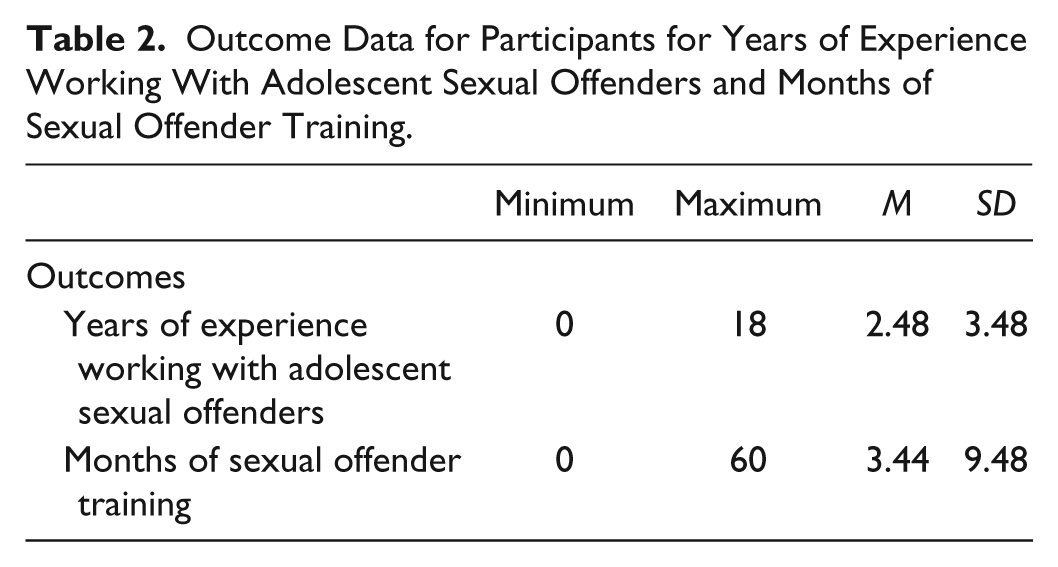
Table 2 presents outcome findings related to participants, years of experience working with adolescent sexual offenders, and months of sexual offender training. The years of experience working directly with adolescent sexual offenders ranged from 0 to 18 (M = 2.48, SD = 3.48). The number of months participants received sexual offender training ranged from zero to 60 (M = 3.44, SD = 9.48).
Outcome Data for Participants for Years of Experience Working With Adolescent Sexual Offenders and Months of Sexual Offender Training.
As shown in Table 3, the attitude scores for participants on the CATSO ranged from 1 to 6 (M = 2.81, SD = .564). On the Social Isolation factor, participants obtained a mean score of 2.93 (SD = .876), with a range of scores between 1 and 4. On the Capacity to Change factor, participants obtained a mean score of 3.02 (SD = 1.07), with a range of scores between 1 and 4. On the Severity/Dangerousness factor, participants obtained a mean score of 3.00 (SD = .557), with a range of scores between 2 and 3. On the Deviancy factor, participants obtained a mean score of 2.95 (SD = .911), with a range of scores between 1 and 5.
Scores on the Community Attitudes Toward Sex Offenders Scale for Participants.

Understanding the Relationship Between Years of Experience and Months of Training on Counseling Professionals/Paraprofessional Attitudes Toward Adolescent Sexual Offenders
The Pearson correlation coefficient was used to understand the strength of the relationship between demographic variables of participants and their attitudes toward adolescent sexual offenders. Complete details of the Pearson correlations for the relationship between years of experience and months of training and outcome variables can be seen in Table 4.
Pearson Correlation: The Relationship Between Years of Experience and Months of Training.

Correlation is significant at the 0.05 level. **Correlation is significant at the 0.01 level.
ANOVA Results Comparing Mean Values of Female and Male Participants in their Attitudes Toward Adolescent Sexual Offenders.

Years of experience
Results showed no significant correlation between years of experience and the measures of Social Isolation (r = .019, p = .83), Capacity to Change (r = .103, p = .24), and Severity/Dangerousness (r = −.145, p = .09). A significant relationship between years of experience and Deviancy (r = −.189, p = .03) was found.
Months of training
The results showed no significant correlation between months of training and measures of Social Isolation (r = .062, p = .47), Capacity to Change (r = .103, p = .23), Severity/Dangerousness (r = .037, p = .66), and Deviancy (r = .005, p = .95).
The Impact of Gender on Attitudes Toward Adolescent Sexual Offenders
A one-way ANOVA was conducted to understand the differences between female and male participants’ attitudes toward adolescent sexual offenders. Table 6 details the results. Results of the study indicate that the scores on the Social Isolation Scale were slightly different across groups, F(2, 131) = 1.02, p = .31. The results indicate that females’ (M = 3.04, SD = .928) scores were slightly different than those of males (M = 2.88, SD = .850).
Regarding Capacity to Change, results showed a slight difference across groups, F(2, 131) = .939, p = .33. The results indicate that scores on the Capacity to Change factor for females (M = 2.89, SD = 1.19) were slightly different than those for males (M = 3.08, SD = 1.02).
For the Severity/Dangerousness factor, results showed a slight difference across groups, F(2, 131) = 3.12, p =. 07. The results indicate that scores on the Severity/Dangerousness factor for females (M = 2.87, SD = .518) were slightly different than those for males (M = 3.06, SD = .568).
Scores on the Deviancy factor showed no difference across groups, F(2, 131) = .022, p = .88. Results for females indicated M = 2.97 and SD = .874, and for males, M = 2.95 and SD = .934.
Discussion
Overall, no significant correlations between the examined variables were found. The results of the analysis indicated that there were no statistically significant correlations between length of experience working with adolescent sexual offenders, months of training, and gender with overall attitudes toward adolescent sexual offenders. However, a significant relationship was found between the length of experience and the Deviancy factor on the CATSO survey. No significant differences in attitudes between females and males toward adolescent sexual offenders were found based on the mean scores.
Effects of Experience, Training, and Gender
Experience
No significant correlation was found between length of experience working with adolescent sexual offenders and participant attitudes. The findings of this study are not consistent with previous studies that have found years of experience working with sexual offenders as a contributory factor in the development of attitudes (Carone & LaFleur, 2000; Nelson, 2007; Sanghara & Wilson, 2006). Nelson et al. (2002) found a significant positive relationship between attitudes toward sex offenders and experience counseling sex offenders using a sample of professional counselors in a psychiatric setting.
Sanghara and Wilson (2006) found that experienced correctional professionals compared with inexperienced correctional professionals endorsed fewer stereotypes regarding sexual offenders. The experienced group obtained significantly higher scores on the ATS than the inexperienced group, indicating that they held more positive attitudes toward child sexual offenders (Brown, 1999; Hogue, 1993; Nelson et al., 2002; Valliant et al., 1994; Weekes et al., 1995). There are no current studies known to the researcher, examining the relationship between counselors’ experiences and attitudes toward sexual offenders.
Regardless of the counseling professionals’/paraprofessionals’ length of experience in this study, their attitudes toward adolescent sexual offenders were positive as indicated by a mean score of 2.48, with a range of scores between 1 and 6. Positive attitudes toward sexual offenders regardless of experience might be attributed to the fact that participants were asked to provide their opinions about adolescent rather than adult sexual offenders. Because adolescents are developmentally different than adults regarding their moral, social, and cognitive development (Billick & Mack, 2005; Calley, 2007, 2009; Feelgood, Cortoni, & Thompson, 2005; Letourneau & Borduin, 2008; Shi & Nicol, 2007), adolescent sexual offenders might be viewed more positively than adult sexual offenders despite the length of experience in this study.
A positive relationship between experience and the Deviancy factor on the CATSO was found. Deviancy refers to atypical sexual behaviors generally defined in moral, legal, or medical terms, such as rape, incest, pedophilia, public masturbation, and so on (Church et al., 2008; Hogue, 2003). Perhaps, the more experience the counseling professionals/paraprofessionals had working with adolescent sexual offenders the more they witnessed varied sexual behaviors. It might be safe to conclude that counseling professionals/paraprofessionals witness varied sexual behavior patterns while working with adolescent sexual offenders. This finding suggests that with experience, participants witness an array of sexual behaviors that might be defined as deviant. For instance, Rasmussen, McAnulty, and Mangum (2001) asserted that sexual offenders often act out sexually (i.e., masturbate, engage in uninhibited sexual fantasies, etc.) in an attempt to resist treatment. Sexual offenders also display sexually deviant behavior when they believe that treatment will cause them to lose something, or their goals are not consistent with those of their counselors. Sexual deviancy is a common problem among convicted sexual offenders, regardless to whether they are receiving inpatient or outpatient treatment. Therefore, it is likely that sexual offenders will engage in sexual deviant behavior while engaged in the treatment process (Carich, Newbauer, & Stone, 2001; Newbauer & Blanks, 2001).
The researcher expected that the length of experience would have an effect on counseling professionals’/paraprofessionals’ attitudes toward adolescent sexual offenders. However, these findings provide no support for the expectation that the length of experience would have an effect on counseling professionals’/paraprofessionals’ attitudes, negative or positive. The findings also indicated a strong relationship between experience and the deviancy factor. The relationship between experience and deviancy should be examined further to better understand the nature of the relationship in future studies.
Training
No significant correlation was found between the amount of training and participant attitudes toward adolescent sexual offenders. The number of months the participants received sexual offender training ranged from 0 to 60 (M = 3.44). This finding is consistent with previous studies that have found no significant relationship between training and attitudes toward sex offenders. Nelson, Herlihy, and Oescher (2002) examined 437 counselors and found that there was no significant relationship between attitudes and the extent that they had received training for counseling sexual offenders. However, a significant positive relationship was found between attitudes and preparedness from training. In other words, counselors felt prepared as a result of receiving training. As a result, counselors held more positive attitudes toward sexual offenders when they felt prepared from their training. Herlihy et al. concluded that the lack of specific sexual offender training available to counseling professionals/paraprofessionals that provide service to this population may account for this finding. Typically, counselors receive specialized training through their clinical experience.
Although there was no significant correlation between the amount of training and counseling professionals’/paraprofessionals’ attitudes, overall attitudes toward adolescent sexual offenders were positive in this study. Positive attitudes might have been attributed to other factors, such as familiarity working with the adolescent offenders in general. In other words, regular contact with adolescent offenders (sexual and nonsexual) might allow participants to view adolescent sexual offenders no differently (Levy & Howells, 1994). Thus, basic training to work with adolescent offenders in general might have contributed to the positive attitudes toward this group. Frequent contact with adolescent sexual offenders might have also contributed to why the counseling professionals’/paraprofessionals’ attitudes were positive regardless of the amount of sex offender training received.
Despite no significant correlations between counseling professionals’/paraprofessionals’ amount of training and attitudes, there is some evidence to suggest that training affects counselor attitudes toward sexual offenders. Hogue (1993) found that after training, participants’ scores on the (ATS) increased. After training, there was an increased belief that they had skills to work with sex offenders, stronger beliefs that counseling would stop offending acts, and a decrease in their perceived need for more information. The participants also experienced a reduced concern about the reactions of colleagues and an increased feeling of safety in their work. Hogue’s study underscores the need for increased training for professionals who counsel sex offenders. Given these results, it might be safe to conclude that training itself may not influence attitudes, and thus, other variables (i.e., familiarity with adolescent sexual offenders and basic training) working with adolescent offenders should be considered. There are no current studies known to the researcher examining the relationship between familiarity with adolescent sexual offenders and basic training, with counselor attitudes toward adolescent sexual offenders.
Gender
No relationship was found between gender and attitudes toward adolescent sexual offenders. In addition, a slight but insignificant difference in attitudes between females and males were found on the four factors that comprise the CATSO. These findings are similar to previous studies that have examined the relationship between gender and counselor attitudes toward sex offenders. Nelson et al. (2002) examined the relationship between gender and attitudes toward sexual offenders and found no significant differences in attitudes related to gender. Ferguson and Ireland (2006) examined the attitudes of forensic staff and students using the ATS and found a significant relationship between gender and attitudes. Although no statistical difference in attitudes between men and women were found, women attitudes were more positive than men. Ferguson and Ireland suggested that their findings regarding women’s attitudes toward adolescent sexual offenders being more positive than men were consistent with the findings from Radley (2001). Radley suggested that such gender differences might be explained by women’s tendency to be more empathic than males.
For this study, there were no significant differences on mean scores between females and males on each CATSO factor. On the Social Isolation factor, males were slightly more positive. On the Capacity to Change factor, males were again slightly more positive. On the Severity/Dangerousness factor, females were slightly more positive than males. On the Deviancy factor, no significant difference was found when comparing the means scores for this factor. The differences between females’ and males’ attitudes toward adolescent sexual offenders are not statistically significant to make adequate assumptions. Therefore, future research might explore the relationship between gender of the adolescent sexual offender (female/male) and the gender of the counseling professional/paraprofessional to further assess its role in the development of attitudes.
Limitations
There are a number of limitations for this study. The study did not include the kind of probability and stratification strategies that are needed to ensure good external validity. That is to say, while convenience sampling was an acceptable, cost-effective method, it limited the sample to those participants found in the chosen groups (i.e., counseling professionals/paraprofessionals) employed or trained within an adolescent treatment facility in or around Michigan. Thus, the study was predicated on opinions from a restricted geographic area. A drawback to the use of group administration was the possibility that participants may not have treated the survey as seriously when filling it out as part of a group than they might have if they were permitted to fill it out unaccompanied. Another potential drawback to group administration of the survey instrument concerned the participant’s right to decline participation)—namely, participants may have felt pressured to participate in the survey because of the observation that all others were participating despite the researcher’s efforts at emphasizing the understanding that participants should not feel compelled to participate. As such, conformity effect may have occurred because participation in the project became the norm defined by the behavior of fellow participants. Consequently, the results of this study might have been affected if participants did not truthfully answer the questions.
In addition, because of the self-reported nature of the measure, participants were vulnerable to social desirability biases, which may have affected the ability on the part of the researcher to draw meaningful conclusions from the data. Socially desirable feedback can be defined as the tendency for participants to present a favorable image of themselves, such as when participants “pretend” to conform to socially acceptable values and norms, avoid criticism, or gain social acceptance. Due to the fact that the CATSO included items that could be deemed socially sensitive, socially desirable responding is a potential limitation.
Unlike previous studies examining counselors’ attitudes toward sexual offenders, this study used only one survey instrument to measure counselors’ attitudes toward sexual offenders rather than diverse assessment methods. Previous studies have used diverse assessment methods to measure counselors’ attitudes toward sexual offenders. Carone and LaFleur (2000) used case histories of sexual offenders and then administered a counselor response form to measure participant responses. Ferguson and Ireland (2006) used vignettes depicting specific sexual offenses followed by an attitude survey with staff working in a forensic setting and students. Carone and LaFleur (2000) used multiple instruments (i.e., opinions about mental illness scale, general attribution questionnaire, and the level of familiarity questionnaire) to assess counselor attitudes. This use of diverse methods to measure attitudes might have improved the researchers’ chance to obtain useful data for a critical analysis and interpretation. The current study was limited to the CATSO and participant demographic information, limiting the conclusions that could be drawn, such as the role the selected demographics (i.e., experience, training, and gender) play in the development of attitudes toward adolescent sexual offenders.
The correlational nature of this study was limiting—That is, due to the correlational design of this study being primarily descriptive in nature, causality could not be determined. Specifically, it is difficult to say that the various professional demographic variables cause particular attitudes toward adolescent sexual offenders; it is only allowable to say that certain attitudes co-vary with certain variables. Future research could delve deeper into other important correlates of other contexts in which these correlations occur. The researcher suggests using a mixed research approach (qualitative and quantitative) to further explore counseling professionals’/paraprofessionals’ attitudes toward adolescent sexual offenders.
Future Studies
The results of this study suggest several areas for future exploration. As noted, this study was the first to examine the attitudes of counseling professionals/paraprofessionals toward adolescent sexual offenders. Previous studies have examined counselor attitudes toward adult sexual offenders. Because adolescents are characteristically different from adult sexual offenders, and given the complexity of adolescent sexual aggression (Billick & Mack, 2005; Calley, 2009; Feelgood et al., 2005; Letourneau & Borduin, 2008; Shi & Nicol, 2007), more future studies should focus on examining counselor attitudes toward adolescent sexual offenders to better understand counselors’ attitudes toward this population.
Although there was no significant correlations found between length of experience, amount of training, and gender with counseling professionals’/paraprofessionals’ attitudes toward adolescent sexual offenders, this study should be replicated in other adolescent residential treatment programs using similar research methods, variables, and instrument. Replication of the current study might produce results different from it and, thus, provide a different perspective as well as add to the body of literature regarding counselors’ attitudes and adolescent sexual offenders.
Future studies might also focus on other demographic variables (i.e., education, amount of contact with adolescent sexual offenders, familiarity with adolescent sexual offenders, culture, etc.) to identify variables that might influence counselor attitudes toward adolescent sexual offenders. Although the aforementioned variables are different from the variables examined in this study, examining other variables might increase the chances of identifying the variables that might affect counselors’ attitudes toward adolescent sexual offenders. Successfully identifying demographic variables that might influence counselors’ attitudes toward sexual offender might provide implications for rapport building, specifically with adolescent sexual offenders.
Although adolescent and adult sexual offenders are viewed differently, there are many similarities to consider in treating both the populations. For example, one similarity is that there must be a good rapport between the offender and counselor for treatment to be effective (Carone & LaFleur, 2000; Ertl & McNamara, 1997; Schneider et al., 2006). Future studies might compare counselor attitudes toward adolescent and adult sexual offenders to determine the attitudinal factors that appear to be common for both populations. This, in turn, would have implications for treatment. In other words, the results of future studies comparing the attitudes of counselors toward adolescent and adult sexual offenders might discover demographic variables significant to treating adolescent or adult sexual offenders. For instance, demographic variables that are found significant to engage adolescent sexual offenders in the treatment process might not be significant variables when treating adult sexual offenders. Per se, this might have implications for what counseling demographic variables are more important treating adolescent or adult sexual offenders.
As noted, this study was limited to one instrument, the CATSO, to measure counseling professionals’/paraprofessionals’ attitudes. Future studies should use multiple assessment methods to measure attitudes. Previous studies examining attitudes of counselors toward sexual offenders have used multiple assessment methods (i.e., case vignettes, various assessment scales, etc.). Multiple assessment methods might produce a more useful and diverse range of data, thereby allowing more opportunity for an in-depth analysis and interpretation of findings.
The current study did not compare the attitudes among and between the types of counseling professionals/paraprofessionals (i.e., therapists compared with family workers) represented in this study. Future studies using a sample of counseling professionals/paraprofessionals should compare attitudes using similar demographic variables to identify differences in attitudes. Identifying differences between counseling professionals/paraprofessionals might provide a better understanding of the relationship between certain demographic variables and attitudes. Comparing counseling professionals/paraprofessionals attitudes might provide implications for training and informing policy.
Conclusion
Attention to the attitudes of counselors toward sexual offenders is an important topic in the sexual abuse field, and is an area that is evolving. It is without question that prejudice against sexual offenders is a destructive force in society because it inhibits people from receiving the kind of care they need (Hogue, 1993; Nelson, 2007; Sanghara & Wilson, 2006). Although Western culture has highlighted the prevalence of sexually abusive behaviors, people within the culture continue to differ in their attitudes toward sexual offenders.
Despite the counseling professionals’/paraprofessionals’ limited experience and training with adolescent sexual offenders in this study, their attitudes were positive. In addition, there were no significant differences in attitudes between females and males toward adolescent sexual offenders. Although these results are somewhat encouraging, there is still a limited understanding as to what variables might have influenced their attitudes. Therefore, research efforts must increase to fully understand the variables that might influence counselor attitudes toward sexual offenders. This, in turn, would have implications for hiring practices, training for counselors, and treatment for adolescent sexual offenders.
Footnotes
Declaration of Conflicting Interests
The author(s) declared no potential conflicts of interest with respect to the research, authorship, and/or publication of this article.
Funding
The author(s) received no financial support for the research and/or authorship of this article.