




Abstract
A sample of 399 secondary school teachers (156 males, 243 females, 18 schools) responded to a survey questionnaire containing one measure of stress and two measures of strain. The Stressors in Teaching Scale (SITS), developed specifically to place work stress within the Scottish “teaching” context (Mulholland, 2005), gauged work stress. The General Health Questionnaire-30 (GHQ-30; Goldberg, 1972) and Glasgow Symptom Checklist (GSC; Mahmood, 1999) presented a unique opportunity to compare teachers’ perception of strain with a “general” and “clinical” population. Positive correlations were observed between work stress and strain. Perceptions of work stress and strain differed significantly according to teaching role. Quantitative job demands (e.g., “workload”) was the main predictor of strain, and middle managers, who held leadership and classroom teaching responsibilities, reported this feature of work and “changing demands” specifically, as significantly more stressful than senior managers. Middle managers’ experiences of work were reflective of a “pile-up” of stressors, indicative of quantitative and qualitative overload. Crucially, 22% of middle managers recorded strain scores (GHQ-30 case) indicative of psychiatric morbidity, and approximately 67% had experienced feelings of “personal ineffectiveness” and “depression” (GSC), normally associated with a “clinical” population. The unique interaction of “stressors” associated with teacher role, job demands, and job resources highlighted a range of risk factors (e.g., “workload,” “teaching-learning interface,” “professional ethos,” “change,” and “role”) that have the potential to affect health in the long term.
Introduction
The interaction between the individual and their “working context” continues to intrigue researchers (Moriana & Herruzo, 2006), with some suggesting a relationship between the nuances of “work,” well-being (e.g., Bakker & Demerouti, 2007; Xanthopoulou, Bakker, Demerouti & Schaufeli, 2007), and mental health indicators, such as anxiety and depression (e.g., Bauer, Stamm, Viznich, Wissing, Muller, & Wizsching, 2006; Mark & Smith, 2008). The demands of work in particular are recognized as a major “occupational stressor,” although it is acknowledged that work demands per se are “not equivalent to work strain” (Fletcher, 1992, p. 10). In effect, work demands are merely potential stressors, which in certain contexts may lead to strain. Within the study reported here the difficulties associated with defining, measuring, and exploring work stress and strain are acknowledged (e.g., Guglielmi & Tatrow, 1998). We start by defining work stress as a complex, relational psychological concept arising from the dynamic interactions between the individual and their working environment (Mark & Smith, 2008; Travers & Cooper, 1996). The individual’s stress response to work would be mediated by their subjective perception of demands (van Dick & Wagner, 2001), such as “indiscipline” or “workload,” within the teaching context. A state of stress would occur when such demands were “perceived” to exceed the individual’s professional and/or personal resources (Cosgrove, 2000, p. 71), or indeed threaten their sense of self and/or well-being (Kyriacou, 2001). While experiences of stress may serve as a positive motivational force (Mousavi, 2007; Nydegger, 2002), for some this can trigger physiological, physical, and/or behavioral changes indicative of “strain” (Mark & Smith, 2008; Nixon, Mazzolla, Bauer, Krueger, & Spector, 2011). Such changes in certain contexts are believed to significantly affect psychological health (Cooper, Dewe, & Driscoll, 2001; Karasek, 1979; LaMontagne, Keegel, Vallance, Ostry, & Wolfe, 2008).
One of the most likely adverse psychological outcomes of remaining under stress is believed to be depression (Tennent, 2001), although burnout, alcohol abuse, unexplained physical symptoms, chronic fatigue, and conditions, such as heart disease, have also been associated with work stress (Belkic, Landsbergis, Schnall, & Beker, 2004; Fletcher, 1992; Kyriacou & Sutcliffe, 1978; Unterbrink et al., 2007; van Dick & Wagner, 2001). Moreover, exposure to a “pile-up” of stressors has been linked to elevated levels of psychological distress (Thoits, 2010). Levels of distress can be diminished if the individual has the opportunity to recover and replenish resources; however, if exposure to stress continues and remains unresolved, more effort is required to manage the daily demands of work. This can place the individual under greater strain and ultimately negatively affect health and well-being (Siltaloppi, Kinnunen, & Feldt, 2009).
The concept of well-being is not easily definable; however, Bricheno, Brown, and Lubansky (2009) suggest that well-being is synonymous with “quality of life” and has a physical and psychological dimension (p. 19). Bearing this in mind, our study gauged perceived levels of strain, by exploring teachers’ subjective reports of physical, behavioral, psychological, and psychosomatic changes from their normal levels of well-being. To fully contextualize teachers’ perceptions of strain, we adopted a unique approach by comparing teacher perception of strain first, with a general population, and second, a general population who had attended a clinical psychology outpatient clinic within the Scottish context (i.e., the “clinical” population).
Models of Work Stress
The Job Demand-Control (JDC; Karasek, 1979) and the Job Demand-Control-Support (JDCS; Johnson & Hall, 1988; Johnson, Hall, & Theorell, 1989) models of work stress have long provided a theoretical foundation for research in this area (van Der Doef & Maes, 1999). The underlying premise of the JDC models is that essential features of work, such as job demands, job control, and social support can influence how work affects our health, levels of stress (Bricheno et al., 2009), and well-being (Hausser, Mojzisch, Nieselt, & Shulz-Hardt, 2010b). Importantly, the pathway from stress to strain is dependent on the interaction, juxtaposition, and indeed, additive manner in which the individual perceives and experiences these job characteristics (de Lange, Taris, Kompier, Houtman, & Bongers, 2003; Näring, Briët, & Brouwers, 2006). Each of these characteristics of work can either act as a conduit for “strain,” or alternatively a buffer against, for example, high job demands (Hausser, Mojzisch, Nieselt, & Shulz-Hardt, 2010a). Individuals who have a greater degree of control of job demands would be less susceptible to job strain (Bakker & Demerouti, 2007). Conversely, the combination of a perceived lack of control and support has been associated with acute “strain” (Bricheno et al., 2009, pp. 20-21). In effect, perceived “control” and “social support” can moderate the extent to which job demands actually culminate in strain (Bradley, 2007, p. 48). Within work, low levels of social support, in particular, have been cited as having “particularly serious consequences for the physical and mental health of working people” (Noblet & LaMontagne, 2006, p. 349).
More recently, the heuristic job demands-resources (JD-R; Llorens, Bakker, Schaufeli, & Salanova, 2006) model of work stress indicates that the interplay between job demands and job resources can result in positive motivational or negative health impairment outcomes (Bakker & Demerouti, 2007). Basically, our efforts to meet demands can, in certain conditions, come at a physiological and/or psychological cost, and lead to health impairment. Alternatively, when efforts are rewarded in terms of achieving work goals, and moreover, reducing the demands and physiological/psychological costs of work, this can serve to motivate us and enhance continued engagement with work (Mark & Smith, 2008). However, when demands exceed resources, this can lead to disengagement, cynicism, and compromised well-being.
A range of psychosocial factors have been confirmed as “risk factors” in terms of work stress. The Health and Safety Executive (HSE, 2004) have developed and empirically tested a management standards indicator tool underpinned by the JDCS and Effort Reward Imbalance (Siegrist, 1996) model of work stress (Mark & Smith, 2008) within the U.K. context. The risk factors identified by the HSE (2004) and Cousins et al. (2004) were confirmed as demands, control, support, relationships, role, and organizational change. Each of these risk factors has long been associated with a host of physical and psychological problems (Mark & Smith, 2008). More recently, Edwards, Webster, van Laar, and Easton (2008) suggest that “support” within this model should be defined in terms of management and peer support. Within the United States, Nixon et al. (2011) highlight a relationship between aspects of work, such as interpersonal conflict, lack of control, role conflict, role ambiguity, workload, and physical health. Role conflict within the context of work in particular appears to be contingent on a level of inconsistency and conflict regarding job demands. Interestingly, Bricheno et al. (2009) argue that there is little evidence to suggest a link between role conflict and teacher well-being.
Role ambiguity may arise when the individual is unclear of their role in terms of expectations and/or they do not have access to the available information or resources to meet demands (Caplan, Cobb, French, & Pinneau, 1975; Nixon et al., 2011). This can lead to feelings of uncertainty and helplessness (Rizzo, House, & Lirtzman, 1970) and has been associated with psychological and physiological strain (Acker, 2004). Although much of the early research into work stress focused on role conflict and role ambiguity, Narayanan, Menon, and Spector (1999) demonstrated that the “demands of work” and in particular, “role overload,” which can be quantitative and qualitative in nature (Guglielmi & Tatrow, 1998; Nixon et al., 2011), was in fact more frequently reported as a source of work stress. Quantitative overload refers to a situation when there is simply too much “work” to be completed in the allotted time, whereas qualitative overload is linked to changes and/or an increase in the difficulty of demands that, subsequently, exceed the individual’s resources in terms of actual skills and abilities (Cooper & Payne, 1988). Therefore, when the quantitative demands of “work” affect the level of mental effort required by the individual, to meet such demands, it could lead to a state of qualitative overload (Nixon et al., 2011). To our knowledge, no study of work stress, within the Scottish context, has considered how teacher perceptions of work stress and strain fit within discourses pertaining to risk factors (HSE, 2004; Nixon et al., 2011) or the JD-R model of work stress (Bakker, Demrouti, & Verbeke, 2004). Before addressing this gap, the following section takes heed of Kyriacou’s (2001) assertion that when exploring work stress, we should consider the “uniqueness” of teachers’ precise occupational circumstances.
The Scottish Context
When teacher health and well-being was explored within the Scottish context, 44% of participants rated “teaching” as “very” to “extremely” stressful, with 90% indicating “teaching” had become increasingly more stressful over the past 5 years (Dunlop & MacDonald, 2004). Notably, teachers experiencing extreme stress and job dissatisfaction were more likely to report poor personal health (p. 70). “Workload,” “pupil indiscipline,” and “relationships” within schools in Scotland, were identified as the three main stressors for teachers. However, it was concluded that if measures were taken to address these sources of stress, it could positively affect teachers’ perception of their physical and mental health. Within this Scottish context, “constant changes” and “new procedures” were only regarded by 5% of participants as stressful (Bricheno et al., 2009). This is especially interesting when we consider that is has been suggested that “since 1996, secondary schools in Scotland have had to deal with change on an unprecedented scale” (Pickard, 2003, p. 418). The reestablishment of the Scottish Parliament in 1999, resulted in the Scottish Government and the Minister for Education having devolved responsibility for educational policy (’O’Brien & Christie, 2008). In addition, a restructuring of the profession of teaching (McCrone, 2000) and radical moves to reconceptualize Scottish education commencing in 2004, have affected education, schools, and the everyday reality of teachers and pupils. Our study was conducted 5 years after Scottish teachers had begun the journey toward the implementation of the curriculum for excellence, considered to be the most significant change in Scottish Education for quite some time (Horrell et al., 2012; Priestley & Humes, 2010). Against this backdrop, teachers were also charged with meeting the national priorities for education, which broadly related to achievement and attainment, framework for learning, inclusion and equality, values and citizenship, and learning for life (Humes, 2003). It could be argued that the Scottish education system is unique in that it “has always had its own separate and distinctive education system within the United Kingdom” (’O’Brien & Christie, 2008, p. 147). However, the plethora of changes experienced by Scottish teachers and schools, during the last 20 years or so, are not dissimilar to those experienced by their colleagues south of the border (Brown & Ralph, 1998) or developed countries across the world (Moriana & Herruzo, 2006). Organizational change may bring with it new challenges and opportunities, but at the same time, most certainly heralds a period of adaptation (Troman & Woods, 2000). As teachers adapt to the changing landscape of education in Scotland, some may find themselves reinvigorated, whereas others may find that strategies that enabled them to cope with the demands of their job and specific role at one point in time maybe “wholly inappropriate in another context” (Baumeister, Faber, & Wallace, 1999, p. 70). It is generally recognized the relationship between organizational change and well-being is complex in nature. Nonetheless, organizational change has been associated with an increase in teachers’ day to day stress (Bricheno et al., 2009), reduced levels of resilience, and compromised well-being (Doublet, 2000; Kyriacou, 2001; Näring et al., 2006; Tennent, 2001).
The Current Research
The pilot study that informed the research reported here, used the Stressors in Teaching Scale (SITS) to measure work stress (Mulholland, 2005). This scale was developed specifically to gain an understanding of the precise nature of work stress for secondary school teachers within the Scottish context, and offered an opportunity to gauge the extent to which these teachers’ experiences were reflective of the risk factors identified by the HSE (2004) within the U.K. context. A factor analysis of SITS highlighted four underlying dimensions of “work stress” for secondary teachers: “workload,” “teaching-learning interface,” “professional ethos,” and finally, “perceived support” comprising an emotional and physical dimension. Moreover, significant differences in perception of work stress (p = .001) were observed in relation to secondary “teaching role” within this Scottish context (Mulholland, 2006). Building on these findings the study reported here set out to explore the relationship between work stress, strain, and teaching role, with a view to adding a Scottish voice to contemporary discourses of work stress. The following research questions underpinned the study.
Research Questions
Method
Research Design
A wealth of research acknowledges that perception of “work stress” varies from one individual to another, even when they operate within the same social or indeed educational context (e.g., Cooper et al., 2001). Within our study, “work stress” is defined as a complex, relational psychological concept shaped by the ebb and flow of the individual’s interactions and transactions with their working environment. It was therefore important that our research design provided a means of capturing teachers’ perceptions of work stress by illuminating their interactions with the everyday nuances of work, within this Scottish context, specifically. This was achieved by adopting a mixed methods approach. In effect the Stressors in Teaching Scale (SITS) described in the next section was derived and developed from teachers’ phenomenological accounts of work stress. This added a qualitative dimension to a research study, which would appear to be more closely aligned with the positivist quantitative family of research.
Participants
A representative sample of urban, suburban, and rural secondary schools (n = 18) in Scotland participated in the study, and from these schools, 399 teachers responded to a survey questionnaire (response rate 68%). The sample population comprised 156 males and 243 females, with a mean age of 44 years (range = 23-63). Forty-seven percent were classroom teachers (n = 185) and 44% middle managers (n = 175) who had classroom and teaching responsibilities while managing their own departments (e.g., English; Physical Education). The remaining 9% were senior managers (n = 38) who were either deputy-heads or head teachers with whole-school management responsibility. Each of the three groups were similar in terms of geographic location and the majority had taught in one to three schools during their career and currently worked in departments/faculties comprising four to eight staff. However, a closer inspection of the demographics highlighted significant differences in relation to gender (p ≤ .007), age (p ≤ .001), percentage of time actively teaching (p ≤ .001), and years of teaching experience (.001). Interestingly, while a gender balance was evident within the middle and senior manager cohort, 67% (n = 124) of class teachers were female. In relation to age, 71% (n = 126) of middle managers were aged 40+ with 80% of this group having amassed more than 16 years of teaching experience. Although class teachers and middle managers spent between 70% and 80% of their working week actively teaching, no senior manager within this study had class teaching responsibilities.
The sample population was representative of the age/gender profile of Scottish teachers and schools within the secondary context (Wilson, 2002). Ethical approval was secured from the School of Education’s ethics committee, and all participants completed informed consent forms, which assured anonymity. Survey-questionnaires containing the self-report scales described below were issued to all participating schools and collected one week later by the researcher at a prearranged time.
The next section provides a more detailed summary of the dependent variables (e.g., work stress and strain), which lay at the heart of this study. “Work stress” is recognized as a contested phenomenon (Wainwright & Calnan, 2002), but in simple terms, can arise when the individual perceives the everyday demands of work to exceed their personal and professional resources. In certain circumstances such an imbalance can lead to “strain.” For the purpose of this study, “strain” is conceptualized as changes from the individual’s normal levels of subjective well-being. In effect “strain” was seen as contingent on the extent to which teachers’ reported physical, behavioral, psychological, and psychosomatic manifestations often associated with work stress (Mark & Smith, 2008; Nixon et al., 2011; Wainwright & Calnan, 2002).
Measures
Work stress
The Stressors in Teaching Scale (SITS) invited participants to indicate on a 4-point scale the extent to which each of the 64 items, such as “large class size” and “curriculum changes” “stressed” them on a daily basis (0 = not at all, 1 = slightly, 2 = quite a lot, 3 = very much so). Total SITS scores were computed to provide a subjective measure of work stress reflective of teachers’ everyday experiences of teaching. Previously, a factor analysis with oblimin rotation identified four dimensions of the SITS: Factor 1—Workload (e.g., “too little time”), Factor 2—Professional Ethos (e.g., “views and opinions not respected”), Factor 3—Teaching-Learning Interface (e.g., “pupil motivation”), and Factor 4—Perceived Support (e.g., “poor course resources”; Mulholland, 2006). On this basis, factor scores were computed to further explore the etiology of work stress and to identify potential ‘risk factors’ within this Scottish context.
Homegrown measures of “work stress” have limitations (Guglielmi & Tatrow, 1998); therefore, it could be argued that the validity of our study was contingent on the extent to which SITS in particular, actually measured what is set out to measure (Blaxter, Hughes, & Tight, 1996; Rudestam & Newton, 2001). To address this at the developmental stage of SITS, a representative sample of 30 teachers from 15 secondary schools within the central belt of Scotland were invited to list “the main sources of work stress for a teacher in their everyday professional life.” Responses were returned anonymously, data were subjected to a content analysis and any rogue “stressor” excluded. The remaining 64 items were compiled and placed in no particular order to form the Stressors in Teaching Scale (Mulholland, 2005). This procedure ensured the “face/content validity” of SITS as a measure of “work stress.”
To establish the “concurrent/predictive validity” (Kumar, 1999) of SITS our study utilized two previously validated measures of “strain”: the General Health Questionnaire (GHQ-30; Goldberg, 1972) and the Glasgow Symptom Checklist (GSC; Mahmood, 1999), which encapsulate a range of manifestations of “stress.” We compared SITS scores with those recorded for the GHQ-30 and GSC. Small to large positive relationships (Pallant, 2005) were observed between SITS and the GHQ-30 (r = .28) and the GSC (r = .59) respectively indicating an acceptable level of concurrent validity.
Reliability of SITS was established by inviting a representative proportion of participants to take part in a 1-week test–retest (n = 40; 10%). Pearson’s product–moment correlations were then calculated and confirmed that measures of work stress (SITS, r = .79) and strain (GHQ-30, r = .64; GSC, r = .73) displayed appropriate levels of reliability. In addition, a preliminary check of scale reliability served to confirm the internal consistency of SITS (alpha = .94), with the alpha values for the four SITS factors ranging from .80 to .92. An alpha value above .7 generally suggests that the scale in question is measuring the same underlying construct (Pallant, 2005).
Strain
The GHQ-30 (Goldberg, 1972), a validated measure of psychological well-being widely used to assess mental health and provide an indicator of psychiatric morbidity within nonclinical settings (Ho, 1996), was used to gauge levels of strain. Teachers were asked to indicate the extent to which a range of items (e.g., “felt constantly under strain” and “tiredness”), linked to “psychological health” (Millings-Monk, 2004), caused them problems in recent weeks (0 = “not at all,” 1 = “no more” than usual, 2 = “rather more” than usual, and 3 = “very much more” than usual). This Likert method (0-1-2-3) of scoring was used to compute a total GHQ-30, that is a “strain” score and enable an exploration of the relationship between work stress (SITS) and strain (GHQ-30). To compare teacher perception of strain with a “general population,” the binomial method (0-0-1-1) of scoring the GHQ-30 was adopted as this provided a measure of “psychiatric morbidity” in that it serves to identify “cases” (Millings-Monk, 2004). As the previous example, a score of “0” would be given if a participant indicated that they were “not at all” or “no more” under strain than usual. Conversely, a score of “1” would be applied if they selected they were “rather more” or “much more” under strain than usual. Generally, a threshold score of “5” would be considered indicative of “caseness.” Scores above this threshold would be considered as probable cases (Moffat, McConnachie, Ross, & Morrison, 2004) in that, they were reflective of the levels of strain reported by the average patient referred to a psychiatrist (Ho, 1996). The proportion of participants scoring 5, 10, and 20 was calculated on account of concerns over the robustness of using “5” as a means of identifying “cases.”
The Glasgow Symptom Checklist (GSC; Mahmood, 1999) was developed from the experiences of a general population attending as clinical psychology outpatients (“clinical population”) within a Scottish context (N = 4,265). This 44-item scale gauges psychological distress by inviting participants to reflect on a range of “problems” associated with healthy and abnormal functioning as well as physical, physiological, and psychological stress-related symptoms (Milllings-Monk, 2004, p. 400). Teachers were asked to indicate, the extent to which a range of items, such as “feeling helpless” and “unable to relax” were more problematic than normal in recent weeks (0 = “not at all,” 1 = “slightly more,” 2 = “quite a lot more,” 3 = “very much more”). Total GSC scores provided a means of exploring the relationship between stress (SITS) and strain (GSC). The scores for the seven subscales of the GSC previously identified by Mahmood (1999) were computed to enable a comparison of teacher strain with the norms of the “clinical” population. These factors were F1: Personal Ineffectiveness (e.g., “making more mistakes than usual”); F2: Depression (e.g., “worried”); F3: Tension (e.g., “lightheaded”); F4: Anxiety (e.g., “feel frightened”); F5: Social Avoidance (e.g., “shyness”); F6: Loss of Control (e.g., “need a drink or drugs”); and F7: Somatic Problems (e.g., “churning stomach”). The proportion of participants recording scores within the clinical norms (Mahmood, 1999) for each of the seven GSC Factors were calculated to further contextualize teachers’ experiences of strain.
Results
Work Stress and Strain
Table 1 provides an initial descriptive analysis of participants’ perceptions of work stress and strain within this Scottish context. To illuminate teachers precise experiences of “work” specifically in relation to “teaching role,” the main Stressors in Teaching Scale (SITS) items identified by each group as “stressful” (>2) on a daily basis are also provided along with the SITS Factor they contribute to. It should be noted that for the group, all items considered as “stressful” fell within SITS F1: Workload (e.g., "too little time") or F3: Teaching-Learning Interface (e.g., "indiscipline") as opposed to F2: Professional Ethos (e.g., “views and opinions not respected”) and F4: Perceived Support (e.g., “poor course resources”). Middle managers recorded higher scores on measures of stress and strain, reporting 14 different SITS items as stressful, whereas senior managers report only two items as stressful on a daily basis (i.e., “indiscipline” and “workload”). For middle managers, who held a management/leadership and classroom teaching role the main stressor according to highest mean was “changing demands” (M = 2.58, SD = 0.71). In contrast to their colleagues, middle managers cited a range of change-related stressors as stressful on a daily basis: “inclusive education” (M = 2.44, SD = 1.0); “not enough time for development work” (M = 2.27, SD = 0 .83); “curriculum changes” (M = 2.10, SD = 0.91); and “overload of new ideas” (M = 2.10, SD = 0.96).
Mean (SD) Sits, GHQ-30 and GSC Scores According to “Teaching Role.” With Main Work-Related Items Deemed as “Stressful” (>2) On a Daily Basis.

Note. F1-WO = Workload; F3-TLI = Teaching-Learning Interface.
Measures of work stress (SITS/SITS Factors) and strain (GHQ-30/GSC) displayed acceptable levels of reliability (alpha coefficients ranging from .72 to .92) and measures of strain were positively correlated (r = .5). The relationship between work stress (SITS) and strain (GHQ-30/GSC) was explored by means of a Pearson’s product–moment correlation coefficient. A small positive relationship was evident between SITS and GHQ-30 (r = .28) and a large positive relationship was observed between SITS and the GSC (r = .59) at the p ≤ .01 level. Coefficients of determination were calculated and highlighted that “work stress” (SITS) explained 8% and 35% of the variance in GHQ-30 and GSC scores, respectively. A series of one-sample t tests indicated that for this particular group of teachers, subjective experiences of “work stress” as measured by SITS, t(398) = 1.156, p < .246, did not differ significantly from what would be expected in a hypothetical population, whereas, levels of “strain” as measured by the GHQ-30, t(398) = −18.771, p < .001, and the GSC, t(398) = −30.704, p < .001, were significantly lower than would be expected in a hypothetical population.
Work Stress, Strain and Teaching Role
To explore perception of work stress and strain in relation to ‘teaching role’ the following analyses were conducted. As SITS and GSC comprised four and seven factors, respectively, a series of one-way between-groups multivariate analysis of variance were computed (Pallant, 2005). Statistically significant differences were observed between groups formed by “teaching role” in the combined SITS variable, F(3,399) = 10.283, p = .001, Wilks’s Lambda = .83, partial eta squared = .09, and the combined GSC variable, F(4, 399) = 1.748, p =. 004, Wilks’s Lambda = .92, partial eta squared = .04. When a Bonferroni adjusted alpha level of p = .01 was applied, significant differences were observed across all four SITS factors but only in relation to GSC F1: Personal Ineffectiveness (PIE; e.g., “can’t make decisions”; p =. 001) and GSC F2: Depression (DEP; e.g., “feel inferior”; p = . 006). In relation to the intersection between SITS Factors and “teaching role,” post hoc comparison indicated that middle managers perceived F1: Workload (e.g., “changing demands”) as significantly more stressful (p =. 001) than both class teachers and senior managers. They also experienced F3: Teaching-Learning Interface (e.g., “indiscipline”) as significantly more stressful than senior managers (p =. 001). Conversely, senior managers perceived issues pertaining to F2: Professional Ethos (e.g., “views and opinions not respected”) and F4: Perceived Support (e.g., “poor course resources”) as significantly less stressful than their colleagues (p < .006 to <.001).
A comparison of teachers’ GSC Factor scores with clinical norms (Mahmood, 1999), indicated that teachers reported similar problems to the clinical population in relation to GSC F1: Personal Ineffectiveness (PIE; e.g., “tiredness”); F3: Tension (TEN; e.g., “feeling tense”) and F6: Loss of Control (LOC; e.g., “needing drink/drugs”; see Table 2). Post hoc comparisons of GSC Factor scores indicated that middle managers experienced significantly greater problems pertaining to F1: Personal Ineffectiveness (PIE; p = .001) and F2: Depression (DEP; p = .004) than senior managers. In relation to F1: PIE the main problems (according to highest mean) for middle managers was “tiredness” and “feeling less able to do things properly.” “Recurring thoughts” and being “worried,” which fell within GSC F2: DEP were also more problematic than usual for middle managers. Notably, a greater proportion of middle managers than any other group fell within the clinical norms across all GSC Factors apart from F5: Social Avoidance (e.g., “avoiding people”). In contrast, around 60% of senior managers did not report similar problems to the clinical population within any GSC factor (see Table 2), whereas, 50% and 67% of class teachers and middle managers, respectively, recorded scores within the clinical norms, in relation to feelings of “personal ineffectiveness” (PIE) and “loss of control” (LOC).
Proportion of Participants within Each Group Recording Glasgow Symptom Checklist (GSC) Factor Scores Similar to the Clinical Population (CP) Norms (M ± 1SD).

Note. N = 399; CT = Class Teachers; MM = Middle Managers; SM = Senior Managers.
The GHQ-30 was treated as a single scale, therefore, a one-way ANOVA test was conducted and identified significant differences in GHQ-30, F(2, 398) = 6.542, p = .002, scores. Post hoc comparisons using the Tukey HSD test highlighted that middle managers (M = 25.4, SD = 17.5) recorded significantly higher (p = .012, p = .001) GHQ-30 scores than both class teachers (M = 17.9, SD = 15.8) and senior managers (M = 13.4, SD = 10.9), respectively. These findings were further supported by a comparison of case scores recorded by each group with the general population. Normally, it is expected that around 30% of the general population would exhibit levels of psychological morbidity (> 5) indicative of “caseness” (Cox et al., 1987; Ho, 1996). However, within this study a relatively greater proportion of middle managers (77%) than any other group would be considered “cases” at this cut-off point (see Figure 1). In light of concerns regarding the robustness of this threshold score (Mahmood, 1999; Millings-Monk & Mahmood, 1999), the percentage of participants scoring in excess of “10” and “20” were also computed (see Figure 1). Notably, 22% of middle managers recorded GHQ-30 scores in excess of 20. This basically suggests that 20 out of the 30 GHQ items had been reported as more problematic than normal by this specific group of teachers in recent weeks. Conversely, no senior manager and only two class teachers recorded GHQ-30 scores in excess of 20 (see Figure 1).
Risk Factors
To ascertain the extent to which features of work could be considered as potential risk factors in terms of “well-being” within this Scottish context, a series of multiple regression analyses (MRA) were computed. Results highlighted that 35% (r = .35) and 36% (r =. 36) of the variability in GHQ-30 and GSC scores, respectively, was explained by a model incorporating all four SITS factors. F1: Workload (e.g., “too little time”) was the main predictor of GHQ-30 (β = .382) and GSC (β= .285) scores (see Tables 3 and 4). However, F2: Professional Ethos (e.g., “management indifference”) made a significant contribution to the variation in GHQ-30 (β = .371) and GSC (β = .270) scores at the p ≤ .001 level, whereas F3: Teaching-Learning Interface (e.g., “indiscipline”) made a significant contribution to variations in GSC (β = .194, p = .001) scores. Consequently, it would be important to consider the interaction between these three features of work in a bid to fully understand the relationship between work stress, strain, and teaching role within this Scottish context.
Results of Multiple Regression Analysis: Coefficients GHQ (Case).

Note. GHQ = General Health Questionnaire.
Results of Multiple Regression Analysis: Coefficients GSC.
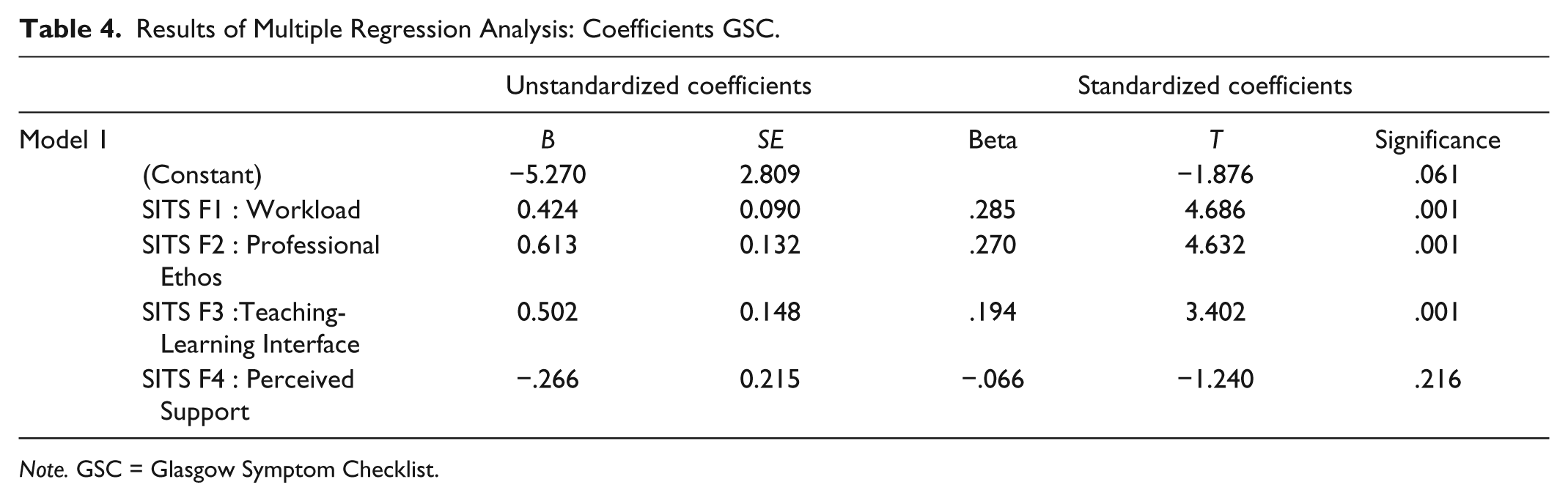
Note. GSC = Glasgow Symptom Checklist.

Percentage of participants recording GHQ-30 scores indicative of “caseness” (>5 to >20) according to teaching role (N = 399).
Significant Findings
Within this study, “teaching role” appeared to significantly affect perceptions of work stress and strain. Teachers who held the role of “middle manager,” were the only group to report a range of “change-related” stressors as stressful on a daily basis and also reported more daily “stressors” than senior managers in particular. The “workload” dimension of work was significantly more stressful for middle managers than both class teachers and senior managers (p = .001). In relation to strain (GSC-clinical measures) and its manifestations, it was clear that a significantly greater proportion of middle managers reported feelings of personal ineffectiveness (p = .001) and depression (p = .004), than senior managers. Of concern, is the fact that 77% of middle managers also recorded strain scores (GHQ-general measure) indicative of compromised well-being. In effect, this measure of strain indicated that middle managers had experienced significantly greater changes in levels of “strain” than class teachers (p = .012) and senior managers (p =.001). It should also be noted that the “workload” dimension of work, which was reported as significantly more stressful, for the middle manager, was the main predictor of strain as measured by the GHQ-30 and GSC. It should also be noted that the “teaching-learning interface” and “professional ethos” aspects of work significantly affected reports of strain (p = .001). Interestingly, senior managers, who had no class teaching responsibility, and therefore, did not engage with the teaching-learning interface on a daily basis, reported no dimension of work as “stressful,” and in some instances reported significantly lower levels of strain than their colleagues.
Discussion
This study set out to explore the relationship between work stress, strain, and secondary teaching role within the Scottish context. Positive significant relationships were observed between work stress and strain and this was especially marked in relation to teacher perception of subjective work stress (SITS) and the clinical measure of strain (GSC). However, as a group, these secondary teachers did not record stress and strain scores that would raise concern for their health and well-being. This is somewhat interesting, as the study took place in the most challenging times of the school year for teachers in terms of final preparation of pupils for national exams. However, experiences of work stress and strain did differ significantly according to which role these teachers held within this Scottish context, with middle managers, in particular, reporting similar issues as experienced by a clinical population (Mahmood, 1999). In addition, 22% of this group reported changes in well-being normally associated with psychiatric morbidity in a general population (Cox et al., 1987). To fully understand why middle managers specifically reported feelings of “personal ineffectiveness” and “depression” similar to that of a clinical population, the precise nature of their experiences of “work” is compared with that of their colleagues and placed within current discourses of “work stress.”
Previously within the Scottish context “workload,” “pupil indiscipline,” and “relationships” were identified as the main work stressors for teachers (Dunlop & Macdonald, 2004). In the study reported here, “indiscipline” continues to present secondary teachers with challenges and was identified as the groups’ main stressor on a daily basis. In relation to “job demands” (Cousins et al., 2004), the main work stressors for the group were associated with workload (e.g., “too little time”) and the teaching-learning interface (e.g., “indiscipline”). Workload was identified as making the greatest contribution to levels of strain. Interestingly, senior managers with whole-school management and no teaching responsibility found work significantly less stressful than any other group, reporting “indiscipline” and “workload” only as stressful on a daily basis. In stark contrast, middle managers, who had responsibility for managing their departments and teaching, reported 14 different stressors relating to workload and the teaching-learning interface as stressful on a daily basis. For this group, the main stressor rather than indiscipline was “changing demands.” In addition, middle managers were the only group to cite three further change-related stressors as stressful on a daily basis. Within this study, it would be true to say that all teachers no matter what role, have experienced the plethora of changes that have relentlessly swept across Scottish education (Pickard, 2003). According to their role, they will have greater or lesser control over these changes. It is suggested here, that the demands of change may be a potential stressor (Fletcher, 1992), but it is recognized that coping with change can also serve as a motivational force (Demerouti, Bakker, Nachreiner, & Schaufeli, 2001) for the teacher. However, within this study “change” appears to be a significant stressor in reality for the middle manager only. This may be because they are charged with implementing and leading change while balancing work demands, such as those associated with “workload” and the “teaching-learning interface.” Moreover, within this study it appears that the range of stressors reported by middle managers clearly indicate a level of both quantitative (e.g., “too much paperwork,” “not enough time for development work”) and qualitative (e.g., “changing demands,” “inclusive education”) overload. The etiology and number of stressors cited by middle managers as stressful on a daily basis suggest not only “overload” but also a level of role ambiguity (Caplan et al., 1975) and role conflict (Kahn, Wolffe, Quinn, Snoek, & Rosenthal, 1964). At one level, the middle manager is striving to ensure an inclusive education as advocated within the national priorities in Scotland (Humes, 2003), while managing administrative duties associated with leading their department. In addition, if we feed the obvious demands of “change” into the everyday reality of being a middle manager, evidence of role conflict emerges. It is quite conceivable that balancing management and teaching within a climate of change could be stress inducing. However, in the case of senior managers within this Scottish context, it is argued that work stress did not culminate in levels of strain that would in the long term negatively affect personal well-being. This may be attributed to the level of control they have within their own institutions, and moreover, within this study no senior manager was balancing a management and teaching commitment. This is further corroborated by the fact that middle managers report workload as significantly more stressful than senior managers. In addition, the interaction between “workload” and the “teaching-learning interface” is further exemplified by the fact that each made a significant contribution to levels of strain reported.
It is recognized that, change in any work context can be stress inducing as individuals adapt to changing demands, such as those cited by the middle managers within this study (Brown, Ralph, & Brember, 2000; Troman & Woods, 2000). For some the stress can serve as a positive motivational force (Mousavi, 2007; Nydegger, 2002) while for others, levels of resilience and indeed well-being can be compromised (Kyriacou, 2001). It is argued that within this study, change in itself cannot be held accountable for the fact that middle managers have reported significantly greater levels of strain than any other group and report multiple daily stressors within their specific work context. Research has highlighted a link between the “pile-up” of stressors and psychological health (e.g., Payton, 2009; Thoits, 2010; van Dick & Wagner, 2001), and it is acknowledged that unresolved stress can negatively affect well-being (Fletcher, 1992). Within our study, both classroom teachers and middle managers reported 8 to 14 aspects of work as stressful on a daily basis. While there were similarities in reported “stressors,” it is clear that middle managers alone were feeling the strain of “change.” Interestingly, when Dunlop and MacDonald (2004) surveyed teachers across the range of schools within the Scottish context, only 5% of the participants reported constant changes and new procedures as stressful (Bricheno et al., 2009). Five years on, it would appear that for those teachers charged with the dual role of managing colleagues and teaching, “change” has brought with it challenges. It is worth noting that a significantly greater proportion of middle managers were aged 40 or more and had amassed 16+ years of teaching experience. These findings may be better understood when we consider middle managers teaching load (70%-80%) and management role within the context of the “passage of time” (i.e., years of teaching experience) and “change.” It has been acknowledged that secondary schools in Scotland have experienced unprecedented change since 1999 (Pickard, 2003). Eighty percent of our middle managers were in post before 1997, meaning that they have, first, been at the heart of these relentless changes, and second, have had to repeatedly strive to match their personal and professional resources, to constantly changing job demands. It is suggested that levels of strain reported by middle managers, in particular, may support the assertion of Baumeister et al. (1999) that the efficacy of “coping strategies” are context dependent. If that context and indeed, landscape is constantly shifting, it is conceivable that mismatch between resources and demands could lead to strain.
Against this backdrop, it could be argued that the significant levels of strain experienced by middle managers in particular, may in the long term negatively affect not only their well-being but also productivity (van Dick & Wagner, 2001), self-efficacy (Kyriacou, 2001), and indeed, their mental health (Tennent, 2001). Dealing with this amount of quantitative and qualitative overload on a daily basis would leave little space for the middle manager to recover from their daily efforts to manage demands (Sitaloppi et al., 2009) and indeed continue to harness their personal and professional resources. It would, however, be wrong to assume that the relationship between stress and strain highlighted here, could not also be associated with factors outside of work or indeed, individual’s efforts to achieve a work–life balance.
Conclusion and Contribution
Findings from this study have further illuminated secondary school teachers’ experiences of work stress within the Scottish context. In addition, the extent to which “teaching role” and specific “features of work” can contribute to levels of strain and indeed potential health impairment, has been demonstrated. More importantly, this study has placed teachers’ perceptions of stress and strain within not only a general but also a clinical context. Crucially, the interaction between demands, such as workload, change, teaching-learning interface, and professional ethos further supports evidence to suggest the dual pathways emanating from the apparently role-specific interaction between job demands and resources. Surprisingly, within this study middle managers experienced levels of strain which would normally be seen in a “clinical” population. The key risk factors for those teachers who reported significantly higher levels of strain were not simply workload, but more significantly, issues relating to organizational change. It could be argued that the levels of “personal ineffectiveness” and “depression” experienced by middle managers suggest an imbalance between resources and demands and provides compelling evidence of the physical and psychological costs of a “pile-up” of stressors (Thoits, 2010) indicative of both quantitative and qualitative overload. Over time, such a scenario could culminate in middle managers in particular, experiencing impaired health, a decrease in professional fulfillment, and ultimately disengaging from work. In times of significant change of an unprecedented nature within this Scottish context the consequences of such a scenario are wide reaching, not only in relation to the well-being of the individual “middle manager,” but also for the colleagues they nurture in the hope that they will become the leaders and middle managers of tomorrow. What is more concerning is that for some middle managers early retirement on health grounds could become a real possibility. And with that, we potentially lose a wealth of experience, which in a “healthy working environment,” in which risk factors are monitored and minimized, could serve to drive “change,” rather than be engulfed by it. In addition, the extent to which middle managers, who report multiple stressors on a daily basis, feelings of personal ineffectiveness, and symptoms of depression, can continue to engage and inspire their pupils in a professional climate where support seems but a distant memory, may be questionable.
Limitations
Within this study it was important to address the uniqueness of secondary school teachers’ experiences of work stress within this Scottish context by using the home grown SITS. However, this prevented a direct comparison with other studies that have used the Management Standards (HSE, 2004) indicator (e.g., Kerr, McHugh, & McCrory, 2009). Nonetheless, it was possible to identify ‘risk factors’ within the Scottish context and consider the extent to which these are commensurate with current discourses of work stress However, these findings merely indicate a relationship and should not be construed as indicative of a causal work stress-strain link. Moreover, the limitations of correlation research are well documented and the researcher inferring “causality” must do so on the basis of underlying theory (Rudestam & Newton, 2001, p. 31)
Future Study
As teachers within the Scottish context continue to meet the challenge of adapting to significant changes at the chalk face, especially, pertaining to curriculum, teaching, learning, and assessment, it would be imperative to consider the complexity of the climate in which they are immersed. This may involve revisiting the study conducted by Dunlop and MacDonald (2004), with a view to comparing teachers (across all sectors) experiences of work stress and well-being in light of the significant changes that have taken place from 2004 onward. However, it would be important to develop the study design to incorporate a qualitative element that enabled teachers to provide a phenomenological account of their reality at this moment in time. Such a study becomes even moretimely when we consider the new revised standards for teachers’ continued professional development recently launched by the General Teaching Council for Scotland (2013). When we place these new “standards” within a climate of change and alongside the findings of this study, it becomes even more crucial that research within the Scottish context considers how best to foster healthy working environments in which all can flourish. This may require research that fully explores teachers perceptions of not simply the demands of work but their perceptions of the “professional ethos” in which they are situated.
Moreover, we need to be confident that teachers, working climate is one which considers the unique role-specific as well as generic demands of work teachers grapple with within the Scottish context, on a daily basis. Building on the findings reported here, it may be time to revisit the notion of work stress and strain across Scottish schools with a clearer focus on recent developments in our understanding of work stress. Against the backdrop of current discourses of equity, inclusion, risk factors, and indeed “health and well-being” (Horrell et al., 2012), it may be timely to consider how teachers experience of work may shape their perception of job demands within the Scottish context. Moreover, the extent to which the ebb and flow of their interactions with “work” enables them to minimize the “risk factors” highlighted within this study, and in addition, harness job-personal resources to good effect is certainly worthy of further consideration.
Footnotes
Acknowledgements
I would like to acknowledge the unwavering support of Adrienne Sillar who I had the pleasure of working with during this particular journey.
Declaration of Conflicting Interests
The author(s) declared no potential conflicts of interest with respect to the research, authorship, and/or publication of this article.
Funding
The author(s) received no financial support for the research and/or authorship of this article.