




Abstract
Levels of cycling for transport (CFT) in Ireland are very low—about 2% nationally—and the government has set a target of 10% of all trips to work by bicycle by 2020. The purpose of this study was to explore the complexities of leisure/sport cyclists’ views about CFT. Sixteen leisure/sport cyclists (four women and 12 men; about half cycled for transport) were interviewed about the factors that influenced their decision to cycle somewhere instead of driving and the role of the weather in that decision, whether they considered CFT to be real “exercise,” and the meaning of “safety.” The findings were that the decision to cycle for transport was dominated by practical concerns, and weather concerns added to this organizational burden. For city-dwellers, the key deciding factor was cycling’s efficiency and reliability. Safety concerns centered around negative interactions with drivers and there was a common belief that the general public had very negative attitudes to cycling and cyclists. Finally, most thought that CFT was not “proper” exercise as it would be of insufficient intensity or duration and would take from the time available to do this. These findings show that to promote CFT among leisure/sport cyclists, government and local authorities must improve and highlight the efficiency, safety, and legitimacy of cycling as a transport option. Without this, promotional activities that just focus on the exercise, health, and enjoyment potential of CFT will have little effect.
Keywords
Background
Cycling for transport (CFT) is a convenient, low-cost, and health-enhancing means of personal mobility that contributes to less-congested cities, cleaner air, and more, livable, people-friendly communities (Garrard, Crawford, & Hakman, 2006). The environmental, economic, social, and health dividends of a more active population that cycles and/or walks for transport have been well documented (Bassett, Pucher, Buehler, Thompson, & Crouter, 2008; Carlos & Phillips, 2000; Cavill & Davis, 2007; Interface for Cycling Expertise, 2002). CFT has an important role to play in ensuring that adults accumulate the recommended minimum of 30 min of physical activity per day (Department of Health and Children, 2009). Despite the perceived risks of cycling, deHartog, Boogaard, Nijland, and Hoek (2010) found 9 times more gains than losses in life-years for those shifting from car to bicycle.
Levels of CFT in Ireland are low (2% overall; 3.2% Dublin city) and have been in decline since mid-1980s (Department of Transport, 2009). There is little culture of CFT here; cycling is seen primarily as a recreational and sporting activity. The private car is the dominant transport mode, even for short journeys of less than 4 km (Central Statistics Office, 2009). The increasing strength of evidence on the benefits of CFT has led the Irish government to set a target of 10% of all trips to work by bicycle by 2020 (or “an extra 125,000 people commuting to work by Bike”; Department of Transport, 2009, p. 5). A National Cycling Policy Framework (Department of Transport, 2009) has been developed to support this. There has been a large increase in the number of cycling trips in Dublin city since 2006 (Gormley, 2012), though there is no equivalent data available for the rest of the country. Anecdotal evidence suggests an even bigger growth in recreational and sport cycling—as evidenced by a large increase in the number of noncompetitive, or sportif cycling events (and events that involve cycling, e.g., triathlon), increased numbers participating in those events and hugely increased nonracing membership of Cycling Ireland (approx. 11,000 in 2012). However, there is no valid and reliable national-level data on this. This may be due to a generous bicycle purchase tax incentive scheme for employees (the “bike to work” scheme), which resulted in sales of an estimated 90,000 bicycles, or 30,000 per year since its inception on January 1, 2009 (Dáil Éireann Debate, 2012) and 50 new bicycle shops (Irish Bicycle Business Association, 2011). However, there has been no evaluation of whether or how often the bicycles purchased through the scheme have been used for active travel, or whether they are just being used for recreation and sport cycling.
For those who cycle for recreation or sport, CFT can present an ideal opportunity to combine commuting with recreation, exercise, or sport training. Indeed, converting recreational/leisure/sport cyclists to CFT should be an important focus because this group may be considered “low hanging fruit” for increasing population levels of cycling. A survey of levels and determinants of CFT among a sample of Irish leisure/sport cyclists, as a preface to this research (Mullan, 2012), found 68.4% of the sample either regularly or sometimes cycled for transport (CFT), while 19% were thinking about doing so. However, the barriers to CFT are well documented: lack of time; lack of changing, storage, and secure parking facilities; bad weather; distance too far (Parkin, Ryley, & Jones, 2007; Shannon et al., 2006; van Bekkum, Williams, & Morris, 2011). In addition, Mullan (2012) also found that safety and weather concerns were the key disincentives to CFT among those surveyed. Regarding road safety, respondents specifically identified dangerous, inconsiderate, and intolerant drivers as disincentives to CFT, while indicating specifically that “safer roads,” “safety,” and “safer cycling conditions” would encourage them to CFT. Given that the population sampled were regular leisure/sport cyclists, who would be more experienced at dealing with traffic, varying road conditions, and keeping “safe” than noncyclists, this desire to feel more safe warranted further investigation. Similarly, “weather” was the most popular disincentive (listed by a third of respondents). However, Irish weather is relatively mild and moderate in comparison with that experienced by our continental European neighbors, where CFT levels are much higher.
Given the Irish government’s target to increase active transport in Ireland, the resurgence in popularity of leisure and sport cycling here and the potential for crossover between the two, it is important to improve our understanding of the factors associated with CFT among leisure/sport cyclists to better target interventions at this group. According to Heinen, Maat, and van Wee (2011) attitudes, norms, and habits significantly influence bicycle use and should receive more attention. As a regular leisure/sport and transport cyclist, E.M. is aware that many regular sport cyclists believe that the (perceived) extra time required to cycle for transport has little or no benefit in terms of exercise, training, or fitness gains; in sum, that CFT is not “proper” exercise. To date, no research has investigated the nature of prevalence of such attitudes among leisure/sport cyclists. Indeed, there is limited research into leisure/sport cyclists views on or attitudes to CFT and even less that is qualitative in nature (Christmas, Helman, Buttress, Newman, & Hutchens, 2011; Daley, Rissel, & Lloyd, 2007). The aim of this research, therefore, was to explore the complexities of leisure/sport cyclists’ views about CFT, specifically the meaning of the concept “safety,” whether CFT is considered exercise, the factors that influence their decision to cycle somewhere instead of driving, and the role of the weather in that decision.
Method
Semistructured telephone interviews were conducted with 16 volunteer cyclists, from an initial pool of 83, who had participated in a web-based survey on similar matters (n = 298) and volunteered to discuss the issues further. Interviews lasted between 25 and 45 min. All participants were involved in the 2009 Sean Kelly Tour, a sportive cycle event, held in the Dungarvan area of Waterford, Ireland, at the end of August 2009. Table 1 below gives background information about the participants.
Participant Information (Pseudonym, Gender, Age, Whether They Cycled for Transport [CFT] and the Sean Kelly Tour [SKT] Distance Completed in 2009).

A small urban area refers to regional cities with populations between 20,000 and 80,000.
A large urban area refers to two major cities with populations between 350,000 and 1000,000.
The large geographical spread of volunteers led to difficulties in arranging face-to-face interviews or focus groups; therefore, participants were interviewed by telephone and two interviewers (the author and Barry Lambe) spoke with approximately half of the 16 volunteers each during October and early November 2010. The final 16 participants were those who were still interested in giving time to the study after several failed attempts to organize a focus group and interviews by phone and email. All had given their informed consent to interview them by phone prior to the actual interviews and all consented to having the interviews recorded by dictaphone or i-phone.
The interviews and analyses were conducted from a social constructivist perspective that explored the lived experiences of and/or opinions about CFT among leisure/sport cyclists, specifically regarding,
Whether CFT is seen as “proper” exercise,
What factors influence the decision to cycle somewhere instead of driving,
How weather affects the decision to cycle,
What the word “safety” means with regard to CFT.
The discussion generally followed the order outlined above. We took an “active interview” approach, as outlined by Holstein and Gubrium (1995), which meant we were forthcoming about our own cycling experiences, opinions, and reasons for doing the research.
As the focus was primarily on the four a priori, or predetermined topics, the transcribed data were analyzed using thematic content analysis and QSR NVivo 8 (www.qsrinternational.com) was used to facilitate this. The four predetermined codes were named before the analysis began: “CFT as exercise,” “decision factors,” “weather,” and “safety.” Possible group differences due to gender, age, cycling experience, or type of cyclists were not explored because of the small sample size and because this was not a focus of the research. The “decision factors” code was initially formatted as a “tree,” or multitheme code; the others were “free,” or single-theme codes. Phrases, sentences, and whole responses were assigned to these codes using inductive, open coding. More free codes were developed as analysis progressed to encompass the diversity and variation in responses. An additional theme, “public attitudes,” emerged from the data during analysis and it was initially classed as a “free code,” then split into a “tree code” with positive and negative elements. Eventually, all free codes were organized into to “tree code” structures as overarching codes with several subcodes. The voice recorder malfunctioned during one interview and the main points, plus some key quotes, were noted by hand during and after the interview.
Findings
The sample comprised 4 women and 12 men, all of whom were regular leisure/sport cyclists and about half of whom cycled for transport. All names used here are pseudonyms, beginning, in order of transcription, with the first sixteen letters of the alphabet. Findings are presented by five themes: (a) CFT as exercise, (b) factors involved in the decision to CFT, (c) weather, (d) safety, and (e) public attitudes. Each theme contains between two and eight subthemes. The numbers in parenthesis in the text and in Figures 1 and 2 (automatically generated by NVivo) represent the number of references, or citations allocated to a theme, which gives a flavor (though crude) of the dominance, or popularity of those themes.

Eight themes (times cited) concerning the decision to CFT or not.
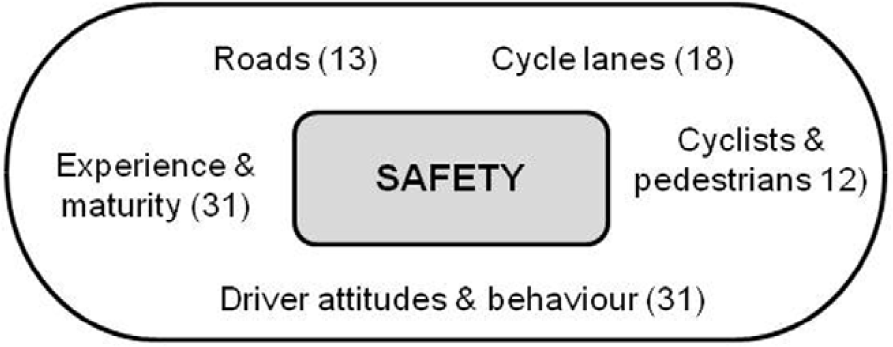
Five themes (times cited) specifically relating to safety.
CFT as Exercise
Most participants took the phrase “cycling for transport” to mean “cycling to work,” even though the general term CFT was used initially by the researchers. Whether CFT was seen as exercise depended on the meaning of exercise to each person and this was condensed into three themes (with number of citations): “health and sport maintenance” (9), “exercise” (15), and “not training” (22). Regarding the former, CFT was seen as benefiting overall health and sport regardless of its duration.
You would feel good about yourself after having a cycle. (Alan, 46, no CFT) I think any physical exercise is beneficial, be it short or long and the benefits are the greater the more I do. I wouldn’t think that there is a point below where it is of no benefit. (Eamon, 49, yes CFT) I don’t look at it as exercise, I look at it as just getting fit to cycle and I like cycling and it’s different exercise; it makes me better. (Martin, 60s, a little CFT)
While some considered CFT to be exercise, for others the distinction between what did and what did not count as “exercise” tended to center on distance, time, type of bike, or gear.
I’m not a member of a gym or anything like that so I kind of use it as my exercise excuse. (Lee, 45, yes CFT) It’s always the sweat factor for me. So, when I come in I go a bit easy but when I come home I maybe go a bit harder [so] I know that when I come home I’ve actually done a my bit of exercise. (Dick, 38, yes CFT) Up to say 3 km I would say I wouldn’t class as exercise but, em, my cycle to work would be 15 km one way. I would class that as exercise (Niamh, 30s, yes CFT) The difference would be between the type of bike and the type of gear I would be wearing. So, for work I have kind of an old mountain bike like, with skinnier tyres on it and I would wear my work clothes. . . I would change my T-shirt when I get in here. But I would consider that transportation. And also, say if I was doing short trips around at city at the weekend, em I just wear my normal clothes or I’d take a Dublin bike (a public rental bike) and go around on that and if I was thinking about cycling for leisure or for sport or exercise I’d have my rain gear and I would wear my proper [clip-on, bike] shoes and all that. (Ciara, age 31, yes CFT)
However, the most commonly expressed opinion viewed exercise as “training” and therefore, viewed CFT as having no training value at all. Specifically, “training” was something that must be done on a racing-style bike that has a bike computer (for recording speed and distance), must be done at a certain speed, without stops, and for a predetermined distance.
Sometimes I would go out for an hour in the evening, if there is enough light, and do a few hills, that would constitute training, whereas riding in and out of work isn’t really serious training as such. (Eamon, aged 49, yes CFT) If I’m going training I’ll take the good bike like. I don’t go for anything shorter than 50k when I go. (Ciara, aged 31, yes CFT) I wouldn’t consider 15 minutes [as training]; I’d em do something at lunch maybe go to the gym or something. (Dick, aged 38, yes CFT) I wouldn’t use the bike for transport as exercise, if you know what I mean. Like, leisure means getting on the proper gear and going off. Transport, or say, commuting: It’s just that id bring a rucksack, or whatever, to bring the stuff home. (Fred, aged 47, no CFT)
Factors Involved in the Decision to Cycle for Transport
Figure 1 shows the range of factors involved in the decision to CFT or not (or take the car). Whether people currently cycled for transport or not, they had many reasons for their decision.
Am, eh, probably the first reason is speed getting in to work; the second reason is that bit of exercise and the third reason is just to clear the mind and I find it always good. (Dick, 38, yes CFT) Ah, a small part of it would be I didn’t see the point in using the car for greener energy and environmental issues, and a greater part is that I simply enjoy cycling. And an element of it, but not a major element, is the fact that it saves me an awful amount of time because the distances I do to and from work: I can do much more reliably and quickly on a bicycle than in the car. (Eamon, 49, yes CFT)
There were only three references to CFT as the more environmentally friendly option. Similarly, health was only mentioned twice as a reason for CFT, but it had been discussed previously as a reason for exercise.
Reasons grouped under the “practical barriers” subtheme echo many of the barriers to CFT expressed in Mullan (2012): distance too far, lack of changing/storage/showering facilities, would need to shower or change and that would take too long, too much stuff to carry, lack of secure parking, wet weather, cannot integrate with public transport, expensive to take bike on intercity journeys, need car for work. For those who sometimes cycled for transport, decision making appeared to be a weighing up process between such concerns and the journey time or purpose. For some, the extra organization required was worth it; for others it was not.
I would plan my decision on what I was buying or whatever and what I was planning on bringing with me. Like, if I was going to do a lot of groceries I probably wouldn’t bring my bike, em, I’d probably take the Dublin bike and go there but then walk back or take a bus back. (Ciara, 31, yes CFT) [It’s] about what I have to carry; the weight or whatever . . . or, where I have to park. Obviously, like, if it is somewhere convenient to me, like the shopping centre down the road, I could pull up outside the door with the car, so there’s less of a temptation to bring the bike, but if I was doing the streets of [place deleted], you know, [with] awkward parking, then I might walk as well. So, timewise really, cause its often more pleasant on the bike, but that would be a factor. (Fred, 47, no CFT) The point is you just have to be that little bit more organised. (Dick, 38, yes CFT) It was just that little bit too much of an ordeal to cycle in and out like. (Ken 33, no CFT)
Appearance-related issues negatively impacted on the decision to CFT but were expressed only by two of the women, for example, “if it’s really heavy rain then all my make-up comes off and then I get to work . . .” (Ciara, 31).
The bike theft worries were a significant deterrent for those who owned expensive bikes and some only cycled to work because they could bring their bikes inside their office building.
I would have to be in my gear—my cycle pants—and, you know, I would have to have [a shower], my hair would be stuck to my head. In my line of work it’s all about being professional and [. . .] how you appear, like. If I got caught in the rain it would take from my confidence and take from my work. (Gayle, 51, no CFT) Both my bikes are good [. . .]. I wouldn’t lock either of my bikes anywhere in town. The only reason if I cycle to work is that I can bring it into the office so there is no way that I am going to cycle out to Tesco and leave one of my bikes outside Tesco somewhere [. . .]. I’m not going to start using them for that kind of stuff. (Ian, 38, no CFT)
For those who cycled to work regularly, convenience was the key motive: It was the fastest and most reliable mode of transport to work. Typically those who cycled for transport most often lived in or near cities where traffic congestion and/or waiting for public transport were unavoidable. Cycling to the shops, on the other hand, was inconvenient: much slower than driving and with heavy goods to carry.
Ya purely time saving. Like, I have compared it against walking, so if I do the same distance walking I think its about 45 minutes, if I get the bus between the time it takes to wait for the bus an then get to where I’m going it could be anything between 20 and 40 minutes [INT: right, ok, so its very much being efficient about your time] ya, cause door to door on the bike it takes 15 minutes between the time I have left my own door and by the time I am at my desk. (Ciara, 31, yes CFT) It wasn’t far enough [to cycle to the shops]. That it made it a bit of an inconvenience to be honest—you were talking about maybe 15-20 minutes—so I just thought I would hop in the car rather than cycle. (Ken, 33, no CFT) If I’m going on a local journey but I’m going to the supermarket I’ll take the car because let’s be honest it’s easier to load the stuff. (Owen, 48, yes CFT)
Enjoyment was a commonly expressed reason for CFT that was not linked to any other practical or time-related reason.
I love it [laughs], em, it’s, it’s ten minutes [. . .], it gives me a pick-up in the morning. It’s great! (Bill, 52, yes CFT) It’s more for the enjoyment that I would cycle, and the exercise. There isn’t a practical element at all for me to cycle, you know, even to work, to the shop, nothing, like, but it’s just for pure enjoyment that I do it. (Harriet, 29, no CFT)
Fundamentally, many were just cyclists at heart; it was part of their identity. Even if it was inconvenient, they would still choose to cycle instead of to drive.
In the summertime you would have the suit and tie on coming to and from [place deleted]. Em, I would look very unusual in that regard, but I enjoy the eccentricity of it. (Bill, 52, yes CFT) Yeh, like, a lot of my friends who are not cyclists would be asking me about events, like. They might see something on the paper, or something, and they would ask me about that, or, like, I am like the first person that they would think of to forward an email [to] if it was something to do with cycling, and, ya, I kind of like being centre of attention as a cyclist, like; being good enough to be identified as one. (Ciara, 31, yes CFT) I’d still invest in the cycling [INT: would ya, yeh?] ah ya definitely, ya even if was parity, even if it was 50% quicker coming in on the car I’d still cycle. (Dick, 38, yes CFT)
The Weather and CFT
The weather was cited as a barrier (26) more often than not (7). Wet, windy, and/or cold weather meant damp clothes, an unpleasant cycle, and increased perceived danger. In addition, the extra effort involved (5) in putting on and/or carrying rain gear was a disincentive. However, for those for whom it was not a barrier, the weather played only a minor role in the decision to CFT. Only in cases of weather extremes, such as snow, ice, or high winds would they not CFT.
I don’t want to arrive somewhere wet and be uncomfortable when I get there. Yeh, I would want to have a change of clothes when I got there. (Ian, 38, no CFT) It’s just the effort of getting geared up and it kind of takes away the time benefit. (Fred, 47, no CFT) I would cycle for ten minutes morning and evening and, no, I cycle no matter what the weather. I would never not cycle when it is raining. I mean, clearly, if I am going out for a leisure cycle I won’t go out if it is raining, it’s no fun, but from a commute point of view I cycle and it doesn’t bother me at all. (Bill, 52, yes CFT)
Safety Concerns
All discussions concerning “the meaning of the word safety” were actually about what made cycling dangerous. For some, “safety” was about avoiding dangerous, frightening, narrow and/or unpleasant roads with heavy traffic, where you could be “thrown into the ditch” (Ken, aged 33, no CFT). For others, safety was about having the experience and maturity to “be very aware all the time” (Ciara, aged 31, yes CFT), to anticipate what drivers and other cyclists might do, and to know the best place on a road to cycle. They knew that they could read a situation and know, instinctively, the appropriate action to take to keep safe and avoid danger, and, therefore, they were not overly concerned with the potential lack of safety.
Know ‘when to chance it and when not to chance it. (Ciara, 31, yes CFT) Being a road cyclist gives ya a good idea of, you know, road conditions and how to manage in traffic. You know, people would be at ya about how do you manage traffic and how do you make traffic go around ya, like, and that. How do you take a roundabout: you would keep well out so you take over the road. Em, on the mountain bike you have very good control. (Fred, 47, no CFT)
Some also expressed the view that cycling experience generally improved drivers’ interactions with and understanding of cyclists and, sadly, many don’t have that knowledge anymore.
I don’t think college kids nowadays ride a bike that much certainly not as much as when I was at that age and I feel that a lot of young drivers don’t know the danger they cause to cyclists. (Eamon, 49, yes CFT)
For the majority, safety was about interactions with vehicles. Dangerous, or too close overtaking, vehicles passing by at high speed, cars pulling out or opening doors without looking, cars pulling out at roundabouts without looking, bad parking, lack of road space for cyclists in multilane situations, and drivers stopping in cycle lanes at traffic lights were given as examples of what made cycling unsafe. Overall, the feeling was that cyclists were not given “that much regard on the road” (Jack, aged 57, a little CFT) and are “seen as an obstruction on the road rather than another road user, [. . .] a very vulnerable road user.” (Lee, 45, yes CFT) Am well the two worst things, one is cutting ya off [by] pulling in front of ya, or passing ya very very close, and another one is opening doors: you know, parked cars opening doors, and, or else, passing you out just to pull in to park. (Fred, 47, no CFT) They would overtake ya but they wouldn’t do it if you were a car, you know, it just wouldn’t be appropriate. Now, I do an awful lot of driving myself and you would get people, eh, say your cycling along the road and there’s an on-coming car and they would overtake you and cut in very close to you, whereas you wouldn’t dream of doing that with another vehicle. (Jack, 57, a little CFT) It’s as if the roads aren’t designed to take cyclists and drivers and pedestrians. (interviewee emphasis: Peter, 38, yes CFT) I have had people scream at me telling me to get off the road, where I definitely have the right to be there. (Niamh, 30’s) I just don’t think they give you a wide enough margin when they’re passing you out. (Alan, 46, no CFT)
Those that cycled with cycling clubs or groups also noted that drivers could get very impatient and frustrated when trying to overtake a large group of cyclists: “People get a bit heated.” (Harriet, 29, no CFT)
Other cyclists and pedestrians were often considered safety hazards. Some described incidents where pedestrians just stepped out in front of them without looking. However, other cyclists got the most reproach for running red lights at junctions and/or pedestrian crossings, not using lights at night, cycling on footpaths, wearing all-black, having faulty bikes or “even trying to race ya!” (Niamh, 30’s, yes CFT) A lot of them don’t know how to cycle. Like, it’s not fair on other cyclists and, you know, [they] overtake you dangerously or they come up on ya on the left-hand side or something. (Niamh, 30’s, yes CFT)
Cycle lanes were often seen as the antidote to all this lack of safety. Nevertheless, many felt that they were not that useful or even suited for purpose as people parked and/or drove in them, they ended abruptly, were badly surfaced, slippy, contained debris, required mounting a footpath, and led to a loss of priority. As a result, some considered them unsafe.
you would nearly go out of your way to follow a cycling track [. . .] if it took you five minutes out of your way but you knew it was safe and you knew it was there then you’d follow that route. (Dick, 38, yes CFT) You are going along the road and all of a sudden there’s a pedestrian crossing or something like that, and the cycle lanes just ends, and then you have to work your way back out into traffic. To be honest I think [. . .] they’re not taking them seriously like, you know, I think the people putting them there [. . .] don’t appreciate what it’s like to have to cycle in them. (Fred, 47, no CFT) Cycle lanes create danger as opposed to making it safer. (Bill, 52, yes CFT)
No one mentioned personal safety and security as an issue; there was no mention of fear of attack, assault, or antisocial behavior.
Public Attitudes
Some maintained that cycling was now more trendy, more common and, therefore, a much more acceptable as a mode of transport (7).
I would think cycling has become much more acceptable now, from a work point of view and from a commute point of view, and, em, as a leisure pursuit. I think its burgeoning and it’s the new golf, to some extent, and, because of that, it has almost got a status now. (Bill, 52, yes CFT)
However, the majority (21) felt that the general public’s general attitude to cycling, either for leisure or transport, was negative. On one hand, people felt that utility cycling is not taken seriously and, therefore, lacks credibility as a transport option.
I think if people see adults doing it they think “Oh Jesus there is something wrong with her that she won’t use her car to go to the shop,” especially in the country. It might be different in the town or the city, like. [There] you would see people cycling more. I think that might be changing a bit, but there would be an element of “why doesn’t she use her car” you know? (Harriet, 29, no CFT) I still think there is that attitude that you only cycle because you can’t afford a car. (Lee, 45, yes CFT)
One the other hand, others believed that we lack a culture of respecting cyclists and cycling, which explains much of the negative driver behavior toward cyclists.
We had a culture of cycling but we never had a culture of respect and I don’t know whether it’s seen as a “poor” [poverty] thing [. . .but] our attitude to cyclist is, em, like, you shouldn’t be there. I could be in on the hard shoulder but they just feel that you shouldn’t be on the road and I have been screamed at by a truck driver for being on the road. (Lee, 45, yes CFT) The car gives you status. (Bill, 52, yes CFT)
Discussion
This study explored the complexities of leisure/sport cyclists’ views about CFT with a focus on four key areas: CFT as exercise; making the decision to cycle for transport; the weather; and the meaning of “safety.” An additional theme, public attitudes, emerged during data analysis. Clearly the findings cannot be generalized beyond this small, nonrepresentative, volunteer sample of mixed gender, age, and experience, but there are some clear conclusions and implications.
CFT as Exercise
While personal definitions of what constituted exercise or training determined the acceptability of CFT as a source of exercise, the majority did not see it as “proper” exercise at all. It seems that the fact that they already cycled for sport was actually a disincentive to cycle for transport: CFT did not have any training value and potentially reduced the time available for training. This finding is similar to one reported by Berends (2006) that found for some sport/recreational cyclists in Victoria, Australia, the cycle to work was too short to cycle, that is, of insufficient length to meet training needs. Research with a larger, representative sample of leisure/sport cyclists is needed to quantify these findings. In addition, it would be valuable to see to what degree this view is prevalent among other active, noncycling segments of the population and to what degree CFT is seen as “proper” exercise among the general population. In the absence of this, the extent of the potential crossover from leisure-sport cycling to utility cycling may be overestimated.
The decision to cycle for transport
The potential health and environmental benefits of cycling barely featured in the decision-making process. Participants were more concerned with practical barriers (time, distance, facilities, appearance, bad weather, wet clothes, etc.) and benefits (convenience and reliability) that had a tangible, daily impact on them. The unpredictable Irish weather was barrier because of the extra organization required to stay dry or change if one got wet. CFT was generally taken to mean cycling to work, and for those living in urban areas, with short cycle journeys, where other transport options took much longer, convenience and reliability was the key deciding factor; bad weather had no influence. Two conclusions are clear from this information: First, as noted by Garrard (2009), the decision to cycle is not made by weighing up the barriers versus benefits of CFT, but by comparing cycling with other modes of transport, typically the car. So, where car transport is quick, convenient, and reliable, it is likely that the practical barriers outlined above and the extra organization required to cycle become more of a deterrent. Second, if regular, experienced cyclists cite such barriers, it is likely that noncyclists and, in particular, sedentary people would find these types of practical barriers insurmountable. Both underline the need for strong physical and policy interventions to make cycling more efficient and reliable than driving (e.g., by restricting parking and/or car access—see Pucher, Dill & Handy, 2009, for a review of interventions).
For the few who cycled for transport regularly in all weather, and had been doing so for years, it was clear they did so because it was part of who they were, part of how they identified themselves and because they just enjoyed it. They had either found ways around the practical barriers or did not see them as such. These people are similar to what Gatersleben and Haddad (2010) refer to as “a very small minority of people who will cycle under most circumstances simply because they like cycling” (p. 302)
Safety and public attitudes
The issue of “safety” was framed almost entirely from the point of view of dangerous or negative motorist behavior. It was seen as indicative of general negative public attitudes toward cycling and of a general view that cycling lacked credibility as a transport option. Motorist hostility toward cyclists is a common theme in the literature (see Ampt, Somers, & Munro, 2011; Audirac, 2008; Christmas et al., 2010; Daley et al., 2007; O’Connor & Brown, 2010). Some believe it stems from a lack of driver knowledge about the rules of the road as they pertain to cyclists (Rissel, Campbell, Ashley, & Jackson, 2002), others that it stems from a belief that cyclists are not legitimate road users (do not pay “road tax,” or have a “license,” and obstruct the motor traffic: O’Connor & Brown, 2010). Interviews with serious sports/training cyclists, who generally cycle in groups, by O’Connor and Brown (2010), found that they perceived the road environment generally as “abusive and adversarial” (p. 57). However, this was not a significant barrier because, with experience, they learned tactics to minimize or avoid conflict with motor traffic. Again, the conclusion here is clear: If regular, experienced cyclists generally see the road as a hostile environment, it is more than likely that many new, inexperienced cyclists will not remain cycling long enough to learn such self-protection tactics. Clearly, there is a need for driver education regarding the rights and vulnerabilities of on-road cyclists.
However, in this research, other cyclists also came in for some scorn for their failure to adhere to the rules of the road and for being a safety hazard. U.K. research by Stone and Gosling (2008) quantified this: Approximately a third of the regular cyclists questioned believed that cyclists were not law-abiding, and were dangerous. This highlights the need for the rules of the road as they pertain to cyclists and to cyclist−driver interactions to be more widely disseminated, and for cycling lessons and cycling qualifications to become more widely available and commonplace. This would also help improve the much lamented lack of legitimacy of cycling as a transport option.
The variety of beliefs regarding cycle lanes shows the lack of consensus, even among regular cyclists, about whether and how cycling should be accommodated on the roads. Some wanted more and better cycle lanes, while others believe that most were not fit for purpose and made on-road cycling even harder. Research by Christmas et al. (2010) categorized cyclists like the former as “avoidance” cyclists, who want cycle lanes to help them avoid traffic. The latter are similar to their “assertion” cyclists who want cycle lanes to make clear how the road is to be shared and to assert their right to be on it. Perhaps until road engineers are clear why they are providing cycle lanes—either to enable cyclists to avoid traffic or to assert their right to road space—cycle lanes will continue to divide opinions among users. Although here in Ireland, the legal requirement to use cycle lanes where provided was recently repealed, in many other countries there is still a legal requirement to use them.
Conclusion
This research has found that regular, experienced leisure/sport cyclists generally see the road as a hostile environment. This is exacerbated by the practical barriers to CFT (time, distance, facilities, bad weather, etc.) but improved by the benefits (convenience and reliability). Potential health and environmental benefits of cycling barely featured in the decision to CFT. This underscores the need for government and local authorities to improve and highlight the efficiency, safety, and legitimacy of cycling as a transport option. Without this, promotional activities that just focus on the exercise, health, and enjoyment potential of CFT will have little effect. Specifically, making cycling safer and more appealing to leisure/sport cyclists requires, first and foremost, government agencies to tackle dangerous and/or negative motorist behavior (e.g., dangerous overtaking). In addition, restrictions on the ease of car transport (e.g., access, speed, free parking) and ample secure and covered bicycle parking are needed to enhance the convenience, speed, and reliability of cycling in the face of the extra organization and weather-proofing required. Further research is needed to see to what degree CFT is seen as “real” or “proper” exercise among the general population. The extent of the potential crossover from leisure/sport cycling to utility cycling may be overestimated unless these issues are addressed.
Footnotes
Acknowledgements
Thanks to Barry Lambe at Waterford Institute of Technology for his help in developing the discussion guide for the interviews, and for organizing and conducting half of them. Thanks also to Rosarie Kealy and others at Waterford Sports Partnership for facilitating access to the Sean Kelly Tour sample.
Declaration of Conflicting Interests
The author(s) declared no potential conflicts of interest with respect to the research, authorship, and/or publication of this article.
Funding
The author(s) received no financial support for the research and/or authorship of this article.