




Abstract
The Ural Mountains in Russia are recognized for their picturesque scenery, exceptional mineral wealth, and geopolitical significance in Russian history. The Urals are also notoriously known as a site of the Soviet military industrial complex, the birthplace of the Soviet nuclear program, and the most polluted region in Russia. The evolving Urals’ imagery as Russia’s “treasure box” and “Russia’s defender” has been a continual theme through the region’s identity and economic progression over the period of 300 years. At different times and by different powers, the Urals was glorified or ostracized, however, preserving its iconic image. The article explores the origins of the Ural’s identity and the evolution of the Urals’ diverse meanings using the evidence from published scholarly sources and works of art.
The Ural range is undoubtedly in one of those enigmatic regions where the landscape has a direct effect on minds.
Introduction: Why the Urals Matter?
In recent decades, there has been an increasing interest in the study of cultural landscapes in connection with regional and cultural identity. Geographers view places not only as environmental spaces but also as subjective “processes,” that are humanly produced and humanly changeable, thus representing the evolution and condensation of a complex history of environmental, economic, political, and social processes (Agnew, 2001; Entrikin, 1996; MacLeod, 1998; Murphy, 1991; Paasi, 2002). There is a reciprocal relationship between the identities of places and of people inhabiting these places. “Representative landscapes” constitute visual encapsulation of a shared past, with such major cultural identifiers as nationality, language, religion, and ethnicity (Norton, 2000). The dynamics of cultural identity are crystallized through region-building institutions, and how these places are reproduced is often regulated by a state or regional government (Frers & Meier, 2007). These intricate processes are embedded in material culture “from above,” in the form of region-building institutions such as economy or governance (Paasi, 2004) and are preserved in visual culture “from below” in the collective memory of people through folklore, mass media, films, and artistic narratives (Paasi, 2003).
Russia, with its vast size, uneven population distribution, and relatively low population mobility, is extremely heterogeneous. Although Russia has always been a center-periphery structured country, the fragmentation of the periphery intensified in the last two decades since the collapse of the Soviet Union in 1991. Although each Russian region is a product of long economic, social, and political development, many regions were formed on a rather artificial basis, which was especially typical for the Soviet period (1917-1991), when the major ideological basis for the region delimitation was the premise of their objective existence (Givental, 2009). The Urals region, however, has been uniquely different in its intrinsic vastly recognizable features that lie deeply within its natural resource base and its deep ties with the history of the entire Russia spanning over 300 years and cutting across the variety of economic and political regimes.
The Ural Mountains in Russia stretch north-to-south for over 2,000 kilometers (1,250 miles) from the Arctic Ocean to the Kazakhstan border. The medieval name for the mountains was the “Stone Belt” or simply the “Stone” (Kamen in Russian), reflecting the stone beauty and the harshness of the region (Figure 1). Russia emerged as Russ Land west of the Urals in the end of the 10th century and continued expanding eastward to “Asian” Russia, across the Urals until the late 18th century. According to the Russian Census (2002), 65.6% of Russia’s population lives to the west of the Urals where the climate is moderate and agriculture is feasible. This includes the old industrial centers of Central and Southern Russia, which form the established European core. The densely populated and resource-rich central and southern parts of the Ural Mountains are combined in one of Russia’s eleven economic regions, with its present boundaries unchanged since the last regionalization update in the early 1980s (Figure 2). This region, although just 5% of the country’s territory, is the home to almost 20 million people or 13.7% of the total Russian population (Russian Census, 2002).
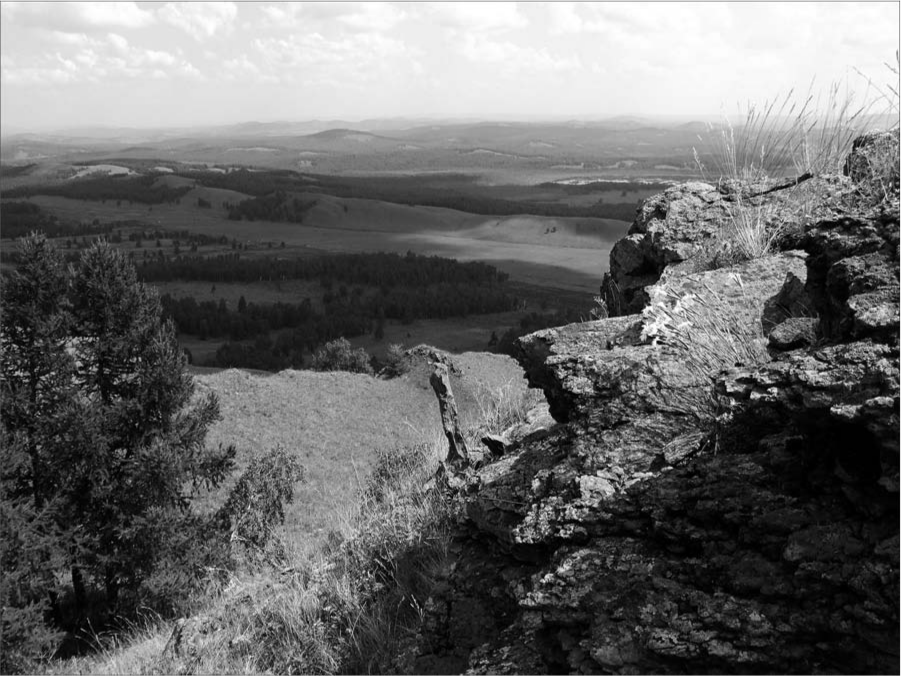
The Urals picturesque landscape with its gentle rolling hills and rock outcrops.

Economic regions of Russia (after Vinokurov, Glushkova, Makar, Plisetskaya, & Simagina, 2004).
Since the times of Tsar Peter the Great, when Russia evolved as a novel metal-producing center in the early 18th century and gained its dominance on the Baltic Sea, and through the years of WWII (1941-1945) and the consequent reconstruction, the Urals region has been perceived in Russia as the country’s mineral treasury and its military stronghold. In Russia’s industrialization efforts, from the 17th century through the Soviet era (1917-1991), the ruling powers maintained the stronghold image of the Urals. Outside Russia, however, the Urals is notoriously known as the heart of the Soviet nuclear industry and an area of extreme environmental degradation. A 2008 online book on comparative regional geography paid sufficient attention to the region contrasting the Russian Urals with the American Appalachia (Braden, 2008). The authors, a team of American and Russian geographers, described the Urals as “these gloomy mountains,” “a region out of sync with time and surrounding space,” and “a forgotten place . . . populated by people not wanted elsewhere” (Rogachev & Brunn, 2008, p. 21). In a few strokes, the authors created a visual image of a depressing, polluted Urals, with its centuries-long dark industrial past and equally dark and hopeless present. “The Soviet galvanization of the nearly stiffened corpse of the antiquated industrial region has considerably worsened the unattractive features of the Urals” (Rogachev & Brunn, 2008, p. 19) stated the authors with a certainty that could forever discourage anyone willing to learn more about the Urals region from plunging into the quest. This contradictory character of the Urals region has produced an array of contested images, both inside and outside Russia. The economic history of Russia over the last 300 years has been closely intertwined with the development of the Urals Region, and reducing the region’s image to a polluted, outdated, and largely forgotten smudge on the face of the Earth is factually incorrect and unfair to the Uralian people.
Method
The cultural landscape is a material record of human activity, and as such we can gather information on the landscape creation and meaning through both visual sources, such as direct and indirect observations, and historical records. As “raw appearances” can be deceptive, it is necessary to move beyond the mere reliance on empirical observations and unearth the repositories of human meaning and interpretation that underpin lived realities. Approaching the landscape as a palimpsest, a manuscript that has been written, scraped, and rewritten many times allows us to analyze a contemporary landscape as an accumulated human occupance in a particular location (Givental, 2011; Rhoads & Wilson, 2010; Schein, 2010).
This article explores the roots of the long-lasting uniqueness of the Urals region through the historic records and the Urals’ imagery. While the former contribute to analyzing the forces that propelled that distinctiveness from “above,” the latter helps to recognize the role of written and visual art as a living testimony to the evolution of the Urals’ identity in the contemporary Russian psyche. Although not the native of the Urals, the author gained a deep familiarity with the region during the years of geological fieldwork spanning the period between 1985 and 1995, the years of the dramatic political and economic upheaval and changes. While the method of direct observations is quite reliable for cross-sectional studies, the goal of this research is to show the longitudinal dimension of the formation of the Urals cultural identity in the minds of the Russian people. This task is accomplished by combining the historical records with the artistic narratives, both written and visual, that may serve as a proof of the long-lasting imagery which differentiates the Urals region from any other region in the vast Russian domain. As the longitudinal study spans the period over 300 years, the narrative has to move from the prerevolutionary Russia (before the Socialist Revolution of 1917) to the Soviet period (1917-1991) characterized by the command economy and the tragic loss of millions of lives due to the Civil War of 1918-1921, the political purges of the Stalin regime (1937-1953), and the WWII on the Soviet territory (1941-1945). The narrative then moves to the post-Soviet Russia, which emerged after the dissolution of the Soviet Union in 1991.
The Mountain Range As a “Treasure Box”
The rich variety of mineral resources is the most characteristic feature of the Urals region and was the root for its industrial development during the last 300 years. The Russians often proudly cite that more than 1,000 minerals and more than 12,000 mineral deposits have been discovered in the Urals, including 48 out of the most important 55 chemical elements used in human economic activity (Vinokurov, Glushkova, Makar, Plisetskaya, & Simagina, 2004). While the western slope of the mountain range is rich in nonmetallic deposits (oil, natural gas, and mineral salts) the eastern slope bears a remarkable variety of valuable metallic ores, especially iron, copper, chromium, vanadium, gold, platinum, and a variety of precious stones. This distinctive geographical dichotomy of the Urals’ mineral resources has determined the location of chemical industries in the western Urals and metallurgy in the eastern Urals.
Iron and copper ore deposits were discovered in the Urals at the beginning of the 17th century and became the basis for the region’s emergence as one of the first heavy industry regions in Europe. Gold was discovered in the Urals in the early 18th century, triggering a Gold Rush. A 36-kilogram (80 pound) gold nugget from the Urals is still exhibited in the Russian Diamond Fund in Moscow’s Kremlin. The Central Urals region also became famous in the 18th and 19th centuries for its unique stocks of malachite, associated with copper ore deposits. The solid blocks of malachite from this area were extensively used for decorating the Versailles Palace in France as well as the winter and summer palaces of the Russian tsars in St. Petersburg.
Although the Urals economic region combines the eastern and western parts of the mountain range, it is mainly the areas of the eastern slope of the Urals (Sverdlovsk and Chelyabinsk regions, Figure 3) with metallic ores and precious stones that have been traditionally recognized as “the treasure box” of Russia. The world famous Russian Court jeweler of French origin, Carl Fabergé (1846-1920), acquired most of his gems and hard stones (emerald, ruby, topaz, alexandrite, jasper, and malachite among others) in the Central Urals where he established his own lapidary factory. Fabergé’s works, made of the Urals’ gemstones, are still on display in the State Hermitage Museum in St. Petersburg, the Forbes Galleries, and Metropolitan Museum of Art in New York.

The Urals economic region: Major cities, natural resources, railroad network (redrafted after Komar, 1969).
The mode of life in the Urals, as well as the artistic inspirations of the Urals’ writers, has long focused on mining activities.
Just as the inhabitant of Central Russia goes out “to nature” to pick berries and mushrooms, so the Uralian drives his old jalopy out looking for gems; to him, a place without deposits and veins makes no sense . . . It’s the rare family whose attic isn’t strewn with fused cobbles and malachite scales covered with black oxides, quartz druses that look like the city’s spring ice, and polished chips of all the common gemstones. (Slavnikova, 2007a, p. 79)
Writers were not only inspired the abundance of the Urals’ gemstones. The Urals-born Russian novelist and essayist, Dmitry Mamin-Sibiryak (1852-1912), who lived and worked in the Urals during the serfdom-abolition reform years, became famous for his social novels that described life in the mining and industrial Urals with its unsaturated drive for profits, distorted morals and legal norms. Olga Slavnikova, a Uralian writer of the new post-Soviet generation, describes a prospering illegal business of precious stone collection in her novel “2017” (Slavnikova, 2007b). However, even depicting the dark sides of the region’s reality, local authors have always preserved their deep appreciation of the Urals’ beauty and deep-lying treasures.
The Ural Mountains, weathered and blanketed in a haze that passes through hundreds of gradations of gray, look like decorative park ruins. There’s nothing left for a painter to do amid this ready-made lithic beauty. Every landscape, no matter where you look, already has its composition and basic colors, a characteristic correlation of parts that combine into a simple and recognizable Urals logo. (Slavnikova, 2007a, p. 76)
Russian writer Pavel Bazhov (1879-1950), also a native of the Urals, created the most poetic and identifiable set of Urals stories based on miners’ folk tales told to him by an old-time Urals prospector. These stories blend the reality of the miners’ and stone-cutters’ hard labor in the 19th century with mythological narratives about the mysterious Mistress of the Copper Mountain and her attendant lizards, and Poloz the Great Snake, guarding the mineral treasures (Bazhov, 1987). Bazhov’s first collection of stories, “The Malachite Casket” was published in the Soviet Union in 1939 and translated into English in the 1940s. The central tale of the collection, “The Stone Flower,” is a romantic love story staged in the Uralian village of the 19th century. A gifted village stone-cutter Danila is enchanted by the Mistress of the Copper Mountain who guards the secret of creative beauty; he is obsessed with the idea of cutting a malachite flower which would be more beautiful than a real one.
The mountain goddess guided him through caverns, each one more beautiful than the last. Their walls shone with outcroppings of gems, and more jewels covered the ground. One cavern had a ceiling so low that Danila could hardly stand upright—the amethyst walls were lit from by an unseen light source and he felt as if he and the Mistress of Copper Mountain were held for a moment in the jewel’s heart. (Jenks, 2007)
Only the love of a simple village girl saves him from the obsessive charms of the mountain queen. This romantic story was turned into one of the first Russian color films in 1946. In 1950, the famous Russian composer Sergey Prokofiev created a ballet “The Tale of the Stone Flower” based on Bazhov’s narrative. The Urals’ “treasure box” identity has left a strong imprint in the minds of the Russian people.
The Urals As a Military Stronghold
If the Urals’ “treasure box” image was created by a popular perception of its enormous mineral treasures, its “military stronghold” identity was promoted during the most trying times linked to Russia’s two controversial leaders: Peter the Great (1682-1725) and Joseph Stalin (1879-1953). Tsar Peter’s imperial policy and strategic decision making launched the first Russian industrialization “from above,” facilitating Russia’s victory in the war with Sweden in 1721 and moving Russia forward into the ranks of the most advanced European monarchies. During Peter’s reign, the Urals, with its newly discovered mineral riches, was transformed into a major metal and armament producing region, thus eliminating Russia’s dependence on the European metal market. Between 1701 and 1725, 23 metallurgical plants, including 13 iron works and 10 copper smelters, took-off in the Urals. By 1750, Russia was the world’s leading producer of iron, with an annual output of 53,000 tons with the Urals’ share being 72%. Almost all Russia’s copper, the main nonferrous metal to be smelted in the 18th century, came from the Urals (Blackwell, 1968; Gavrilov, 2005; Parker, 1968).
The 18th century Industrial Revolution in Europe, however, tarnished the Uralian glory and the Urals’ metallurgical industry “surrendered” to Great Britain due to a failure to adopt the latest technological innovations in steel production (Goldman, 1956; Harris, 1999). In the 1890s, when the Russian Finance Minister Sergei Witte (1849-1915) promoted development of the new technologically advanced and railroad-connected metallurgical base in the Donets Basin of Ukraine (Donbas), the Urals lost the economic competition to Ukraine (Goldman, 1956). Thus, the Urals entered the 20th century as an old industrial region, with partially exhausted mineral resource base and obsolete equipment.
The Russian industrialization during the Soviet regime, in the 1930s under the leadership of Joseph Stalin, marked the period of the second rise of the Urals region. Earlier, the Bolshevik Revolution of 1917 and the ensuing Civil War of 1918-1921 had left Russia’s economy in ruins. At the end of the 1920s, Stalin designed a centrally planned command economy with the goal of erasing all traces of capitalism and transforming the Soviet Union into an industrialized state, which would be able to effectively compete with the capitalist world. The measures for achieving these goals were industrialization and agricultural collectivization “from above.” During this dramatic period of rapid industrialization in the Soviet Union (1927-1941), the Urals got a second chance to become Russia’s largest and most advanced producer of metals and heavy machinery. Dozens of existing iron plants and copper smelters were reconstructed, and several new industrial giants were completed. The Magnitogorsk Metallurgical Complex in the Southern Urals, constructed in 1929-1933, became the biggest steel plant in Europe with annual capacity of 2.5 million metric tons of pig iron (Kotkin, 1991).
The Russians popularly believed that defense of the Soviet territory during World War II (1941-1945) could not have succeeded without the development of the eastern regions beyond the enemy’s reach. Between July and November 1941, over 1,500 industrial enterprises were physically transferred, piece by piece, from the European part of the Soviet Union to the east. Of these enterprises, 667 factories, together with the evacuated population, were resettled in the mining and manufacturing areas of the Urals (Polyakov, 1966). The share of national iron ore produced in the Urals increased from 26% in 1940 to 90% in 1942 (Figure 4). Heavy machinery plants in the Urals were retooled to produce weapons. Literally from scratch, the Urals workers created a gigantic tank-manufacturing base. In 1941-1945, the three Urals tank plants, located in Yekaterinburg, Chelyabinsk, and Nizhniy Tagil (Figure 3), manufactured 54,000 heavy and medium tanks and self- propelled artillery, which comprised 70% of the total armament production in the Soviet Union (Kirillov & Popov, 2000; Shabad, 1969; Zubrilov & Dementiev, 1995).

The share of the Urals’ steel production in percent of the total U.S.S.R. during World War II, 1941-1945 (calculated from Zubrilov and Dementiev, 1995).
“Pravda,” the official newspaper of the Soviet Union’s leading Communist Party, wrote in its front page article on January 3, 1943: “The Urals carried on its strong shoulders the heaviest burden of supplying the Soviet Army with the weapons. The people of the Urals accomplished it! They have added a new glorious eternal page to the Urals’ long-lived fame” (Zubrilov & Dementiev, 1995, p. 124). Although Russians were rarely inclined to accept Soviet mass media propaganda labels, of which the Urals as “the foundry of the victory” was one of many, the Urals’s identity as “Russia’s defender” was truly embedded in the Russian postwar national consciousness.
The Soviet Legacy: Gloom Instead of Glory?
By the late 1960s, the Urals heavy industry ran out of cheap local open pit ores and developed a raw-material dependence on the county’s eastern regions: Siberia, Central Asia, and Kazakhstan (Lydolph, 1990; ZumBrunnen & Osleeb, 1986). David Hooson, a well-known Western scholar of the Soviet economy, reflected on this tendency of “filling out of the Soviet manufacturing belt toward Lake Baikal” (Siberia) in his regional essay of the Soviet Union (1964).
At present, the crucial axis of nationally important industry in the Soviet Union runs north from the Donbas to Moscow and then east through Gorky, Kuybyshev, Chelyabinsk, Karaganda, Novosibirsk, and Krasnoyarsk to Irkutsk. This is by no means continuous enough yet to be called a “belt,” but the lines are drawn, the capital invested, and a psychology of “Go East, young man” sedulously fostered, which has become at least as nationally emotive as its American equivalent—quite possibly with even more realistic justification. (Hooson, 1964, p. 46)
In addition to its economic decline, the old industrial Urals suffered from severe environmental pollution, the result of rapid heavy industrialization without regard to environmental consequences. By the 1990s, the Urals held notorious “first place” in the levels of industrial air pollution, including 50% of all mercury, 40% of chlorine, and 30% of fluorine air emissions in Russia. Many rivers in the Urals contained the amounts of oil, ammonia, zinc, chromium, phenols, and other chemicals that significantly exceeded the permissible state limits (Gramolin & Yevseev, 1996; Pryde, 1995).
Sulfur air pollution as a result of the metallurgical technological process, which turned iron sulfide ores into pig iron and steel, was blamed for widespread cases of respiratory diseases and asthma among the residents of the Urals’ major industrial centers. The “giant of industrialization,” the Magnitogorsk Metallurgical Complex, was described by a witness: The metallurgical complex dominates city life in every way . . . Signs of industrialization are everywhere, from the multicolored and unbreathable air to the many young men wearing bandages or walking with a limp . . . The roar and smoke and smell of steelmaking can be sensed from any part of the city twenty-four hours a day. (Kotkin, 1995, pp. 1-2)
After WWII, which ended in 1945, the Urals, maintaining its militarization track, became the birthplace of the Russian Soviet nuclear industry. In the 1950s, a series of nuclear accidents near the city of Kyshtym in the Southern Urals resulted in air and water radioactive contamination of a vast territory. More than 20 million curie of radioactivity was released into the environment. In accordance with the Soviet “traditions,” the accidents were kept secret, and no effort was made to inform the villagers who lived nearby. Although the total amount of released radiation was 25 times lower than that released by the infamous 1986 Chernobyl catastrophe in Ukraine, the health consequences of the radioactive pollution were still traced 30 years later, marked by elevated children mortality, various birth defects, and lower life expectancy (Lydolph, Johnson, Mintz, & Mills, 1978; Nakipelov & Drozhko, 1990).
As a result of environmental degradation and the crisis in resource based industries, the Urals experienced a large net out-migration. In a 1-year interval (1968-1969) 110,000 people left the Urals. Although the intensity of out-migration decreased over the next decade, with the loss of 55,800 people between 1979 and 1988, it still remained the highest in the Russian Federation until the collapse of the Soviet Union in 1991 (Koroteev, Fedorov, & Ivanov, 2006).
The Urals’ post-Soviet experience is as ambivalent as the past 300 years. The remembrance of the ruthless assassination by the Bolsheviks of the Romanov royal family in the Uralian capital city of Yekaterinburg in 1918 blends with the more recent memories of the largest GULAG labor camps during the Stalin regime. The Soviet command economy built upon the tremendous natural and human potential of the Urals to achieve its industrialization goals, but left the region behind in the 1970s moving resources to Siberia and Central Asia. The Russian economic recession of the 1990s also had a deconstructive effect on the Urals region: The problems of low birthrate and depopulation, alcohol abuse and high male mortality, high unemployment rate due to the region’s demilitarization and overall decrease in industrial production, and general degradation of living standards—these are the signs of the post-Soviet situation in the Urals. Regional disparities in the Urals regions are great; however, here, more than anywhere else in Russia, one can see a direct relationship between the “treasure box” status and the rate of capital investment. Due to Russian government’s policy of promoting clusters of growth rather than investing in depressed regions, the Urals resembles a mosaic of industrial and commercial high-tech hubs alternating with the depressed and economically underdeveloped areas (Giannias, Liargovas, & Chepurko, 2005).
Unexpectedly, the traditional old mining areas of the Urals’ eastern slope, especially Sverdlovsk and Chelyabinsk provinces (Figure 3), became the “winners” in the process of disintegration of the Soviet Union. While the breakdown resulted in Russia losing a significant part of its metal-producing capacities and raw-material base in the new post-Soviet countries of Ukraine, Kazakhstan, and Central Asia, it also increased Russia’s demand for metals produced in the Urals, thus providing an incentive for the modernization of the Urals’ existing mining and manufacturing capacities (Koroteev et al., 2006; Tatarkin, 2006). The Russian federal program “The Ore” and the regional program “The Ore of the Urals” have amplified the “treasure box” identity of the Urals region by directing a large volume of federal and foreign investments necessary to the recovery of the Urals mining activity. Under these new programs, the Urals Geological Survey has intensified ore prospecting in the underexploited northern parts of the Urals. The first years of the program’s implementation have clearly shown that the Urals’ “treasure box” of mineral resources is not depleted. In fact, the potential reserves of manganese, chromium, copper, and bauxite in the Urals are estimated to comprise 25%, 37%, 33%, and 40% of the total Russia’s reserves of these metals, respectively (Koroteev et al., 2006; Yakovlev, Burykin, & Stakheyev, 1999). As a result of revived mining activity in the Urals, capital investments in industrial enterprises, based on the utilization of mineral resources, have grown tremendously since the beginning of market reforms. The investments come from American, European, and East Asian companies, among them Philips, Lufthansa, Ford, Audi, and Volvo. The region has become the site of an exceptional growth of technopolises, many of them based on the former military–industrial R&D complexes. The regional government, together with the Boeing and Airbus corporations, has been working on a project to create a technopolis, ambitiously termed “Titanium Valley,” for designing and manufacturing titanium modules for commercial aircrafts (Russia to Set Up Titanium Valley, 2011). According to the project, the Special Economic Zone Titanium Valley will attract at least 20 industrial residents and US$1.7 billion in investment. As a federal program, incorporated in the Russian Federation’s Long-Term Plan on Economic and Social Development, the Titanium Valley is a top-down pilot project of a high-tech cluster (Special Economic Zone Titanium Valley, 2012).
Conclusion: The Contested Symbolism of the Urals
In spite of the obvious significance of the Urals in Russian history, the Urals region has been largely overlooked in recent scholarly narratives. The only above-mentioned reference to the Urals region in the western geographical literature (Braden, 2008) projected a highly unattractive image of the Urals. There is, however, strong evidence that the Russians themselves are far less negative in their perceptions of the Urals. “Only the rocky Urals have turned out to provide fertile soil for a cultural blossoming,” writes a literary critic in her assessment of the latest developments in Russian literary art (Margolina, 2007). Olga Slavnikova, the most renowned Uralian young writer, though being deeply aware of the region’s economic and social wounds, finds poetic words to describe its natural beauty and richness: The picturesqueness of the Ural Mountains seems intentional . . . Gentle lizards bask on heat-retaining outcrops of gold-laden quartz; these are the Uralian’s friends, living pointers to subterranean riches. (Slavnikova, 2007a, pp. 76-77)
And, commenting on the famed resilience of the Uralian people: For the true Uralian, the land is rock, not soil. Here, he possesses a profound—in the literal and figurative sense of the word—geologically grounded truth. (Slavnikova, 2007a, p. 79)
It is true that after almost two decades of disastrous and unpopular post-Soviet military-conversion course, the Urals, as “Russia’s defender” has largely lost its vividness. However, the romantic “treasure box” sense is still present among Uralians themselves, nurtured by the environmental and cultural realities of the mountain region. In the above-mentioned book on regional geography of Russia and the United States, the Appalachian region, a counterpart of the Urals in the United States, is portrayed as a tradition- and identity- preserving area, in spite of the years of neglect “from above.”
Tradition is an appropriate term to describe the peoples of Appalachia. It is not difficult to understand the strong sense of pride and identity the residents have to their region, nor to understand why many people believe that the region has changed little for the better in recent decades. (Rogachev & Brunn, 2008, p. 22)
If the economic comparison of the Urals with the American Appalachia is valid, it might be reasonable to expect parallels in people’s perceptions. Similar to the people of Appalachia, the Uralians have a strong sense of pride and identity mixed with bitterness. While the bitterness stems from the many unresolved socioeconomic issues that still plague the region, the source of the pride is the Urals’ long glorious history as the country’s manufacturer and defender. In line with the sense of Russian nationalism forced “from above,” the stronghold image of the Urals is alive, reinforced by the revival of mining and manufacturing activities. Where outside observers can distinguish only colored smokes of metallurgical plants and the stench of polluted rivers, the locals still discover the beauty of surrounding valleys and hills. Whether it is the harsh climate and hostile living conditions of the Urals, or the natural beauty of its landscape and the mineral richness of the interior, the recent changes have not altered the traditional “treasure box” image. The indisputable evidence rises from the works of art following the century long tradition of embracing the Urals’ natural beauty and wealth.
Footnotes
Acknowledgements
The author is grateful to Dr. Dianne Meredith for her essential comments on the manuscript, and to Irina Sorokina for her indispensable assistance with the graphics. My special thanks to the reviewers for their constructive criticism and valuable suggestions.
Declaration of Conflicting Interests
The author(s) declared no potential conflicts of interest with respect to the research, authorship, and/or publication of this article.
Funding
The author(s) received no financial support for the research and/or authorship of this article.
Author Biography