




Abstract
Collateral intimate partner homicide (CIPH) is an underinvestigated genre of intimate partner violence (IPV) where an individual(s) connected to the IPV victim is murdered. We conducted a content analysis of a statewide database of CIPH newspaper articles (1990-2007). Out of 111 collateral murder victims, there were 84 IPV female focal victims and 84 male perpetrators. The most frequently reported CIPH decedent was the focal victim’s new partner (30%); 45% of focal victims were themselves killed. News reports framed CIPH as the unexpected result of interpersonal conflict, despite evidence of a systematic pattern of coercion and violence that capitulated in murder.
Keywords
A man angered after a dispute with his wife confessed to tossing his four young children off a bridge, authorities said Wednesday as they searched the murky waters for the bodies. Lam Luong, 37, who is charged with four counts of capital murder, told authorities Tuesday night that he drove to the Dauphin Island Bridge and dropped the children from a span that reaches 80 feet in places, said Detective Scott Rivera.
Intimate partner violence (IPV) is a significant social and public health issue because of its pervasiveness (Tjaden & Thoennes, 2000) and deleterious outcomes (Bargai, Ben-Shakhar, & Shalev, 2007; Campbell, 2002; Carbone-Lopez, Kruttschnitt, & Macmillan, 2006; Golding, 1999; Scott-Tilley, Tilton, & Sandel, 2010). Intimate partner homicide (IPH) is regarded as the most severe outcome of IPV (Garcia, Soria, & Hurwitz, 2007); however, there is a paucity of research exploring cases of IPH in which persons other than the primary intimate partner, or focal victim, are killed.
For the purposes of this study, collateral intimate partner homicide (CIPH) is defined as the killing of individuals exogenous to an intimate dyad—including one’s children, parents, siblings, friends, or new intimate partner. Previous research has indicated the risk of death for child witnesses of IPV (Jaffe & Juodis, 2006), but CIPH is broader in nature. Collateral victims may include individuals not biologically related to the focal victim or perpetrator.
To better understand this phenomenon, we extracted a subset of CIPH news reports from a larger database of IPHs and conducted an analysis of characteristics associated with the crime. The goals of this study are twofold: (a) to identify common perpetrator and victim characteristics and (b) to situate journalistic explanations for CIPH in extant violence against women (VAW) theory, namely, feminist and family violence theoretical frameworks. Next we review the literature on the utility of newspaper stories for social research, explain the concept of news frames, and highlight deficiencies in news media coverage of IPV and IPH.
Literature Review: News Media Framing
News frames provide a structure for crime reporting and serve as a consistent social construction template for audiences (Surette, 2010). Frames “organize the world for both journalists who report it and, in some important degree, for us who rely on their reports” (Gitlin, 1980, p. 7). Framing is often described as the way in which media content is shaped and contextualized according to some familiar point of reference or latent structure of meaning, which in turn simplifies the world by organizing experiences according to categories and labels (Surette, 2010). It is the typical manner in which journalists shape news content, and subsequently, how the audience adopts these frames and sees the world in a way similar to journalists and their informants (McQuail, 2005; Tuchman, 1978). According to Tuchman (1978), “the news frame organizes everyday reality, and the news frame is a parcel of everyday reality . . . [it] is an essential feature of news” (p. 193). Media frames encompass the working routines of journalists, allowing them to quickly identify and classify information and package it “for efficient relay to their audiences” (Gitlin, 1980, p. 7).
Entman (1993), a scholar widely believed to lay the groundwork for most modern framing research (McQuail, 2005), has referred to it as a “fractured paradigm.” He noted that to frame is “to select some aspects of a perceived reality and make them more salient in a communicating text, in such a way to promote a particular problem definition, causal interpretation, moral evaluation, and/or treatment recommendation in the item described” (p. 52). Therefore, framing consists of selection and salience in that frames “define problems,” “diagnose causes,” “make moral judgments,” and “suggest remedies.” This particular conceptualization is especially useful in assessing the reporting of crimes as it overlaps with the phases involved in the criminal justice process (i.e., arrest, judicial proceedings, and sentencing).
Frames can take on an episodic or a thematic format. Episodic frames treat a story as a discrete event—a crime is described and a case is followed. These frames typically encourage the audience to place responsibility for a social problem on individuals and ignore possible societal contributions. Thematic frames are less frequently used; however, they illuminate trends, chronic problems, or other systemic considerations of an entire criminal justice issue or specific crime that is explored in detail (Surette, 2010). Specific factors that influence journalistic framing include (a) social norms and values, (b) organizational pressures and constraints, (c) influence of interest groups, (d) journalistic routines, and (e) ideological or political orientations of journalists (Shoemaker & Reese, 1996; Tuchman, 1978). However, there may be additional factors, including ignorance, pressure from the editor, or word space limitations (Shoemaker & Reese, 1996).
Literature Review: News Media Frames of IPV
News media reports of homicide are produced daily in the United States. While murder is not the most frequently occurring violent crime, it receives the most regular news coverage (Graber, 1980). Crime reporting relies heavily on official sources (Ferrand-Bullock, 2008) and is a durable news commodity (e.g., Garofalo, 1981). As a result, newspaper articles serve as an excellent data source for researchers interested in investigating the trends and characteristics associated with IPV and IPH (e.g., Ferrand-Bullock & Cubert, 2002; Taylor & Sorenson, 2002). To date, police records, death certificates, and surveys have been the primary sources used to capture homicide data. But newspaper articles may be more useful in providing additional information about the phenomenon, as news coverage “provides a map of the world of criminal events that differs in many ways from the one provided by official crime statistics” (Sacco, 1995, p. 143), specifically the cultural, social, geographical, and temporal contexts of the act.
Studies on the framing of IPV indicate that journalists provide a distorted view of the crime (Berns, 1999; Consalvo, 1998; Meyers, 1994). Meyers (1994) found that news coverage of domestic violence is typically framed to support the status quo—coverage blames the victim while relieving society of any obligation to the incident. Similarly, Maxwell, Huxford, Borum, and Hornik (2000) determined that articles cover specific incidents only and tend to place blame or solutions with individual victims and perpetrators. Berns (2004) reported that newspaper stories primarily focus on victims, either celebrating their courage for leaving a violent relationship or blaming them for letting the abuse continue. Frames frequently utilize accusations by holding the victim responsible for instigating his or her own abuse, and then failing to exit given the opportunity. Berns (2004) warned that as a result of these episodic frames, IPV is not seen as a social problem originating within a context of male violence; consequently the violence perpetrated by abusers is lost.
Deficiencies have also been noted regarding news media coverage of IPH. Ferrand-Bullock and Cubert (2002) analyzed newspaper coverage of domestic violence fatalities in a Washington state sample, focusing on the accuracy of victim portrayals and attention to the broader social issue of IPV. They determined that coverage was often inaccurate and supported common stereotypes/misconceptions of IPV. Likewise, Taylor and Sorenson (2002) completed a content analysis of homicides reported in the Los Angeles Times from 1990-1994. Results suggested that coverage of homicide was episodic. By investigating gender issues in the reporting patterns of IPH, Wozniak (2007) supported Best’s (1995) hypothesis that the media attempt to sensationalize the news by highlighting the worthiness (or lack thereof) of the victim. Wozniak found that the broader issue of IPV was not mentioned in 99% of the sampled articles, further confirming the episodic, noncontextual reporting assumption found in other studies.
With little prior knowledge of news media framing of CIPH, however, it leads to a rationale for doing the present study. To situate victim and perpetrator characteristics as well as types of media frames within established social science theory, we turn to a long-standing debate as to whether IPV is gender symmetric or asymmetric. Next we review two competing points of view that informed our research, namely, the family violence and feminist perspectives.
Theoretical Rationale
Family violence and feminist theories represent two markedly different perspectives on the causes and consequences of IPV. Of specific interest is the concept of gender symmetry in IPV (e.g., Anderson, 1997, 2005; R. P. Dobash & Dobash, 2004; Kimmel, 2002; Post, Mezey, Maxwell, & Rhodes, 2011; Renzetti, 2006; Saunders, 2002; Schwartz, 1987). There is a well-established literature on this debate, with feminist formulations indicating that it is disproportionately a problem of men assaulting women (R. E. Dobash & Dobash, 1979; R. P. Dobash & Dobash, 2004; Stark, 2007; Stark & Flitcraft, 1991; Ÿllo, 1993), whereas family violence theorists contend that men and women are equally likely to perpetrate IPV. While each theory agrees that both sexes have the potential to be violent (e.g., Johnson, 2006; Straus, 1999), the fundamental differences come down to the context in which the violence occurs (Bouffard, Wright, Muftic, & Bouffard, 2008; DeKeseredy & Dragiewicz, 2007; R. P. Dobash & Dobash, 2004; Johnson, 1995, 2005, 2006); specifically, how IPV is defined (e.g., DeKeseredy, 2000) and how the data are captured (e.g., DeKeseredy, 2000; Kimmel, 2002; Schwartz, 1987).
Family Violence Perspective
How the research community defines IPV plays an important role in how data are captured and the resultant prevalence and incidence rates. The use of broad versus narrow definitions of IPV impacts the perceived causes and motivations for this crime and frequently leads to conflicting reports of perpetrator/victim sex ratios. For example, general crime surveys that use narrow, legal definitions of physical and sexual violence frequently find low incidence rates of IPV (DeKeseredy, 2000; Kimmel, 2002). Studies such as the National Family Violence Survey (NFVS) define violence as the frequency with which cohabiting partners use various conflict tactics during an argument. The Conflict Tactics Scales (CTS) are often used by family violence theorists (Straus, 1979) and routinely identify high rates of IPV, low rates of injury, stable levels of severity, and gender symmetry in perpetration (Kimmel, 2002; Schwartz, 1987).
Studies that identify gender symmetry in IPV frequently conceptualize the phenomenon as “common couple violence” or “situational couple violence,” both of which occur when partners use physical violence against each other within the context of an argument (Bouffard et al., 2008; Johnson, 2006). Other conceptualizations that lend support to sex-symmetric IPV include “situational couple violence” and “mutual violent control.” Situational couple violence occurs when violent acts are perpetrated by either intimate partner but are not rooted in the desire to control the other. Mutual violent control, however, occurs when both partners are violent and controlling toward the other person (Johnson, 2006).
Feminist Perspective
Feminist researchers, however, use broader definitions of IPV that include psychological, verbal, economic, and emotional violence (DeKeseredy, 2000). The National Violence Against Women Survey (NVAWS; Tjaden & Thoennes, 2000) utilized this broader definition and included measures of physical violence, sexual assault, stalking, and emotionally abusive and controlling behaviors. Not only was there a larger proportion of female victims, but study results also indicated that 81% of female victims were stalked by a former or current partner, and of those women, 31% were sexually assaulted as well (Tjaden & Thoennes, 2000). These are much higher rates than those detected in family violence surveys.
Feminist scholars contend that narrow definitions of IPV ignore “the context, meanings, and motives of both men’s and women’s violence” (DeKeseredy & Dragiewicz, 2007, p. 875). Such scholars argue that lethal and nonlethal violence is overwhelmingly perpetrated by men against women (R. P. Dobash & Dobash, 2004) and the abuse is situated within an environment of coercion and control (Stark, 2007). Johnson (2006) termed this type of violence “intimate terrorism,” as it encompasses nonphysical forms of abuse that are rooted in the desire to control another. Tactics associated with intimate terrorism include threats, economic control, the use of privilege and punishment, using children, isolation, emotional abuse, and sexual control.
Extending the pioneering work of DeKeseredy and MacLeod (1997), Stark’s (2007) coercive control theory builds upon the feminist perspective of IPV by more clearly defining coercion in intimate relationships. Coercion is defined as the use of force or threats to either compel or dispel a certain response in another human being. This theory implies the systematic subjugation and methodical action perpetrated by an abuser, and is among the first to place the concept at the forefront of theoretical development. Stark noted that if men want to maintain their structural-hierarchical superiority they “must do so directly and personally in each relationship” (pp. 199-200). The killing of a current or former intimate partner’s children or other loved one, as is the case with CIPH, is reflective of the most extreme form of coercive control as in the aforementioned case study. A man was mad at his wife, so he murdered their four children as a means to punish and control his wife. Is it possible that taking the life of a collateral individual is a more extreme form of coercion than killing the victim herself?
Method
This study used newspapers to describe the occurrence of CIPH in Michigan by demographic and other variables during 1990-2007. Given the paucity of information included in homicide archives maintained by law enforcement agencies, surveillance that includes newspaper reports of murders has proven to be an innovative and efficient way to monitor statewide intimate partner-related homicides. This particular data collection approach was also used by Michigan’s health department for IPH surveillance due to incomplete records maintained by prosecutors, police, medical examiners, and registrars (Biroscak, Smith, & Post, 2006).
We conducted a quantitative content analysis of articles extracted from a larger database assembled by the Michigan Reading Press Service (MRPS), a clipping service that reviews all daily and weekly newspapers. Articles that covered IPH as well as CIPH were collected by MRPS and archived at the Michigan Domestic Violence Prevention Board. We reviewed all newspaper articles about violent deaths occurring within domestic relationships (murder or homicide of men or women involved in an intimate relationship). Articles were also reviewed if a death occurred during a sexual assault by an intimate partner.
The full database contained approximately 1,200 stories. This study included homicides that occurred within the context of a current or former intimate partner relationship—that is, there was a clearly identified intimate partner “focal victim” identified by the journalist as having a past or present romantic relationship with the homicide perpetrator. A collateral victim was any individual outside that primary intimate relationship. This study excluded stories where the homicide victim did not have a familial, romantic, or social connection with either the focal victim or perpetrator (e.g., strangers/bystanders).
Analysis of Key Story Characteristics
We had two units of analysis in this study: (a) the individual CIPH incident and (b) individual news reports. Incidents were identified according to perpetrator and/or focal victim name, and news reports consisted of individual articles collected by MRPS. In addition to recording characteristics of CIPH perpetrators, focal victims, and CIPH victims, trained coders documented the following: (a) the phases of crime covered in each news report and (b) specific homicide characteristics. Coders documented how frequently the homicides were framed as accidental, the result of a mutual fight between focal victim and perpetrator, or premeditated with malice aforethought. Last, homicide portrayal (i.e., whether it was shocking or expected) was captured.
In addition to documenting victim and perpetrator characteristics of CIPH, a major goal of this study was to assess how the media portray and explain the crime. For the purposes of the present analysis, “homicide portrayal” is defined as the journalistic framework for presenting the CIPH. This variable assessed the frequency with which shock or expectation was used to portray the killings. Shock occurred when the journalist discussed the unexpected nature of the crime, while expectation occurred when the journalist discussed how the crime was a logical outcome of escalating violence or psychological deficiencies. Explanation for the CIPH is defined as the primary reason for committing the killing(s). Homicide expla-nations were categorized as incident-specific/episodic or thematic. Incident-specific explanations focus on a single triggering event; a thematic explanation focuses on background factors or contexts prior to the CIPH that may have contributed to the killings.
Intercoder Reliability Analysis
A reliability analysis was conducted prior to study initiation. Two independent coders were trained in data collection and underwent three rounds of testing that included all potential study variables on which they could disagree. Stories were randomly selected from all available articles, as stratification was not a viable option due to small number of cases. The variables were tested using simple percentage of agreement and Scott’s pi (ρ) to correct for chance agreement. Scott’s pi is the standard measurement of interrater reliability for nominal variables in the communication sciences (Schiff & Reiter, 2004; Zwick, 1986).
All variables that obtained 100% agreement were excluded from further reliability analysis. The remaining study variables were expected to obtain high levels of agreement, specifically 0.85 and above. If they failed to meet this threshold, they were retested in subsequent analyses. The sample size for Rounds 2 and 3 was n = 15, so there were instances in which coders disagreed only once but failed to reach 0.85. Instead of throwing the variables out, we met with coders to review them and only moved forward when percentage of agreement was deemed acceptable.
Results
Victim and Perpetrator Characteristics
During 1990-2007, a total of 202 CIPH news reports were recorded in the MRPS database, representing 84 CIPH incidents. Table 1 details all of the individual incidents, including total number of focal victims, perpetrators, and collateral victims.
Total Perpetrators and Victims (N = 84).

Note: Names are not used in this table to protect survivors’ identities.
All CIPH perpetrators were male in this study (Table 2). More than half were between the ages of 18 and 34 years. About 4 out of 10 perpetrators (44.1%) were either married or dating the focal victim, while approximately the same percentage (45.2%) were separated, divorced, or estranged. Firearms were the weapon of choice (68.7%). CIPH perpetrators killed 45.2% of the focal victims in addition to collateral killings and CIPH perpetrators killed themselves in 28.6% of the cases.
Characteristics of CIPH Perpetrators—Michigan, 1990-2007.

Note: CIPH = Collateral Intimate Partner Homicide.
Just as all CIPH perpetrators were male, all focal victims were female (Table 2) even though this study did not exclude male on male or female on female violence. A majority of victims were between the ages of 18 and 34 years (59.7%). As reported above, most victims were either current/ex-wives or girlfriends of CIPH perpetrators.
The 84 CIPH incidents resulted in 110 homicide victims (Table 3). Nearly 30% of CIPH victims were the new intimate partners of the focal victim, encompassing current boyfriends or husbands, perceived romantic interests, and those engaging in a sexual relationship with the focal victim. Children of the focal victim only (no biological ties to the perpetrator; 16.5%) and those shared by the focal victim and perpetrator (biological connection was established; 12.1%) were prevalent. The focal victim’s parent was killed in 18.7% of the cases.
Characteristics of CIPH Focal Victims—Michigan, 1990-2007.

Note: CIPH = Collateral Intimate Partner Homicide.
Media Portrayal and Explanation of CIPH
Homicide Portrayals
As many articles only contained basic facts about the crime, 60% provided no journalistic framework (Table 4). Still, 31% portrayed the killings as shocking whereas 9% portrayed the expected nature of the crime. For instance, after Andrew Marcello Osura killed a pregnant woman and her toddler in a “domestic disturbance” and led authorities on a high-speed chase, the journalist noted, “word of the slayings shocked the neighborhood, though some said they had called police on previous occasions to complain about loud arguments from the woman’s apartment” (Associated Press, 2004).
Characteristics of CIPH Victims—Michigan, 1990-2007.
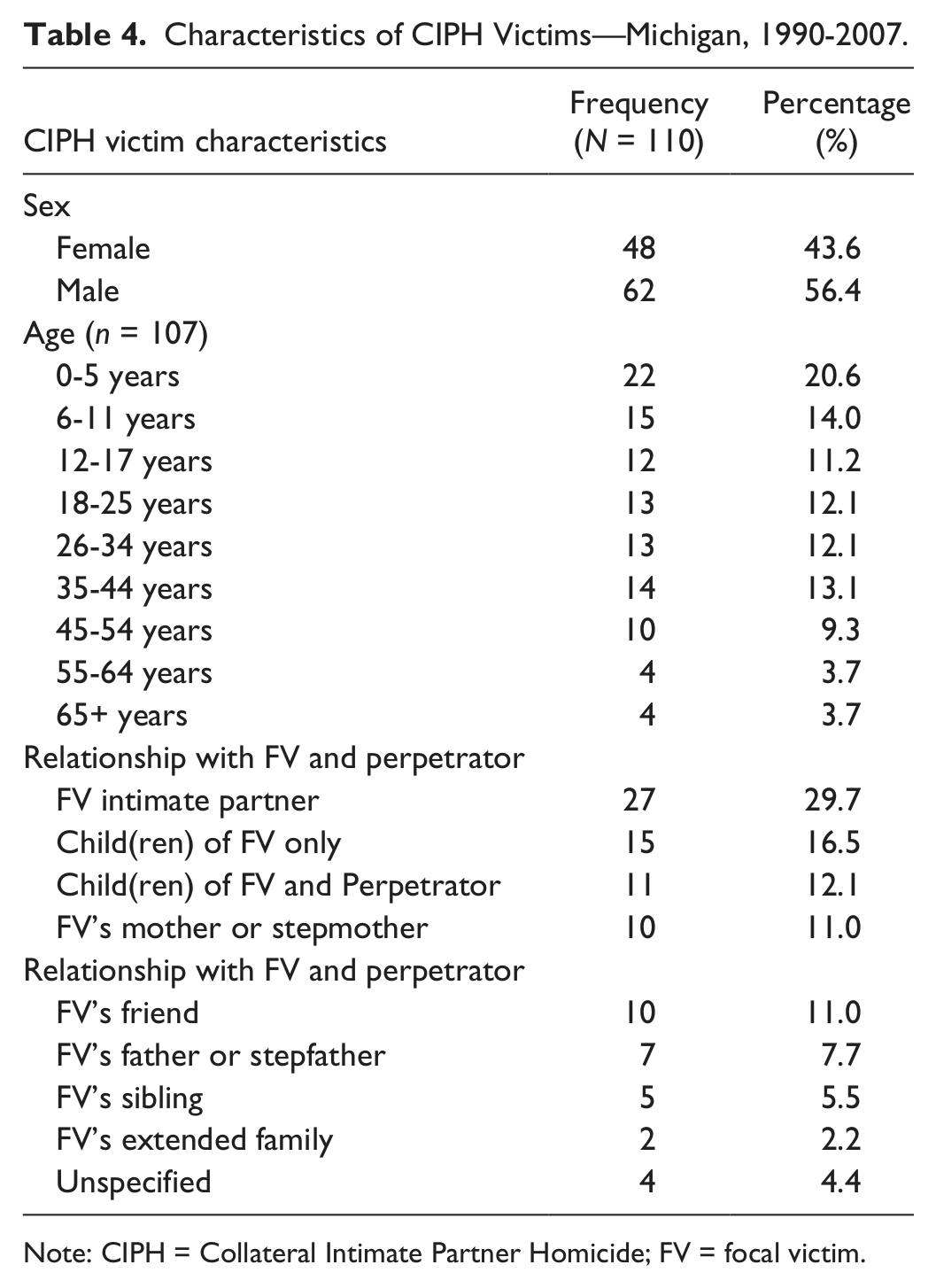
Note: CIPH = Collateral Intimate Partner Homicide; FV = focal victim.
In an article about the shooting of a 9-day-old infant, the journalist portrayed expectation by reporting evidence of previous violence and several warning signs leading up to the homicide. Space was dedicated to local domestic violence resources and explored risks associated with escalating violence. Thus, a pattern of abuse and coercion was established: Dean had kicked her in the stomach and blackened her eye when she was 7 ½ months pregnant, and that Omar Dean Jr. was born with a broken collarbone . . . she [Morlethia Bellman, the focal victim] described a series of other incidents, and said she made several reports to police at the 9th (Gratiot) Precinct. (Wilson, 1992, pp. 3A, 11A)
Homicide Explanations
CIPH coverage in 83% of the articles was incident-specific, covering only the present homicide(s), while 17% mentioned past relationship problems or abuse (i.e., thematic; Table 5). Two types of explanations were present: (a) the homicide(s) was perpetrated with malice aforethought and (b) the homicide(s) was the result of an interpersonal conflict in which the focal victim played an instigating role. More than half of the articles (52%) stated that a recent familial/interpersonal conflict or fight within the primary dyad triggered the CIPH. Only 5% said that the CIPH was a willful act based on previous violence or abuse in the focal dyad, and 43% offered no explanation.
News Media Explanations and Portrayals of CIPH—Michigan, 1990-2007.

Note: CIPH = Collateral Intimate Partner Homicide; AP = Associated Press.
To illustrate an example of focal victim and perpetrator conflict as a contributing factor, infidelity was the reason given for why Leo Carmona killed his girlfriend’s 2-year-old son, Jonathon Matson: A man accused of throwing his girlfriend’s 2-year old son to the floor and killing him out of jealousy over her going out with another man has been convicted of second-degree murder . . . Carmona was home alone with Jonathon while Matson was out with another man and got upset because the toddler was misbehaving. (Associated Press, 2005)
In an example of homicide perpetrated with malicious aforethought, a man killed his three children and then himself in a house fire: Hicks, 41, threatened to steal his children, blackened the eye of his wife on one occasion and subjected her to a “history of physical abuse, mental abuse and violent behavior” . . . Theresa Hicks had filed for divorce last year, saying her husband physically and mentally abused her. She also filed a personal protection affidavit against her husband. (Associated Press, 1998)
Discussion
CIPH occurs when an individual exogenous to an intimate dyad is killed because of his or her affiliation to a focal victim. In our study, all CIPH perpetrators were male, with nearly half identified as ex-/estranged husbands or ex-boyfriends of the focal victims. Perpetrators primarily targeted focal victims’ new intimate partners and their children. While 81% of CIPH cases reported one collateral victim, the maximum number killed in a single event was four. These data paint an interesting picture of a male-dominated crime in which collateral victims are limited to female partners’ friends or family members. The only cases in which the perpetrator injured his children occurred when they were biologically related to the female partner/ex-partner. Focal victims, who were all female, were also injured in about a quarter of reported cases and nearly half were killed.
Our content analysis revealed that CIPH is primarily framed as incident-specific or episodic (83%), with no mention of contextual issues beyond the immediate homicide event. This finding is in line with previous IPH research. The crime is overwhelmingly depicted as shocking and unexpected, with less than 10% of news reports making note of a history of abuse or violence in the primary intimate dyad. However, when journalistic explanations were offered, more than half attributed the CIPH to an interpersonal conflict between the focal victim and perpetrator. Based on the homicide explanation definitions used in this study, when conflict was used as a reason for CIPH, both the focal victim and perpetrator were framed as contributing to the death(s). As a result, it appears as though a social breakdown frame dominates—that is, CIPH is the result of a family problem (Surette, 2010).
However, when considering the theoretical implications of the aforementioned findings, we must turn to the drastic gender differences in perpetration and victimization. In no prior study on IPV-related crimes has such a gendered pattern emerged. Previous studies of IPH have reported both male and female perpetrators/victims (Biroscak et al., 2006; Biroscak & Smith, 2005; Craven, 1996; Garcia et al., 2007; Rennison, 2003), albeit disproportionately leaning toward male perpetrators and female victims. Still, this finding lends support to the feminist perspective of IPV in that power and control over the woman is a likely goal of the violence. Many CIPH perpetrators were no longer in a relationship with the focal victim, but their actions appear to be driven by a desire to hurt their estranged/ex-partner. Taking away a child or a new intimate partner in her life is a powerful control tactic that lends credence to the coercive control perspective of Stark (2007) and other feminist scholars. Despite this contrast in sex ratios and relationship status of the perpetrators/victims, the news media framed the crime in an episodic fashion, using a family violence perspective to describe the crime. This framework has the potential to sway audiences to believe that severe outcomes of IPV, including CIPH, are the result of a triggering incident rooted in the intimate dyad.
Potential Limitations
A major limitation of this study is that collateral victims who survived an altercation were not included because the inclusion criterion was restricted to homicides. The exclusion of those who were not killed allowed us to focus on CIPH specifically; however, generalizations cannot be made about the nature and characteristics of the crime in cases where collateral victims survive an attack. It is possible that a different reporting pattern could emerge in this particular context. Moreover, while we took steps to ensure interrater reliability of collected data, we did not assess measurement validity. However, given the extreme nature of homicide events, it seems unlikely that many false positives would occupy our database.
It is also important to note the challenges associated with using the news to study crime. The news media are more likely to report newsworthy crimes and provide filtered, molded pieces of information to the public. News producers largely determine a crime’s newsworthiness by choosing which stories to report out of all known events, leaving those that are not bizarre, spectacular, or extreme on the desk (Surette, 2010). In addition, journalists and other news media personnel are under tremendous organizational constraints, which may impede their ability to produce an objective image of reality (Cohen & Young, 1981). Unfortunately, this coupled with the economic landscape of traditional media leads to decreased support for gathering additional information. Journalists are likely processing news releases, official records, or press conferences instead of conducting their own investigations (Mason, 2007). This lack of investigation and journalistic specialization has negative ramifications on the reporting of complex situations such as CIPH.
Finally, although newspaper articles are a good data source and we have an exhaustive collection of CIPH coverage, all deaths may not be reported by each newspaper (Biroscak et al., 2006). What is considered newsworthy in Detroit is going to be different from rural newsrooms in northern Michigan. Crimes are more likely to be deemed newsworthy if they are unusual, different, out of the ordinary, or affect individuals of higher social status or celebrity (Chermak, 1995; Meyers, 1997; Oliver & Meyer, 1999; Surette, 2010; Tuchman, 1978). Although CIPH is a unique, relatively rare crime, murders are perceived as less newsworthy by journalists in urban areas and when murder victims are disproportionately African American (Lundman, 2003; Meyers, 1997). As a result, not all homicides are going to make the news. Notwithstanding limitations such as these, our findings are novel and help further our understanding of IPV.
Conclusion
This study has several implications, the most immediate of which are its contributions to the IPH literature. Through an intensive content analysis of reported incidents of CIPH, we now have a better understanding of the dynamics and nature of CIPH. Our findings suggest that members of focal victims’ social and familial networks are also at risk for injury or death. As such, court systems, law enforcement officials, and Child Protective Services (CPS) professionals should broaden their definitions of IPV victims and IPH to include persons outside of the immediate dyad.
The next step in this particular line of research is to conduct a qualitative analysis of CIPH news reports. This will produce a more detailed understanding of the crime and supplement the quantitative findings presented in this article. As we have assessed newspaper articles in Michigan, we recommend examining CIPH across the United States. We also suggest primary data collection with members of the media industry, including both journalists and editors. The more we learn about this phenomenon, the better we can train journalists to consider CIPH through a more critical lens and within the broader context of IPV. In addition, this information support tailoring prevention and intervention efforts for individuals outside of, yet still connected to, the intimate dyad.
In conclusion, this is the first study to investigate media reporting of CIPH. Our analysis of all reported cases suggests that a feminist theoretical model of IPV better explains the crime, despite a preponderance of family-conflict-oriented news frames. While CIPH is frequently presented as the result of interpersonal conflict, the striking gender asymmetry in perpetration and victimization positions it as a gender-based crime. This study pushes the literature one step closer to understanding the complex relational issues involved in CIPH.
Footnotes
Declaration of Conflicting Interests
The authors declared no potential conflicts of interest with respect to the research, authorship, and/or publication of this article.
Funding
The authors received no financial support for the research and/or authorship of this article.
Author Biographies