




Abstract
Rarely in recent history has there been a challenge to public health as great as the COVID-19 pandemic. With newer cases still being reported on a daily basis, the media has maintained close track of the development of the outbreak in their news reports. This study analyzes representations of the European Union and the United States in China Daily, one of the major Chinese state media, through a content analysis of 88 news reports concerning the pandemic situations in 2020 from a broad perspective without explicitly elucidating the individual differences of the countries and states within these two global players. It reveals that China Daily represents the EU and the US differently within the global context of the COVID-19 pandemic, particularly in the intensity of the outbreak, coordination and response, and most notably, their amicable and antagonistic relations with China. The results of the analysis epitomize China’s interactions with major global actors from the West, which are increasingly shifting away from the traditional “East versus West” dichotomy, and the EU and the US are viewed as differentiated “others” from China’s perspective according to the reports involved in this study.
Introduction
The Coronavirus disease (COVID-19) has swept across the globe at an unprecedented rate. The outbreak of the pandemic has inflicted serious damages on public health; numerous studies have already focused on the transmission and mitigation of the disease from a medical perspective (e.g., D. Wu et al., 2020); and the WHO and health departments of various countries have issued extensive reports and guidelines concerning the COVID-19. During the global outbreak, Chinese news media have provided broad coverage concerning not only the pandemic situations in China but also those of other countries and regions, including the European Union and the United States, two of the world’s largest economies and most influential global players that share with China a relation characterized both by contentions for power and interest as well as cooperation and coordination (M. Li, 2011).
By analyzing China Daily’s pandemic-related reports of both the EU and the US, this study aims to offer a glimpse of recent representations of these two major global players from Chinese state media. China Daily may not be viewed as representative of Chinese state media as a whole, it is nonetheless one of the largest English news portals in China. More importantly, as a news press operated by the Publicity Department of the CPC Central Committee and the Information Office of the State Council, China Daily is often seen as one of the major voices of the central government of China, and like other official Chinese press, embodies “the traditional Communist orthodox framing of news” (H. Zhou, 2000, p. 612). Studying the news frames constructed by this news portal could at least yield a generalized understanding of the perceptions of the EU and the US from the Chinese government.
The reports involved in this study have covered the severity of the outbreak, the responses for pandemic control and attitudes toward cooperation in containment measures in the EU and the US, constructing and presenting them as the differentiated “others.” What needs to be clarified, however, is that the study considers both the EU and the US as single organisms rather than a collection of countries or states, as has been done by multiple previous studies (Chaban & Elgström, 2014; Jiang et al., 2021; Lams, 2010). In other words, this study views the EU and the US as two major global players in a broader international landscape, since comparisons of the nuanced differences between the countries or states within them is very well beyond the scope of this study. Through investigating how the images of the two sides are constructed in the news reports by adopting the approach of inductive framing, we intend to analyze the interpretive packages identified in these reports and the ideological foundation that may contribute to the differences of images constructed by the journalists. The study seeks to contribute to our understanding that Chinese state media’s representations of major global actors in the West, reflected from our analysis of the news reports from China Daily, are not unitary but are multiple and continuously changing.
Literature Review
Historical Context: How China Was Represented by the US and the EU
Before we dive straight into the studies on Chinese media’s representations of the EU and the US, it might be necessary to redirect our attention to how China was represented by media from the EU and US. Admittedly, the EU and the US are not equal to the totality of the entire western world and news media from them certainly do not represent all the western media, but they are nonetheless major players in the league. An analysis of the representations of China from these two countries would offer the historical context for Chinese media performance of representing the West.
Early representations of China from the US media date back to the founding of the PRC in 1949, if not earlier, and had always paralleled the fragile US-China relationship (Lee, 2002), mostly manifested as ideological biases against the country (Peng, 2004). With historical events including the Korean war, representation of China in US newspapers often involved the use of ideological and emotional symbols, such as “Red China” or “Communist China” (Chang, 1989), instead of the legal and official symbol of the country (e.g., PRC), revealing a strong anti-Communist ideology (Yan, 1998). Former US president Nixon’s visit to the China and the subsequent establishment of diplomatic relationship between the US and China offered a brief moment of general amicability in the US media’s depictions of the country, when China was seen as a non-threatening socialist country with rich cultural heritage and historic sites (X. Xu & Parsons, 1997). However, this rather amiable representation quickly deteriorated after some historical events, such as the breakup of the USSR, which greatly shaped the then US-China relationship with their implications percolating to present interactions between the two countries. As Stone and Xiao (2007) has pointed out, the coverage of China from the US media increased significantly in the post-breakup era, but the themes and frames about China were drastically different and increasingly negative. The collapse of the Soviet Union and the Eastern bloc communist countries have left China “as the single largest remaining communist nation emerged to fill the vacuum” (Ono & Yang Jiao, 2008, p. 407). From this point on, China was mostly represented by the US media in a negative light, as can be witnessed from previous longitudinal studies (e,g, L. Tang, 2018). Liss (2003) analyzed US print media’s representations of Sino-US relations and found that the negative images of China overwhelmed the positive, though the relations between the two sides is sometimes seen as a partnership. Peng’s (2004) study of New York Times and Los Angeles Times showed that the coverage of China has become more negative with political frames and ideological frames of the country being more likely to be unfavorable.
One of the possible reasons of the generally negative representations of China’s image from the US media may reside in its selections of the topics and themes when it comes to covering China in their news reports. As scholars have pointed long ago, the predominant frame of China adopted by US media has always been that of “anti-Communism” or “the deceitfulness of Communists” (Kobland et al., 1992). Although China has emerged as a rising power with political and economic influence across the globe, “a Sinophobic dimension remains a constitutive aspect of the discourse” (Ono & Yang Jiao, 2008, p. 409). Though there is literature suggesting China’s image has seen a slight improvement a decade ago (e.g., Moyo, 2010), but that did not stop the mounting Sinophobic discourse in the US media’s representations of China (Lams, 2016), which is often fueled by the stories on human right abuses and political suppression (Lee, 2002; Liss, 2003; Stone & Xiao, 2007; Syed, 2010). Moyo (2010) compared the reports of CNN and Xinhua news agency’s reports on the Tibetan protests and pointed out that the CNN intended to advance a manipulative and unjust neoliberal international order through its selective articulation of human right and use it as a political tool. As Hall (2000) suggested, the US media has always used political and ideological frames to depict China’s event, and the recurring themes of human right issues in US media’s representations of China, which partly derive from the longstanding anti-Communist and Sinophobic sentiments in the West, are still present in the US media’s coverage of China.
As China has become a rising economic power and its impact in international affairs increased, the country was moved to the “elite” group of nations in terms of coverage (Sparks, 2010). The rise of China’s economy and global status certainly had influenced the US media’s representations on the country, but recurring themes of anti-Communist and Sinophobic rhetoric did not fade away and has taken into other forms. On the one hand, the media paid more attention to the economic reform of China and its big potential market and investment opportunities. On the other hand, the “linkage and de-linkage” of human rights and trade policies toward China by the US were still hotly debated by the media (Zhang, 2010). China was depicted as a competitor of the US and its increased global influence would negatively affect the US (Stone & Xiao, 2007). The increased global influence of China has led to more diversified topics when it comes to representing China from the US media, though this diversity does not necessarily lead to an improved image of the country. Apart from aforementioned topics such as human rights and political oppression, topics outside the political realm began to surface, ranging from medical care to sports. For example, Huang and Leung (2005) studied the media representations of China during its handling of the SARS epidemic and reported the negative coverage of China, though the negativity is not the result of ideological bias, but rather due to China’s mishandling of the epidemic. Syed (2010) studied coverage of editorial boards of widely circulated newspapers and three largest cable networks in the US on the 2008 Beijing Olympic and concluded that China’s image has become increasingly negative directly before, during, and after the game. More recent studies focused on environmental issues relating to China’s economic boom, which have become another major topic in representing the nation (M. Liu & Li, 2017; M. Liu & Zhang, 2018; Shapiro, 2012; Tong, 2014; J. H. Xu, 2012). One of the particular focuses in this line was the US media’s representations of the smog in China. As studied by M. Liu and Li (2017) and M. Liu and Zhang (2018) have demonstrated that the Anglo-American English-language newspapers tended to amplify and dramatize the smog as a disaster with severe health risks for Chinese citizens and pressurized the Chinese government to take responsibility in both domestic and international environmental protection against the context of climate change, thus once again represented China in a negative light.
The long cultivated “anti-China” ideology revealed in the US media’s representations of the country was also observable in media in the European Union. Press in the EU were partly consistent with their US counterparts in representing China, as major focuses of the EU media on China also included human right issues, political suppression, and pollution, where the country was often negatively represented (De Swert & Wouters, 2011). Differing from the US media, which depicted China’s economic rise as a threat and has made China a competitor against the US, the EU media’s representations of China as an emerging economic power tended to be filled with mixed reactions, acknowledging China’s achievement in the economic sector while also foregrounding general negativity in areas including politics, ideology, and environmental protections. For example, Wilke and Achatzi (2011) analyzed two leading German newspapers’ representations of China and revealed that Chinese enterprises were assessed most positively and other economic topics including international economics and national economics from China were also represented in a generally positive manner. In comparison, coverage of environment, justice, ideology, catastrophe, and domestic policies was often negative, and sometimes overshadowed the positive representations of the economic development of China. Moreover, despite the recent growth in economy and boost in international influence, China was still insufficiently covered by the EU media (Cohen, 2011), as the frames and topics included in China-related reports often appeared to be uni-dimensional and event-driven. Lams (2016) revealed that China was only marginally reported in Belgian international news reports. Similarly, Sparks’s analysis of UK news press found that down-market and middle-market titles mostly included little substantial coverage of China and often concentrated on large-scale and dramatic event that often represent the country negatively. Only elite titles carried more detailed coverage (Sparks, 2010). It showed that media representations of China in the EU were generally partial and often followed the approach of event-driven journalism (De Swert & Wouters, 2011). Topics such as social issues, education, science, and technology in China were completely disregarded, and the media often opted for themes with negative news values such as conflict and violence (Richter & Gebauer, 2011).
In a very brief summary, the US and EU media often represented China in a negative light with issues including human rights, political suppression, environmental problems, and economy. Whereas the US media often adopted an anti-Communist frame of China driven by Sinophobic sentiments, the EU media often marginally covered the country and followed an event-driven journalism during their reports of China and also represented the nation negatively.
Other as the Negative Mirror of the Self: Chinese Media’s Representations of the US and the EU
Compared to the plethora of literature on the western media’s representations of China, the quantity of research on Chinese media’s reports of western countries, in this case, the EU and the US, was surprisingly small. Representations of the two in the economic sector were often grounded in the context of globalization. The Chinese media discourse in this respect reflected “how the state has over time repositioned itself in response to challenges posed by competitive world powers, especially the United States” (Curtin, 2012, p. 7). In other words, how the US and the EU were represented depended not on their domestic economic landscapes, but on how they are linked economically to China. The relational dynamism to China dictates the difference of representations of the US and the EU in the economic dimension. In analyzing the Chinese media’s representations of the Sino-American trade relations, Murphy and Vilceanu (2014) identified from the reports that the press from China revealed a sense of historical inevitability of China’s ascension from periphery to the core of globalization and the US was no longer considered as the sole player of global economy, but one of the many partners for China. Lee (2012) noted a similar representation of the dynamism in Sino-US trade relations where the US was “bound to lead” in the post-breakup era of the USSR and China was “bound to rise” in the age of globalization. Their study echoed previous studies’ findings that with the progress achieved from its economic development, China has made the ascension from being a peripheral country to the “elite” group of countries (M. Wu, 2006), in this case, the core of globalization. The EU was seen by the Chinese media as less of a competitor in global economy and was often revealed as being in a position of needing China’s assistance. This may partly explain why media representations of the EU in China were explored occasionally (e.g., Zhang, 2009) and revealed a less antagonistic stance. The EU still retains a major role in the multi-polar world, yet it has become increasingly dependent on China in terms of economic recovery, and is thus an important trade partner and market opportunity for China (Chaban & Elgström, 2014).
Economic representations of the US and the EU from the Chinese media seemed to be less hostile, but politically it was another story. Traditionally, western media often adopted biased, negative, and event-driven coverage of foreign countries, and tended to construct a negative “other” stereotype of communist countries, including China (De Beer, 2004). This binary division between “we,” the western countries, and “them,” non-western countries like China (Leung & Huang, 2007), created a basic dichotomy between the West and China as the “self” versus the “other” from the western perspective. In both the US and EU media’s representations of China, “an ‘us’ versus ‘them’” Cold War mentality prevailed (Peng, 2004, p. 57) and China has long been the embodiment of the foreign and the “other” (W. Li, 2020, p. 110) and the “‘Sinophobic’ perception of the untrustworthiness of the Chinese people” (W. Li, 2020, p. 114) due to the dominant anti-Communism frames mentioned in the previous section. The misalignment of China’s perceptions of herself and other nations’ views (Zhang, 2010) propelled the country to fight back by dealing with these propagandistic images in an almost “tit-for-tat” fashion. A great number of Chinese people believed that the western media presented a “systematically, and maliciously, distorted account of Chinese realities” (Sparks, 2010, p. 347). In answering the “bad Communist” image depicted by the western media, the US was framed as a “beautiful imperialist and warmongering hegemon” (Hao & Su, 2007). In reversing western media’s “othering” of China, state-owned Chinese news press set up the US “other” as the negative mirror of the Chinese “self” and fueled the anti-other rhetoric through discursive practices of an ideological nature and linguistic tools of alienation. (Lams, 2010). This result was not surprising, given the history of antagonistic representations between the two sides. However, researches on the EU from this perspective were rarely available, at least in international publications, with the exception of the study on the Chinese media’s representations of the EU refugee crisis from Jiang et al. (2021). Yet the event centered in the discussion (the refugee crisis) was a relatively local issue in the EU, not an international incident faced by both the EU and China. Due to the complex representations between China and the EU in the past, it would be interesting to explore how Chinese media represent the EU as a different “other” to China in a global context.
Admittedly, the traditional discourse of “East versus West” is challenged and the international relations under globalization cannot be simply described as a dichotomy between the two sides. However, “fossilized images of the Other do not quickly erode” (Lams, 2010, p. 323) and the anti-Communism frame from the West and antagonistic portrayal of the West from China can still be witnessed in their present news coverage of each other. The US and the EU were still seen by the Chinese media as who often force western democracy and liberty to other countries with failure to bring peace and prosperity. The EU, as an “ideological partner” with the US (Wang, 2019) saw itself as US’s alley (Men, 2016), and sided with the US in the “Us versus US” confrontation (X. Zhao, 2020) between the two global powers. On the other hand, however, China’s important economic ties with the EU has partly differentiated the country’s approach to the region in comparison to the ones with the US. Moreover, China and the EU shared common aspirations in jointly promoting a fairer, more just, and more balanced global governance system, as can be witnessed from their cooperation efforts after the US unilaterally exited the Paris Climate Agreement, as well as joint reform on the World Trade Organization (H. Zhou & Jin, 2019). Although the US is still the focal point of China’s diplomatic interactions, the EU is now seen by China as a “more balanced partner in a multilateral world” (Y. Hong & Li, 2018; Lucarelli, 2007). The relations among China, the US, and the EU have formed a “New Strategic Triangle” where the EU-China relation can be considered as a “new axis in world affairs” (Shambaugh, 2005). Recent scholarly literature from China tend to consider the relationship among these three global players as “intricately intertwined with conflicts and shared interests” and “the EU would not simply follow the US and give up the huge interests from its interactions with China” (Y. Tang, 2021, p. 25).
Given the “reflexive expectations” between the EU and China (Zhang, 2016), it would be interesting to investigate if Chinese state media’s representations align with the relational dynamism among the three global players. Specifically, we feel compelled to see if the US and the EU were represented respectively as differentiated “others” by the Chinese media, or opponents separated by the traditional “East versus West” dichotomy. Naturally, one may argue that the ways of reporting the two sides from the Chinese media may already be varied as they involved two different actors which treated the same event with dissimilar approaches. However, as mentioned above, it is still not clear if the representations of the Chinese state media of the EU follow the “East versus West” dichotomy or the “New Strategic Triangle” hypothesis as there is literature available on Chinese state media’s representations of the EU as the “other.” Moreover, the selections of topics and themes in the EU-related media coverage can be viewed as an indicator of the core news values adopted by the media, reflecting its intentions in representing a given subject.
“An investigation of domestic media messages about powerful “Others” is critical to understanding international relations and national policy choices (Chaban & Elgström, 2014, p. 171). This study follows the line of research from Lams (2010) in analyzing the representations of the western “others” from Chinese perspectives, but with a slight alteration as it adds a comparative dimension between Chinese state media’s representations of two western actors. Also, the context in which the comparison is conducted is not a single, one-off incident that happened between two nations like the Hainan Standoff between China and the US, but in a pandemic that places the comparisons of the Chinese media representations of the “others” in a wider global context. Consequently, in order to enrich the scarce literature of Chinese state media’s performance in representing the western “other” and provide potential reference to studies of future Chinese policies and relations with the US and the EU, this study aims to answer the following questions:
RQ1: What are the most salient news frames and interpretive packages of the COVID-19-related news reports of the EU and the US in China Daily?
RQ2: What are the signature matrices that constitute the interpretive packages and how were the US and EU represented accordingly?
RQ3: Based on the representations of the US and the EU elucidated from the interpretive packages, were these two global players constructed as differentiated “others” to China in China Daily’s COVID-19-related news reports?
Theoretical Framework
As an analytical tool, frame analysis has been widely used to study media discourse, particularly in political news (Van Gorp, 2005). News framing involves the selection of certain elements of a story while neglecting some aspects of the story (Entman, 1993; Goffman, 1974), intentionally or unintentionally. Entman believes that to frame is “to select some aspects of a perceived reality and make them more salient in a communicating text, in such a way as to promote a particular problem definition, causal interpretation, moral evaluation, and/or treatment recommendation for the item described” (Entman, 1993, p. 52). A frame should be seen as “a central organizing idea of a set of agendas for making sense of relevant events, suggesting what is at issue” (Gamson & Modigliani, 1989, p. 157). Based on Gamson’s and Modigliani’s definition, Tankard (2001, p. 100) then proposes that a frame is “a central organizing idea for news content that supplies a context and suggests what the issue is through the use of selection, emphasis, exclusion, and elaboration,” which is later summarized by Entman (2007, p. 164) “as the process of culling a few elements of perceived reality and assembling a narrative that highlights connections among them to promote a particular interpretation.” To achieve this purpose, however, it requires an operative approach such as the analysis of interpretive package, which was based on the constructionist view of frames in news discourse mentioned in the previous section, and more specifically, the “inductive frame,” which allows researchers to design new frames inductively with an open-ended view if no previous frame model suggests itself as suitable for adoption to analyze news content (Pak, 2016). Applications of inductive framing of media discourse analysis, represented by the adoption of interpretive package, can help researchers to identify a particular frame with different condensing symbols that suggest the core frame and positions (Gamson & Modigliani, 1989).
This study adopts the concept of the interpretive package from Gamson and Modigliani (1989) in analyzing the differentiated representations of the EU and the US from the Chinese media. As an approach of inductive framing analysis of news discourse, the interpretive package provides an alternate research path and theoretical guidance to the analysis of news discourse (Q. Zhou & Wu, 2017). An interpretive package contains a signature and framing devices that suggest integration and synthesis into wholes and reasoning devices that emphasize analysis and differentiation into parts. The core of a package is, similar to “dominant frames” or “content themes” (e.g., Anderson et al., 2005), a central organizing idea or frame and condensing symbols that demonstrates the package as a whole with symbolic devices (Gamson & Modigliani, 1989). Specifically, “a package offers a number of different condensing symbols that suggest the core frame and positions in shorthand, making it possible to display the package as a whole with a deft metaphor, catchphrase, or other symbolic device (Gamson & Modigliani, 1989, p. 3),” which can be then summarized in “a signature matrix that states the frame” (Gamson & Modigliani, 1989, p. 4) which contains a signature that stands for a set of elements that suggest its core frame and position. This can be further divided into a framing device and a reasoning device, with the former including metaphors (characteristics of the associated subject that attach to the principal subject), exemplars (real events of the past or present are frequently used for the same purpose), catch-phrases (a single theme statement, tag-line, title, or slogan that is intended to suggest a general frame, depictions), depictions (certain principal subjects that they characterize in a particular fashion), and visual images (icons and other visual images that suggest the core of a package), while the latter including roots (the causal dynamics underlying the strip of events), consequences (a characteristic analysis of the consequences that will flow from different policies), and appeals to principles (characteristic moral appeals and uphold certain general precepts; Gamson, 1981; Gamson & Lasch, 1983; Gamson & Modigliani, 1989). These elements form a signature matrix where the said elements can reveal the package’s core frame in a condensed manner.
Methodology
Data
The data are English news reports of the COVID-19 pandemic collected from China Daily, a news portal with the most print circulation of any English-language newspaper in China. The target audience of China Daily are mainly diplomats, foreign expats, and tourists, making it an “instrument of China’s public diplomacy” (Hartig, 2017). Hence, the selection of this news portal as the source of data for this study is because it is considered as one of the major platforms of explaining the government’s stance on foreign policy issues. The data was retrieved from the China Daily news source on Dow Jones Factiva news database (www.factiva.com) by searching the keywords “COVID-19 or Coronavirus” in the time-span from 10th January 2020 to 28th December 2020, covering most of the pandemic-related news reports from the media in 2020. All articles retrieved from the Factiva database were manually selected based on their relevance as news reports that mentioned the EU or the US less than three times were omitted. Moreover, articles that are less than 100 words (e.g., bulletins), interviews, captions, and duplicate articles were also excluded. As a result, 88 news articles were selected for the analysis.
Gathering Interpretive Packages
By considering a frame as “a central organizing idea for making sense of relevant events and suggesting what is at issue” (Gamson & Modigliani, 1989, p. 157), we first conducted multiple readings of all articles and tried to separate the major themes or issues in the article through the process of “open-coding” (Strauss & Corbin, 1990), which includes constant comparisons of the themes emerged in the articles. After identifying the most dominant themes in the articles, we began categorizing the repetitive themes by using the article as the unit of the analysis, which led to three major frames of the articles in both EU and US related coverage. We then introduced the extraction and categorizations of the dominant frames to two graduate students who worked as independent coders. The students were initially trained on the coding instrument of the articles, followed by discussions with the researchers which led to the modifications of the code sheet. Intercoder reliability test performed by the student coders was based on the total population of the reports. The level of agreement across the three major frames range from 0.84 to 0.91 (mean), using Holsti’s formula, indicating all the frames had acceptable agreement.
After the initial coding and categorizations of the dominant frames emerged in the articles, the researchers and the student coders then discussed together the potential interpretive package gathered during the initial reading and the subsequent coding of the data, following an inductive approach. The typology of the packages was based on the categorizations of the frames. The packages revealed in articles of sub-category frames under the same dominant frames may be merged due to their relevance and similarity (e.g., content, causal linkage, etc.). For example, packages under the sub-category “spread of the disease” and “social and economic disruptions” could be merged as they often establish a causal relationship, in other words, the spread of the disease usually lead to social disruptions, as is stated in many articles. Moreover, packages under certain sub-categories were omitted as they rarely appear in the articles. For example, only one article falls into the sub-category “individual case,” thus the package from this sub-category is not considered as one of the major packages identified in its superordinate theme “risks and crises.” After eliminating articles that do not reveal a dominant frame and sub-category articles that only appeared once, we selected 79 out of 88 articles in the analysis of the interpretive packages.
Certain adjustments to the elements in the signature matrix of the packages were also conducted due to the nature of the research subject and the data collected. After a careful examination of the articles included in the research, we only found a few metaphors and catch-phrases in the articles and they often appeared to be less relevant to the topics discussed or were less representative of the texts’ central organizing ideas. Thus, the analysis of metaphors and catch-phrases will be excluded from this research. Instead, plenty of linguistic evidence relating to the expressions of the positions of the journalists and, in turn, the Chinese government, can be observed. Accordingly, we included position as a new element to the framing device, which we defined as the authors’ attitude or opinion on the news subject. Moreover, exemplar was replaced with examples, as the journalists often used current events to consolidate their points in the news reports. Lastly, the visual image is not included in this study since the analysis is focused on text-based materials.
Based on the aforementioned structural modifications, this research subdivided the data into text and context in analyzing the interpretive packages observed from the news reports of EU countries and the US in the pandemic. Each package contains a signature, a central organizing idea of the package; a core, which is the frames and positions of the signature; a framing device that includes the depictions and examples to the core; a reasoning device, which includes the roots, consequence, and appeals to principle that serves as the reasons and results of the core.
After establishing the structure of the interpretive packages adopted in this study, the author first analyzed the articles included and identified the interpretive packages in the reports of EU countries and the US respectively by illustrating the signature, the core, the framing device, and the reasoning device in these reports. The author then investigated the representations of EU countries and the US constructed based on these findings. Finally, a detailed comparison of these representations was conducted to get a glimpse of if and how EU countries and the US have been constructed as differentiated “others” in Chinese state-owned media.
Results
RQ1: What Are the Most Salient News Frames and Interpretive Packages of the COVID-19-Related News Reports of the EU and the US in China Daily?
We have identified three major frames in the reports, including Risks and crises, which concerns the spread of the disease, health risk, social and economic disruptions, individual case, and pressure for the government; Response measures, which includes containment measures, internal coordination, and individual story; Interactions with China, which are mostly depicted on three levels, namely governmental, medical, and civil. Based on the frames identified, we have gathered and summarized the dominant interpretive packages in the COVID-19 related reports of the EU and the US. Tables 1 and 2 reveal the interpretive packages, dominant frames and salient sub-frames gathered from reports of the EU and the US, respectively.
General Information of EU-Related News Frames and Interpretive Packages.

General Information of US-Related News Frames and Interpretive Packages.

As can be seen in Table 1, the most common interpretive package of EU-related reports are the Scientific breakthrough package (42.9%, n = 15) which is dominated by the technological advancement sub-frame under response measures, followed by containment measures adopted by the EU. The second most popular package is Tortured by the pandemic (22.9%, n = 8), represented by both the spread of the disease and social and economic disruptions sub-frames. This package is followed by Partners with China (22.9%, n = 8), which mainly include the governmental and civil interactions between the EU and China
As can be seen in Table 2, interpretive packages of the US are led by Devastated by the pandemic (39.6%, n = 21), which mainly concerns the spread of the disease, social and economic disruptions, and individual cases. The next package is Political antagonism and medical cooperation (28.3%, n = 15) and it mainly includes the US’s governmental and medical interactions with China. This is followed by the Chaotic response package (22.6%, n = 12), which focused mostly on the response measures of the US in its containment measures, internal coordination, and technological innovations. Detailed analysis of the different packages can be seen in the following sections.
RQ2: What Are the Signature Matrices That Constitute the Interpretive Packages and How Were the US and EU Represented Accordingly?
The signature matrix of the interpretive packages of the EU in the reports can be seen in Table 3.
Signature Matrix of the EU-Related Reports.

Tortured by the pandemic
The core of this package is the risks and crises for the EU during a global pandemic, particularly in the face of the spread of the disease and relevant economic and social disruptions. The deadly nature of the virus is highlighted as one of the critical factors that are causing significant public health risks, as can be witnessed from examples that “Europe have seen their daily Coronavirus infection numbers set new records” (“Europe reeling as surge pushes coronavirus cases to record highs,” 2020, para. 1). The pandemic situation in the EU continues to worsen and the EU is still yet to relieve itself from the pressures of the COVID-19. The disease also causes troubles for the economy as companies are forced to “close factories and cut output” (“ Coronavirus piles up pressure on Europe’s stricken auto sector,” 2020, para. 1). Other sectors including education are affected as well, since the pandemic “has delayed college applications and visas” (Yang, 2020, para. 1). The roots of the risks and crises are the deadly nature of the disease, worsened by a second wave of the pandemic, which left EU nations under-prepared. As a result, the EU experienced an uncontrollable spread of the disease, leading to grave health, social, and economic problems. The tone of the package is neutral as it mostly involves fact-based reports of the pandemic situations in EU countries. In summary, the construction of this package is mainly achieved through listing statistics of new cases and deaths, introducing the contagious nature of the disease and its toll on the medical system, and pointing out the pressure faced by the economic and educational sectors.
Scientific breakthrough
The major focus of this package lies in the response measures from the EU, which is dominated by depictions of technological innovations in disease control, though the lockdown measures could be more stringent. The progress made in disease containment and testing has led to multiple inventions including the SPOR-COV nasal spray (Mcneice, 2020a), quick testing (Mcneice, 2020b), and other innovative measures. The roots for this advancement can be attributed to contributions from researchers and medical professionals as well as the funding from the government, leading to increased effectiveness in preventing the spread of the virus. However, despite the progress made in scientific innovations, a relatively small number of articles also focused on the lockdown measures of EU countries, depicting them as not very stringent since they are sometimes in the form of a “light version of quarantine” in some EU nations (Chen, 2020b, para. 9). The roots of this are due to the fact that the government is unable to impose strict lockdown measures as they do not possess the ability to provide support system to their citizens and people are tired of the quarantine, thus countries sometimes are unable to stop the transmission of the disease. The tone of this package is mostly neutral, as only one article covering the containment measures of the government reveal a slightly negative tone. In summary, the construction of the signature Scientific breakthrough is mainly achieved through highlighting scientific progress of the medical sector, though a small portion of articles have also focused on the difficulties and flaws in EU’s lockdown measures.
Partners with China
The central issue of this package is EU’s interactions with China with the journalists adopting a mostly positive position in their reports. The EU is depicted as both China’s partner and beneficiary of China’s assistance, as can be exemplified from Serbian President Vucic that “China is the only country in the world that can help Serbia” (Gale et al., 2020, para. 15). The collaboration between the two sides has exceeded beyond the medical sector as leaders from both sides have agreed to advance cooperation in other fields, as President Macron suggested that “his country stands ready to strengthen bilateral trade and investment cooperation as well as teamwork in international affairs” (Cao, 2020, para. 12). Other examples include the positive dialogues between President Xi and Chancellor Merkel, Prime Minister Conte, and other national leaders from EU countries. The cooperative attitude between the business and civil sectors are also demonstrated by the reports. The roots of these cooperative efforts are the mutually supportive attitudes between national leaders, high level officials, and the business and civil sectors. As a result, the ties between the two sides have been strengthened during the pandemic. In summary, the construction of the signature Partners with China is mainly achieved through highlighting the cooperation between various levels from the two sides and the results of the cooperation.
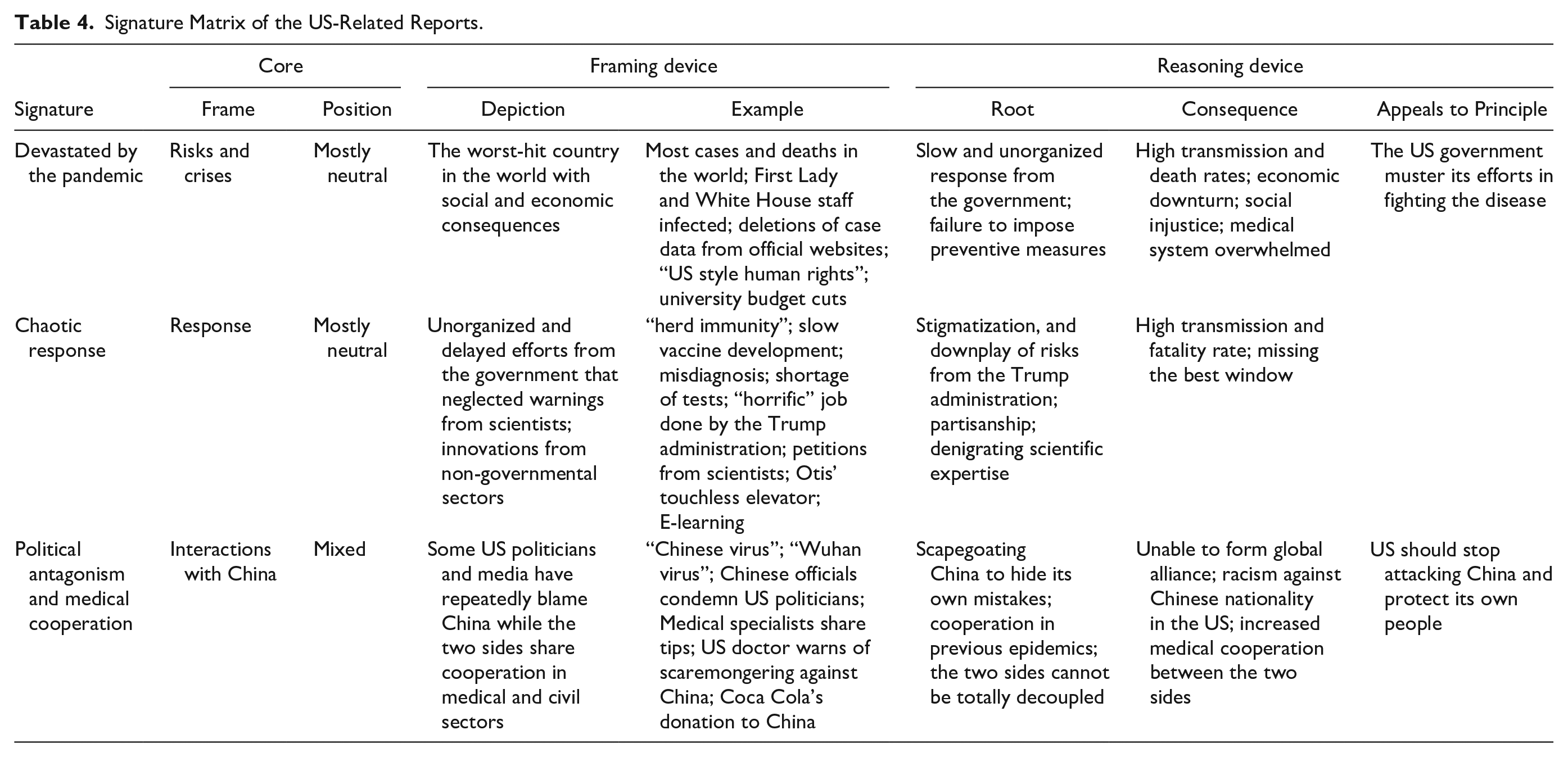
The signature matrix of the interpretive packages of the US in the reports can be seen in Table 4.
Signature Matrix of the US-Related Reports.
Devastated by the pandemic
The package focuses on the risks and crises in the US during the pandemic and adopted a mostly neutral tone. The US was depicted as the worst-hit country in the world, as can be seen from the examples that the US has “the highest number of confirmed COVID-19 cases worldwide” (Robinson et al., 2020, para. 1). By highlighting specific numbers of cases and deaths and the country’s overloaded medical system, the media delineated a gruesome picture of COVID-19 in the US. The pandemic also caused significant turbulence in other sectors of the society, as businesses were shutting down and schools were forced to close, racism against Asian ethnicities intensified, and social inequality exposed. The roots of the pandemic situation in the US are the slow and unorganized response efforts from the government, resulting in the country’s failure to impose preventive measures, and the stigmatization and downplay of health risks further weakened the country’s ability to contain the spread of the virus (H. Zhao, 2020). The consequences are thus the high transmission and death rates in the country, as well as economic disruptions, social injustice, and overloading of the medical system. Thus, the journalists have appealed the US government to “step up their efforts to prevent the virus from spreading in the first place” (Ai, 2020a, para. 21). In summary, the construction of the signature Devastated by the pandemic is mainly achieved through listing statistics of new cases and deaths, highlighting individual cases and pressure faced by the medical system, as well as coverage of social injustice and economic problems.
Chaotic response
This package mainly focuses on the response measures from the US, which is depicted as slow and unorganized, lacking a coordinated anti-epidemic plan. Moreover, the inability of the government was highlighted by its disregard of scientific measures in preventing the spread of the virus. Most notably, the Trump administration was criticized for the misleading promotion of ineffective response measures such as the “herd immunity” (Haseltine, 2020, para. 2), and was accused of “denigrating scientific expertise” (“US surpasses 5 million cases of coronavirus,” 2020, para. 14) in an open letter signed by 1,200 US scientists. Other examples of the chaotic response efforts from the US government include the country’s delayed vaccine development (Ai, 2020b), misdiagnosing COVID-19 as influenza (R. Zhao, 2020), and shortage of tests from the CDC (Zhu, 2020). Among the few articles that focus on the innovations of containment measures, the journalists all focused on non-governmental projects such as the Otis’ touchless elevator (Reeves, 2020) and E-learning (Yang, 2020). The roots in this package are the stigmatization and downplay of risks from the Trump administration and the partisanship (X. Hong & Ai, 2020) from the government, which led to consequences to high transmission and fatality rates in the country and the inability of the authority to form a coordinated anti-pandemic plan. In summary, the construction of the signature Chaotic response is mainly achieved through highlighting the lack of coordination of the government in its containment measures and the contradiction between the government and the medical sector due to their differences of attitudes toward pandemic control.
Political antagonism and medical cooperation
The core issue of this package is the US’s interactions with China, which is depicted as both antagonistic and cooperative. Thus, this is the only package that the journalists adopted mixed positions. Politically, the articles revealed that some US politicians, including ones from the top leadership, have been repeatedly criticizing China and blaming China as the source of the pandemic outbreak, as can be seen from the stigmatization of the virus from US State Secretary Pompeo, calling it the “Wuhan virus” (Chen, 2020a, para. 3), and President Trump and White House staff termed the virus as “Chinese virus” or “Kung-flu” (Y. Liu & Chen, 2020, para. 2). Unsurprisingly, this received heated response from the Chinese side, as Geng Shuang, Spokesperson of the Chinese Foreign Ministry, condemned the US politicians for “disrespecting science, scorning the WHO and denigrating efforts to contain the virus.” In contrast to the hostility between the two sides in the political spectrum, the reports depicted the medical exchanges between the two sides in a completely different and cooperative manner. As can be seen from examples that the medical specialists shared experience in combating the disease (Du, 2020) and a leading surgeon in the US warns of unnecessary scaremongering and “praises China’s medical rooms and operating rooms” (Robinson, 2020, para. 15). The roots for this contrasting image of US’s interactions with China lies in the fact that from a medical perspective, neither sides cannot succeed without the other, and the two sides have shared medical experience in previous epidemics. On the other hand, the reasons of political antagonism between the two sides, according to the reports, are due to the fact that the US politicians are scapegoating China to divert attentions from its own incompetence. Consequently, although the two sides shared medical cooperation during the pandemic, they were unable to form a global alliance against the virus. Thus, the journalists appealed in their reports that the US should stop attacking China and protect its own people. In summary, the construction of the signature Political antagonism and medical cooperation is mainly achieved through highlighting the contrasting attitudes toward China between the political and medical sectors in the US.
RQ3: Based on the Representations of the US and the EU Elucidated From the Interpretive Packages, Were These Two Global Players Constructed as differenTiated “Others” to China in China Daily’s COVID-19-Related News Reports?
As a medium, media often influence our imagination of the outside world through its construction of “reality.” Media reorganize “reality” through framing to help readers process the flood of news reports and perceive and identify salient messages (Goffman, 1974). Based on the packages identified from the EU and US related reports, we found varied representations of the EU and the US by China Daily during the outbreak of the COVID-19 pandemic in 2020, which mainly include the intensity of the pandemic situation, internal coordination and unity, and political interactions with China.
In terms of the intensity of pandemic situations in the EU and the US, the reports have demonstrated that the latter was experiencing a worse outbreak of the pandemic than the former with more cases detected, faster transmission rates, and more death tolls. This result is unsurprising as a simple comparison of the pandemic-related statistics between the two sides could verify this difference of intensity. However, reports of the EU are often grounded in the context of public health risks. By making the deadly and contagious nature of the virus and subsequent sufferings of EU nations salient, the journalists construct a “casual explanation” (Entman, 1993, p. 52) between a destructive pandemic and the vulnerability of the region. In contrast, reports of the US during the pandemic often adopted a political context where the handling of the pandemic situation by the government is equally, if not more, salient than the deadly nature of the virus. The journalists often imply the authority’s actions as one of the root causes of the outbreak of the pandemic in the US, adding a political context to the reports, thus the journalist establishes a causality of “pandemic-mishandle-suffering,” implying the government’s slow and delayed reactions have, to a certain degree, led to the outbreak of the pandemic
The different representations between the two sides in their internal coordination and unity during the pandemic outbreak are even more pronounced in the response measures frames. Reports of EU in this regard are dominated by the technological innovations from scientific projects in EU countries, which were often funded by the government. The united efforts taken by the government and the scientific circle have yielded promising results in the fight against the COVID-19 and the actions taken by the government are often depicted in a positive light, showing the dedication of the authorities during the outbreak and the support to the medical workers and researchers. These reports are in line with previous media representations of the EU during crises, which often depicted it as a “Union of integrity and a global actor” (Jiang et al., 2021, p. 1). In comparison, journalists often adopted a context of conflicts when it comes to reports of the response measures of the US and sometimes compared them with the ones adopted in China, representing the US as the negative other who handled the pandemic disastrously. Externally, polarized attitudes toward containment measures are mainly attributed to the government’s reluctance in adopting quick response measures, which has led to the lack of resources of the US in fighting the disease. Internally, the scientific circle is depicted as vulnerable and voiced their criticism on Trump’s policies. Admittedly, the difference in representations between the EU and US in their response measures may be due to their different approaches to the pandemic, as have been the case for China and Vietnam in their handling of the SARS outbreak (Huang & Leung, 2005). However, the comparison between China and US’s response measures and the subsequent good and bad outcomes, the media revealed an inclination of depicting the US not only as the negative other to China, but more importantly, the “negative mirror of the self” (Lams, 2010, p. 315), which is markedly different from representations of EU’s response to the outbreak.
The biggest divergence of representations between the EU and the US lies in their interactions with China in the political spectrum, especially between the top leadership. The journalists often highlighted the mutually supportive attitudes between Chinese and EU leaders and their willingness to expand cooperation into other sectors outside the realm of pandemic control. One of the potential reasons of the media’s representations of the amicable political interactions between the two sides, as Chaban and Elgström (2014) suggested, could be attributed to the facts that the EU has been increasingly framed by Chinese media as “dependent on China as a global partner” and “an important trading partner and a market opportunity for China.” Moreover, the EU is also seen by China as key player in China’s efforts of leveling the field of multilateral diplomacy and for checking the unilateral world dominated by the US (M. Li, 2011). In comparison, the political interactions between China and the US were often represented as less pleasant, and sometimes hostile, with US being the initiator of conflicts. As the media often demonstrated the US politicians’ “scapegoating” and stigmatization of China during the pandemic, and considered these acts as diversions of their mishandling of the virus outbreak, which portrays a political image of the United States as strong but aggressive, democratic but hypocritical with double standards (He et al., 2012). Just as the long-standing “China threat” argument is a US discursive construction of China as the “other,” the “US hegemonic threat” argument is a response from China in its “otherization” the US (Lams, 2010). which can be seen as the continuation of the long-standing anti-US rhetoric from the Chinese government and China’s self-representation as the victim of external aggression from colonial and capitalist powers (Brady, 2006).
Conclusion
Mapping out the ways in which different interpretive packages represent the EU and the US during the COVID-19 pandemic advanced the knowledge of how these two major global powers are represented by Chinese state media and added to the relatively scarce scholarly focus on the Chinese state media performance in representing the western “other.” This study reveals that the Chinese state media, in this case, China Daily, represents the EU and the US differently in terms of the intensity of the outbreak, internal coordination and unity, and political interactions with China. Admittedly, media reports cannot fully reveal the “reality” of international relations, which is far more intricate and complex, but the findings of this study did further prove the existing hypothesis on Chinese state media’s representations of China’s relation with the EU as increasingly cooperative while representations of the China-US relation are still dominated by the old “anti-US” rhetoric. We hope, through our analysis of the different interpretive packages of pandemic-related reports of the EU and the US from China Daily, to suggest that from the point of view of the Chinese government, the relations between China and the West are not seen by as unitary but are multiple and continually changing. As the EU and the US are constructed as differentiated “others” to China, it indicates an ongoing decomposition of the traditional dichotomy between the East and the West and a gradual shift toward the “New Strategic Triangle” formed by the US, the EU, and China where the EU-China relation is seen as the “new axis in world affairs” (Shambaugh, 2005).
Indeed, this study did have several limitations. First, the content analysis focused on a narrow period of time and considered the EU as a single organism, neglecting the differences of the countries within the EU. For example, Chinese state media’s representations of the UK are certainly not identical to those of Germany. The same limitations could also be applied to the representations of the US, as the image of the Trump administration does not necessarily represent the image of the entire country. To debate the “proper” representations of a country, or a union of countries, would result in endless discussions. Thus, this study merely offers a rather generalized understanding of the differences in representing the EU and the US by the Chinese state media. Speaking of which, this leads to the second limitation of the study, that is the relatively limited amount of news articles involved in the analysis, coming from only China Daily. Although it is one of the most important news outlets of China with a great quantity and variety of readership, inclusions of more news sources from China, such as other state and non-state media, and news outlets outside the mainland of China, would offer a more encompassing and objective view of the EU and the US from China.
Follow-up studies in this perspective are suggested in mainly two aspects: First, media representations of the US from China’s point of view might be reexamined amid shifts of leadership in the US; Second, future studies are needed to study how the West is presented by the ordinary people in China in their discussions and comments of the EU and the US during a global crisis like the COVID-19, and social media discourse in this perspective could be considered a possible candidate, forming a prospective vista in this area.
Footnotes
Declaration of Conflicting Interests
The author(s) declared no potential conflicts of interest with respect to the research, authorship, and/or publication of this article.
Funding
The author(s) received no financial support for the research, authorship, and/or publication of this article.
