




Abstract
Whether managers are concerned with financial issues, marketing, or human resource management (HRM), cultural values and practices do matter. The purpose of this article is to understand Norwegian managers’ cultural values within the cross-cultural landscape of her neighbors in the “Scandinavian cluster.” Clearly, subtle but disturbing differences may surface even when representatives from similar cultures work together. As a follow on from the GLOBE project, data based on the GLOBE instrument were collected on culture and communication values in Norway from 710 Norwegian middle managers for this present study. Although the Scandinavian cultures appear ostensibly similar, the results illustrate that research can reveal subtle but important cultural differences in nations that are similar yet dissimilar. All three Scandinavian societies appear intrinsically egalitarian; they appear to value low Power Distance, directness, and consensus in decision making and to promote Gender Egalitarianism. Nevertheless, there are significant differences in the degrees of commitment to these values by each individual Scandinavian partner. These differences need to be understood and appreciated to avoid misunderstandings.
Introduction
Clearly, culture matters in both business practices and academic research. Indeed a Google search for “culture” provides more than half a billion hits, and major social science electronic databases provide links to 100,000 to 700,000 articles when “culture” is used as the search key word (Taras, Rowney, & Steel, 2009, p. 357). Furthermore, a recent search by this author of published studies based on Scandinavian culture alone during the last decade shows more than 100 papers with culture as an independent variable (please see appendix). Indeed, academic studies published in the last two decades have indicated some distinctive aspects of Scandinavian management. Smith, Andersen, Ekelund, Gravesen, and Ropo’s (2003) seminal paper, “In search of Nordic management styles,” offers a valuable contribution to this field. Nevertheless, little has been published in the last decade to update these findings or to highlight the unique element of each individual Nordic society. Hence, the debate of how culture matters is ongoing. Consequently, this article will compare the findings from the GLOBE study of societal cultural practices from the Danish and Swedish data, to the Norwegian data from the author’s doctoral research, to understand any such cultural differences in Scandinavia.
The methodology and quantitative instrument applied in this present study of Scandinavian societal culture is based on Project GLOBE’s (Global Leadership and Organizational Behaviour Effectiveness) study (House, Javidan, Dorfman, & Gupta, 2004). This ongoing research is a multiphase, multimethod project examining the interrelationships between societal culture, organizational culture, and leadership. A total of 170 social scientists and management scholars from 62 cultures representing all major regions of the world are engaged in this long-term programmatic series of intercultural studies. Approximately 17,300 middle managers from 950 organizations took part in the original study by House et al. (2004), and 710 middle managers took part in this researcher’s doctorate study of Norwegian societal cultural practices. The meta-goal of GLOBE is to develop empirically based theories to describe, understand, and predict the impact of specific cultural variables on leadership and organizational process and to determine their effectiveness. More detailed information can be found on GLOBE’s website at http://mgmt3.ucalgary.ca/web/globe.nsf/index.
Intercultural research supports the belief that to be able to understand cultural and communication values, business people first need to be open and aware of their own values and then be able to compare their own cultural norms with those of their business partners. In terms of societies in the Nordic region, if business people appreciate how their behavior is perceived by others and how they can expect the other party will act, cultural clashes that could otherwise threaten the business relationship can be avoided (Warner-Søderholm, 2010b).
Participants in the Norwegian study unanimously saw societal culture and behavior in business in Scandinavia as regionally different (Warner-Søderholm, 2010a). Figure 1 below summarizes the findings of this “Scandinavian cluster study” from this researcher’s doctoral research. The following section then discusses the GLOBE dimensions of Uncertainty Avoidance, Collectivism, Assertiveness, Performance Orientation, Humane Orientation, Power Distance, Gender Egalitarianism, and Future Orientation, in a Norwegian context within a Scandinavian framework.
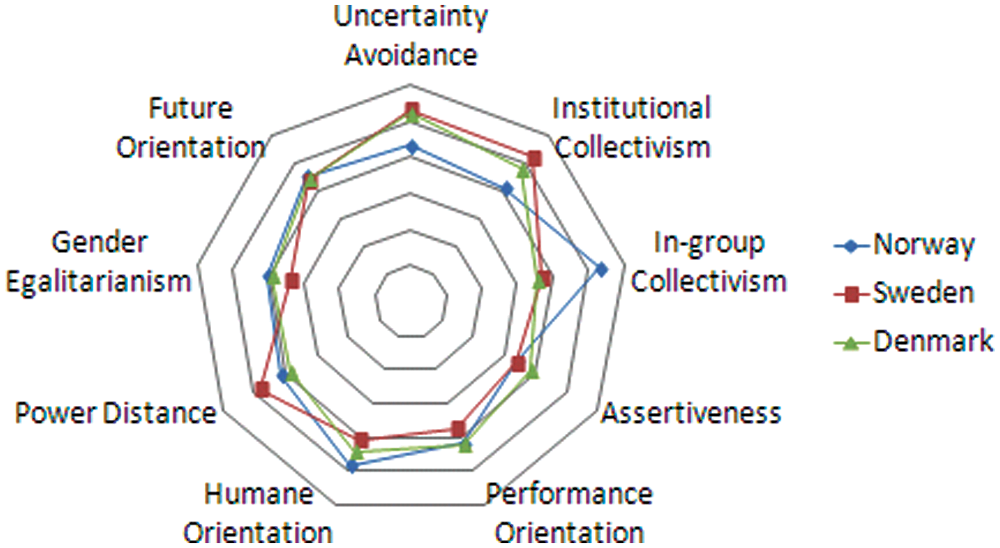
Societal cultural practices scores from Norway, Sweden, and Denmark
Project GLOBE’s Performance Orientation Within a Scandinavian Context
Performance Orientation is an important cultural dimension that has not been sufficiently examined in past theoretical or empirical cultural research (House et al., 2004). The few researchers such as Parsons and Shils (1952) and Trompenaars (1993) who have discussed elements of Performance Orientation have explored this in relation to other society values such as how status is accorded. Project GLOBE presents Performance Orientation as the degree to which an organization or society encourages and rewards group members for performance improvement and excellence (House et al., 2004). Kahn (1979) and Hofstede and Bond (1988) argue that performance values are not limited to regions with Protestant beliefs. They posit that Confucian principles of perseverance, working hard, and learning new skills mirror performance, thus proposing that Confucius teachings and Weber’s emphasis on hard work reach similar conclusions: that cultural values of performance exist more strongly among some cultural and regional groups than others (Hofstede & Bond, 1988).
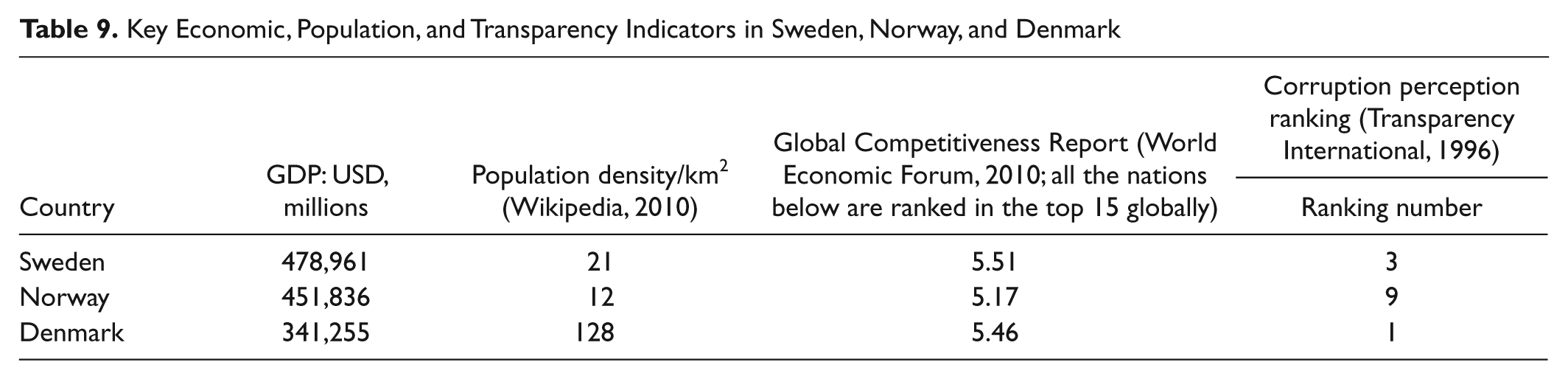
High-scoring cultures tend to focus on achievement, the future, taking initiative, and job-related accomplishments. Low-scoring countries, however, tend to focus on tradition, family, affiliation, and social ties. Hence, social relationships are valued more than achieving. Additional predictors of Performance Orientation were found to be related to a country’s level of economic prosperity, higher levels of human development, and a stronger social support for competitiveness (House et al., 2004). Data gathered from the IMD’s Global Competitiveness Ranking (1998), the United Nation’s Human Development Report (1998), and The World Values Survey (Inglehart, 1997) supported these hypothesized correlations. Table 9 offers a summary of economic indicators related to the intercultural focus of this study.
As can be seen in Table 1, Performance Orientation evaluates the extent to which a community encourages and rewards setting challenging goals, striving for innovation, and performance improvement versus valuing family relations, traditions, sensitivity, and experience. Norway, along with all her Scandinavian partners are categorized within band “B” of the GLOBE scores (moderate to high Performance Orientation), with scores as follows: highest in Denmark (4.22), followed by Norway (4.18) and Sweden (3.72).
Key Elements of Performance Orientation

Source: Based on House, Javidan, Dorfman, and Gupta (2004, p. 245).
Project GLOBE’s Future Orientation Within a Scandinavian Context
Future Orientation is the degree to which individuals in organizations or societies engage in future-oriented behaviors such as planning, investing in the future, and delaying individual or collective gratification (House et al., 2004). With regard to the economic and social predictors of this dimension, project GLOBE applied relevant data from the IMD Global Competitiveness Ranking (1994), the World Economic Forum’s Competitiveness Ranking (1998), the United Nation’s Human Development Report (1998), and the World Values Survey (Inglehart, 1997). This data show the following factors as predictors of high levels of Future Orientation: economic prosperity, high levels of society health, active political ideology, and positive attitudes toward gender issues. Norway, along with Denmark, is placed in band “A” and ranks highest of all the Scandinavian countries in this study, while Sweden is placed in band B (moderately high). The mean scores for Future Orientation in the Scandinavian cluster are for Norway: 4.48, followed by Denmark: 4.44 and Sweden: 4.39
These results correlate with Hofstede and Bond’s study of long-term orientation (Hofstede & Bond, 1988). Government planning, tax contributions, public investment, and a commitment to a strong welfare state are elements of all the Scandinavian nations’ long-term approach to planning for a stable future. Table 2 offers a summary of the key elements recognized in the Future Orientation dimension.
Key Elements of Future Orientation

Source: Based on House et al. (2004, p. 302).
Project GLOBE’s Gender Egalitarianism Within a Scandinavian Context
One of the most fundamental ways in which societies differ is the extent to which each prescribes and proscribes different roles for women and men (Hofstede, 2001). Some societies are more gender egalitarian and seek to minimize gender role differences (House et al., 2004). Researchers of this dimension support these claims (Barry, Bacon, & Child, 1957/1967; Coltrane, 1996; Williams & Best, 1982). Gender Egalitarianism is defined as the degree to which an organization or society minimizes gender role differences while promoting gender equality. Predictors of gender egalitarian values include national wealth per capita (Hofstede, 2001). The figures in Table 9 summarize GDP, with Norway’s figures indicating a stable national wealth and a variation from her main trading nations. Schwartz (1994) posits a positive correlation between levels of mastery or self-assertiveness in society and lower levels of Gender Egalitarianism. Coltrane (1996) claims that an important predictor of strong Gender Egalitarianism is the degree of men’s parental investment. He claims that a greater investment in child rearing by men in society exposes children to nontraditional parent roles, which then encourages their efforts in balancing gender roles in society later. Furthermore, this increased parental investment by men gives women the time to pursue nontraditional careers. Nordic countries have introduced state incentives and regulations that help fathers to achieve a work–life balance (Kvande, 2009).
Project GLOBE claims to have discovered meaningful variances in societal values such as Gender Egalitarianism as a function of a society’s climate. Project GLOBE found a negative relationship between ambient temperatures and a society’s placement on the Gender Egalitarianism scale. The lower the average daytime temperature, the more a gender egalitarian a society will be (House et al., 2004). Hofstede’s masculine/feminine construct research correlates closely to these findings. Hofstede claims that in less hospitable climates with stable economies, both men and women must take part in daily tasks to manage or even ensure survival (Hofstede, 2001). Scandinavian countries experience harsh winters with average winter temperatures falling as low as −20 degrees. Hence Hofstede’s research posits that Scandinavian countries, with harsh climates, value high levels of Gender Egalitarianism.
The findings of the GLOBE study of societies correlate closely to Hofstede’s masculinity index, with Norway’s score of 4.03 placing her in the top band A, with Denmark’s score of 3.93 and Sweden’s score of 3.38 placing them also in band A.
A strong correlation is also posited to be that of GNP per capita and societal values such as Gender Egalitarianism. Norway’s post–World War II regional development policy has encouraged industry and work opportunities in all regions of Norway. Table 3 summarizes the key elements of Gender Egalitarianism.
Key Elements of Gender Egalitarianism

Source: Based on House et al. (2004, p. 359).
Project GLOBE’s Assertiveness Within a Scandinavian Context
The concept of Assertiveness originates in part from Hofstede’s cultural dimension of masculinity versus femininity (House et al., 2004). In masculine societies, men are supposed to be assertive and tough and women are expected to be modest and tender (House et al., 2004). Kluckhohn and Strodtbeck (1961) discussed dominance as an element of Assertiveness in relation to the nature of the relationship of individuals, groups, and societies with the outside world. In line with Kluckhohn and Strodtbeck (1961), Trompenaars and Hampden-Turner (1998) researched societies’ orientation to nature. They posit that certain cultural groups believe that they can and should control or dominate nature (Trompenaars & Hampden-Turner, 1998). Hence, assertive societies will thus view relations in terms of dominance.
All elements of previous research into cultural Asser-tiveness share a common understanding that Assertiveness is the degree to which individuals in organizations or societies are assertive, confrontational, and aggressive in social relationships (House et al., 2004). Foreigners often regard Norwegians and indeed all Scandinavian societies as somewhat reserved and “cold-hearted” due to the fact that many Scandinavians are nondominant and do not reveal their emotions openly. This way of showing feelings is very culture specific. A Scandinavian person’s insular approach does not mean that individuals do not feel emotions: It is an indication of the sense of order and of keeping control in an interdependent society such as Norway. In Scandinavia, it is rare to have a heated argument or strong disagreement at work or in private life. In traffic, it is unusual to blow your horn or to push into a queue. A sense of order and fairness is prevalent from the time one starts in nursery schools and learns to take turns to the custom of patiently waiting in line in the company canteen. Country mean scores for Norway and her Scandinavian partners are as follows: Denmark showing slightly higher scores of 3.80, placing them in band B, and Sweden and Norway showing slightly lower scores of 3.38 and 3.37, placing them in band C, indicating moderate to low levels of Assertiveness in comparison. Table 4 summarizes key elements of Assertiveness.
Key Elements of Assertiveness
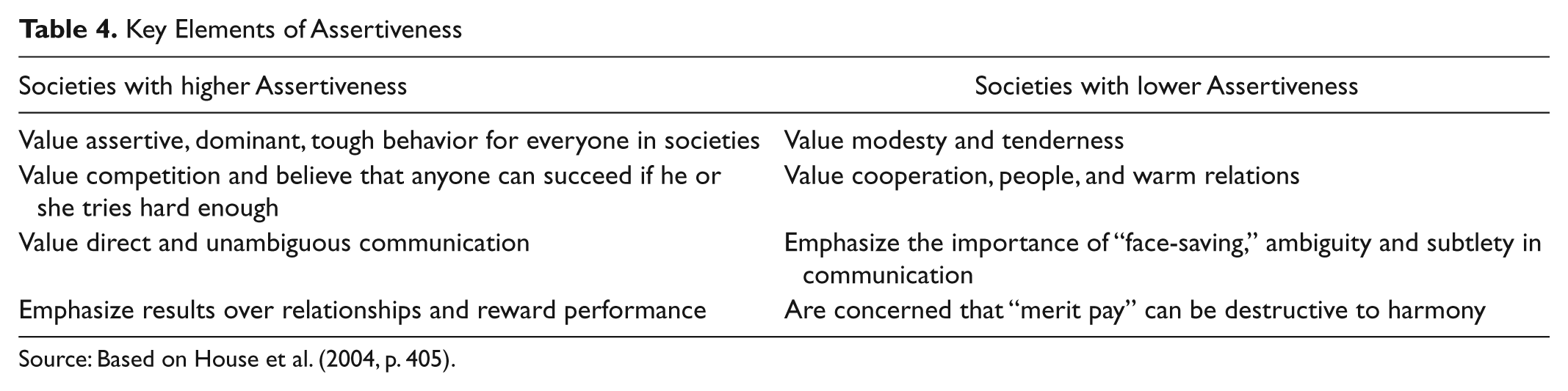
Source: Based on House et al. (2004, p. 405).
Project GLOBE’s Collectivism Within a Scandinavian Context
Across all disciplines researched, the importance of the individual versus the importance of the group has been studied. Hofstede (2001) posits a correlation between individualism and wealth, with industrialized countries such as England, the United States, and Australia as the most individualistic cultures (Hofstede, 2001). He also suggests that an increase in national wealth in a developing country causes an increase in individualism (Hofstede, 2001). Levine and Norenzayan (1999) posit that a more accurate predictor of individualism is pace of life. They argue that individualistic cultures have a faster pace of life than collectivist cultures as they focus on achievement. Triandis (1995) discusses intrinsic family systems as an antecedent to Collectivist values.
Project GLOBE divided this dimension into two constructs at the second stage of their pilot study (House et al., 2004): Institutional Collectivism and In-Group Collectivism. Institutional Collectivism (Collectivism 1) is the degree to which organizational and societal institutional practices encourage and reward collective distribution of resources and collective action (House et al., 2004). In-Group Collectivism (Collectivism 2), however, is defined as the degree to which individuals express pride, loyalty, and cohesiveness in their organization or families (House et al., 2004). Table 5 offers a summary of the key traits of these two dimensions of Collectivism.
Key Elements of Collectivism-Individualism

Source: Based on House et al. (2004, p. 463).
To conclude, mean country scores for Institutional Collectivism practices show rather high levels for all Scandinavian nations: Sweden: 5.22 (band A), Denmark: 4.80 (band A), and Norway: 4.07 (band B). An interesting reflection from Lindell and Sigfrids (2007) is that Institutional Collectivism seems, at least to some extent, to go in waves. When times are good in society, individuality will be stronger, and in bad times Collectivism is stronger.
A specific anomaly in Norway’s In-Group Collective culture lies in the Norwegian tradition for expecting the state to take care of old people and the sick rather than expecting the family to take this collective responsibility. A culture that scores high on In-Group Collectivism is traditionally a culture that values a home where many generations live together and where the family collectively assumes responsibility for the elderly or infirm within the home and where young people at work and university traditionally stay at home until they start their own family. In Norway, the high taxation system supports a comprehensive welfare state that in turn provides for state care of the elderly or sick—Thus, the collective responsibility is not to provide a home for all generations but to contribute to the welfare state via paying one’s taxes. It is not therefore the norm to take care of elderly parents personally. The state pension scheme alleviates the financial responsibility of taking care of the elderly. To sum up, mean In-Group Collectivism scores for Norway and her Scandinavian partners are as follows: Norway: 5.34 (band B), Sweden: 3.66, Denmark: 3.53 (both in band C).
Project GLOBE’s Power Distance Within a Scandinavian Framework
Power Distance is defined as the degree to which members of an organization or society expect and agree that power should be stratified and concentrated at higher levels of an organization or government (House et al., 2004). McClelland (1961) and McClelland and Burnham (1976) determined that effective managers were characterized primarily by their need for power. Bass (1985) posits that charismatic attributes and behaviors play an important role in Power Distance. Haire, Ghiselli, and Porter (1966) explored the differences in preferences for power among different cultures. Hofstede (2001) posits that the three most significant predictors of relative position on the Power Distance continuum are (a) latitude—distance from the equator, (b) population size, and (c) wealth—GNP per capita. Geographical latitude in a region predicts the variance in Power Distance, with a decrease in Power Distance as distance from the equator increases.
As population increases, its members accept a political power that is more distant and less accessible than smaller societies. In terms of the third predictor of Power Distance, namely, wealth per capita, this relationship is explained by Hofstede as the fact that societal wealth is directly correlated to the growth of the middle class, which can act as a bridge between the powerless and the powerful. As presented above, Norway’s post–World War II regional development policy has encouraged industry and work opportunities in all regions in Norway.
Norway’s mean score of 4.13 in the Power Distance dimension depicts Norway as a low Power Distance society, in keeping with her Scandinavian profile. Such low Power Distance values in Scandinavia are manifested in certain aspects of Norwegian business practices such as little use of formal titles, dress codes, and attitudes to practical tasks in the workplace. Most organizations do not adhere to strict dress codes to show status. Even in institutions such as parliamentary offices and legal institutions, a senior member may be dressed as informally as a junior staff member. Titles or last names are rarely used when addressing others, even if they are of senior rank. Another element of Power Distance—the roles and hierarchy within a society—is mirrored in the egalitarian practices at work. In company canteens, for example, all staff, whether directors or junior staff, pick up their food themselves in the staff canteen in an orderly manner and dispose of uneaten food and used plates. Canteens are almost never segregated on a basis of position.
As a society that expects and agrees that power should be equally shared, the Norwegian progressive and comprehensive tax system, the high union membership, and the generous welfare state exemplify systems that are in place to protect and promote egalitarian values. Holmberg and Åkerblom (2007) discuss elements of low Power Distance seen outside the workplace in Sweden. These cultural elements can be seen to be equally pertinent to the discussion of Power Distance within a Norwegian context. Burial grounds for instance, are generally similar for everyone, regardless of family wealth or social status. Nor is the ability to get on a bus or any other public transportation helped by personal status as such: Everybody is obliged to queue (Holmberg & Åkerblom, 2007). Thus, egalitarian values are promoted on a national and company level.
To sum up, the mean scores in Power Distance for the countries in this study are as follows: Denmark: 3.89 (band “D,” low), Norway: 4.13 (band D, low), and Sweden:v 4.85 (band B, moderate). Indeed, these results support the findings from Lindell and Arvonen (1996) that a dominant feature of the Scandinavian management style is delegation of responsibility. Table 6 offers a summary of Power Distance.
Key Elements of Power Distance

Source: Based on House et al. (2004).
Project GLOBE’s Humane Orientation Within a Scandinavian Framework
The concept of “urban helpfulness” is an important concept in relation to this cultural dimension. Project GLOBE claims that there is a correlation between decreasing unhelpfulness and urbanization with increasing population density (House et al., 2004). According to Triandis (1995), values of altruism, benevolence, kindness, love, and generosity are salient motivating factors guiding people’s behavior in societies characterized by a strong Humane Orientation. Rokeach’s Value Theory (1968) and Schwartz’ Value Theory (1994) support this proposition. Schwartz posits that the central norms of a society can be categorized based on their position on the bipolar dimensions of Self-Transcendence (including values of tolerance and protection of others) versus Self-Enhancement (self-gratification; House et al., 2004). A supporting theory to this is Espen-Anderson’s studies of welfare states and their relationship to Humane Orientation (Espen-Anderson & Korpi, 1987). The social democratic model of a welfare state in Scandinavia is claimed to be more humanely oriented compared with the liberal model exemplified in England and the United States. The social democratic model in Scandinavia recognizes the personal rights of all individuals as an element of universal welfare rights, whereas the liberal model found in England and the United States offers welfare state on a proportionally means-tested basis (House et al., 2004). Table 7 below offers an overview of the main traits of this dimension.
Key Elements of Humane Orientation
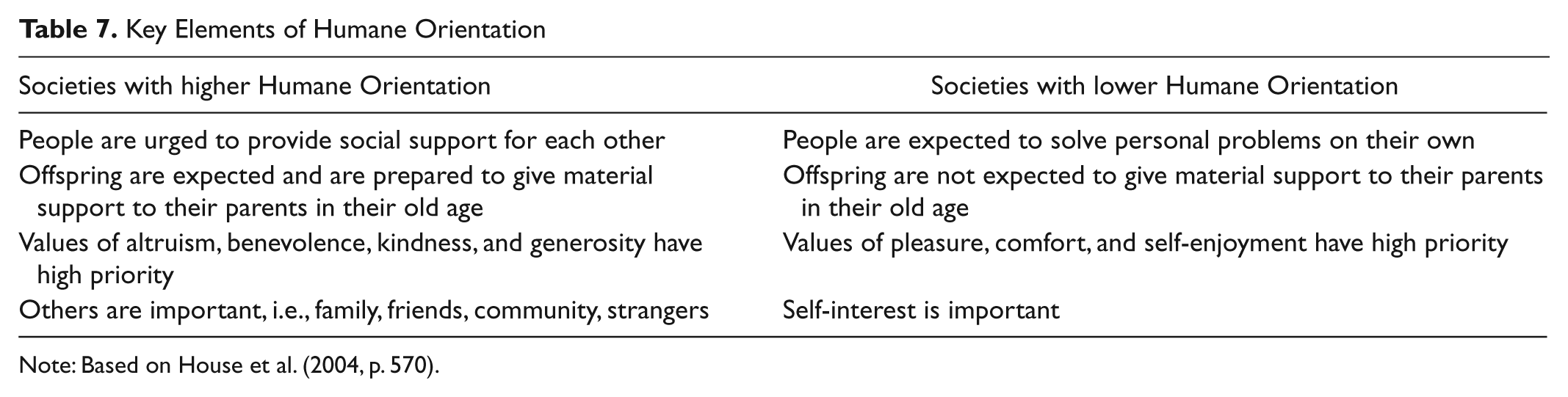
Note: Based on House et al. (2004, p. 570).
The scores in Humane Orientation for the countries in this study are highest for Norway: 4.81 (band A, high), followed by Denmark: 4.44 (band B, moderate to high) and Sweden: 4.10 (band C, moderate to low). The social concern that is characteristic of Norway is captured in part by this dimension, where Norway scores rather highly. At a regional level, historically, as a predominately agricultural and fishing nation, local communities living in harsh climates have traditionally helped each other in times of need. Even today, the philosophy of “civic duty” and taking part in a dugnad (voluntary local help projects) remain a part of daily life in most regions in Norway, but to a lesser extent in large cities.
Project GLOBE’s Uncertainty Avoidance Within a Scandinavian Context
Uncertainty Avoidance is the extent to which members of an organization or society strive to avoid uncertainty by relying on established social norms, rituals, and bureaucratic practices. People in high Uncertainty Avoidance cultures actively seek to decrease the probability of unpredictable future events that could adversely affect the operation of an organization or society, and remedy the success of such adverse effects (House et al., 2004). Hofstede (2001) posits that people in societies create coping mechanisms to handle the anxiety produced by excessive uncertainty. He notes that technology has helped us to defend ourselves against uncertainties caused by nature and the law, and against uncertainty in the behavior of others and religion, and to accept the uncertainties we cannot defend ourselves against (Hofstede, 2001).
The GLOBE study of Uncertainty Avoidance practices revealed high correlations between high Uncertainty Avoidance scores, and high economic prosperity and extremely supportive governments in terms of economic initiatives. The Norwegian government has introduced supportive initiatives countrywide to support industry and welfare in all districts, and Norway scored high on Future Orientation. Table 8 below offers a summary of the key traits associated with this dimension:
Key Elements of Uncertainty Avoidance
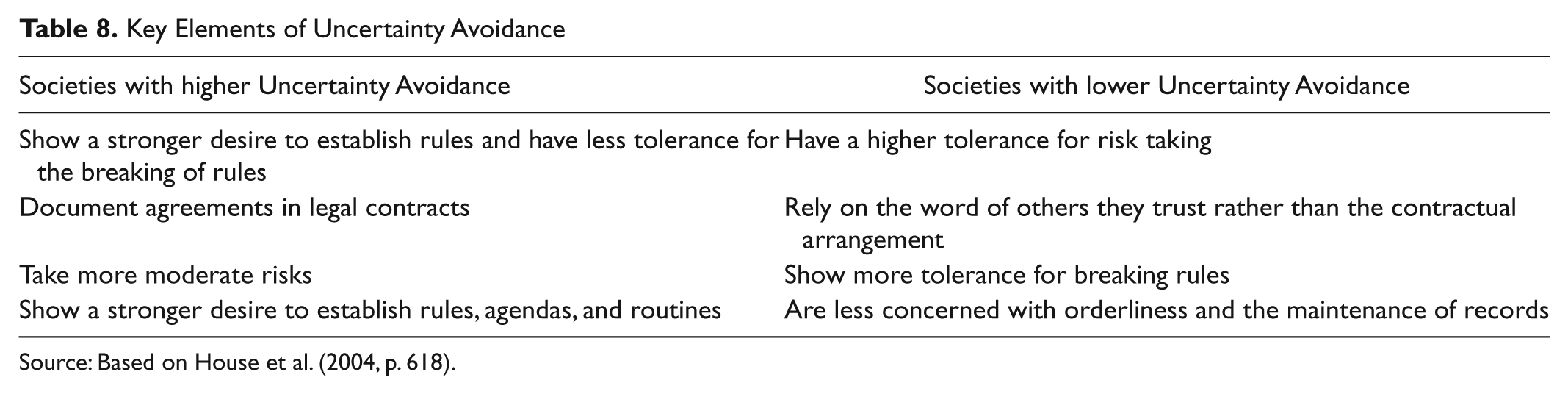
Source: Based on House et al. (2004, p. 618).
Examples of uncertainty reduction and protection measures in Norway and also in her Scandinavian neighbors include the high value placed on the comprehensive welfare system with generous social security payments for sick leave, long-term disability, unemployment, and maternity and paternity pay. A second Norwegian institution that mirrors the value placed on Uncertainty Avoidance is the ombudsman system—a system of checks and balances that protects individuals against misgovernment in the legal or public administration systems. Another element of Norwegian culture that is reflected in the sense of order in society is people’s approach to time. The social norm is to always be “on time” for both business meetings and social gatherings. Agendas are frequently distributed in business meetings and social club meetings, and even for birthdays, weddings, and christenings, to ensure a sense of order. In this way, good time keeping and the ethos of sticking to agreed times is important in the maintenance of good social relations, both in working and private life in Norway. The mean country scores for Uncertainty Avoidance showed a high level for all Scandinavian countries with Denmark and Sweden falling into band A with the following scores: Denmark: 5.22, Sweden: 5.32. Norway falls into band B (moderate to high) with 4.31.
Key Economic Data
Table 9 below summarizes key data for the countries in this study in terms of Gross Domestic Product, population density, Corruption Perception Index, and Global Competitiveness. The Global Competitiveness Report (2010), published by the World Economic Forum “ assesses the ability of countries to provide high levels of prosperity to their citizens, as it measures the set of institutions, policies and factors that set the sustainable current and medium-term levels of prosperity”(World Economic Forum, 2010).
Key Economic, Population, and Transparency Indicators in Sweden, Norway, and Denmark
Summary of Findings on Scandinavian Cultural Practices
To summarize, although the Scandinavian cultures studied in this intercultural research appear ostensibly similar, the results illustrate Ashkansy’s (1997) point, that such research can reveal subtle but important cultural differences in nations that are similar yet dissimilar. All three societies appear intrinsically egalitarian, they appear to value low Power Distance, directness, and consensus in decision making and to promote Gender Egalitarianism. Nevertheless, there are significant differences in the degrees of commitment to these values by each individual Scandinavian partner. These differences need to be understood and appreciated to avoid misunderstandings. The hallmark of Norwegian cultural practices within a Scandinavian context was seen to be higher Gender Egalitarianism. The most pronounced Norwegian cultural values within a Nordic framework were also lower Power Distance and higher Humane Orientation values.
Conclusion
The purpose of this article was twofold: first, to map contemporary Norwegian cultural practices within a Scandinavian context in relation to the author’s recent doctoral research and project GLOBE findings (House et al., 2004), and second, to briefly introduce the argument that culture matters in Scandinavian academic research, by offering a summary of published research in the last decade where culture has been a variable. A future direction for research could be a more in-depth meta-analysis of such studies.
There is no shortage of advice available to managers about how to succeed with a new project in a culturally different region. Unfortunately much of this can be superficial as it only focuses on the practical elements of etiquette, such as “speak in a low voice in Asia and avoid eye contact with females in Japan.” On the other end of the scale, we might be given only general advice such as “always be ethical.” What is important to bear in mind here, however, is that what might be seen as ethical business behavior in one country may not be the same in another (Warner-Søderholm, 2010a).
As discussed earlier in this paper, culture matters. Subtle but disturbing differences may surface when representatives from neighboring regions in Scandinavia work together. As depicted in the literature review of Scandinavian cultural research during the last decade (appendix), culture impacts a wide range of business issues from investment activities, environmental commitment, social responsibility, management practices, and dealing with crises to employee relations. Management practices in Norway differ in subtle ways from those of her Scandinavian counterparts because Norwegians tend to place greater value on directness, stronger Gender Egalitarianism values, and a greater tolerance for uncertainty. Furthermore, Norway’s higher scores in Humane Orientation and In-Group Collectivist scores indicate a stronger focus on a more paternal, inclusive style of management in Norway. While these differences are not major, their combined effects may have consequences in certain situations. If a manager from Sweden operates in a more hierarchical, assertive manner in Norway, this could have a negative impact on the outcome of the negotiation. Furthermore, a statement could be made by a Danish consultant such as, “I’m afraid that we believe that the company should consider cutbacks.” The manager from Norway might have phrased this message as, “You, you have make cutbacks!” Knowledge about such specific cultural characteristics can help team members from different regions value and anticipate differences. Potential problems such as interpersonal conflict that leads to stress and unnecessary personal strain and potential loss of revenues can then be minimized. Clearly, culture does matter.
Footnotes
Appendix
Academic Articles in the Last Decade With Scandinavian Culture as a Variable
| Authors | Article | Nordic cultural context |
|---|---|---|
| Smith et al. (2011) | Individualism—Collectivism and business context as predictors of behaviours in cross-national work settings: Incidence and outcomes. International Journal of Intercultural Relations. | Multicountry study of cross-national work settings |
| Chiang and Birtch (2010) | Appraising performance across borders: An empirical examination of the purposes and practices of performance appraisal in a multicountry context. Journal of Management Studies. | Cultural issues related to performance appraisals |
| Saleh, Hassan, Jaffar, and Shukor (2010) | Intellectual Capital Disclosure quality: Lessons from selected Scandinavian countries. Journal of Knowledge Management. | Intellectual capital and corporate cultures in Scandinavia |
| Gjølberg (2010) | Varieties of corporate social responsibility (CSR): CSR meets the Nordic Model. Regulation and Governance. | CSR and corporate cultures |
| Peltokorpi (2010) | Intercultural communication in foreign subsidiaries: The influence of expatriates’ language and cultural competencies. Scandinavian Journal of Management. | Intercultural communication in foreign subsidiaries: the influence of expatriates’ language and cultural competencies |
| Stavrou and Kilaniotos (2010) | Flexible work and turnover: An empirical investigation across cultures. British Journal of Management. | Overtime and shift systems: Scandinavian culture |
| Kvande (2009) | Work-life balance for fathers in globalized knowledge work. Some insights from a Norwegian context. Work and Organization. | Scandinavian culture and gender issues |
| Clemmensen, Hertzum, Hornbeck, Shi, and Yammiyavar (2009) | Interacting with computers: Cultural cognition in usability evaluation. Proceedings Interacting With Computers. | International systems development: Human-computer interaction and culture |
| Sanchez-Franco, Martinez-Lopez, and Martin-Velicia (2009) | Exploring the impact of individualism and Uncertainty Avoidance in web-based electronic learning: An empirical analysis. Computers and Education. | Cross-cultural differences in learning |
| Sandhu, Helo, and Kekale (2009) | The influence of culture on the management of project business: A case study. International Journal of Innovation and Learning. | National cultures and management style |
| Muller, Spang, and Ozcan (2009) | Cultural differences in decision making in project teams. International Journal of managing Projects in Business. | Decision making: cultural differences in German and Swedish teams |
| Sippola (2009) | The two faces of Nordic management? Nordic firms and their employee relations in the Baltic states. International Journal of Resource management. | Corporate culture, management by objectives |
| Ekelund (2009) | Cultural perspectives on team consultation in Scandinavia: Experiences and reflections. Scandinavian Journal of Organizational Psychology. | Cultural values and feedback styles in teams |
| Gheorghiu, Vignoles, and Smith (2009) | Beyond the United States and Japan: Testing Yamagishi’s emancipation theory of trust across 31 nations. Social Psychology Quarterly. | Individualism, Collectivism, and trust |
| Bengtsson (2008) | Socially responsible investing in Scandinavia—a comparative analysis. Sustainable Development. | Business ethics and corporate cultures in Scandinavia |
| Hookana (2008) | Organizational culture and the adoption of new public-management practices. Management. | Culture and management practices |
| Rubin, Schultz, and Hatch (2008) | Coming to America: Can Nordic brand values engage American stakeholders? Journal of Brand Management. | Branding and business ethics |
| Chandrasekaran and Tellis (2008) | Global takeoff of new products: Culture, wealth, or vanishing differences? Marketing Science. | Innovation and communication |
| Uslaner (2008) | Where you stand depends on where your grandparents sat. Public Opinion Quarterly. | Cultural values |
| Brannback and Carsrud (2008) | Do they see what we see? A critical Nordic tale about perceptions of entrepreneurial opportunities, goals, and growth. Journal of Enterprising Culture. | Entrepreneurial values |
| Ramstrom (2008) | Interorganizational meets interpersonal: An exploratory study of social capital processes in relationships between Northern European and ethnic Chinese firms. Industrial Marketing Management. | HRM values between Northern Europe and China |
| Langvasbråten (2008) | A Scandinavian model? Gender equality discourses on multiculturalism. Social Politics. | Gender equality and inequality in Scandinavia |
| Halldorsson, Larson, and Poist (2008) | Supply chain management: A comparison of Scandinavian and American perspectives. International Journal of Physical Distribution & Logistics management. | Cross-cultural studies of supply chain management |
| Gotcheva (2008) | A cross-cultural study of leadership styles among executives in Bulgaria and Finland. Journal of Human Resources Development and Management | Cultural differences in leadership styles |
| Hjorth (2008) | Nordic entrepreneurship research. Entrepreneurship Theory and Practice. | The Nordic context |
| Håvold (2007) | National cultures and safety orientation: A study of seafarers working for Norwegian shipping companies. Work and stress. | Safety orientation culture on Norwegian vessels |
| Marnburg (2007) | Management principles in hospitality and tourism. Journal of Human Resources in Hospitality and Tourism. | Conflict vs. harmony values, functionalism vs. idealism, and organic vs. mechanic values |
| Waldstrøm and Madsen (2007) | Social relations among managers: Old boys and young women’s networks. Women in management Review. | Gender values and networking |
| Demir and Søderman (2007) | Skills and complexity in management of IJVs: Exploring Swedish managers’ experiences in China. International Business Review | Management values in China versus Sweden |
| Lawler (2007) | Janus-faced solidarity—Danish internationalism reconsidered. Cooperation and Conflict. | Internationalism, politics and culture |
| Nafstad, Carlquist, and Blaker (2007) | Community and care in a world of changing ideologies. Community, Work and Family. | Consumers, ideological conflict |
| Kjeldgaard and Ostberg (2007) | Coffee grounds and the global cup: Global consumer culture in Scandinavia. Consumption, Markets and Culture. | Scandinavia consumption culture |
| Ekman and Emami (2007) | Cultural diversity in health care. Scandinavian Journal of Caring. | Culture’s impact of care provision |
| Lutgen-Sandvik, Tracy, and Alberts (2007) | Burned by bullying in the American workplaces: Prevalence, perception, degree, and impact. Journal of Management Studies. | Masculine/feminine cultural values and bullying: the United States vs. Scandinavia |
| Pollanen (2006) | Northern European Leadership in transition—a survey of the insurance industry. Journal of General management. | Cultural issues in leadership in the insurance industry |
| Peltokorpi (2006) | Japanese organizational behaviour in Nordic subsidiaries: A Nordic expatriate perspective. Employee relations. | Insights into Japanese culture through Nordic eyes |
| Lynes and Dredge (2006) | Going green: Motivations for environmental commitment in the airline industry. A case study of Scandinavian airlines. Journal of Sustainable Tourism | Environmental commitment in the airline industry in Scandinavia |
| Peltokorpi (2006) | Japanese organizational behaviour in Nordic subsidiaries. Employee Relations. | Collectivism and culture |
| Zander (2005) | Communication and country clusters: A study of language and leadership preferences. International studies of Management and Organization | Leadership styles across groups of countries |
| Maenpåå, Antii, Hannu, and Pallab (2006) | More hedonic versus less hedonic consumption behaviour in advanced Internet bank services. Journal of Financial Services Marketing. | Consumer behaviour in different cultures |
| Wurtz (2005) | A cross-cultural analysis of websites from high-context and low-context cultures. Journal of Computer-Mediated Communication. | Direct vs. indirect communication in different cultures |
| Ka (2005) | Cultural traditions and the Scandinavian social policy model Social Policy and Administration. | Scandinavian traditions and social policy |
| Haner (2005) | Spaces for creativity and innovation in two established organizations. Creativity and Innovation Management | Work environment and corporate culture |
| Åselius (2005) | Swedish strategic culture after 1945. Cooperation and conflict. | Culture and national security |
| Neumann and Heikka (2005) | Grand strategy, strategic culture, practice: The social roots of the Nordic defence. Cooperation and conflict. | Culture and national security |
| Howlett and Glenn (2005) | Epilogue: Nordic strategic culture. Scandinavian Journal of Hospitality and Tourism. | International relations |
| Asheim and Coenen (2005) | Knowledge bases and regional innovation systems: Comparing Nordic Clusters. Research Policy | Technological innovations and forestry products |
| Gyekye and Salminen (2005) | Responsibility assignment at the workplace: A Finnish and Ghanaian perspective. Scandinavian Journal of Psychology. | Power Distance issues, assignment of responsibility, and accidents in the workplace |
| Roper (2005) | Marketing standardisation: Tour operators in the Nordic region. European Journal of Marketing. | Culture and marketing decisions |
| Arellano-Gault and Del (2004) | Maturation of public administration in a multicultural environment: Lessons from the Anglo-Saxon, Latin, and Scandinavian political traditions. International Journal of Public Administration. | Scandinavian political culture in public administration |
| Holmqvist (2004) | Experiential learning processes of exploitation and exploration within and between organizations. Organization Science. | Interorganizational relations, corporate culture |
| Ulijin and Lincke (2004) | The effect of CMC and FTF on negotiation outcomes between R&D and manufacturing partners in the supply chain: An Anglo/Nordic/Latin comparison. International Negotiation. | Negotiation cultures |
| Aperia, Simcic, and Schultz (2004) | A reputation analysis of the most visible companies in the Scandinavian countries. Corporate Reputation Review | Social responsibility of Scandinavian businesses |
| Metcalf et al. (2004) | Cultural tendencies in negotiation: A comparison of Finland, India, Mexico, Turkey and the US. Journal of World Business | Cultural differences in negotiation styles |
| Smith, Andersen, Ekelund, Gravesen, and Ropo (2003) | In search of Nordic management styles. Scandinavian Journal of Management. | Cultural values of Nordic managers |
| De Geer, Borglund, and Frostenson (2003) | Anglo-Saxification of Swedish business. Business Ethics: A European Review. | International business |
| Gregory (2003) | Scandinavian approaches to participatory design. International Journal ENGNG | Distinctive Scandinavian approaches to participatory design |
| Tellis, Stremersch, and Yin (2003) | The international takeoff of new products: The role of economics, culture, and country innovativeness. Marketing Science. | International business enterprises |
| Webster Rudmin, Ferradanoli, and Skolbekken (2003) | Questions of culture, age, and gender in the epidemiology of suicide. Scandinavian Journal of Psychology. | Cultural values as predictors of suicide |
| Grennes (2003) | Scandinavian managers on Scandinavian management. International Journal of Value-Based Management. | Cultural values of Scandinavian managers |
| Kasper (2002) | Culture and leadership in market-oriented service organizations. European Journal of Marketing. | Achievement oriented managers and culture |
| Suutari and Riusala (2001) | Leadership styles in Central Eastern Europe: Experiences of Finnish expatriates in the Czech Republic, Hungary, and Poland. Scandinavian Journal of Management. | Cultural differences in management in Central Eastern Europe |
| Kurzer (2001) | Cultural diversity in post-Maastricht Europe. Journal of European Policy | Culture, social policy, and liquor laws |
| Mykletun and Haukeland (2001) | Scope and background: The Nordic context. Journal of Hospitality and Tourism. | Hospitality industry and culture |

Note: HRM = human resource management; IJVs = International Joint Ventures; CMC = computer mediated communication; FTF = face-to-face communication.
Declaration of Conflicting Interests
The author(s) declared no potential conflicts of interest with respect to the research, authorship, and/or publication of this article.
Funding
The author(s) received no financial support for the research and/or authorship of this article.