




Abstract
The authors originally posited that a new construct must be developed to measure the success of affective training for sexologists, particularly the Sexuality Attitudes Reassessment (SAR) modality. Couching their critique in studies that have been conducted to measure the SAR’s effectiveness as a method used to evoke perspective transformation and more sensitive and humanistic service provision, the authors argued that the development of a professional’s sexological worldview would be a more accurate construct than attitude change to measure when considering the outcomes of SAR training. This study in the United States used a two-phase qualitative approach to validate the proposed sexological worldview construct. In the first phase, they surveyed a panel of 16 sexologists regarding their original proposed definition of sexological worldview and refined it. In the second phase, they completed 30 one-on-one interviews with a convenience sample of sexologists and sexology students. Using an inductive content analysis of the interview transcripts, seven themes emerged in support of the proposed definition of sexological worldview, including its components and its developmental characteristics. The article concludes with a discussion of the implications for the use of the construct for the training of sexologists.
Validation of Sexological Worldview
In 2009, we called for the development of a new construct to measure the effectiveness of the Sexuality Attitudes Reassessment (SAR), a modality for the training of sexologists in both the awareness and sensitivity toward diverse sexual expression (Sitron & Dyson, 2009). Supported by the literature discussing perspective transformation (e.g., Mezirow, 2000; Perry, 1970), worldview (e.g., Ibrahim, 1991; Ibrahim & Kahn, 1987; Koltko-Rivera, 2004; Sarason, 1984; Watts, 1994), and sensitivity to cultural and individual difference found in the literature of counseling, education, and psychology (e.g., Brown, 2004; Horner & Vandersluis, 1981; Ibrahim, 1991; Lehman, 1993), we argued for the measurement of an individual’s sexological worldview development. Measuring sexological worldview, they proposed, would be more effective than the approaches used in the past to measure SAR effectiveness that have focused on measuring changes in participants using a set of specific attitudes about sex and sexuality. A measure based on sexological worldview would identify in individuals whether their sexological worldview was more relativist or more dualist (see Perry, 1970) across a continuum of sexological worldview development; those individuals with more relativist sexological worldviews would be more likely to be sensitive in their approach to working with others who they perceive or experience as sexually different, a trend supported in the intercultural competence literature around more general cultural differences.
The concept of developing sensitivity to differences and measuring that sensitivity is not new; it has been developed extensively in the field of intercultural communications. M. J. Bennett (1986) developed a model to explain an individual’s sensitivity to cultural differences and has utilized it as a way to frame training for individuals and groups in intercultural competence (J. M. Bennett, 1993; J. M. Bennett & Bennett, 2004; M. J. Bennett, 1986, 1993). The Intercultural Development Inventory (IDI) was developed to assess sensitivity to cultural differences based on M. J. Bennett’s six stages of intercultural sensitivity and has developed the measure further to assess both individual and group sensitivity (Hammer, 1999; Hammer, Bennett, & Wiseman, 2003). While Hammer’s measure could provide a possible solution to measuring the sensitivity to difference in a sexologist’s worldview, the measure more generally assesses one’s approach to cultural differences, broadly, and does not include the diverse and complex components of sex and sexuality with which sexologists more familiar. In addition, authors (e.g., Koltko-Rivera, 2004; Sarason, 1984; Sue & Sue, 1990; Watts, 1994) writing about worldview as a construct in general do not include areas of sexuality in their definitions of worldview or their conceptualization of culture as a framework to understand individuals and cultural groups. This absence of sex and sexuality in the IDI and worldview literature presents a challenge to using the IDI as a measure of sexological worldview development. While our primary research interest is in the development of an instrument to assess the sensitivity of one’s sexological worldview for the purposes of measuring sensitivity-training outcomes, until the construct of worldview includes sexuality or sexological components, such a construct cannot be measured.
For the reasons stated above, this study began as a first step toward the development of an instrument to measure a worldview construct that contained sexuality—sexological worldview. Worldview with regards to sexuality has been considered before but not extensively. To date, it appears that the only author to consider worldview and sexuality in any depth has been Francoeur (1991); however, Francoeur’s definition of sexuality worldview framed the construct with regards to an individual’s personal experience of sexuality and their perspective on the sexuality of others, and did not consider the sexologist or another professional’s worldview regarding sexuality. Furthermore, Francoeur presented his definition and discussion as a theory and did not support it using data collected through methods of scientific inquiry. To more rigorously establish the construct of sexological worldview, we conducted this study to validate sexological worldview using a scientific qualitative approach.
General Research Design and Purpose
In this study, we used a qualitative design to answer the following research question: Is sexological worldview, as we defined it in 2009, a valid construct? We selected a qualitative, interactive, and emergent design (Maxwell, 1999), as this method allowed us to pursue the question openly and to pursue the further development of the construct should the data provide such opportunities as we collected it.
At the start of this study, the definition of sexological worldview was posited as
the often unexamined but changeable perspective held by each person about the world around them with regards to sexuality; it is the result of the socialization process that is comprised of values, beliefs, opinions, attitudes and concepts specific to sexuality, including any and all sexual behaviors and identities. (Sitron & Dyson, 2009, p. 173)
The validation procedures were divided into two phases: (a) an expert panel review of the proposed definition and (b) a set of 30 one-on-one interviews with informants about their sexological worldview. The first phase sought feedback about our original adaptation of general worldview definitions to come to a second draft of the definition. The second phase utilized a grounded theory approach where individuals were interviewed and asked to describe their sexological worldview or perspective on sex and sexuality. From those interviews, we expected that themes would emerge across individuals as to the components of the worldview and its manner of development. Those themes could be compared with the definition that emerged in Phase 1 using a comparative deductive analysis. As a final result, we propose a final definition of sexological worldview that includes the factors that contribute to its development.
Method
Prior to the recruitment of any participants in this research, we sought and received Internal Review Board approval for the study at our university. All participants were provided with informed consent, none were remunerated for their participation, and all were offered access to a summary of the results of the study.
Phase 1: Expert Panel Review
For the initial validation of the definition, we sought out a panel of experts in the field of sexology for their feedback on the proposed construct using a brief quantitative and qualitative questionnaire (Appendix A) according to the guidelines in Trochim (2002).
Participants
The individual experts were recruited using a standard email that was sent to three professional email listserves, each with several-hundred members. For selection purposes, an expert was defined according to specific criteria. These criteria were established to assure a high standard for the types of individuals we would call “experts”; we sought respondents who had credentials, training, and/or experience in the field of sexology, in addition to an established length of time in practice. “Experts” were individuals who met at least one criterion from among A, B, or C, below and also criterion D:
(A) a full, nonstudent member of American Association of Sexuality Educators, Counselors, and Therapists (AASECT), confirmed using the AASECT directory; or
(B) a practitioner of sexological research, therapy, or education for at least 10 years as documented on a curriculum vitae; or
(C) a person holding a graduate-level (master’s or doctoral) degree from an accredited university in the field of sexuality;
and
(D) has practiced as a professional sexuality educator, counselor, or therapist for an additional 5 years beyond completion of criterion A, B, or C.
A total of 20 experts responded indicating their interest in participation and all 20 met the requisite criteria as an expert. These 20 were established as the expert panel. The sample included a total of 20 individuals: 6 individuals who were full, nonstudent members of AASECT and who had been practitioners of sexological research, therapy, or education for at least 10 years; 12 individuals who held a graduate degree from an accredited university in the field of sexuality and had practiced for at least 5 years beyond the completion of their degree; and 2 individuals who were practitioners of sexological research, therapy, or education for 15 years. Table 1 represents the expert sample as it met the determined criteria.
Sample of Expert Panel Reviewers and the Criteria Met

Procedure
We sent each expert a summary of our literature review (Sitron & Dyson, 2009) calling for the need for the new construct and explaining its relevance to the field along with the preliminary definition we developed. Each expert was asked to complete a standard questionnaire about the contents of the proposed definition and the need for the construct. The response rate for the expert panel was 85%; 17 of the 20 experts returned complete responses. One of the 17 was illegible and incomplete and was not included in the final results, which makes the response rate 80% (n = 16, of 20).
Data analysis
The experts’ responses to each item on the questionnaire were tabulated, summarized, and a final definition was drafted based on the expert feedback. The revised definition was retained for use during the data analysis procedures in Phase 2.
Phase 2: Interviews With Sexologists and Sexology Students
The interview phase of the study included 30 open-ended, semistructured, one-on-one interviews with individuals about their perspective on sex and sexuality, their sexological worldview.
Participants
The population for this study consisted of practicing sexologists, graduate students of sexology, and students just beginning graduate-level study of sexology. While a more general population of study could have been utilized, we were primarily interested in the worldviews of sexologists, as they are the population who receive SAR-style sensitivity training described in our original work on the subject (Sitron & Dyson, 2009). For this reason, and the convenience of the sample, we decided to use sexologists and students of sexology as the population for this study. Participants were recruited using a recruitment email that was distributed to several professional organizations’ email listserves (the same as those used to recruit the experts in Phase 1) and also through the student email list of individuals enrolled in Widener University’s Graduate Programs in Human Sexuality, the only fully accredited doctoral program in the United States. The selection of the interview participants followed a purposeful sampling strategy (Patton, 2002) to select for a general heterogeneity among respondents. The worldview literature (Ibrahim & Kahn, 1987; Koltko-Rivera, 2004; Sue & Sue, 1990) not only discussed common attributes of worldview as a construct but also described the variety of ways in which individuals’ experiences and social origins impact the development of an individual’s specific worldview. To select for this diversity in respondents, we used maximum variation sampling (Patton, 2002). This method allows the researcher the opportunity to fully consider and select for the specific “heterogeneity in the population” (Maxwell, 1999, p. 87).
A spectrum of individual, sexual, and sociocultural attributes have been reflected in the literature about sexual diversity. These served as the specific heterogeneity of interest in this study (e.g., Popovic, 2006; Roughgarden, 2004; Rubin, 1984; Tiefer, 2004; Watts, 1994; Weeks, 2003a, 2003b). To plan for the variation, quotas were determined based on our knowledge of the population (both authors are sexologists and professors of sexology), the developmental nature of worldview as described by M. J. Bennett (1986), and our awareness of the diversity of sexual identities and behaviors experienced by individuals.
In Hammer et al.’s (2003) development of the IDI, they utilized a sample size of 45 participants across multiple nationalities, cultures, and countries of origin. Using that as a base, we aimed to recruit 30 participants, because we were not aiming for an international sample, and were more specifically focused on U.S. cultural differences and varied sexuality differences. Considering that most participants would likely meet more than one criterion, the following quotas were established before recruitment began:
Ten respondents between 18 and 35 years, 10 between 36 and 50 years, and 10 between 51 and 65 years at time of interview
Minimum of 10 respondents who identify their race as something other than White/Caucasian
Minimum of 10 respondents who identify themselves as religious, spiritual, belonging to or having belonged to a faith community, family, or other social system
Minimum of 10 respondents who identify themselves as one or more of the following: gay, lesbian, bisexual, transgender or other nonmale/nonfemale gender identity, intersex, sexual minority, person who experiences a paraphilia, as defined in the Diagnostic and Statistical Manual of Mental Disorders (4th ed., text revision; DSM-IV-TR; American Psychological Association, 2000) 1
Minimum of 10 respondents who identify as heterosexual and either male or female
Ten respondents who were new students or persons expressing interest in studying in Widener University’s Human Sexuality Graduate Program
Ten respondents who were current students of Widener University’s Human Sexuality Graduate Program
Ten respondents who were practicing as sexuality professionals at the time of interview, 5 five of whom have AASECT certification
Ten respondents who will have participated in a SAR training program (as it is defined in Sitron & Dyson, 2009, and Stayton, 1998).
More than 500 individual members of the three email lists were contacted for recruitment purposes and 36 responded, of which 30 were ultimately interviewed for the study based on the quotas that were established for recruitment. Recruitment was finalized when it appeared through data analysis and comparative validation process, described in the following sections, that the sampling criteria and quotas were fulfilled as closely as possible, the data had become redundant, and there was substantial evidence to support the resulting themes discovered during constant comparative, grounded theory analysis. Certainly, a broader sample would strengthen the methods of the study; however, at this point in time, our goal was to gain a deep understanding of a set of individuals’ perspectives and experience with their perspectives, not to access a broad population. The final sample of interview participants included 30 individuals in all. Table 2 represents the distribution of the sample across the established quotas.
Frequency Distribution of Sample by Demographic Criteria

Note: DSM-IV = Diagnostic and Statistical Manual of Mental Disorders (4th ed.); SAR = Sexuality Attitudes Reassessment.
No participants in this study were paid, reimbursed, or given any tangible incentive to participate in this study. All participants were given the opportunity to remain in contact with the researchers and receive a summary copy of the results of the study if they desired.
Procedure
We designed our interview guide (Appendix B) according to the procedures described by Hammer et al. (2003) in their development of the IDI, as they also sought to interview participants about their worldview and interactions with others with different worldviews. We adapted more general worldview-related questions to meet the sexuality-specific nature of this study. The individual interviews were audio recorded electronically and transcribed verbatim. Prior to the start of the interview, written informed consent was obtained from participants along with a verbal consent on the audio recording. All recordings were given code numbers so that the identity of each participant would not be associated with the recording itself. Demographic questions were asked at the end of each interview to collect data on how the participant met the sampling criteria. Interviews concluded with an opportunity for the participants to add any further information that they felt would be of use to the researchers, and participants were afforded the opportunity to ask questions about the study.
Data analysis
Transcripts were created from the digital-audio files and were reviewed for accuracy prior to any data analysis. The transcript from each recorded interview was entered as a data source in NVivo 7 (2006; Bazeley, 2007), qualitative data analysis software. Data analysis began using an inductive, constant comparative, grounded theory approach (Patton, 2002; Trochim, 2002). We utilized text analysis for the purpose of finding patterns that described a construct or phenomenon that can be better explained by a theory. In this process, we combed through each transcript line-by-line and coded each topic and attribute about participants and the perspectives/worldviews that they discussed. Those themes or concepts that were supported by at least 10 other respondents were considered significant, as they represented at least one third of the overall cases. Lincoln and Guba (1985) described this as ending analysis on achieving redundancy because the data (or participants when sampling) become redundant.
For the purposes of validating the data, we utilized a comparative method (Patton, 2002; Trochim, 2002) to compare the emergent themes with the definition of sexological worldview. We were specifically looking at how the data that emerged from interviews supported the proposed definition of the construct. In addition, we evaluated the legitimacy of the themes by using discrepant case analysis, looking for cases in the data that would be contrary to the themes that emerged. Such discrepant cases might highlight an error in our analysis or in the proposed definition (Maxwell, 1999; Patton, 2002). Any discrepant cases were then analyzed by a second expert analyst to check the accuracy of the coding and for any errors in attribution to a theme, and/or other supporting cases that might indicate an error in the emerging theory about, or definition of, sexological worldview.
Results
Phase 1
We posed three questions to a panel of 20 expert sexologists, ultimately resulting in 16 usable responses. The first question asked “Do you think that the construct of sexological worldview exists?” and included “yes” and “no” as the potential responses; 15 respondents answered “yes,” 1 respondent answered “no” and included a comment saying that she did not believe that it already existed. In an effort to clarify this response, the expert was contacted and indicated that she believed the construct existed theoretically but that no one had yet described/defined it.
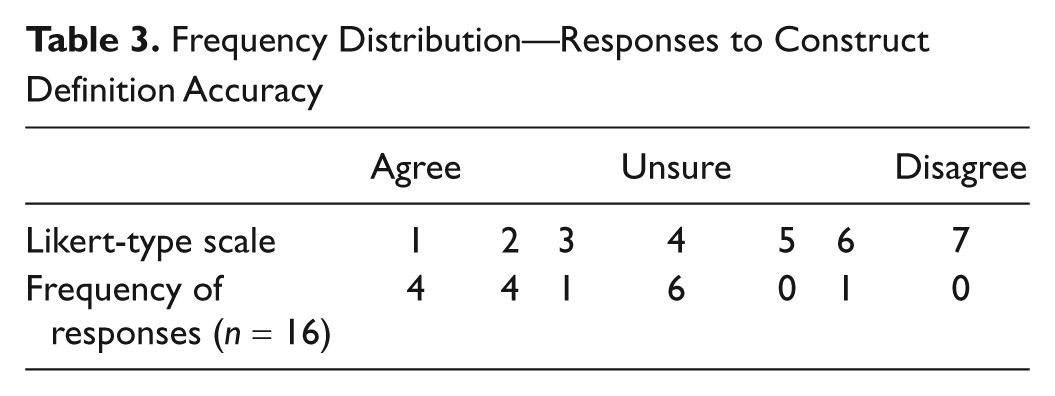
The second item of the questionnaire asked experts to respond using ratings on a 7-point Likert-type scale (1 = agree, 4 = unsure, 7 = disagree) to indicate their agreement with the following statement: “I find that the definition as written in the box on the end of page two is complete and accurate.” The frequency distribution is presented in Table 3. Half (n = 8) of the experts answered between 1 and 3; however, almost another half (n = 7) responded as unsure, and one expert felt some level of disagreement. Respondents were asked to complete further questions if their response to the second item was rated at as “unsure” or toward “disagree.” The first follow-up question was “What would you add to the definition?” and the second was “What would you delete from the definition?”
Frequency Distribution—Responses to Construct Definition Accuracy
Revising the definition of the construct
After receiving and compiling all of the comments for each of the two sections (presented in Table 4), we considered ways that the experts’ critique could be incorporated. Of particular note was that none of the experts disagreed with or offered additions to the initial statement of the proposed definition, “Sexological worldview is the often unexamined but changeable perspective held by each person about the world around them with regards to sexuality.” All feedback from the experts was targeted to the etiology, influences, and components of the construct. This finding was significant, in that it supported the basic foundational elements of the definition as a whole.
Summary of Suggested Additions and Deletions to Construct Definition

The first issue addressed from the expert feedback was that of causation and how the initial definition described sexological worldview as being “the result of the socialization process.” We removed the word result, and instead used the phrase it emerges from. The next issue was one involving physiological dimensions of sexuality. Some experts were concerned that one’s disposition, mental health, or other biologically based attribute of a person may have an impact on their worldview. This pair of experts also discussed the importance of recognizing arousal patterns, sexual behavior, and sexual biology and suggested it might be added. In response, the additional text, “the physical and biological components like sexual arousal . . . sex hormones, and other neurophysiology” was added among the list of possible dimensions and influences on one’s sexological worldview.
Religion was an issue of concern among several of the experts but both in favor of and against its inclusion. One of the suggestions presented was that the term spirituality be used instead of religion. Another expert argued for its deletion because of its similarity to “beliefs.” A third expert felt that reference to “religious teachings” should be included as an influence on the worldview. We elected to include both the terms religion and spirituality and to add “the absence or the presence of” earlier in the definition to show that it may be either the existence or lacking of a certain component that influences the sexological worldview.
One expert made the comment that “there is no one way to express a worldview.” This echoed the sentiments expressed in the Developmental Model of Intercultural Sensitivity (DMIS) and the importance of relativism when looking at different individuals’ worldview and it then seemed odd that it was not already included. The words infinite combinations were added to indicate the multitude of variations of worldviews that may exist.
There were two experts that mentioned Francoeur’s (1991) discussion of worldview in his book Becoming a Sexual Person. Francoeur did not use the term sexological worldview, but just the term worldview (or its German-language equivalent weltanschauung), and introduces it as a continuum with two opposing categorical types of worldview, absolutist/fixed worldview (seen through right and wrong) and relativist/process worldview (seen through constant change). What is missing in Francoeur’s presentation of the construct is field-based research as validation for his definition of the construct. Francoeur’s discussion was more of an observational descriptive model, rather than one designed to be utilized in any way. To include and expand on this work, we added the last sentence: Sexological worldview develops across a continuum with worldviews at one end being expressed as “dualistic (right or wrong)” and at the opposing end as “relativist (possible perspectives are endless and no one perspective is right or wrong)” and varied expressions in between.
The next theme that emerged in the experts’ comments was about the role that individuals’ experiences play in the development of their sexological worldview. One expert commented that experience, and construed experience specifically, is what creates learning. This comment is reflective of Kelly (1963), as cited by M. J. Bennett (1986), and so the second sentence of the definition was altered to explain that worldview emerges through the lifetime, based on a person’s life experience, including socialization. The sentence now reads as follows: “It emerges throughout life experiences and the socialization process . . . ”
The last comment presented by experts was that of “customs and taboos” and their contribution in the creation of one’s sexuality worldview. This point echoes the issues presented in the multicultural counseling literature and the literature on intercultural communications. Customs and taboos are just one small piece of what is often described as and referred to as culture. As this was not something that surprised us and is supported by the literature, the word culture was added to the definition as one of the influential variables to sexuality worldview. A summary of the changes identified by the expert panelists can be found in Table 4.
Based on the collective feedback of the experts, the following is the revised version of the definition, incorporating the suggested changes:
Sexological worldview is the often unexamined but changeable perspective held by each person about the world around them with regards to sexuality. Sexological Worldview emerges throughout life experience and the socialization process and is influenced by the presence or absence of infinite combinations of the following components and their variations: culture, knowledge, values, beliefs, religion or spirituality, opinions, attitudes and concepts specific to sexuality, relationship style and type, sexual behavior, sexual orientation, and gender identity. Sexological worldview develops across a continuum with worldviews at one end being expressed as “dualistic (right or wrong)” and at the opposing end as “relativist (possible perspectives are endless and no one perspective is right or wrong)” and varied expressions in between.
Phase 2
The second phase of the study consisted of interviews with individuals about their perspective on sexuality. The interviews yielded seven themes regarding sexological worldview, which fell into three broad categories: identification, inclusion, and etiology. The first category, identification, included themes (a) beliefs/worldview statements and (b) awareness of one’s own perspective. The second category, inclusion, included themes (c) sexological diversity and (d) professional versus personal perspectives. The third category, etiology, included themes (e) personal identity and personal experience, (f) sexological worldview change/ constancy, and (g) influences on sexological worldview. Each of these is presented here along with supportive exemplars from the respondents (see Table 5).
Emergent Themes—Research Question 1

Identification
Identification, the first broad category, is based on the notion that individuals have to have a basic concept for understanding as well as the realization that an idea or construct has relevance for them personally. In this category, the themes of beliefs/worldview statements and awareness of one’s own perspective emerged (Themes a and b).
Beliefs and worldview statements
All respondents used belief statements in describing their worldview, or in reflecting on the way they interact with others. Belief statements emerged one by one and there was a pattern in them. In looking at the belief statements in a group, each statement seemed to belong to one of three categories: (a) those that were statements of judgment or evaluation, (b) those that were just stating generalizations about sexuality as a concept, and (c) those that described the way that people should or should not do things. As this pattern emerged, we returned to the worldview literature to see if there was any discussion about categories of beliefs. There we discovered Koltko-Rivera’s (2004) article that compiled and compared major worldview theories and presented their common components.
In his meta-analysis of worldview literature, Koltko-Rivera (2004) described that worldview beliefs were a consistent component of the worldview as a construct across various models. He described three different types of worldview beliefs: (a) evaluative beliefs, (b) existential beliefs, and (c) pro/prescriptive beliefs. Koltko-Rivera’s model became a piece of data. Summarizing his findings, he wrote,
Beliefs may be existential, evaluative, or prescriptive/proscriptive, of which values refer only to the last kind; a given worldview may include all of these kinds of beliefs, but not all beliefs are worldview beliefs. Worldviews, thus, encompass certain values but go beyond to include other kinds of beliefs as well. (Koltko-Rivera, 2004, p. 5)
At this point, we revisited the list of themes that had emerged around worldview beliefs and found that the structure described by Koltko-Rivera (2004) did, in fact, apply. Our categories (a), (b), and (c) corresponded with the first, second, and third of Koltko-Rivera’s belief types, respectively. As such, these subthemes were renamed following Koltko-Rivera’s terminology.
Existential beliefs are those belief statements “that describe entities thought to exist in the world” or “concerning the nature of what can be known or done in the world” (Koltko-Rivera, 2004, p. 5). Existential beliefs were present among 19 of the respondents; here are three examples:
There’s a wide variety of experience levels, orientations, gender identities, relationship status. [Sexuality] is more of a continuum . . . our need to express ourselves sexually, physically, emotionally, I think that’s universal. We are all human, all have feelings, all are sexual, even asexual folks in the broad definitions of sexuality, are sexual.
Evaluative beliefs are those belief statements that “describe human beings or actions in evaluative terms (e.g., ‘Those who fight against my nation are evil’ or ‘Human nature is basically good’)” (Koltko-Rivera, 2004, p. 5). In all, 14 respondents made evaluative statements in the discussion of their perspective and interactions with others. These are examples of evaluative beliefs stated by respondents.
Others can be incredibly judgmental about people’s sexuality. I feel sometimes I pity those who can’t see the world the way I see it. Anyone who doesn’t try to make the world more encompassing is bad or negative.
Each of these statements passes judgment on a person or group of people. This makes them evaluative beliefs because the judgment is based on a belief held by the person making the statement about others.
The third category of worldview beliefs is proscriptive/prescriptive beliefs. Proscriptive or prescriptive beliefs are those that “describe preferred means or ends” (Koltko-Rivera, 2004, p. 5). This type of belief, as Koltko-Rivera describes, is more often called “values.” Of the three belief components of worldview, as described by Koltko-Rivera, this type was the most representative among the respondents, with two thirds of respondents mentioning them. The following are examples of prescriptive or proscriptive beliefs about sexuality:
I think that talking about [sexual behavior with a partner] is really important and I think making it a priority is really important. You should do what you can do to be satisfied and sexually healthy. If you are in a relationship with somebody, you should be in a relationship with just that person.
Koltko-Rivera’s model serves as an opportunity for triangulation of the data. That all of the worldview statements fell into one of these categories of an existing model again validated the existence of the construct overall.
Awareness of perspective
When speaking with interviewees about their perspectives, 17 of them were able to recognize a level of awareness that they had a perspective on sexuality and had some ability to control or develop the perspective. Not all of the respondents understood how to control their perspective or understood how it develops, but they indicated an awareness of their perspective and how it is engaged. This first example from a respondent shows this recognition by qualifying her response to a question with a reflection on her age and lack of clinical experience, demonstrating her self-awareness:
I think I’m so young, going into . . . I haven’t had much experience in a clinical setting . . . I feel like I have a lot to learn about counseling and therapy, and knowledge in general.
This response indicates a clear understanding of the respondent’s role as a professional and reveals the impact of the self-awareness on the respondent’s interactions:
I consider it my job to make room for [a student’s] perspective and the various perspectives within a classroom or training. But, personally, I think it’s much harder because I don’t . . . I’m not in control of [a personal] conversation and so I’m much more hesitant to bring up my perspective.
For some participants, thinking about worldview was rather challenging, or on reflecting on it, they were stumped, confused, or unsure about their worldview. Nine, nearly one third of the respondents, gave responses that indicated their being unclear about how to describe their perspective, or that they “try” to have a perspective of a particular kind, or try to interact with others in a particular way:
I don’t even know where to begin . . . I don’t know . . . what do you mean?
Another responded similarly:
I don’t know. I don’t know how to answer that. I’m not very in tune with myself.
The issue of self-awareness supports the initial definition of the construct again, wherein it states, “Sexological worldview is the often unexamined but changeable perspective.”
Inclusion
The next major thematic category was that of inclusion. This category is characterized by the elements that one believes are part of sexological worldview as well as the ways in which one understands them. The themes here included sexological diversity and professional versus personal perspectives (c and d).
Sexological diversity
Respondents, throughout the interviews by and large mentioned a variety of topics in sexuality. The following topics were mentioned: abortion, activism, advocacy, age, behavior (sexual), biology, culture, “everything,” gay marriage, gender, intimacy, leather and kink, litigation, monogamy and polyamory, politics, relationships, religion, sex education, sexual addiction, sexual dysfunctions/ disorders, sexual subcultures, sexuality in childhood, spirituality, and values. These pieces begin to mirror the construct definition as it considers the sexological issues about which one holds different perspectives.
Professional versus personal perspective
For one third of the respondents, when asked about their perspective or sexological worldview, it was important to distinguish the difference between professional and personal perspectives. They often asked for clarification, for example,
Are you asking about myself, personal or professional?
Then, more than half the total respondents continued throughout their interview to differentiate between their personal and professional perspectives:
I think my personal perspective is a little more, um, liberal and open than my professional perspective and I wrestle with that, but yield it as a professional . . . I’ve got a professional, ethical um, obligation to, to present a message to the rest of the world that isn’t necessarily my message, and I need, cause I do live and work in a culture, it reflects some of the culture’s values in the work that I do . . . so, um, I think that in my personal world I am uh, I would do things and, and, um, say things I probably, that I don’t say or do in the professional kind of way.
And,
I think as a professional I would describe my attitudes as very open, um, very positive, inquisitive. I think I would also describe my attitude as um, my professional attitude as really exploratory still um and not completely um solidified in a specific way. . . . I also, I think then personally um I would describe my attitude [laughing] my perspective as I think as open-minded um again, still inquisitive.
This duality of perspective supports the construct definition as individuals try to make sense of the differing and sometimes competing values that have emerged from their culture, religion or spirituality, professional training, and so on.
Etiology
The final major thematic category was that of etiology. This category supports the construct in the remaining section of its definition,
Sexological Worldview emerges throughout life experience and the socialization process and is influenced by the presence or absence of infinite combinations of the following components and their variations: culture, knowledge, values, beliefs, religion or spirituality, opinions, attitudes and concepts specific to sexuality, relationship style and type, sexual behavior, sexual orientation, and gender identity. Sexological worldview develops across a continuum with worldviews at one end being expressed as “dualistic (right or wrong)” and at the opposing end as “relativist (possible perspectives are endless and no one perspective is right or wrong)” and varied expressions in between.
In this category are the themes personal identity and personal experience, sexological worldview change/constancy, and influences on sexological worldview (Themes e, f, and g).
Personal identity and personal experience
The next theme that emerged was the role that personal identity and personal experience played in the way that respondents described their worldview or their perspective on sexuality. Most of the respondents, when asked about their worldview either initially or throughout the interview, discussed ways their identities influenced their perspectives, their personal lives, and at times even the history of their perspective. For example,
I think of sexuality as, not only my sexual orientation but how my gender plays into that and then what I choose to do about it . . . So, uh, by being bisexual and with a woman currently, like, society has a lot of impact on our sex and sexuality.
Another respondent also makes a similar connection.
I’m XX
2
years old. I have been working in the field of sexuality probably from the early 19XX’s . . . I am gay-identified, and I came out in the middle 19XX’s, so I came out before I began working in sexuality . . . I got into working in sexuality in a kind of more um, avocationally and then vocationally, I was just very interested in sexuality largely b/c of my own experiences of wrestling with coming out and recognizing that no one was around teaching anything I needed to know about sexuality.
Some indicated ways in which their professional work in sexuality influenced them personally:
I think my sexual self is very impacted by the work I do in sexuality. Um, in work with people who have sexual addictions . . . when, um, I’m doing a lot of work in those areas it tends to lower my desire for sex or my interest in the world of sexuality in general.
Sexological worldview change or constancy
Part of the interview focused on talking with respondents about how they explain the history and formation of their worldview. The exploration and reflection of the participants’ perspectives often included a relaying of the history of their worldview or perspective. This category had two subthemes: (a) whether a person’s perspective changed or not and (b) specific influences on the worldview. For exactly half of the respondents, their perspective did change in some way or at some point in their lives:
My perspective has changed certainly . . . getting into a different frame of reference . . . saying there’s more out there. Before I didn’t think about sexuality as a whole, but then in high school, I realized that sexuality was really sort of a broad thing. In terms of um homosexuality, um, attraction to other people, um, all of that changed as I began to, um, learn more about the world around me and the differences among people.
For 11 participants, just over a third of the sample, they experienced their perspective as being the same or constant.
I’ve always had a sexual perspective of freedom. I’ve always been interested in finding out more about sexuality and learning about what people are into . . The sort of underlying fundamentals of why I can embrace the things that I embrace and why I act the way I act so I think those have always been there.
While some respondents describe an evolving worldview and others describe a constant worldview, they all have elements of the second subtheme (specific influences on the worldview) that are evidenced in varying ways. The first type of influences we have named “personal experiences and interpersonal interactions.” This type of influence was present in almost all cases, with one third of the histories included a reflection specifically on parents and family:
My parents, yeah, my parents always talked about, like a man and a wife getting married, kids, like that’s what it’s supposed to be, so I just grew up with that as the ideal. I had this sort of deserving monogamous marriage role model that I grew up with and yet um I had relatives who got married and divorced, married late, gay relatives, etc. I guess I would say my family . . . um, we’re pretty open about everything . . . I could talk about anything . . . she sat me down in middle school and said if I wanted to have sex, she would buy me condoms, and . . . I don’t think a lot of kids have that experience.
Almost a third of the participants reflected on their personal experiences and interactions specifically as children:
As a child we were really playful and sexually expressive and we didn’t really hold back, but we did hold back because part of us knew that what we were doing is wrong and dirty and what have you. As a child talk about sexuality wasn’t really existent. We all grew up when there was absolutely nothing taught about sexuality in high school. Through Girl Scouts, I was a camp counselor for years. I went to Girl Scouts camp and then I, there was a staff member there, and uh, yeah there’s a lot of, uh, queer women who worked there. Um, and definitely, and that was also one of the first places that I really felt like exploring gender was an okay thing.
Without doubt, the discussion of the respondents’ history supports the component of the sexological worldview construct that one’s worldview emerges through life experiences.
Influences on sexological worldview
Two thirds of respondents specifically mentioned what the influences were on their worldview. All of the influences referenced either individuals’ experiences or aspects of their environment:
It came from an internship at an HIV/AIDS clinic. My worldviews, my views on sexuality, are very much colored by growing up here [in an urban community in the Northeastern United States] in the 19XXs.
Participants also discussed the ways in which their worldview developed and a component of their reflection often included a discussion of the ways in which their sexological worldviews changed. The two most commonly described influences that promoted change in their sexological worldview were (a) exposure to difference or an interaction with other people and (b) being trained in sexuality.
Exposure or interactions with different others accounted for 11 respondents’ experiences of changed perspectives.
I love to find out the differences [in others] and I love to have dialogue how they’re living their life and what they do for excitement, not necessarily sexually but every aspect of life and sexuality comes into it, as an aside, but . . . to me it’s fun . . . for me, gathering information over the years has expanded my repertoire, my acceptance and my knowing, and it has helped me to develop a greater sexuality.
The use of the words greater sexuality in this context seem to refer to the participant’s sexological worldview, which the participant described had developed, in part, due to dialogue with others about their lives and new information gathered via exposure to different environments. Another participant echoed this experience:
And as I went off to college . . . my concept of sexuality just began to evolve even more. Obviously, being away from home and being an adult and having to be responsible for yourself and being able to go to different places and see different things and meet different people, um, opened me up.
This idea of new experiences and exposure to differences leading to the evolution of one’s worldview echoed in the voices of the 17 respondents who described their academic studies as contributing to this same goal. They described their training as eye-opening, as developing in them a new sense of understanding:
I started grad school and, actually, I decided to become part of a peer education program at my [grad] school. That’s when I got all my formal education about sexuality for the first time . . . that changed a lot in my perspective; it gave me a wider view, it gave me a context to put sexuality and sexual health into, which I didn’t have before.
This participant added another component and more micro-level explanation of what actually happened to her in the process of interacting with differences and others’ values:
When I started to realize that people could be in the same division, department, program, but have completely different backgrounds and experiences and started to recognize, this is going to sound horrible, but that there was value in what other people believed and that I could actually grow from that, versus it being something that was . . . versus it being something to ah to shun or to ah you know or to or to run away from, it was something I could actually grow from.
These two participants eloquently summarized the experiences of the respondents who indicated a change as a result of sexological studies. Together they demonstrated all of the different components other respondents mentioned about the development of their sexological worldview.
Summary of Results
After an expert panel review, the proposed definition of sexological worldview was revised and represented. Through the coding of data from 30 individual interviews, seven themes emerged that supported the revised definition. A summary of these themes can be found in Table 5.
Discussion
Sexological Worldview as a Valid Construct
As a result of this study, we argue that the proposed construct is valid for the following three reasons: (a) It is grounded in the literature on worldview as demonstrated in our previous work (Sitron & Dyson, 2009) and meets the needs for a new construct for the framing of affective training for sexologists, (b) it has been vetted by experts in the field and revised according to their comments, and (c) data collected using interviews with individuals about their perspective, or worldview, regarding sexuality support the key components of the definition:
Sexological worldview is the often unexamined but changeable perspective held by each person about the world around them with regards to sexuality. Sexological Worldview emerges throughout life experience and the socialization process and is influenced by the presence or absence of infinite combinations of the following components and their variations: culture, knowledge, values, beliefs, religion or spirituality, opinions, attitudes and concepts specific to sexuality, relationship style and type, sexual behavior, sexual orientation, and gender identity. Sexological worldview develops across a continuum with worldviews at one end being expressed as “dualistic (right or wrong)” and at the opposing end as “relativist (possible perspectives are endless and no one perspective is right or wrong)” and varied expressions in between.
The seven themes together speak in support of the definition or offer minor changes to its content. The seven themes are as follows: (A) beliefs/worldview statements, (B) awareness of one’s own perspective, (C) sexological diversity, (D) professional versus personal perspectives, (E) personal identity and personal experience, (F) sexological worldview change/constancy, and (G) influences on sexological worldview.
The pattern of beliefs and worldview statements that emerged as Theme A was directly in line with the way Koltko-Rivera presented his explanation of worldview statements in his 2004 work. This validated the construct overall and offers some clarification for the definition. The following statement was added as the fourth sentence of the definition to clarify what types of statements are sexological worldview statements: Sexological worldview statements are those that indicate prescriptive/proscriptive beliefs, evaluative beliefs, or existential beliefs about sexuality.
Themes B and F, awareness of perspective and sexological worldview change or constancy, both support the first sentence of the definition. The definition describes the sexological worldview as “an often unexamined but changeable perspective.” Participants discussed all sides of this experience; some participants were not aware of their sexological worldview at all because they had never thought about it, some were aware that they had a perspective but had not thoroughly examined and/or articulated it, while others were very aware of their perspectives and had considered them frequently in personal and/or professional interactions. In addition, some respondents described a change in perspective and others did not. As the definition includes the words often and changeable it allows for the variation of awareness and experiences of change that were present in the interview data.
Theme C, sexological diversity, clearly lends support to the definition. The participants discussed a variety of topics in sexuality that called for the inclusion of the statement “the presence or absence of infinite combinations of the following components and their variations” and the subsequent list of subtopics included as a part of the sexological worldview. While it may seem lengthy to include the list, as a new construct we believe that including these topics can only help to better clarify the components of the sexological worldview as something different than the worldview discussed in the psychological literature. For example, in his analysis of previously published worldview literature, Koltko-Rivera (2004) included a summary of the relevant topics that are included in describing the worldview; they include items like human nature, will, cognition, behavior, the interpersonal, truth, world, and life, each of which has a variety of dimensions. We aim to do the same for sexological worldview, so that when the definition is utilized, it is clear what types of subtopics ought to be referenced.
Theme D, professional versus personal perspective, speaks to interview participants’ ability to clearly consider the sexological worldview of having two major variations, the personal and the professional. Respondents discussed a perceived ability to separate their personal sexological worldview from their professional in ways such that their professional practice and perspective differed from their personal perspective. This appears to be an attempt by the individual to resolve conflict that might arise between values and beliefs that they were taught through their life experiences with culture and family and those that they have adopted for professional reasons.
This topic did not come up in the expert panel review, and is actually antithetical to the ways in which Hammer et al. (2003) and M. J. Bennett (1986) described the nature of the worldview. They describe the individual as having a core orientation to cultural/worldview differences that is central to the way individuals respond to different others. As such, we are not sure that this perceived separation among our respondents is valid or just a perception. This is one area for further study. Future investigators may seek to determine whether individuals really have two separate sexological worldviews, the professional and the personal, or whether they are one and the same. It could be that some individuals have a worldview that is more adaptive, which would be represented by M. J. Bennett’s adaptation stage of the DMIS.
Theme E, personal identity and personal experience, speaks to the role that one’s personal identity and personal experience plays in the development of the sexological worldview and an individual’s experience of it. Participants talked about key components of their self that were influenced by, and represented in, their sexological worldview. Theme G particularly focuses on the influences that invoked change on individuals’ worldview. Again, in this area it was personal experiences or professional training in sexuality, both of which support the more general “life experiences.” While the definition up until now has included the role of one’s life experiences, which are naturally personal, it has not included the relationship that personal identity has with the worldview; therefore, we have revised the definition somewhat to incorporate this aspect of the interview participants’ experiences.
Implications
Sexological worldview, as a valid construct, offers several opportunities for sexology as a field but particularly for the training of sexologists in humanistic and pluralistic practice that values individuals and their unique experiences of their own and others’ sexuality. The specific implications of this construct are profound. First and foremost, the construct is based strongly in a broad literature review on more generalist worldview constructs that omit sexuality, so its creation adds to generalist worldview studies the importance of sexuality (supported by the World Health Organization and the World Association of Sexual Health) as a key attribute of humanness to be considered when considering a person’s or group’s worldview. From a practical point of view, the construct could be incredibly valuable for use in framing sexological training programs and the training of other human service professionals in sexuality.
As M. J. Bennett (1986) developed the DMIS as a tool to measure individuals’ worldview development for the purposes of creating trainings that are sensitive to the membership of the class, sexological worldview could be measured similarly to measure the effectiveness of trainings that are key components to sexological training.
Much research has been done to study the effects of such training programs without much success (see Sitron & Dyson, 2009), yet they still remain as requirements for certification or credentialing as a sex therapist, sex counselor, and/or sex educator. As we argued, perhaps it is because past training programs have measured specific attitude change, rather than measuring the sensitivity of one’s worldview to others with differing worldviews. In the intercultural communications literature, Hammer et al. (2003) already developed a precedent for the measurement of intercultural development and intercultural sensitivity. By utilizing sexological worldview in the same way that Hammer utilized general worldview, an instrument could be developed to measure individuals’ sexological worldview and its sensitivity to others’ sexological worldviews.
On a larger scale, sexological worldview offers an opportunity to bring sexology, as a field, in line with other human services field. To date, researchers (M. J. Bennett, 1986; Middleton, 2002; Pohan & Aguilar, 2001; Sue & Sue, 1990) have demonstrated in psychology, counseling, and education that a relativist worldview is central to providing service that is sensitive to the “other” (Fowers & Davidov, 2006) and is culturally competent. AASECT (2006), Reiss (1991), Stayton (1998), Tiefer (2006), and Weerakoon and Stiernborg (1996) have discussed the importance of practicing sexology from humanistic, pluralistic, or sensitive perspectives. It is now time for sexology to follow the leadership of education, psychology, counseling, and social work toward more multicultural practices that embrace humanism and pluralism and the value of diversity. It is becoming necessary to begin a more cohesive dialogue in the field by sharing a language of sexological worldview development. In a time of evidence-based practice, it becomes more important to follow the guidelines of AASECT to outline sexological training programs that not only focus on the preparation of culturally competent and sensitive professionals as outcomes but that also hold as their central components methods that are grounded in theory and based on process, rather than just aiming at a product without a solid route through which to get there.
Conclusion
The development of this construct has been primarily based in our review of the literature, a basic qualitative investigation presented in this article, and theoretical discussions with colleagues at professional conferences and meetings. We are confident that there are opportunities for use and real-world applications of the construct, particularly in measuring the ways in which the sexological worldview develops to be sensitive to sexual diversity. We also suggest that continued investigation will broaden the scope of this work and further stabilize the construct.
A potential area for further exploration of the construct would be with a larger sample that represents a broader population because this study focused primarily on individuals in the United States who are interested in studying sexology, studying it currently, and those practicing as sexologists. Such a study would require more resources than were available to us for this study. While the small-scale qualitative approach was feasible and reasonable in scope for us, the outcome of the outlined construct validation process is the product of research methods that inherently are subject to the bias of the researchers and the participating respondents.
Finally, we set out to define a construct that had not previously been defined through scientific inquiry and published in the literature, in an effort to give our field a construct other than attitudes toward sexuality to discuss and describe as we talk about ways in which people’s own sexuality are different. We recognize that it is the first in a line of studies to better understand the way individuals see the world around them in sexological terms, and the impact that those perspectives have on the practice of sexology. Some of our peers have suggested or confounded our construct for one that is more typological in nature. We are not aiming to paint a picture of a particular person’s sexological worldview—to typify the different manifestations of sexological diversity—as they are potentially infinite. Instead, we provide a construct that can help us to name what, until now, has gone unnamed and without any scientific validation. We are more interested in defining the construct preliminarily using scientific methods of inquiry so that it can be published, discussed, and studied further by colleagues in our field and related fields to contribute to knowledge about the human experience of sexuality, sexual diversity, and its impact on our professional work as human service professionals.
Footnotes
Appendix A
Construct Validation Questionnaire

Appendix B
Interview Guide

|
(1) Tell me some basic information about yourself, like how you would describe yourself to someone you are meeting for the first time. (2) Please describe your perspective on sexuality? (A person’s perspective includes their sexual attitudes, values, behaviors, what is and is not ok.) (3) Tell me about the history of your perspective, about its constancy or evolution/change.
If it has changed, what has provoked or influenced that change/those changes? (4) Have you ever had the experience where you questioned your perspective? If so, describe that experience. What happened? How did it happen? Why did it happen? What was the outcome? (5) Describe your perspective in the context of other people’s perspectives. Include in your answer a description of others perspectives in comparison with your own. (6) What kind of environment does the presence of these perspectives (as described in # 4) create? (7) What is it like for you to interact with others and their perspectives? (8) Do you think there is much difference in sexuality attitudes, sexual identities, and sexual behaviors among others around you?
If no, can you say more about that? If so, can you give some examples of some of the differences you see? What can you say about those differences? (9) What kinds of difficulties or problems can you see with having sexuality differences around here? (10) When it comes down to the bottom-line, is it more important to pay attention to differences or similarities among us?
If respondent emphasizes the importance to pay attention to similarities, follow up with: What do you think the similarities are? (11) Do you make any specific efforts to find out more about the differences around you?
If not, why? What keeps you from finding out more? (12) Do you try to adapt your communication to show your recognition of people with other experiences or perspectives on sexuality? (13) Does it mean anything to you to look at the world through the eyes of a person with a different experience of sexuality than yours? (14) Do you feel you identify, fit into, or belong to two or more sexuality-related groups? (15) Has your adjustment to taking other perspectives led you to question your own sexual orientation, sexual preference, gender, or other sexual identity? (16) Do you feel apart from those sexuality identity groups that you have been involved in? |
The author(s) declared no potential conflicts of interest with respect to the research, authorship, and/or publication of this article.
The author(s) received no financial support for the research and/or authorship of this article.