




Abstract
Voice Over the Internet Protocol (VoIP) holds promise as a platform by which services can be delivered to students in rural and remote regions who have reading difficulties. VoIP is an Internet-based protocol that allows two or more individuals to videoconference from remote locations. This study used a single-case research design to investigate whether VoIP would produce significant gains in reading ability in BM, a 10-year-old with long-standing word-level reading problems. BM was provided with a theoretically motivated reading intervention 4 times weekly. The intervention was delivered remotely using the Apple iChat software. Substantial growth in regular- and nonword reading covaried with onset and removal of treatment. Treatment gains were maintained at 10-week follow-up. Meaningful gains were also seen in text-reading accuracy and reading comprehension. VoIP-based instruction represents an important avenue for future research and is a teaching method that holds much promise for rural and remote students.
Reading is not a natural task, and learning to read is not easy (Coltheart & Prior, 2007). Although perhaps 85% of students learn to read via home experiences and classroom instruction, approximately 15% will need additional school support beyond that feasibly provided in the classroom (Department of Education and Training [DET], 2010). Of that 15%, a subgroup of perhaps 5% may need intensive support beyond that provided within the school (DET, 2010).
While many urban areas provide families with access to private- or government-funded services—such as speech-language pathologists specializing in reading, cognitive and developmental psychologists, pediatricians, specialist learning and developmental clinics, and even quality tutoring services—these services are not often available to those who reside in rural or remote regions of Australia. Graham and Bailey (2007) claimed that appropriate support systems for isolated families are not yet available, and a recent report has identified that there is a lack of services in rural and remote areas and suggested that the distance and costs involved in travel to access services in the city compound the already considerable effects of isolation (DET, 2010). The current study reports on a pilot investigation of the effectiveness and feasibility of using Voice Over the Internet Protocol (VoIP) to deliver reading intervention services to children in rural and remote regions.
VoIP is an Internet-based protocol that allows two or more individuals to videoconference from remote locations. It is usually freely available for users (e.g., Skype) or comes bundled with computer operating systems (e.g., the Apple Macintosh iChat software) and can be used, usually without difficulty, by anyone with an Internet connection, a microphone, and a webcam. The software chosen for this study was iChat (Apple Computer, Inc., 2004), which comes bundled with the Mac OS X operating system. iChat was chosen because it allows screen sharing with good screen resolution. The teacher is able to open a document on their computer that contains the reading materials and then share their screen with the student. The student sees a facsimile of the teacher’s display. Screen sharing also allows the teacher to provide prompts (e.g., by highlighting parts of words using the mouse), to make modifications to words (e.g., such as in letter–sound manipulation games—changing sit to sat to pat to pit and so on), and to use a blank document to present new reading stimuli (e.g., a new irregular word) in the same way traditional teaching would use a whiteboard.
The expected advantages of VoIP are twofold. First, there are benefits to parents and children in terms of improving access to quality services and reducing costs. Second, there are potential advantages for the state and economy due to the possibility of centering instruction services around centers of excellence rather than having intervention services spread throughout a state or the nation. It is expected that VoIP instruction would represent a third tier of intervention for children with refractory reading weaknesses. Third-tier interventions are the most intensive in a response-to-intervention model and are implemented when students have not responded to ideal class instruction and to evidence-based, small-group instruction within the school setting (Fuchs, 2003).
Characteristics of Effective Reading Programs
Children with refractory reading difficulties (RD) are likely to require intensive interventions that specifically target weaknesses within reading subsystems (e.g., Wright & Conlon, 2009). It is generally held that students with RD will require instruction that targets one or more of the following: phonemic awareness, systematic phonics, fluency, spelling, teaching of high-frequency irregular words, and vocabulary and comprehension strategies (e.g., Bowey, 2006; Castles & Coltheart, 2004; Department of Education, Science and Training, 2005; National Institute of Child Health and Human Development, 2000; Reynolds, Wheldall, & Madelaine, 2010; Torgerson, Brooks, & Hall, 2006). This study will use Understanding Words (Wright, 2011) to deliver reading instruction. The program allows the teacher to provide targeted and systematic instruction in any of the seven elements of reading instruction noted above. There is evidence that the program produces clinically meaningful gains in reading skills in complex populations (Wright & Conlon, 2009; Wright, Conlon, Wright, & Dyck, 2011a, 2011b).
Study Design and Hypotheses
This study used a single-case research design with a 10-week baseline, 10-week treatment period, and 10-week follow-up. It was predicted that growth would be negligible during baseline and that introduction of treatment would covary with positive growth in reading ability. Finally, it was predicted that reading growth would be less marked when formal treatment was removed during the maintenance period.
Method
Participant
BM was a 10-year-old, right-handed male who was in Grade 4 at a rural school. There is a history of learning difficulties and nonspecific learning support. He was referred to a private development psychology clinic for assessment and treatment of reading problems.
Pretreatment Assessment
Intelligence was assessed using the Wechsler Intelligence Scale for Children–Fourth Edition (Wechsler, 2003). BM’s full-scale IQ was in the average range. Full-scale IQ is shown in Table 1.
BM’s Scores on the WISC-IV, CELF4, Test of Narrative Language, and Peabody Picture Vocabulary Test

Note: WISC-IV = Wechsler Intelligence Scale for Children–4th Edition; CELF4 = Clinical Evaluation of Language Fundamentals–4. Average range for standard scores is 85 to 115.
Oral language
Oral language skills were assessed using the Clinical Evaluation of Language Fundamentals (Semel, Wiig, & Secord, 2003), the Test of Narrative Language (Gillam & Pearson, 2004), and the Peabody Picture Vocabulary Test (Dunn & Dunn, 1997). Table 1 shows BM’s scores on these tests. In summary, BM had mild expressive language weaknesses. His receptive language skills were normal.
Mathematics
The Numerical Operations subtest from the Wechsler Individual Achievement Test–Second Edition (Wechsler, 2003) was used to assess skill in mathematics. BM’s score was in the average range (standard score = 99), indicating that the weaknesses in reading and language did not extend to maths.
Attention
The Disruptive Behavior Rating Scale (DBRS; Barkley & Murphy, 2006) was used to screen for attention-deficit/hyperactivity disorder (ADHD). The DBRS includes two forms for parent and teacher report. Each form assesses Diagnostic and Statistical Manual of Mental Disorders (4th ed.; DSM-IV; American Psychiatric association, 1994) symptoms of ADHD. Symptoms are rated on a 4-point scale (never/rarely, sometimes, often, and very often). Items rated as often or very often were scored as positive symptoms and items rated as sometimes or never/rarely were scored as negative symptoms (Willcutt, Pennington, Olson, Chhabildas, & Huslander, 2005). Ratings were obtained from BM’s mother, his current teacher, and his teacher from the previous school year. In summary, none of the raters reported significant symptoms of ADHD.
Outcome Measures
Word-Level Reading Skills
Four different tests of word-level reading skills were used. These were the Castles and Coltheart regular-, irregular-, and nonword lists (CC2; Castles et al., 2009) and a curriculum-based measure of nonword decoding.
Castles and Coltheart word lists
The revised version of the CC2 (Castles et al., 2009) was used to assess word-level reading skills. The CC2 includes three word lists each of 40 words: regular-, irregular-, and nonwords. The test is available in two formats: a web-based version and a pencil-and-paper PDF version (see http://www.motif.org.au). The web version was used in the current study and was administered face-to-face. The child is presented with the items for reading aloud, one at a time, until he or she makes five consecutive errors on any single item type. At that point, presentation of that type of word list is ceased. Testing proceeds until the child makes five consecutive errors on the final item type.
Curriculum-based nonword reading test
A curriculum-based nonword reading test (hereafter referred to as CBM Nonwords) was constructed. The participants read 88 nonwords constructed from each of the grapheme-to-phoneme conversion (GPC) rules taught in Level A of the intervention program (program name and reference removed to enable blind review). The items were presented on a 13.3-inch Apple Macintosh Macbook computer using Mac OS X v10.6 operating software. Each word was embedded in a Microsoft Power Point file in 48-point Comic Sans font. The words were presented to BM in slide show mode where the assessor pressed an arrow key to introduce subsequent words after the first word had been attempted. No feedback was provided.
Reading Comprehension
The Neale Analysis of Reading Ability—Third Edition (NARA-III) (Neale, 1999) was administered as a measure of reading comprehension. Form 1 was used at the initial assessment and Form 2 at the conclusion of the 10-week treatment (rxx = .71 for internal consistency for Form 1 and rxx = .81 for Form 2; parallel form reliability r = .86; maximum raw score = 44). There are four questions for the first passage and eight for each passage thereafter.
Text Reading Accuracy
The NARA-III (Neale, 1999) was used to assess text reading accuracy. Form 1 was used at the initial assessment and Form 2 at the conclusion of the 10-week treatment (rxx = .95 for internal consistency for Forms 1 and 2; parallel form reliability r = .98; maximum raw score = 100).
Procedure
The study was conducted under the auspices of a private clinic, and use of the data was authorized via University Human Research Ethics Committee arrangements. Following the initial assessment, the family was invited to participate in a pilot program that had the stated aim of investigating whether VoIP could be used to deliver reading intervention for children with RD. Following their consent, all services were provided gratis.
All measures were administered at initial assessment. The CBM Nonwords were administered weekly. The first author delivered the treatment. The initial three sessions occurred face-to-face, and thereafter, all sessions were run remotely using VoIP. Sessions occurred 4 times weekly and ran for ~40 min (43 sessions in total). All assessments occurred face-to-face with the exception of the weekly CBM Nonwords, which were tested using the iChat VoIP medium.
Intervention Procedures
Teaching Program
Understanding Words (Wright, 2010) was used to deliver reading intervention. The effectiveness of the program for improving reading skills has been demonstrated previously in traditional face-to-face format (Wright & Conlon, 2009; Wright et al., 2011a, 2011b). The teaching curriculum of Understanding Words contains seven strands: phonological awareness, phonics, spelling, fluency, irregular words, vocabulary, and comprehension strategies. A brief summary of the types of activities used in each strand is provided below.
Phonological awareness
Understanding Words teaches phonological awareness until the student can identify initial, medial, and final phonemes in cvc, ccvc, and cvcc words and when the student can blend and segment phonemes in vc, cvc, ccvc, cvcc, and ccvcc words. As BM had mastered all skills, the phonological awareness strand did not form part of the current treatment.
Phonics
Approximately 10 min of each session was devoted to phonics. A maximum of one new GPC rule was introduced per session. BM was explicitly taught the new GPC, and the act of phonological decoding was reinforced via reading of words lists. The words in each list consisted of the new GPC and GPCs previously mastered. The grapheme sequence in Level A of the program is as follows: t, a, s, p, i, n, d, o, ck, e, m, r, h, u, f, l, b, g, ai, j, oa, w, ay, ch, tch, sh, th, qu, final “e,” ng, oo, ee, x, or, igh.
Irregular words
Approximately 2 to 3 min of each session was devoted to high-frequency irregular words (those that cannot be or can only partially be identified using phonological decoding strategies, for example, “put”). The words were selected from the Children’s Printed Word Database (Masterton, Stuart, Dixon, & Lovejoy, 2003) and were taught using a combination of flashcards and spelling—methods that have been shown to be effective in improving lexical processing in single cases (e.g., Kohnen, Nickels, Brunsdon, & Coltheart, 2008).
Spelling
Spelling activities occupied up to 5 min. Spelling served two purposes. First, spelling was used to reinforce new and old GPCs. When a new GPC was introduced, BM was asked to spell unfamiliar regular words that included the new GPC and previously mastered GPCs. Second, spelling was used to reinforce the orthographic patterns in irregular words (see above).
Fluency
Repeated oral reading of sentences and stories was used to address fluency. The sentences and stories were all part of the program. The sentences and stories were written to be as decodable as possible and to contain as many of the irregular words as possible. For example, if BM had learned all of the single-letter sounds, that the digraph “ai” represents/ae/and the irregular word “put,” he might read the sentence: “Ted put his bag on the train.” These activities comprised 5 to 10 min of session time.
Vocabulary
Understanding Words (Wright, 2010) uses a method for teaching vocabulary that borrows from Corrective Reading (e.g., Engelmann, Osborn, & Hanner, 1999) and the rich vocabulary approach (e.g., McKeown & Beck, 2004). BM was taught that many English words can have multiple meanings depending on context and that the best clues to the meaning of a novel word can be found in sentence context. The teacher then presents a target word (produce) in a sentence (e.g., Maggie helped her Mum produce a chocolate cake). BM was asked to use the context to identify the meaning of the target produce. The activity continues with a discussion of things BM has produced himself or things he owns that have been produced by others. Finally, the target produce was placed in oral sentences, and BM had to repeat the sentence using a synonym (e.g., Maggie helped her Mum produce a chocolate cake).
Oral sentence comprehension
The student engages in oral comprehension of simple and then complex sentences. For example, the activities begin with simple subject–verb sentences (Dad drove) and BM was asked questions that had to be answered specifically (e.g., Who drove [Dad]; What did Dad do? [Drove]). Later activities present subject–predicate sentences (Dad drove to work; What did Dad do? [Drove]; Who drove? [Dad]; Where did Dad drive? [To work]) and complex sentences (Dad drove to work because he was lazy; What did Dad do? [Drove]; Who drove? [Dad]; Where did Dad drive? [To work]; Why did Dad drive to work? [Because he was lazy]; Who is lazy? [Dad]). BM was taught similar strategies for “understanding” passive sentences and how words such as before, after, as, during, when, then, during, under, over, above, below, first, and next contribute to sentence meaning.
Inference activities
Inference activities begin by teaching that sentences do not always include all the information we might need for comprehension. For example, BM repeated the sentence “Kate hates eating toast at breakfast” and was asked specific questions about sentence meaning (see sentence comprehension above). He was then asked whether the sentence tells why Kate hates toast and whether Kate eats cereal for breakfast (the answer being no to both). The teacher then explained that sentences provide facts but that sometimes we have to go beyond what the sentence tells us directly to help with comprehension. BM then learned how to play a “Yes, No, Maybe” game in which he repeated a sentence (e.g., Jack ate all his lunch) and was then asked questions to which he had to answer yes, no, or maybe. The maybe questions (e.g., Did Jack have yoghurt for lunch?) tap information that is not contained in the sentence. The notion of drawing an inference is then introduced by using words such as all, some, always, and sometimes. For example, BM might repeat “Jack ate all his lunch” and was then asked “Was there anything left in his lunchbox?” (No). BM then began to make cohesive inferences by providing him with two facts (e.g., All cats are black; Snowy is a cat) and requiring him to answer a question that required an inference based on the facts (e.g., What else do we know about Snowy? She/He is . . . black).
Reading comprehension
The oral sentence comprehension method described above is carried into reading after the oral method is mastered. BM read sentences (e.g., The dog dug a hole in the backyard) and then read and answered questions that required specific answers: “What dug?” (The dog), “What did the dog do?” (Dug), “What did the dog dig?” (A hole), Where did the dog dig a hole? (In the backyard), and “What did the dog do in the backyard?” (Dug a hole).
Treatment delivery
The study used an Apple Macintosh platform with the Mac OS X operating system. Videoconferencing and screen sharing was accomplished with the iChat AV v.3 (Apple Computer, Inc., 2004), a software program bundled with Mac OS X (Version 10.4.3).
Results
BM’s scores in the baseline period, after the 10-week intervention, and at 10-week follow-up are shown in Figures 1 and2.

Raw reading accuracy on CBM Nonwords
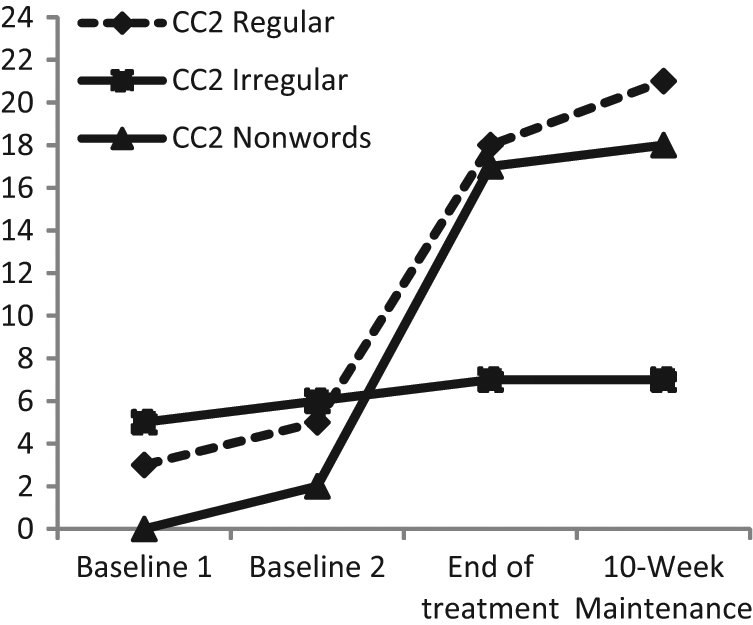
Raw reading accuracy for the CC2 reading lists before and after the 10-week baseline, after the 10-week treatment, and at 10-week follow-up.
Baseline Data and Reading Growth
BM had poor lexical and nonlexical reading skills. His z score on the CC2 irregular-word test was −2.17 (second percentile). His nonword reading score from the CC2 was −2.68 (lesser than first percentile). Text-reading accuracy from the NARA-III was in the first percentile and reading comprehension in the second percentile.
Growth on the CBM Nonwords measure over each of the three 10-week stages of the study (baseline, treatment, and maintenance) is shown graphically in Figure 1. Little growth in nonword reading occurred during baseline. In contrast, substantial improvement occurred over the treatment period. There was also an upward trend in the maintenance period; however, the growth slope was substantially shallower than when formal treatment was being provided.
Figure 2 shows gains made on the CC2 word-reading lists over the three 10-week stages of the study. There was little growth in any of the different types of word-reading skills across baseline. In contrast, sharp improvements can be seen during the treatment period on the CC2 regular- and nonword-reading measures. These gains were maintained at the conclusion of the 10-week maintenance period. There was no obvious trend for gains in irregular-word reading at any stage of the study.
Quantitative Analysis of Reading Gains
To assess BM’s reading gains quantitatively, it was necessary to adopt a rule of thumb against which the clinical significance of changes could be compared. Some studies have used posttreatment status (e.g., a posttest standard score of ≥90) as a benchmark for clinically significant response to intervention (Torgesen, 2000; Torgesen et al., 2001). However, this method may obscure the amount of reading growth in response to intervention (Fuchs, 2003). To assess the clinical significance of BM’s reading growth, we obtained the standard deviation of the relevant raw score distribution for the CC2 word-reading tests (Castles et al., 2009) and the NARA-III text-reading accuracy and reading comprehension tests (Neale, 1999). These data were obtained from the test manuals. The CC2 SD was based on a 10- to 10.5-years-aged cohort, and the NARA-III SD was based on a grade-level cohort.
The criterion then required BM to make change of ≥0.8 of a standard deviation from the highest of the two baseline measures to posttreatment. The ≥0.8 standard deviations rule of thumb was selected because it represents a large effect size (Cohen, 1992).
BM made >0.8 of a standard deviation change from baseline to posttreatment on all measures except the CC2 irregular-word list. The amount of change on each measure with the exception of CC2 irregular-words list was equivalent to a strong effect (Cohen, 1992).
Posttreatment Reading Status
At 10-week maintenance, BM’s z score on the CC2 regular-word test was −1.32 (9th percentile). His z score on the irregular-word test was −2.48 (1st percentile). His nonword reading score from the CC2 was −1.4 (8th percentile). Text-reading accuracy from the NARA-III was in the 4th percentile and reading comprehension in the 10th percentile at posttreatment.
Treatment Satisfaction
BM’s mother indicated being satisfied with his response during the treatment. She also indicated that she was very satisfied with VoIP as a platform for delivering reading instruction. She identified that it allowed BM to access services to which he might not otherwise have had access. She also identified costs savings in terms of travel and savings in time because the instruction was delivered within the home.
Discussion
The purpose of this study was to provide a pilot investigation of whether VoIP provides a platform via which effective reading instruction can be delivered to students in rural and remote regions. The preliminary answer is yes. The intervention covaried with substantial gains in the ability to recognize and/or phonologically decode novel words. Gains in regular- and nonword reading also covaried with substantial improvements in text-reading accuracy and reading comprehension.
Was Growth Due to the Treatment?
Provided sufficient experimental controls are employed, single-case research allows conclusions to be drawn about treatment effectiveness. Indeed, single-case research is considered a rigorous scientific method that can form part of the process of establishing evidence-based practices (Horner et al., 2005). In single-case research, an independent variable (e.g., reading intervention) is systematically varied to document a functional relationship between independent and dependent variables. Performance during treatment is contrasted with performance during, preferably, multiple baselines and untreated periods. An experimental effect is demonstrated when predicted change in a dependent variable (e.g., improvements in reading) covaries with manipulation of the independent variable (onset and/or cessation of intervention; Horner et al., 2005).
In this study, little growth was seen during the no-treatment baseline. In contrast, substantial growth in regular- and nonword reading was seen in the 10-week treatment phase. Furthermore, removing treatment during the maintenance substantially slowed growth in all word-level skills. This covariation of treatment onset and removal with growth and nongrowth in reading therefore provides evidence that the effects were due to the treatment itself and not due to some other psychosocial variable.
While a single case on its own cannot be considered to provide strong support for evidence-based practice, this study at least provides preliminary evidence that VoIP-based instruction can be effective. Furthermore, the current results indicate that VoIP-based instruction is an important area for future investigation.
Different Types of Reading Improvement
The principle gains seen in this study were in regular- and nonword reading. This is unsurprising given the emphasis on phonics. In contrast, irregular-word reading remained static throughout the three phases of the study. The simple explanation for this is that while irregular words were taught in the intervention program, they were not the same words as on the CC2 test. By their very nature, irregular words cannot be decoded using phonological information (at least not completely), and irregular-word training may not generalize to untaught words (Broom & Doctor, 1995).
Gains were seen in text-reading accuracy and reading comprehension that were equivalent to a strong effect size (Cohen, 1992). However, conclusions about these skills must be tempered by the fact that only pre–post measures of these skills were acquired. There is therefore less evidence for their covariation with onset and removal of treatment than there is for the word-level skills discussed above. Nevertheless, they at least provide preliminary hope that VoIP-based instruction can also deliver meaningful gains in text-reading and comprehension.
Advantages of VoIP
It is unlikely that VoIP will produce better gains than traditional face-to-face teaching or therapy (although it may produce comparable gains). However, where such services are unavailable, it may represent an effective alternative. Its advantages seem to lie mainly in ease of access and lower costs. The treatment in this study was delivered from a number of remote locations—the first author ran teaching sessions from his office, from home, and in other locations while away on business. BM was able to videoconference from a room at his school, at home, and when away on a family trip. It was time-effective in that there was no travel to a mutual venue for either teacher or student. The sessions simply involved logging onto iChat using an Internet connection. This ease of use may represent advantages for future government and nongovernment projects because teaching can be delivered from anywhere, thus reducing costs. Second, while some children who have RD will respond quickly to an outreach service such as that mooted by the New South Wales (NSW) Centre for Effective Reading, there will remain a significant minority who will have refractory reading problems. These children will require significant and intensive intervention and support from their parent school and possibly from private bodies outside of school. Unfortunately, this intervention and support is not always available in many rural and remote locations. While the recent DET review associated with the NSW Centre for Effective Reading (DET, 2010) has noted the need for effective professional development and for training young teachers in evidence-based practices, there is still no guarantee that sufficient skill or the time and financial resources to deploy that skill effectively will be available “at the coalface” in rural and remote schools. If VoIP proves effective in larger studies, it may allow government or nongovernment organizations to concentrate teaching assets in one or several locations and thus ensure that quality teaching services are provided to children in rural and remote regions. Finally, VoIP could also be a useful tool in an urban area to reduce travel time and costs for parents. It would allow reading specialists to provide services to a larger client base due to reduced travel time.
Limitations and Future Research
The principle limitation is inherent in the single-case design. It is not clear from a single case just how far the results will generalize. Future research will be required using students who have a range of characteristics to determine which children respond best to this novel treatment delivery format. For example, it may be that students who have ADHD may not respond as well because VoIP makes it more difficult, relative to face-to-face teaching, to manage inattentive and/or challenging behavior. This could be accomplished using a multiple case-series design. Studies should also investigate the characteristics of teachers who provide the best instruction via VoIP. Future research should also use control group designs to investigate whether VoIP has comparable efficacy to face-to-face teaching. Finally, the intensity of the current intervention delivered by a skilled teacher will not be easy to replicate in the real world. It is more likely that students will receive a less intensive intervention (e.g., one to two sessions per week). Future studies should seek to determine the minimum intensity required to make meaningful change. Studies should also investigate whether parents are capable of increasing the intensity of therapist-led intervention by administering treatment between therapist sessions.
Footnotes
The author(s) declared no potential conflicts of interest with respect to the research, authorship, and/or publication of this article.
The author(s) received no financial support for the research and/or authorship of this article.