



Abstract
Might “impostor syndrome” be more than the private trouble it is often described to be? Instead, might it be deeply rooted in sociological processes? I explore this possibility drawing on my personal experience and Pearlin’s insistence that much that distresses us in our personal lives originates in social structures. I use Bourdieu’s theory to conceptualize the processes that may instill the “syndrome,” and once in place, surreptitiously recreate inequality. I test this conceptualization, using new sociologically relevant measures, in a stratified sample of over 2,000 American college students. Experiencing impostor concerns in college was significantly related to low parental income. Results were consistent with a model in which impostor concerns mediate the association of low parental income to depression/anxiety and low college persistence. Cultural aspects of impostorization played a larger role than the intellectual aspects emphasized in the traditional conceptualization of impostor syndrome. I advocate the replacement of the within-the-person term “impostor syndrome” with the sociological term “impostorization.”
“I was convinced that I would be discovered as a phony when I took my comprehensive doctoral examination” “If I can get a Ph.D. in astrophysics from M.I.T., anybody can”
These quotes illustrate what has been termed “impostor syndrome,” the “persistent inability to believe that one’s success is deserved or has been legitimately achieved as a result of one’s own efforts or skills” (https://languages.oup.com/google-dictionary-en/). Could it be that this so-called syndrome is much more than the “private trouble” (Mills 1959) it has often been described as? Instead, could it be conceptualized as having origins deeply rooted in sociological processes and consequences that reinvigorate the very same social inequalities that gave rise to it in the first place? I take as my task the exploration of these possibilities. I use my own personal experience with “impostor syndrome” in concert with my training as a mental health sociologist to inform my inquiry. I take inspiration from Leonard Pearlin, who gave name to the Pearlin Award I have received, and in particular to his insistence that much of what distresses us in our personal lives can be traced back to social origins in social structures. I use the theory of Pierre Bourdieu to conceptualize the sociological processes that may instill the “syndrome,” and once in place, surreptitiously recreate inequality. I put this conceptualization to test, aided by sociologically relevant measures I constructed, in a stratified sample of over 2,000 young current or former American college students. I begin my accounting of this sociological story about “imposter syndrome” with my own personal encounters with it.
My Story
I am a first-generation college graduate from the not-coastal not-cool “Inland Empire” of southern California, which Joan Didion (1968) immortalized as the sort of place you could “live and die without knowing what an artichoke was” (p. 4). Imagine. Growing up, I was a relatively advantaged high achiever among classmates of generally modest socioeconomic backgrounds, and I thought I was pretty hot stuff. I had all the confidence in the world. However, when I arrived at UCLA for undergraduate school, I made a discovery that deeply shook me. The place was swarming with kids who—even if they might not have been smarter than me—sure sounded that way. They were articulate. They could discuss. And they knew about things. Artichokes.
My intellectual self-esteem plummeted. I disidentified (Steele and Aronson 1995) with academics and my GPA dropped, but I continued. I entered a clinical psychology PhD program, which was even worse! As other academic “impostors” understand, at each stage of advancement, the competition gets stiffer (Morgan et al. 2021), the expectations to know about certain things—both substantive and trivial—and to be able to talk the talk, get stronger.
I got caught in a vicious cycle, which will be familiar to some of you. I was too frightened to speak up in my seminars, and the longer that went on, the more impossible it was to break out of the pattern. “What—Jo’s going to talk? It had better be good!” I avoided professor’s office hours, did not seek feedback because it would surely be negative, procrastinated to delay the certain verdict that my work was not good enough, and smoked a lot of marijuana to escape my anxieties. Obviously, none of these coping strategies were very helpful. I came very close to leaving my doctoral program with a terminal master’s degree.
I was saved from this truly horrible situation by a stroke of luck. For reasons unrelated to my impostor feelings, I transferred from my clinical psychology program to sociology, where no one knew me as a shy person. I broke my vicious cycle of silence by forcing myself to speak up at the first opportunity in every class session. I discovered that no one made fun of me; professors seemed to appreciate my comments. I began a long road to recovering my intellectual self-confidence, which continues to this minute.
Clinical and Sociological Approaches to “Impostor Syndrome”
The concept of impostor syndrome (also called “impostor phenomenon” or “impostorism”) was developed by clinical psychologists Clance and Imes (1978), and its study remains primarily in the domain of clinical psychology, where its interpretation as a stable personality trait predominates (Bernard, Dollinger, and Ramaniah 2002; Clance 1985). It is seen as rooted in early childhood experiences such as family dynamics and parental expectations (Clance and Imes 1978) and carried forward by durable personality traits such as perfectionism and neuroticism (Bernard et al. 2002; Thompson, Foreman, and Martin 2000). It is commonly viewed as a psychological or psychiatric syndrome (Kets de Vries 2023), and a recent systematic review of the literature (Bravata et al. 2020) calls for its inclusion in the Diagnostic and Statistical Manual of Mental Disorders (DSM). Solutions to the problem focus on clinical treatment (Bravata et al. 2020). A substantial lay literature has also blossomed (Bravata et al. 2020), focusing predominantly on how to manage “impostor syndrome” with recommendations in turn focused largely on cognitive reframing of fraudulence-affirming beliefs.
But what did Pearlin (1989) tell us in “The Sociological Study of Stress?” Stressful experiences [such as impostor syndrome] typically can be traced back to surrounding social structures and people’s locations within them. The most encompassing of these structures are the various systems of stratification that cut across societies, such as those based on social and economic class, race and ethnicity, gender and age. . . . The search for the origins of stress, I believe, will reveal how ordinary people can be caught up in the disjunctures and discontinuities of societies, how they can be motivated to adopt socially valued dreams and yet can find their dreams thwarted by socially erected barriers. . . . Sociological inquiry does not have the option of ignoring these origins (Pearlin 1989:242).
I was driven to follow Pearlin’s lead in my attempt to understand impostor “syndrome,” which in keeping with a sociological perspective and the term “minoritized,” I heretofore refer to in terms of “impostorization” and being “impostorized.”
Theoretical Framework: Impostorization in Social Reproduction
What theory might connect Pearlin’s (1989:242) “encompassing structures of social and economic class, race and ethnicity, gender and age” to impostorization? The idea of impostorization slots very well into an important theoretical and empirical literature in sociology, that is, Pierre Bourdieu’s ideas about the reproduction of class structure via the educational system (Bourdieu 1986, 1990; Bourdieu and Passeron 1977; Bourdieu and Wacquant 1992). Although higher education is generally viewed as a major conduit for upward social mobility, Bourdieu and colleagues argued that the university system, with its ability to give or deny access to power and privilege, is actually the key social arena in which inequality is reproduced.
Bourdieu’s concepts of “cultural capital,”“misrecognition,” and “habitus” are key to my analysis of impostorization. Bourdieu argued that students from higher-social-class backgrounds 1 achieve more success in higher education because they are advantaged in terms of several forms of capital, including economic capital (wealth and income), social capital (valuable social connections), and, central to his theory, cultural capital. Cultural capital can be institutionalized, (e.g., educational credentials), objectified (e.g., possession of cultural objects such as paintings and books), or embodied (e.g., values, cultural norms, and knowledge relating to, for example, gestures and posture, accent, style of speech and dress, etiquette, and manners). Bourdieu saw embodied cultural capital as “carrying the greatest ‘weight’ in terms of class reproduction, because it is the ‘best hidden’ form of hereditary transmission of capital” (Friedman and Laurison 2019:199). It is hidden by the process of misrecognition, a dynamic social process in which a situation, process, or action is not recognized for what it is. Misrecognition can be illustrated as follows: lower- and higher-class groups have different habitus (attitudes, dispositions, habits, and tastes) that they develop throughout childhood (Lareau 2011). For example, lower- and higher-class groups may differ in their affinity for popular versus classical music; beer versus wine; bowling versus tennis; crime novels versus “literary fiction”; loud versus muted colors and vocal expression; and speaking in short sentences with few clauses versus speaking in long sentences with many clauses. These differences could easily be seen simply as different ways of knowing and being in the world. In fact, however, because of the dominance of the higher class, its version, its habitus, is misrecognized as the superior way, indicating legitimate competence, natural sophistication, or even intelligence. Higher-class values, norms, and forms of knowledge are seen to confer cultural capital, whereas the lower-class version of habitus is seen to confer nothing—only an absence of cultural capital (Lamont and Lareau 1988). This differential valuation is particularly pronounced in higher education, which, as the primary tool of class reproduction, promotes and rewards the capitals possessed by the dominant group (Bourdieu and Passeron 1977).
According to Bourdieu and Wacquant (1992:127), when among one’s own group, habitus is “like a ‘fish in water’; it does not feel the weight of the water and it takes the world about itself for granted.” However, when different groups come into contact, as in the college setting [an example of what Ridgeway and Fiske (2012) call “gateway encounters”], differences in habitus become obvious. Higher-class habitus is more congruent with the norms and values of the higher-education setting. The rules of the game are their rules. The culture shared by higher-class students and the institution is misrecognized as superior. Consequently, lower-class students are the ones who feel inferior and out of place. “When people lack the capital required to successfully navigate a social field, they are marginalized, feeling the ‘weight’ of their habitus within a context in which it does not fit” (Bourdieu and Wacquant 1992:127). The resulting disjunctures can generate disquiet, ambivalence, insecurity, and uncertainty (Reay, Crozier, and Clayton 2009). It is through lower-class students’ realization that their habitus is out of place and devalued in the higher-education field and in their distress over this realization that impostorization finds its way into Bourdieu’s model. In short, lower-class students may feel like impostors.
Two important implications of Bourdieu’s analysis for impostorization can be drawn here. First, he raises the idea that much of what makes impostorized people feel fraudulent relates not to the intellectual-competence terms in which impostor syndrome has traditionally been framed, but rather to cultural competence, or cultural capital. Not only “Am I smart enough? Competent enough?” but Do I speak correctly? Dress correctly? Understand the dominant group’s cultural references? Laugh at the right things? Applaud at the right times? Know how to order in a fancy French restaurant? Have experience with world travel? Know who the trendiest scholars are in my field? Know about really obscure scholars in my field, familiar only to the cognoscenti? Know what the most prestigious colleges and universities are?
Second, he shows that feeling like an impostor can be a rational response because that is exactly how lower-class students are often viewed and treated. His thinking transforms what might be deemed irrational, even pathological, into an understandable circumstance rooted in reality.
The last important component of my Bourdieusian analysis of impostorization is this: being impostorized, once established, may in turn contribute to the social reproduction that is Bourdieu’s overarching theme. Social reproduction happens in part simply because lower-class students, ill-equipped with cultural and other capitals, are less rewarded and likely to succeed, for example, in terms of getting good grades and letters of recommendation. They are in effect “pushed out.” However, Bourdieu’s concept of “self-elimination” points to an important role for impostorization in social reproduction. In self-elimination, lower-class people reject education because they judge it will not be rewarding for them and anticipate with anxiety and insecurity the barriers they will face in the field of higher education, “becom[ing] the accomplices of the processes that tend to make the probable a reality” (Bourdieu 1990:65). Thus, self-elimination is a consequence of both the objective judgment of not belonging and the accompanying subjective distress that characterizes impostorization. In this way, those who feel like impostors may self-eliminate by leaving college without completing their degree, lowering their educational goals, or declining to pursue further education, becoming accomplices in their own domination.
Literature Review
Research on “Impostor Syndrome”
In the (primarily psychological) literature focused explicitly on “impostor syndrome,”“impostor phenomenon,” or “impostorism,”Bravata et al. (2020) systematically reviewed 62 studies, nearly half of which used undergraduate samples, published between 1990 and 2018, which examined the prevalence, predictors, correlates, and treatment of impostor syndrome. Only two small studies (both of undergraduate students) examined social-class predictors of impostor syndrome. Neither family income, occupation, nor class standing was significantly related to impostor feelings, but private high school attendance predicted lower impostorism. The review finds fairly abundant support for potential consequences of impostor feelings that are consistent with a Bourdieusian model: the most consistent finding in the review was the association of impostorism with depression, anxiety, low self-esteem, impaired job performance, job satisfaction, and burnout.
Research on Belonging and Related Concepts among Lower-class College Students
A separate literature in the fields of sociology and education looks at the experiences of lower-class college students. These studies only occasionally refer explicitly to “impostor” feelings, but the issues raised strongly overlap with impostorization. These studies address intellectual self-doubt, the core content of impostor syndrome as originally conceptualized, but venture further into issues of cultural self-doubt, alienation, and lack of belonging.
The results of quantitative surveys are consistent with my Bourdieusian model. Lower-class students have lower perceptions of their competencies, self-efficacy, and their own intelligence (Ivcevic and Kaufman 2013). There is also a lower sense of belonging and greater alienation at college among lower-social-class students (Ostrove 2003; Ostrove and Long 2007; Soria and Stebleton 2013), which in turn is associated with negative academic and psychosocial outcomes (Ostrove and Long 2007).
A number of qualitative studies, often adopting a Bourdieusian perspective, employ interviews with lower-class-origin undergraduate students (Aries and Seider 2005; Granfield 1991; Jury et al. 2017; Lehmann 2007; Ostrove 2003; Reay, Crozier, and Clayton 2009), graduate students (Gardner and Holley 2011; Kosut 2006), academics (Reyes 2022; Waterfield, Beagan, and Mohamed 2019), other professional workers (Friedman and Laurison 2019; Karp 1986), and middle-class women (Lawler 1999). Although participants usually do not frame their situations in terms of social reproduction or seem to recognize the arbitrariness with which one habitus is considered superior to another, they do show a clear awareness that their habitus is not the favored one and that they lack the cultural capital necessary to successfully navigate the settings in which they find themselves. Major themes in these studies are (1) the importance of seeming intelligent; (2) concerns about lack of sophistication, including a lack of familiarity with higher-class cultural practices such as skiing, classical music, foreign travel, mastery of foreign languages, and “appropriate” speech and dress; (3) fear of exposure as an outsider; (4) embarrassment about family and social origins, such as parents’ jobs or experiences with criminal justice; (4) feelings of alienation; (5) experiences of being dismissed; and (6) experiences of social rejection and feeling excluded from “the club.”
In some cases, impostorizing experiences are quite overt: One of the first nights I got here . . . There was a party in my dorm . . . I didn’t realize it was a rich white kids’ party. Everyone was giving me one-word answers, turning their face and that made me feel kind of crummy that night (Aries and Seider 2005:428).
In my own case, there was a clinical supervisor who remarked that I had “farmer’s hands” and set about to eradicate the remnants of my family’s Iowa accent. By contrast, in many cases, impostorizing messages are very subtle and not necessarily hostile. Simply realizing that the insiders share something valued (Bourdieu has given us the concept of “cultural capital” to describe that something) that you don’t is plenty to induce feelings of being an impostor. “[Wealthy students] know . . . that they have a certain niche, and it fosters in them a really unique bond between each other and excludes you. They can be totally friendly with me, not hostile or anything like that, but it excludes me” (Aries and Seider 2005:428). Another indirect form of impostorization has been described by Link and Phelan (1999) as “incidental rejection.” Here, demeaning comments are made to an impostorized person (who is presumed to be an insider) about an outsider. For example, a White graduate student who grew up poor attends a conference where he hears both an admired luminary in his field (in a paper session), and his own mentor (at a mentor’s lunch!) makes references to the “white trash” outside the conference center (Jaremka et al. 2020). For me, there was a boss who exclaimed in derisive disbelief about some unfortunate person: “He didn’t know what language ‘La Bohême’ was written in!” Gulp—was he about to ask me? This kind of interaction is doubly pernicious. First, impostorized persons are told that people like them are inferior. Second, they force impostorized persons to either out themselves (“Well, actually, I don’t know what language it’s in either.”) or stay silent, hoping not to be exposed, and thereby behaving like an impostor—trying to be something they are not. My own experience with impostorization has by and large involved indirect and subtle forms rather than direct degradation and rejection.
Contribution of my Study and Considerations in its Design
I began by describing my experiences with impostorization, experiences which many of you may have shared. The empirical question I address is to what extent these feelings and experiences, prominently attributed to a dysfunctional psychological syndrome, can instead be traced to social-structural inequalities and may contribute to the reproduction of those inequalities. Bourdieu provides a compelling theoretical framework for understanding how this might work, a framework that inspires my conceptual model (Figure 1).
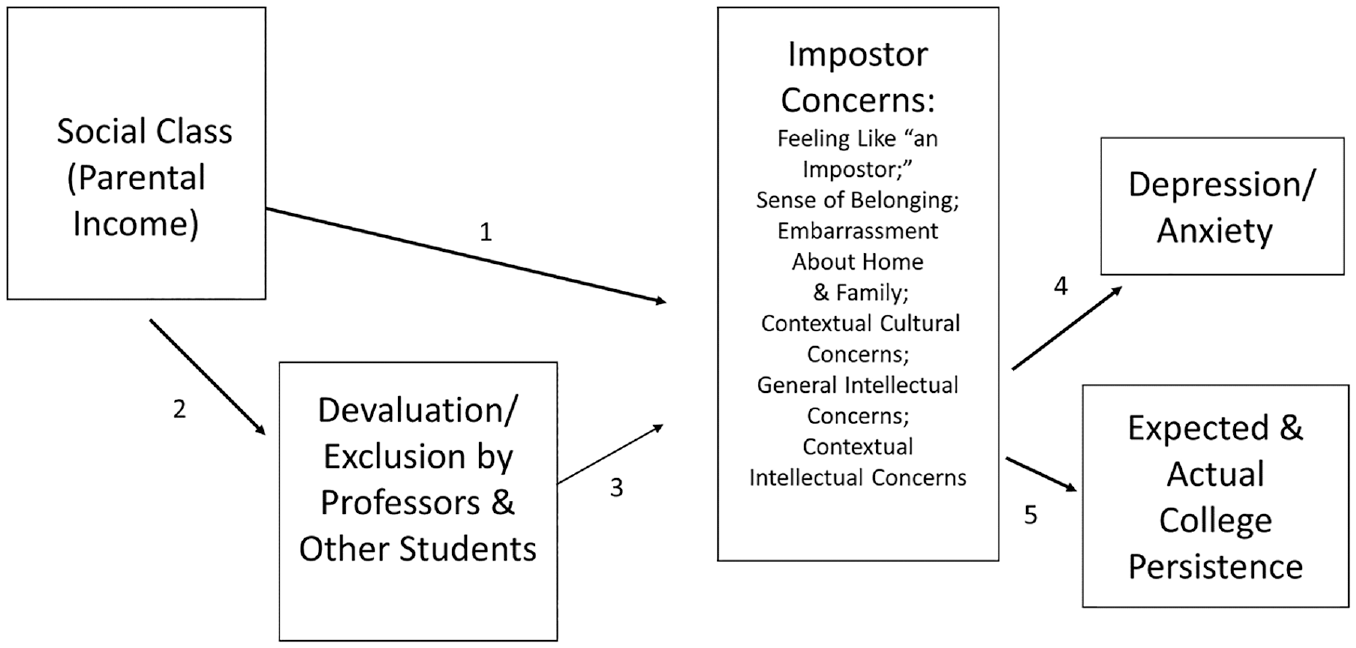
Conceptual model of impostorization process, as tested.
At the center are impostor-related concerns. In keeping with Pearlin, I hypothesized that lower-class students would experience more impostor concerns (Pathway 1). In keeping with Bourdieu, I proposed a more elaborate model in which lower-class students encounter more devaluation and exclusion, which in turn leads to impostor concerns, which in turn lead to depression/anxiety and lower college persistence. Specifically, I hypothesized that experiences of devaluation and exclusion in college would partly account for heightened impostor concerns among lower-class students (Pathways 2 and 3). I hypothesized that impostor concerns would in turn be associated with depression/anxiety and lower college persistence (Pathways 4 and 5). Finally, I hypothesized that impostor concerns would partly account for the effects of lower social class on outcomes of depression/anxiety and college persistence (Pathways 1, 4, and 5).
What empirical support for this model currently exists? The psychological literature on impostor syndrome provides some support by showing that impostor concerns are associated with anxiety, depression, burnout, and impaired job performance, but it provides little evidence regarding the association of impostor concerns with social class. The quantitative literature on the sense of belonging in college provides reasonably good evidence that the sense of belonging is related to social class and some evidence that it plays a role in reproducing class inequalities. The power of this variable begs us to explore what experiences and feelings may make up, may lie behind, and may be related to a feeling of belonging. The qualitative literature provides compelling evidence that lower-class students experience impostor feelings that relate to devalued habitus and that those feelings have consequences for emotional well-being and academic outcomes. This evidence provides the impetus for studies with larger and less selected samples that can provide better answers as to how common these experiences are among lower-class students and to what degree those experiences vary by class background.
To get closer to an answer to my question, I carried out an online survey of over 2,000 18- to 26-year-old current or former college students in the United States with quotas for first-generation White students, as well as for Asian, Latinx, and Black students. The survey assessed parental income in adolescence and other sociodemographic factors; reports of devaluation and exclusion in college; feelings, perceptions, and concerns relating to being an impostor in college; depression/anxiety; considering leaving college without graduating; and actually leaving without a degree.
Although quantitative analysis of Bourdieu’s theory is unusual (and I feel some eyes rolling), I took this approach for several reasons. First, I clearly have a point of view on the issue of impostorization, so it was important for me to subject my hypotheses to falsification by rigorous testing (Link 2003). Second, my quantitative survey allowed me to answer questions that prior studies could not. Most importantly, the relatively large sample with quotas for racial and ethnic groups and first-generation White students gives me an opportunity to detect the degree to which the experiences described in previous qualitative studies are differentially distributed by class and race/ethnicity. Second, most previous studies have drawn samples from one or two colleges or other institutions. My national sampling frame, not tied to particular colleges, as well as a neutral recruitment procedure that avoids self-selection based on negative college experiences or outcomes, improves generalizability to students of four-year undergraduate programs in the United States. The sampling frame also allowed me to include former as well as current students, in turn allowing me to assess whether the former students had completed their four-year degrees, providing an objective measure of college persistence.
Finally, quantitative measures of impostor concerns are extremely limited, and the domain needs to be explored. What is it like to be impostorized? What does the experience include? Exclude? What triggers it? I constructed several new measures of impostor concerns and a measure of devaluation and exclusion experienced at college. My aims in creating these measures were to (1) expand the intellectual-self-doubt domain covered by traditional measures of impostor syndrome to include the domain of cultural-self-doubt and exclusion emphasized by Bourdieu, (2) translate the experiences of devaluation/exclusion and impostor-like feelings reported by lower-class students in qualitative studies into quantitative measures, and (3) explore more specific feelings and experiences that may be represented by the “sense of belonging” that has been shown to play a role in the reproduction of inequality in college.
Methods
Sample
Data come from an anonymous, online survey of 2,034 participants conducted via Qualtrics Panels. The Qualtrics Panel is a nonprobability panel whose participants are recruited from a variety of sources with varying sociodemographic compositions. Panel members are sent an email invitation or prompted on a survey platform to proceed with a given survey and are informed at that time what they will be compensated. Participants took the survey between February 28 and March 30, 2023. The survey was restricted to English speakers between the ages of 18 and 26 who were currently or had previously been enrolled in a four-year undergraduate program at an in-person (not exclusively online) college or university. The survey employed quotas for Whites with no parent who had attended college, and Blacks, Latinxs, and Asians to achieve at least 200 participants (10 percent of the overall sample) from each of these groups. The quota for first-generation students was limited to Whites because I wanted a large enough sample of students whose impostorization experiences could be attributed to class as distinct from race or ethnicity. The rest of the sample comprised individuals who did not fall into one of those groups. Data were weighted to the subsample of the 2021 Current Population Survey who were 18–26 and currently enrolled in a four-year college or university. Weights were based on 20 strata defined by the intersection of gender (male/female), parental education (at least one parent had some college education or not), and race/ethnicity (Black, Latinx, Asian, White, other race). After weighting, the study sample and the CPS generally corresponded quite closely on these variables (see Online Supplement Table S1).
Measures
Some measures are presented here in abbreviated form. Full descriptions for all abbreviated measures are available in the Online Supplement.
College enrollment
“What is your college enrollment status? Don’t count online colleges that conduct all classes online.” Response options: “Currently enrolled at a campus-based 4-year college” (55.1 percent); “Previously enrolled at a campus-based 4-year college” (44.9 percent).
Sociodemographic variables
Parental income
What is your best estimate of your parents’/primary caregivers’ total income before taxes for most of the time when you were in high school? Note: This includes money from jobs, net income from business; farm or rent, pensions, dividends, interest, social security payments and any other money income received.
Response categories ranged from 1 (less than $5,000) to 16 ($150,000 or more). Mean = 9.29; SD = 4.56.
Race/ethnicity
Participants chose one or more of 16 detailed categories. I grouped them into the larger categories of Black (12.2 percent); White (57.3 percent); Asian (10.3 percent); Latinx (19.1 percent); and Other (1.1 percent). Because of their small numbers, “Others” were excluded from analyses.
Rural Origin: “How remote/urban was the hometown you lived in during most of your time in high school?” Response options: (7) “Remote” (7.5 percent); (6) 3.7 percent; (5) “Rural” (25.5 percent); (4) 11.8 percent; (3) “Suburban” (32.3 percent); (2) 5.5 percent; and (1) “Urban” (13.6 percent).
Gender was assessed as “Female” (58.7 percent); “Male” (38.9 percent); “Non-Binary” (1.9 percent); or “Other” (0.4 percent). Because of the small numbers of Non-Binary and Other gender, present analyses include Female and Male only.
Age was restricted to 18–26 years. Mean = 23.89 years; SD = 2.55 years.
High school grade point average (GPA)
(5) A or A+ (33.3 percent); (4) A– (20.9 percent); (3) B+ (22.7 percent); (2) B (13.1 percent); and (1) D to B– (9.8 percent).
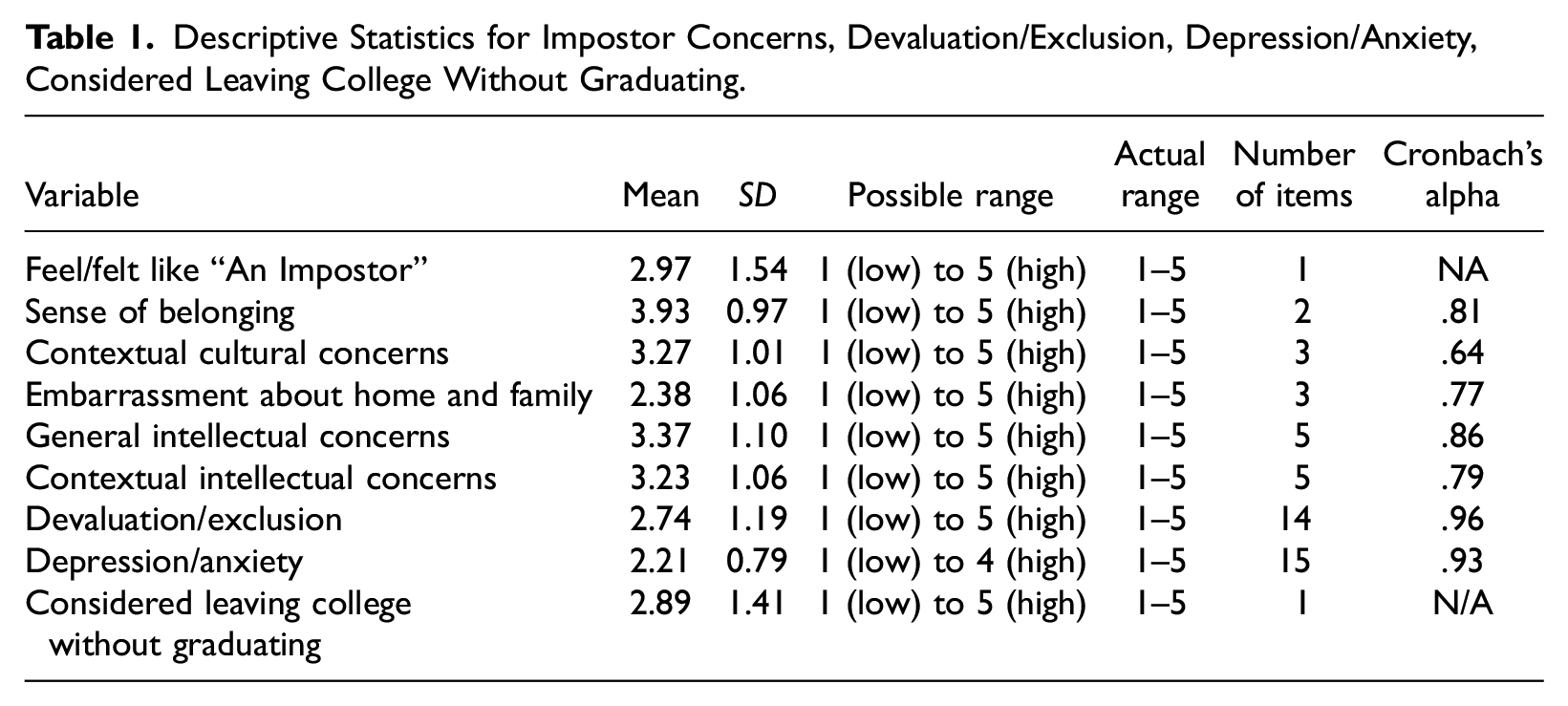
See Table 1 for a summary of descriptive statistics for impostor concerns, devaluation/exclusion, depression/anxiety, and considered leaving college without graduating.
Descriptive Statistics for Impostor Concerns, Devaluation/Exclusion, Depression/Anxiety, Considered Leaving College Without Graduating.
Impostor concerns
Feeling like “an Impostor” is an item I created: “I have felt like an impostor at my college”/“I felt like an impostor at my last 4-year college.” Response options range from (5) “strongly agree” to (1) “strongly disagree.” Mean = 2.97; SD = 1.54.
Sense of belonging is the mean of two items adapted from Ostrove and Long (2007). “Overall, I feel like I belong at my college/Overall, I felt like I belonged at my last 4-year college” and “I feel that I fit in as part of the college environment/At my last 4-year college, I felt that I fit in as part of the college environment.” Response options range from (5) “strongly agree” to (1) “strongly disagree.” Mean = 3.93; SD = 0.97; Cronbach’s alpha = .81.
I used findings of the qualitative studies reviewed above to create measures of worry in anticipation of two hypothetical situations at college. The Seminar Scenario asks participants to imagine they will be taking a seminar class in which they will be expected to analyze the course material and communicate their own perspectives in class. The Dinner Scenario asks them to imagine attending a dinner at a professor’s house where there will be many students and professors they don’t know. Participants are asked about a number of worries they might have about the situations. From responses to these items, I constructed two scales. See the Online Supplement for complete wording of the scenario descriptions and the scale items.
The first scale is contextual cultural concerns, the mean of three items describing worries about seeming like a cultural outsider in terms of life experiences, speech, dress, and familiarity with foods and drinks. Mean = 3.27; SD = 1.01; Alpha = .64. See below for the second scale.
Embarrassment about home and family is the mean of three items I constructed inspired by the qualitative studies referenced above and the Class-Based Rejection Sensitivity Questionnaire (Rheinschmidt and Mendoza-Denton 2014). “I would be ____ to talk to college classmates about where I grew up; I would be ____ to have college classmates visit my parents’ home; I would be ____ to have classmates’ parents meet my parents.” Response options ranged from (1) “very proud” to (5) “very embarrassed.” Mean = 2.38; SD = 1.06; Alpha = .77.
General intellectual concerns, the mean of five items, is adapted from the Clance Impostor Phenomenon Scale (CIPS; Clance 1985), the most widely used measure in the impostor syndrome literature. Following Cohen and McConnell (2019) and Muradoglu et al. (2021), I drew five items from the dominant “fake” factor of the CIPS (McElwee and Yurak 2010). The items address fears that one is not as intelligent, capable, or knowledgeable as others and that these shortcomings will be discovered. Response categories range from (5) “very true” to (1) “not at all true.” Mean = 3.37; SD = 1.1; Alpha = .86. See Online Supplement for item wording.
Contextual intellectual concerns is derived from the same Seminar Scenario and Dinner Scenario described above for the contextual cultural concerns measure. Contextual intellectual concerns is the mean of five items describing worries about seeming less intelligent, less sophisticated, and “ignorant.” Response options to the statements “I would worry that . . . “ ranged from (5) “strongly agree” to (1) “strongly disagree.” Mean = 3.23; SD = 1.06; Alpha = .79.
Devaluation/exclusion
Drawing on the qualitative research reviewed earlier, I created items asking about devaluation and exclusion by professors (seven items) and by other students (seven items), as follows: Based on your race, ethnicity, gender, social class or where you come from, how often have professors, instructors or teaching assistants . . . paid less attention to you than other students? acted as if you are not as smart as other students? made you feel like an outsider? acted as if you didn’t belong in college? acted as if things you said were trivial or uninteresting? treated you as if you weren’t a serious student? paid more attention to your physical appearance than to what you had to say? Based on your race, ethnicity, gender, social class or where you come from, how often have other students . . . excluded you from conversations or activities? teased you because of the way you speak or dress? acted as if you weren’t worth listening to? treated you with less respect than other students? acted as if you weren’t as smart as other students? acted as if you were unsophisticated? acted as if you didn’t belong to their ‘club’? paid less attention to you than other students?
Response options ranged from (5) “very often” to (1) “never.” I created a scale which is the mean of the 14 items: Mean = 2.74; SD = 1.19; Alpha = .96.
Hypothesized consequences of impostor concerns
Depression/anxiety
The PHQ and GAD are well-established Diagnostic and Statistical Manual of Mental Disorders (4th ed.; DSM-IV; American Psychiatric Association, 1994)-based screening measures for diagnosis and severity of depression and generalized anxiety, respectively (Kroenke et al. 2016). Participants were asked “Over the last 2 weeks, on how many days have you been bothered by . . .” a series of symptoms. Response options ranged from (1) “not at all” to (4) “nearly every day.” See Online Supplement for item wording. The items of the PHQ-8 and GAD-7 formed a single factor, and I constructed an omnibus scale, the mean of the 15 items. Mean = 2.21; SD = 0.79; Alpha = .93.
Considered leaving college: “Since entering this college, how often have you thought seriously about leaving college without graduating?/At your last 4-year college, how often did you think seriously about leaving college without graduating?” Response options: (5) “very often” to (1) “never.” Mean = 2.89; SD = 1.41.
Graduated
Participants who were previously (N = 840) as opposed to currently enrolled in college or university were asked: “Did you receive a 4-year college degree (e.g., B.A., B.S.)?” Response options: (1) “yes” (67.2 percent) and (0) “no” (32.8 percent).
Analysis Plan
I used binary logistic regression in analyses predicting the one dichotomous outcome—whether the participant had graduated from college. I used ordinary least squares regression in predicting the other outcomes, which were continuous. I report unstandardized regression coefficients and standard errors throughout. When continuous variables are used as predictors, I have converted them to standardized variables for the regressions. Gender is always analyzed as a dichotomy. Race/ethnicity is always analyzed as a categorical variable. All results were weighted as described above, and I used the SPSS Complex Samples software to compute statistics and standard errors to incorporate the stratification design. All analyses of indirect effects are conducted using Stata 17 with the Karlson, Holm, and Breen (KHB) approach implemented using the program of Kohler, Karlson, and Holm (2011). Eliminating “other race,”“non-binary,” and “other gender” participants resulted in an analysis N of 1,904, of whom 840 were former students. The percentage of missing cases for variables used in the present analyses is quite small. Nearly all were missing 0.5 percent or less, including for parental income. Consequently, I used complete-case analysis.
Results
See Figure 1 for the conceptual model. Results are presented in Tables 2–4 and illustrated visually in Figures 2–4. Results were fairly consistent and sometimes strongly supportive of the model.
Multiple Regression Analysis Showing Associations between Parental Income, Impostor Concerns, and Reported Devaluation/Exclusion (N = 1,904).
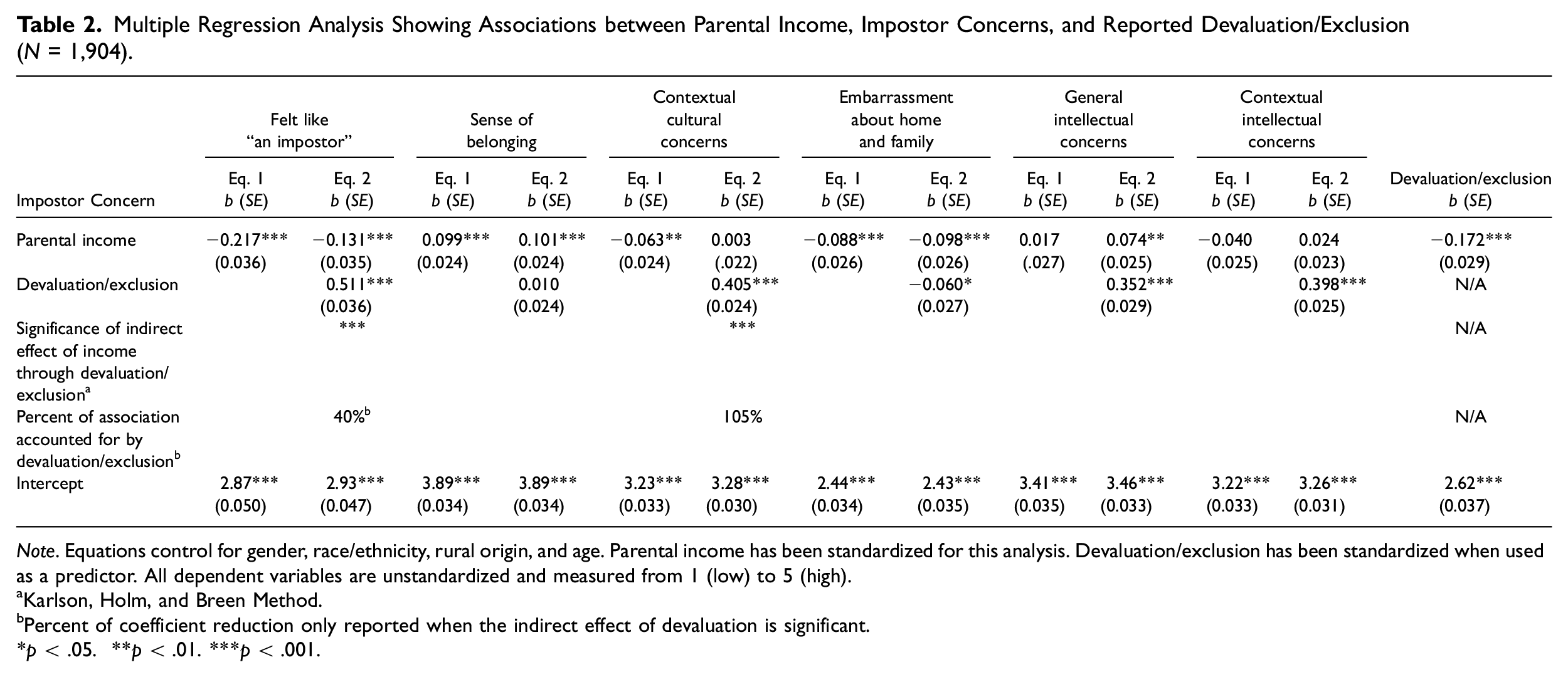
Note. Equations control for gender, race/ethnicity, rural origin, and age. Parental income has been standardized for this analysis. Devaluation/exclusion has been standardized when used as a predictor. All dependent variables are unstandardized and measured from 1 (low) to 5 (high).
Karlson, Holm, and Breen Method.
Percent of coefficient reduction only reported when the indirect effect of devaluation is significant.
p < .05. **p < .01. ***p < .001.
Multiple and Binary Logistic Regressions Showing Associations between Impostor Concerns and Outcomes of Depression/Anxiety and College Persistence.
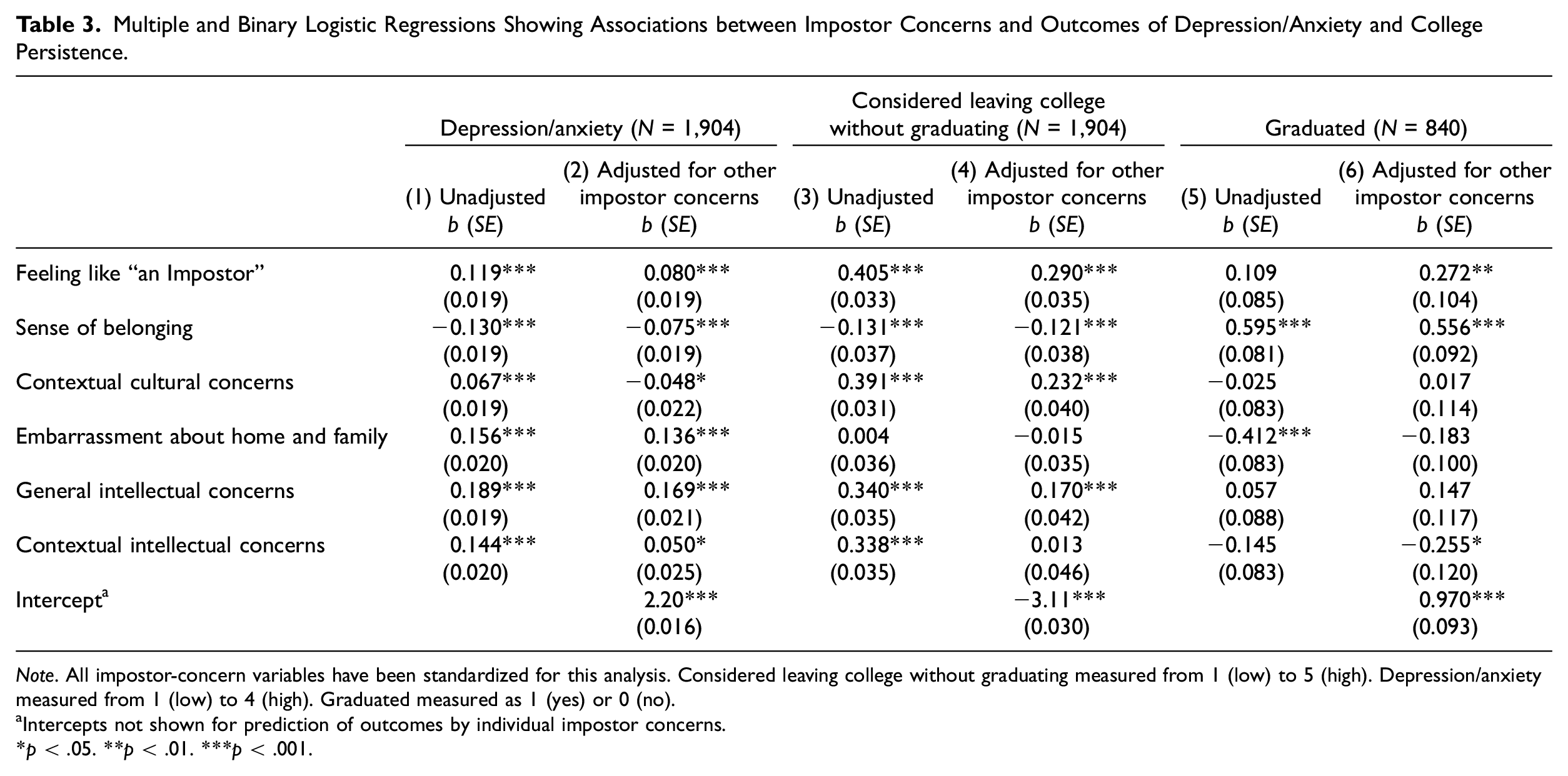
Note. All impostor-concern variables have been standardized for this analysis. Considered leaving college without graduating measured from 1 (low) to 5 (high). Depression/anxiety measured from 1 (low) to 4 (high). Graduated measured as 1 (yes) or 0 (no).
Intercepts not shown for prediction of outcomes by individual impostor concerns.
p < .05. **p < .01. ***p < .001.
Multiple and Binary Logistic Regressions Showing Associations between Parental Income, Impostor Concerns and Outcomes of Depression/Anxiety and College Persistence.
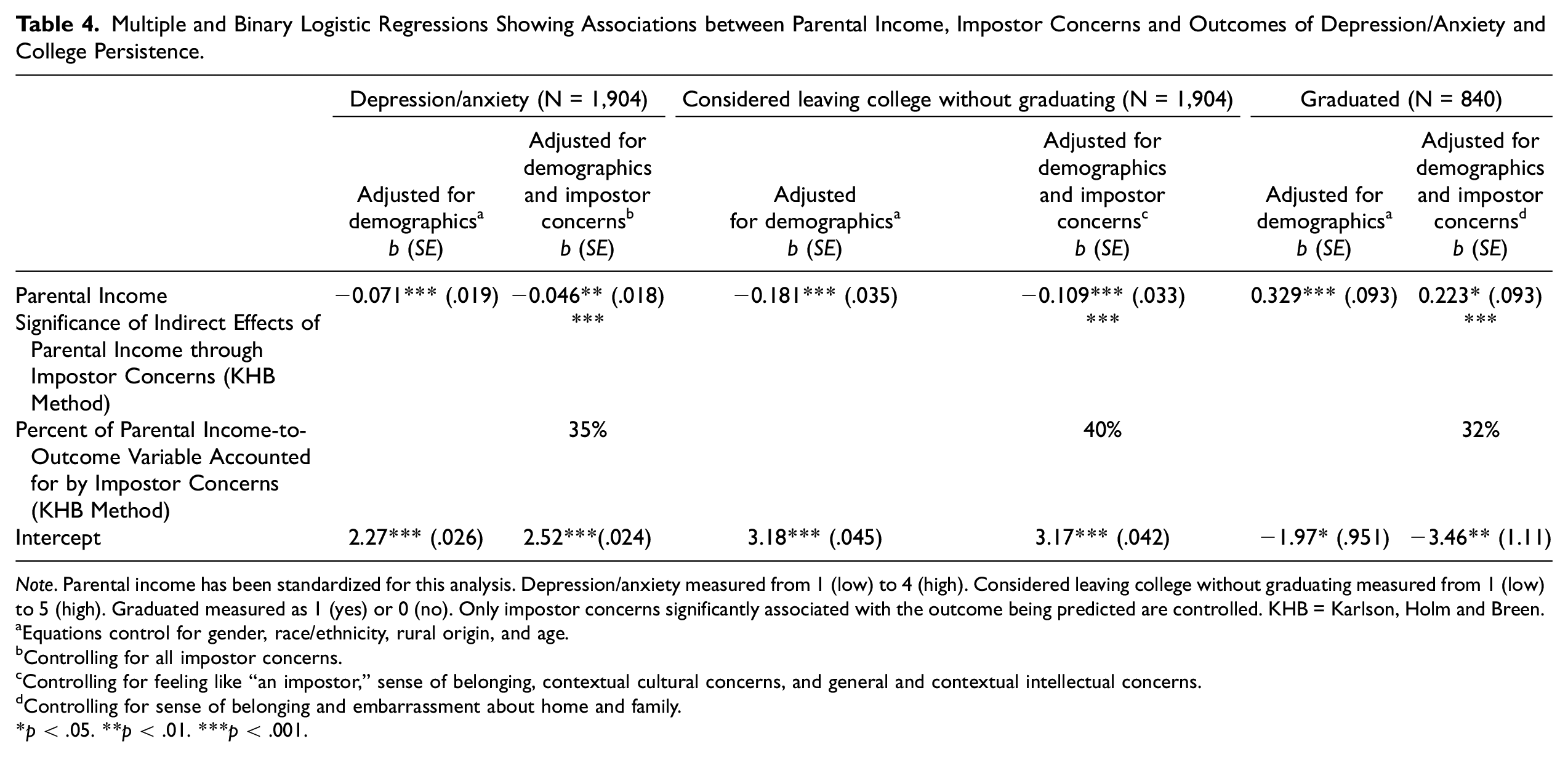
Note. Parental income has been standardized for this analysis. Depression/anxiety measured from 1 (low) to 4 (high). Considered leaving college without graduating measured from 1 (low) to 5 (high). Graduated measured as 1 (yes) or 0 (no). Only impostor concerns significantly associated with the outcome being predicted are controlled. KHB = Karlson, Holm and Breen.
Equations control for gender, race/ethnicity, rural origin, and age.
Controlling for all impostor concerns.
Controlling for feeling like “an impostor,” sense of belonging, contextual cultural concerns, and general and contextual intellectual concerns.
Controlling for sense of belonging and embarrassment about home and family.
p < .05. **p < .01. ***p < .001.
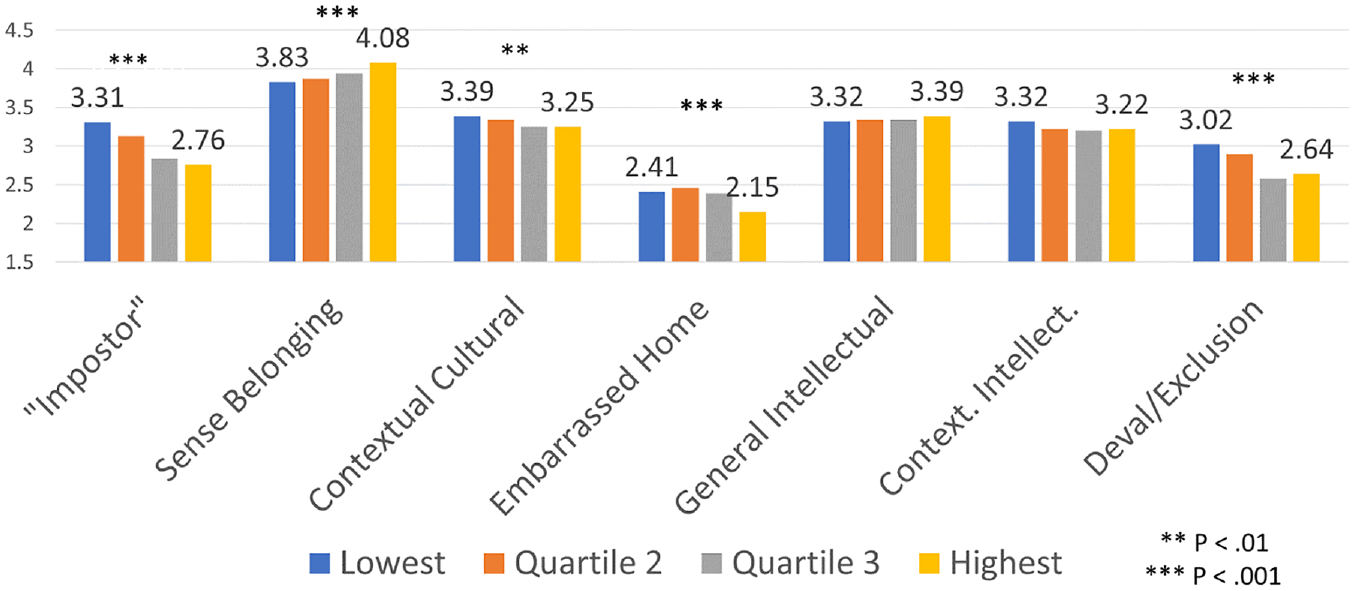
Mean impostor concern and devaluation/exclusion (adjusted for race, gender, rural origin, and age) by quartile of parental income.
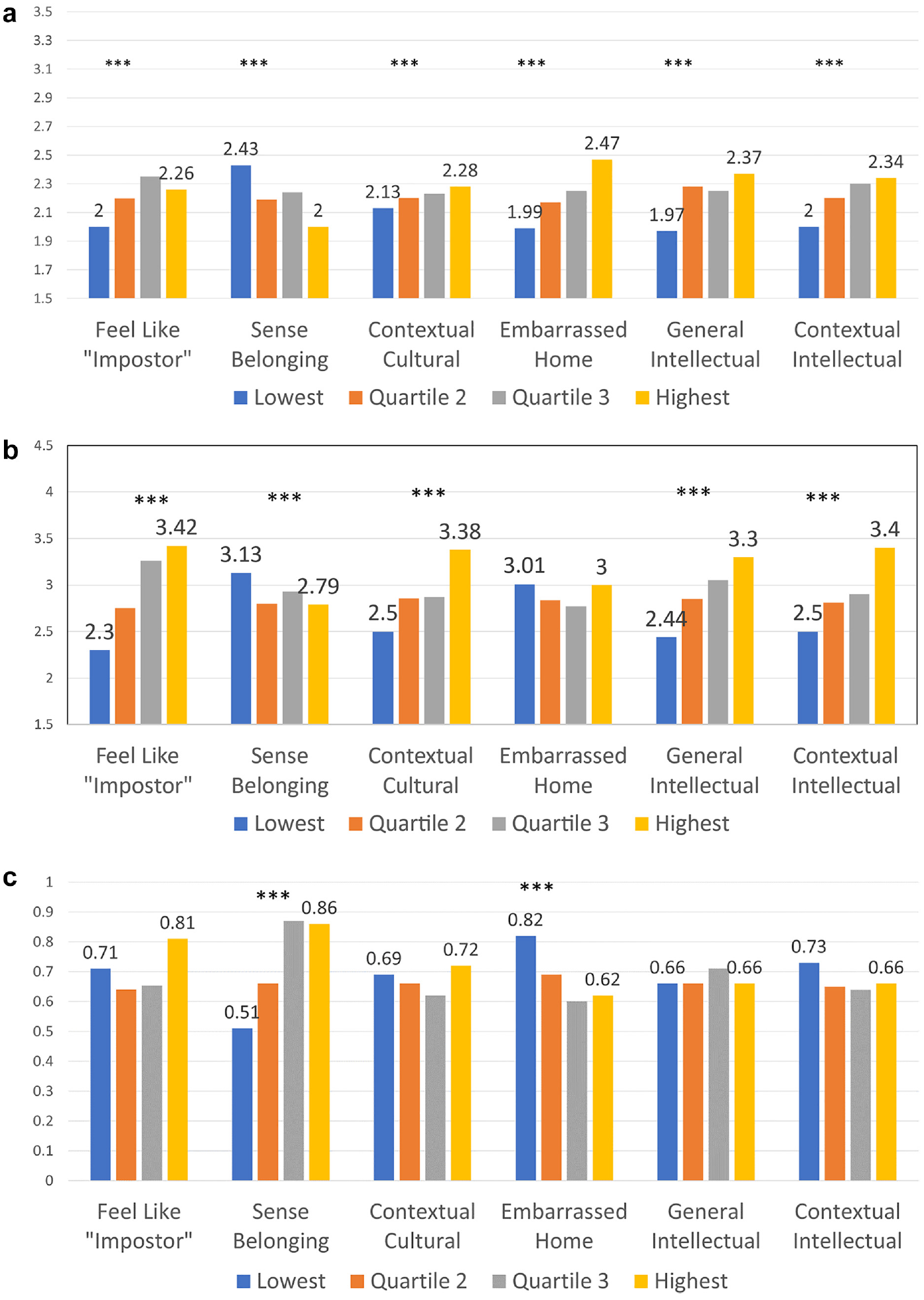
(a) Mean depression/anxiety by quartile of each impostor concern. P values from analysis of impostor concerns as a continuous measure (see Table 3). (b) Mean considered leaving college without graduating by quartile of each impostor concern. P values from analysis of impostor concerns as continuous measures (see Table 3). N = 1,904. (c) Predicted probability of graduation by quartile of impostor concern. P values from analysis of impostor concerns as continuous measures (see Table 3). N = 840.
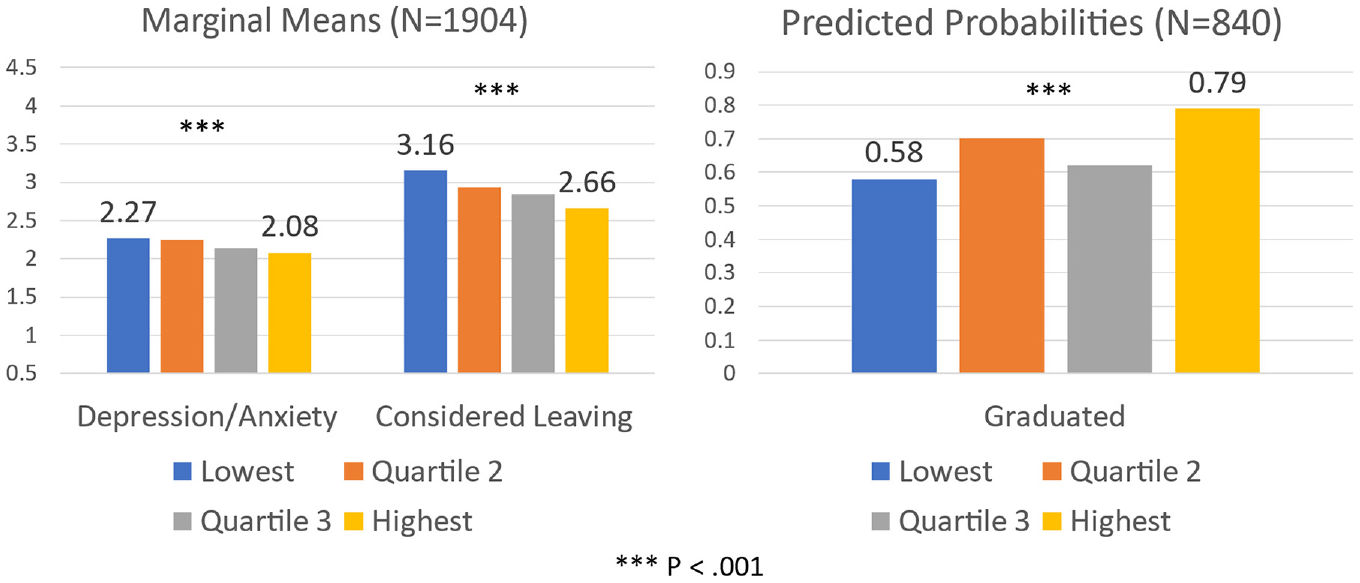
Outcome variables by quartiles of parental income (adjusted for race/ethnicity, gender, rural origin, and age).
Figure 1, Pathway 1: my most central hypothesis recalls Pearlin’s advice to look for the source of stressful experiences in systems of stratification and is the first test of my placement of impostor concerns within Bourdieu’s class-reproduction model. Are impostor concerns more common in students with lower parental income? The answer is “yes.”Table 2 shows that parental income in adolescence was significantly related in the predicted direction to four of the six impostor concerns (all but the two intellectually focused concerns)—feeling like “an impostor”; sense of belonging; embarrassment about home and family (each at P < .001) and contextual cultural concerns (P < .01). 2 Figure 2 illustrates these findings visually by showing mean levels of each impostor concern by quartile of parental income.
Figure 1, Pathway 2: next, I bring in Bourdieu’s notion that the sometimes-subtle message is expressed to lower-class students that they are less valued and do not belong in college. This hypothesis is supported. Table 2 and Figure 2 show that reported devaluation/exclusion was significantly higher (P < .001) among students from lower-income families.
Figure 1, Pathways 2 and 3: next, is there evidence that these messages of devaluation and exclusion help explain the heightened impostor concerns of lower-class students, as my impostorization model predicts? There is moderate support for this hypothesis. Table 2 shows that reported devaluation/exclusion played a role in linking parental income to two impostor concerns. Specifically, reported devaluation/exclusion accounted for over 100 percent of the association between parental income and contextual cultural concerns and 40 percent of the association between parental income and feeling like “an impostor” at college (P < .001 for both indirect effects).
So far, we have seen that low parental income is related to negative feelings in the form of impostor concerns. This is an important finding in itself. However, do these concerns have further consequences, such as psychological distress? And, relevant to the role of impostor concerns in class reproduction, are impostor concerns related to lower college persistence? Results below show that impostor concerns are indeed significantly related to both these outcomes.
Figure 1, Pathway 4: Table 3 Column 1 shows that depression/anxiety is significantly related in the predicted direction to all six impostor concerns (P < .001 for each). Figure 3a illustrates this with mean depression/anxiety by quartile of each impostor concern. Thus, this portion of the impostorization model, linking impostor concerns to depression and anxiety, is strongly supported.
Figure 1, Pathway 5: next, concerning the two measures of college persistence: Table 3 Column 3 shows that considering leaving college without graduating is fairly strongly and consistently related to impostor concerns. It is significantly related in the predicted direction (P < .001 for each) to five of the six impostor concerns—feeling like “an impostor,” sense of belonging, contextual cultural concerns, general intellectual concerns, and contextual intellectual concerns. Figure 3b illustrates this with mean considered dropping by quartile of impostor concern.
Table 3 Column 5 shows that, among the 44 percent of the sample who were former students, impostor concerns were also related to having graduated, albeit less consistently than for having considered leaving college. Only two impostor concerns were significantly related to graduating (P < .001 for each). However, those two associations were quite dramatic. As Figure 3c shows, the predicted probability of graduating is only .62 for someone who feels the most embarrassed (in the highest quartile) about their home and family, compared with .82 for someone who feels the least embarrassed. Even more extreme, the predicted probability of graduating was only .51 for someone who had the least sense of belonging (in the lowest quartile) but .86 for someone who had the most sense of belonging.
Table 3 Columns 2, 4, and 6 show what happens when impostor concerns are adjusted for each other when predicting the outcome variables. For each outcome, there is evidence that the impostor concerns share some explanatory power in predicting the outcomes. Note particularly the reduction to nonsignificance in Column 6 of the coefficient for embarrassment about home and family, suggesting that its strong association with graduating may operate through a reduced sense of belonging.
Figure 1, Pathways 1, 4, and 5: so far we have seen that low parental income is related to impostor concerns, potentially in part due to devaluing treatment by professors and students, and that impostor concerns in turn are associated with depression/anxiety and lower college persistence. My last question is whether impostor concerns may mediate the relationship between social class on one hand and depression/anxiety and college persistence on the other. In other words, might impostor concerns serve a role in reproducing intergenerational inequality, as I have hypothesized?
For there to be mediation, social class must be related to outcomes of depression/anxiety and college persistence in the first place. Table 4 and Figure 4 show this to be the case. Parental income is significantly associated with depression/anxiety, considering leaving college without graduating and having graduated (P < .001 for each). Strikingly, Figure 4 shows that the predicted probability of graduating is only .58 in the lowest quartile of parental income, compared with .79 in the highest quartile of parental income.
Finally, is there evidence that impostor concerns may help explain these associations? Yes, there is. Table 4 shows that all three associations were accounted for to a significant degree by impostor concerns (P < .001 for each outcome). Impostor concerns accounted for 35 percent of the association between parental income and depression/anxiety, 40 percent of the association between income and considering leaving college, and 32 percent of the association between income and graduating from college.
In summary, the data were moderately to strongly supportive of each component of my Bourdieu-inspired impostorization model in which lower-class students encounter devaluation and exclusion at college based on their “inappropriate”habitus, react to this devaluation with impostor feelings and more general psychological distress, and “self-eliminate” from higher education, paving the way for class reproduction in the next generation.
Discussion
Pearlin papers sometimes offer a retrospective on the awardee’s sociological contributions in the area of mental health. I undertook a different kind of retrospective, applying a sociological lens to my personal life as an academic. My goal was to draw attention to the problem of impostorization among us—sociologists of mental health, sociologists, academics. By sharing my experiences, I wanted to tell young impostorized colleagues they are not alone, and I wanted to encourage other senior scholars to do the same. I am sure that, during my worst years of feeling like an impostor, there were professors who closeted their outsider backgrounds, and it would have helped me to know that someone like me was “making it,” and that not everyone who seemed like a Brahmin actually was one. I also hoped that drawing out these largely “invisible” processes of reward, devaluation, and exclusion in academia might help “produce understanding” (Link 2003) among readers who have never experienced such problems and might even encourage them to examine whether their own assumptions and behavior might contribute to these problems for others.
Even more importantly, I wanted to empirically test a counter-narrative to the prominent focus on “impostor syndrome” as a maladaptive personality trait. In talking to people about this project, I have learned that people feel like impostors for many reasons. In the same way, people experience stress for many reasons. However, Pearlin and others working within the stress paradigm, by looking for important social-structural regularities in stressful circumstances, have shown that structural locations, although they might not be the only sources of stress, are extremely important ones. My goal was to examine the same kinds of structural regularities in the origins of impostor feelings—regularities that would not account for every person’s experience but that would explain an important part of the variation in these feelings.
A social-stratification-based account of impostorization, if valid, would be important not only in helping impostorized people realize they are oppressed rather than defective but also because it might pave the way for changes in our field that will help prevent us from discarding so many worthy colleagues and help us develop more representative and higher-quality institutions. Such a counter-narrative is emerging in popular and academic commentaries (Feenstra et al. 2020; Tulshyan and Burey 2023), and research on the experiences and “sense of belonging” of lower-class students in college is consistent with this narrative. However, empirical testing of such a model focused explicitly on impostor concerns is quite limited, and a theoretical framework has been lacking. To develop an empirical test, I focused on Bourdieu’s model of the reproduction of class inequality. I placed impostor concerns in the middle of this process, hypothesizing a mediating role for impostor concerns between social class and leaving college without graduating (Figure 1).
Although predicted associations were not significant in every case (please remember that I included six measures of impostor concerns, four of which I created for this study!), in general, we see that each component of the model was fairly regularly and strongly supported. Results are consistent with a process in which low parental income leads to devaluation/exclusion in college, which in turn leads to impostor concerns, which in turn leads to depression/anxiety and lower college persistence.
It is worth highlighting the role of cultural impostor concerns in the results. Bourdieu’s theory and associated empirical literature suggest that the existing concept of impostor syndrome, focusing on self-doubt regarding one’s intelligence and competence, is not adequate to understand the experiences of lower-class-origin students in the academy. Even though cultural capital “shortcomings” are often misrecognized as intellectual ones, it would also be necessary to look directly at feelings of being a cultural outsider. I included measures of these factors, and this turned out to be important. Parental income was significantly associated with both of the explicitly cultural impostor concerns—being worried that one would be culturally out of place at a professor’s dinner (P < .01) and feeling embarrassed about one’s home and family (P < .001). Parental income was not significantly related to either of the explicitly intellectual impostor concerns. 3 One of the most important lessons from this study is that a thorough examination of impostorization in the academy must include cultural capital factors.
Limitations and Further Questions
This is by no means a definitive empirical study. Here I discuss some of the major limitations and alternative explanations and suggest how future research might address them.
Causal inference
I hypothesized a set of causal relationships that were consistent with the results. However, the study is based on cross-sectional, observational data, preventing me from concluding that the actual causal relationships were the ones I hypothesized. Nevertheless, there was plenty at stake and much to be learned when I rolled the dice of hypothesis-driven empirical research by pressing “run all.” Impostor concerns might not have been differentially distributed by social class. They might not have been related to reports of devaluation/exclusion. They might not have been related to depression/anxiety or college persistence. If not, the likelihood would have been diminished that my model describes reality, and others may reasonably choose to move on to other questions. However, I did observe these associations, motivating further pursuit of the questions I have addressed. A longitudinal study, beginning at college enrollment and following students periodically until they leave the institution, whether by graduating or otherwise, would go a long way toward clarifying cause and effect.
Generalizability
Generalizability to the population of U.S. undergraduate students was enhanced by employing a national sample not tied to one or a few selected colleges. However, although I weighted my data to the Current Population Survey, mine is not a probability sample, and I therefore cannot assert that my findings generalize to students of four-year undergraduate programs in the United States.
Furthermore, my findings cannot be generalized to other countries, to previous points in time, or to populations other than young undergraduate students. The reproduction of inequality was a major focus of this study, and the college-undergraduate population is well suited to addressing this issue. Undergraduate school is where many potential academics from lower-class backgrounds will first discover the incongruity between their habitus and what is expected and rewarded in academia. This is also where the largest number who enter higher education will be eliminated. However, although not emphasized by Bourdieu (Friedman and Laurison 2019; Swartz 1997), the engine of class reproduction is not perfect, and many lower-class-origin students persist and become upwardly mobile. This is my story, the story of other impostorized readers of this paper, and the story of Bourdieu himself, who climbed to the pinnacle of his field despite coming from a modest family background (Friedman 2015:130). What becomes of us? Do we suffer even greater impostor concerns as we become increasingly rare and increasingly surrounded by colleagues with more advantaged backgrounds? Or do our impostor concerns subside as we advance in our careers and garner achievements? This study was not designed to look at these questions. Previous research has addressed this question to some degree, primarily from a qualitative perspective (Friedman and Laurison 2019; Lee 2017; Muradoglu et al. 2021; Reyes 2022; Waterfield et al. 2019), but I hope that other researchers will further address the long-term trajectory of upwardly mobile impostorized academics.
Following Bourdieu, my primary focus was on social class. Yet being White, male, and nonrural might also bestow cultural capital that is prized by the academy and may be pertinent to social reproduction in college. I therefore repeated the above-described analyses to assess the extent to which my model was consistent with data for race/ethnicity, gender, and rural origin. In general, the results for these three social statuses are consistent with a Pearlin-inspired hypothesis that impostorization is rooted in social-structural inequalities, but they were not consistently supportive of my more elaborated Bourdieu-inspired theoretical model. In addition, interactions between class, race/ethnicity, gender, and rural origin in their associations with impostor concerns, devaluation/exclusion, depression/anxiety, and college persistence were rare (eight of 120 possible interactions were significant). See the Online Supplement for the results of these analyses and discussion of their significance. The role of race/ethnicity, gender, and rural origin in impostorization needs further study.
Measurement limitations
Previous studies (Aries and Seider 2005) have found that the experience of lower-class students varies depending on the prestige of the school they attend. I was unable to assess variations in impostor concerns by institutional measures of selectivity or other indicators of prestige. Because a large majority of students attend less elite colleges, we can assume that my results for the most part represent the experiences of that majority, and it would be fair to predict that impostor concerns would play an even larger role at more elite schools than what I found.
To translate qualitative findings into quantitative ones, I developed several new measures. Most but not all had adequate to excellent internal consistency reliability. In general, further work is needed to establish and measure the domain of impostor concerns.
Alternative explanations
Beyond generic methodological limitations, some specific alternative explanations need to be considered. First, I did not include in my analyses the early-family factors posited as important determinants of impostor syndrome in the psychological literature. The biggest threat to validity posed by excluding them would be if they were confounded with lower social class, such that the relationships I observed were actually due to these early childhood factors. This seems unlikely. For example, higher social class is related to higher, not lower, parental achievement expectations (Lareau 2011). 4 This implies that my results occurred not because of but despite any associations there may be between social class and parental achievement expectations. That is, if parental achievement expectations had been controlled in the analyses, my hypothesized findings would likely be even more pronounced.
Another alternative explanation is that lower-class-background students experience more devaluation/exclusion and impostor concerns not because of discrimination or lack of cultural capital, but because they are actually less able or accomplished than their classmates. By this reasoning, it is the recognition of this lesser ability by themselves and others that leads lower-class students to experience more devaluation/exclusion and impostor concerns. I tested this alternative by controlling for high school GPA to assess whether indirect effects of parental income through GPA suggested that it might explain the observed associations between social class and devaluation/exclusion or between social class and impostor concerns. I found only modest support for this explanation. The strongest evidence for a possible mediating role of high school GPA is that it accounts for 22 percent of the association between parental income and sense of belonging. In none of the six remaining associations did GPA account for more than 18 percent of the effect of parental income. For five of the seven associations, coefficients for parental income were virtually unchanged by including high school GPA in the model (see analyses in Online Supplement).
Finally, my measure of devaluation and exclusion by professors and other students is self-reported and consequently subject to reporting bias. Indeed, questions about the validity of self-reports of such experiences have become prominent in recent discussions of devaluation and discrimination in academia. For example, Brint (2020:359) suggests, “A potential exists for misinterpreting words of disagreement or ambiguous facial expressions as microaggressions.” While such misinterpretation may sometimes occur, I have shown that reports of these experiences are significantly more common in a social group that we would expect to be devalued and excluded in the college environment. This suggests that there is a strong basis in reality to lower-class students’ reports of devaluation and exclusion. Even stronger evidence for the reality and power of devaluing experiences has been provided by Friedman and Laurison (2019), who use individual interviews and observations of group interactions to show that lower-class-origin employees’ perceptions of devaluation and exclusion are mirrored by higher-class senior colleagues’ negative attitudes toward lower-class employees and that those negative attitudes have detrimental consequences for the careers of the lower-class employees.
Conclusion
The study has methodological limitations and tests a fairly bare-bones model that needs elaborating. Nevertheless, I showed that concerns about being an impostor on campus are significantly heightened by coming from lower-social-class backgrounds. I showed that the associations of lower-class background with reported experiences of devaluation and exclusion in college, impostor concerns, depression/anxiety, and low college persistence are consistent with the idea that impostor concerns play a role in the reproduction of social inequality in higher education as described by Bourdieu. These findings, in conjunction with previous research on “impostor syndrome,” sense of belonging at college, and experiences of lower-class students, I believe, are persuasive enough to justify further, more detailed, and more conclusive research and to justify a consideration of how the problems revealed in this body of research might be addressed.
I expressed the hope that impostorized academics who have succeeded in our fields come out of our closets and share our back-stories to help young impostorized colleagues feel more at home. That is a step but not the ultimate solution. What needs to change is the structure in which many of us students and academics do not just feel like impostors, we have been made impostors—impostorized. The culturally biased notion of who we must be—what qualities, styles, abilities, and knowledge we must have—in order to belong and succeed, needs to change. This means the culture of the institution cannot be an upper-class culture. Our rewards need to be based on what we can do as sociologists, not on how we sound or look or how much irrelevant knowledge we possess.
How can we move toward this goal? Certainly, we need to populate the upper echelons of our fields with a diverse set of people and either broaden what counts as cultural capital or make cultural capital irrelevant altogether. One route is a direct one, calling for the selection and advancement of individuals to be based in part on social class origin. A second, more indirect route is suggested by again calling on the thinking of Bourdieu. Are there ways we—at the level of academic departments, schools, or even colleges and universities—can choose to rob cultural capital of its power? For this, we need to keep in mind that the processes favoring those with greater cultural capital are often “misrecognized,” perhaps especially by those in leadership roles. These hidden processes can be combatted by “formalis[ing] the informal” (Friedman and Laurison 2019). We need to think carefully about what qualities are truly important for being a good academic in our particular fields and what qualities are irrelevant and culturally biased. As Friedman and Laurison (2019:220–21) say, “those working in elite occupations, particularly at the upper echelons, [need] to critically interrogate the ‘objective’ measures of ‘merit’ they rely on and think carefully about whether such measures have a subjective or performed dimension.” Furthermore, I believe we should develop written guidelines for language to be used and language to be avoided in departmental descriptions, student and faculty evaluations, job ads, and so on. These guidelines should communicate that many types of intelligence, styles, abilities, and skills—not just the ones most associated with a particular higher-class habitus—are valued. We need to avoid the “tyranny of fit” (Friedman and Laurison 2019; also see Reyes 2022), in which decisions to accept, promote, help, or affiliate with other students, postdoctoral fellows, or professors are swayed by the comfort one feels when surrounded by people similar to oneself. Subjective judgments that a candidate is “just not professorial material” or “just not a good fit” are absolutely unacceptable.
The steps needed to bring about these changes are daunting and, frankly, a bit depressing to contemplate. However, the first step is to recognize that impostorization is a public issue rather than a private trouble (Mills 1959); that the problem lies not in the impostorized but in the biased system in which we must operate; that we impostorized people should stand tall; should be defiant rather than embarrassed. This process is underway, and I am happy to have been able to use the soap box afforded by the Pearlin award to play a part in it.
Supplemental Material
sj-docx-1-smh-10.1177_21568693231222626 – Supplemental material for Impostorization in Academia, Psychological Distress, and Class Reproduction
Supplemental material, sj-docx-1-smh-10.1177_21568693231222626 for Impostorization in Academia, Psychological Distress, and Class Reproduction by Jo Phelan in Society and Mental Health
Footnotes
Acknowledgements
The author thanks her colleagues in the ASA Section on the Sociology of Mental Health for honoring her with the Leonard I. Pearlin Award. She thanks Bruce Link for his unwavering enthusiasm for this project. He is not one of us, fellow impostorized academics, but he is with us at the barricades. She also thanks Bruce for his invaluable feedback on every aspect of the paper. She thanks Georg Schomerus’s Mental Health and Society Research Group in the Department of Psychiatry and Psychotherapy, University Medicine Leipzig, Germany, for their encouragement and helpful feedback on this project. In particular, she thanks Toni Fleischer, Christian Sander, and Stephanie Schindler for challenging questions that led to an improved paper. She thanks her father, Adrian Charles Firman, who did not provide her with the finer points of cultural capital but did instill deeply in her the idea that she was as good as anyone else and deserved as much as anyone else.
The term “impostorization” was first used by Angélica Gutiérrez (Gutiérrez 2021). She defined impostorization in terms of policies, practices and seemingly innocuous interactions in the workplace that may lead employees to feel like a fraud and trigger a fear that others will discover that they do not belong.
Gutiérrez and her colleagues (Holmes et al. 2022; Gutiérrez and Cole 2023) have also described experiences of impostorization among women of color in business and academia. Finally, Gutiérrez (2023) discusses institutional remedies for impostorization that are similar to those the author recommends in this article.
The author wishes to acknowledge the contributions of Gutiérrez and her colleagues and to apologize for her unintentional oversight of their important work.
Correction (May 2024):

Supplemental Material
Supplemental material for this article is available online.
Notes
References
Supplementary Material
Please find the following supplemental material available below.
For Open Access articles published under a Creative Commons License, all supplemental material carries the same license as the article it is associated with.
For non-Open Access articles published, all supplemental material carries a non-exclusive license, and permission requests for re-use of supplemental material or any part of supplemental material shall be sent directly to the copyright owner as specified in the copyright notice associated with the article.
