



Abstract
In the Stress Process Model, the sense of control is situated as a central psychosocial resource that buffers the effect of stressors on psychological distress. Although studies support this proposition, scholars have called for more research on whether buffering effects generalize across social contexts and groups. I address this call by examining cross-cultural differences in the sense of control’s buffering effects. Prior studies suggest that perceived control is a less important resource for well-being among individuals in collectivistic cultures compared with those in individualistic cultures. This has stimulated the diminished buffering hypothesis, which predicts weaker stress-buffering of perceived control among those in collectivistic cultures. This study tests this hypothesis using population-based data of Americans and Japanese, two groups that have been deemed quintessentially individualistic and collectivistic, respectively. Results show that across a set of five prominent work stressors, there are no differences in the stress-buffering functions of the sense of control between Americans and Japanese. These patterns pose questions about the view that sense of control is a less important resource for those in collectivistic cultures. As a stress-buffering resource, the sense of control appears to be just as important for Japanese as it is for Americans.
A fundamental proposition of the Stress Process Model is that psychosocial resources weaken or buffer the effects of stressors on psychological distress (Pearlin 1989; Pearlin and Bierman 2013; Turner 2010). Primary among psychosocial resources is the sense of control, the belief in personal control over life outcomes (Pearlin and Schooler 1978; Ross and Mirowsky 2013; Ross and Sastry 1999). As Ross and Mirowsky (2013:379) contend: “[O]f all the beliefs about self and society that might affect distress, belief in control over one’s own life may be the most important.” Studies have documented the buffering effects of the sense of control across a variety of stressors (Badawy and Schieman 2020; Jang, Chiriboga, and Small 2008; Koltai and Stuckler 2020; Krause and Stryker 1984; Pudrovska et al. 2005). However, whether the buffering effects generalize across social contexts and groups remains inadequately understood. In their discussion of future directions in stress process research, Pearlin and Bierman (2013:333) call for more investigation on the contingencies involved in buffering effects: [W]e need to be better informed as to which resources serve as effective moderators of what kinds of stressors, for what kinds of people, and under what kinds of conditions. These matters constitute a major part of future agenda of research into the buffering role of psychosocial resources.
In this study, I respond to Pearlin and Bierman’s (2013) call by examining cross-cultural differencesin the buffering effects of the sense of control. My motivation stems from prior suggestions of a Western bias in the literature on perceived control. Specifically, some have argued that compared with individuals in individualistic cultures, the sense of control may be a less important resource for those in collectivistic cultures (Kitayama et al. 2010; O’Connor and Shimizu 2002; Sastry and Ross 1998). This perspective has stimulated what I refer to as the diminished buffering hypothesis, which predicts that the sense of control provides weaker stress-buffering among those in collectivistic cultures compared with those in individualistic cultures. 1 To my knowledge, however, this hypothesis is yet to be empirically tested. Given the central role that the sense of control plays as a stress-buffer, it is essential to document whether this function is generalizable across cultures. I test this hypothesis by comparing Americans and Japanese—twogroups that have been deemed quintessentially individualistic and collectivistic, respectively. To this end, I utilize population-based data from Midlife Development in the United States Refresher study (MIDUS-R) and the Midlife Development in Japan study (MIDJA) that contain identical and reliable measures of chronic stressors, sense of control, and psychological distress.
Background
Sense of Control and its Stress-Buffering Functions
The sense of control refers to the belief that meaningful life events and circumstances are shaped by one’s own choices, efforts, and actions, rather than external forces such as luck, fate, and powerful others (Mirowsky and Ross 2003; Ross and Mirowsky 2013; Ross and Sastry 1999). The sense of control shares conceptual terrain with other constructs that assess perceived causal relevance, including the sense of powerlessness (Seeman 1959), locus of control (Rotter 1966), and sense of mastery (Pearlin and Schooler 1978). The expectation that one’s efforts translate to desired ends is empowering, and thus a higher sense of control is associated with lower psychological distress (Pearlin et al. 1981; Ross and Mirowsky 1989; Turner, Taylor, and Van Gundy 2004; Wheaton 1980). In addition to its direct effect on distress, the sense of control also moderates the effect of stressors on distress—that is, the effect of stressors on distress is weaker for those with a higher sense of control (Badawy and Schieman 2020; Jang et al. 2008; Koltai, Bierman, and Schieman 2018; Koltai and Stuckler 2020; Krause and Stryker 1984; Pudrovska et al. 2005). This moderating effect (also known as the buffering effect) may emerge for a few reasons. First, the belief in control over one’s life may make life’s challenges seem less ominous, thereby reducing the perceived threat posed by stressors (Pearlin 1989; Pearlin and Bierman 2013). Second, the sense of control is associated with coping strategies that involve actively defining and solving problems, rather than avoidance or denial (Ben-Zur 2002; Caplan and Schooler 2007). As a result, a higher sense of control may promote the motivation and persistence to overcome stressful circumstances (Turner et al. 2004; Wheaton 1983).
I examine the buffering effect of perceived control across a variety of stressors. According to Wheaton and colleagues (2013), chronic stressors exist in several forms, including conflict, demands, uncertainty, and structural constraints. I therefore examine stressors that represent those forms: Work–family conflict, job pressure, job insecurity, and perceived inequality in work. First, work–family conflict refers to interrole conflict that arises in the enactment of responsibilities in work and family roles (Greenhaus and Beutell 1985). Both work-to-family conflict (WFC) and family-to-work conflict (FWC) are growing concerns, given the rise in dual-earner and single-parent households, the proliferation of communication technologies that allow work to be completed anytime and anywhere, and the need to take care of children and aging family members (Allen and Martin 2017; Bellavia and Frone 2005; Greenhaus and Powell 2017). Second, job pressure refers to the strain associated with time pressure and workload (Diestel and Schmidt 2009; Schieman 2013). It is a central component of well-known work stress frameworks such as the Demand-Control model (Karasek 1979), and the sense of overload is an increasingly common problem among contemporary workers (Kelly and Moen 2020). Third, job insecurity refers to the subjective evaluation of the threat of job lossin the future (Sverke, Hellgren, and Näswall 2002). Economic trends characterized by increased global competition, shifts toward flexible production systems, and replacement of permanent positions with contract work have contributed to the rise in precarious work and a growing sense of job insecurity (Kalleberg 2018). A long tradition of research on occupational stress identifies work–family conflict, job pressure, and job insecurity as key stressors that impinge on contemporary workers’ health and well-being (Bellavia and Frone 2005; Hakanen, Schaufeli, and Ahola 2008; Sverke et al. 2002). In addition to these well-known stressors, I also assess perceived inequality in work, which refers to the evaluation of having fewer structural opportunities and resources at work relative to others (Ryff et al. 1999). Perceived inequality in work dovetails with Wheaton and colleagues’ (2013) notion of structural constraints, which refers to “the lack of access to opportunity or necessary means to achieve ends” (p.304), and prior research has documented the stressor’s negative effects on health (Fuller-Rowell et al. 2018). In sum, I begin by examining the buffering effect of perceived control across a range of chronic stressors. Next, I turn to the question of whether the buffering effects differ across cultures.
Cultural Differences in Stress-Buffering Functions
Are the stress-buffering functions of perceived control generalizable across cultures? Cross-cultural researchers have frequently drawn upon the concept of individualism and collectivism (I/C) to explain social–psychological differences between individuals in Western and Asian nations. This research can be traced back to the influential work of Hofstede (1980), who analyzed work values among employees of a multinational cooperation (later revealed as IBM) in 40 countries. His analysis revealed four cultural dimensions by which nations can be ordered, one of which was I/C. The United States ranked first as the most individualistic country and other Western nations such as Australia (second), Great Britain (third), and Canada (fourth) also ranked high. By contrast, Asian nations like Japan ranked significantly lower (22nd; Hofstede 1980). Hofstede (1980) was careful to note that his country-level analysis cannot be used to explain behavior at the individual level. Nevertheless, his work stimulated a large body of research that used Hofstede’s I/C rankings to explain psychological differences between individuals in Western and Asian nations and inspired others to theorize and assess individualism and collectivism at the individual level (see Oyserman, Coon, and Kemmelmeier 2002). For instance, in a seminal study Markus and Kitayama (1991) proposed that individuals in individualistic cultures (referencing Americans) tend to hold independent construals that entail “a conception of the self as an autonomous, independent person” (p. 226). By contrast, individuals from collectivistic cultures (referencing Japanese) tend to hold interdependent construals that involve “seeing oneself as part of an encompassing social relationship and recognizing that one’s behavior is determined, contingent on, and to a large extent organized by what the actor perceives to be thoughts, feelings, and actions of others in the relationship” (p. 227). While various individual-level measures of I/C has been developed, a core theme across measures of individualism is personal independence, while a core theme across measures of collectivism is the sense of duty and obligation to the in-group (Oyserman et al. 2002). According to Matsumoto (2018), Hofstede’s I/C rankings and the specific comparisons between Americans and Japanese that appeared in subsequent work on individualism and collectivism have reinforced what Takano and Osaka (1999, 2018) call the “common view”: The idea that Americans are typical individualists and Japanese are typical collectivists.
This “common view” has served as a basis for theorizing about group differences in the levels and effects of perceived control. If Japanese are more collectivistic and therefore have a greater sense of duty to the in-group and give priority to the goals of the collective, then they may perceive that their life outcomes are often determined by external forces. This suggests that Japanese should report a lower sense of control. Some scholars have also argued that Americans and Japanese may attain well-being through different means, suggesting group differences in the effect of sense of control on well-being. If Americans are motivated toward independence, it is feasible that they would achieve better health by exercising a sense of personal control (Kitayama et al. 2010). By contrast, if Japanese are motivated toward interdependence, they may achieve better health not through a sense of personal control but through relational means (Kitayama et al. 2010). Further, others have argued that the pursuit of personal goals and autonomy may be sanctioned for those in collectivistic cultures, and as such the benefits of sense of control for well-being should be weaker among those in collectivistic cultures. As Sastry and Ross (1998:103) argue, Failure to achieve personal goals may be less important because individuals are encouraged to subordinate their own needs to those of the group. Not only are these individuals rewarded for fulfilling their obligations to community and family; individuals who pursue individual autonomy and who strive to meet their personal goals may be punished. Compared with those in individualistic cultures, persons in collectivistic cultures may derive less benefit to well-being form a high sense of personal control.
In apparent support of these ideas, prior studies document that Asian groups (including Japanese) report a lower average level of perceived control (O’Connor and Shimizu 2002; Sastry and Ross 1998; Steptoe et al. 2007). Furthermore, analysis of the main effect of the sense of control indicates a weaker association between perceived control and well-being among Asian groups compared with Americans and other Western groups (Kitayama et al. 2010; O’Connor and Shimizu 2002; Sastry and Ross 1998). A meta-analysis on locus of control and psychological distress indicates that perceived control is less strongly associated with anxiety symptoms (but not depression) among collectivistic countries as defined by Hofstede’s I/C scores (Cheng et al. 2013). These patterns are consistent with what we would expect based on the “common view,” that Japanese tend to be collectivistic, while Americans tend to be individualistic. However, it is noteworthy that prior studies rarely incorporate a measure of I/C at the individual level to assess whether the patterns exist because Americans tend to be individualistic while Japanese tend to be collectivistic. As I discuss in a following section, recent reviews have challenged the common view, generating questions about its role in shaping group differences in levels and effects of personal control.
While prior research has examined cultural differencesin levels and main effects of sense of control, there has been little attention to cultural differences in its buffering effects. This is a significant omission given that perceived control is frequently situated as a key buffering resource in the Stress Process Model. The idea that perceived control is a less important resource for the well-being of those in collectivistic societies can be applied to buffering effects. If Americans are motivated toward independence and achieve better health through the exercise of personal control (Kitayama et al. 2010), then a sense of control should be an important resource that facilitates coping under stressful circumstances. By contrast, if Japanese are motivated toward interdependence and achievebetter health through relational pathways (Kitayama et al. 2010), then personal control should not be as essential. Furthermore, if the pursuit of personal goals and autonomy are sanctioned in collectivistic cultures (Sastry and Ross 1998), it is difficult to imagine that personal controlwould confer any health advantages— including one if its key functions, which is to weaken the effect of stressors. Taken together, these ideas suggest that the sense of control should exhibit diminished buffering among Japanese compared with Americans. That is, the extent to which the sense of control functions as a stress-buffer should be weaker among Japanese.
Few have examined the Western-Asian differencesin the stress-buffering effect of the sense of control. An exception is O’Connor and Shimizu’s (2002) study that used a sample of British and Japanese undergraduate students to assess group differences in the associations among perceived stress, sense of control, and psychological distress. In one analysis, their study revealed that sense of control had significant negative correlations with perceived stress and each measure of psychological distress (negative mood, malaise, and anxiety) in the British sample, but no significant correlations were observed in the Japanese sample. The authors interpret this pattern through the I/C lens: The absence of any significant associations between personal control, stress and psychological distress in the Japanese sample provides support for the notion of a Western bias within the stress literature. That is, control beliefs do not play a buffering role in stress–psychological distress relations within interdependent, allocentric cultures. (O’Connor and Shimizu 2002:181)
O’Connor and Shimizu’s (2002) efforts to uncover cultural differences in the buffering effect of perceived control are important. However, the absence of the correlations in the Japanese sample, on its own, is insufficient to support the interpretation that perceived control does not play a buffering role. Stress-buffering is typically demonstrated with an interaction between the stressor and the resource in question, such that the positive association between the stressor and distress is attenuated for those with a higher level of the resource (Wheaton 1983, 1985). Under this conception of stress-buffering, support for the diminished buffering hypothesis requires three conditions to be satisfied: (1) A significant two-way interaction term between the stressor in question and sense of control, indicating that the sense of control functions as a buffer among those in a individualistic culture, (2) the same two-way interaction should indicate weaker or no buffering among those in a collectivistic culture, and (3) a significant three-way interaction among the stressor, sense of control, and culture such that the extent to which the sense of control functions as a buffer is significantly weaker among those in a collectivistic culture. It is important to note that satisfying Conditions (1) and (2) are insufficient to claim group differences; the three-way interaction term in Condition (3) directly tests whether the buffering effect significantly differs between groups. In this study, I evaluate the diminished-buffering hypothesis based on these conditions.
Beyond the lack of prior research, another motivation for examining group differences in stress-buffering effects of perceived control stems from emerging evidence that the “common view” needs reconsideration. In their review of 15 studies comparing Americans and Japanese on I/C, Takano and Osaka (1999) find: “[s]urprisingly, 14 studies did not support the common view; the only study that supported it turned out to bear little relevance to the ordinary definition of individualism/collectivism” (Takano and Osaka 1999:311). Similar conclusions have been reached in another review (Oyserman et al. 2002). In a recent updated review, Takano and Osaka (2018) examined 20 additional studies published since their 1999 study and again found little evidence to support the common view. Subsequent commentaries of Takano and Osaka’s (2018) review (Hamamura and Takemura 2018; Matsumoto 2018; Uleman 2018; Vignoles 2018) are in general agreement that the common view is untenable given the empirical evidence. Furthermore, research that has examined the explanatory role of individualistic values on group differences in the levels and main effects of perceived control show that individualistic values did not explain why Asian groups (including Japanese) report lower sense of control than Americans and did not explain the weaker association between sense of control and subjective well-being among Asian groups (Narisada and Schieman 2016). Collectively, these studies challenge the common view and raise questions about the role of I/C in explaining group differences in levels and effects of the sense of control. Based on the common view, the sense of control should be a less important resource for well-being for those in collectivistic cultures. That idea should generalize to the sense of control’s key function as a stress-buffering resource. I therefore examine whether the sense of control provides weaker stress-buffering for Japanese compared with Americans.
Research Problem
Despite the centrality of the sense of control as a stress-buffer, sociologists have called for more investigation into the contingencies involved in buffering effects. I address this call by comparing the stress-buffering functions of the sense of control between Americans and Japanese. The idea that Americans tend to be individualistic while Japanese tend to be collectivistic has informed prior theorizing about the weaker effects of the sense of control on well-being for the Japanese. However, emerging evidence indicate that this “common view” needs to be reconsidered. In this study, I test whether the buffering effects of sense of control is consistent with what we would expectfrom the common view. I ask: Are the stress-buffering effects of perceived control weaker among the Japanese compared with Americans?
Method
Data
I draw on two population-based data sets: the MIDUS-R and the MIDJA. MIDUS-R (Ryff et al. 2017) is a national sample of non-institutionalized English-speaking adults aged 25 to 75 in the United States and was conducted between 2011 and 2014. Participants were selected using a Random Digit Dial (RDD) landline telephone sample frame, a list frame targeted to decadal age brackets, and a RDD cellphone sample frame. Data collection consisted of an initial 30-minute phone interview with 3,577 adults (59 percent response rate), and 2,598 subsequently completed the mailed self-administered questionnaire (SAQ) that assessed information on psychosocial factors and health, including work stressors, sense of control, and psychological distress. The analytical sample consists of those who completed the SAQ and were currently employed (n = 1,587) as the focal independent variables in the present study (work stressors) were assessed only among the employed.2,3
MIDJA (Ryff et al. 2018) examines psychosocial factors in health and well-being among middle- and older-aged Japanese adults and was conducted between April and September 2008. The eligible participants were non-institutionalized, Japanese-speaking adults aged 30–79 residing in one of 23 wards of Tokyo. Data were collected with an SAQ using the “deliver-and-pick-up” method, where the questionnaire was delivered to each participant’s home and consent obtained upon delivery. The sample consists of 1,027 adults, with a response rate of 56.2 percent. As with MIDUS-R, the analytical sample of MIDJA consists of those who were currently employed (n = 735). Online Supplemental Appendix Table 1 displaysthe sociodemographic characteristics of the full sample and the employed sample in the MIDUS-R and the MIDJA. In both data sets, the employed sample consists of a lower proportion of women, although the gap is larger in the MIDJA. The proportion of married individuals is similar between the full and employed samples, while the employed sample is slightly younger and more educated.
Measures
Psychological distress
Psychological distress is assessed with the K6 measure (Furukawa et al. 2008; Kessler et al. 2002). The measure assesses the frequency of the following in the past 30 days: “So sad nothing could cheer you up,”“hopeless,”“nervous,”“restless or fidgety,”“that everything was an effort,” and “worthless.” The response choices are coded as: (0) none of the time, (1) a little of the time, (2) some of the time, (3) most of the time, and (4) all of the time. The items were averaged to construct the psychological distress index, where higher scores indicate more distress (αUS = .86, αJapan = .87). 4
Work-to-family conflict
WFC is assessed with the following four items that refer to the past year: “Your job reduces the effort you can give to activities at home,”“Stress at work makes you irritable at home,”“Your job makes you feel too tired to do the things that need attention at home,” and “Job worries or problems distract you when you are at home.” The response choices are coded: (1) never, (2) rarely, (3) some of thetime, (4) most of the time, and (5) all of thetime. The items were averaged to construct a work-to-family conflict index (αUS = .83, αJapan= .83). This measure has appeared in prior research (Grzywacz and Marks 2000, 2001; Voydanoff 2004) and is similar to WFC measures used in well-known surveys of workers such as the National Study of the Changing Workforce.
Family-to-work conflict
FWC is assessed with the following four items that refer to the past year: “Responsibilities at home reduce the effort you can devote to your job,”“Personal or family worries and problems distract you when you are at work,”“Activities and chores at home prevent you from getting the amount of sleep you need to do your job well,” and “Stress at home makes you irritable at work.” The response choices are coded: (1) never, (2) rarely, (3) some of the time, (4) most of the time, and (5) all of thetime. The items were averaged to construct a family-to-work conflict index (αUS = .78, αJapan = .72). Like the WFC measure, this FWC measure has appeared in prior research (Grzywacz and Marks 2000, 2001).
Job pressure
Job pressure is assessed with the following five items that refer to the current job: “How often do you have to work very intensively—that is, you are very busy trying to get things done,”“How often do different people or groups at work demand things from you that you think are hard to combine,”“(How often) you have too many demands made on you,”“(How often) you have a lot of interruption,” and “(How often) you have enough time to get everything done” (reversed). The response choices are coded: (1) never, (2) rarely, (3) some of the time, (4) most of the time, and (5) all of the time. The items were averaged to construct a job pressure index, where higher scores indicate more pressure (αUS = .76, αJapan = .76). This measure has appeared in prior research (Grzywacz and Marks 2000; Voydanoff 2004).
Job insecurity
Job insecurity is assessed with the following item: “If you wanted to stay in your present job, what are the chances that you could keep it for the next two years?” The response choices are coded: (1) excellent, (2) very good, (3) good, (4) fair, and (5) poor. The measure has appeared in prior research (Kim, Kramer, and Pak 2021) and is similar to global measures of job insecurity assessed in other national surveys, including the U.S. General Social Survey (Glavin and Schieman 2014; Smith et al. 2019).
Perceived inequality in work
Perceived inequality in work is assessed with the following six items: “I feel cheated about the chances I have had to work at good jobs,”“Most people have more rewarding jobs than I do,”“It makes me discouraged that other people have much better jobs than I do,”“When I think about the work I do on my job, I feel a good deal of pride”“I feel that others respect the work I do on my job,” and “When it comes to my work life, I’ve had opportunities that are as good as most people’s.” Respondents are asked the extent to which the statements describe their current job, with the following response choices: (1) not at all, (2) a little, (3) some, and (4) a lot. The last three items are reverse coded. The items were averaged to construct a perceived inequality in work index, where higher scores indicate more perceived inequality (αUS = .78, αJapan = .68). This measure has appeared in recent research (Carr and Namkung 2021).
Sense of control
Sense of control is assessed with twelve items from Lachman and Weaver (1998). The measure consists of all seven items from Pearlin and Schooler’s (1978) mastery scale and five additional items: “There is little I can do to change the important things in life,”“I often feel helpless in dealing with problems of life,”“I have little control over the things that happen to me,”“There is really no way I can solve the problems I have,”“I sometimes feel I am being pushed around in my life,”“Other people determine most of what I can and cannot do,”“What happens in my life is beyond my control,”“There are many things that interfere with what I want to do,”“I can do just about anything I set my mind to,”“What happens to me in the future mostly depends on me,”“When I really want to do something, I usually find a way to succeed at it,” and “Whether or not I am able to get what I want is in my own hands.” The response choices for the first eight items are coded as: (1) strongly agree, (2) somewhat agree, (3) a little agree, (4) neither agree or disagree, (5) a little disagree, (6) somewhat disagree, and (7) strongly disagree. The last four items are reverse coded. Following previous studies (Hong et al. 2021; Kirsch and Ryff 2016; Morton, Mustillo, and Ferraro 2014; Prenda and Lachman 2001), the items were averaged to construct a sense of control index, where higher scores indicate more perceived control (αUS = .87, αJapan = .82). 5
Culture
U.S. respondents are coded 0, and Japan respondents are coded 1.
Control variables
I control for socioeconomic and demographic variables that may function as confounders. Socioeconomic controls include education (0 = less than high school, 1 = high school, 2 = vocational/some college, 4 = university degree, 5 = graduate degree), occupation (0 = non-professional, 1= professional), financial situation (a 11-point scale ranging from 0 = the worst possible financial situation to 10 = the best possible financial situation), financial need (1 = more money than you need, 2 = just enough money, 3 = not enough money), and home ownership (1 = own home outright, 2 = paying on a mortgage, 3 = rent). Demographic controls include gender (0 = men, 1 = women), age (in years), and marital status (0 = not married, 1 = married). Unlike MIDUS-R, MIDJA does not contain measures of personal or household income. Fortunately, both data sets contain measures of financial situation, need, and home ownership that together assess respondents’ financial circumstances. Prior research using the MIDJA have used these items to control for financial circumstances (Bierman 2014).
Plan of Analysis
I analyze the MIDUS-R and MIDJA data by appending them into one data set. This step is necessary to test the diminished buffering hypothesis. As mentioned previously, assessing whether the stress-buffering effect of sense of control differs between Americans and Japanese requires the estimation of a three-way interaction among the stressor in question, sense of control, and culture. A separate culture analysis of two-way interactions between the stressor in question and the sense of control is insufficient, as this approach cannot determine whether buffering effects are significantly different between groups.
Overall, 9 percent of the combined data are missing due to nonresponse (11 percent in MIDUS-R and 5 percent in MIDJA). Missing data are addressed using multiple imputation with chained equations (MICE) with 50 imputations. The dependent variable (psychological distress) was used in the imputation stage, but cases that were missing on this variable were excluded from the regression analysis (von Hippel 2015). This step results in a final analytical sample of 2,308 respondents (nUS = 1,576; nJapan = 732). The MIDUS-R data contain a sampling weight constructed by the MIDUS team while the MIDJA data do not. To analyze the combined sample, I constructed a weight variable that adjusts the MIDUS-R respondents by its sampling weight while giving each MIDJA respondent a weight of 1.
Table 1 presents the descriptive statistics for all study variables. Then I use OLS regression to test the diminished buffering hypothesis in Tables 2–6. In Table 2, I begin with the analysis of the American sample. Model 1A examines the main effects of WFC and sense of control on psychological distress. Model 1B adds a two-way interaction, WFC × Sense of Control, to test whether the sense of control buffers the effect of WFC. The same models are examined in the Japanese sample in Models 2A and 2B. Finally, Model 3 uses the combined data to test the diminished buffering hypothesis directly with a three-way interaction: WFC × Control × Japan. This three-way interaction tests whether any observed two-way interactions are significantly different from each other. The same set of models are examined for each stressor in subsequent tables: FWC (3), job pressure (4), jobinsecurity (5), and perceived inequality in work (6).
Descriptive Statistics.
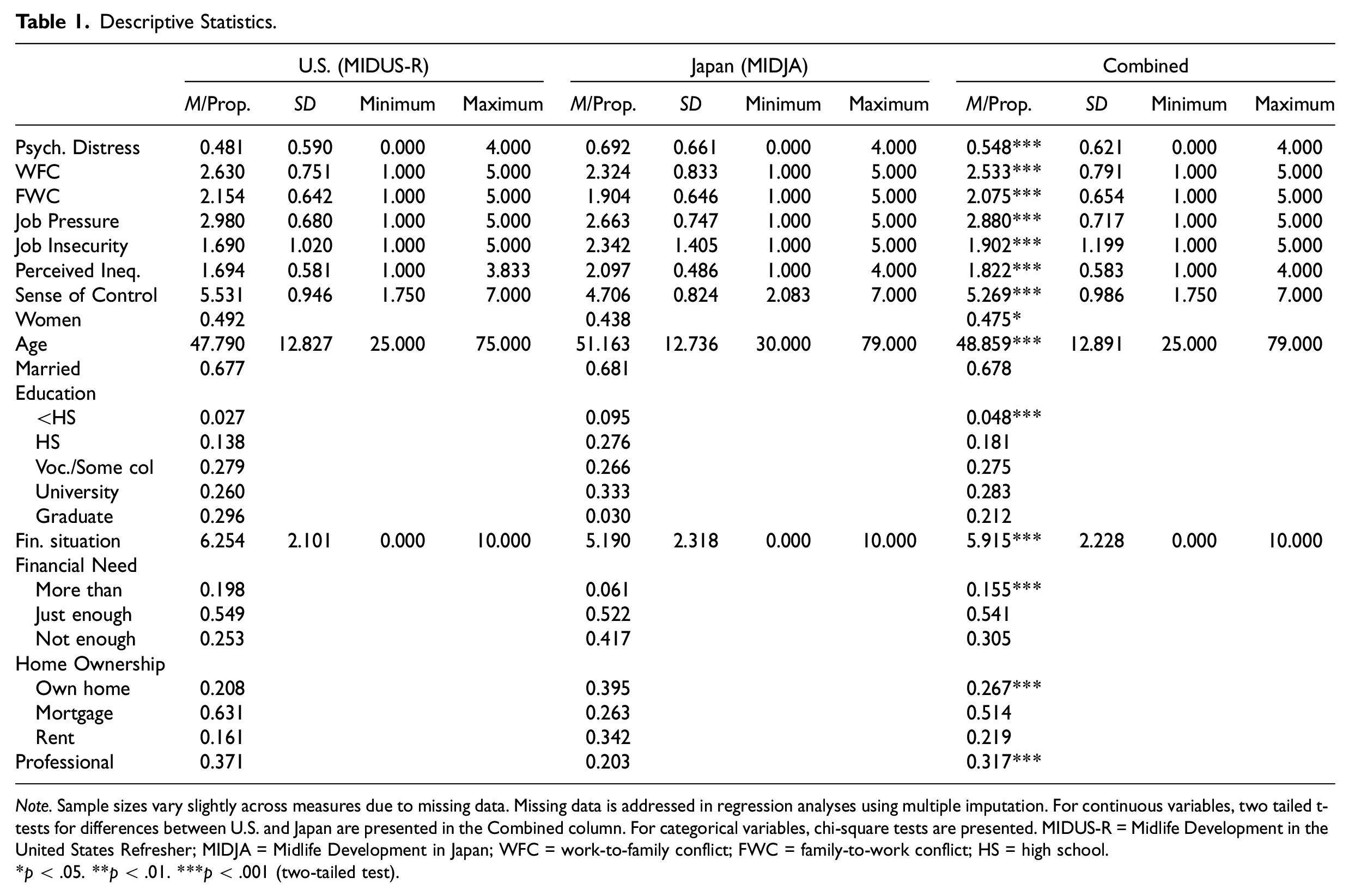
Note. Sample sizes vary slightly across measures due to missing data. Missing data is addressed in regression analyses using multiple imputation. For continuous variables, two tailed t-tests for differences between U.S. and Japan are presented in the Combined column. For categorical variables, chi-square tests are presented. MIDUS-R = Midlife Development in the United States Refresher; MIDJA = Midlife Development in Japan; WFC = work-to-family conflict; FWC = family-to-work conflict; HS = high school.
p < .05. **p < .01. ***p < .001 (two-tailed test).
Psychological Distress Regressed on WFC, Sense of Control, and Interactions.
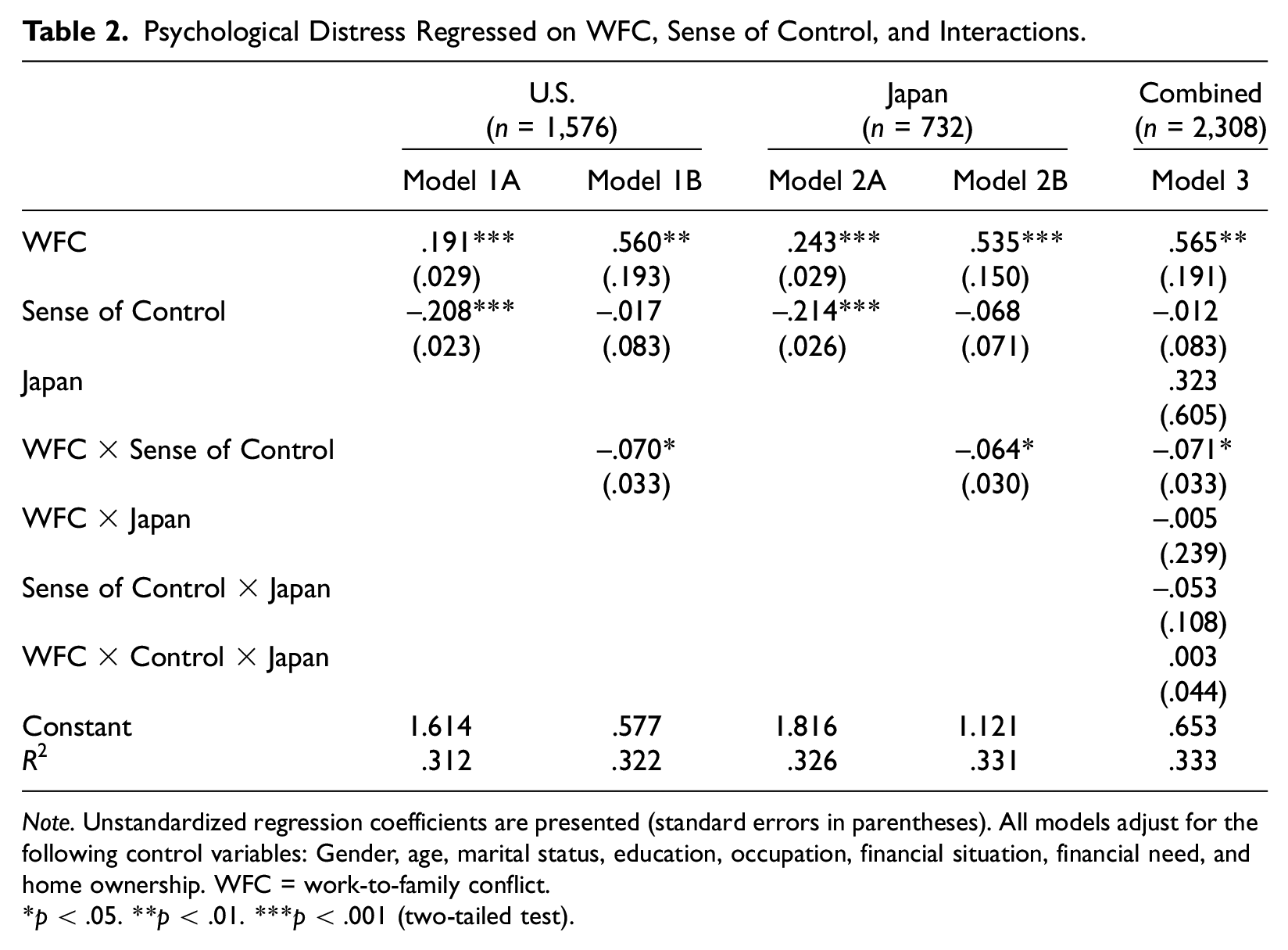
Note. Unstandardized regression coefficients are presented (standard errors in parentheses). All models adjust for the following control variables: Gender, age, marital status, education, occupation, financial situation, financial need, and home ownership. WFC = work-to-family conflict.
p < .05. **p < .01. ***p < .001 (two-tailed test).
Psychological Distress Regressed on FWC, Sense of Control, and Interactions.
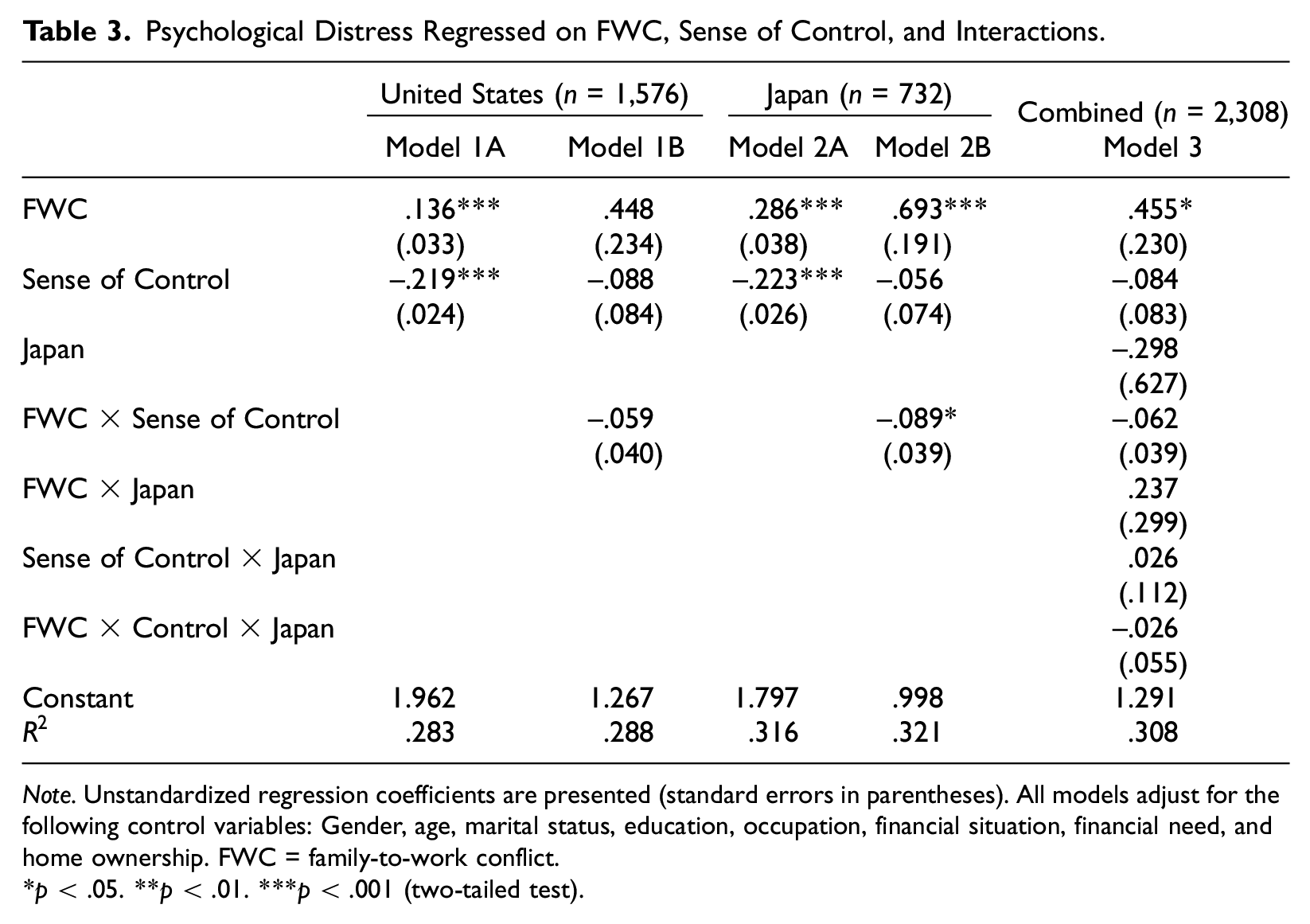
Note. Unstandardized regression coefficients are presented (standard errors in parentheses). All models adjust for the following control variables: Gender, age, marital status, education, occupation, financial situation, financial need, and home ownership. FWC = family-to-work conflict.
p < .05. **p < .01. ***p < .001 (two-tailed test).
Psychological Distress Regressed on Job Pressure, Sense of Control, and Interactions.
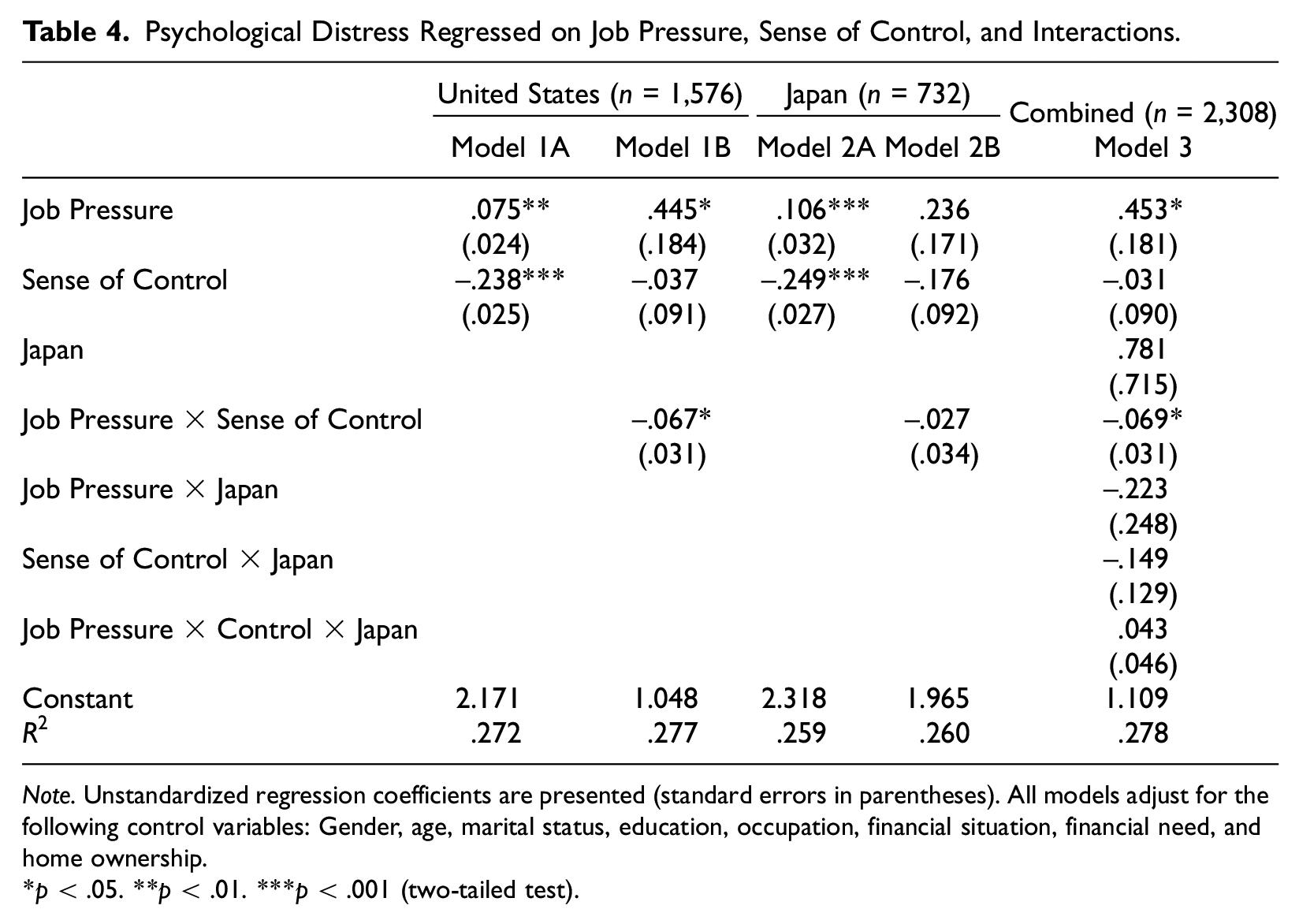
Note. Unstandardized regression coefficients are presented (standard errors in parentheses). All models adjust for the following control variables: Gender, age, marital status, education, occupation, financial situation, financial need, and home ownership.
p < .05. **p < .01. ***p < .001 (two-tailed test).
Psychological Distress Regressed on Job Insecurity, Sense of Control, and Interactions.
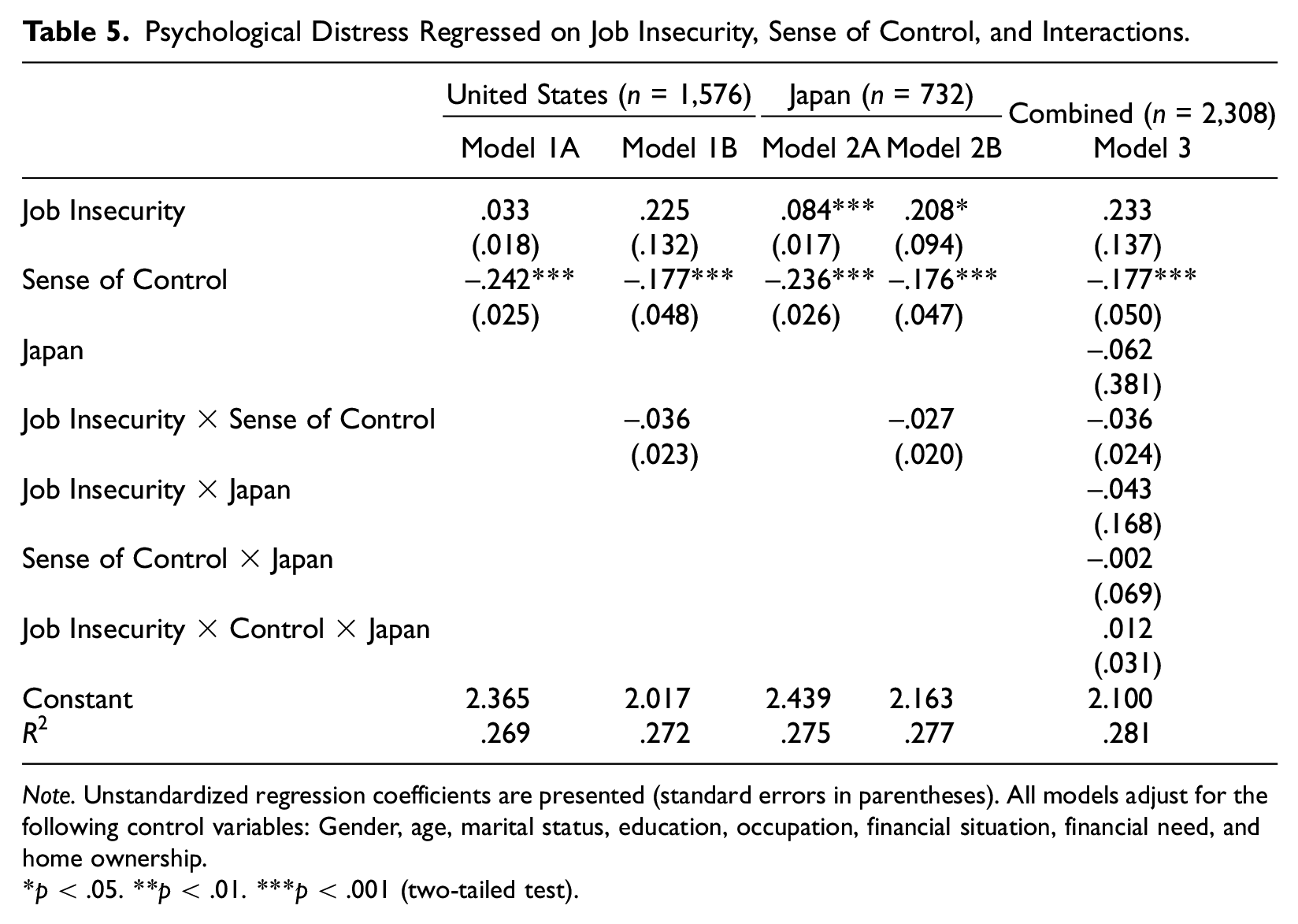
Note. Unstandardized regression coefficients are presented (standard errors in parentheses). All models adjust for the following control variables: Gender, age, marital status, education, occupation, financial situation, financial need, and home ownership.
p < .05. **p < .01. ***p < .001 (two-tailed test).
Psychological Distress Regressed on Perceived Inequality in Work, Sense of Control, and Interactions.
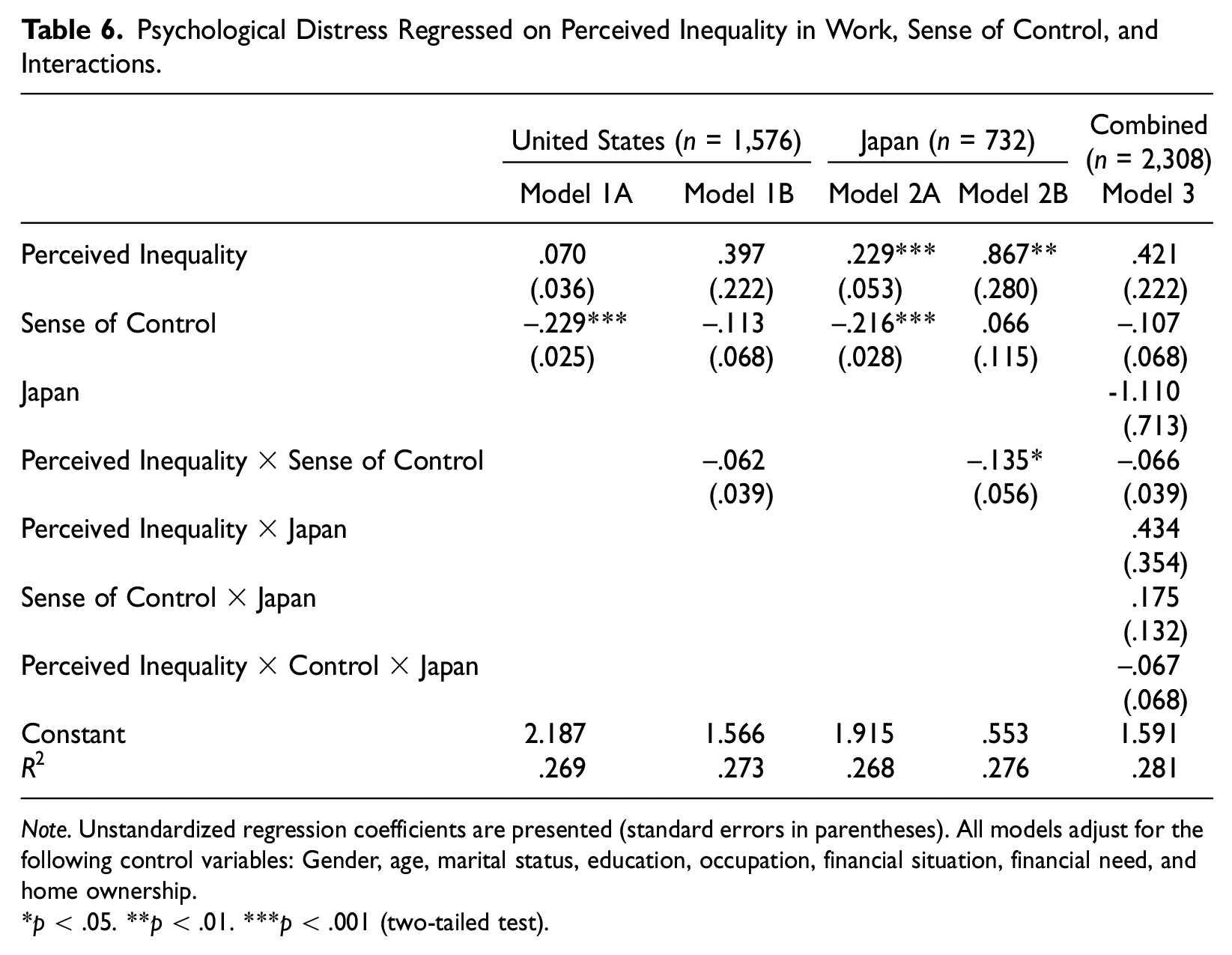
Note. Unstandardized regression coefficients are presented (standard errors in parentheses). All models adjust for the following control variables: Gender, age, marital status, education, occupation, financial situation, financial need, and home ownership.
p < .05. **p < .01. ***p < .001 (two-tailed test).
Results
Before presenting the results from multivariate analysis, some descriptive patterns in Table 1 are noteworthy. First and foremost, we observe a lower level of sense of control in Japan compared withthe United States. This pattern is consistent with prior analyses of nationally representative data from the World Values Survey that contains a single-item measure of perceived control (Hornsey et al. 2019; Narisada and Schieman 2016; Sastryand Ross 1998). Patterns from the other focal variables show higher levels of WFC, FWC, and job pressure in the United States, and higher levels of psychological distress, job insecurity, and perceived inequality in work in Japan. Correlation matrices for all study variables are reported in Online Supplemental Appendix Table 2.
In Table 2, I turn to testing the diminished buffering hypothesis: Are there group differences in the stress-buffering effects of the sense of control? Among Americans, Model 1A indicates that WFC is positively associated with distress (b = .191, p < .001), while sense of control is negatively associated with distress (b = −.208, p < .001). Model 1B shows a significant two-way interaction between WFC and sense of control (b= −.070, p = .036), indicating that the sense of control buffers the effect of WFC on distress. Similar patterns are found among Japanese. Model 2A indicates that WFC is positively associated with distress (b = .243, p < .001), and sense of control is negatively associated with distress (b = −.214, p < .001). Model 2B shows a significant two-way interaction between WFC and sense of control (b = −.064, p = .036), indicating that the sense of control also buffers the effect of WFC for the Japanese. The central question is whether two-way interactions are significantly different from each other. That is, does the buffering effect of sense of control significantly differ between Americans and Japanese? In the combined sample, Model 3 indicates that the three-way interaction term (WFC × Control × Japan) is not statistically significant (b = .003, p = .955). This demonstrates that perceived control’s buffering effect for WFC does not differ between Americans and Japanese.
Next, I examine the patterns for FWC in Table3. Among Americans, Model 1A shows that FWC is positively associated with distress (b = .136, p < .001), and sense of control is negativelyassociated with distress (b = −.219, p< .001). Model 2A shows no significant two-way interaction between FWC and sense of control (b = −.059, p = .135), indicating that sense of control does not buffer the effect of FWC on distress. Among Japanese, Model 2A shows that FWC (b = .286, p < .001) and sense of control (b = –.223, p < .001) are associated with distress in the expected directions. Model 2B shows that the interaction between FWC and sense of control is significant (b = −.089, p = .023), indicating that the sense of control buffers the effect of FWC. Thus, when Americans and Japanese are examined separately, the two-way interactions indicate that the sense of control functions as a stress-buffer for FWC among Japanese but not among Americans. However, a test of the three-way interaction is necessary to test whether the differences in the two-way interactions are large enough to conclude that the stress-buffering effects are significantly different between Americans and Japanese. In the combined sample, Model 3 shows that the three-way interaction term (FWC × Control × Japan) is not significant (b = −.026, p = .641). Thus, for FWC the sense of control’s buffering effect does not differ between groups.
Next, I turn to the results for job pressure in Table 4. Among Americans, Model 1A shows that job pressure (b = .075, p = .002) and sense of control (b = −.238, p <.001) are associated with distress in the expected directions, and Model 1B shows that sense of control buffers the effect of job pressure (b = −.067, p = .032). Among the Japanese, Model 2A shows that pressure (b = .106, p <.001) and sense of control (−.249, p < .001) are associated with distress in the expected direction, but Model 2B shows that the sense of control does not function as a stress-buffer (b = −.027, p = .415). Thus, when Americans and Japanese are examined separately, sense of control functions as a stress-buffer for job pressure for Americans but not for Japanese. The next question is whether the differences in the two-way interactions are large enough to conclude that stress-buffering effects of perceived control differ between groups. Model 3 shows that the three-way interaction term (Job Pressure × Control × Japan) is not significant (b = .043, p = .340). Thus, sense of control’s buffering effect for job pressure does not differ between groups.
Next, the results for job insecurity are shown in Table 5. Among Americans, Model 1A shows that job insecurity is not significantly associated with psychological distress although the coefficient approaches statistical significance (b = .033, p = .069), and the sense of control is negatively associated with distress (b = −.242, p < .001). Model 1B shows no significant two-way interaction between job insecurity and sense of control (b = −.036, p = .122), indicating that the sense of control does not buffer the effect of job insecurity. Among Japanese, Model 2A shows that job insecurity (b = .084, p < .001) and sense of control (b = −.236, p < .001) are associated with distress in the expected directions. Model 2B shows no significant two-way interaction between job insecurity and sense of control (b = −.027, p = .171). In the combined sample, Model 3 shows that thethree-way interaction term (Job Insecurity × Control × Japan) is not significant (b = .012, p= .689). Thus, sense of control does not buffer the effect of job insecurity in either group, and there are no group differences in sense of control’s buffering effect.
Finally, the results for perceived inequality in work are presented in Table 6. Among Americans, Model 1A shows that perceived inequality is not significantly associated with psychological distress although the coefficient approaches statistical significance (b = .070, p = .055), and the sense of control is negatively associated with distress (b= −.229 p < .001). Model 1B shows no significant two-way interaction between job insecurity and sense of control (b = –.062, p = .113), indicating that the sense of control does not buffer the effect of job insecurity. Among Japanese, Model 2A shows that perceived inequality (b = .229, p < .001) and sense of control (b = −.216, p < .001) are associated with distress in the expected directions. Model 2B shows a significant two-way interaction between perceived inequality and sense of control (b = −.135, p = .017). Thus, when the Americans and Japanese are examined separately, sense of control functions as a buffer for the Japanese, but not for Americans. But are the differences in the two-way interactions large enough? In the combined sample, Model 3 shows that the three-way interaction term (Perceived Inequality × Control × Japan) is not significant (b = −.067, p = .327). Thus, there are no significant group differences in the way that perceived control functions as a buffer. Collectively, the results across the five chronic stressors—WFC, FWC, job pressure, job insecurity, and perceived inequality in work—do not support the diminished buffering hypothesis.6,7,8
Discussion
One of the central propositions of the Stress Process Model is that psychosocial resources— exemplified by the sense of personal control—buffers the impact of stressors on psychological distress (Pearlin 1989; Pearlin and Bierman 2013; Turner 2010). Empirical support for this proposition has been documented across various stressors (Badawy and Schieman 2020; Jang et al. 2008; Koltai and Stuckler 2020; Krause and Stryker 1984; Pudrovska et al. 2005). However, in their review of research on the Stress Process Model, Pearlin and Bierman (2013) have called for more investigation on the conditions under which the psychosocial resources functions as a stress-buffer. This question is important to consider as buffering effects may not be generalizable across social contexts and groups. Inspired by this call, I assessed cultural differences in the ways that sense of control functions as a stress-buffer. The motivation for comparing Americans and Japanese stems from prior theoretical arguments and evidence suggesting that the sense of control is less beneficial for well-being among those from Asian nations due to their collectivistic (as opposed to individualistic) culture, and comparisons between Americans and Japanese have appeared prominently in cross-cultural research on individualism and collectivism.
A common view is that Americans are typical individualists, while the Japanese are typical collectivists (Takano and Osaka 1999, 2018). Implicitly or explicitly, this idea has served as a basis for interpreting group differences in the levels and effects of the sense of control. If Japanese place emphasis on duty to the in-group while placing less focus on the pursuit of personal independence and autonomy, they may perceive that life outcomes are often determined by others, suggesting a lower sense of control. Similarly, if interdependence rather than independence is the source of health and well-being among the Japanese, and if the pursuit of personal goals and autonomy is sanctioned in collectivist cultures, sense of control should be less strongly associated with well-being among the Japanese (Kitayama et al. 2010; O’Connor and Shimizu 2002; Sastry and Ross 1998). The crux of this perspective—that the sense of control has reduced benefits for well-being among those in collectivistic cultures—can be applied to buffering effects, a major function of the sense of control. We should observe that when the Japanese are exposed to stressful conditions, the sense of control should provide weaker protection. However, this diminished buffering hypothesis has not yet been empirically tested.
To test the hypothesis, I analyzed population-based data from MIDUS-R and MIDJA. These data are well-suited for testing the hypothesis as they contain identical and reliable measures of chronic stressors, sense of control, and psychological distress. Across five chronic stressors that impinge on contemporary workers—WFC, FWC, job pressure, job insecurity, and perceived inequality in work—the results reject the diminished buffering hypothesis. That is, the ways in which the sense of control functions as a stress-buffer are equivalent among Americans and Japanese. There were some differences in the buffering effects when two-way interactions were examined separately within each group. For instance, in the analysis of job pressure, stress-buffering was found among Americans but not among Japanese. For FWC and perceived inequality in work, stress-buffering was observed among Japanese but not among Americans. However, across all stressors, three-way interactions—which directly test group differences in the buffering effects—revealed no significant group differences in the buffering functions of the sense of control. In other words, when Americans and Japanese are analyzed separately, there are some differences in the two-way interactions; however, the nonsignificant three-way interactions indicate that the differences in the two-way interactions are not large enough to conclude that the stress-buffering effects differ between Americans and Japanese. Taken together, these patterns do not support the diminished buffering hypothesis. Ultimately, the results raise questions about the claim that the sense of control has reduced benefits for well-being among the Japanese compared with Americans—this does not appear to be the case for stress-buffering effects.
Why did the sense of control provide similar buffering effects against stressors among Americans and Japanese? Although my analysis does not empirically assess why the buffering effects are equivalent, recent scholarship on American and Japanese differences in I/C may give us clues. Prior cross-cultural research on group differences in levels and effects of the sense of control have often drawn on the I/C perspective to interpret why Asian groups report a lower sense of control and demonstrate a weaker relationship between sense of control and well-being (Kitayama et al. 2010; O’Connor and Shimizu 2002; Sastry and Ross 1998). However, some scholars (Takano and Osaka 1999, 2018) have challenged the validity of the “common view.” Therefore, one potential reason for the similarity in buffering effects may be that Americans and Japanese do not differ in individualism and collectivism. It is worth noting, however, that while I find that the stress-buffering effects are equivalent, I find that the Japanese report a significantly lower average level of sense of control—a pattern that is consistent with previous studies and is aligned with what we would expect based on the common view. More research is needed to explain why the Japanese report a lower average level of perceived control than Americans, but the stress-buffering effects are equivalent. The pattern is also noteworthy because we might expect that if a group is lacking in a resource, the capacity for the group to use the resource as a buffer may also be diminished. On the contrary, the results indicate that a relative lack of perceived control does not negate its capacity to use the resource as a stress-buffer.
Another noteworthy pattern is that the sense of control did not buffer the effect of job insecurity among both Americans and the Japanese. This result may point to the limits of sense of control as a buffer in the context of uncertainty. One reason why the sense of control is thought to function as a stress-buffer is that it tends to foster coping efforts that involve defining and solving problems (Ben-Zur 2002). This suggests that the extent to which the sense of control functions as a stress-buffer should depend, in part, on whether the stressor in question is amenable to strategizing and problem solving. The threat of job loss is an inherently uncertain experience that is usually difficult to anticipate (De Witte et al. 2015). Thus, perceived job insecurity may be relatively impervious to beliefs about personal control. This may be why I do not observe buffering effects for job insecurity in either group. Prior research has documented the limits of perceived control as a buffer in the presence of job insecurity, showing that the resource does not buffer the effects of high job insecurity on distress (Glavin and Schieman 2014).
Before concluding, several study limitations require discussion. First, the analysis is based on cross-sectional data. The design prevents the ability to establish temporal ordering and there may be unobserved factors that confound the relationships examined here. Second, MIDUS-R is a probability sample of U.S. residents, while MIDJA is a probability sample of Tokyo residents. It is unclear whether the patterns observed in MIDJA are generalizable to Japan as a whole. Future studies should therefore replicate the analyses with a nationally representative sample of Japanese residents. Third, the study was restricted to those who were employed, and the working sample in both the MIDUS-R and the MIDJA tends to be less female, younger, and more educated (see Online Supplemental Appendix Table 1). This choice was made to assess a range of widely studied stressors that tap various forms of chronic stressors—conflict, demands, uncertainty, and structural constraints—which, in turn, provided a broad test of the diminished buffering hypothesis. Nevertheless, it is possible that the patterns documented in the present study do not generalize to the unemployed because of differences in the characteristics between these groups. Future studies should therefore test the diminished buffering hypothesis across other types of stressors beyond the work role. Fourth, future research should examine the patterns for other psychosocial resources like self-esteem and social support. It is possible that the patterns identified for the sense of control might generalize to self-esteem. Conversely, if the Japanese tend to achieve health through relational means (Kitayama et al. 2010), then social support may exhibit stronger stress-buffering effects among the Japanese compared with Americans. Fifth, the current study examined the K6 scale as the outcome as it is a widely used measure of psychological distress that has been validated in both United States and Japan (Furukawa et al. 2008; Kessler et al. 2002) and because theory predicts that perceived control is a key determinant of psychological distress (Mirowsky and Ross 2003). However, it is possible that the results may differ across measures of mental well-being utilized in other studies, such as the Center for Epidemiological Studies Depression (CES-D) Scale (O’Connor and Shimizu 2002) and the Bradburn affect balance scale (Sastry and Ross 1998). In the present study,I replicated the results with positive affect, a measure of positive emotions complementary to psychological distress, and these results are consistent with the findings for psychological distress (see note 6 and Online Supplemental Appendix Tables 3A–3E). Nonetheless, future research might consider whether the patterns hold for other mental health outcomes. Finally, this study is limited in that only residents of the United States and Japan are assessed. As discussed above, the groups were chosen because comparisons of United States and Japan have appeared prominently in the I/C literature, previous studies have used the I/C literature to motivate predictions about Western-Asian differences in perceived control, and based on data availability. Nevertheless, future studies should examine whether the patterns replicate with residents of other Western and Asian nations. Despite these limitations, the MIDUS-R and the MIDJA are unique in that they are representative samples and provide identical and reliable measures of stressors, sense of control, and psychological distress across cultural contexts. In this regard, these data provide advantages over prior cross-cultural analyses of perceived control that have used a single-item measure of sense of control from the World Values Survey (Hornsey et al. 2019; Narisada and Schieman 2016; Sastry and Ross 1998) or samples of undergraduate students (O’Connor and Shimizu 2002).
Conclusion
Ross and Mirowsky (2013) state that the sense of control over life outcomes may be the most important belief about self and society that affect psychological distress. But are its stress-buffering effects generalizable across cultures? One hypothesis is that the belief in personal control is a less important buffering resource among individuals in collectivistic cultures compared with those in individualistic cultures. In a comparison of Americans and the Japanese—two groups that have been deemed quintessentially individualistic and collectivistic, respectively—the present study rejects this hypothesis. Across a set of prominent work-related chronic stressors, the sense of control functions as an equivalent stress-buffer. These results suggest that the sense of control—as a stress-buffering resource—is just as important for distress among Japanese as it is for Americans. Given the centrality of the sense of control in the stress process, future studies should continue to examine whether its buffering effect is generalizable across or is contingent upon social contexts and groups.
Supplemental Material
sj-pdf-1-smh-10.1177_21568693231161108 – Supplemental material for Work Stressors and the Buffering Functions of the Sense of Control in the United States and Japan: A Test of the Diminished Buffering Hypothesis
Supplemental material, sj-pdf-1-smh-10.1177_21568693231161108 for Work Stressors and the Buffering Functions of the Sense of Control in the United States and Japan: A Test of the Diminished Buffering Hypothesis by Atsushi Narisada in Society and Mental Health
Footnotes
Acknowledgements
I thank Philip Badawy and the anonymous reviewers for their helpful feedback. Finally, I thank the MIDUS and MIDJA teams for making the data available for public use.
Author’s Note
A previous version of this manuscript was presented at the 2022 Annual Meeting of the American Sociological Association in Los Angeles, CA.

Supplemental Material
Supplemental material for this article is available online.
Notes
References
Supplementary Material
Please find the following supplemental material available below.
For Open Access articles published under a Creative Commons License, all supplemental material carries the same license as the article it is associated with.
For non-Open Access articles published, all supplemental material carries a non-exclusive license, and permission requests for re-use of supplemental material or any part of supplemental material shall be sent directly to the copyright owner as specified in the copyright notice associated with the article.
