



Abstract
Identity theorists assume that individuals intentionally construct and maintain a culturally valued sense of self. Although this logic makes sense for positive identities—doctor, parent, or scientist—it becomes questionable when applied to the construction of negative, or stigmatized, identities, such as that of a drinker. By interviewing 16 members of a metropolitan recovery community, I focus on how marginalized identities form seemingly absent of intention. In doing so, I show how stress and negative messaging from guardians, peers, and community members produce persistent painful emotions that restrict access to culturally valued identity pathways and steer individuals toward spaces of consumption. Through each lost socially valued role, the drinker identity becomes more salient, achieving more importance in daily life and becoming central to individuals’ lived experiences. That is, the drinker role becomes a primary source of positive affect and belongingness when these essential ingredients of social life are unobtainable elsewhere. More broadly, I challenge current theoretical assumptions that dominated intervention strategies and recovery policy for decades and offer considerations for policy and intervention programs.
Keywords
Introduction
This article investigates how achieving an identity as a drinker relies upon the pursuit of belongingness and the positive effect absent of identity-relevant goals. Given the substantial increase in alcohol use over the past two years (Mohr et al. 2021; Pollard, Tucker, and Green 2020), resulting in increased rates of alcohol-related physical and mental disorders and deaths (Calina et al. 2021), understanding both how and why alcohol misuse occurs is a pressing public health problem. Four conversations undergird why pathological alcohol use occurs: (1) alcohol-related cultural norms and beliefs are passed through marketing, family, and peers, which motivates drinking (Grenard, Dent, and Stacy 2013; Jackson et al. 2014; Paschall et al. 2012), (2) alcohol use in early adolescence fosters patterns of alcohol misuse across the life course (Flory et al. 2004; Johnston et al. 2021), (3) risky situations, traumatic experiences, chronic stress, or deviant behaviors produce negative emotions which, in turn, influence alcohol-based self-medication (Bonomo et al. 2004; Elliott and Lowman 2015; Tapert and Schweinsburg 2005), and, most recently, (4) the development of drinker identity influences patterns of alcohol misuse (Lee, Corte, and Stein 2018; Lindgren et al. 2016). Tying these four literature studies together is the fact that identity-relevant experiences foster pathways to alcohol misuse. Past research has sufficiently outlined these pathways (Dingle, Cruwys, and Frings 2015). The related question of how individuals come to acquire meanings associated with drinker identities remains underexamined. Through a necessary investigation of meanings associated with drinking, we learn how patterned self-relevant feelings, thoughts, and actions, vis-à-vis others, influence the enactment and formation of a stigmatized identity.
Part of the problem is that most theories on how and why individuals commit to identities, like that of a drinker, tell only incomplete pictures. Psychology, for instance, emphasizes the intentional pursuit of beliefs and goals associated with an identity and a consequential sense of achievement (Erikson 1956, 1963). This results in a sense of belonging (Walton and Brady 2017), increased social support (Thoits 2011; Umberson and Karas Montez 2010), improved mental health (Thoits 2003), and greater emotional regulation (Crocetti et al. 2008), while presumably reducing pathological substance misuse (Jones and Hartmann 1988; Luyckx et al. 2005; Schwartz et al. 2011). Drinker identity is thus not achieved, as it is negatively valued and stigmatized (Goffman 1963b). Rather, it results from failure to achieve positive identities (White 2000; White, Wampler, and Winn 1998). Opposing psychology, research on alcohol misuse draws attention to social interactions revolving around alcohol as providing the protective benefits of belongingness (Torgerson, Love, and Vennum 2018), social support (Peirce et al. 2000), and emotional regulation (Berking et al. 2011) as individuals form self-conceptions related to alcohol use in interaction. Thus, findings seem to change when moving beyond static interpretations toward a process of identity development. For instance, sociologists point to self-formation related to substance use as a process, rather than a state, influenced by distress (Thoits 2013). In fact, many stigmatized or devalued identities, such as drug users (Simmonds and Coomber 2009), alcoholics (Denzin and Johnson 2017), the mentally ill (Marcussen, Gallagher, and Ritter 2019), or homeless (Snow and Anderson 1987) can be understood as processual, as self-conceptions evolve across time without a final achieved identity. Because quantitative sociological investigations into stress, alcohol use (Elliott and Lowman 2015), and identity (Stets 2005) are unable to capture the underlying processes of stigmatized identity formation, qualitative methods must be used to understand how individuals acquire negative self-conceptions.
To account for the aforementioned gaps, I draw upon novel qualitative data gathered through in-depth interviews with members of an alcohol recovery community and synthesize psychological theories of identity development (Erikson 1956, 1963; Marcia 1966) and social psychology (Burke and Stets 2009; McCall and Simmons 1978; Stryker 1980; Thoits 2013). I begin by describing identity development theory. I subsequently outline how social psychological research on identity (Stryker 1968) fits into stress research, focusing on processes related to identity work, symbolic interactionism (Blumer 1969; Stryker 1980), sociology of emotions (Scheff 1988; Scheff 2014), and the formation of stigmatized identities (Becker 1963b; Denzin and Johnson 2017; Goffman 1963b). In turn, my findings offer several key advances to the study of drinker identity more specifically and to making sense of how people come to commit to stigmatized identities. First, this study reveals how persistent negative emotions impede the exploration of and commitment to positive identities following continuous stress exposure, compelling action and subsequent identity formation. Second, as a result, I articulate a process of drinker identity formation that speaks to the links between identity, emotions, and symbolic interactionism. Third, I advance substance use research by honing in on identity processes, providing primary intervention points for recovery from addiction to substances (Beckwith et al. 2015; Buckingham, Frings, and Albery 2013; Lee et al. 2018). I now turn to identify development theory and the significance of intention in identity achievement.
Literature Review
Intention in Identity Development Theory
Erik H. Erikson (1963, 1968) and others argued that identity achievement is the primary task in adolescence and throughout young adulthood; and, failure to achieve stable identity results in a variety of social maladjustments, such as substance misuse. That is to say, commitment to an identity involves intentional exploration of the identity in practice (Archer 1982; Grotevant, Thorbecke, and Meyer 1982), in addition to contemplating the meaning of one’s actions, such as a drinker imagining themselves as an alcoholic and taking actions in line with this goal. Of course, this process is also marked by the evaluative consideration of one’s personal values (Newman and Newman 1978). For example, choosing between a social life around alcohol consumption, getting eight hours of sleep each night, or maintaining high marks in education. Evaluation is, thus, grounded in the goal of achieving an imagined future identity through commitment (Gollwitzer 1987). Taken together, then, commitment to an identity is to be found in the amount of time, energy, and resources directed toward acquiring said identity (Heshmati and Rahiminejad 2020:229)—for example, investing time, energy, and resources into the pursuit of a drinking habit would be indicative of commitment; subsequent praise or positive affect of attitudes and actions related to this identity will likely maintain or strengthen commitment. While this may be true for “positively” valued identities, like educational (Assor 2012) and religious (Hunsberger, Pratt, and Pancer 2001) identities, psychology tends to pathologize the myriad “negatively” valued identities that many people commit to in the course of their life. Recent research (Lee et al. 2018), however, challenges this assumption, arguing that identities of this kind do manifest and are seemingly achieved in the absence of intention.
Identity and Stress Processes
Conversely, sociologists emphasize the importance of social interactions and perceptions of others in the development of and commitment to self-conceptions (Burke 1991; Stryker 1980). Burke’s perceptual control model, for example, describes identities as a process whereby individuals compare identity-relevant self-meanings to reflected appraisals from others (Burke 1996). This comparative process forms a reflexive self, developed within and from a real or imagined generalized community (Cooley [1902] 1964). Discrepancies, or identity nonverifications (Stets 2005), between self-meanings, or identity standard, and appraisals theoretically contribute to distress and negative emotion which foster identity modifications or changes (Stets 2021). These discrepancies influence people to seek out identities that produce belongingness and positive affect. Likewise, when an individual is consistently verified for enacting an identity, they experience positive emotions, trust in the collective, and commit to identities (Burke and Stets 1999). Some appraisals come in the form of labels, such as “you’re the boss” or “you’re a drunk” (Goffman 1963b; Link and Phelan 2013), while other evaluations are interpreted through nonverbal displays, or what Erving Goffman (1963a) termed the “body idiom.” People develop stable self-meanings throughout this process which subsequently produce consistent lines of action (Burke and Reitzes 1991), like consuming alcohol. Commitment, then, is not a function of one’s own achievement of the identity, but rather the extent to which a role is intensively and/or extensively integrated into a network of significant others (Stryker and Serpe 1982). People intentionally elevate identities of positive valence into a salience-hierarchy of self, reliant upon the extensive social relationships that activate them within groups and in interaction (Stryker 1980; Stryker and Burke 2000). Self-conscious emotions—pride, shame, and guilt—result from meeting or failing to meet behavioral expectations in situations (Scheff 1988; Stets and Trettevik 2014). Individuals determine how good or bad they are in this way, further impacting one’s emotions and mental health (Blumer 1969; Culatta and Clay-Warner 2021).
While identity theory does not specify how people come to acquire new identities, their attention to stress (Burke 1991) affords us the ability to incorporate the stress literature (Thoits 1991). More specifically, stress process scholars draw connections between situational challenges and threats to psychological distress and disorder. Although overwhelmingly quantitative, decades of stress research show that major life events and stressors, such as trauma and abuse, can negatively impact mental health (Folkman et al. 1986) and influence alcohol use (Krause 1995) and many other detrimental outcomes. Stress, at times, may be perceived as harm, loss, threat, or challenge to self (Lazarus and Folkman 1984) and perceived as an inadequate person-environment fit (Thoits 1995). A mismatch between self and situation likely forms the belief that the global self is the source of imagined or real problems, that somehow, the individual is an outsider or deviant from group rules (Becker 1963b). Stressors that impact individuals’ most salient, prominent, or committed self-conceptions are likely perceived as more threatening, more predictive of psychological distress, and impact emotions more severely than those lower in the hierarchy (Thoits 2013). While other strains may take the form of highly situational nonverification of roles (Burke and Stets 2009), with others relating to global conceptions of self. Research points toward individuals’ abilities to employ situationally appropriate (psychological and social) coping strategies that maintain self-esteem, a sense of control, and social support as key to ameliorating the impact of identity-relevant stressors (Stets and Trettevik 2014). As outlined above, many individuals find that alcohol and drinking networks provide one with each of these essential identity-preserving elements. This begs the question: how does alcohol-based coping with stress alter one’s self-concept to the source of a stigmatized identity, such as that of a drinker? One possible answer to this question comes from Norman K. Denzin and John M. Johnson’s (2017) work on emotions and experiences related to alcoholic identities.
Self as a Drinker
Norman K. Denzin and John M. Johnson’s (2017) insightful work on the formation of drinker identities proves essential in understanding how alcohol-based social roles evolve and change both before and after recovery from alcohol. A product of a painful past, the drinker “lives out, in and through alcoholic consciousness, all the anger, the resentment, the fear, the lust, the desire, the frustration, the anxiety, and the love that were or were not present in childhood and adolescence” (Denzin and Johnson 2017:103). This work makes clear that pathological drinkers experience a complex dynamic of emotions that transition from feelings of self-doubt and hatred, despair, and anguish to self-pride. Encapsulated in the experience of emotional negativity, the drinker senses a division of self that is exacerbated by alcohol. It is the shared experience of emotions occurring prior to recovery which Alcoholics Anonymous (AA) speaks to and that allows for shared understanding between members. Upon entering AA, individuals experience radical transformations as they attribute the meanings of the alcoholic concept to self as provided by the program, influencing how individuals tell their stories related to self.
Norman K. Denzin and John M. Johnson (2017) argue shame, guilt, and self-pride drive the commitment to alcohol misuse (p. 121), just as psychologists argue, negatively valued identities are not achieved but are compelled. Symbolic interactionism and identity theory, however, teach us that identities are often committed to because of the positive affect acquired from specific and diffuse social ties. These affective benefits are compared easily against the relational ties that cause or have caused stress or trauma. By comparing how stress and strain influence the likelihood of alcohol misuse and psychological distress across the life course (Elliott and Lowman 2015; Martin, Conger, and Robins 2019) while remaining attune to positive affect, an undertheorized process of identity development as a drinker may unfold. Alcohol misusers also rely upon social drinking to feel as though they belong to a community, to sense that they are indeed normal, unstigmatized individuals (Goffman 1963b). This brings Denzin’s argument related to alcoholic isolation into question, providing an additional opportunity for theoretical sharpening. This is where the heart of my analysis rests, on the experiences that instill a self-concept that, when subsequently merged with alcohol, takes on the form of a drinker identity. In so doing, I account for Denzin and Johnson’s consideration of negative affect and stress while remaining open to the possibility that more positive aspects of pathological drinkers’ developmental processes remain untapped.
To reveal how drinker identities form, I draw upon narrative sociology and criminology to focus on drinking stories of alcoholics in recovery. As personal tales of past drinking experiences are associated with patterns of consumption (Tutenges and Sandberg 2013) and self-development, revealing the interpretive strategies self-identified alcoholics use to understand their alcohol misuse uncovers how drinker identities form. My goal with this study is to examine the identity-relevant mechanisms undergirding alcohol misuse by exploring how nonverification of culturally prescribed roles produces shame, a driving force for seeking new identities and social ties (Abrutyn and Lizardo 2022), while contributing to the verification of culturally unvalued roles, such as that of a drinker.
Methods
Sample and Site Selection
I draw on interview data from 16 current or past members of the 12-step recovery community in a metropolitan area in western Canada to investigate how alcohol users form drinker identities. I purposively sampled 12-step programs, rather than current alcoholics, due to the following characteristics: (1) members are driven to achieve sobriety; (2) they attempt absolute honesty as a component of the program—countering misinformation that is often provided through self-reports on undesirable topics (Chan 2009), like alcohol misuse; (3) members reflect upon the experiences, thoughts, emotions, and actions that contributed to their drinking; and (4) they discuss these elements as a component of the recovery program (Randles and Tracy 2013). I selected this metropolitan area as an “enabling place” (Duff 2011) of recovery due to the city’s reliance upon the Canadian Managed Alcohol Program. This program enables recovery from alcohol using four pillars: alcohol intervention, housing or accommodation intervention, primary care services, and social and cultural interventions (Pauly et al. 2018).
Data and Codes
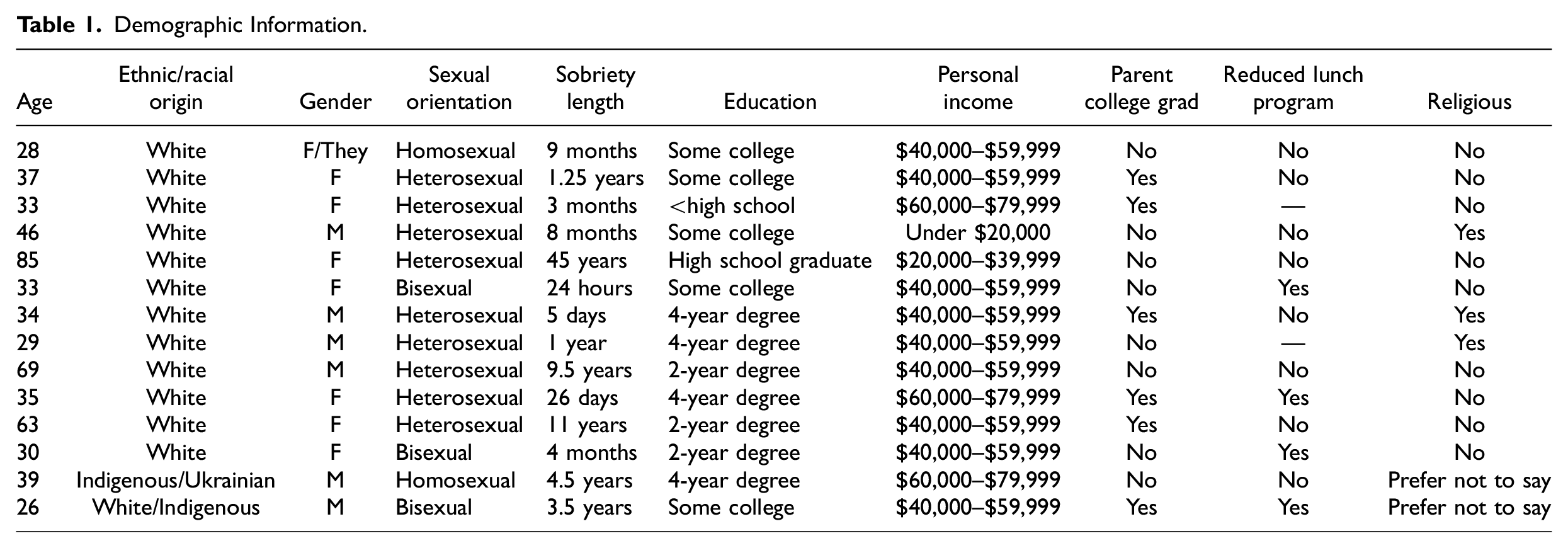
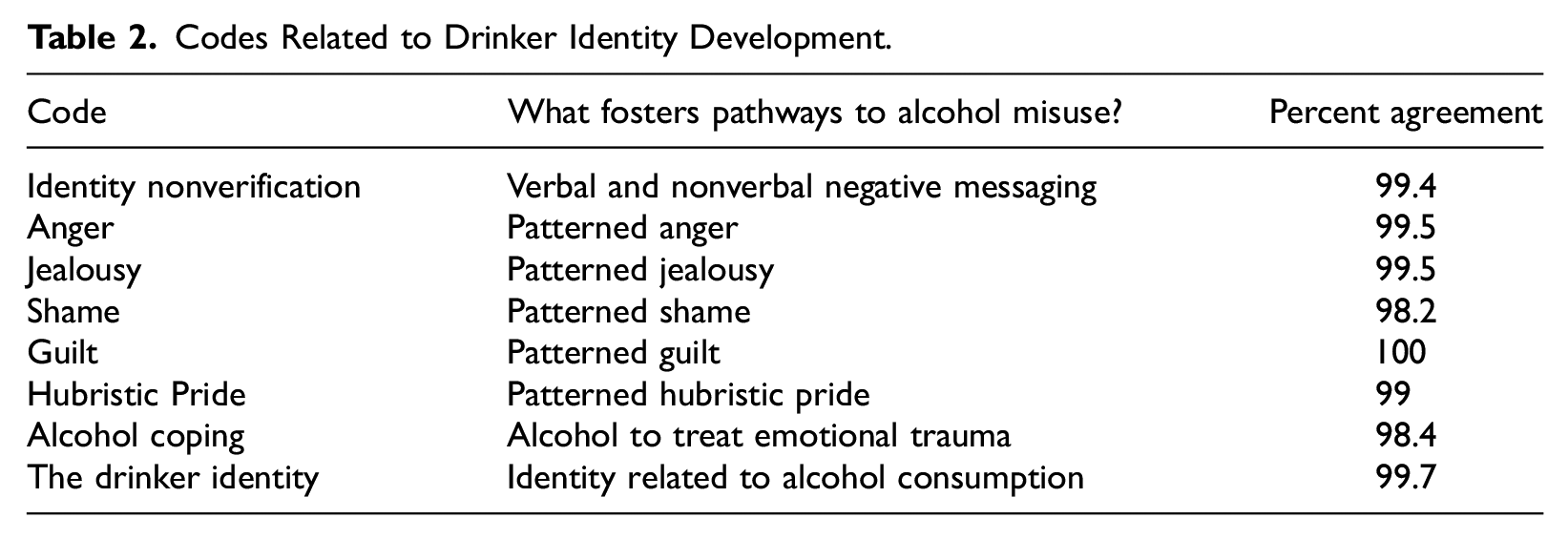
My data consist of transcribed 17 semistructured interviews from 16 self-identified alcoholics (N = 16; nine females, seven males; 13 White, three people of color; eight college graduates; age range 26–85; see Table 1 for additional demographic information). As a nonprobabilistic sample, 17 interviews exceed the standard of 12 interviews necessary for saturation (Guest, Namey, and Chen 2020). I retrospectively interviewed using a critical realist approach (cf. Fletcher 2016 for the similar procedure to interviewing). This process involves framing interview questions related to known influencers of a phenomenon and subsequently modifying the interview protocol for new themes that emerge. I used this method to verify and identify defined (e.g., trauma and loneliness) and undefined (e.g., hubristic pride and nonverification) factors, respectively, which contribute to alcohol misuse. For example, I asked questions related to shame and guilt, but incorporated question sets regarding hubristic pride and nonverification as they increased in relevance (see Table 2). I chose this interviewing technique due to the dearth of information on the foundational components of drinker identity formation while linking novel findings to prior and emerging theory (Miles and Huberman 1994). Retrospective interviewing is the process of asking respondents to recall information about their past as it relates to an outcome, in this case, alcohol misuse (Gant 1977). This method allowed me to locate emotionally traumatic central events (Boals 2018) in one’s memory that contributed to patterns of alcohol misuse and drinker identity formation across the life course. I sampled participants from July to September 2021 via fliers and by convenience and snowball sampling techniques. I employed flyers to account for difficulties related to identifying current alcohol misusers. Snowball sampling also supplemented the participant identifying process as self-identified alcoholics leverage their own networks of known alcohol misusers.
Demographic Information.
Codes Related to Drinker Identity Development.
Interviews ranged from 60 to 145 minutes and averaged 104 minutes. All interviews were one-on-one and conducted through online encrypted Zoom software. I analyzed the final 461 single-spaced pages of transcribed text line-by-line using the data analysis software NVivo 1.3. Using the retroductive coding method (Ragin and Amoroso 2019), I prioritized references to known contributing factors of alcohol misuse (e.g., deductive codes associated with trauma, negative emotions, emotional nonverification, loneliness, and development of a drinker identity) and untheorized factors associated with alcohol misuse (e.g., inductive codes constellating around positive emotions, nonverification, belongingness, and a predrinker identity) (cf. Ghaziani 2014; Sutherland 2021 for similar approaches to coding). I also remained open to surprises emerging from the data as I engaged with abductive theory formation (Timmermans and Tavory 2012). I focused on the experiences and emotions that precipitated drinker identity pathways to alcohol misuse, thereby honing in on a predrinker “outsider” identity.
Establishing reliability of findings is a core concern in social research. I addressed this by engaging in a two-phase process of intercoder reliability. The first phase consisted of an initial selective coding process (Strauss and Corbin 1990), which produced 111 codes. Next, I used the constant comparative method (Glaser and Strauss 1967) to refine my codes, reducing them, first, to 33 basic themes, then, to 10 organizing themes (cf. Attride-Stirling 2016). To verify my coding scheme and achieve reliability, I trained an independent researcher on my codebook. This process involved defining variables associated with the central themes in the data. I then removed all code markers from the transcripts and the independent researcher coded for the themes present in 10 percent of my data (Potter and Levine-Donnerstein 1999). A commonly held standard for intercoder reliability is 80 percent (Krippendorff 1980). Through negotiated agreement (Campbell et al. 2013), all themes of primary importance received agreement scores above 96 percent (see Table 2).
Data Limitations
This study has limitations surrounding participant memory in regard to retrospective interviews and social desirability associated with undesirable topics (Bell and Bell 2018). As alcohol misuse and the actions associated with it are highly stigmatized (Kilian et al. 2021), participants may have minimized the reality of their experiences. Moreover, stories from members of recovery communities are imbued with language and meaning provided by the program, possibly biasing information (Denzin and Johnson 2017). I used multiple techniques to respond to these issues of memory and reliability in retrospective data. Previous research (Abrutyn and Lizardo 2020) describes how persistent emotionally charged situations, like chronic stress and trauma, are more readily and easily recalled episodic memories that relate to one’s sense of self. As such, all participants experienced, at minimum, one measure of trauma accounted for in the Centrality of Events Scale (Berntsen and Rubin 2006) related to drinking outcomes. This scale is thought to be indicative of individuals’ recollection of a central event influencing one’s identity across the life course (Boals 2018). Additionally, narrative criminology underscores that, regardless of the “factuality,” there is a direct link between stories actors contribute to drinking and drinking behaviors across time (Tutenges and Sandberg 2013). Memory research also underscores that events encapsulated in high emotional involvement—much like celebratory or somber experiences surrounding alcohol use—are the most distinct during recall (Berntsen and Rubin 2002). The primacy effect also contributes to individuals remembering novel events, like one’s first alcoholic beverage, much more clearly than events that follow (Pillemer et al. 1988), enhancing the vividness of these tales. I also pinpointed temporal landmarks, a memory retrieval tool, in participants’ life stories, related to drinking, which they structured their drinking narratives around (Shum 1998). By applying these memory-enhancing techniques, I overcame some limitations of retrospective interviews related to undesirable topics from members of a recovery community.
Results
I begin by exploring the narratives people use to make sense of their drinking with a focus on nonverification, negative emotions, and alcohol use. I follow this discussion with an investigation into stories individuals draw upon that relate to their drinker identity as a positive development that provides belongingness. I, then, move temporally into the process of self-stigmatization of the drinker role and conclude with my underlying consideration of intentional identity processes related to negative social roles.
Nonverification, Negative Emotions, and Alcohol
In my sample, the narrative surrounding nonverification, negative emotions, and alcohol use was present and important. Specifically, 100 percent of my respondents (n = 16/16) mentioned that they experienced significant invalidation in the household, contributing to negative emotions, experienced as “stress,” and alcohol use to cope. The only variation within this sample related to negative emotions. While 100 percent disclosed that they felt shame associated with their self-image, 87.5 percent (n = 14/16) indicated that they also felt guilt associated with the actions that they took in response to the shame experienced. For example, Sandi, a member of the recovery community with 1.25 years of sobriety, detailed her experience of nonverification: Honestly, just attention, validation, and just time. Just time and kindness. That’s all I needed. I just needed my parents, relatives, whatever, to just make me feel like I was special, cause’ kids need that. . . . I couldn’t understand why I didn’t get the same attention my brother did. I couldn’t understand it. I tried soccer. I tried softball, you know. I did gymnastics. I did swimming. That, I can understand them not wanting to come to. But team sports, I couldn’t get why they didn’t want to come.
Many of my respondents, like Sandi, for whom verification and social support were unavailable, were driven and successful in education, athletics, and occupations. Positive feedback from others was their primary desire, cited as striving for positive reputations and a sense of belonging or self-worth. Sandi also spoke at length about coping with experienced nonverification through achieving exceptional grades in middle and high school, attempting to form a valued academic identity. This strategy, however, did not make her feel valued. Persistent devaluation from others influenced intense exploration of identities. Rather than nonverification of situational role identities, as is the focus of identity theory (Burke and Stets 2009; Stets 2018), Sandi, along with other participants, had their self-concept or person identity threatened or damaged (Turner 2010:133ff). She described this experience in the following statement: There was something missing, and I just felt sad. . . . I was sad. Just, something was missing or off or broken or something was wrong with me and . . . and I always wanted . . . like its still something with me. I just want to feel like I’m here for a reason and this is all not for nothing and I have purpose.
For Sandi, her sadness was directed toward her feeling that something was wrong with herself, that she did not have purpose. This echoes most respondents’ life stories. Elaborating upon her experience, she describes how she felt “disposable or, again, didn’t hold a lot of value because [she] was so easily written off or forgotten about or dropped. Like, [she] . . . didn’t have value.” Sandi, thus, highlights how shame and other painful emotions, such as guilt, are expressed through language. In this case, her statement that she “didn’t have value” or lack of worth is a clear expression of shame in discourse (Retzinger 1995). From athletics to education, she did well, but when compared to her brother, she held inferior worth for reasons unknown to her. Like other participants, she perceived herself as valueless. It was seemingly the only conclusion they could form given persistent nonverification. Another example of nonverification, related to a vocational role, comes from Erik, a Black male who landed and lost his dream job: Anyway, so I knew this is the one job that I’ve been wanting to do all my life, I just never had an opportunity. . . . And because of the diligence that I did on that job, we had worked ourselves out of a lot of the work that was coming in, and because I was the last one to get hired, I was the first one to get let go. And my alcoholism said, See, it doesn’t matter how good you are, you’re not good at all. . . . And it sort of reinforced how I had been treated at home by my mom. It doesn’t matter how many things you do well, you’re still not good enough. (Emphasis added)
Erik explained that the loss of his job was simply the last straw in a much longer line of rejection. The grief produced from this specific nonverification negatively influenced his drinking. However, it was another 30 years before he identified as an alcohol misuser after being fired, again, and spending a holiday alone with a case of liquor. Through illustrating persistent nonverification experience in his household that links to his alcohol use, a clear picture develops of how chronic stressors related to such experiences inspired negative thoughts related to self and subsequent alcohol misuse. For Erik, his perceived inability to achieve positive appraisals throughout his life, beginning with his mother, indicated that he was “not good enough.” Erik exemplified this process when he said: “. . . not having any other abilities, insofar as any kind of real job experience, [drafting] was something that I could do. When that was taken away from me, it’s like a certain part of me shut down.” His drive to accomplish cognitively engaging work and subsequent occupational identities were what shut down. He elaborated upon this point by stating how he sought “physical” and “manly” jobs after this particular firing, confirming to self and others that his abilities ended where cognitively demanding occupations began. Thus, for Erik, to consider risking additional stress reminded him of pain he experienced throughout time, inhibiting exploration of, and commitment to, potentially valued roles.
Additionally, my respondents describe how nonverification in daily interactions influenced negative emotions and substance use to cope. Mark, for example, a self-identified gay male, lived in a household with an abusive and homophobic father, a man who persistently denied Mark’s self-concept—much like Sandi above—through threats to life. His inability to express his authentic self within both family and educational spheres triggered negative emotions and subsequent substance user achievement: I was running from myself, but, also, I really just wanted to be myself. So, I felt a lot of guilt about that. Even though I was favored, I felt guilty that I was [not abused], but I also felt guilty that my dad’s favoring this kid and he doesn’t even know who this kid is. . . . I was really athletic and I was really popular and people liked me, but I didn’t like myself. I hated it because I was a fraud, and by nature, I’m a really real person. . . . So, I was trying to be the opposite of who I really was.
Mark’s interview is congruent with other respondents’ stories. Within constraining environments, others influence how they “ought to act.” Constant states of dissonance triggered escapism. Similar to the shame language used above by Sandi, here Mark expresses that he was “running” from himself. This terminology of running away is indicative of shame individuals experience as they violate expectations (Scheff 1988), often referred to as running or hiding, much like both Sandi and Erik express above. From household interactions relating to his father, Mark was forced to exist in a state of secrecy for his personal safety and well-being, enhancing personal pain from his inability to express one of his most cognizant identities. For example, Mark highlights the severity of his daily lived situation: . . . one night, he came out with a shotgun and he was pointing it at me and saying, “Oh, you better not be gay!” and all this shit. So, after stuff like that, I’m like, there’s no way [I can enact my authentic self].
He attempted identity coping strategies by keeping things “strictly business” around family and peers, but the emotional impact was unbearable. Emotional pain persisted until alcohol ameliorated it, as evidenced in the following passage: I just did everything that was against who I was . . . I’m living this life that’s totally not who I am and I’m doing things that goes against my own values that I have. Like really bad shit that I don’t even want to do, but I’m doing it and umm . . . yeah, it just . . . I guess it just slowly broke me down and then . . . no matter how much or what you use, it just doesn’t take that away anymore, right. . . . I felt guilty about what I did. And then, umm. Obviously, shame. Shame’s a big one for me . . . I felt guilty about the actions I was doing, but the shame was thinking that, ya know, there’s something wrong with me that I’m doing this stuff. And I could never put my finger on what was wrong with me.
Much like Sandi detailed above, Mark makes the connection between his actions and guilt, but also shame related to feeling like something was “wrong with [him]” due to continuing to take actions in opposition to his values. As Mark made clear, “I just kind of dealt with my mental and emotional well-being the way I did, which ended up being addiction.” Alcohol only lasted so long as it no longer took away the pain associated with his past, present, and anticipated future.
Verification, Positive Emotions, and Alcohol
While my respondents’ self-concepts became saturated in negative affect, their drinker identity came to be a source of verification and, thereby, positive emotions built from connectedness and drinking. Precisely, 100 percent (n = 16/16) described positive emotions associated with a verified drinker identity, motivating additional use of alcohol as a means to belong. For example, Henry, a 26-year-old male with 3.5 years of sobriety lends a salient story related to this process: I was very much of that group the most like that; the biggest shambles in the group. But, like, the people, they’d be like, “Yeah. That’s my cool alcoholic friend. He’s a train wreck, but he’s fun. Look at him. He’s being ridiculous, again, look at that. He’s so funny.” So, it was almost rewarded a little bit, I think. So, I was definitely . . . that validation was really nice. . . . It’s nice being able to have certain low expectations of you or having the expectation that you’re going to behave in a certain way that’s . . . ya know, you’re not letting anyone down. Because people are like, “Oh yeah. He’s gonna be an absolute shit-show,” or “yeah, that’s just who he is.”
As stated by another interlocutor, “Love, understanding, and connection,” were what he was searching for throughout life. That is, until they found an enclave of like others in drinkers. As one respondent put it, “[I] identified . . . as the fun party girl because that was what kept me in everyone’s good graces.” Every participant labeled the drinker role. However, these labels such as “the clown,”“the funny drunk,”“the party guy,” or “train wreck” seem saturated with shame, but for these individuals, it meant being recognized and experiencing positive affect. Through interactions undergirded by alcohol and feelings of comradery, my participants became committed to drinker identities due to received emotional and social benefits unobtainable elsewhere. They consistently expressed new freedom of self that came with alcohol and community. This interactional component is clearly articulated by Erin, a newly sober respondent, when describing her first experience with alcohol: “I just felt like the smartest, wittiest, prettiest creature ever to grace the face of the earth.” This burst of experienced positive emotions could not have occurred without a grouping of like others. It was through interacting within spaces of consumption that she felt a sense of self-worth. Erin made this clear when describing how she found her sense of belonging among others: For me, my drinking has always been fueled, first and foremost, by the original addiction, which is just like a desperate need to be loved and find connection. Even the worst of my drinking has always been social. . . . I was rarely lonely for long. Even if I was visiting a new town, I would do the same thing. And so, the idea of giving up drinking and giving up this means that had always . . . umm . . . been how I found connection, and [quitting] seemed insurmountable for me.
Many others described a sense of pride in self and feeling like their milieu of drinkers was the “first place that felt like home.” Here, we look toward Cheryl, a participant with 11 years of sobriety, as she detailed her turning point that guided her toward a life of alcohol misuse: Cheryl: I got drunk one night. Not blacked out, but drunk. I said to Linda, the next day, “Oh my god, Linda, how was my behavior, last night?” And she said, “Oh you were great!” . . . She said, “Oh yeah, you’re a fun drunk!” I said, “What?! I’m a fun . . . well, isn’t everyone a fun drunk?” Because I was young and new at this new career I was developing . . . my work career and my drinking career. And I went, “What do you mean fun drunk? You mean there’s bad drunks out there?” I did not know that. I did not know that there were bad drunks. And she said, “No, no, you’re a good drunk. You’re fun.” So, I was validated.
Interviewer: And you held on to that for a long time? Cheryl: I definitely held on to that. Absolutely. That was pride. My false pride, for sure. For sure. “I’m a fun drunk.” And that is exactly how I perceived myself, for sure, 100%, until I became the blackout, fall down drunk.
For Cheryl, and individuals that have a long history of chronic stress and nonverification, verification of a drinker role produced a sense of pride, belonging, and self-worth that kept them consuming. As Erin described above, it was how they found connection to others. For once, they felt like “normals,” or that they somehow “fit in.” In short, my participants intentionally sought out spaces related to alcohol use that both made them feel pride, self-worth, and a sense of connection to others. This experience was short-lived, however, as the focus on interactions related to alcohol was unsustainable in a social world that generally places negative value on drug and alcohol misuse. Thus, just as drinkers learned to be drinkers because it brought positive affectual rewards, so too did they have to learn to see the identity as negatively valued, more broadly, and learn to self-stigmatize.
The Drinker Role: From Pride to Shame
The contradictions, however, between being labeled a train wreck or ridiculous, such as Henry above, and realizing that one’s self-concept was built on negative appraisals from others, could only last for so long; that is, one’s drinker identity was not a matter of stigmatization but required learning to stigmatize oneself. All participants (n = 16/16) described a pivotal moment in their lives when the drinker role transitions to an identity of negative valence. James, for example, a participant with five days of sobriety, provides his experience related to self-stigmatization.
It was fantastic. Yeah. To be the life of the party? To be like you’re finally out of your shell and you finally got all this attention and, like, girls are interested in you and umm . . . you can drink obscene amounts of booze and still be present and outlast everyone else. While they’re getting sloppy, you’re just getting sharper. It was uhh . . . it was great. Yeah. I . . . but, the thing was, I wasn’t making any sacrifices. I wasn’t making any preparations for the next phase of my adult life. Like, I was in arrested development. Because all I wanted to do was stay in that place and . . . people were starting to go to school and people were starting to figure their career out, and I just wanted to stay at the bar.
James described the transitional moment in life when his pride associated with a drinker role waned. His reflection upon his position as a regular at this bar which provided him with positive emotions and a sense of belonging shifted his perception of self as falling behind others. As James drifted away from the goal-oriented behavior associated with self-improvement, he perceived himself as an outsider because of his identity as a drinker. Sera, a newly sober individual of 30 days, also detailed her drinking in this way: I feel like I probably held onto it way longer than . . . and it started getting like negative . . . ya know . . . it wasn’t . . . it started becoming like not cool and people were like, “Hmmm. That’s a little much there, Sera. You’re not like 24 anymore.” And then . . . ya know . . . I don’t want to go too far into it, but I think that played into a lot of the continuation of the drinking. It was because . . . I was chasing that . . . feeling . . . of friendship and comradery and as you get older, life shifts and I wasn’t shifting with it because I was so . . . just trying to just hang on to that piece.
Sera began to experience nonverification of her drinker role, but did not want to lose that which provided her with a sense of connection to others. She expanded upon this as she said, And I think that stemmed a lot from the bullying in the beginning, because I didn’t want to lose this and I didn’t want to go back to being bullied or being, ya know, made fun of or not being . . . not being popular . . . not being cool.
She explained how alcohol was the only way she knew how to make friends. Even at the time of our interview, as a newly sober individual with less than a month of participation in the recovery community, she still struggled to imagine making friends without consuming alcohol. However, in Sera’s mind, and every other respondent I spoke with, the drinker role became stigmatized as something that was “not cool.” In this moment, through their similar realizations, the very thing that generated pride and a sense of community transformed into that which triggered shame by excluding them from others. Through this process, my respondents made clear that “the thing that was keeping them afloat, was ruining [their] goals.” For my interlocutors, they reformulated these goals, many of them achieving them, once they joined 12-step recovery.
Discussion and Conclusion
Given the increase in alcohol-related physical and mental disorders and deaths over the past two years (Mohr et al. 2021; Pollard et al. 2020), understanding why alcohol misuse occurs, and, if possible, how to intervene is a pressing problem of public health. Although decades of research point toward stressful experiences, negative emotions, stigma, and drinker identities as contributing to alcoholism, rarely have these studies homed in on specific processes or mechanisms that precede risky drinking that contribute to drinker identity formation.
By examining the narratives of members from a recovery community in a metropolitan area in Canada, I aimed to advance the study of alcohol more generally and drinker identity specifically in a new direction. Namely, one that considers how negative experiences may turn even a stigmatized identity into a protective role saturated in positive affect. That is, by creating a role as a heavy drinker, my participants came to find belongingness, something that was seemingly unobtainable elsewhere, while progressing deeper into alcohol misuse. Thus, by considering social psychology, especially, symbolic interactionism, along with sociology of emotions and identity, a process by which drinker identities form emerged.
With this study, I showed how individuals have negative meaning structures imposed by their families, peers, and community members. From within social spaces and institutions—household, school, workplace, and community—that frequently foster valued self-conceptions relevant to positive mental health, my participants were motivated to reduce negative emotions experienced from stress and nonverification of culturally valued roles, as was discussed by Sandi, Erik, and Mark above. This drove my interlocutors to pursue identities that provided them with essential social ties and positive affect. As highly valued role identities were reduced through nonverification and stress processes, more marginalized roles, such as a drinker, increased in salience and prominence, fostering commitment. This was expected as identities that come with chronic stress, and/or rejection/exclusion, can motivate individuals to seek new identities and commitments (Abrutyn and Lizardo 2022; Lofland and Stark 1965). Along with these experiences, my participants detailed how alcohol misuse was initially a positive aspect of their lives as it provided them with a personally valued identity of low expectations, as Henry described. This finding was also anticipated as identity theorists and symbolic interactionists more generally predict that identities we land on are those that bring positive verification when compared with the negative affect received from old rewards. It helps, of course, that these identities are built around activities that literally dull the pain, like drinking. Beyond these physiological benefits, however, individuals must also learn to be drinkers through a process of self-stigmatization (Becker 1963a). Eventually, as James and Sera disclosed, contradictions emerged between new-found social ties and the positive verification and more global stigmas attached to the new identity, causing even those social ties that appeared positive to seemingly turn on the individual, leading them to relearn what it means to be a drinker or whatever may be the stigmatized identity.
By expanding current empirical research and theories of identity and alcohol misuse, I pinpointed theoretical and empirical research avenues. Because these findings come from members of a recovery community, this may have influenced the stories of this sample. Therefore, future research should investigate whether or not stigmatized identities, beyond drinker identity, form due to nonverification of culturally valued roles. The case of drinker identity is also an example of extreme achievement. Investigating extreme cases of identity achievement may also prove beneficial. Mental illness is not uncommon among famous actors, athletes, and musicians. Without clearly understanding what a role entails prior to forming it, emotions may guide identity processes, resulting in psychological distress and subsequent social maladies. Finally, by investigating mechanisms that motivate transitions from one stage of stigmatized identity formation to the next, opportunities to direct individuals away from the commitment to identities of this kind may be revealed. Thus, intervention programs may be refined to further hinder the acquisition of self-concepts that negatively impact mental health and personal well-being across the life course.
Footnotes
Acknowledgements
I would like to extend a special thank you to the anonymous reviewers for their detailed comments that contributed to this article. I would also like to thank Dr. Amin Ghaziani for his extensive feedback and suggestions toward this work. Thank you to Carly Hamdon, Parker Muzzerall, and Mary Jessome for their support and advice during the earlier stages of this manuscript. Finally, thank you to Dr. Seth Abrutyn for reading and commenting on each draft and for always instilling confidence when I needed it most.
