



Abstract
The study conducted a 10-year (2011–2021) content analysis of K–12 Black student mental health literature. The analysis aimed to review school counseling literature concerning mental health support for Black youth. Findings revealed that the majority of the qualifying studies had Black students as the sample focus, and most frequently examined prevention services and protective factors for poor mental health. We address research gaps and provide future research and practice recommendations.
According to Centers for Disease Control (CDC) data, young people were dealing with mental health issues on a large scale even before the COVID-19 pandemic (CDC, 2021). On average, 37% of high school students in 2019 reported having felt depressed or hopeless over extended periods (CDC, 2021). After more than 2 years of the pandemic, many schools are still not equipped with resources to meet the mental health needs of students, specifically Black students (Foxx et al., 2020; Whitaker & Lopez-Perry, 2022). Researchers have reported increased barriers for Black youth due to a lack of resources such as school funding (Lavner et al., 2022). Notably, Black and Brown children with mental illness are more likely to end up in the legal system than to receive treatment (Cotton & Shim, 2022).
In March 2022, President Joe Biden said in his State of the Union Address, “Let’s take on mental health, especially among our children, whose lives and education have been turned upside down” (Jones, 2022). He pledged to increase student mental health support by hiring more school counselors (Jones, 2022). School counselors are uniquely situated to support students’ social/emotional, academic, and postsecondary needs (Placeres et al., 2022) and, as such, are an integral part of supporting Black youth. Despite the importance of school counselors and their impact on student mental health, gaps may exist in the understanding of how school counselors address the specific needs of Black youth. Therefore, exploring the school counseling literature is essential to gain insights into the strategies, interventions, and practices employed by school counselors to support the mental health of Black students. The purpose of the current study is to take stock of the school counseling literature on mental health support for Black youth in K–12 education in hopes of highlighting current practices and research gaps.
Mental Health and Schools
Black Youth Mental Health
Recent findings suggest a growing crisis in the mental health and well-being of Black youth. The 2021 report from the Office of the Surgeon General noted that Black youth were more likely than any other racial group to lose a parent or caregiver to COVID-19 and, as such, were noted to be among the groups who were at higher risk of mental health challenges. Similarly, the suicide rate among Black youth is increasing faster than in any other racial/ethnic group (American Academy of Child and Adolescent Psychiatry, 2022). Black youth are now more likely to die by suicide than White children (Bridge et al., 2018). A policy statement from the American Academy of Pediatrics identified racism as a factor in mental health disparities for Black children and adolescents (Trent et al., 2019). The pandemic and systemic racism have a disproportionate impact on the mental health of Black students and their families (Horsford et al., 2021). Although recent literature has considered how practitioners can embrace strengths-based practices in schools to protect students from the racism they experience, much work is still needed to understand the implementation and impact of strengths-based practices on mental health (Kearl et al., 2024).
The mental health and wellness of Black youth has emerged as an issue that warrants the immediate attention of school counselors. Unfortunately, what is known about Black youth and their mental health comes primarily from clinical literature with a focus on risk factors and clinical and community settings (Assari et al., 2018; Lavner et al., 2022; Lindsey et al., 2013; Malhotra et al., 2015; Pena et al., 2012; Sheftall & Miller, 2021). Literature around school counseling is limited, particularly on how school counselors can center assets such as Black joy in their work with Black students to directly impact their mental health (Kearl et al., 2024). Schools are a critical point of access for preventive and early intervention services, and school counselors are the primary drivers of school-based mental health services (Ali et al., 2019; Lopez-Perry & Whitson, 2022; Tegethoff et al., 2014). Given the central role of schools and school counselors in addressing the mental health needs of students, particularly Black youth, we made a deliberate choice to narrow our study’s scope to two existing school counseling journals: Professional School Counseling and Journal of School Counseling. This focused approach allowed us to thoroughly explore insights from specialized knowledge and expertise in these journals, ensuring a comprehensive examination of mental health support for Black youth within the context of school counseling.
School Counselors and Student Mental Health
School-age children spend most of their waking hours in a school setting, making the school environment an influential context to address mental health (Lambie et al., 2019). Notably, among U.S. adolescents ages 13–17 with a DSM-IV disorder who received mental health services, more than half obtained services at school (Costello et al., 2014; Green et al., 2013). Research also indicates that adolescents in racial and ethnic minority groups with lower family income or public health insurance were disproportionately more likely to receive services from school-based mental health professionals (e.g., school counselors, school social workers, school psychologists; Ali et al., 2019). School counselors collaborate with stakeholders to plan, implement, evaluate, and improve school counseling supports (Goodman-Scott et al., 2023). The use of multitiered systems of support (MTSS) helps at the Tier 1 (universal), Tier 2 (supplemental), and Tier 3 (intensified) levels (Goodman-Scott et al., 2023). To this end, school counselors are uniquely positioned to provide mental health promotion, prevention, and early intervention support.
School counseling mental health services range along the continuum of care from promotion and prevention to continuing care. Their role as advocates and leaders, along with their training, makes school counselors essential when discussing mental health in schools (Johnson et al., 2023; Lopez-Perry & Whitson, 2022). School counselors support mental health promotion through school-wide programming and classroom lessons with a focus on enhancing protective factors and encouraging healthy behaviors to prevent the onset of diagnosable mental disorders and reduce risk factors (Johnson et al., 2023; National Research Council and Institute of Medicine, 2009). While facilitating this work, school counselors must promote equity in their approaches to support prevention (Johnson et al., 2023). Prevention services are delivered prior to the onset of a disorder and include universal, selected, and indicated prevention via classroom lessons, and individual and group counseling (Cowan et al., 2013; National Research Council and Institute of Medicine, 2009). School counselors can also work with teachers and provide professional development to help increase teacher awareness and skills to better address student needs as a form of prevention (Manjula, 2018). When students need long-term counseling, school counselors connect students and their families to outside treatment services (ASCA, 2019). They also provide continuing care, offering support following a crisis or extended absence, and after treatment to maintain gains made during treatment (National Research Council and Institute of Medicine, 2009). Given the critical role of school counselors in student mental health, exploring the outcomes and evidence-based research regarding school counseling supports for Black youth is important.
Purpose of the Study
In the current study, we sought to address the gap in school counseling literature on school-based mental health support for Black youth. The following set of research questions guided this study: 1. How is Black student mental health represented in the empirical school counseling literature? 2. What empirical research designs have been implemented in the study of Black student mental health? 3. What empirical topics are found in or missing from school counseling literature related to K–12 Black student mental health?
Method
Given the research questions, we decided to systematically review the school counseling literature using a content analysis. A content analysis is a research method used to determine the presence of specific words, themes, or concepts in qualitative and quantitative data, such as text (Boreus & Bergstrom, 2017). For an identified subject area, content analysis can provide a historical overview of a profession’s research focus, progress on particular topics, and areas receiving institutional attention (Griffith et al., 2019). Content analysis is identified as a way to uncover themes in the text that could be overlooked through casual observations (Neuman, 2019). In the school counseling literature, researchers have used content analysis to examine trends in supervision publications (Bledsoe et al., 2018), classroom lesson plan design (Lopez & Mason, 2017), and school counselors’ conceptualization of their students (Waalkes et al., 2021).
Content analysis has three approaches: conventional, directed, and summative (Hsieh & Shannon, 2005). In directed content analysis, the researcher uses existing theory or prior research to guide the development of the initial coding scheme and operational definitions (Hsieh & Shannon, 2005). As analysis proceeds, the researcher develops additional codes and revises or refines the coding scheme. The current study used a directed content analysis to assess the school counseling literature to determine the extent to which research focuses on Black student mental health support in schools, including empirical research designs, topics found in school counseling literature regarding K–12 Black student mental health, and any gaps or missing empirical topics.
The steps for analysis included formulating the research questions to be answered, selecting the sample to be analyzed, defining the categories of analysis and coding scheme, outlining the coding process and training coders, testing the coding scheme, implementing the coding process, determining trustworthiness, analyzing the results, and drawing conclusions (Krippendorff, 2018).
Adapting Tevis et al.’s (2021) systematic review approach, we focused this study on school mental health support and Black youth mental health. We selected relevant journals within a 10-year timeframe, using a scoping search and hand search strategy for data collection to ensure alignment with the inclusion criteria. Following Tevis et al.’s (2021) methodology, data analysis included screening for racial identity and mental health phrases, followed by a content and thematic analysis for data extraction. We present a detailed explanation of the procedures below, including positionality, inclusion and exclusion criteria, search procedures, and coding.
Positionality Statement
Reflexivity is an approach that pays systematic attention to the context of knowledge formation, particularly to the influence of the researchers, at every stage of the research process (Cohen & Crabtree, 2006). The four authors of this article served as the coders for the analysis and, as such, required an understanding of positionality. Such an understanding is helpful for determining how the present researchers view the study. The first author is a school counselor educator in a school counseling master’s program and identifies as Latina. The second author is a school counselor and identifies as a Mexican-American woman. The third author is a school counselor educator in a school counseling master’s program and identifies as a Mexican-American woman, and the fourth author is a counselor educator in a school counseling master’s program and identifies as a biracial Black woman. The third and fourth authors are licensed clinical mental health professionals. All of the authors have experience addressing student mental health as school counselors and recognize how mental health and school-based supports can impact Black student achievement. We believe school counselors have the training and knowledge to address mental health in schools.
Inclusion and Exclusion Criteria
Tevis et al. (2021) selected leading peer-reviewed journals that regularly published on their study’s research topic and were published in a 10-year time span due to the legislative context. Similarly, we selected articles to include in the present study based on the following criteria: (a) published in either of the two leading peer-reviewed journals identified below, (b) published between 2011 and 2021, and (c) topically related to school mental health support. The Professional School Counseling (PSC) journal and Journal of School Counseling (JSC) were selected because of their direct impact on preparing school counselors and providing research related to best practices in school counseling. We reviewed the journal issues from 2011 to 2021 to reflect the impact of critical legislation directing K–12 education, No Child Left Behind (NCLB), and Every Student Succeeds Act (ESSA) policies (Tevis et al., 2021). During this period, educational policies brought increased pressure on school-based programs, including school mental health, to document how they contribute to the educational priorities of schools (Brown et al., 2019; Daly et al., 2006). Because the focus of our study was empirical research, we excluded commentary articles or introductory articles to a journal issue from the data set due to their lack of empirical data and rigorous research findings, which are essential for our research on outcomes and evidence-based research regarding school counseling supports for Black youth.
Search Procedures
Developing the systematic review protocol began with the first author performing a scoping search to gain an overview of the range and depth of the research related to school-based mental health and Black youth mental health (Boland et al., 2017). This phase included refining research questions and identifying key phrases (Tevis et al., 2021). To meet the inclusion criteria, titles or abstracts had to include the presence of a racial identity phrase (e.g., “Black/African-American students,” “students of color”; Tevis et al., 2021). The emphasis on racial identity phrases rather than a sample size threshold allowed for flexibility in considering studies with impactful conclusions on Black mental health, even if the Black sample size was small. The inclusion also required phrases related to mental health or mental health support (i.e., anxiety, bullying, coping, depression, diagnosis, group counseling, group intervention, individual counseling, interpersonal skills, intervention, continuing care, mental health, prevention, promotion, protective factors, risk factors, screening, self-harm, social-emotional, social skills, stress, suicide, trauma). In the initial search, we noticed a few articles that discussed topics affecting youth mental health but did not explicitly draw a connection to mental health. Therefore, we agreed to flag articles of interest that did not contain the key phrases but might relate to mental health.
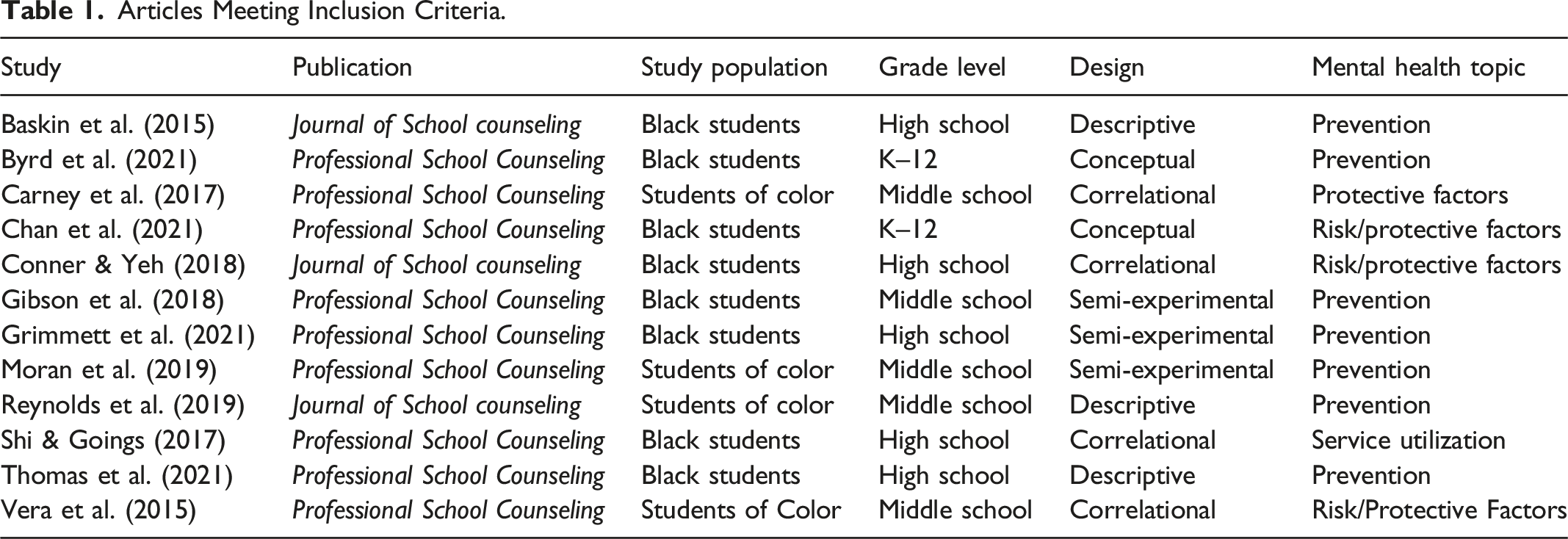
Once key phrases were established, we conducted an initial screening using a hand search strategy, in which the first two authors manually searched the electronic tables of contents of the two journals to identify articles with key phrases in the titles and abstracts (Tevis et al., 2021). The first two authors then reviewed one year of Professional School Counseling together for internal consistency. During this joint review, they aimed to reach a shared understanding and consensus on whether each article met the predefined inclusion criteria. This collaborative process allowed them to establish a baseline level of agreement in their screening process (Tevis et al., 2021). Once they achieved internal consistency of 90% during their joint screening, indicating a high level of agreement on which articles should be included, they both screened the remaining articles independently. This independent dual screening ensured that both reviewers consistently applied the inclusion criteria without mutual influence, further enhancing the study’s rigor and reliability (Tevis et al., 2021). The two authors then met to compare lists, address discrepancies, review flagged articles, and confirm inclusion. The decision to expand the original inclusion criteria was prompted by the recognition that certain articles, although not initially meeting the criteria, contained relevant content related to mental health or mental health support. The authors identified specific words or phrases such as “belonging,” “identity,” “resiliency,” “school climate,” and “self-awareness” within these flagged articles, which indicated a potential connection to mental health support or support for mental well-being. Expanding the inclusion criteria allowed for a more comprehensive exploration of relevant research. Similarly, we expanded the target racial identity phrases to include articles that focused on “ethnic minority” and “inner city youth” because Black students were a focus of the population studied and often grouped into one of those two descriptions. The process began with an initial pool of 575 articles published in PSC and JSC from 2011–2021. These articles were screened to identify those that met the study’s inclusion criteria: (a) published in either of the two leading peer-reviewed journals, (b) published between 2011 and 2021, and (c) topically related to school mental health support for Black youth. After a rigorous screening and evaluation, 12 articles were deemed suitable for inclusion in the final data set. These 12 articles form the basis for the coding and analysis described below.
Coding Procedure
Aligned with Tevis et al. (2021), we utilized both deductive and inductive procedures to generate and describe categories and subcategories. To develop coding procedures, we generated classification categories and subcategories deductively. However, our study diverged in focusing on an examination of the mental health and school counseling literature (Cowan et al., 2013; Dekruyf et al., 2013; National Research Council and Institute of Medicine, 2009; Tevis et al., 2021). First, we coded the articles utilizing four classification categories. We then met and used inductive procedures to further refine the categories (Tevis et al., 2021). Next, the first author trained the other three authors, who also served as coders, to ensure consistency and comprehension of the coding process. We then worked as a team to fine-tune the codes. This iterative process involved further discussions and adjustments to align the codes accurately. Consensus was deemed to have been achieved when 3 out of 4 coders reached an agreement on how to apply a specific code to a particular piece of content.
The final coding system included five classification categories: Population referenced, grade level, sample size, research design, and mental health topic. The population referenced category examined whether articles were specifically focused on Black students or students of color. The grade level category assessed which K–12 school level was the focus of the study (i.e., elementary, middle, high school, K–12). Sample size categorized the articles according to the number of participants in the study (i.e., 1–25, 26–50, 51–100, 101–200, 201+). Research design documented the research design used in the study (i.e., descriptive, correlational, experimental, semi-experimental, meta-analytic, review, conceptual). The mental health topic category classified the topics of each article as they related to parent engagement with mental health support, student utilization rates of school counseling services, risk and protective factors, and the complete range of mental health programs and services offered in schools, also referred to as the continuum of care (i.e., promotion, prevention, intervention, continuing care, parent engagement, utilization rates, risk factors, protective factors).
The 12 articles were divided among the four coders to allow for two independent analyses; thus, each article was read by two coders. Each coding subset read and coded the assigned articles individually before meeting as a coding subset to address discrepancies in coding and to enhance coding accuracy. Consensus was reached by cross-referencing the notes and codes highlighted and talking through any discrepancies.
Trustworthiness
We facilitated multiple activities to address trustworthiness. During each meeting, we discussed our individual positionalities related to the research. Because our professional positions varied, conversations regarding power differentials and experiences with research occurred frequently. Each coder had an equal opportunity to participate and contribute to conversations regarding the entire research process. This allowed for the incorporation of new insights and nuances that emerged from their discussions.
Results
Black Student Mental Health in the Literature
Articles Meeting Inclusion Criteria.
Content-Analysis Categories.
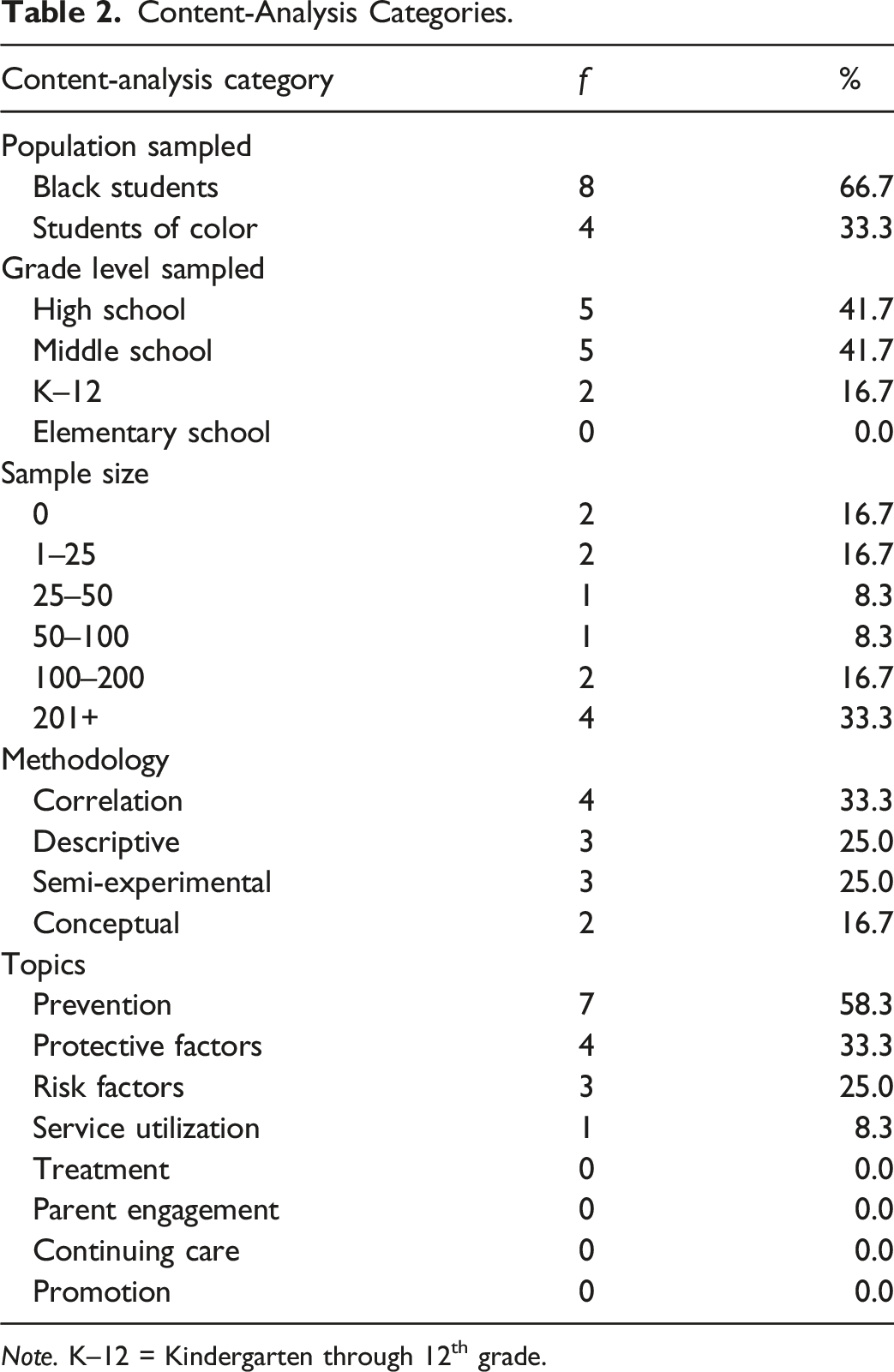
Note. K–12 = Kindergarten through 12th grade.
Research Design in Studies of Black Student Mental Health
The second research question considered the research design of studies that were published related to Black student mental health. Correlational design accounted for 33.3% (n = 4) of the studies. Semi-experimental and descriptive designs were each 25% (n = 3) of the studies. Finally, 16.7% (n = 2) were conceptual pieces, and we found no qualitative studies that met the inclusion criteria.
Topics Related to Black Student Mental Health
The third research question considered the topics in the school counseling literature related to K–12 Black student mental health and supports along the continuum of care. Prevention accounted for 50% (n = 7) of the mental health themes. Of these, four of the articles focused on group counseling (57.14%), one focused on individual counseling (14.29%), one aimed at a grade-level-wide classroom lesson (14.29%), and one addressed universal screening (14.29%). Articles that focused on protective factors of Black youth accounted for 33.3% (n = 4), risk factors accounted for 25% (n = 3), and service utilization accounted for 8% (n = 1) of the mental health topics. No articles studied mental health promotion, treatment, continuing care, or parent engagement (n = 0). This finding is especially relevant because the school counselor’s role as a mental health provider has yet to be clearly defined in the literature. More specifically, we found that little is known about school counselor characteristics, behaviors, and interventions that contribute to the utilization and impact of services on Black students’ mental health.
Discussion
This study sought to understand how the school counseling empirical literature addresses the mental health of Black students. We discuss our findings through the focus areas of our research questions.
Nature of Representation
The purpose of the present study was to examine the representation of Black student mental health in school counseling literature with the aim of highlighting current practices and identifying gaps in the literature. Findings revealed several interesting factors related to both the search process and the results of the content analysis. First, only 12 of the 575 articles screened were related to Black students’ mental health and support. We faced challenges in narrowing down key phrases to accurately reflect articles related to mental health and school mental health supports. Mental health problems can affect a wide range of aspects of students’ daily functioning, including social interactions, classroom learning, attendance, behaviors, and physical health (Frydman & Mayor, 2017). However, the included articles did not explicitly draw connections to the previously indicated effects, which may have resulted in some relevant articles being excluded during the screening process.
Simultaneously, although the school counseling literature notes the importance of school counselors in addressing mental health, it does not clearly define the role of school counselors in school mental health supports (Dekruyf et al., 2013). Lack of clarity on what constitutes mental health support in schools and the role of school counselors in mental health present a challenge for understanding and evaluating the effectiveness of current practices. Dekruyf and colleagues (2013) have long called on the profession to embrace an identity in which school counselors can view themselves as both educational leaders and mental health professionals. The present findings suggest that scholars also view school counselors as mental health professionals and conduct research that clearly documents the impact of such services. The school counseling profession should consider how to operationalize and measure the mental health supports provided by school counselors and the outcomes of implementing supports, which can have a significant impact on the accurate evaluation of current practices. One possibility is utilizing language along the continuum of care (promotion, universal prevention, indicated prevention, selective prevention, treatment, and continuing care) to distinguish the different types of services provided and clearly delineate how the level of care for the populations studied was identified.
The content analysis also revealed that, before 2018, very few published articles addressed mental health support for Black students or students of color as a population studied. Although research has improved over time, representation is still minimal: only about 2% of 575 articles studied mental health support for Black students or students of color independent of their White counterparts. Further, PSC housed most of the publications studied, and a recent special issue on males of color in 2021 contributed to many of the articles. As such, the majority of articles that did focus on Black youth used males as the primary population of the study, with little attention given to Black females or gender nonbinary youth. The present findings support what Byrd and colleagues (2022) have noted, namely that the mental health needs of Black girls have been neglected and minimized. This could be related to the lack of literature related to Black girls’ experience in K–12 education compared to that of their male counterparts. Decades of literature and funding initiatives (e.g., My Brother’s Keeper; Obama Foundation, n.d) highlight the crisis surrounding the institutional failure of Black boys in K–12, with little attention paid to Black girls and their independent needs, differences, and experiences (Neal-Jackson, 2018). The lack of focus on other subgroups highlights the need for more inclusive and comprehensive research.
In terms of grade levels studied, the majority of research focused on the secondary level, with little attention given to elementary-aged youth. Only two studies included elementary participants in samples that captured the entire K–12 student population. None of the articles reviewed focused only on elementary-aged youth. The fact that research findings focus primarily on secondary students raises concerns because mental health problems can manifest at any age, and early intervention is crucial for preventing more severe issues later in life (Cowan et al., 2013).
Types of Research Design
With regard to the types of research design in the study of Black student mental health, our analysis revealed no qualitative studies that met the criteria for this review, indicating the need for more qualitative research designs. Student voices were often missing, highlighting the need for more inclusive and participatory approaches (Edirmanasinghe et al., 2022). Qualitative research designs can provide in-depth insights into the experiences and perspectives of Black students (Neuman, 2019), helping school counselors understand this population’s unique experiences and needs, which can inform the development of school counseling approaches that center on Black students. Qualitative research also can help school counselors gain a better understanding of the cultural, social, and contextual factors that impact the mental health of Black students. This is particularly important given that the school counseling field is predominantly White and that cultural and social differences can influence the way mental health concerns are experienced and expressed (Placeres et al., 2022).
Related Topics in the Literature
Regarding mental health themes related to K–12 Black student mental health, our findings suggest a need for more research on mental health promotion, treatment, continuing care, parent engagement, and service utilization for Black youth. The majority of articles focused on mental health prevention, as we expected, because school counselors play a critical role in addressing mental health problems early on (Cowan et al., 2013). However, more research on mental health promotion for Black youth is needed to provide a better understanding of the factors that contribute to mental health problems in the school setting and develop effective interventions to address them. We were not surprised to find that treatment services received little attention, because school counselors do not treat diagnosable disorders. Nonetheless, research should explore the potential role of school counselors in connecting Black youth who meet the criteria for a diagnosable disorder to access appropriate services. Further research could illuminate the extent to which school counselors are able to identify and refer students who may benefit from treatment services and how this may impact the mental health outcomes of Black youth. Given current rates of suicidality in Black youth (Bridge et al., 2018), continuing care is particularly important for developing support plans for students receiving treatment and those returning to school after a crisis, and thus is an area in need of further study.
Another factor to consider is parents’ key role in the lives of their children and impact on their mental health and well-being. Further research is needed to understand how parents of Black youth engage with school-based mental health support. Similarly, the utilization of school counseling services for Black youth has received little attention. Further research into Black students’ use of school-based services could provide insights into the factors that influence students’ decision to seek support from school counselors and identify any barriers that may prevent them from accessing services.
Most important, school counseling research on Black youth mental health must shift away from the historical deficit-based approaches focused on the weaknesses of groups or individuals to a focus on liberatory school counseling practices (Bemak & Chung, 2005; Kearl et al., 2024; Mayes et al., 2022). Research on the implementation and impact of culturally situated, asset-based practices is critical (Gaylord-Harden et al., 2012). Scholars should consider creative methodologies for this work, such as narrative analysis, photovoice initiatives, and culturally grounded arts-based research. Researchers should also consider participatory action research methodologies, which can empower participants to play a central role in the research process (Mayes et al., 2022). These types of methodologies can amplify diverse voices and provide valuable insight into strength-based practices that support the mental health of Black youth.
Limitations and Implications for Future Research
First, we limited the search to Professional School Counseling and the Journal of School Counseling within a 10-year timeframe (i.e., 2011–2021). Although we conducted an extensive search, based on our inclusion criteria, many articles focused on Black student mental health support were not included. For this reason, we recommend a more exhaustive list of journals that may include literature on Black students and mental health support in K–12 education. Another limitation was our small sample size, with few studies meeting inclusion criteria. We believe this could be attributed to the role of school counselors in school mental health support not being clearly defined in the school counseling literature (Dekruyf et al., 2013). More research is needed in the area of evaluation and assessment of mental health support by school counselors. Despite the listed limitations, we hope readers will find the results from this study helpful in guiding their work and research to support Black students’ mental health.
Conclusion
The purpose of this present study was to examine the current state of research on mental health support for Black youth in K–12 education. Overall, the content analysis highlights the need for more outcomes and evidence-based research on school counseling supports for Black students’ mental health. School counselors can serve as a critical access point for mental health services. By addressing these gaps in the literature, school counselors can better support the mental well-being of Black students in schools.
Footnotes
Declaration of Conflicting Interests
The author(s) declared no potential conflicts of interest with respect to the research, authorship, and/or publication of this article.
Funding
The author(s) disclosed receipt of the following financial support for the research, authorship, and/or publication of this article: This project was supported by the California State University Center to Close the Opportunity Gap.
Author Biographies
 ), is an associate professor in the Department of Advanced Studies in Education & Counseling at California State University Long Beach. Email:
) is a school counselor with Santa Ana Unified School District in Santa Ana, CA.