




Abstract
Antiracism in school counseling calls for an active stance in addressing racism in K–12 schools while building homeplace to affirm and protect students. As such, this qualitative study focuses on how Black school counselors understand and reclaim Black joy and resistance as a part of homeplace, a place where students’ humanity is affirmed and honored. This study revealed three themes: (a) We’ve Done Been Knowing, (b) It’s One and the Same, and (c) When Two or More Are Gathered. Findings are foundational toward building a firm understanding of Black joy and resistance while recognizing the educative power of Black school counselors.
Introduction
In the summer of 2020, a series of state-sanctioned violent acts and murders of Black men and women (e.g., Breonna Taylor, George Floyd) sparked a racial reckoning in the United States. Individuals poured into the streets to protest these atrocities as they deepened their commitment to addressing racism in their respective communities and professional spaces. Among those making such commitments were educators, administrators, school counselors, and other K–12 school staff. According to EdWeek Research Center (2020), the spring/summer protests of 2020 showed educators, especially White educators, how equity gaps persist in schools. These equity gaps often point to the academic underperformance of Black youth. However, a more nuanced understanding of this underperformance links to anti-Blackness that is experienced both in and outside of the classroom.
Youth who are Black, Indigenous, or persons of color (BIPOC), especially Black youth, are subjected to institutional racism and overall anti-Blackness as a part of their K–12 school experiences. One example of this institutional racism is that Black youth disproportionately receive harsher disciplinary actions and greater surveillance when compared to their non-Black peers (Morris & Perry, 2016). Black students are expelled at significantly higher rates than their White counterparts (Richey, 2021). Black students also frequently experience significant gaps in educational resources and opportunities (Holcomb-McCoy, 2022). For example, literature shows that schools with predominantly Black student populations are significantly more likely to have limited resources, including minimal technology access, outdated textbooks, inadequate facilities, and a shortage of highly qualified teachers (Baker, 2021; Sosina & Weathers, 2019). Anti-Blackness in schools is also illustrated through racial bias in curriculum (Atkins & Oglesby, 2018). The curriculum in many schools often lacks diverse perspectives (Ladson-Billings, 2021) and fails to adequately address the history and contributions of Black people. This failure, or lack of inclusiveness in curriculum, can further perpetuate stereotypes, exclude important narratives, and diminish the cultural identities of Black students (Southern Poverty Law Center, 2019). Black youth often report incidents of cultural insensitivity and microaggressions from both peers and teachers (Gold, 2017; Huynh, 2012) that create a hostile learning environment leading to decreased self-esteem, disengagement, and lower academic performance (Keels et al., 2017; Lea et al., 2022). Although the literature is replete with examples of anti-Black racism experienced in K–12 schooling, fewer studies have located and centered Black joy and resistance as building blocks to counter anti-Blackness. School counselors are called by professional standards to promote equity through decreasing opportunity gaps in education, yet many are up against school policies and other school leaders’ incongruent perceptions of their role that present challenges to them in achieving these goals (ASCA, 2021; Ruiz et al., 2018). Toward this end, the current study focuses on how Black school counselors have come to understand Black joy and resistance.
Homeplace: The Birthplace of Black Joy and Resistance
Critical responses to anti-Blackness in schools are antiracist policies and practices that actively work to dismantle racism while building supportive and affirming spaces (Mayes & Byrd, 2022). In particular, these spaces are what hooks (1990) called homeplace, which centers a joyful resistance where individuals can be affirmed despite the sociopolitical and historical contexts that may enact violence and oppression on Black youth (Love, 2019). As such, antiracist practice is more than addressing racism; it also incorporates the affirmation and humanizing possibilities related to homeplace. Homeplace helps Black youth develop a critical consciousness that recognizes that their pain is real, and that they are more than their pain and suffering, thus are irreducible (Love, 2019). Further, homeplace invites Black youth to engage in resistance through the radical imagining of freedom dreaming (Mayes et al., 2022). Said differently, homeplace humanizes Black youth in order to both affirm and protect their joy and resistance.
Black Joy
The word joy is commonly used as a synonym for happiness (Merriam-Webster, nd); however, Black joy is much more nuanced than simply happiness. Lu and Steele (2019) explored the nature of Black joy and determined that it is an expression of the full human experiences that the Black community has not been afforded historically. Lu and Steele examined this nuanced Black joy in online behavior within the Black community. They found that such behavior, like using hashtags (e.g., #CarefreeBlackKids, #BlackBoyJoy, #BlackExcellence, #BlackGirlMagic), represents generational use of storytelling and signifying one’s collective life through centering joy as resistance (Lu & Steele, 2019). They proposed that “Black joy online … can be (re)invented as critical sites of Black resistance that seize upon, yet are ultimately indifferent to, widespread public visibility” (Lu & Steele, 2019, p. 824). Black joy is not relegated to online and virtual spaces; rather, these virtual expressions of joy are an extension to the ways in which the Black community experiences and expresses joy. As a collective act, joy then creates and celebrates the humanity and diversity of the Black community in spite of the policing and surveillance nature of anti-Blackness.
Black Resistance
Black resistance is a tool meant to hedge off anti-Blackness in an effort to bring about social change and protection (Gillen, 2014). More specifically, Black resistance counters colonization and institutional racism that renders Black bodies as nonhuman, less than, fungible, and disposable (Wynter, 2003). Black resistance, particularly that of youth, then seeks reconnection and restoration of the whole by disrupting the false narratives of anti-Blackness on an individual and systemic level. Further, Black resistance, for youth in particular, refuses to accept anti-Blackness as a permanent state, but rather disrupts in order to engage in freedom dreaming and radical imagination of liberatory futures for all. This is not to say that resistance is separate from joy, but that resistance is indeed joyful, in creating space for Blackness to exist wholly and fully while intentionally challenging anti-Blackness.
Black Fugitivity
A distinct form of Black resistance is Black fugitivity, or the “subversive practices in Black social life” used to resist “over and against the persistent violence of white supremacy” (Givens, 2021, p. 10). Originally rising out of enslavement, Black fugitivity is contemporarily used as a social orientation toward Black liberation. Faced with anti-Blackness in spaces steeped in white supremacy, Black fugitives use a politics of refusal of reform and respectability to disengage from dominant structures and create homeplaces, sites where they can be their whole, expansive selves (Sojoyner, 2017). Black fugitivity, then, is a collective act, operating as a means of resistance and a strategy for rehumanization and sustenance (Stovall et al., 2023).
Black Joy and Resistance in K–12 Schools
The cultivation of Black joy and resistance in schools is likely to lead to a greater sense of school belonging, especially within the different opportunities presented in the school system: interpersonal, instructional, and institutional (Gray et al., 2018). Black joy may also foster healing from experiences of racism and discrimination while supporting a racialized self-awareness (Griffin et al., 2020). For example, instructional opportunities occur when students become engaged in academic activities that reinforce cultural meaning systems, and institutional opportunities arise when students and educators collaborate to reduce structural barriers within minority students (Gray et al., 2018). As Black joy is centered, an important step is to evaluate and reimagine practices that may interrupt it. This intentional engagement resists practices that perpetuate white supremacy, enforce compliance, and dehumanize Black students (Drake & Oglesby, 2020; Mayes et al., 2021). Further, Oglesby (2019) stated that school staff can create safe spaces or homeplaces for minoritized students by building upon what others are doing in terms of Black joy and resistance. For school counselors in particular, these spaces can incorporate healing-centered engagement, youth participatory action research, and critical hip-hop practices, all of which center Black joy and resistance through student voice and cultural knowledge (Mayes et al., 2022). Part of this objective is for school staff, including school counselors, to acknowledge that oppressive “experiences are psychologically, intellectually, emotionally, and economically traumatic. To function—and to thrive—these groups need the respite found in safe spaces” (Oglesby, 2019, p. 48) to begin cultivating Black joy and resistance. Accumulation of these strategies, with strong use of interpersonal connection with students, equips school staff, including school counselors, to cultivate Black joy among students.
Theoretical Framework
Terms like antiracism have gained traction in education as a means to supporting the success of a diverse student population. However, antiracism is more than not being racist. It is an intentional engagement with addressing and dismantling racism in every setting. In fact, the majority of educators (81%) identified themselves as antiracist/abolitionist educators who understand antiracist curriculum to be one that promotes diversity and equality (EdWeek Research Center, 2020). Although most educators (84%) are willing to teach antiracist curriculum, only 14% have adequate resources to do so (EdWeek Research Center, 2020).
For school counseling, antiracism is “an action-oriented process that begins with development of critical consciousness, focused on continuous reflection of the school counselors’ and their students’ power, privilege, and oppression and how it impacts their experiences within the school setting” (Mayes et al., 2022, para 3). Thus, antiracist school counseling is a purposeful act of loving and protecting students, especially those most vulnerable to racism and oppression (Mayes & Byrd, 2022). A crucial concern of antiracism is intersectional racism, which includes the intersections of racism, classism, sexism, ableism, homophobia, and transphobia (Holcomb-McCoy, 2022; Love, 2019). Holcomb-McCoy (2022) described antiracism in school counseling as having the following assumptions:
The status quo in counseling practices and programs is characterized by an inequitable distribution of power and resources based on race, socioeconomic status, ethnicity, ability, language, and so on. Racism is embedded in the fabric of our schools and communities. Racism influences our behavior and attitudes. We as counselors have internalized racist attitudes, ideas, understandings, and patterns of thought that allow us to function in racist and oppressive systems. (p. 12)
Antiracist school counselors are actively working to interrupt the status quo by recentering BIPOC ways of knowing, using culturally sustaining practices and strengths-based practices that recognize both the struggle and BIPOC joy and excellence (Holcomb-McCoy, 2022). As such, school counselors must disrupt the dominant (i.e., White, cisgender, heteronormative) influences on counseling (e.g., counseling theory) and recenter BIPOC cultural knowledge and healing practices as the way to advance practice (Washington et al., 2022). To do this, Mayes and Byrd (2022) suggested that antiracist practice must include the development of a critical consciousness informed by both systems theory and critical race theory. Further, Mayes and Byrd defined a framework with four key roles for school counselors: love, protect, dismantle, and build. To love and protect students means that school counselors affirm the whole humanity of students and recognize their strengths. School counselors must love students for who they are and recognize their brilliance, often in spite of a society set for their demise. An extension of this love is to protect students’ humanity and dignity through the intentional creation of homeplace (hooks, 1990). This creation of homeplace is what recognizes and sustains Black joy, which supports healing from the realities of anti-Black racism while promoting a deeper, more nuanced understanding of self (Griffin et al., 2020). Part of the healing of Black joy is a cultivation of resistance to protect against the insidious nature of anti-Black racism and oppression of all forms. Moreover, antiracist school counselors dismantle racist practices and systems while building new, antiracist systems that create and sustain homeplace. Essentially, antiracist school counselors engage in policy creation and practices that create and sustain homeplace (love, protect, and build) while challenging (dismantle) those policies and practices that threaten homeplace.
Antiracist school counseling is systemic in that it is engaged in both student-level supports and in the school as a system. Toward this end, Edirmanasinghe et al. (2022) described how antiracist practices can be anchored to multitiered systems of support (MTSS) in K–12 schools. Before school counselors begin to engage in this process, we suggest that they must understand the perpetual nature of institutional racism and white supremacy in the K–12 educational system. Further, school counselors must process their own feelings and reactions to antiracism. In keeping with the traditions of MTSS, Edirmanasinghe et al. (2022) recommended interrogating multiple data points, interrogating systems, and interrogating practices alongside students and stakeholders to gain comprehensive knowledge of the ways in which specific student identities and cultural backgrounds matter, and how school systems and practices perpetuate oppression. Data review should use root cause analysis not just to understand student need but also to determine system functioning and practices that contribute to and create disparities (Edirmanasinghe et al., 2022). Essentially, this process engages the aforementioned foundation of antiracist school counseling practice through the use of data to love and protect students by building homeplace individually and systemically while dismantling systems and practices that are a threat. For the purposes of this study, the theoretical framework serves as a guide for developing and making meaning of the individual interviews (see data collection and data analysis) because our focus is on components of antiracism: Black joy and resistance.
Purpose of the Study
As previously mentioned, commitments to antiracist practice in K-12 schools are greater today than in the past among educators, including school counselors. Current literature provides a framework for antiracist school counseling practice including using evidence-informed practice (Mayes & Byrd, 2022) and MTSS (Edirmanasinghe et al., 2022). Although these frameworks are helpful as process models, more is needed to understand the critical, unique experiences that undergird the foundation of antiracist practice—the cultivation of homeplace. Thus, an exploration of the components of homeplace (e.g., Black joy, resistance) is needed. As such, the current study focuses on how Black school counselors make meaning of both Black joy and resistance, which are key components of homeplace. More specifically, the research question guiding this study is: How do Black school counselors make meaning and experience Black joy and resistance?
This knowledge can serve as the bedrock for the construction of antiracist school counseling programs that must address the lived realities and experiences around race and racism while also building capacities toward liberation, freedom, and joy. Further, this study serves to disrupt the counseling canon (Washington et al., 2022), which often centers whiteness in theories and practices, to recenter Black school counselors as experts as they share their ways of knowing and being related to Black joy and resistance. In other words, we as researchers purposefully embrace and recognize that antiracism, homeplace, and Black joy in school counseling cannot exist without the work and expertise of Black school counselors, who both experience Black joy and homeplace and work to cultivate it for the Black youth and families in their lives, in spite of the racism and oppression they face inside and outside of K–12 schools (Dollarhide et al., 2013). This insider knowledge and experience is valuable when trying to understand the intersections between Black joy, homeplace, and school counseling. This study is meant to highlight Black school counselors’ collective knowledge and critical insights, which are often overlooked or silenced in the school counseling profession.
Methods
Participants
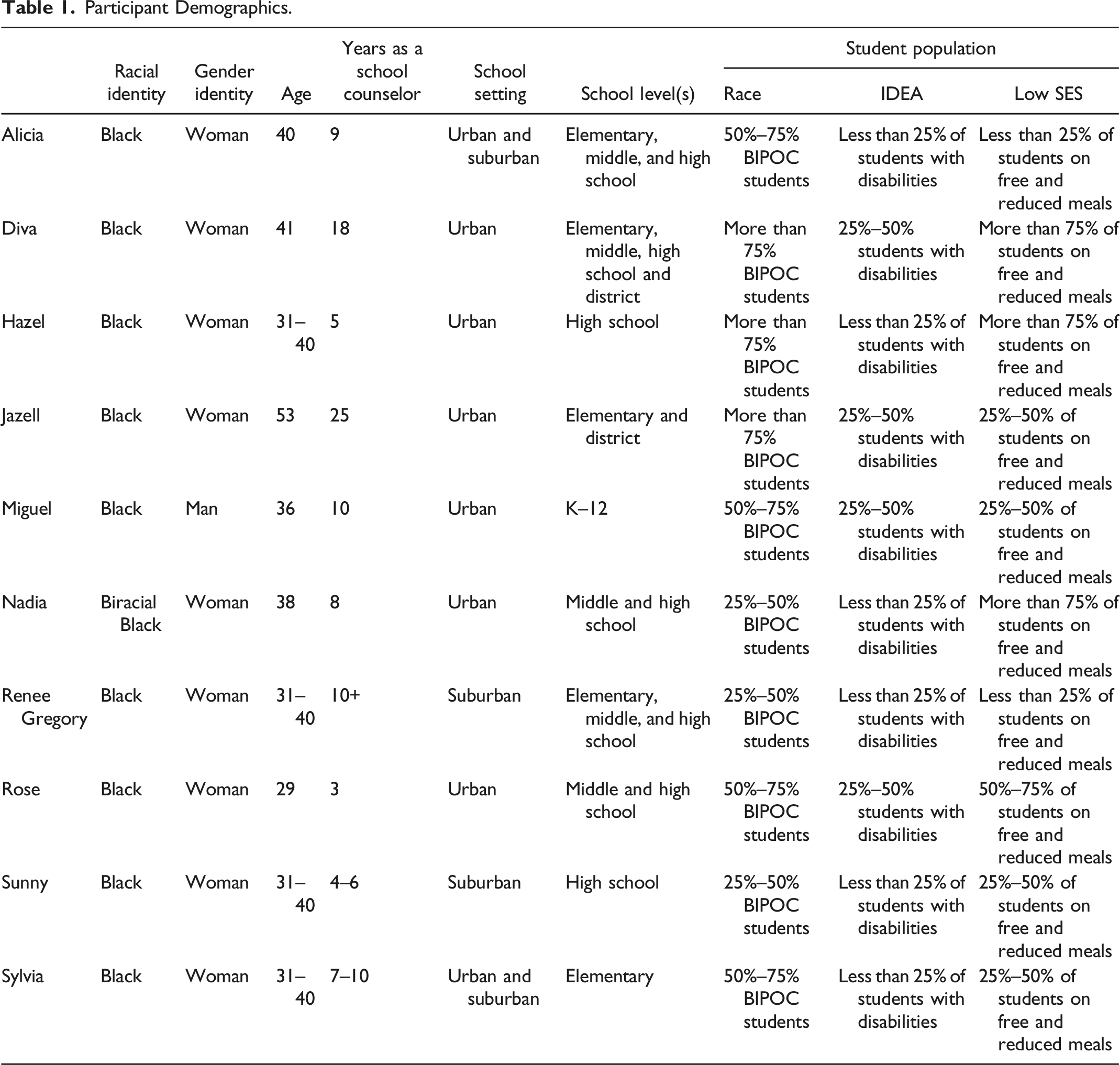
Participant Demographics.
Procedures
After approval from the institutional review board, the first author began recruiting participants who were school counselors or school counselor leaders at the district level, who identified as Black and as antiracist. Initial recruitment began through antiracist school counseling formal and informal networks. The first author contacted potential participants, provided an overview of the study, and invited them to contact the researchers if they were interested in participating in the study. Those who indicated their interest were provided with an informed consent document and a biographical questionnaire to review via email before scheduling an individual interview. A total of 13 Black school counselors indicated their interest in participating in the study and 10 consented to participate. Individual interviews via Zoom video conferencing software were scheduled with the first and fifth author. Although interviews were virtual, both participants and researchers were in private, confidential locations.
Data Collection
Biographical Questionnaires
The first author administered biographical questionnaires designed to collect background information about the participants in areas related to the study. The questionnaire included current information about their experience as school counselors including, but not limited to, grade level, years in service, school setting, and student population served. The questionnaire also incorporated questions related to participants’ background. The biographical questionnaires provided important descriptive data that complemented the study.
Individual Interview
The primary method of inquiry was guided by a semistructured interview protocol (Hays & Singh, 2012). The semistructured interviewing guide was created based on the researchers’ experiences with Black joy and resistance in K–12 schools, and a comprehensive literature review regarding Black joy, resistance, homeplace, human development, and antiracist school counseling practice. Sample interview questions included: “How do you characterize Black joy?”, “What does it look like?”, “How do you know it’s happening?”, and “How did you come to understand this as Black joy?” As a part of the interview process, interviewers modified or subtracted questions based on participants’ responses before, during, or after the interview. This allowed for a comprehensive interview with the flexibility to ask follow-up questions or divert from the semistructured interviewing guide (Hays & Singh, 2012). Individual interviews were conducted using video conferencing software in which participants were provided the option to use video and audio or only audio. Interviews lasted 1–1.5 hours and were recorded and transcribed under a participant’s chosen pseudonym.
Data Analysis
For this study, the first and second authors used a narrative inquiry to gather stories and experiences regarding Black joy and resistance from participants (Hays & Singh, 2012). Narrative inquiry elicits stories that provide greater insight into the narrator’s culture, historical experiences, identity, and lifestyle. We analyzed the stories using interpretive phenomenological analysis (IPA; Smith & Osborn, 2008), which provided a structure for detailed examinations of the participants’ narratives without preexisting conceptualizations and notions. Each transcript was read five times as a way to become familiar with participant experiences while using the left-hand margin to annotate significant and interesting areas of each transcript (Smith & Osborn, 2008). This process allowed the first and second authors to capture how each participant makes sense of their experiences, while the researcher is also making sense of each participant making sense of their experiences (Smith & Osborn, 2008). We reviewed each transcript and annotations individually so that we could note subordinate themes in the right margin. The first and fifth authors then created a table detailing subordinate themes for each transcript and used it to understand superordinate themes across all transcripts (Smith & Osborn, 2008).
The themes were generated by the codes that were developed as a part of the data analysis process. Initially, we had organized themes in three areas: Black joy, resistance, and antiracism; this was likely due to the literature used to develop the interview protocol. However, upon further discussion, we found that the delineation between Black joy and resistance in the data was not as clear as expected; thus we perceived a need to look more deeply at the codes to find the most meaningful way to capture their content in themes that represented the interconnectedness between Black joy and resistance. Our research team continued to refine themes independently and then met to discuss newly generated themes until we reached consensus.
Researcher Positionality
Researcher reflexivity regarding positionalities was an important part of data analysis. The first author, who collected data and guided the process of data analysis, is a Black woman and school counselor educator with expertise in antiracist school counseling and supporting the success of Black youth, primarily exceptional Black youth and Black girls. The second author is a White woman and school counselor educator with expertise in antiracist school counseling and school, community, and family partnerships that support liberation and freedom. The third and fourth authors are Black women in counselor education doctoral programs, each with a respective focus on antiracist counseling practices in clinical and school settings and a focus on service Black youth and adults. The fifth author is a biracial Black woman who is a recent graduate of a master’s-level counseling program and is currently a middle school counselor in an urban school.
Authenticity and Trustworthiness
We engaged in multiple strategies to ensure trustworthiness of the data. First, the creation of the semistructured interview protocol was guided by a comprehensive literature review. This review included literature on antiracist school counseling, Black joy and Black youth, Black resistance and Black youth, and homeplace. The interview protocol was reviewed by two experts in the field of school counseling; both identify as Black men who have experience as school counselors in K–12 schools and engage in research focused on strengths-based and intersectional experiences of Black youth, antiracism, academic success, and postsecondary readiness. They also actively work with local school districts to build antiracist and culturally responsive practices to support Black youth.
After the initial data analysis, themes were shared with all 10 participants, five of whom provided feedback for member-checking purposes. These participants reviewed the themes and shared their general agreement. One participant suggested clarifying what resistance means in this particular context. This feedback helped to refine the categories and led us to reorder them to ensure clarity.
Results
In keeping with IPA as a tool for data analysis, we present thick, in-depth descriptions to illustrate the contextual details and nuances of the participants’ experiences that were analyzed through an antiracist lens. These experiences were divided into three general themes, likely because the interview protocol was situated in extant literature based on Black joy, resistance, and antiracism. The themes are (a) We’ve Done Been Knowing, (b) It’s One and the Same, and (c) When Two or More Are Gathered.
We’ve Done Been Knowing
Although participants agreed that Black joy and resistance is not something they were born knowing, most did experience it early on as being a part of their families and communities. It was in family reunions, time with play cousins and extended family where, as Sunny shared: “It was just us being us like we didn’t have to be anybody else. There was no code switching. Just us, like barefoot running in the country … like that kind of thing, and it was just carefree.” Most participants described positive early experiences, but we also perceived a level of active engagement and growth as a part of Black joy. Diva, who began her life in Africa, described an innateness about Black joy: “It was a part of who we were … and [I] was super confident.” However, when her family moved to the United States and thrust her into a new community and culture, she had to come to Black joy in ways that differed from her African roots: Where I rediscovered myself really, was my later years in high school, where I couldn’t really identify with anyone like me, but then meeting a teacher who helped me kinda start to accept myself. I also started to ask questions about my background and learning about my grandfather’s background and where he came from. What he was able to overcome and achieve in his life. I think through the years to give me that boost of confidence. Like wow! I came from that!
That purposeful connection brought Diva back to the Black joy she experienced early on, gave her a newfound sense of confidence in her identity, and invited her to keep learning more about her culture and Blackness in the U.S. context. Similar to Diva, others shared about early experiences of Black joy including learning and feeling deeply connected to their histories and ancestors. That connection to histories, families, and communities was, as Alicia described, “super supportive and encouraging” in ways such that participants knew that they knew they were having the “this is it, right here!” moment of Black joy.
Other participants talked about how they grappled with whether and how to experience Black joy and resistance growing up, particularly how to navigate this in predominantly White communities. Miguel, Nadia, and Sylvia all shared how they struggled in expressing their own joy, cultural pride, and resistance. For example, Miguel shared that he grew up in predominantly White spaces.… So what I did was always kind of just know where I can be comfortable and make other people comfortable, but I wouldn't really express my internal excitement for Black joy moments.
Nadia talked about how, growing up in a small town, her community didn’t talk about really race like that.… There are a lot of things that we didn’t talk about so because it appeared as though Black people were equal, even though they weren't … I had this false sense of like, understanding, so never … I never grew up really seeing resistance.
Despite these early experiences where Black joy and resistance was minimized, Miguel, Nadia, and Sylvia pointed to later experiences in connection to others that gave them the courage to live their Black joy and resistance out loud. For Sylvia, being a mother, a school counselor, and a doctoral student set a course of self-reflection on “the inequities of a system that’s designed for us to fail for me and for my kids, and for my school kids.” This realization springboarded her to use her voice to change schools: I had to engage my heart and mind, and mission, as a mother of Black boys and a Black girl and you know realizing the push out of Black girls … what was happening in my current present-day environment, and then, reflecting on all the things that I should have done while I was a school counselor, the things that I saw, the things that I didn't put a stop to. I just said I can no longer sit back and take a passive role in changing this environment and really changing the school environment, and therefore changing the world that we live in to make a place that not only welcomes Black people, but invites and embraces and encourages, and pushes to succeed. And a part of that is Black joy. And celebrating it, and you know, being thankful that we persisted, and that we're here, and that we can, you know, be successful, and have, and that we deserve joy, you know and fulfillment, and success.
Being in spaces that invited a deeper understanding of the fullness of Blackness that also invited critical reflection on inequities propelled participants forward, not only in their recognition of Black joy and resistance but also in their pursuit of it.
This kind of growth and deeper understanding of Black joy and resistance was salient for all participants. For example, Hazel talked about how her own understanding of Black joy and resistance has grown with her own reflection and learning. Hazel shared that as she has gotten older, she has become more reflective and asks specifically what Black joy means for her, in addition to “reading and expanding on Black joy and what we’re looking at not only in the world and what does that [Black joy] look like in schools.”
Several participants discussed how they experienced Black joy and resistance in childhood, but did not necessarily have the words “Black joy” to describe these experiences until recently. Essentially, as Jazell shared: “We’re putting a language on things that we have been doing over the past couple years or even throughout our lifetimes.” Nadia elaborated on this particular point: You know the term Black joy, even though I saw it, the term was never used. I didn't learn the term until adulthood and probably like late 20s, you know, even though I celebrated Black joy. I saw Black Joy. It wasn't something that we defined it as, you know, I never really had that defined in that way. And so you know, when I started hearing the term, then started thinking about just all these places and spaces where I see it. Somebody posts an accomplishment and everybody is just like, you know, “Black girl magic, Black girls rock,” you know all that kind of stuff. It's like that's Black joy. Celebrating each other and supporting each other. I think about my family reunions growing up—that was Black joy.… A friend of mine's mom taught me how to make her greens years ago, and her cornbread, and me being able to send her the first picture of when I made them on my own, like that was Black joy to me is passing along those things and doing those things.
Black joy and similar phrases (e.g., Black girl magic, Black boy joy) are helpful in building language to describe events and moments that have served as connective points, but certainly do not preclude those moments that have happened over generations and lifetimes. These phrases also serve as a means to rehumanize Blackness, to, as Renee Gregory shared, “intentionally point out Black joy … to counter the stereotypes that [are] so easily and readily assigned to us.”
It’s One and the Same
Participants defined Black joy as a collective freedom, a freedom to be authentic, genuine, and whoever they were and are meant to be. Alicia described this freedom: So I would characterize it as authenticity. I would characterize it as a sense of safety and belonging. Like not even just like belonging, I guess imagining it in all environments, so community, home, school. You know, so I think, you know very specifically the Black children being free to be themselves—whatever that means for them. To ask difficult questions of themselves and others. I always think of and come back to one of the first presentations about interrogating, and being able to do that freely would be a joyful thing. Of course the typical things like laughter, and playfulness. Those kind of things come to mind as well.
That sense of safety and belonging that is a part of freedom is a way that Black joy is humanizing. It welcomes the full humanity of Blackness, in that who a person is in any moment is a part of a joyful existence. Sunny described this as “like just allowing kids just to be who they are in and outside the [school] buildings … and we just loving them in nurturing that part of them.” Said differently, Black joy, as Sylvia shared, is not “the absence of sadness and stress,” but rather the joy of experiencing the fullness of emotions, “light, and encouragement.”
As participants defined resistance, they situated it as an extension of Black joy. In particular, resistance was something that was protective of Black joy, it was something that an individual did despite the ways society may attempt to police and dehumanize Blackness. Renee Gregory captured this sentiment: Black resistance as being your authentic self in spite of being in those spaces of various forms of discrimination. I would characterize Black resistance as putting up a fight towards the things that want to demonize or negatively characterize us as people and that you know, that resistance can look like so many different things.
She went on to share that resistance can be as big as protesting, but can also be as seemingly small as existing in spaces as authentically yourself and demanding respect. As Hazel put it: Black joy is the freedom of being yourself but that resistance is staying there, staying in that joy and like, “Okay, I’m home, I’m with my people, I’m with my friends, let me be myself.”… So maybe resistance is just, yeah, just like, “You know what, screw it, this is who I am and I’m going to continue to experience my life like I want to, regardless of where I’m at.”
That freedom that participants described in being yourself is also situated in a deep cultural connection and engagement in advocacy to protect others’ access to and experience of Black joy. Diva described Black joy and resistance as having the capacity to build connections and spaces for others by being a person who is open about their culture, embodies their culture and embraces it. Someone who is comfortable with speaking their mind, not holding back. Someone who welcomes affinity spaces and being around those who are like them. Someone who is open to learning about their history and embraces it. Someone who … I mentioned who speaks up and not hold back, but then also advocates for others as well, too.
It is that advocacy and resistance that pushes Black joy towards an existence of thriving, often in spite of anti-Blackness. Rose captured this: Black joy is like something special the Black community has where everything is crumbling or seemingly crumbling around you but somehow we still find a way to smile, a way to laugh.… You know even when we’re pushing through, even if it seems like life is smacking us at every end, we still find a way to be somewhat lighthearted about it or encourage each other or, you know, try to soften the blow with a little bit of happiness, laughter, joy, sometimes companionship, things like that.
That resistance helped participants push for being authentic across spaces rather than engaging in code switching to ensure the comfort of others. Instead, they actively sought to show up and make room for the fullness of their authentic selves, as Hazel described: “especially when you just learn the history of not only Blackness in America but Blackness globally, like people don’t want us to be happy and so you know, just to truly embody that joy is resistance.” As Nadia stated, resistance is “embracing the curls” of natural hair rather than “following social norms” of beauty standards.
Regarding building on resistance as being one’s authentic self, Rose shared that resistance is a way of humanizing and speaking honestly about lived realities and experiences of Blackness: “Black resistance is us no longer saying, ‘This is just how things are,’ but actually saying, ‘No, this is actually not okay.’” Sunny and Alicia described this kind of speaking up as an act of confidence, love, self-preservation, and affirmation against the ways that others, especially through anti-Blackness, may try to define or limit Black joy. So as Black joy is resistance, resistance is also Black joy; Diva shared: “Resistance, if you live it, you breathe it, you automatically get rewarded by it because you see the fruits of your labor so it’s kinda like resist, you see the fruits of your labor, it brings joy. It creates joy.” Black joy and resistance, then, are not experienced as an either/or but rather both/and, as Jazell illustrated: You still can work on systems to change the circumstance while you celebrate within the circumstances.… You can experience joy, and then have an uprising and resistance at the same time … both things can be true at the same time.
Black joy and resistance, then, are not competing notions but complementary and deeply intertwined as an experience.
When Two or More Are Gathered
As participants sought to discuss Black joy, they each situated Black joy as something that did not necessarily belong uniquely to them, but was something that they were a part of. Essentially, Black joy was a part of a collective consciousness and experience. Jazell described Black joy as something experienced in community: Black joy is the voice of the soul, it's the song of the soul. It's the whisper in the wind. It is the can do, will do, despite [barriers] .… And it's the connection that’s universal .… I would say, is the resiliency of the people and that resiliency comes from something that's innate … it's that head nod after President Obama was elected. It's a repast after the funeral. It's that porch conversations, barbershop, beauty shop. It's those nonverbal cues. It's the language … that we may say that's urban slang, but it has African roots of connection. So, it's the flavor of the people.
Jazell highlighted the ways that Black joy is also multifaceted and multidimensional rather than static. It is expressed through innate verbal and nonverbal cues, and radiates out to build connections in spite of barriers. Miguel added that the communal aspect of Black joy is about Black spaces big and small that are expressive: It’s not, not by any means an individual thing. It’s joy. I think it’s always shared with other people, definitely not a joy just for me. It’s a joy that is communal. Like I really feel like it’s, and you see Black joy a lot in spaces where there’s a high population of Black people, too, and that so you can see that smaller space but I think the prevalence of it we can get that cultural connection, especially in landmark areas, locations. Churches, I think you see those kind of, you get that feeling, I know for me growing up in the church, I would feel, and what Black joy looks like would be expressions, music, singing. We celebrate everything, kindergarten, you know, like, I love graduations because you go to those graduation ceremonies, and they always say “Please hold your applause to the end.” Yeah, we won’t be doing that.
For Miguel and others, Black joy is something that happens in community and it something that happens out loud, in celebration and connection with others.
As participants noted that Black joy is experienced in community, resistance is also communal. Resistance is both a collective experience and something that one engages in to protect the collective. For example, Sunny spoke about the collective and affirmative power that happens as a part of resistance: I think it goes back to like that collective thing, like when I call it here, like when we have Black people meetings with two or more gathered. When two or more are gathered, there is Black resistance. And so, like having those conversations like, “Hey, did you know this? Did you notice that?” So more so, more so of us like coming together as a collective and knowing that, like our voice is a little more powerful and our situations are understood a little bit more? If there’s like more of us who are speaking up and not just one of us.
As participants spoke about the collective nature of resistance, they also drew connections to injustice. Resistance, then, was often a counter to systemic racism that, as Diva said, “not only call[ed] attention to the injustices that exist, the wrong-doing that exist but also having the courage to provide ideas, suggestions, creating space for dialogue.” In this way, resistance is protective of the collective, but also has restorative capacities that invite healing, growth, and more Black joy.
Discussion
The resonant themes culled from the meaning making and experiences of Black joy and resistance by Black school counselors represent a practice in reclamation. Despite ASCA’s (2021) call to school counselors to build knowledge and skills as essential steps toward antiracist practice, the joy and resistance of Black school counselors as a collective knowing and critical element of antiracist practice is frequently neglected in professional practice and scholarly circles. To recognize anti-Blackness and racism yet exclude and limit Black school counselors’ conceptions of Black joy and resistance neglects a fullness needed in the profession to “center life and possibility in praxis” (Coles & Stanley, 2021). Our results indicate that Black school counselors’ experiences and understanding of Black joy and resistance as rooted in their histories and ways of being, invitations for wholeness, and practices in community act as a reclamation of power. Their reclamation—ways of knowing, being, and doing—offers powerful entry points for school counselors to cultivate comprehensive antiracist practice, countering the dehumanization and elevating the full humanity of Black students in schools.
The Black school counselors in this study reclaimed Black joy and resistance as critical ways of being and part of their histories: for many, experiences of Black joy and resistance were rooted in their childhoods in spaces with Black family and friends and minimized in predominantly White spaces. Black joy served as self- and community-love and protection against the violence of anti-Blackness. As central to loving and protecting Black students (Mayes & Byrd, 2022), school counselors must learn about and uplift these students’ histories and identities into schooling spaces that act as homeplace: These sites for Black students to be and grow in Black joy may counter the diminishment of Black cultural identities and schools as spaces of hostility (Keels et al., 2017; Lea et al., 2022; Southern Poverty Law Center, 2019).
Next, Black school counselors reclaimed Black joy and resistance as freedom. Black joy is cultivated in freedom to be full and expansive in social/emotional experiences and resist anti-Blackness. Love (2019) testified that educators must develop this type of freedom and wholeness by creating homeplace. School counselors must welcome and hold the range of emotions and social experiences of Black students with no expectations for students to conform or reduce themselves. In homeplace, Black students may experience fullness as freedom, where their emotions and experiences of joy and resistance are legitimized, affirmed, and humanized, where they are made “irreducible” (Love, 2019). Homeplace, then, as sites of freedom may become a fugitive practice in resisting dehumanization (Wynter, 2003), acting as a school counseling tool to dismantle anti-Black racism in K–12 schooling (Mayes & Byrd, 2022; Sojoyner, 2017).
Finally, Black school counselors reclaimed Black joy and resistance as community: Their joy and resistance were part of something bigger than them as individuals. In community, Black joy and resistance is alive and circulating, building affirmation and freedom dreams as radical prefigurations of Black healing and growth (Griffin et al., 2020; Mayes & Byrd, 2022; Mayes et al., 2022). For our participants, Black joy circulates to dismantle anti-Black injustice, and also builds the resourcefulness and creativity to imagine and create more joy. In their reclamation of Black joy and resistance as community, Black school counselors’ meaning making calls school counselors to consider how they build reimagined spaces and practices that center Blackness in community as nourishment for solidarity and collective wellness (Mayes & Byrd, 2022).
In this study, we focused on a frequently neglected component of antiracist practice in school counseling: Black joy and resistance. For the participants, who are Black school counselors, we understand their meaning making as a fugitive act in reclaiming Black joy and resistance, making visible their identities, ways of being, and practices for joy and liberation that are often forgotten or overlooked in conceptualizing comprehensive antiracist practice in school counseling. We center and elevate Black school counselors’ meaning making and experiences as critical references for the construction of antiracist school counseling programs, addressing anti-Blackness in and beyond schools and elevating Black students’ capacities to grow in their cultural ways of being, freedom to be whole, and community power and cultural connections.
Implications for Practice and Research
The results of this study provide implications for school counseling and counselor education research. School counselors are uniquely positioned within schools to be social justice advocates and change agents who respond to the changing needs of students from marginalized groups and backgrounds (ASCA, 2021). Because of this position, centering Black school counselors as experts in the conversation about Black joy and resistance is critical for the profession. Understanding how Black joy and resistance can function as tools in antiracist school counseling practice cannot occur without first comprehending how Black school counselors conceptualize and make meaning of these phenomena. A key implication of this study is the need for schools to prioritize the hiring of Black school counselors and school staff. In many cases, Black school counselors experience race-related challenges in schools similar to those of their Black students (Parker et al., 2022). To establish school communities where Black students and staff can experience homeplace collectively, school counselors who can help cultivate this environment must be present within schools. Further, school counselors should identify and function as antiracist change agents within the school building (Mayes & Byrd, 2022). To visualize the dream of Black joy and resistance within schools, school counselors must possess a high level of cultural awareness and should commit to actively assessing their biases to challenge racist systems, beliefs, and attitudes that are embedded within themselves and the culture of public schools (Mayes & Byrd, 2022).
Our findings revealed that participants experienced Black joy in community with others. To establish a foundation for such community, school counselors must work to actively build connection with Black students, families, and community members (Washington et al., 2022). These connections are important because school counselors cannot adequately support the whole student without intentionally building relationships with them and their families. Said differently, joining and building community in diverse spaces allow one to understand Black joy and resistance while also learning from experts from the community. This, then, translates into building comprehensive school counseling programs to address the unique needs of Black students. These programs should be centered on Black joy and resistance, which honor the ways in which Black students connect, resist, and dream with one another (Mayes et al., 2022). This might look like developing counseling or affinity groups that center Black students’ racial and cultural identities. These homeplaces, or safe spaces, may promote school belonging and may improve Black students’ mental health and academic outcomes. Another implication that evolved from this study is the importance of school counselors’ use of language when communicating with Black students. Several participants discussed experiencing homeplace and Black joy when they were young, but that they lacked the language necessary to name this phenomenon until just recently. When school counselors help students recognize and name Black joy, they are normalizing the use of this generational joy to resist oppressive systems. They are also highlighting Black joy as a tool and a strength that lives within Black students and can help them move through hardships to thrive psychologically, socially, and academically.
This article reinforces the need for school counseling research to be conducted utilizing critically conscious, intersectional, and humanizing theoretical frameworks when researching BIPOC populations. By doing so, researchers are intentional about adopting an intersectional and antiracist lens from start to finish throughout the research process (Washington et al., 2023). These frameworks may position the researcher to capture nuances in participants’ responses that may be otherwise overlooked or clumped together with a less related finding or theme. Researchers also should continue to consider how school counselors can promote the expression of Black joy in schools. Deeper exploration of this area might lead to the development of a framework or set of steps that school counselors can take to promote Black joy that practicing school counselors can adapt to use in different contexts. Last, a critical component is that researchers are intentional in disseminating the results of such studies back into the communities they were intended to support. Researchers should publish in practitioner-centered journals like Professional School Counseling that are frequented by practicing school counselors who are actively engaging with students whom the research might benefit.
Limitations
A limitation of this study is that nine of the 10 participants identified as women, while the remaining participant identified as a man. The experiences and worlds of trans and nonbinary Black school counselors are critically lacking across school counseling scholarship. Capturing understandings of Black joy and resistance across a spectrum of gender identity would have provided richer insight into Black school counselors’ reclamation of Black joy as power and freedom. This study may also be limited by the anti-Black sentiment raging across the United States as far-right crusades against critical race theory and Black humanity attempt to strip education of truth telling and any criticality that was present. Despite these limitations, our findings offer essential insights into the Black joy and resistance of Black school counselors at this important historical moment: an epoch in which Black joy and resistance must be central to our practices as school counselors both in and beyond school walls.
Further research on Black joy and resistance of Black school counselors of diverse gender identities should be explored qualitatively. Moreover, Black youth’s experiences of Black joy and resistance with Black school counselors might provide more context regarding the practice of Black joy and resistance in school counseling. More specifically, future research could employ youth participatory action research co-led by Black youth and Black school counselors committed to the study and practice of Black joy in schools.
Conclusion
Fighting anti-Blackness in schools requires serious inquiry into the experiences of Black educators, especially Black school counselors, whose experiences have not often been sought in humanizing ways. Black school counselors have critical wisdom and lived experiences of Black joy, resistance, and fugitivity that allow them to sanctify sites of belonging as homeplace in schooling spaces. Through their own lived experiences and conceptualizations, Black school counselors described homeplace as central to their identity, where and how they are whole, and communal, positioning them as powerful conduits toward creating and sustaining homeplace for and with Black students. Through their own reclamation, Black school counselors’ knowledge, ways of being in community, and cultural wealth are centered in these pages, just as they should be in school counseling programs and schools globally.
Footnotes
Acknowledgments
We recognize and acknowledge the labor upon which our country, state, and institutions are built. We remember that our country was built on the labor of enslaved people who were kidnapped and brought to the United States from the African continent and recognize the continued contribution of their survivors. We also acknowledge all immigrant and indigenous labor, including voluntary, involuntary, trafficked, forced, and undocumented peoples who contributed to the building of the country and continue to serve within our labor force. We recognize that our country is continuously defined, supported, and built upon by oppressed communities and peoples. We acknowledge labor inequities and the shared responsibility for combatting oppressive systems in our daily work.
Declaration of Conflicting Interests
The author(s) declared no potential conflicts of interest with respect to the research, authorship, and/or publication of this article.
Funding
The author(s) received no financial support for the research, authorship, and/or publication of this article.
