




Abstract
Despite the pervasiveness of bullying, less is known about the protective factors that could mitigate the effect of victimization on life satisfaction. We investigated the role of school connectedness as a mediator in the association between victimization and life satisfaction. Participants included 1284 elementary school students. The results from the structural equation modeling suggested that peer victimization has negative impacts on children’s life satisfaction both directly and indirectly through lowered level of school connectedness. we address implications school counseling practice.
The ASCA National Model from the American School Counselor Association (ASCA, 2019) posits that school counselors should support every student in the development of their whole self, including a holistic balance of mental, social/emotional, and physical well-being. Evidence-based school counseling practices (Lemberger-Truelove et al., 2020) advocate that solid empirical evidence is required to justify school counselor roles in promoting students’ well-being. Researchers have operationalized the broad construct of well-being as subjective well-being in the literature (Vacek et al., 2010). Life satisfaction is the cognitive component of subjective well-being that refers to the subjective evaluation of one’s life as a whole (Diener et al., 2018). Substantial studies have highlighted how students’ overall life satisfaction promotes their academic and social/emotional outcomes in schools (Lewis et al., 2011; Lyons & Huebner, 2016). Literature also indicates that students with high life satisfaction demonstrate significantly fewer emotional and behavioral problems than students with low life satisfaction (Proctor et al., 2010). Given the benefits of life satisfaction toward students’ school success, school counselors should be informed about the protective and risk factors that contribute to life satisfaction and how to use that information to actively promote student well-being.
The literature points out that peer victimization is one significant risk factor that can result in decreased life satisfaction (Kerr et al., 2011). American School Counselor Association has recognized the harmful consequences of peer victimization and advised school counselors to implement antibullying programs to create safer and more caring learning environments (ASCA, 2016). Over the past decades, school counselors have increased efforts to prevent bullying as part of comprehensive school counseling programs (Goodman-Scott et al., 2013; Young et al., 2009). Nevertheless, bullying in schools is still pervasive and serious (Hannon et al., 2019), with national statistics indicating that approximately one out of five students experiences peer victimization (National Center for Educational Statistics, 2016). Students in historically marginalized groups, such as immigrants, students with special needs, and LGBTQ students, are reported to be even more vulnerable to peer victimization (Griese & Buhs, 2014). Considering the adverse reality that being bullied is almost inevitable for some students (Greene et al., 2014), a better understanding among school counselors of how to mitigate the harmful effects of victimization on students’ positive well-being and development is imperative.
Studies reveal that not all students who are targeted end up developing adverse outcomes (Greene et al., 2014) and that protective factors such as family support (Miranda et al., 2019), emotional intelligence (Quintana-Orts et al., 2021), schoolwork-related anxiety (Huang, 2020), and psychological capitals (Cassidy et al., 2014) help students better cope with their victimization experiences. Even though school plays a major role in children’s everyday life, particularly in relation to peer victimization (Hong & Espelage, 2012), little research has explored the role of the school environment in explaining the mechanism that underlies the relationship between victimization and life satisfaction (Huang, 2020). Such information is important for school counselors to better promote a caring school environment that supports children’s positive development (ASCA, 2016).
School counselors are a valuable resource in supporting students who are being bullied (Phillips & Cornell, 2012). Given the protective role of school connectedness in children’s positive development (Liu et al., 2020), we explored school connectedness as a mediator in the association between peer victimization and life satisfaction. These results can assist school counselors in designing and implementing more effective support systems for students who are bullied and prevention strategies for promoting school connectedness that may lead to enhanced satisfaction on students’ lives (Watson, 2017).
Victimization and Life Satisfaction
Bullying refers to “any unwanted aggressive behavior(s) by another youth or group of youths who are not siblings or current dating partners that involves an observed or perceived power imbalance and is repeated multiple times or is highly likely to be repeated” (Gladden et al., 2014, p. 7). Considerable evidence shows that students who are bullied experience increased social and emotional problems (Phillips & Cornell, 2012). For example, in their longitudinal study with 433 children, Rudolph et al. (2011) concluded that early exposure to peer victimization (second grade) was a unique contributor for depressive symptoms and aggressive behavior by the end of elementary school (fifth grade). Ttofi et al. (2011) conducted a systematic review of longitudinal studies and found that peer victimization was a major risk factor that uniquely predicted children’s depression later in life, even after controlling for other major childhood risk factors. These findings underscore the need for school counselors’ timely interventions to mitigate the long-term impact of peer victimization on children’s mental health concerns (Carney et al., 2019). Previous studies primarily focused on the negative outcomes of victimization, and limited research investigated the link between victimization and positive well-being, such as life satisfaction (Vera et al., 2015).
Several studies have provided empirical support for the influence of peer victimization on life satisfaction (Gini et al., 2018). For example, Kerr et al. (2011) examined the relationship between peer victimization and overall life satisfaction in a sample of 1325 students in Grades 9–12 and found that those who were targeted were less likely to report being satisfied with their lives. Prati et al. (2018) also found that peer victimization predicted lower levels of life satisfaction in their study of 1076 adolescents. Although these findings support the negative influence of peer victimization on life satisfaction among adolescents, investigating children’s bullying experience has received far less attention (Carney et al., 2019). Given the long-term effects of the early exposure to peer victimization (Rudolph et al., 2011), it is vital to better understand children’s victimization experiences in order to better mitigate harmful effects of victimization on students’ wellbeing.
School Connectedness as a Mediator Between Victimization and Life Satisfaction
School connectedness in this study refers to “the belief by students that adults and peers in the school care about their learning as well as about them as individuals” (Centers for Disease Control and Prevention, 2009, p. 3). The connectedness to school is one of the crucial standards in the ASCA Mindsets & Behaviors for Student Success (ASCA, 2021), which highlight the importance of creating a safe and caring school environment for all students. When implementing comprehensive school counseling programs, school counselors are encouraged to develop strategies and activities that help students promote the knowledge and skills needed to create the relationships with other students and adults at school that promote these safe and caring school environments (ASCA, 2021).
Few studies have examined the potential relationship between peer victimization and school connectedness. Cunningham (2007) examined group differences among bully group, victim group, bully-victim group, and nonbully/nonvictim group relative to school connectedness in their study of 517 elementary school students and found that students who reported frequent victimization appeared to have lower levels of school connectedness than students in the nonbully/nonvictim group. Relatedly, in a longitudinal study with 500 middle school students, Loukas et al. (2012) demonstrated that students who experienced relational victimization reported reduced level of school connectedness. These two studies suggest that students who are bullied appear to feel uncomfortable in the school environment and less connected with peers and teachers at school.
School connectedness research has identified connections to satisfaction with life (In et al., 2019). Tian et al. (2015), in their study with 1476 adolescents, found that students’ perceptions of their relationships with teachers and peers were associated with their subjective well-being and supported the importance of students’ experience in the school context for enhancing adolescents’ subjective well-being. In another longitudinal study with 2174 children and adolescents, Jose et al. (2012) also found that school connectedness was significantly associated with individual students’ well-being. Their study further showed that students who felt more connected to school tended to report higher levels of life satisfaction, which resulted in improved social connections in other contexts, including family and community. These findings imply that school connectedness could help students feel more connected to the people in their lives, which may yield a stable and long-term impact on well-being.
School counseling literature suggests that school connectedness is one important key component of bullying prevention and interventions (Coyne-Foresi, 2015; Goodman-Scott et al., 2013). School connectedness may serve as a mechanism through which peer victimization is linked negatively to life satisfaction. Several studies have hinted that school connectedness might be a mediator in the relationship between peer victimization and life satisfaction. For example, Flaspohler et al. (2009), in their study with 4331 elementary and middle school students, found that the relation between victims of bullying and quality of life was mediated by teacher and peer support. Another study of 5774 adolescents found that support from adults at school mitigates the harmful effect of victimization on life satisfaction (Miranda et al., 2019).
The Present Study
The developmental assets approach elaborates the process by which students can achieve student developmental success through environmental assets, such as school connectedness. Scales (2000) suggested that developmental assets “help children and youth not only survive but thrive, and move closer to achieving their full human potential” (p. 84). The more developmental assets children and adolescents possess, the greater their likelihood of promoting a successful development (Benson et al., 2011).
In line with strengths-based school counseling, the developmental assets approach has been promoted as a framework that complements the social/emotional and academic domains of the ASCA National Model (Stevens & Wilkerson, 2010). School counselors are uniquely positioned in creating opportunities for building developmental assets (Dobmeier, 2011). School counselors are encouraged to facilitate students’ holistic development through their comprehensive school counseling programs that influence the multiple contexts of children’s lives (Scales, 2005). In particular, school counselors should support every student to feel a sense of belonging to their school environment (ASCA, 2019).
Guided by the ASCA National Model and developmental assets approach, we hypothesized that children who are bullied would feel less connected to peers and adults at school, which in turn leads to lower life satisfaction. Specifically, we tested the following hypotheses: (a) Victimization would negatively predict life satisfaction and (b) school connectedness would mediate the relationship between victimization and life satisfaction. In line with evidence-based school counseling practices (Dimmitt & Zyromski, 2020), a better understanding of the process by which victimization negatively impacts children’s life satisfaction could provide insight for school counselors to better support children who are bullied.
Method
Participants
Participants in this study comprised 1284 students attending six elementary schools in two school districts, one rural and one urban, in the Northeastern United States. Approximately 40% of the districts’ students are eligible for free and reduced lunch. Participants included 647 (50.4%) boys and 637 (49.6%) girls. With respect to ethnicity, 869 self-reported as White (67.7%), 200 as African American (15.6%), 66 as multiracial (5.1%), 34 as Hispanic (2.6%), and 115 as other (9.0 %). Of these students, 276 were third graders (21.5%), 300 were fourth graders (23.4%), 335 were fifth graders (26.1%), and 373 were sixth graders (29.0%).
Procedures
Prior to data collection, we obtained approval from the university institutional review board, including for a passive parental consent procedure. Administrators informed all parents whose child was in third through sixth grade about the purpose of the study by sending the cover letter and consent form electronically. Approximately 10% of parents returned the consent form with their signature, indicating that they did not want their child to participate in the investigation. Student assent forms were not used in the study per administrators’ directive. Students completed the approximately 15-minute electronic survey using their own personal computer during the school day.
Measures
Peer victimization
Self-reported peer victimization was measured using the University of Illinois Victimization Scale (UIVS; Espelage & Holt, 2001). The UIVS is a 4-item measure that assesses students’ experience of being victimized by peers. Participants were asked to indicate how often over the past 30 days they experienced peer victimization such as “Other students called me names,” “Other students made me fun of me,” and “Other students picked on me.” Items are anchored on a 5-point Likert scale, with responses including Never, 1 or 2 times, 3 or 4 times, 5 or 6 times, and 7 or more times. Higher scores on the scales expressed higher level of peer victimization. The UIVS has been shown to exhibit adequate convergent, construct, and discriminant validity (Espelage & Holt, 2001; Rose et al., 2011). Previous studies using the UIVS have demonstrated good internal consistency reliability, ranging from .85 to .88 (Espelage & Holt, 2001; Holt & Espelage, 2007). Internal consistency reliability of the UIVS in the current study was .89.
School connectedness
The School Connectedness subscale from the Community and Youth Collaborative Institute School Experience Scales (CAYCI-SES; Anderson-Butcher et al., 2013) was administered to assess individual students’ perceptions of their relationship to school. The School Connectedness subscale contains four items; participants responded using a 5-point Likert-type scale ranging from strongly disagree to strongly agree. Sample items include “I have good relationships with teachers and other adults at my school” and “I enjoy coming to school.” The School Connectedness subscale demonstrated satisfactory psychometric properties in the instrument development study (Anderson-Butcher et al., 2013). Internal consistency of the instrument in previous studies with elementary school students ranged from .80 to .83 (Anderson-Butcher et al., 2013; In et al., 2019). The internal consistency reliability of the School Connectedness measure was .85 in the present study.
Life satisfaction
We used a 7-item measure, the Students’ Life Satisfaction Scale (SLSS; Huebner, 1991), to measure students’ global life satisfaction. Higher scores reflected greater levels of life satisfaction. Students were asked to rate each item on a 5-point Likert-type scale (1 = strongly disagree to 5 = strongly agree). Sample items include “My life is going well” and “I have what I want in life.” Previous studies demonstrated adequate convergent and discriminant validity of the SLSS (Huebner, 2004). The internal consistency reliability of the SLSS was found in the .80 range and 2-week test-retest reliability of the SLSS was .74 (Huebner, 1991, 2004). The internal consistency reliability of the SLSS was .83 in the current study.
Data Analysis
We tested the hypothesized mediation model using a structural equation modeling (SEM) analysis with a two-step procedure recommended by Anderson and Gerbing (1988). First, we conducted a three-factor confirmatory factor analysis (CFA) to test the proposed measurement model, including four items for victimization, four items for school connectedness, and seven items for life satisfaction. All three latent variables’ covariances were freely estimated to develop the measurement model of the 15 indicators. Second, we applied a full structure model to test the hypothesized model after obtaining an acceptable fit of the measurement model. The model suggested that school connectedness would partially mediate the effect of victimization on life satisfaction. We conducted all analyses using Mplus 7.0 (Muthén & Muthén, 2012).
Goodness of fit of the model was evaluated on the basis of several fit statistics suggested by Kline (2016): (a) the comparative fit index (CFI), values of > .95 indicate good model fit; (b) root mean square error of approximation (RMSEA), values of ≤ .06 suggest acceptable model fit; (c) the standardized and root mean square residual (SRMR), values of ≤ .08 are considered acceptable; and (d) Chi-square test of model fit, which is sensitive to sample size and contains a restrictive hypothesis test, so we mainly relied on the other three indices.
Results
Preliminary Analyses
Correlations and Descriptive Statistics.
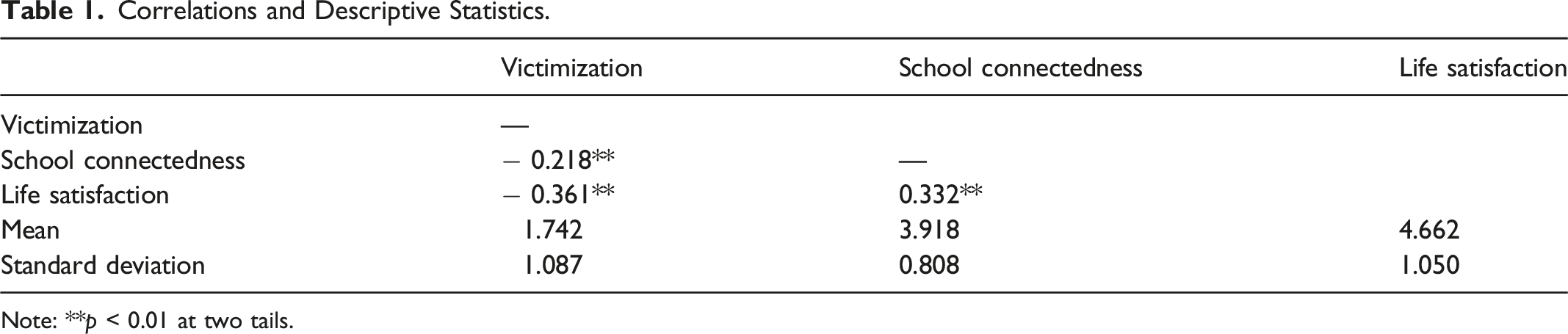
Note: **p < 0.01 at two tails.
Measurement Model
The CFA consisted of three latent variables and 15 observed variables. All three latent constructs were allowed to covary with each other. The results showed that the measurement model had good fit to the data: χ2 (86) = 336.596, p < 0.001, RMSEA = 0.048 with 90% CI = (0.042, 0.0453), CFI = 0.958, and SRMR = 0.045. All 15 standardized factor loadings were statistically significant and uniformly moderate to high, ranging from 0.373 to 0.925, with a mean of 0.703.
Structural Mediation Model
We hypothesized that the relation between victimization and life satisfaction would be mediated by school connectedness. To examine the plausibility of our hypotheses, we tested the hypothesized structure model (see Figure 1). Model fit indices suggested the hypothesized model fit the data well: χ2 (86) = 488.096, p < 0.001, RMSEA = 0.057 with 90% CI = (0.052, 0.063), CFI = 0.960 and SRMR = 0.045. Results showed that the direct effects of victimization on life satisfaction (β = - 0.276, p < 0.001) was statistically significant. Victimization negatively predicted school connectedness (β = - 0.233, p < 0.001), and school connectedness positively predicted life satisfaction (β = 0.333, p < 0.001). See Figure 1 for more details. The model explained 23% of the variance in life satisfaction (R2 = 0.23), indicating a medium effect size (Cohen, 1992). Modified hypothesis model with standardized regression coefficients. Note. **p < 0.01; ***p < 0.001; error terms are omitted for simplicity of representation. VT = victimization; SC = school connectedness; LS = life satisfaction.
We conducted the bias-corrected bootstrap test to examine the significance of mediation effects. Random sampling with replacement generated 1000 bootstrap samples from the original dataset. The 95% confidence interval (−.093, −.042) for the indirect path from victimization to life satisfaction, via school connectedness, did not include zero, which indicated that the indirect effect was statistically significant. The direct effect of victimization on life satisfaction was significant, supporting a partial mediation effect. Findings indicate that victimization leads to life satisfaction directly and indirectly through decreased school connectedness.
Discussion
The purpose of this study was to investigate the role of school connectedness as a mediator in the relationship between peer victimization and life satisfaction among elementary school students. We attempted to extend our understanding of the protective role of school connectedness and the influence of peer victimization on student positive development. Our findings support the role of school connectedness as a protective factor that could mitigate the negative effect of victimization experiences on children’s life satisfaction.
The results of our study demonstrate that peer victimization was related to lower levels of life satisfaction, which is consistent with previous studies that peer victimization is a risk factor for students’ well-being (Gini et al., 2018; Kerr et al., 2011; Martin et al., 2008). These combined results suggest that students’ experience in victimization at an early age may be a stressor that is particularly detrimental to students’ perceptions of their life satisfaction. Our findings suggest that children’s victimization experiences are also associated with low connectedness with school, which is consistent with prior cross-sectional and longitudinal research (Cunningham, 2007; Loukas et al., 2012). Cunningham (2007) argued that students who are bullied may perceive the school environment as lonely, socially isolated, and unsupported by teachers and school staff, potentially resulting in students feeling less connected to school. Our results also supported the previous study finding that victimization experiences may interfere with school affiliation, closeness with peers, positive relationship with teachers at school that impede students’ feeling of connectedness to school (Gini et al., 2018). Taken together, we conclude that victimization is one risk factor for school connectedness and life satisfaction among elementary school students.
The results also supported the role of school connectedness in children’s overall life satisfaction. The current finding confirmed Watson’s (2017) study in which the more students felt connected to school, the more likely they were to have high levels of wellness. Given the extent of time children spend in schools, teachers and peers in the school environment influence student life experiences, including life satisfaction (Jose et al., 2012). Our study also provides evidence for the developmental assets model that suggests school connectedness serves as an environmental asset that contributes to increasing positive student outcomes (Benson et al., 2011; You et al., 2008).
Our findings from SEM and bootstrapping procedures supported the role of school connectedness as a mediator between peer victimization and life satisfaction. Children who are bullied may feel isolated and uncomfortable in their school environment, which in turn may lead to decreased life satisfaction. Our findings are in line with previous studies that highlighted the protective role of school connectedness against the consequences of peer victimization (Loukas & Pasch, 2013; Mulla et al., 2020). These findings may help explain why not all young children who experience victimization subsequently experience low life satisfaction. One might conclude that students’ perceptions of caring and supportive relationships with peers and teachers are very important factors when considering how to promote students’ overall satisfaction with their lives.
School is an important microsystem where school connectedness can help promote children’s life satisfaction, even when they experience peer victimization. Still, we emphasize that the structural model explained 23% of the life satisfaction variance (R2 = .23). Future studies could benefit from examining a more comprehensive model by including other variables, such as family support (Miranda et al., 2019) or psychological capital (Cassidy et al., 2014) that might explain additional variance of children’s life satisfaction.
Limitations and Future Research
Several limitations should be considered when interpreting the results. First, although our sample size was large enough to test (N = 1284), the use of convenience sampling for this study may limit generalization of our findings to other populations. Future studies could benefit from investigating the associations with more representative samples of students. Future studies could also benefit from collecting data from multiple schools to consider the influences of school contexts on peer victimization (e.g., Espelage et al., 2014).
The use of the cross-sectional design requires caution in interpreting of the findings. Although previous empirical studies supported the directions we hypothesized (e.g., Gini et al., 2018), it is possible that students’ life satisfaction preceded their experience of peer victimization. Longitudinal research is required to clarify the causal direction of the variables, including the possibility of reciprocal relationships.
Another limitation is the use of self-report measures, which could cause social desirability bias. Students’ responses might have been influenced by the presence of peers in the classroom. Thus, students may have reported lower levels of peer victimization while reporting higher levels of life satisfaction and school connectedness. Future studies could consider collecting data using multiple methods, such as teacher/parent observations or peer nominations.
Implications
The results of this study made important contributions to the literature on peer victimization of upper elementary school students. Our finding that school connectedness mediated the relation between peer victimization and life satisfaction suggests that facilitating school connectedness could be important in successful bullying interventions. School counselors are in a key position to help students improve the social skills needed for these quality interactions among peers and student-adult relationships at school (Carney et al., 2018), which could mitigate the harmful influence of being bullied on their life satisfaction. Lapan et al. (2014) provided empirical evidence that students who received counseling services and believed their counselors are very responsive to meet their needs reported that they are more likely to feel connected to schools. Enhanced social skills through individual counseling or classroom lessons can help students develop prosocial behaviors and gain the friends and social support at school that could reduce further victimization incidents and buffer its adverse impacts (Smith & Low, 2013).
School counselors best support students’ positive development when they work at both the individual and school-wide levels (Lemberger & Hutchison, 2014). ASCA (2019) emphasized that school counselors should provide leadership to create a safe, respectful, and caring school environment. Given the critical role of teachers’ responses to bullying in students’ bullying behaviors and their willingness to intervene (Hektner & Swenson, 2012), school counselors should consider providing teacher and staff training on how to respond to bullying incidents. School counselors could also consider facilitating parent involvement to help students feel more connected to school (Shochet et al., 2008) and improve the success of their programs. Farrington and Ttofi (2009), in their review of identifying factors that are related to effectiveness of bullying programs, concluded that comparatively simple activities that include parent engagement, such as providing educational material about bullying, can increase the success of antibullying programs.
School counselors could also consider integrating evidence-based bullying prevention interventions into their comprehensive school counseling program to create a supportive school environment (ASCA, 2016). One example is utilizing positive behavioral interventions and supports (PBIS) to maximize the success of the school counseling program (Goodman-Scott et al., 2015). Positive behavioral interventions and supports is a multitiered prevention framework for promoting academic and social/emotional outcomes for all students, and includes teaching school-wide behavioral expectations (Horner & Sugai, 2015). Goodman-Scott et al. (2013) conducted an action research project to show how school counselors integrate PIBS in their bullying prevention work. Their project highlighted the benefits of having a consistent, school-wide message in preventing bullying and strengthening relationships between students and adults at school.
Our study’s results provide support for the school counselor’s role in school-based bullying interventions in line with the ASCA National Model’s emphasis on a comprehensive and evidence-based school counseling program (ASCA, 2019). Surprisingly, despite the school counselor’s unique role of serving the whole school population to increase the school success of all students, school counselors have received relatively limited attention from the literature in relation to bullying interventions, compared to teachers and administrators (Jacobsen & Bauman, 2007). School counselors should be aware that antibullying literature has begun to emphasize students’ relationships at school in bullying interventions, revising the traditional school-based bullying interventions that demonstrated limited success in reducing bullying incidents (Richard et al., 2012). Considering that bullying is a systematic, interpersonal group process that happens over time (Carney & Hazler, 2016), school counselors could advocate that their professional identity and training as agents of systemic change is specifically appropriate for leading efforts to disrupt bullying dynamics. This understanding and leadership of disrupting bullying dynamics is critical, because developing policy and increasing school safety alone may not lead to desired outcomes in bullying interventions.
Footnotes
Declaration of Conflicting Interests
The author(s) declared no potential conflicts of interest with respect to the research, authorship, and/or publication of this article.
Funding
The author(s) received no financial support for the research, authorship, and/or publication of this article.
