




Abstract
Burnout has high costs for pediatricians and their patients. There is increasing interest in educational interventions to promote resilience and minimize burnout among pediatric trainees. This study tested a conceptual model of factors that might promote resilience and protect against burnout, and which could serve as targets for addressing burnout in pediatric residents. Questionnaires were administered in a cross-sectional survey of (n = 45) first-year pediatric and medicine-pediatric residents. A minority (40%) of residents met one or more criteria for burnout. Physician empathy and emotional intelligence were not significantly correlated with burnout or resilience. Self-compassion and mindfulness were positively associated with resilience and inversely associated with burnout. Thus many residents in this sample endorsed burnout; mindfulness and self-compassion were associated with resilience and may promote resilience and protect against burnout in these trainees. Future studies should explore the impact of training in mindfulness and self-compassion in pediatric trainees.
Many medical professionals suffer from burnout, which adversely affects quality of care and threatens professionalism. 1–4 Burnout includes emotional exhaustion, cynicism, and decreased sense of personal accomplishment. 5 Multiple studies have documented a high prevalence (40% to 60%) of burnout among health professionals, including pediatric residents. 6–9 This is concerning because resident burnout has negative consequences for both the patient and the resident. 6,7,10 Thus, understanding and addressing these robust trends among medical professionals has become a major priority. 11,12 While burnout is common, not all residents experience or report burnout. Characteristics among those who are handling stressors well may be very useful information.
Resilience, the ability to bounce back from adversity, may protect professionals from the common ravages of the work place and personal stressors and the tendency to burnout. 13 Several characteristics that facilitate well-being such as emotional intelligence, empathy, self-compassion, and mindfulness could help explain resilience in these trainees. Emotional intelligence has been described as the ability to perceive, understand, and manage emotions in one’s self and others 14 ; it is associated with lower burnout among internal medicine residents. 15 Additionally, reliable decrements in physician empathy, or the ability to understand another individual’s experiences and hardships, 16 have been documented among medical trainees and pose a threat to the quality of care provided. 17,18 Self-compassion, defined as caring for oneself during hardship and stress, has been linked to psychological well-being 19,20 and adaptive coping with negative events. 21 Furthermore, self-compassion has been positively associated with emotional intelligence in nursing students. 22 Mindfulness refers to being aware of the current moment in a way that is nonjudgmental and accepting rather than reactive. 23,24 Mindfulness helps buffer against the deleterious effects of stress and promotes increased psychological and physical well-being, which has been shown to increase resilience in medical students and nurses. 25,26
The objective of this study was to test a conceptual model that defined selected intrinsic factors that are related (and ultimately may be causative) to burnout in first year pediatric and medicine-pediatric residents. The hypothesis was that emotional intelligence, mindfulness, empathy, self-compassion, and resilience would be inversely correlated with burnout and therefore be identified as potential targets for focused interventions to minimize and/or treat burnout in pediatric residents. Demonstration of such significant relationships may not only assist in providing opportunities to detect individuals at increased risk of burnout but may also assist efforts to better understand individuals who appear to be managing the stressors of residency well. We believe that cross-sectional study of a group of first year pediatric and medicine-pediatric residents could provide foundational insights on these important questions and is an important first step to facilitate empirically driven and theoretically sound intervention research.
Materials and Methods
We report the results of cross-sectional survey measures obtained in first-year pediatric and medicine-pediatric residents (n = 45) in a large Midwestern urban children’s hospital. Measures of burnout, emotional intelligence, empathy, mindfulness, self-compassion, and resilience were collected by the program coordinator as part of required professional development explorations and the results tabulated and returned to each individual resident privately as a means of self-assessment. The residents were instructed that the results would not be seen by the program directors or other program personnel. Burnout was measured in the eighth month of the intern year as part of an intern workshop while measures of emotional intelligence, empathy, mindfulness, self-compassion, and resilience were obtained in the ninth month of the intern year prior to another workshop devoted to professional development.
Measures
Burnout
We measured burnout using the Maslach Burnout Inventory Human Services Survey, a 22-item scale developed to assess burnout among professionals that work in emotionally taxing environments. The scale includes 3 subscales; emotional exhaustion, depersonalization or cynicism, and personal accomplishment. This scale has been used extensively to study burnout in health professionals and is regarded as the standard tool for assessing the construct. 5 We used standard scoring criteria for medical professionals: for emotional exhaustion ≤18 is low, 19 to 26 is average, ≥27 is high; for depersonalization ≤5 is low, 6 to 9 is average, ≥10 is high; and for personal accomplishment, ≥40 is high, 34 to 39 is average, and ≤33 is low. High scores in emotional exhaustion and depersonalization and low scores in personal accomplishment are viewed as indicators of burnout. The measure has demonstrated good internal consistency reliability for the 3 subscales (Cronbach’s alphas ranging from .74 to .89).
Emotional Intelligence
We measured emotional intelligence 27 using the Emotional Social Competency Inventory (ESCI 3.0, Hay Group, Cleveland, OH). 28 The Emotional Social Competency Inventory is a 68-item measure which is answered on a 0 to 5 scale reflecting frequency with which a behavior is observed. The measure includes a self-assessment (“self-report”) and assessments by up to 6 other individuals (“other report”) including the supervisor. Thus, a multisource comprehensive assessment of emotional intelligence is generated. The Emotional Social Competency Inventory identifies competencies that have been associated with superior work performance. 29 Internal consistency reliability have been reported for “total others” ratings demonstrating adequate reliability with Cronbach’s α = .63. For purposes of this study, the emotional intelligence value based on the average of the other scores was used for each individual as has been reported in other work with this assessment tool. 28
Empathy
We measured professional empathy using the Jefferson Scale of Physician Empathy. The Jefferson Scale of Physician Empathy is a 20-item instrument answered on a 7-point Likert-type scale that has scores ranging from 20 to 40 and has been used and validated in multiple studies of health professionals. 17,30–35 This measure was shown to have good internal reliability among a sample of residents (Cronbach’s α = .87). 30 Although the Jefferson Scale of Physician Empathy is a self-report measure, it correlates well with patients’ assessments of their physician’s concern for their feelings. 18
Mindfulness
Among the many measures of mindfulness, we selected the Five Facet Mindfulness Questionnaire, a 39-item tool that provides data on 5 facets of mindfulness based on its ease of completion and reliable psychometric qualities. 36,37 In the study by Baer et al 36 in 2006, all 5 facets (nonreactivity to inner experience, observing/attending to feelings/thoughts, acting with awareness, describing with words, nonjudging of experience) were strongly and significantly correlated with emotional intelligence and self-compassion. The measure has demonstrated adequate to good internal reliability with Cronbach’s alphas ranging from .75 to .91 for the 5 subscales. 37
Self-Compassion
We measured compassion using the short-form of Neff’s Self-Compassion Scale, which includes 26 items scored on a 5-point Likert-type scale. 19 Self-compassion consists of several elements, including a kind and nonjudgmental attitude toward oneself when suffering; recognition that one’s experiences are part of the larger human experience (common humanity); holding painful thoughts and feelings in balanced awareness in which they are observed and accepted without judgment, rumination, or self-pity. The Self-Compassion Scale has an internal consistency of α = .92, a test-retest reliability of .93, positive correlations with social connectedness, emotional intelligence, and life satisfaction; and significant negative correlations with self-criticism, perfectionism, depression, and anxiety.
Resilience
We used Smith’s Brief Resilience Scale, which measures a unitary construct in both student and clinical samples using 6 items on a 5-point scale (1 = strongly disagree, 5 = strongly agree, eg, “I tend to bounce back quickly after hard times”). The item means in the original study ranged from 3.53 to 3.98. The Brief Resilience Scale has good internal consistency with Cronbach’s alpha ranging from .84 to .91 and test-retest reliability of .69 at 1 month. It has positive correlations with social relations, coping, and health, and negative correlations with anxiety, depression, and physical symptoms. 38
Analytic Strategy
Research assistants blind to the study questions entered each resident’s data into a Microsoft Excel spreadsheet. Data were imported for analysis into the software program Statistical Analysis System (SAS 9.2). Descriptive statistics were used to summarize demographic information (Table 1). Averages, standard deviations, and range of responses were calculated for each variable to check for expected ranges and to allow comparisons with normative values identified in populations of interest (Table 2). Group differences between individuals that met threshold scores for burnout (n = 18) were compared to those that did not meet threshold (n = 27). Last, Pearson correlations were calculated to examine the relationship between variables (Table 3 and Figure 1). To provide a more rigorous test of the hypotheses, additional analyses (analysis of variance and Pearson correlations) were completed to identify potential covariates of the outcome variables (ie, burnout and resilience) including age, sex, marital status, and residency type. This study was approved by Nationwide Children’s Hospital’s Institutional Review Board.

Proposed conceptual model of factors related to burnout severity in first-year pediatric and medicine-pediatric residents.
Demographics of the 45 First-Year Pediatric and Medicine-Pediatric Residents Involved in the Study.

Results From the Six Separate Measures Obtained in the Study.

aStanding indicates ability to stand in patient’s shoes.
Relationships Between Six Factors Measured in the 45 First-Year Pediatric and Medicine-Pediatric Residents.
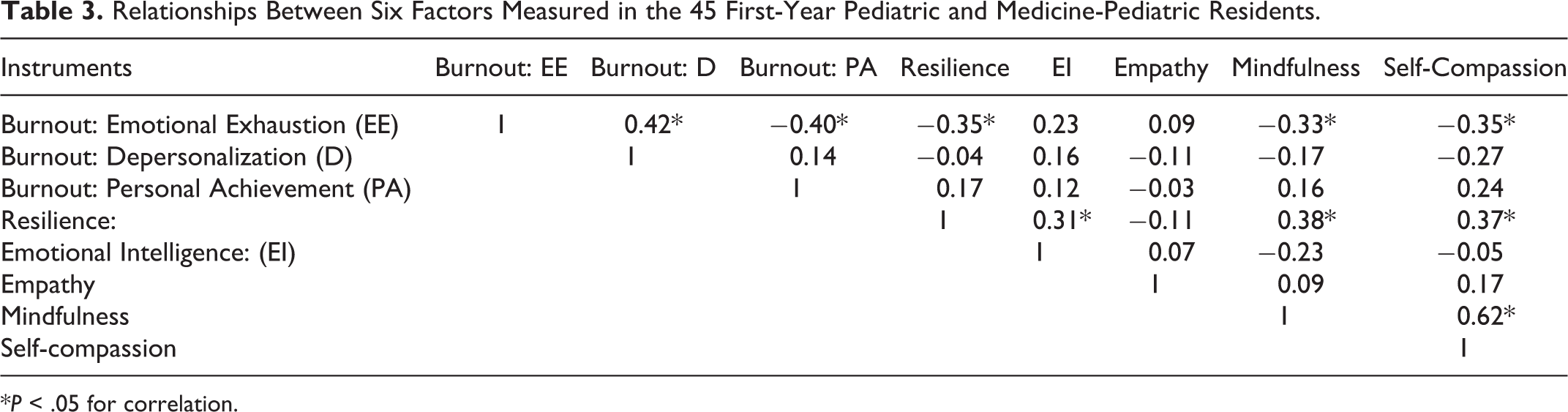
*P < .05 for correlation.
Results
All 45 residents (pediatric, n = 35; medicine-pediatrics, n = 10) in the program in 2013-2014 participated in this project and their demographics are presented in Table 1.
Scores on each of the scales are shown in Table 2. All variables were normally distributed with the exception of 2 of the burnout subscales: depersonalization and personal accomplishment. More than one-third (40%) of the residents met criteria for burnout with scores exceeding the standard cutoff on 1 or more of the 3 subscales (high emotional exhaustion scores were seen in 12, high depersonalization scores were seen in 11, and low personal accomplishment in 4; 7 had multiple high burnout subscale scores). Analyses to identify potential covariates of the outcome variables revealed a significant difference between male and female residents in the emotional exhaustion burnout subscale (F = 12.38, P = .001), but gender was not related to resilience. Resilience and burnout scores did not significantly differ by residency type, marital status, or correlate with age.
Analysis of variance to compare burned out individuals to those that did not meet threshold for burnout revealed a significant difference between groups on mindfulness (F = 4.06, P = .05) with those meeting threshold for burnout reporting lower mindfulness. There were no other significant differences between the 2 groups although the contribution of self-compassion to mindfulness (F = 3.23, P = .08) was close to significance. Table 3 shows the relationships among the scores on the study scales. For burnout, the depersonalization and personal accomplishment subscales were associated with each other—significantly and in the inverse direction (as expected). Neither variable (depersonalization or personal accomplishment) was significantly associated with any of the other outcomes. The emotional exhaustion subscale of the Maslach Burnout Inventory was inversely associated with resilience (r = −0.35, p < 0.02), mindfulness (r = −0.33, P = .03), and self-compassion (r = −0.35, P = .02). Overall scores as well as the subscales on the Jefferson Scale of Physician Empathy were not significantly associated with burnout, resilience, or any other study variables. Emotional intelligence was significantly and positively correlated with resilience (r = 0.31, P = .04), but no other study variables. Mindfulness and self-compassion were significantly and strongly correlated with each other (r = 0.62, P < .05), and significantly negatively associated with emotional exhaustion and positively correlated with resilience.
Because the emotional exhaustion subscale was higher among females than males, 2 regression models were used to control for gender while testing the relationships between the emotional exhaustion subscale and mindfulness and self-compassion. Both mindfulness (F = 12.27, P < .001) and self-compassion (F = 10.07, P < .001) remained significantly associated with emotional exhaustion while controlling for gender. Analyses for potential covariates revealed no other significant demographic variables (ie, age, marital status, residency type) requiring statistical control in follow-up analyses.
The relationships between these factors are displayed in Figure 1. In this model, we propose that burnout is diminished by higher resilience, mindfulness, and self-compassion. Emotional intelligence is associated with higher resilience but does not appear to be directly related to burnout. Also in contradistinction to our working hypothesis physician empathy was not positively or negatively associated with burnout or any other study factors.
Discussion
To our knowledge, this is the first study exploring the relationship between potentially protective factors and burnout in pediatric residents. Although the first-year pediatric and medicine-pediatric residents reported relatively high levels of resilience, self-compassion, and mindfulness, a concerning number of them met criteria for burnout (40%). Identifying and understanding the subset of pediatric trainees at greater risk of burnout will be important for design of effective interventions. Second, 2 factors (mindfulness and self-compassion) were negatively associated with burnout and positively correlated with resilience, providing potential targets for prevention efforts. While the correlations were modest (in the 0.33-0.37 range for all significant correlations except for the r value of 0.62 between mindfulness and self-compassion) this is not at all surprising in a phenomenon—burnout—that is multifactorial in pathogenesis.
Burnout scores in our sample appear to be consistent with recent studies of pediatric residents 9,39 and better than that found in earlier studies and in other specialties. For example, Pantaleoni et al 9 first reported an increase in burnout scores from the start of the first year to the middle of the year and a stabilization of burnout throughout the rest of the time in pediatric residency. At the middle of the first year of training our pediatric and medicine-pediatric residents’ mean values for each of the burnout subscales were similar to those reported in the sample of Pantaleoni et al. 9 On the other hand, the 40% burnout rate in our sample is much lower than that reported by Fahrenkopf et al, 39 who reported that almost three-fourths of their pediatric resident sample had high levels of burnout; that study included residents across all years of training. Our population of pediatric residents had lower burnout scores than other resident specialties in the United States. 40–42
Research on self-compassion, resilience, and mindfulness among residents is relatively new, as are the measures used to assess these constructs. Therefore there is limited published data available for comparison. In comparison to groups of other healthcare professionals, self-compassion scores in our pediatric and medicine-pediatric residents were higher than those reported by fourth-year medical students, 43 but lower than scores reported in nurses. 44 Our residents had mean resilience scores higher than that of the normative sample used by Smith et al 38 to validate the Brief Resilience Scale. On the other hand, the mean mindfulness score in our sample was lower than a community sample used to assess the construct validity by the scale developer. 37 This study provides an important first step in describing these characteristics among pediatric and medicine-pediatric residents.
In addition to providing a novel description of characteristics such as mindfulness and self-compassion among first-year pediatric and medicine-pediatric residents, this study provides preliminary data assessing hypothetical relationships between these variables (see Figure 1). The current study indicates that several positive factors (mindfulness and self-compassion) are associated with higher resilience and less emotional exhaustion. These findings add to the list from other studies of factors associated with less burnout (eg, more social support, less fatigue and stress), 45 and expand potential targets for intervention. Interestingly, not all subscales of the Maslach Burnout Inventory were associated with mindfulness and self-compassion. This suggests that emotional exhaustion may be the most important target of interventions focused on mindfulness and self-compassion, particularly in interns undergoing their first powerful experiences in this new role; depersonalization and personal accomplishment may require other interventions.
Some of our findings are discrepant with earlier studies in other professional groups. A recent study of self-compassion among nursing students found that increased self-compassion was positively associated with emotional intelligence. 22 This finding was not replicated in our sample, but the earlier study used a different, less complex measure of emotional intelligence with fewer items and fewer raters, which may explain the different findings. Satterfield et al used a single assessment instrument to determine that higher emotional intelligence was associated with lower burnout among internal medicine residents. We were unable to replicate these findings but feel that the use of different instruments (such as the multisource assessment used in this study) makes it difficult to fully assess whether these reflect true population differences or methodological factors. The level of empathy reported by residents in the current study was similar to those reported by Hojat et al, 30 but physician empathy was not significantly correlated with any other measured factor in our sample. Our sample did have sufficient power (based on a GPower power analysis) to detect this relationship, but our distribution of Jefferson Scale of Physician Empathy scores was less variable than other studies and this may have limited our ability to detect true differences, 16,17,30–33,46 due to restriction of range.
Overall, this study provides valuable insight by exploring the relationships between burnout and resilience and trainable qualities that might protect against burnout among pediatric and medicine-pediatric residents. The next logical question is to evaluate whether or not intervening on one or more of these variables may influence the level of burnout among pediatric and medicine-pediatric residents. Recent intervention trials among nonpediatric trainees and clinicians indicate that mindfulness can be increased and that improvements in mindfulness are associated with increased quality of life, 47,48 decreased burnout, 24,47 and increased empathy. 25 Furthermore, studies of mindfulness training among other health professionals (eg, nurses, clinical psychology trainees, and teachers) suggests that mindfulness may facilitate increased self-compassion 49–52 and improve interpersonal functioning. 49,53 Given the challenges and stress of providing health care, increasing mindfulness and self-compassion among medical professionals may improve quality of care by facilitating resilience, preventing burnout, and improving well-being among clinicians. Further study is needed to evaluate the effects of a mindfulness-based intervention among pediatric and medicine-pediatric residents.
Limitations
This was a cross-sectional study conducted in 1 pediatric residency sample, so the results cannot be used to impute causal relationships or generalized to other types of training programs. We elected to focus on intrinsic factors that may have an impact on burnout; we recognize that a number of extrinsic factors (family support, debt burden, medical/mental health issues, etc) that likely influence burnout are not captured in this study. The measurements were not all obtained at the same time (Maslach Burnout Inventory obtained 1 month before the other 5 measures) and this may have introduced additional variability into the analysis. It is possible that a sample of residents with more variability in empathy scores may affirm previously reported relationships between physician empathy, burnout, and resilience. Multicenter studies would be needed to test these relationships in larger, more diverse groups of residents. This study did not measure the direct impact of any factor on patient or family satisfaction or on quality of care. Additional research is needed to evaluate the secondary impact of training residents in qualities such as mindfulness and self-compassion on patient experience, quality of care, communication, and other patient outcomes.
Conclusion
Despite these limitations, the results indicate mindfulness and self-compassion were positively associated with higher resilience and less emotional exhaustion thus indicating mindfulness and self-compassion may be attractive targets for training pediatric and medicine-pediatric residents. These findings expand on other studies of factors associated with less burnout. This exploration suggests that both mindfulness and self-compassion may protect professionals’ personal health and well-being. These findings deserve to be further explored in larger, more diverse samples, and interventions, such as mindfulness training and reflective exercises to promote self-compassion may be worthy of prospective study on trainees, including the effects of such training on both professional and patient outcomes.
Footnotes
Acknowledgments
We would like to thank Dawn Shontz and Jennifer Long for their assistance with data management as well as the Hay group for access to the Emotional Social Competency Inventory measurement for research purposes.
Author Contributions
JDM had full access to all the data in the study and takes responsibility for the integrity of the data and the accuracy of the data analysis. KO was responsible for all data analyses conducted and reported for this study. All authors (KO, KJK, JDM) contributed to writing and revising the manuscript.
Declaration of Conflicting Interests
The authors declared no potential conflicts of interest with respect to the research, authorship, and/or publication of this article.
Funding
The authors received no financial support for the research, authorship, and/or publication of this article.
Ethical Approval
This study was approved by Nationwide Children's Hospital's Institutional Review Board.